it is not by chance that global problems have emerged only when the world economy has constituted, i.e. on a certain level of the internationalisation and
interdependence processes (of internationalisation and the mutual interdependence), resp. of the com-plex production capacity development. it does not
Global problems of the world – structure, urgency
Globální problémy světa – struktura, naléhavost
V. Jeníček
University of Economics, Prague, Czech Republic
Abstract: global problems are very different. The division of global problems into three big groups: inter-social global problems usually included the problems like the problem of diverting world wars, nuclear, eventually other conflicts con-nected to the problematic of armament (the problem of war and peace). At present, there gains in importance also the fight towards terrorism. The problem of the social and economic backwardness of developing countries, eventually the whole north-South relationship also belong there, as well as the problem of solving global debts, the relationship of the indebted and creditors. The problem of the international relationships (namely economic) changes under the new conditions formed namely by the scientific and technological progress. into the second group of natural-social global problems, there are most often included the following problems: environmental problem, raw material and energy problem, population problem, food, respectively nutrition problem. Lastly, the third group of anthropo-social problems includes the general human pro-blems of the social, cultural and humanitarian-ethical nature. Sometimes, they are ranked as one great complex problem (so-called problem of the future of man), sometimes this group is divided into a number (10–15) of partial “sub-global” problems the common denominator of which are the shortcomings of the development of man in the relationship to the life and social conditions created by himself. here belong different kinds of the unequal approach to education, health care, housing, culture, human rights, eventually also serious defects in their securing or a disharmonic and uncontrolled develo-pment (e.g. accelerated urbanisation) etc.
Key words: global problems, intersocial global problems, natural-social problems, anthropo-social problems
Abstrakt:globální problémy jsou velmi diferencované. Dělení globálních problémů do tří velkých skupin: intersociální problémy zahrnují problém případné světové války nukleární, případně další konflikty zbrojení (problém války a míru). V současnosti nabývá důležitosti boj proti terorismu. Dále sem patří problém sociálně-ekonomické zaostalosti rozvojových zemí, resp. vztah Severu a Jihu, rovněž problém zadluženosti rozvojových zemí, resp. vztah dlužníků a věřitelů. Konečně je to problém mezinárodních vztahů (zvláště ekonomických) včetně změn podmínek vědeckovýzkumných a technologických rozvojových zemí. Do druhé skupiny přírodně-sociálních problémů patří problém životního prostředí, surovinový a ener-getický, populační a potravinový, resp. nutriční. Třetí skupina antroposociálních problémů zahrnuje sociální, humanitní, kulturní a etické problémy. někdy se uvádí jako jeden velký komplexní problém budoucnosti člověka, někdy je tato skupina členěna do většího množství (10–15) dílčích „subglobálních“ problémů, jejichž společným jmenovatelem jsou nedostatky ve vývoji člověka samého ve vztahu k životním a společenským podmínkám, které jsou jimi samými vytvářeny. Sem patří různé druhy nerovného přístupu ke vzdělání, zdravotní péči, bydlení, kultuře, lidským právům, popř. i závažné nedostatky v jejich zabezpečování aneb disharmonický, nekontrolovatelný rozvoj (např. překotná urbanizace).
Klíčová slova: globální problémy, intersociální globální problémy, přírodně sociální globální problémy, antroposociální problémy
regard only that what is well known from the classi-cal definition of the global problems, i.e. that these are the problems which can be solved only through the world-wide effort and which regard the whole human civilisation. it regards also the fact that their origin itself is determined by the existence of the global interdependence, be it the interdependence in the economic or non-economic sense – while the economic sense is dominant.
As well as the processes of internationalisation and interdependence, driven by the enormous scien-tific and technological progress that are accelerated enormously, also the global problems are multiplied and dramatised. Their quantitative growth is a clear proof of the fact that humankind is lagging behind is seeking and finding the forms, methods and tools how to face the accelerating interdependence. hence also obviously issues the still more frequented term of “global threats” or “global challenges”, which are used instead of the rather usual term of “global problems”. We think, however, that there is hitherto no reason to change the original term, since it is obvious that every problem sets automatically the question of its solution and is therefore a threat as well as a chal-lenge “sui genesis”.
internationalisation and interdependence them-selves are objective processes and cannot therefore be avoided. however, it is necessary to distinguish between their symmetrical and asymmetrical form. it is just the disparity between the two forms and the deepening asymmetry, which contributes most to the worsening and multiplication of global problems. neither the asymmetry of interdependence is, how-ever, a negative phenomenon in itself, since highly complicated diverse forms of social life will always be of the tendency to develop non-proportionately. however, global problems originate because the ability of human civilisation to realise activities and to use properly the mechanisms which would dampen this non-equilibrium and eliminate the consequences of the asymmetrical forms of the mutual interdepend-ence is lagging behind. hinterdepend-ence issues for example the criticism from the part of developing countries, but also some Western left-oriented intellectuals. These arguments are based on the statement that it is only a verbal smokescreen which should cover the fact that the asymmetrical forms of interdependence will always favour the stronger and handicap the weaker.
global problems in the modern sense of the world begun to be mentioned only after the WW2, even if already the WW1 and the world economic crisis of the 30s hinted that the most important problems of the humankind development were globalising. Today, it is already obvious that the world as a whole is
develop-ing in such a dynamic and sometimes even chaotic way that even a simple categorisation and rough numbering of these problems becomes a still more difficult matter. With the deepening internalisation and interdependence, the range of the problems which should be perceived as world-wide is still widening. Furthermore, none of these problems can be quite clearly defined and it is impossible to delimitate not only its borders but even its shape because of the multiple interconnection of these problems not only mutually but also with regard to the different sides of the human society life. it is therefore not surprising that different authors mention different numbers of these problems, ranging from 6–8 up to 30 and more (our global partnership 1995).
Each of the global problems has its economic as well as non-economic dimension. it is natural that the economic dimension prevails at the majority of them. however, it would be obviously wrong to be limited only to the economic dimension at the ex-planation of their development, position, hierarchy or classification, because at some of these problems the non-economic dimension even prevails, and that through the phenomena of ideology, military, administration, environmental and other aspects. regarding global problems, neither the moral (ethi-cal) side of the problem should be forgotten, which is a very important component even regarding the prevalently economic problems. The endeavour to transfer everything to the economic level or the level of economic calculations is not correct and it led in past to considerable theoretical and methodological biases and conflicts, the most persistent of which is the endeavour to define global problems through the analytical instruments and the notions of scientific and technological progress, or the categories of the international division of labour. it is then stated that the interdependency relationships are, as the development of the functional interconnection of the processes and relations of the social, natural and technological system into a single ecological and anthropological complex, the result of the interna-tional division of labour development, which grows over from national subjects into the global frame. Thus, we can explain the origin and development of most global problems inside human society and its relationship to the nature, but hardly, however, the anthrop-social problems, the most significant of which is the problem of the position of man in the changing world itself (our global partnerships 1995).
with difficulties in the globalisation and internalisa-tion context. The world is not developing only and singly under the determining common denominator of globalisation (which also has a series of nega-tive aspects just in this area), but in the polycentric way, when the above mentioned questions will be still for a long time – even for centuries- defined in a different way in different cultural and religious spheres and also understood by them in a different way, not to speak of solving them. Therefore, there is still more often expressed the opinion during the last years, that also this polycentric trend has to be considered adequately according to the globalisa-tion trend, which can push forward still more as the primary one, but not the only one. There begins to emerge an opinion, that just this was omitted in the last decades and that the stress on the globalisation, interdependence and internalisation aspects was too prevalent. it is then not necessary that the globalisa-tion and poly-centric tendencies were understood as totally contradictory, but rather as simultaneously functioning tendencies, while in many aspects can be realised not to the detriment, but as complementary to the others.
GlobAl problems clAssificAtion
controversies persist also regarding the systemisa-tion of problems, which occur globally (accelerated urbanisation, problems of the educational, health and other systems), but which are, however, solved on the national levels, and that often successfully. For these problems, there is used the term of “sub-global”. Further, there is also discussed the systemization of the problems for which the science has not hitherto found the origin or an efficient therapy, but which occur as pandemic (AiDS, tumour diseases). For those, there is being used, besides the term “global”, also the term “universal”. notwithstanding the above mentioned difficulties, there is commonly accepted the division of global problems into three big groups, as follows (Jeníček 2004):
– inter-social global problems – natural-social global problems – Anthropo-social global problems
inter-social global problems
inter-social global problems are usually ranked as the highest in hierarchy, into the first group. They are connected with the mutual impact of the different social and economic systems and the global
co-ex-istence of humankind in the conditions of different value criteria and ideologies, as well as different reactions to the global social situations with the principal clash of interests. here, there are usually included the problems like:
– the problem of diverting world wars, nuclear, eventually other conflicts connected to the prob-lematic of armament (the problem of war and peace). At present, there gains in importance also the fight towards terrorism
– the problem of the social and economic back-wardness of developing countries, eventually the whole north-South relationship
– the problem of solving global debts, the relation-ship of the indebted and creditors
– The problem of the international relationships (namely economic) changes under the new condi-tions formed namely by the scientific and techno-logical progress.
Sometimes the question of scientific and technologi-cal process is, with regard to its importance and the relationship to internalisation and interdependence, ranked as a special global problem of the optimal utilisation of scientific and technological progress in different social and economic conditions. This problematic used to be most often connected with the need to reconstruct the system of international economic relationships. it is then obvious, that it regards problems which origin inside human society as the result of mutual antagonisms and contradic-tory interests of its pasts. however, people live also in complicated relationships to the bio-sphere, eco-sphere and the nature in general. Therefore, the second big group of problems regards the harmonisation of these relationships.
natural-social global problems
natural resources efficient utilisation. The increased difficulties in each of these areas contributes to their individual understanding, while, on the other hand, the fact that they are of the common base and are interconnected by their reasons as well as conse-quences contributes to their connecting together. in this text, we observe rather the first way, and that not only because of the growing difficulties in each independent area, but also for the reason of lucid presentation and, last but not least, also with regard to the world trend of specialisation in the global problems research sphere.
into the second group of natural-social global prob-lems, there are most often included the following problems:
– environmental problem
– raw material and energy problem – population problem
– food, respectively nutrition problem
Anthropo-social global problems
Lastly, the third group of anthropo-social problems includes the general human problems of the social, cultural and humanitarian-ethical nature. Sometimes, they are ranked as one great complex problem (so-called problem of the future of man), sometimes this group is divided into a number (10–15) of partial “sub-global” problems the common denominator of which are the shortcomings of the development of man in the relationship to the life and social con-ditions created by himself. here belong different kinds of the unequal approach to education, health care, housing, culture, human rights, eventually also serious defects in their securing or a disharmonic and uncontrolled development (e.g. accelerated ur-banisation) etc.
The complex problem of the future of man is set by most authors (our global partnership 1995) as an independent problem, since the existence of the global problem of the future of man is the issue of all the questions, problems and relationships determin-ing the life of man and human society. however, this complex problem cannot be solved as such, but only through the solution of other global problems as well as of the problems of a different order. The problem of the future of man basically falls into two partial problems. First, the problem of the future of man in the biological sense of the word, as the future of the “homo sapiens” genus. Secondly, also as the problem of the future of the individual, non-repeatable, crea-tive and accrea-tive human being in all its relationships, relations and life manifestations.
Discussion
interdependence and all global problems, whether we can sort them into any group in whichever shape, are mutually interconnected. it has been already said that they have common reasons (lagging behind in solutions and correction mechanisms of the asym-metrical forms of interdependence and mastering of the accelerated manifestations of the economic life and the common activities in general internationali-sation), but they can also have common and mutu-ally conditioned consequences. These consequences can reach enormous and really catastrophic forms. Already at present many authors (robertson 1992) state that any single one of the global problems can, if self-developing without control, endanger the whole human civilisation (formerly, this was generally ac-cepted only regarding the problems of the global nuclear conflict). it becomes still more obvious that also other global problems, connected both with the mutual interactions of people and their relationships to nature, can issue, in a relatively short time, into disastrous consequences, which would, together with the necessary deterioration of the problems connected and consequent, lead to really cataclys-matic consequences . Therefore, world economics is relatively the nearest to the so-called globalistics, as the science on the development and possibilities of the global problems solution is called during the last few years.
situ-ation in the area which is immediately endangered, but, as a consequence of the interconnecting of the whole system of global problems, in several of them. globalistics can be in this sense understood as a tool of the fight against the humankind dying quickly on its own crimes.
The stress put on the negative but also positive aspects of the global problems analysis has led during the last time to the discussion which approached in a very critical way the hitherto prevailing tendencies of globalistics rather to identify and register these problems, eventually to describe the main symp-toms of the social mechanisms failure caused by their growing and deepening. Today, there is rather commonly accepted the opinion that such a “pas-sive” approach is not acceptable any more and that globalistics has to be “active”, that is oriented also at seeking the ways and tools of the global problems consequences mitigation. Even if this opinion seems to be quite logical at the first sight, pushing through of this “active” methodological approach was not easy. Many authors and public actors argued that this has to be secured by the traditional scientific disciplines of the social, technical and natural sci-ences. it lasted almost 25 years before it become clear that globalistics cannot naturally fulfil the research tasks of the traditional scientific disciplines, but that it regards the positive and active seeking of the ways and tools facing the global problems consequences from the viewpoint of their system and mutual rela-tionships. The development of globalistics was also up to the end of the 80s hindered considerably by the Marxist opinion that the world is divided politically and according to social classes and that the global co-existence of the systems is possible only on the level of the peaceful coexistence. The blame for the origin and development of many global problems was unanimously ascribed only to one of the two social systems – the capitalism and market economy in general. The analysis and research of global prob-lems was established only with difficulties in the former Eastern block countries even in the 60s and 70s, the situation started to improve only in the 80s and namely after the beginning of the gorbatschov era (1985) and its new ideological approach, among which pushing through of the global world approach formed one of the corner stones.
however, there still exist arguments whether it is ever possible to form the so-called globalistics into an independent scientific branch. Therefore, we have rather used the term “teaching”. The nature of global problems then demands categorically such an approach to their research which presupposes the co-operation of practically all scientific branches. During the last
time, there is prevailing the opinion that, due to the supreme complexity and interdisciplinarity of global problems, globalistics will never be an independent scientific branch but rather a method or a direction of outlook, which would draw a certain “energy” of interconnection from the existing scientific branches. Some authors (robertson 1992) even stand against the individual problems research and point out their mutual interconnection. That represents, however, a rather extreme approach. global problems can be researched and explained separately if we do not forget their complex and complicated character. The solution of each of them influences to a certain extent also the solution of other difficult problem spheres.
Thus, another methodologically complicated ques-tion is the relaques-tionship of global problems and their national (eventually regional or sub-regional) mani-festations. global or all-planet problems emerge as phenomena in their concrete state, national, regional or sub-regional appearances since the world is (hith-erto) thus divided by the state and other borders. however, this substance form represent always a mutually influencing unity of the given kind. it is not decisive, therefore, whether e.g. the problem of food and nutrition does not exist in certain, and very numerous ones, national units. notwithstanding that, it is a global problem the often very different and contradictory dimensions of which on the level of the states and regions are only its manifestations and they can be solved only by the endeavour of all humankind. regarding the food and population problem, there are not many difficulties with this understanding of it but the situation is more complicated e.g. regarding the drug abuse problem, AiDS etc.
With regard to the outlined global interdependence and interrelation of the global problems, also these problems are now, however, still more understood as the full global problems, even if we can still meet with labelling them as “sub-global” etc.
To make this rather dry text a little bit more acces-sible to the reader, we can perhaps allow in explaining this relationship of the “big”, “partial” or “sub-global” problems to use the rather anecdotal parallel from the well-known book of Arthur Block “Murphy’s Law” (“if something can fail, it will fail”). Some of the author’s notions contain, notwithstanding the overall satirising and anecdotal character, a rational kernel well expressing the substantial fact. For example the relationship of hierarchy and the connection of global problems are well expressed by the so-called hoar law of big problems: “in every big problem, there is hidden a smaller problem which scrambles to the light with all its might”. Then there exists the so-called Schneiker inversion of the hoar law, and that: “in every small problem, there is hidden a big problem which scrambles to light with all its might”. it seems that this fact is valid on the factual as well as territorial level, and that still more because there exists in the mentioned anecdotal version also a so-called ruckert law which says: “nothing is that small that we could not be over ears in it”. So far the humorists, even if on quite serious matters.
Global problems hierarchy
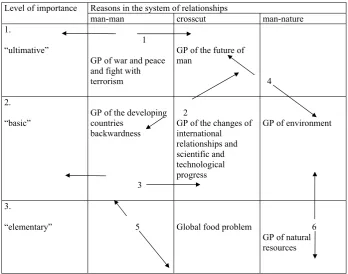
The question of the global problems hierarchy is really rather disputable in the outlined consequences. To state unambiguously that some problems are of absolute priority or more pressing than the other is impossible. All of them are of vital importance for the mankind; a possibility of a certain hierarchy can be at the utmost presupposed in a certain time hori-zon. it is clear that in the sphere of the international pressure escalation, the peace problem is of higher priority. nevertheless, the former opinion that this problem is in itself always supreme over the oth-ers is now made relative by the growing realisation that not only the global war, but also all the other global problems would – even if perhaps in a longer time horizon – lead to the global catastrophe of the humankind. A more useful seems to be the division of global problems into the so-called a) ultimative, b) basic, c) elementary. Ultimative problems are those the solution of which conditions the exist-ence and the way of life of the mankind in the most basic sense of the word. Basic problems then are es-sentially conditioning the solution of the ultimative global problems, are relatively narrow regarding their impact scope and their determination is the most concrete. Basically, all global problems are mutually interconnected, even if in some cases only indirectly. Among the individual problems, there exist e.g. the
following basic relationships (we will mention only some of them):
– The future of man and human society is ultimatively determined by the solution of the problem of war and peace, eventually of terrorism.
– The liquidation of the developing countries back-wardness is a substantial factor determining the further development of mankind.
– This backwardness, eventually the whole relation-ship between the “north” and “South” is substan-tially connected to the problem of the international relationships change, respectively the problem of the developing countries global debts.
– Solving of the global environmental problem is the condition of the further development of mankind in the sphere of its relationships to nature and the social, cultural and ethical problems of the whole human civilisation.
– Solving of the food problem directly conditions solving of the problem of developing countries backwardness.
– Solving of the problem of natural resources the condition for solving of the problem of environ-ment and sustainable developenviron-ment.
naturally there exist many of these relationships; the above mentioned ones are only the main illustra-tion. however, to document this existence as clearly as possible, we will develop the relationships of one of the problems in a more concrete way. it can be well done regarding the environment problem.
Quite obvious is its relationship to the problem of raw materials and energy. Mining of the non-renew-able stocks of raw materials is oriented at still less easily accessible resources, while their consumption is still increasing. The fuel and energy complex is one of the biggest polluters of environment. Expressly negative is also the impact of refuse in all forms and other problems connected with production. By solving the problem of energy and raw materials, there would be to a higher extent helped also the solution of the environment problem. Also the food problem is closely connected to the environment. in the interest of securing the sufficient food supply for mankind, there are often used the means which are not ecological but even are often unhealthy for man. The negative impact of intensive fertilising by artificial fertilisers on the quality of agricultural production and on water resources is well known. Similarly problematic is also the excessive use of pes-ticides and other chemicals in agriculture, including the devaluation of the food chain.
developing countries. That is so namely because developing countries usually have so little means that they invest only into the relatively more press-ing problems, therefore solvpress-ing of the environmen-tal problems is usually not paid such an attention. Basically, it can be said that in the developed coun-tries, there is relatively little means for ecology, while in the developing countries there is little means absolutely.
concerning the problem of war and peace and the fight against terrorism, it has a common alarm-ing consequence with the environment problem – if not solved, they threaten with a catastrophe for humankind. Solving of the problem of war and peace would also help to an enormous extent to solve the environment crisis. By lessening of the international tension and therefore an easier co-op-eration in the political and economic sphere, there would occur also freeing of an enormous amount of financial means which could be, among other, invested into ecology. There is also a clear direct relation between the global problem of the future of man and the environment problem, because it is obvious that securing of healthy environment is a sine qua non for the further development of mankind. The global problems of the 2nd and 3rd level of importance are concentrated in the sphere
man-nature and in the crosscut of both systems. on the contrary, the problems of the 1st and 2nd level of importance are concentrated in the system of man-man relationships and the crosscut of both systems (Pearce, Warford 1993).
it is for example possible to use for depicting the mutual interconnecting of the main global problems the Figure 1 (even if it is only partial, showing only the relations of some global problems).
As is obvious, the scheme utilised both criteria, firstly the level of importance (ultimative, basic and elementary) in combination with the second criterion, i.e. determination of the system of relationships, in which basically the reasons of the existence of the given main problem origin (man-man, man-nature and the crosscut of both previously mentioned). The scheme depicts that for each global problem included into one system, it is possible to find also reasons issuing from the other two systems.
conclusion
The development of human society is inseparable from the development of nature; however, at the same time human society and nature as such have their own specific laws and rules. human society is
Reasons in the system of relationships Level of importance
man-man crosscut man-nature 1.
“ultimative” 1 GP of war and peace and fight with terrorism
GP of the future of man
4
2.
“basic” GP of the developing countries backwardness
3
2
GP of the changes of international relationships and scientific and technological progress
GP of environment
3.
[image:7.595.124.473.69.343.2]“elementary” 5 Global food problem 6 GP of natural resources
much more active in its interaction with nature that nature itself. Therefore, society is the active element determining the changes, and that both in the world as well as national frame, which do not exclude each other. All global problems then exist on the world scale and, at the same time, also as a manifestation of the global problems on the national scale. Both ways of their existence are influencing and determining each other. Every state economic form endeavours, in the frame of its conditions and possibilities, for solving of the global, respectively national problems which are actual for it. generally, the isolated endeavours for solution cannot be, however, a consequential solution of global problems since it is impossible to solve global problems consequently through a relatively isolated endeavour. From this, there issues the need of a wide international co-operation not only in the economic, but also technological, political and other spheres.
The practice testifies that the opinions on the global problems classification as well as the methodology of their research are still further developing, so that it is possible to expect a whole series of changes regarding even these quite basic questions of globalistics, and that even in the nearest future.
references
Block A. (2004): Murphy’s Law. SAn, new York. our global partnership (1995). Un, new York. Jeníček V. (2004): global Problems and World
Econ-omy. h. c. Beck, Prague.
Pearce D., Warford i. (1993): World without End. oxford University Press, oxford.
robertson r. (1992): globalisation: Social Theory and global culture. Sage, London.
Arrived on 18th September 2007
Contact address: