The difference between combining and aggregating the outputs of multiple FESs has been described in (Aly, Vrana 2005). Combining the outputs of FESs is needed when those FESs share a common do-main knowledge, whereas aggregating the outputs of FESs involves accumulating the outputs of knowl-edge-unique FESs, the inclusion of each of which is necessary to comprehend all aspects of the decision
problem. In this paper, a fuzzy model is proposed to combine or aggregate the outputs of FESs, when applicable, utilizing the If-then knowledge gained from the past historical experience and information. The past historical knowledge accumulated over time in form of expertises If-then linguistic rules may be available in many situations. In this case, it is considered an unequaled solution for the
ill-Multiple parallel fuzzy expert systems utilizing
a hierarchical fuzzy model
Mnohonásobné paralelní fuzzy expertní systémy s využitím
hierarchického fuzzy modelu
S. ALY, I. VRANA
Czech University of Life Sciences, Prague, Czech Republic
Abstract: Business, economic, and agricultural YES-or-NO decision making problems often require multiple, different and specific expertises. This is due to the nature of such problems in which decisions may be influenced by multiple different, relevant aspects, and accordingly multiple corresponding expertises are required. Fuzzy expert systems (FESs) are widely used to model expertises due to its capability to model real world values, which are not always exact, but frequently vague or uncertain. In this research, different expertises, relevant to the decision solution, are modeled using several correspon-ding FESs. Every FES produces a crisp numerical output expressing the degree of bias toward “Yes” or “No” decision. A unified scale is standardized for numerical outputs of all FESs. This scale ranges from 0 to 10, where the value 0 represents a complete bias “No” decision and the value 10 represents a complete bias to “Yes” decision. Intermediate values reflect the degree of bias either to “Yes” or “No” decision. These systems are then integrated to comprehensibly judge the binary decision problem, which requires all such expertises. Practically, the main reasons for independency among the multiple FESs can be related to maintainability, decision responsibility, analyzability, knowledge cohesion and modularity, context flexibility, sensitivity of aggregate knowledge, decision consistency, etc. The proposed mechanism for realizing integration is a hierarchical fuzzy system (HFS) based model, which allows the utilization of the existing If-then knowledge about how to combine/aggregate the outputs of FESs.
Key words: fuzzy expert system, hierarchical fuzzy model, integration
Abstrakt: ANO-NE rozhodovací problémy v podnikání, ekonomii i zemědělství často potřebují mnohanásobné, rozdíl-né expertízy. Rozdílrozdíl-né expertízy relevantní k rozhodovacímu tématu jsou v tomto příspěvku integrovány a modelovány pomocí několika odpovídajících fuzzy expertních systémů (FES). Pro jejich numerické výstupy je použita normalizovaná stupnice [0, 10]. Navrženým mechanizmem pro integraci je hierarchický fuzzy model. Některé části tohoto příspěvku byly prezentovány na konferenci Agrární perspektivy v roce 2006.
Klíčová slova: fuzzy expertní systém, hierarchický fuzzy model, integrace
structured decision making problems. Under many circumstances, human expert’s linguistic rules usually constitute an efficient controller of complex systems. Human expertise and intuition expressed conveniently in natural language can provide a good and reliable solution to the ill-structured decision problems. The use of fuzzy models enables utilization of these If-then logics and takes into account the vague and uncertain relationship and values involved. Hence, a fuzzy model is the most adequate choice in such circumstance, which enables the use of such human-type control and thinking.
Two special issues are related to the nature of com-bination/aggregation problem of concern. The first issue is that the decisions of some subset of FESs may be related, which necessitates a separate combination of them in order to exploit this information. A second issue is that a standard fuzzy model which includes the outputs of FESs as inputs require large number of rules to fully model the involved relationships. Therefore, these two issues necessitate the existence of a certain type of fuzzy model that reduces in some way the total number of rules required, and which enable the hierarchical mapping of relationships among the FESs taking into account the related FESs within the subsets and the related subsets themselves. Typically, all these requirements are the characteristics of the hierarchical fuzzy systems based models. The Hierarchical Fuzzy System (HFS), introduced by Raju in 1991 (Raju et al. 1991), provides with a solution for the dimensionality problem resulting from large rule base of the standard fuzzy systems. This type of fuzzy systems reduces the total number of If-then decision rules involved and allows for hierarchical mapping of relationships taking into account the related subgroups of the input variables.
The next section will introduce the proposed model and demonstrate how it helps in combining/aggregat-ing the FESs’ outputs.
A HIERARCHICAL FUZZY MODEL FOR INTEGRATING FESs
This section is concerned with describing how to utilize the available If-then knowledge in combin-ing/aggregating the crisp outputs of the FESs. This knowledge tells how the FESs’ conclusions relate to the final consolidated output of the group. The mechanism proposed to realize such integration is a HFS-based model. HFSs are used for two purposes, first to help minimize the total number of decision rules necessary to describe system control. Second, it is used also to logically structure the
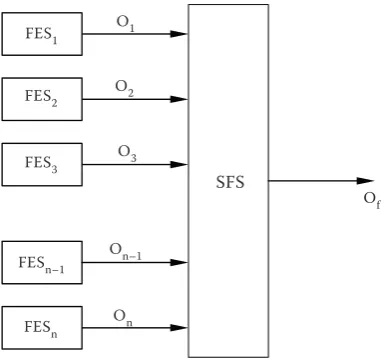
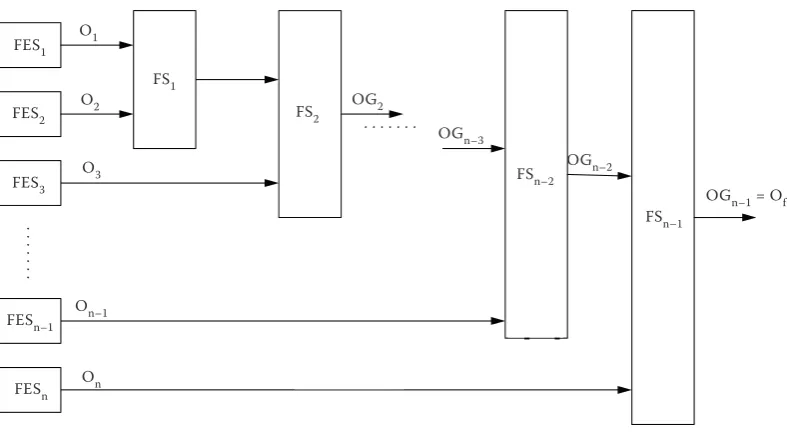
relation-ships among the input variables. These two notions will be exploited to develop a HFS-based model to combine/aggregate the outputs of FESs in case of existence of such If-then knowledge. Figures 1 and 2 show the difference between utilizing a standard fuzzy model and utilizing the HFS-based model to structure the relationship between the crisp outputs of FESs and their finally collective decision. In both figures, Of stands for the final group output, and in Figure 2, OGi stands for the output of the ith related
subgroup of FESs. In the first case, Figure 1, the total number of rules is exponentially proportional to the total number of input variables, whereas in the second case, Figure 2, the system consists of several hierarchical low dimension fuzzy systems (LDFSs), and the total number of rules is linearly proportional to the total number of input variables. For instance, for total number of input variables equal 5, and a five fuzzy sets for each variable, then in the case of the standard fuzzy systems, the total number of decision rules for complete control system is (55) or
3 125 rules, whereas in the case of 2-inputs 4-LDFS system, the total number of rules for the whole sys-tem is (52 × 4) or 100 rules. It is obvious how the
HFS contributes to the reduction of the total rules required. As Figure 2 shows, it is possible to logi-cally structure the relationships among the outputs of FESs to finally obtain the consolidated output. It is not necessary for each LDFS to be always of two inputs; it can be of three or more. An important implicit notion that can be extracted from Figure 2 is that the decision logics should be able to not only specify how the influential relationships of the FESs’ outputs determine the final group output, but also
FES1
FES2
FESn–1 FES3
FESn
SFS O1
O2
O3
On–1
On
[image:2.595.304.497.543.722.2]Of
should specify how the influential relationships among the outputs of the subgroups of the related FESs determine the final output.
In order to use the proposed HFS-based model, it is necessary to specify a set of fuzzy logics. These fuzzy logics involve determining the types of mem-berships or fuzzy sets for describing the range of values of input factors and the output decisions, the operations used to fuzzify the values of inputs, the type or form of decision rules utilized to map relationships, and the operations used to compute and defuzzify membership values of the consequents or the implied fuzzy sets. For simplicity, ease of computation and the adequate efficiency as well, the
commonly utilized standard membership functions like triangular one could be utilized as a default when there is no knowledge, empirical observations or other methods that can be used to construct mem-berships. In the proposed model, all the intermedi-ate outputs will have the same physical meaning as the final collective output. Consequently, only one membership function will be used for inputs (i.e., FESs’ crisp outputs), intermediate outputs, and fi-nal output when needed. Regarding the operation used in fuzzification of input values, the well-known maximum operator will be used. The If-then deci-sion logics are the most important input, and are the linguistic formulation of the past knowledge
FES1
FES2
FES3
FES4
FES5 O1
O2
O4 O3
O5
OG1
OG2
OG3
Of FS1
FS2
FS3
FS4 Electronic
Power
Vibrational
Structural
[image:3.595.78.472.63.280.2]Chemical
Figure 3. A HFS-model for combining/aggregating the outputs of five FESs of the example problem FES1
FES2
FES3
FESn–1
FESn O1
O2
O3
On–1
On
FS1
FS2
FSn–2
FSn–1 OG2
OGn–3
OGn–2
OGn–1 = Of . . .
. .
.
. .
.
[image:3.595.112.464.548.739.2].
available about how to obtain a collective decision, based on the given status of the FESs’ crisp outputs. These If-then rules must also involve the knowledge about how the subgroups’ outputs relate to the final collective decision. For instance, consider the fol-lowing two linguistic rules:
– If the output of FES1 is High and the output of
FES2 is Medium, then the output of the first group
is High.
– If the output of the first group is High and the output of the second group is High, then the output of the third group is High.
The first rule is concerned with the two related FESs, whereas second rule involves two related sub-groups of FESs. The widely utilized Minimum opera-tor (Mamdani, Assilian 1975; Mamdani 1976) will be used to find the consequent membership value as a minimum of premise’s memberships; this is when the connective or conjunction AND is used. The Maximum operator will be used when the disjunction OR is the connective of the premise’s memberships. At the final fuzzy system, only one output will be in hand, and the maximum defuzzification rule is then used on a single implied fuzzy set, which gives its center value as a final group decision. The next example will demonstrate how this proposed model could be practically utilized.
µ
0 5 10 No Yes L
[image:4.595.104.441.80.184.2]µ
[image:4.595.305.530.524.609.2]Figure 4. A triangular membership function of a FES’s output
Table 1. Fuzzy sets and associated membership values of outputs’ values
Variable name (Oi)
Fuzzy set
label µ (grade of membership)
O1 medium 0.6
O2 medium 0.6
O3 medium 0.8
O4 high 1
[image:4.595.64.292.646.767.2]O5 low 0.6
Table 2. If-then decision rules for FS1 defining the joint influence of O1 and O2 on the output of the first subgroup, OG1
Then (OG1)
IF O1
L M H
A
nd
if
O2 L L L H
M L M H
H H H H
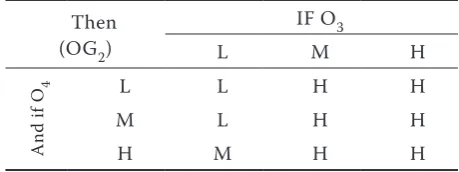
Table 3. If-then decision rules for FS2 defining the joint influence of O3 and O4 on the output of the second sub-group, OG2
Then (OG2)
IF O3
L M H
A
nd
if
O4 L L H H
M L H H
H M H H
AN ILLUSTRATIVE HFS EXAMPLE MODEL
Let us suppose that five FESs are used to deci-de whether or not a modeci-dern tractor undeci-der testing should undergo an intensive maintenance course. Two decision alternatives are possible: either “Tractor needs maintenance” or “Tractor does not need ma-intenance”. The five relevant, participating FESs are: Electronic, Electric power, Vibrational, Structural mechanic, Chemical. The related sub-groups of FESs are hierarchically structured in the model as shown in Figure 3.
[image:4.595.302.532.680.766.2]fol-lows: O1 = 3, O2 = 7, O3 = 6, O4 = 10, O5 = 2. Three linguistic values are used to describe the output range. Then, the computationally simple triangular mem-bership function is constructed as in Figure 4. The numerical values of outputs are fuzzified as shown in Table 1. Then, the applicable decision rules in Tables 2 to 5 are fired.
The output of the FS4 is the final output, which is “High”. Then, the final crisp consolidated decision is the 10, which is interpreted as: “Tractor needs maintenance”.
CONCLUSION
The provided example has demonstrated that the use of HFS-based model simply enables to logically structure the relationships among FESs, and then to apply the available past knowledge to make a final decision. It should be noted that the importances or weights of FESs have not been explicitly utilized, because they are implicitly contained in the influence of every crisp output existing in the decision rules. Also, the developed model could flexibly provide for the satisfaction of some specific requirements
Table 4. If-then decision rules for FS3 defining the joint influence of O5 and OG2 on the output of the third sub-group, OG3
Then OG3
IF OG2
L M H
A
nd
if
O5 L L L M
M M M H
H H H H
Table 5. If-then decision rules for FS4 defining the partial influence of OG1 and OG3 on the output of the fourth subgroup, the final system’s output, Of
Then Of
IF OG1
L M H
A
nd
if
O
G3 L L M H
M M H H
H H H H
like: preserving extreme output values, expressing relatedness among FESs’ decisions, and allowing for the veto-type or critical decisions easily through building decision rules in the whole set of the model’s decision logics to express these specific relationships and controls.
REFERENCES
Aly S., Vrana I. (2005): Integrating Multiple Fuzzy Expert System under Restricting Requirements. In: Proceedings of the 5th International Congress,
on Information Technology in Agriculture, Food and Environment. Adana, Turkey.
Mamdani E.H., Assilian S. (1975): An experiment in linguistic synthesis with a fuzzy logic controller. International Journal of Man-Machine Studies,
7: 1–13.
Mamdani E.H. (1976): Advances in the linguistic synthesis of fuzzy controllers. International Journal of Man-Machine Studies, 8: 669–678.
Raju G.V.S., Zhou J., Kisner R.A. (1991): Hierarchical fuzzy control. International Journal of Control, 54
(5): 1201–1216.
Arrived on 15th December 2006
Contact address:
Shady Aly, Ivan Vrana, Czech University of of Life Sciences in Prague, Kamýcká 129, 169 51 Prague 6-Suchdol, Czech Republic
e-mail: [email protected], [email protected]
The fired decision rules are: