The growth of the society’s information and the transfer to knowledge society has been a reality of the current development at all levels. The rapid changes which have been taking place cannot be controlled in usual ways. The firms are much larger and their turnovers much bigger, there is a growing need of better tools to support cooperation, communication and knowledge sharing within the selected strategy of their development. The competitive advantage requires inevitably to make use of all intellectual resources which the firm or the organisation owns. The globalised competitive environment requires the firms to quickly respond to the customer’s needs and problems for which they need enough knowledge. And that is precisely what requires quality knowledge and strategic management.
OBJECTIVES AND METHODS
The objective of the present paper is to formulate the core categories, bases, and expected trends of
the development of knowledge and strategic man-agement. The methodological basis consists in the research conclusions made at the Department of Management, Faculty of Economics, University of Agriculture Prague, in the analyses of the current requirements of business entities of their manage-ment, using the method of inference and formulation synthesis of the core characteristics of knowledge and strategic management.
KNOWLEDGE AND STRATEGIC MANAGEMENT
In principle, knowledge management is a process which helps the enterprises to identify, select, arrange, extend and transfer important information and spe-cialist knowledge. In simple terms, its objective is to deliver relevant knowledge to relevant people at the right time. Knowledge management is based on the production, storage and use of knowledge. Knowledge
Knowledge and strategic management
Znalostní a strategický management
J. HRON
Czech University of Agriculture, Prague, Czech Republic
Abstract: The article summarizes recent developments in the field of knowledge management and its vital influence on strategic management. Knowledge has become a resource of key importance with regard to the competitive advantage of a business. It thus strengthens the resource-based view of competitive advantage and develops it further by providing guideli-nes for developing, storing, and sharing knowledge within a busiguideli-ness with the use of the concept of organisational learning. Tacit and explicit knowledge is distinguished in order to differentiate their contribution towards the competitiveness of a business. Based on these developments major trends affecting current development of strategic management are defined as well as recommendations drawn from the experience of leading subjects in the field.
Keywords: knowledge and strategic management, competence, organisation, information systems
Abstrakt: Článek shrnuje vývoj poznatků v oblasti řízení znalostí a významný vliv tohoto oboru na strategické řízení. Znalosti se staly jedním z nejdůležitějších zdrojů konkurenční výhody podniků. Tyto poznatky jsou potvrzením zdrojového přístupu k tvorbě konkurenční výhody, který dále rozvíjejí prostřednictvím nástrojů pro rozvoj, ukládání a sdílení znalostí v rámci podniku s využitím konceptu organizačního učení. Popis tacitních a explicitních znalostí umožňuje diferencovat jejich přínos pro konkurenceschopnost podniku. Na základě popsaného vývoje jsou vymezeny trendy ovlivňující soudobé strategické řízení a zároveň jsou ze zkušeností vůdčích subjektů v oboru odvozena doporučení pro praktické aplikace. Klíčová slova: znalostní a strategický management, kompetence, organizace, informační systémy
categorisation and codification allows for successful and efficient problem solutions, dynamic learning, strategic planning and decision-making.
Knowledge management is focused at distinguish-ing between knowledge and its interpretation. If this becomes a common part of the organisation’s work the value of the knowledge thereby classified will show up through its repeated application.
A suitable organisation structure and modern in-formation technologies can make use of knowledge in problem solutions regardless of place and time. The possibility of the exchange of knowledge between the organisation’s members and a continuous extension of the knowledge basis is a fundamental pre-condition of the reasonable application of knowledge manage-ment on the way towards success.
STRATEGIC MANAGEMENT
Strategic management as an independent science deals with the production of value, i.e. achieving out-standing yields through the value thereby produced. The value can be produced on the assumption of a successfully formulated and implemented strategy which the competitors are unable of imitating or it would be much too costly for them (Durand 2002). In strategic management a very strong opinion trend has arisen over the recent decade based on the resource approach to the competitive advantage formation (Nelson 1991). In this opinion, the ‘resource approach’ deviates from the traditional perception of strategic management defining the strategy through products and markets where they are realized, and the
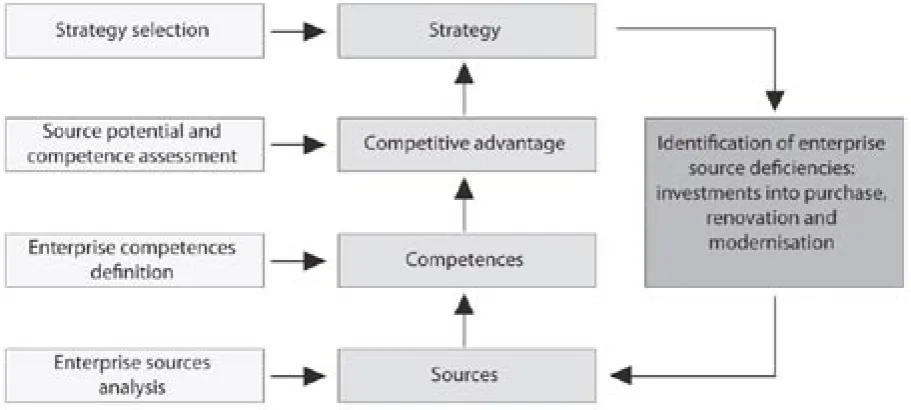
atten-tion has been focused inside the enterprise: upon its resources and potential. Through this approach, the enterprise should build its strategic position on the basis of unique, valuable and non-imitable re-sources rather than on products and services which are produced using such resources. The application of such resources becomes a strategically important driving force across various markets and products, in contrast with the hitherto marketing of a specific product on a specific market. While the products and markets have been increasingly becoming transient, the resources are of a more permanent nature. The resource approach thereby provides a longer-term prospect compared with the traditional approach and a guideline in times of uncertainty and of the increasing dynamism of the competitive environ-ment. The core attributes of the resource approach to the formation of a competitive advantage are given in Figure 1.
The unique approach to the value resources has been one of the ways how to establish a suistanable competitive advantage. However, it is not always possible to secure such a unique opportunity, there are times when the competitors are able to imitate or replace such resources. But the enterprises that do have unique knowledge are usually able to combine and coordinate the use of their resources in a unique way which offers the customers higher value than that offered by the competitors.
[image:2.595.71.527.530.735.2]It follows from the above, that exceptional intel-lectual resources allow the enterprise to better use the resources that need not necessarily be unique (Boisot 1995). In an enterprise just like in the economy as a whole, the physical and intellectual capitals are
the generators of wealth and value. With respect to the external environment changes and to the cri-teria changes, which measure the rate of success, the intellectual capital becomes the most important strategic resource. Intellectual capital consists of two parts: human capital and knowledge capital (Stewart 1997). Human capital includes individual skills and knowledge obtained through education, training, experience and learning. Knowledge capital includes documented knowledge available in a variety of forms: specialist articles, news, books, patents, software, etc. Another dividing line that can be drawn between the human and knowledge capital can be based upon the differentiation between the implicit and explicit knowledge: human capital includes predominantly implicit knowledge while knowledge capital includes explicit knowledge.
KNOWLEDGE MANAGEMENT
The development of knowledge management was primarily focused at the production of applications based on information technologies, and it dealt with the implementation of new organisation standards only marginally. At the beginning the relationship between knowledge and business strategy was gen-erally ignored. Knowledge management has thereby become much more a matter of information tech-nologies, and although the discussion on knowledge usually started at the level of strategic management in an enterprise it very quickly moved on towards the area of designing applications, architecture of the knowledge databases, searching for tools, etc. The importance of knowledge for the establishment of
competitive advantage had been admitted intuitively but the strategic matters were quickly substituted with the problem of the up-to-date technologies (Zach 1999). This situation is reminiscent of the infor-mation technologies and their contribution to business in 1970s. Without the fundamental determination of the sense (purpose), however, the implementation of information technologies appeared to end up only in the ‘productivity paradox’. Interconnection with business strategy has been the main insufficiency with respect to the efficient application of the man-agement principles that is the strategic models that would interlink the knowledge-based technologies and enterprise organisation structures in favour of the formulation and implementation of a successful strategy (Zach 1999).
FROM RESOURCE-BASED PERCEPTION TO KNOWLEDGE
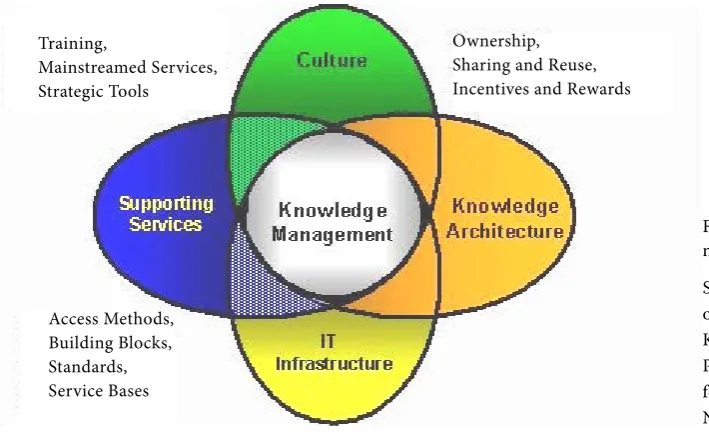
[image:3.595.64.419.552.768.2]Knowledge is currently considered as the most important strategic resource, and the ability to create and apply knowledge has been a key ability in estab-lishing a relatively suistanable competitive advantage (Penrose 1980). It has been naturally assumed that the enterprises that have better knowledge of their customers, products, technologies, markets and links between them, and that can apply such knowledge, can achieve better results. Such an opinion further develops a resource-based approach to the enterprise and pushes it towards the ‘knowledge approach’, which perceives an enterprise as a tool for creat-ing, integratcreat-ing, storcreat-ing, sharing and application of knowledge.
Figure 2. Knowledge manage-ment within an organisation Source: Holm J. (1999): Devel-oping a Strategic Approach to Knowledge Management. Jet Propulsion Laboratory, Cali-fornia Institute of Technology, NASA
Access Methods, Building Blocks, Standards, Service Bases Training,
Mainstreamed Services, Strategic Tools
While in the past, knowledge had been perceived as self-evident, something that was not explicitly neither valued nor controlled, the current competi-tive environment makes pressure at the enterprises to pay attention to strategic decisions concerning the establishment, maintenance and development of their own knowledge basis. The current level of knowledge of this problem offers the entrepreneurs only sporadic technological solutions for knowledge sharing and codification, and little knowledge has been available in the field of strategic decision-making on knowl-edge resources. Enterprises that would like to apply the knowledge concept of an enterprise are facing a number of problems in the proces of formulating their knowledge strategy. A simple application of the traditional strategy formulation processes would lead towards seeking a balance between the knowledge (knowledge resource) within an enterprise and the demands of the knowledge with respect to the pro-duction of goods that can generate exceptional yield. Identification of the knowledge which is a unique and a valuable resource, which processes are unique and valuable and which combination of knowledge and processes can support the unique position of the enterprise products on the markets thereby sup-plied – such are the strategy cornerstones based on knowledge (Zach 1999). Each enterprise must have a certain level of knowledge of its own technologies, products, markets, customers and branches so as to have a chance at all to stay and defend its position in the sector. A strategic decision of the enterprise’s
standpoint towards these factors has direct influence upon what the enterprise and its employees must know so as to be competitive.
From the other perspective, the enterprise must have enough knowledge to be able to identify the best products and market opportunities for the efficient use of its knowledge basis.
Knowledge and learning are inseparable. The en-terprise knowledge basis and its development can be supported efficiently through organisational learning. The ability to learn, to accumulate knowledge and experience and to re-apply them is alone a resource of a competitive advantage. There is evidence of the fact that the most valuable and the least imitable knowledge is implicit knowledge (Tichá 2001) which is part of the work processes, collective spirit, of organisation culture. A knowledge-based enterprise, however, requires sharing the knowledge, i.e. its transformation into knowledge using the explicit form of articulation and codification. Such a requirement bears in itself an important paradox: the knowledge must be explicit so that it could be transmitted and shared within the enterprise. As soon as the knowledge becomes explicit the posibility of its transmission into other enterprises increases thereby decreasing its competitive value.
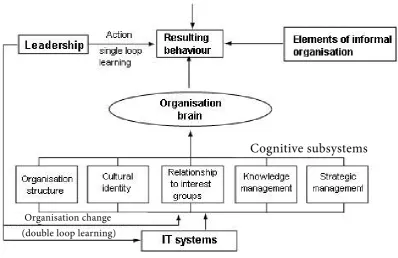
[image:4.595.86.485.484.742.2]In knowledge-based organisations, human resourc-es management must be focused at increasing the organisation’s brain (intelligence), at releasing the workers’ potential through learning, participation, cooperation, initiative (Horalíková, Berglová 2002).
Figure 3. Organisation brain Organisation change
Cognitive subsystems
The organisation’s brain in terms of knowledge eco-nomics, has four levels:
1. knowing what – learning, cognitive knowledge, knowing the specialist area
2. knowing how – top skills, efficient realisation 3. knowing why – systems understanding and trained
intuition
4. investigating why – self-motivating creativity.
The organisation brain value grows substantially on the intelligence scale, from cognitive knowledge to self-motivating creativity (Figure 3).
Competitiveness of human resources consists not only in increasing their “intelligence” but also in increasing their adaptability and flexibility, willing-ness of mobility, change of attitudes particularly to changes.
In connection with the knowledge support of stra-tegic management it is necessary to study in detail the workers’ potential which has been traditionally called competence. One of the potential approaches to managers´ general competence can be formulated in several complex groups:
– intellectual, comprising particularly: strategic viewpoint, analysis and judgment, planning and organising;
– interpersonal: personnel and work team manage-ment, cogency, assertivity and determination, in-terpersonal sensitivity, verbal communication; – adaptability and flexibility;
– accent on results: energy and initiative, drive towards success, sense of business (Romer 1995).
Such and other questions remain unanswered and, if knowledge management is to become a useful concept, it must be systematically interlinked with the principles of business strategy development including economic assessment of knowledge and its effects.
CONCLUSION
Global and social economic environment has been changing. Strategic management must be proactive
under the turbulent conditions. Right at the time when the managers have been thinking that they have developed a strategy for a future success new technologies have been developed or the consumer behaviour patterns have changed.
Table 1 shows relations between the environment turbulence level and strategy types in the short and long run:
Currently there are at least 6 tendencies causing substantial changes in the strategic approach to man-agement and implementation: These forces cause a transfer:
– from information to knowledge and wisdom – from bureaucracy to networking
– from local/national to transnational/global and metanational
– from competitive to cooperative learning
– from a single or more intertwined relationships towards “bi-corporate relations”.
Following the changes summary above, there are 3 forces leading towards important changes in strategic management:
1. Effect of knowledge and learning upon the con-sumer value perception
2. Effect of global thinking upon the enterprise pur-pose
3. Effect of the change of thinking, from individual organisations, bureaucracy and competing value chains towards networking organisations, meritoc-racies and cooperating bi-corporate value systems (Leibold et al. 2002).
REFERENCES
Boisot M.H. (1995): Is your firm a creative destroyer? Competitive learning and knowledge flows in the technological strategies of firms. Research Policy, 24: 489–506.
Durand F. (2002): Competitive advantages exist: A critique of Powell. Strategic Management Journal,
23: 867–872.
Horalíková M., Berglová P. (2002): Intellectual capital and talents in agribusiness organisation
develop-Table 1. Environment turbulence level and strategy types in the short and long run
Environment Short run Long run
Unstabilised, chaotic, intertwined
[image:5.595.66.530.85.156.2]ment. Agricultural Economics – Czech, 48 (11): 505–510.
Hron J. (2005): Knowledge management. Conference on Firm Management, Brno.
Leibold L., Probst G., Gibbert M. (ed.) (2002): Strate-gic Management in the Knowledge Economy: New Approaches and Business Applications. Erlangen, Publicis, Wiley.
Nelson R. (1991): Why do firms differ and does it matter? Strategic Management Journal, 12 (Winter Special Issue): 61–74.
Penrose E.T. (1980): The Theory of the Growth of the Firm.U.S. edition, M.E. Sharpe, Inc., White Plains, NY: 76–80.
Romer P. (1995): Beyond the knowledge worker. World Link, January/February.
Stewart T.A. (1997): Intellectual Capital: The new Wealth of Organizations, Brealey, London. Tichá I. (2001): Knowledge: A source of competitive
advantage in global economy. Conference Proceed-ings Agrarian Perspectives X.
Zach M.H. (1999): Knowledge and Strategy. Butter-worth and Heinemann, Boston, USA.
Arrived on 1st February 2006
Contact address: