Commercial preparations of phytases used in poultry nutrition include preparations of 3-phy-tase A, such as Natuphos® (BASF, Lampertheim,
Germany), produced by the Aspergillus niger strain carrying phyA genes from Aspergillus ficuum, which initiate phytate hydrolysis by removing the
phos-phate residue (iP) from position 3 of the myo-inosi-tol ring. Another subclass of phytases – 6-phytases – like the enzyme from a recombinant Aspergillus oryzae strain transformed with the phytase gene of Peniophora lycci (Ronozyme P®, DSM-Nutritional
Products, Basel, Switzerland) or enzymes from
Effects of phytase B on laying performance, eggshell
quality and on phosphorus and calcium balance
in laying hens fed phosphorus-deficient maize-soybean
meal diets
K. Żyła
1, M. Mika
1, S. Świątkiewicz
2, J. Koreleski
2, J. Piironen
31Department of Food Biotechnology, University of Agriculture, Krakow, Poland
2Department of Animal Nutrition and Feed Science, National Research Institute of Animal
Production, Balice, Poland
3AB Enzymes Oy, Rajamäki, Finland
ABSTRACT: A study was conducted to evaluate the effects of dietary supplementation of phytase B (product of the Aspergillus nigerphyB gene expressed in Trichoderma reesei) on feed intake, laying performance, eggshell quality, and on phosphorus and calcium balance in laying hens. Seventy-two, 40 weeks old Hy Line Brown hens were fed for 14 weeks the following four phosphorus-deficient (0.12% nonphytate phosphorus, NPP), maize-soy-bean meal-based diets: (1) calcium-deficient (2.8% Ca) control diet; (2) diet 1 + phytase B at the activity of 2.5 acid phosphatase units (AcPU/kg); (3) control diet (3.8% Ca); (4) diet 3 + phytase B at the activity of 2.5 AcPU/ kg. Each dietary treatment was fed to 18 cages of hens, 1 hen/cage kept in individual cages. Hens fed the NPP- and Ca-deficient diets consumed more feed (P < 0.01) and excreted less calcium (P < 0.01) than those receiving P-deficient diets with the standard calcium level. There were no effects of calcium level on feed utilization, egg mass, egg weight, and eggshell breaking strength. Egg production, although numerically higher in hens fed low Ca diets with no enzyme added, failed to be significantly different due to the low number of hens investigated and therefore the measurement should be considered as preliminary and supplementary. Phytase B increased mean egg weight by about 7% in layers fed the NPP- and Ca-deficient diet (Ca × phytase B interaction, P < 0.05), increased shell breaking strength, particularly at the standard calcium level, significantly enhanced amounts of calcium retained by layers and amounts of phosphorus retained by hens fed the Ca-deficient diets. Additionally, phytase B improved Ca retention at both dietary Ca levels and phosphorus retention in hens fed the Ca-deficient diets. Results of the study indicate that the efficacy of phytase B in NPP-deficient diets is strongly influenced by the dietary calcium level and the enzyme may modulate egg weight, eggshell quality, phosphorus and calcium retention in laying hens fed low-NPP, maize-soybean meal-based diets.
Keywords:phytase B; laying hen; laying performance; eggshell quality; retention of P and Ca
hosts carrying the appA gene from Escherichia coli (Phyzyme XP, Danisco, Malborough, UK; Quantum phytase, AB Enzymes GmbH, Darmstadt, Germany; OptiPhos®, JBC, Sheridan, USA), start the
degrada-tion of phytate by removing iP from posidegrada-tion 6 or 4 on the phytic acid molecule (Hatten et al., 2001; Applegate at al., 2003; Ullah and Sedhumadhavan, 2003; Vats and Banerjee, 2004; Onyango et al., 2005). Despite many attempts to characterize and classify phytases, considerable differences in descriptions of properties and particularly in the mode of action of the same catalyst (Mullaney and Ullah, 2003; Oh et al., 2004; Vats et al., 2005; Greiner, 2006; Mullaney and Ullah, 2006) remain confusing, especially in the light of the official IUB enzyme classification. In con-trast to the above-mentioned enzymes, phytase B is an enzyme with broad substrate specificity, high specific activity and low optimal pH (Oh et al., 2004; Vats et al., 2005). Phytase B, previously known as a non-specific acid phosphatase (EC 3.1.3.2), is clas-sified nowadays as a histidine acid phytase (HAP). Although the preparation of phytase B has been available exclusively in an experimental form for some time (Finase® AP, Roal Oy, Finland), it has
the full potential to be commercialized (Miettinen-Oinonen et al., 1997). Previously, it was postulated that the simultaneous application of either of phytas-es A along with phytase B offers an effective way to enhance phytate dephosphorylation in poultry (Żyła et al., 2000). In that study combinations of phytases A with phytase B were investigated thoroughly, but scarce information is available about the effects of phytase B fed as a sole supplemental enzyme, and nothing is known about its efficacy in the nutrition of laying hens. In broilers fed maize-soybean meal-based diets phytase B increased feed intake, BWG, toe ash and P retention, but not the retention of Ca (Żyła et al., 2004).
There have been many studies conducted on laying hens fed maize-soybean meal indicating that microbial phytase A improves performance, bone mineralization, phosphorus utilization and digestion of nutrients from nonphytate phospho-rus (NPP)-deficient diets (Scott et al., 1999; Wu et al., 2006; Liu et al., 2007; Zaghari et al., 2008). Multifactor experiments employing different lev-els of NPP and Ca clearly indicated that the Ca level and Ca/NPP ratio in a diet effectively modu-late phytase efficacy in laying hens (Gordon and Rolland, 1997; Jalal and Scheideler, 2001; Hughes et al., 2009). Phytase A preparations increased feed intake, feed conversion ratio and egg mass,
improved eggshell quality and reduced phosphorus excretion in laying hens fed maize-soybean meal diets comprising 0.10 to 0.15% of NPP and care-fully adjusted Ca level. A few reports suggest that phytase A may reduce the impact of low dietary Ca on hen performance (Gordon and Roland, 1998) al-though other data indicate the opposite (Francesch et al., 2005; Liu et al., 2007). Studies where different phytase A preparations (3-phytase A; consensus 3-phytase A, 6-phytase A) were tested simultane-ously did not show any significant differences among sources of the catalyst used for supplementation of feeds fed to laying hens (Jalal and Scheideler, 2001; Wu et al., 2006; Liu et al., 2007).
To our knowledge, no studies have been per-formed to date with phytase B as a supplemental enzyme in maize-soybean diets fed to laying hens. Therefore the purpose of the current investiga-tions was to evaluate effects of phytase B added to nonphytate phosphorus deficient maize-soybean meal-based diets containing either 2.8 or 3.8% Ca on production characteristics, eggshell quality, and on P and Ca balance in laying hens.
MATERIAL AND METHODS
Enzyme activity measurements and units The microbial phytase B (E.C. 3.1.3.2; Finase®
AP) with the declared activity of 225 000 units/g was from AB Enzymes OY, Rajamäki, Finland. The enzyme was characterized by the producer as being derived from a genetically modified Trichoderma reesei strain carrying the Aspergillus niger acid phosphatase gene and having side activities of β-glucanase, cellulase and xylanase. In our study one unit of phytase B activity (AcPU) was equal to 1µM/min of p-nitrophenol liberated from 5.5mM disodium p-nitrophenylphosphate at 40°C, pH 4.5. Finase® AP was found to have the phytase B activity
equal to 13.15 AcPU/g.
Animals, housing and experimental diets
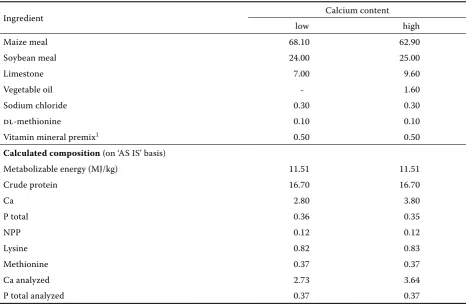
under controlled climate conditions with minimal temperature maintained at 20°C, lighting period 14L:10D and light intensity of 10 lux. At 40 weeks of age, hens were randomly assigned to one of the four dietary treatments with 18 cage replications of 1 hen and fed experimental diets until week 54. Feed and water were provided ad libitum. The ingredient and nutrient contents of basal maize-soybean meal-based diets are shown in Table 1. Experimental diets were formulated to meet or exceed nutrient recom-mendations (NRC, 1994) with the exception of P (0.12% NPP; 0.36% total phosphorus) and Ca (2.8 or 3.8%). One of the two diets at each level of calcium was supplemented with phytase B at 2.5 AcPU/kg. The enzyme preparation was premixed with a small quantity of feed and added to the remaining part of the diet during final mixing. Diets were isocaloric (2750 kcal/kg) and isonitrogenous (16.70% CP). The 2 × 2 factorial experimental design was used, with two levels of calcium and two levels (supplemented versus not supplemented) of phytase B.
Data collection
[image:3.595.64.531.100.406.2]The number and weight of eggs were registered daily during the entire experimental period and egg production was expressed as percentage of hen-day EP, feed intake was recorded monthly whereas feed utilization was calculated for the entire experimen-tal period and expressed as g of egg mass per g of feed mass consumed. Egg mass was calculated as the daily mass of eggs: egg production × egg weight/100 and egg weights were calculated as the mean weight of a single egg in each treatment. Eggs collected on day 95 (18 eggs from each treatment) were analysed for shell breaking strength using an Instron Testing Machine, Model 5542 (Instron Ltd., High Wycombe, UK), equipped with a 500 N load cell. The eggs were compressed at a constant crosshead speed of 10 mm/min and the breaking strength was determined at the time of the eggshell fracture. Eggs collected on day 96 (18 eggs from each treatment) were analysed for shell thickness Table 1. Composition and nutrient content of the low NPP, basal diets with low and standard calcium content(%)
Ingredient Calcium content
low high
Maize meal 68.10 62.90
Soybean meal 24.00 25.00
Limestone 7.00 9.60
Vegetable oil - 1.60
Sodium chloride 0.30 0.30
dl-methionine 0.10 0.10
Vitamin mineral premix1 0.50 0.50 Calculated composition (on ‘AS IS’ basis)
Metabolizable energy (MJ/kg) 11.51 11.51
Crude protein 16.70 16.70
Ca 2.80 3.80
P total 0.36 0.35
NPP 0.12 0.12
Lysine 0.82 0.83
Methionine 0.37 0.37
Ca analyzed 2.73 3.64
P total analyzed 0.37 0.37
1premix provided per 1 kg of diet: vitamin A, 10 000 IU; vitamin D
3, 3000 IU; vitamin E, 50 IU; vitamin K3, 2 mg; vitamin B1,
1 mg; vitamin B2, 4 mg; vitamin B6, 1.5 mg; vitamin B12, 0.01 mg; Ca-pantothenate, 8 mg; niacin, 25 mg; folic acid, 0.5 mg;
and shell density with semi-automated egg quality equipment [QCM+, Technical Services and Supplies (TSS), York, UK] as described by Świątkiewicz et al. (2010). Shell thickness was measured in the equator area of the egg using an electronic mi-crometer (QCT device, TSS, York, UK). Eggshell density (the dried shell weight per unit of shell area, mg/cm2) was calculated by the Eggware software (TSS, York, UK). During the 52nd and 53rd week the collection of total excreta from each cage was performed. Excreta were stored in plastic bags at –20°C. After thawing, the excreta were dried in an oven at 50°C to constant weight, weighed and ground to pass a 1-mm sieve. Duplicate samples of feed and excreta were digested by a wet-ash pro-cedure, which was validated by including standard reference material 1572 (Citrus leaves) from the National Institute of Standards and Technology, Gaithersburg, USA. Phosphorus concentration was determined colorimetrically by the molybdo-vana-date method (AOAC, 1995). Calcium concentration in feed and manure samples was analysed by flame atomic absorption spectrophotometry.
Statistical analyses
Data were analysed by the General Linear Models procedure of Statgraphics Plus for Windows sta-tistical software (1996). Analysis of variance was based on two-way ANOVA using the 2 × 2 factorial design. Mean differences were determined using Duncan’s test. Additionally, the equality of vari-ances was assessed by Levene’s test and subsequent one-way ANOVA was performed to estimate dif-ferences among means where interactions of the experimental factors were significant. Statistical significance was accepted at P < 0.05.
RESULTS AND DISCUSSION
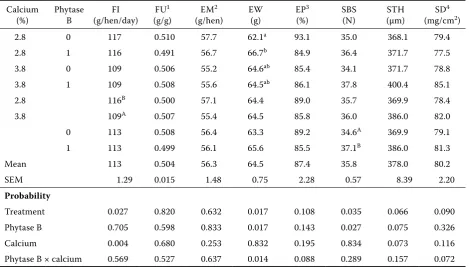
The experimental design employed in the study was based on the assumption that phytase B, simi-larly like phytase A, may allow 0.12% NPP diets, eliminate added iP and reduce P excretion in lay-ing hens (Panda et al., 2005). Feed utilization, cal-culated as the mean across all dietary treatments, for the 14 weeks experimental period was 0.504 g of egg mass per g of feed consumed; egg pro-duction averaged out at 87.4%; mean egg weight was 64.5 g, and egg mass amounted to 56.3 g per
low-Ca diets supplemented with 3- and 6-phytases A. Mean egg weights in those studies were increased by Aspergillus niger 3-phytase A, but not by two different preparations of 6-phytases A derived from Escherichia coli. Liebert et al. (2005), who tested the effects of a consensus phytase A expressed in Hansenula polymorpha, observed no influence of the supplemental enzyme on feed intake but rather on the feed conversion ratio that was significantly improved in laying hens fed low NPP, Ca-deficient maize-soybean meal-based diets. There seems to be a general consent that the productivity of laying hens fed maize soybean meal-based diets, contain-ing 0.10 to 0.15% of NPP and supplemented with phytase A, is similar to that of hens fed diets with a normal NPP concentration (Gordon and Roland, 1997; Liu et al., 2007; Hughes et al., 2008). Wu et al. (2006) reported that both 3- and 6-phytases A pre-vented the decline in feed intake of hens fed P-de- ficient diets. Similar conclusions may be drawn
[image:5.595.65.535.128.395.2]from the data provided by Sohail and Roland (2000) and Augspurger et al. (2007). Decreased feed intakes in hens fed diets with 3.8% of calcium and inability of phytase B to overcome this effect observed in our study suggest that in contrast to phytases A, phytase B does not stimulate feed in-take in hens fed low NPP, adequate-Ca diets. Sohail and Roland (2000) observed no effect of phytase A on egg weight and egg production in hens fed 0.3% NPP diets while Augspurger et al. (2007), who stud-ied the effects of Escherichia coli 6-phytase A on the performance of laying hens fed the 3.8% Ca, 0.10% NPP diets, reported significant increases in egg weight associated with the presence of the supplemental enzyme. It seems therefore that both the inability of phytase B to enhance performance parameters of hens fed low NPP and adequate-Ca diets and its ability to increase egg weight in hens fed low NPP and Ca-deficient diets are unique fea-tures of the enzyme.
Table 2. Effect of phytase B and calcium level on feed intake (FI), feed utilization (FU), egg mass (EM), egg weight (EW), egg production (EP), shell breaking strength (SBS), shell thickness (STH), and shell density (SD)of laying hens fed maize-soybean meal-based diet
Calcium
(%) Phytase B (g/hen/day)FI FU
1
(g/g) EM
2
(g/hen) EW (g) EP
3
(%) SBS (N) (µm)STH SD
4
(mg/cm2)
2.8 0 117 0.510 57.7 62.1a 93.1 35.0 368.1 79.4
2.8 1 116 0.491 56.7 66.7b 84.9 36.4 371.7 77.5
3.8 0 109 0.506 55.2 64.6ab 85.4 34.1 371.7 78.8
3.8 1 109 0.508 55.6 64.5ab 86.1 37.8 400.4 85.1
2.8 116B 0.500 57.1 64.4 89.0 35.7 369.9 78.4
3.8 109A 0.507 55.4 64.5 85.8 36.0 386.0 82.0
0 113 0.508 56.4 63.3 89.2 34.6A 369.9 79.1
1 113 0.499 56.1 65.6 85.5 37.1B 386.0 81.3
Mean 113 0.504 56.3 64.5 87.4 35.8 378.0 80.2 SEM 1.29 0.015 1.48 0.75 2.28 0.57 8.39 2.20
Probability
Treatment 0.027 0.820 0.632 0.017 0.108 0.035 0.066 0.090 Phytase B 0.705 0.598 0.833 0.017 0.143 0.027 0.075 0.326 Calcium 0.004 0.680 0.253 0.832 0.195 0.834 0.073 0.116 Phytase B × calcium 0.569 0.527 0.637 0.014 0.088 0.289 0.157 0.072
Values are means of 18 replicates of 1 hen kept in individual cages
a,b,A,Bmeans within a column with no common superscript differ significantly (P < 0.05) 1g egg per g of feed
2daily mass of eggs = hen-day egg production × egg weight/100
The best eggshell quality was reported for either high or low levels of both Ca and NPP (Scott et al., 1999). In the study presented here, phytase B clearly enhanced shell breaking strength at both levels of Ca (P < 0.05) and tended to increase the shell thick-ness (P < 0.1; Table 2). In hens fed the adequate level of calcium, however, both effects were much more pronounced. Therefore, the efficacy of phytase B resembles the effectiveness of phytase A reported by Jalal and Scheideler (2001) and Hughes et al. (2008), who observed improved eggshell quality in hens fed diets supplemented with Natuphos and Quantum phytase, respectively.
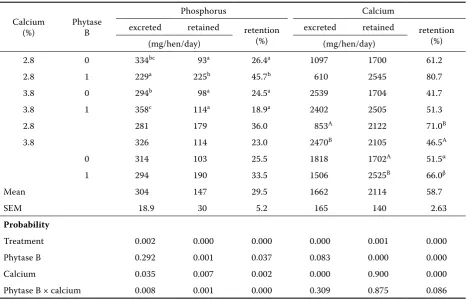
There were significant calcium with phytase B in-teractions in relation to the amounts of phospho-rus excreted, P retained and to the percentage of P retention in laying hens (Table 3). Different levels of calcium in the experimental diets affected the amounts of P excreted, P retained and Ca excreted as well as the percentage of P and Ca retention (P < 0.05) but did not influence the amounts of Ca re-tained by experimental birds. Phytase B significantly
[image:6.595.64.533.113.413.2]increased the amounts of P and Ca retained by hens and improved the percentage of P and Ca reten-tion (P < 0.05). Significant calcium with phytase B interactions observed in this study reflect the well-known phenomenon that in laying hens a proper Ca to available P ratio is the key factor influenc-ing the efficacies of supplemental phytases and the digestibility of minerals (Sohail and Roland, 2000; Lim et al., 2003; Wu et al., 2006; Liu et al., 2007; Hughes et al., 2009). Lim et al. (2003) observed no effects of different Ca levels or 6-phytase A on the g/hen/day retention of P and Ca in hens fed 0.15% NPP. In a similar study, Liu et al. (2007) observed an improved P ileal digestibility due to the supplemen-tation 3- and 6-phytases A and a higher Ca digest-ibility in hens fed 6-phytase A. Increased amounts of P excreted by hens fed Ca-adequate diets that had been supplemented with phytase B were the most unexpected result of the study presented here. Liebert et al. (2005) did not find any effects of a consensus phytase A on P excretion and P utiliza-tion in NPP and Ca-deficient diets. Wu et al. (2006) Table 3. Effect of phytase B and calcium level on phosphorus and calcium excretion and retention in laying hens fed maize-soybean meal-based diet
Calcium
(%) Phytase B
Phosphorus Calcium excreted retained retention
(%)
excreted retained retention (%) (mg/hen/day) (mg/hen/day)
2.8 0 334bc 93a 26.4a 1097 1700 61.2
2.8 1 229a 225b 45.7b 610 2545 80.7
3.8 0 294b 98a 24.5a 2539 1704 41.7
3.8 1 358c 114a 18.9a 2402 2505 51.3
2.8 281 179 36.0 853A 2122 71.0B
3.8 326 114 23.0 2470B 2105 46.5A
0 314 103 25.5 1818 1702A 51.5α
1 294 190 33.5 1506 2525B 66.0β
Mean 304 147 29.5 1662 2114 58.7
SEM 18.9 30 5.2 165 140 2.63
Probability
Treatment 0.002 0.000 0.000 0.000 0.001 0.000 Phytase B 0.292 0.001 0.037 0.083 0.000 0.000 Calcium 0.035 0.007 0.002 0.000 0.900 0.000 Phytase B × calcium 0.008 0.001 0.000 0.309 0.875 0.086
Values are means of 18 replicates of 1 hen kept in individual cages
reported that hens fed low NPP and Ca-adequate diets did not excrete less phosphorus when they consumed feeds supplemented with Natuphos 3-phytase A or Phyzyme 6-3-phytase A. A similar con-clusion was drawn by Hughes et al. (2009), who studied phytate phosphorus digestibility in feeds supplemented with Quantum 6-phytase A. An ex-perimental consensus 3-phytase A from Aspergillus niger was efficacious in promoting P absorption but not Ca absorption in laying hens fed maize- or bar-ley-based feeds (Francesch et al., 2005). In our study, the supplementation of phytase B to Ca-deficient diets reduced the amounts of P excreted, greatly increased the amounts of P retained and, in conse-quence, highly improved P retention (46% vs. 27%). Similarly, the greater improvements in the retention of Ca (81% vs. 61%) resulted from phytase B addi-tion to Ca-deficient feeds and were caused by the elevated amounts of Ca retained by hens. It should be emphasized that phytase B, although increased the amounts of Ca retained by hens at both dietary calcium levels, was more effective in reducing Ca excretion and in promoting the retention of that nutrient in laying hens fed Ca-deficient diets.
Therefore it seems that the strain of Trichoderma reesei carrying the Aspergillus niger phytase B genes produces an interesting and unique enzyme protein that, in contrast to phytases A, may be efficacious in low-NPP and Ca-deficient maize-soybean meal-based feeds fed to laying hens. However, further studies with a higher number of hens are necessary to elucidate the effects of long-term feeding of phytase B on laying hen per-formance and the efficacy of the enzyme in NPP-adequate diets.
Acknowledgements
The authors would like to acknowledge the AB Enzymes OY company (Rajamäki, Finland) for sup-plying the Finase®AP preparation.
REFERENCES
AOAC, Association of Official Analytical Chemists. (1995): 4. Animal feeds. Phosphorus. 965.17 Photo-metric method. In: Official Methods of Analysis. Wash-inghton, DC., USA, p. 27.
Applegate T.J., Webel D.M., Lei X.G. (2003): Efficacy of a phytase derived from Escherichia coli and expressed in
yeast on phosphorus utilization and bone mineraliza-tion in turkey poults. Poultry Science, 82, 1726–1732. Augspurger N.R., Webel D.M., Baker D.H. (2007): An Es-cherichia coli phytase expressed in yeast effectively re-places inorganic phosphorus for finishing pigs and laying hens. Journal of Animal Science, 85, 1192–1198. Boling S.D., Douglas M.W., Johnson M.L., Wang X.,
Par-sons C.M., Koelkebeck K.W., Zimmerman R.A. (2000): The effects of dietary available phosphorus level and phytase on performance of young and older laying hens. Poultry Science, 79, 224–230.
Francesch M., Broz J., Brufau J. (2005): Effects of exper-imental phytase on performance, egg quality, tibia ash content and phosphorus bioavailability in laying hens fed on maize- or barley-based diets. British Poultry Science, 46, 340–348.
Gordon R.W., Roland D.A. (1997): Performance of com-mercial laying hens fed various phosphorus levels, with and without supplemental phytase. Poultry Science, 76, 1172–1177.
Gordon R.W., Roland D.A. (1998): Influence of supple-mental phytase on calcium and phosphorus utilization in laying hens. Poultry Science, 77, 290–294.
Greiner R. (2006): Phytate-degrading enzymes: Regula-tion of synthesis in microorganisms and plants. In: Turner B.L., Richardson A.T., Mullaney E.J. (eds): In-ositol Phosphates Linking Agriculture and the Enviro-ment. CABI Publishing, Wallingford, 78–92.
Hatten L.F., Ingram D.R., Pittman S.T. (2001): Effect of phytase on production parameters and nutrient avail-ability in broilers and laying hens: A review. Journal of Applied Poultry Research, 10, 274–278.
Hughes A.L., Dahiya J.P., Wyatt C.L., Classen H.L. (2008): The efficacy of quantum phytase in a forty-week production trial using white leghorn laying hens fed corn-soybean meal-based diets. Poultry Science, 87, 1156–1161.
Hughes A.L., Dahiya J.P., Wyatt C.L., Classen H.L. (2009): Effect of quantum phytase on nutrient digestibility and bone ash in white leghorn laying hens fed corn-soybean meal-based diets. Poultry Science, 88, 1191–1198. Jalal M.A., Scheideler S.E. (2001): Effect of
supplementa-tion of two different sources of phytase on egg produc-tion parameters in laying hens and nutrient diges- tibility. Poultry Science, 80, 1463–1471.
Liebert F., Htoo J.K., Sünder A. (2005): Performance and nutrient utilization of laying hens fed low-phos-phorus corn-soybean and wheat-soybean diets sup-plemented with microbial phytase. Poultry Science, 84, 1576–1583.
phosphorus excretion of laying hens fed different lev-els of dietary calcium and nonphytate phosphorus. Poultry Science, 82, 92–99.
Liu N., Liu G.H., Li F.D, Sands J.S., Zhang S., Zheng A.J., Ru Y.J. (2007): Efficacy of phytases on egg production and nutrient digestibility in layers fed reduced phos-phorus diets. Poultry Science, 86, 2337–2342. Miettinen-Oinonen A., Torkkeli T., Paloheimo M.,
Ne-valainen H. (1997): Overexpression of the Aspergillus niger pH 2.5 optimum acid phosphatase gene in a het-erologous host Trichoderma reesei. Journal of Biotech-nology, 58, 237–243.
Mullaney E.J., Ullah A.H.J. (2003): The term phytase com-prises several different classes of enzymes. Biochemi-cal and BiophysiBiochemi-cal Research Communication, 312, 179–184.
Mullaney E.J., Ullah A.H.J. (2006): Phytases: Atributes, catalytic mechanisms and applications. In: Turner B. L., Richardson A.T., Mullaney E.J. (eds): Inositol phos-phates: Linking Agriculture and the Enviroment. CABI Publishing, Wallingford, 97–110.
NRC (1994): Nutrient Requirements of Poultry. 9th ed. National Academic Press, Washington, DC, USA. Oh B.C., Choi W.C., Park S., Kim Y.O., Oh T.K. (2004):
Biochemical properties and substrate specificities of alkaline and histidine acid phytases. Applied Microbi-ology and BiotechnMicrobi-ology, 63, 362–372.
Onyango E.M., Bedford M.R., Adeola O. (2005): Efficacy of an evolved Escherichia coli phytase in diets of broiler chicks. Poultry Science, 84, 248–255.
Panda A.K., Rama Rao S.V., Raju M.V.L.N., Bhanja S.K. (2005): Effect of microbial phytase on production perform-ance of white leghorn layers fed on a diet low non-phytate phosphorus. British Poultry Science, 46, 464–469. Scott T.A., Kampen R., Silversides F.G. (1999): The effect
of phosphorus, phytase enzyme, and calcium on the performance of layers fed corn-based diets. Poultry Science, 78, 1742–1749.
Skřivan M., Englmaierová M., Skřivanová V. (2010): Effect of different phosphorus levels on the performance and egg quality of laying hens fed wheat- and maize-based diets. Czech Journal of Animal Science, 55, 420–427. Sohail S.S., Rolland D.A. (2000): Influence of phytase on
calcium utilization in commercial layers. Journal of Applied Poultry Research, 9, 81–87.
Snow J.L., Douglas M.W., Koelkbeck K.W., Batal A.B., Persia M.E., Biggs P.E., Parsons C.M. (2004): Minimum phosphorus requirement of one-cycle and two-cycle (molted) hens. Poultry Science, 83, 917–924.
Statgraphics Plus for Windows (1996): Advanced regres-sion. Manugistics, Inc. Rockville, USA.
Świątkiewicz, S., Koreleski, J., Arczewska, A. (2010): Lay-ing performance and eggshell quality in layLay-ing hens fed diets supplemented with prebiotics and organic acids. Czech Journal of Animal Science, 55, 294–306. Ullah A.H.J., Sedhumadhavan K. (2003): PhyA gene
prod-uct of Aspergillus ficuum and Peniophora lycii produces dissimilar phytases. Biochemical and Biophysical Re-search Communication, 303, 463–468.
Vats P., Banerjee U.C. (2004): Production studies and catalytic properties of phytases (myo-inositolhexaki-sphosphate phosphohydrolases): an overview. Enzyme and Microbial Technology, 35, 3–14.
Vats P., Bhattacharyya M., Banerjee U.C. (2005): Use of phytases (myo-inositolhexakisphosphate phosphohy-drolases) for combating environmental pollution: A biological approach. Critical Reviews in Environmen-tal Science and Technology, 35, 469–486.
Wu G., Liu Z., Bryant M.M., Roland D.A. (2006): Com-parison of Natuphos and Phyzyme as phytase sources for commercial layers fed corn-soy diet. Poultry Sci-ence, 85, 64–69.
Zaghari M., Gaykani R, Shivazad M., Taherkhani R. (2008): Evaluation of phytase nutrient equivalency for old layer hens. Asian Journal of Poultry Science, 2, 24–29. Żyła K., Koreleski J., Świątkiewicz S., Wikiera A.,
Kujaw-ski M., Piironen J., Ledoux D.R. (2000): Effects of phos-phorolytic and cell wall-degrading enzymes on the performance of growing broilers fed wheat-based diets containing different calcium levels. Poultry Science, 79, 66–76.
Żyła K., Wikiera A., Mika M., Stodolak B., Koreleski J., Świątkiewicz S. (2004): Towards complete dephospho-rylation and total conversion of phytates in poultry feeds. Poultry Science,83, 1175–1186.
Received: 2010–12–15 Accepted after corrections: 2011–03–10
Corresponding Author
Krzysztof Żyła, Prof. dr. hab., University of Agriculture in Krakow, Faculty of Biotechnology, Department of Food Biotechnology, ul. Balicka 122, 30-149 Krakow, Poland