133 An undesirable acrylamide concentration in heat
treated foods was first observed by Swedish scien-tists in 2002 (TAREKE et al. 2002) and since then the efforts to minimise the acrylamide content in foods have been in the forefront of the food safety authorities. The formation of significant levels of the suspected carcinogen acrylamide in the heated foods high in carbohydrate arising from the reac-tion between free asparagine and intermediates of the Maillard reaction, has been widely reported (MOTTRAM et al. 2002; STADLER et al. 2002). The formation of such intermediates is determined by the concentrations and types of sugars and amino acids present. These intermediates also react with
other amino acids forming coloured products (melanoidins) and flavour compounds. Thus, the formation of acrylamide from asparagine is one of a number of competing processes. For this reason, it is postulated that the yield of acrylamide is sensi-tive to the free amino acid and sugar compositions of the food substrate, and to the conditions which are known to promote the Maillard reaction, such as the temperature and the moisture level. The likelihood of Maillard reaction browning products increases as the water activity increases, reach-ing maximum at water activities in the range of 0.6 to 0.7. In some cases, however, further increase in water activity will hinder Maillard reaction.
Study of Factors Affecting Acrylamide Levels
in Model Systems
ZUZANA CIESAROVÁ, EUGEN KISS and EMIL KOLEK
Food Research Institute, Bratislava, Slovak Republic
Abstract
CIESAROVÁ Z., KISS E., KOLEK E. (2006): Study of factors affecting acrylamide levels in model systems. Czech J. Food Sci., 24: 133–137.
The factors important for the acrylamide formation in model systems were studied. The effects of two starch matrices (potato, wheat), the share of two monosaccharides (glucose and fructose) on the formation of acrylamide, and the im-pact of water addition were compared in model systems under isothermal conditions. Acrylamide was determined by GC/MS-NCI technique. The results showed that the water content is one of the most important factors in the formation of acrylamide, besides the reaction temperature and time. The minimum of acrylamide formation was observed at the water content between 25 and 40%; outside of this range, the acrylamide concentration was higher. The presence of starch reduced the amount of acrylamide formed from asparagine and saccharide, moreover, the effects of potato and wheat starches were similar. Fructose was more effective for the acrylamide formation in comparison with glucose. The combined contribution of glucose and fructose in the mixture with asparagine and starch to the acrylamide level corresponded to the sum of separate contributions of saccharides only at the middle content of added water.
Keywords: acrylamide; water content; GC-MS; Maillard reaction
134
The importance of moisture has been reported by some research groups (BECALSKI et al. 2003; TAEYMANS et al. 2004, 2005; ROBERT et al. 2004, 2005). MATTHAUS et al. (2004) have shown that the faster reduction of the water content in the outer zones of the product, as a result of higher processing temperatures, favours the formation of acrylamide and leads to higher amounts of acrylamide in French fries. Additives with the capacity to bind water reduce the net formation of acrylamide by the inhibition of the pyrolysis reactions. ROBERT et al. (2005) have shown that acrylamide formation is affected by the physical state of the reaction system. The reaction time and temperature markedly influence acrylamide formation and degradation in the thermal proc-ess. On the other side, the latter authors have also demonstrated that acrylamide formation in equimolar glucose/asparagine model system was not much influenced by water activity and glass transition temperature. Clearly, far more work is needed to get a better understanding of the role of water in different foods in relation to acrylamide formation, and of how this knowledge may pos-sibly be used to direct the reaction towards the desired Maillard route.
In our study, we have ascertained how the acry-lamide yields are affected by the temperature, the presence and origin of starch, the exchange of reducing sugars (glucose and fructose), and the water addition. The observations were performed in model systems comprising dry starch (potato or wheat), mixtures of asparagine and glucose and/or fructose and water under isothermal conditions.
MATERIAL AND METHODS
Reagent and chemicals. Native starches from potato and wheat, glucose (Glc), fructose (Fru), and asparagine (Asn) were obtained from Fluka Chemie AG (Switzerland), 2,3,3-D3 acrylamide from Cambridge Isotope Laboratories Inc. (Andover, USA). All other solvents and chemicals used were of analytical grade.
Experimental design. Native starches from potato and wheat with initial moisture app. 10% were dried at 105°C to the final moisture of 2%. 1 g of dried starch was homogenised mechanically with 0.2 g of mixture consisting of saccharides and asparagine. After adding water (0.1–4.0 ml), the suspensions were kept in 40 ml vessels sealed with Teflon caps in Thermochem Metal-block Thermostat (Liebisch
Labortechnik, Bielefeld, Germany) at a fixed tem-perature. The heat treatment was terminated after 20 min and acrylamide (AA) was analysed after hot water extraction in ultrasonic bath followed by extraction with ethyl acetate, clean-up through silica gel column, and washing with methanol/ace-tonitrile 20:80. Three replicates were performed with each sample.
GC-MS analysis. Acrylamide without derivatisa-tion was determined by GC-MS method according to Application Note #9195 Thermo Electron Corporation (ROBARGE et al.) which offered a negative chemical ionisation (NCI) mode for underivatised acryl-amide determination where the top trace is m/z 70. Analyses were run on Agilent 6890/MSD 5793 inert under the following conditions: split/splitless inlet 250°C, 2 µl pulsed splitless, single tapered liner with glass wool, oven: 60°C (1.0 min), 10°C/min to 190°C (0 min), 50°C/min to 240°C (2 min), column: 30 m × 0.25 mm × 0.25 µm DB-FFAP, 0.8 ml/min constant flow, Negative Chemical Ionisation, SIM mode, internal standard: 2,3,3-D3 acrylamide, In-terface/Source/Quad: 250°C/150°C/150°C, tune: NCI CH4.U, reagent gas: methane 2 ml/min, EM offset: 400 above tune, resolution: low, dwell time 150 ms. All analyses were run in triplicate.
RESULTS AND DISCUSSION
[image:2.595.323.503.540.700.2]In our study, the model system was based on the raw potato composition which was published as follows (TAEYMANS 2005): asparagine 0.23–3.94%, glucose 0.02–2.71%, fructose 0.02–2.5%, sucrose
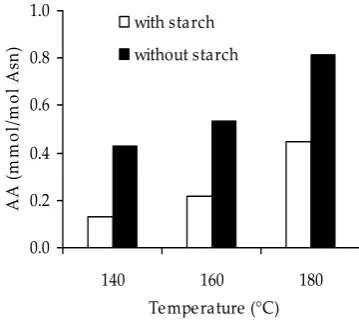
Figure 1. The comparison of
acrylamide yields from dry mixture
of asparagine and fructose with and
without potato starch after 20 min
heat treatment at different
temperatures
0.0 0.2 0.4 0.6 0.8 1.0 1.2 1.4 1.6
0 10 20 30 40 50 60
moisture (%)
A
A
(
m
m
o
l/m
o
l A
sn
) potato starch
w heat starch
Figure 2. Effect of potato and wheat starch on the acrylamide yields in the model system
consisting of starch and equimolar mixtures of glucose and asparagine with addition of water
after 20 min heat treatment at 180°C
0.0 0.2 0.4 0.6 0.8 1.0
140 160 180
Temperature (°C)
A
A
(m
m
ol
/m
ol
A
sn
) with starchwithout starch
135 0.14–4.23% respectively, of potato dry weight. The
concentrations of reducing sugars and free aspar-agine used to be higher in stored potatoes. In raw potatoes, the content of starch varied between 8.0 and 29.4%, the content of water used to be in the range of 63.2–83.9%. Sucrose as a non-reducing sugar should not participate in the acrylamide formation (ROBERT et al. 2004).
The first step in our study was to find whether and how the presence of starch influences the acrylamide amount. The results showed that the acrylamide yield in the presence of starch was lower (Figure 1) which indicated the fact that the starch presence can have an inhibitive effect on the formation of acrylamide.
Subsequently, the influence of the starch origin was investigated. It was observed that, in spite of different physical and chemical properties of starch genetically dependent on origin (size and shape of starch granules, amylose/amylopectin ratio etc.), the acrylamide yields from equimolar asparagine and glucose in the presence of water after 20 min heat treatment at 180°C were similar with potato and wheat starches (Figure 2). A more important factor which affected the acrylamide yield appeared to be the water content. The minimum amount of
acrylamide was observed in the range of the initial moisture content between 15 and 45%.
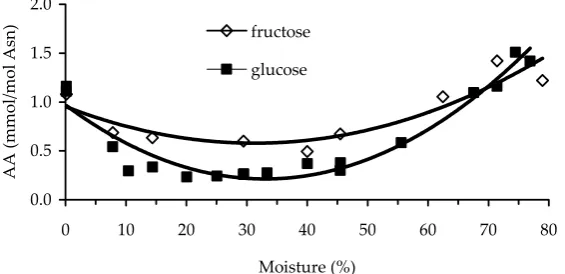
In the case fructose was used instead of glucose in the equimolar model mixture with potato starch, the acrylamide yields were app. 2-times higher, but only in the middle moisture range (Figure 3). From the chemical point of view, glucose was expected, as an aldohexose sugar, to generate more acryla-mide from asparagine, due to its higher chemical reactivity provided by the more reactive aldehyde group, as compared to the ketohexose fructose. Our results confirmed the previously reported studies that fructose leads to the formation of relatively higher levels of acrylamide (STADLER et al. 2002; BECALSKI et al. 2003), whereas glucose, although considered to be more reactive in Mail-lard chemistry, leads to the formation of relatively lower levels.
The different molar proportions of fructose and asparagine (1:6) chosen on the basis of the sugar composition in raw potatoes resulted in a lower acrylamide yield (Figure 4) probably because of the sugar limitation. If both glucose and fructose were present in a low-moisture system with potato starch, the acrylamide yield was not higher than in that containing glucose itself. At 140°C without
0.0 0.4 0.8 1.2 1.6
0 10 20 30 40 50 60 70 80
Moisture (%)
A
A
(m
m
ol
/m
ol
A
sn
) potato starch
[image:3.595.65.344.89.228.2]wheat starch
Figure 2. Effect of potato and wheat starch on the acrylamide yields in the model system consisting of starch and equimolar mixture of glucose and asparagine with the addition of water after 20 min heat treatment at 180°C
Figure 3. Effect of glucose and fructose on the acrylamide yields in the model system consisting of starch and equimolar mixture of sugar and asparagine with the addition of water after 20 min heat treatment at 180°C 0.0
0.5 1.0 1.5 2.0
0 10 20 30 40 50 60 70 80
Moisture (%)
A
A
(m
m
ol
/m
ol
A
sn
) fructose
[image:3.595.65.348.617.754.2]water addition, higher amounts of acrylamide were produced with fructose compared to glucose. This means that acrylamide is formed from fructose at lower temperatures. On the contrary, in the case of glucose high temperatures (above 140°C) were
required to observe acrylamide release (Figure 5). Interestingly, these findings correlate well with the hypothesis reported by ROBERT et al. (2004) claiming that acrylamide is not released as long as the sugar has not started to melt. They found out that the sample with fructose started to melt at 127°C, while the system with glucose at 150°C, which was also confirmed by our DSC measure-ment (not published).
Glucose and fructose contributions to the acry-lamide yield were summed up only at the initial moisture between 15 and 40% (Figure 6). Outside of this range – at a lower and also at a higher moisture – the acrylamide content was higher.
[image:4.595.64.378.82.444.2]Physical aspects of the Maillard-driven reaction to acrylamide have been less studied. The water content and the physical state of the food matrix can affect the mechanistic pathway to the acry-lamide formation. Water impacts the chemical route (e.g. hydrolysis of the imine) as well as the molecular mobility of the chemical constituents which indirectly contributes to the formation of
Figure 6. The course of acryla-mide yields in the mixture of potato starch and asparagine with glucose and/or fructose in the dependence on the initial moisture after 20 min heat treat-ment at 180°C
0.0 0.4 0.8 1.2 1.6
140 160 170 180 190
Temperature (°C)
A
A
(m
m
ol
/m
ol
A
sn
)
Fru Glc+Fru Glc
Figure 4. The acrylamide yields in the mixture of potato starch with asparagine and glucose and/or fructose without water after 20 min heat treatment at different temperatures
Figure 5. The acrylamide yields from dry equimolar mix-ture of asparagine and glucose after 20 min heat treatment at different temperatures
0.0 0.4 0.8 1.2 1.6
0 10 20 30 40 50 60 70 80
Moisture (%)
A
A
(m
m
ol
/m
ol
A
sn
) fructose
glucose
fructose + glucose 0.07 1.09 6.74
54.46
105.42
0 20 40 60 80 100 120
A
A
(n
g/
g
A
sn
+G
lc
)
120 130 140 160 180
[image:4.595.66.551.587.757.2]137 acrylamide. On the other hand, ROBERT et al. (2004)
have shown that the chemical reactivity of the sugar is the major driver of acrylamide formation in the reaction system where molecular mobility does not play a limiting role. In low-moisture systems, however, the molecular mobility is the major driver of the acrylamide formation (TAEY-MANS et al. 2004) which is in agreement with our observations.
CONCLUSION
Mitigation of acrylamide levels in starch foods may be achieved by different ways (e.g. lower temperature, shorter cooking time). Besides the reaction time and temperature, the major difference between thermal procedures leading to high or low amounts of acrylamide from asparagine is the water content of the respective reaction system, which directly influences its physical state. However, physical parameters such as fusion, mobility, or water activity are crucial and influence the amounts of acrylamide generated. Water management may be a key factor in controlling acrylamide levels in foods and warrants studies in both industrial processing and domestic cooking.
References
BECALSKI A., LAU B.P.Y., LEWIS D., SEAMAN S.W. (2003): Acrylamide in food: Occurrence, sources, and
model-ling. Journal of Agricultural and Food Chemistry, 51:
802–808.
MATTHAUS B., HAASE N.U., VOSMANN K. (2004): Fac-tors affecting the concentration of acrylamide during deep-fat frying of potatoes. European Journal of Lipid
Science and Technology, 106: 793–801.
MOTTRAM D.S., WEDZICHA B.L., DODSON A.T. (2002): Food Chemistry: Acrylamide is formed in the Maillard
reaction. Nature,419:448–449.
ROBARGE T., PHILLIPS E., CONOLEY M.: Optimizing the analysis of acrylamide in food by quadrupole GC/MS.
Application Note #9195, Thermo Electron Corporation, Austin, TX; http://www.thermo.com/com/cda/products/ product_application_details/1,1063,11640,00.html. ROBERT F., VUATAZ G., POLLIEN P., SAUCY F., ALONSO
M.-I., BAUWENS I., BLANK I. (2004): Acrylamide for-mation from asparagine under low-moisture Maillard reaction conditions. 1. Physical and chemical aspects in crystalline model systems. Journal of Agricultural
and Food Chemistry, 52:6837–6842.
ROBERT F., VUATAZ G., POLLIEN P., SAUCY F., ALONSO M.-I., BAUWENS I., BLANK I. (2005): Acrylamide for-mation from asparagine under low-moisture Maillard reaction conditions. 2. Crystalline vs. amorphous model systems. Journal of Agricultural and Food Chemistry,
53:4628–4632.
STADLER R.H., BLANK I., VARGA N., ROBERT F., HAU J., GUY P.A., ROBERT M.-C., RIEDIKER S. (2002): Food chemistry: Acrylamide from Maillard reaction products.
Nature,419:449–450.
TAEYMANS D., ANDERSSON A., ASHBY P., BLANK I., GONDÉ P., VAN EIJCK P., FAIVRE V., LALLJIE S.P.D., LINGNERT H., LINDBLOM M., MATISSEK R., MULLER D., STADLER R.H., STUDER A., SILVANI D., TALLMADGE D., THOMPSON G., WHITMORE T., WOOD J., ZYZAK D. (2005): Acrylamide: Update on selected research acti-vities conducted by European food and drink industry.
Journal of AOAC International, 88: 234–241.
TAEYMANS D., WOOD J., ASHBY P., BLANK I., STUDER A., STADLER R.H., GONDÉ P., VAN EIJCK P., LALLJIE S., LINGNERT H., LINDBLOM M., MATISSEK R., MULLER D., TALLMADGE D., O’BRIEN J., THOMPSON S., SILVANI D., WHITMORE T. (2004): A review of acrylamide: An industry perspective on research, analysis, formation, and control. Critical Revue in Food Science and
Nut-rition, 44: 323–347.
TAREKE E., RYDBERG P., KARLSSON P., ERIKSSON S., TORNQVIST M. (2002): Analysis of acrylamide, a car-cinogen formed in heated foodstuffs. Journal of
Agri-cultural and Food Chemistry, 50:4998–5006.
Received for publication July 22, 2005 Accepted after corrections January 23, 2006
Corresponding author: