The broadleaved-Korean pine (Pinus koraiensis) mixed forest is a dominant native forest vegetation type in the eastern Eurasian Continent (Barnes et al. 1992). Changbai Mountain, located at the border of China and North Korea, is the centre of the mixed forest zone (Nakashizuka, Iida 1995). To protect the valuable, undamaged old-growth forest ecosys-tems, a nature reserve with an area of 200,000 ha was established around the mountain top in the 1950s and became a biosphere reserve in 1979. Outside the protected area, the mixed forest is managed by state-owned forestry enterprises. Extensive log-ging started in the 1970s and the old-growth forest
stands declined around the reserve (Shao et al. 1996, 1998).
The old-growth mixed forest was well known for its high biodiversity and abundance of high quality timbers (Barnes et al. 1992). The timbers from the forest used to be almost the only source of revenue for local people (Hammett et al. 2001). Selective cutting was suggested first by Liu (1963). Computer simulations indicated that appropriate cutting inten-sity was 20–30% (Shao et al. 1994). Unfortunately, single-tree harvesting or selective cutting was not adopted until the later 1990s (Zhao, Shao 2002; Dai et al. 2003 ). The existing forestry regulation does not
Supported by National Natural Science Foundation of China (No. 30470302) and the National Science and Technology Support Program of China under Grant No. 2006BAD03A09; the National High-Tech Research and Development Plan of China under Grant No. 2006AA10Z251.
Structural and compositional responses to timber
harvesting for an old-growth forest on Changbai
Mountain, China – Short Communication
H. Gu
1,2, L. Dai
21
School of Forestry
,
Northeast Forestry University, Harbin, China
2
Institute of Applied Ecology, Chinese Academy of Sciences, Shenyang, China
ABSTRACT: Broadleaved-Korean pine (Pinus koraiensis) mixed forest is a dominant native vegetation type in the eastern Eurasian Continent. We intended to examine the implications of high-intensity timber harvesting (ca 70% of stand volume) for the sustainable management of a mixed forest ecosystem. We measured trees at three sites: control without cutting, older-cut site cut in 1987 and newer-cut site (cutting in 1997). There were significant differences in structure and composition between these three sites in 2003. There were 4,441 trees of 14 species with basal area 56 m2 at control plot, 6,314 trees of 16 species with basal area 9 m2 at newer-cut site and 8,438 trees of 21 species with basal area 31 m2 at older-cut site (all on the area of 1 ha). The high-intensity timber harvesting system helped promote natural regeneration and the growth of small trees but it also allowed light-demanding tree species to invade into the forest. Dominant position and suitable diameter distribution of economically important species (Pinus koraiensis and Tilia amurensis) were maintained across the three sites. The existing timber harvesting appears to consider short-term economic values to a larger extent than long-term ecological values. To manage the broadleaved-Korean pine mixed forest for both timber production and biodiversity conservation, timber-harvesting intensity must be lowered.
Keywords: forest harvesting; stand structure; species composition; northeast China; forest conservation;Pinus ko-raiensis
allow cutting intensity to exceed 30% of total stand stocking before cutting. However, the regulation does not restrict the cutting cycles. For example, af-ter 2–3 cuts within a few years, up to 80% of timbers could be harvested in a forest stand. It is important to examine some consequences of the high-intensity timber-harvesting system.
METHODS
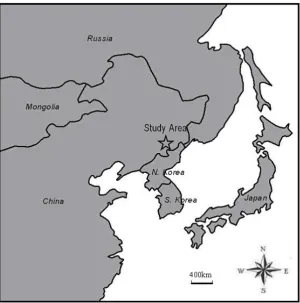
The study area was Baihe Forestry Bureau, which is located on the north-facing slope of Changbai Mountain, geographically ranging from 127°06' to 128°55'E and from 41°20' to 42°28'N (Fig. 1). Char-acterized by a continental climate and by the altitude between 700 and 900 m, the typical forest ecosystem
in the study area is a broadleaved-Korean pine mixed forest (Dai et al. 2003).
The first study site was a forest stand that was cut for the last time in 1987. The overall harvesting in-tensity was 70% by volume. The second study site was a forest stand that was last cut in 1999. The overall harvesting intensity was 72%. The control was a for-est stand that was not cut. The three study sites were located within a compartment and are called older-cut site, newer-older-cut site and control, respectively, in this paper.
[image:2.595.64.365.53.357.2]In 2003, we systematically set up 15 parallel 10 × 100 m transects with an interval of 50 m within each study site. Each transect was divided into ten 10 × 10 m plots. All the living trees > 1 cm in di-ameter at breast height (dbh) were identified and
Fig. 1. Map of the study area showing the location of the study
Table 1. A comparison of trees and basal area by dbh classes between the three sites
dbh class dbh range Control Older-cut site Newer-cut site
density basal area density basal area density basal area
Sapling 0–4 3,457 0.88 7,329 0.42 5,837 0.41
Small 4–12 456 2.12 519 3.54 231 1.82
Mid-size 12–28 256 8.87 465 14.29 228 5.79
Large > 28 272 43.90 125 13.12 18 1.11
[image:2.595.66.532.653.756.2]measured. All the tree species were categorized into three tree forms: understory tree species, mid-story tree species, and canopy tree species. All the trees measured in the field were grouped into four dbh classes: sapling (≤ 4 cm), small (4–12 cm), mid-size (12–28 cm), and large (≥ 28 cm). We statistically compared the differences in forest attributes with ANOVA. Statistical analyses were performed by us-ing SPSS 10.0J (Anonymous 1999).
RESULTS
There were 4,441 trees/ha at control site, which
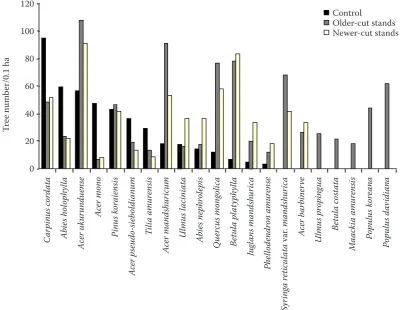
belonged to 6 families, 8 genera, and 14 species; 6,314 trees/ha at newer-cut site, coming from 7 fa-milies, 9 genera, and 16 species; and 8,438 trees/ha at older-cut site, representing 11 families, 14 genera, and 21 species (Table 1, Fig. 2). Stand density at older-cut site was significantly higher than that at
any other site (P < 0.01) but there was no difference
in total tree count between control and newer-cut
site (P > 0.05). All of the tree species observed at
control and newer-cut site were also found at older-cut site (Fig. 2). There were at least 7 tree species observed at both cutting sites but not at control. Tree densities were clearly different for the 14 commonly
shared tree species among the three sites (Fig. 2). The control was dominated mainly by shade-tolerant or
mid-story/understory tree species, such as Carpinus
cordata and Acer spp. while both cutting sites were dominated by light-demanding or pioneer tree
spe-cies, such as Quercus mongolica, Betula platyphylla,
and Populus davidiana.
There were 55.77 m2/ha of basal area at control,
9.13 m2/ha at newer-cut site, and 31.37 m2/ha at
old-er-cut site (Table 1). The stand basal area of the
con-trol was greater than that of older-cut site (P < 0.01),
which, in turn, was greater than that of newer-cut
site (P < 0.05). The first dominant tree species by
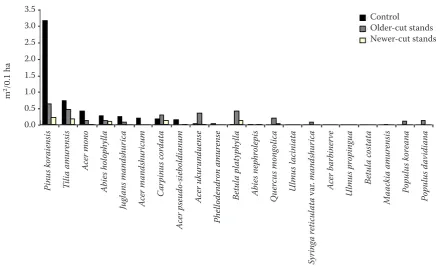
basal area was Pinus koraiensis at each site (Fig. 3). It
accounted for 57% of the total basal area at control, 20.4% at older-cut site, and 23.9% at newer-cut site. The second dominant tree species by basal area was Tilia amurensis at each site. The distribution of basal
area of Pinus koraiensis by dbh classes at control site
was significantly different from that at both cutting
sites (P < 0.01). There was no significant difference in
basal area distribution for Pinus koraiensis between
both cutting sites. The same was true of Tilia
amu-rensis. However, the 3rd and 4th dominant tree
[image:3.595.85.489.66.376.2]spe-cies by basal were different between the three sites: Acer mono and Abies holophylla at control; Carpinus
Fig. 2. Comparison of tree density (trees 0.1/ha) of individual tree species between the three study sites
0 20 40 60 80 100 120
Carpinus cordataAbies holophyllaAcer ukurunduenseAcer monoPinus koraiensis Acer pseudo-sieboldianum
Tilia amurensis
Acer mandshuricumUlmus laciniataAbies nephrolepisQuercus mongolicaBetula platyphyllaJuglans mandshurica Phellodendron amurense Syringa reticulata var. mandshurica
Acer barbinerveUlmus propinguaBetula costataMaackia amurensisPopulus koreanaPopulus davidiana
cordata and Betula platyphylla at newer-cut site; Acer ukurunduense and Betula platyphylla (Fig. 3). By comparing only the top six dominant tree spe-cies between the three sites, both cutting sites were nearly the same whereas the control was obviously different from any cutting site.
Sapling density at older-cut site was significantly
higher than that at control or newer-cut site (P < 0.01)
but there were no consistent differences in tree density between the three sites (Table 1). There were larger trees
at control site than at any cutting site (P < 0.05 or 0.01);
there were more mid-size trees at older-cut site than at
control or newer-cut site (P < 0.01); the difference in
the number of medium-sized trees was not significant
(P > 0.05) between control and newer-cut site.
The three study sites were different in the composi-tion of canopy, mid-story, and understory tree species (Table 2). There were more canopy-tree-species
sap-lings at newer-cut site than at any other site; there were more canopy-tree-species small and mid-size trees at older-cut site than at either of the other two sites; the control site has the highest number of canopy- or mid-story-tree-species large trees. The number of trees for understory species was significantly lower at newer-cut site than that at control or older-newer-cut site.
DISCUSSION AND CONCLUSIONS
[image:4.595.75.518.52.318.2]Higher sapling densities at older- and newer-cut sites indicate that tree regeneration after timber harvesting has been significantly enhanced. The enhancement was made by removing large trees and by cleaning forest floors where understory tree species grow. The success of tree regeneration after cutting suggests that selec-tive cutting is effecselec-tive to maintain the structure and composition of the broadleaved-Korean pine mixed
Fig. 3. Comparison of basal area (m2/0.1 ha) of individual tree species between the three study sites. (The actual basal area for Pinus koraiensis was 31.8 m2/ha at control site)
0 0.5 1 1.5 2 2.5 3 3.5
Pinus koraiensisTilia amurensisAcer monoAbies holophylla
Juglnas mandshuricaAcer mandshuricumCarpinus cordata
Acer pseudo-sieboldianumAcer ukurunduensePhellodendron amurenseBetula platyphylla
Abies nephrolepisQuercus mongolicaUlmus laciniata
Syringa reticulata var. mandshurica
Acer barbinerveUlmus propinguaBetula costata
Maackia amurensisPopulus koreanaPopulus davidiana
Tree Species sq m/0 .1h a Conrtrol Older-cut stands Newer-cut Stands Pi nu s k or aien sis Ti lia a m uren sis Acer mono Abie s holoph yl la Ju gl an s ma nd sh ur ic a Acer ma nd sh ur icu m C ar pi nu s cord at a Acer p seudo-sieb old ia nu m Acer u ku ru nd uen se Phel lo dend ron a m uren se Betu la pl at yph yl la Abie s neph rolepi s Q uercu s mon gol ic a Ul m us l aci ni at a Sy ri ng a reticu lat a var . ma nd sh ur ic a Acer b ar bi ner ve Ul m us propi ng ua Betu la co st at a M aac ki a a m uren sis Popu lu s k ore ana Popu lu s d av id ia na m
2/0.1 ha
3.5 3.0 2.5 2.0 1.5 1.0 0.5 0.0 Control Older-cut stands Newer-cut stands
Table 2. A summary of tree densities by dbh classes and “life forms” (canopy, midstory, and understory species) at the three study sites
dbh class Control Older-cut site Newer-cut site
canopy mid-story understory canopy mid-story understory canopy mid-story understory
Sapling 289 2,073 1,095 2,614 4,227 488 3,958 1,781 98
Small 90 290 76 274 231 14 134 97 0
Mid-size 55 196 5 301 164 0 177 51 0
Large 154 118 0 109 16 0 18 0 0
[image:4.595.65.532.654.758.2]forest in the long run. The sharp increase of saplings in older-cut site implies that canopy openings created with the high-intensity timber harvesting were effec-tive for the growth of tree seedlings for at least 15 years after cutting. The high tree density of mid-size trees at older-cut site indicates that high-intensity selective cutting also promotes the growth of small trees left by selective cutting. These represent the positive impacts of the high-intensity timber harvesting.
The differences in structure and composition be-tween control and older-cut-site suggested that the high-intensity timber harvesting had major impacts on the mixed forest. The first impact is the change in species composition. For example, light-demanding
tree species Quercus mongolica and Betula
platy-phylla became two of the dominant tree species at both cutting sites in terms of tree density. Yu et
al. (2001) argued that both Quercus mongolica and
Betula platyphylla grew faster under larger gap ar-eas. It is clear that high-intensity timber harvesting creates too large gaps in forest canopies, represent-ing a negative impact (Yu et al. 2001).
Pinus koraiensis and Tilia amurensis are economi-cally more important as the former produces pine nuts and the latter produces honey. The consistent
dominant positions of Pinus koraiensis and Tilia
amurensis across the three sites indicated that the high-intensity timber harvesting successfully main-tained the dominant positions or diameter
distribu-tions for the two tree species. Abies holophylla is not
a purpose tree species but is a unique ecological in-dicator in the study area. It was one of the dominant tree species at control site but almost disappeared at the cutting sites in terms of tree density. From this point of view, the existing harvesting system consid-ered short-term economic values to a larger extent than long-term ecological values.
The total basal area at older-cut site was about a half of that at control site whereas the tree density at older-cut site was much higher than at control. This indicated that it would take much longer than 15 years for the post-harvest forests to be restored to the original structure and composition represented by the control. The cutting cycle has to be increased for the purpose of sustainable management of the forest ecosystems in the study area.
In conclusion, the stand structure, species com-position, and basal area of the tree species differed between the three forest stands studied. The diffe-rences were due to high cutting intensities and short recovery time. The high-intensity timber harvesting applied in the study area promoted the growth of seedlings, saplings and trees, and it also helped in-troduce light-demanding species into the old-growth
forests. The post-harvest stands could not be reco- vered to the original forest structure and species composition within a few decades at least, meaning that this is not an ecologically and economically sound timber-harvesting method. For the purposes of eco-logically sustainable forest management, both cutting intensity and cycling must be carefully planned.
Acknowledgements
We would like to thank the Baihe Forestry Bureau for providing assistance in field data collection. We would also like to thank Dr. Guofan Shao at Purdue University for polishing the English.
References
ANONYMOUS, 1999. SPSS 10.0J. Chicago, SPSS Inc. BARNES B.V., XU Z., ZHAO S., 1992. Landscape ecosystems
of the Korean pine hardwood forests of the Changbai Moun-tain Preserve, Northeast China. Canadian Journal of Forest Research, 22: 144–160.
DAI L. et al., 2003. Forest cutting and regeneration methodol-ogy on Changbai Mountain. Journal of Forestry Research, 14: 56–60.
HAMMETT A.L., SUN X., BARANY M., 2001. Industries in transition forestry and forest products in China. Journal of Forestry, 7: 4–10.
LIU S., 1963. The Korean pine forests must be harvested with selective cutting and grew with natural regeneration. China Forestry, 10: 8–10.
NAKASHIZUKA T., IIDA S., 1995. Composition, dynamics and disturbance regime of temperate deciduous forests in Monsoon Asia. Vegetation, 121: 23–30.
SHAO G., ZHAO G., 1998. Protecting versus harvesting of old-growth forests on the Changbai Mountain (China and North Korea): A remote sensing application. Natural Areas Journal, 18: 334–341.
SHAO G., SCHALL P., WEISHAMPEL J.F., 1994. Dynamic simulations of mixed broadleaved – Pinus koraiensis forests in the Changbaishan biosphere reserve of China. Forest Ecology and Management, 70: 169–181.
SHAO G. et al., 1996. Forest cover types derived from Landsat TM imagery for Changbai Mountain Area of China. Cana-dian Journal of Forest Research, 26: 206–216.
YU Z. et al., 2001. Canopy gap characteristics and their influ-ences on the regeneration of broad leaved Pinus koraiensis forests in Changbai Mountain. Resources Science, 6: 64–68. (In Chinese)
ZHAO G., SHAO G., 2002. Logging restrictions in China: A turning point for forest sustainability. Journal of Forestry, 4: 34–37.
Corresponding author:
Dr. Huiyan Gu, Northeast Forestry University, School of Forestry, 26 Hexing Road, Harbin, 150040, P. R. China tel.: + 86 451 8219 1829, fax: + 86 451 8219 2234, e-mail: [email protected]
Vliv těžby na druhové složení a strukturu horských porostů v oblasti Changbai
(Čína) – Krátké sdělení
ABSTRAKT: Smíšené lesy s hlavní dřevinou borovicí korejskou (Pinus koraiensis) tvoří dominantní lesní spole-čenstvo v oblasti východní Asie. Práce se zabývá problematikou důsledků těžby vysoké intenzity (ca 70 % zásoby) na udržitelný vývoj těchto smíšených porostů. Druhové složení a četnosti stromů byly sledovány na třech lokalitách s různým managementem (kontrolní netěžená plocha, starší obnovní seč s těžebním zásahem v roce 1987 a novější obnovní seč s těžbou v roce 1999). V roce 2003 bylo na kontrolní ploše 4 441 stromů 14 druhů s kruhovou základnou 56 m2, na starší ploše 8 438 stromů 21 druhů s kruhovou základnou 31 m2 a novější obnovní seč s 6 314 stromy 16 dru- hů s kruhovou základnou 9 m2 (vše na výměru 1 ha). Jednotlivé lokality vykazovaly statisticky průkazné rozdíly v druhové skladbě dřevin a ve struktuře porostů. Obnovní zásahy silné intenzity podpořily přirozenou obnovu a růst jedinců v nižších porostních etážích, ale také zvýšily riziko invaze dřevin s vyššími nároky na světlo do porostů. Odpovídající podíl i tloušťkové rozdělení hlavních druhů (Pinus koraiensis a Tilia amurensis) zůstaly zachovány na všech plochách. Dosavadní systém silných těžebních zásahů má krátkodobý pozitivní ekonomický efekt, střednědobý ekologický vliv je však negativní. Možnosti návratu vhodné porostní struktury a druhového složení na plochách se silným těžebním zásahem jsou omezené v průběhu několika desítek let. Intenzita těžeb a návratná doba musí být pečlivě plánována pro zajištění trvale udržitelného hospodářství v dané oblasti. Při požadované druhové skladbě smíšených porostů s borovicí korejskou musí být intenzita současných těžeb snížena.