With the use of the comparative methodology it is possible to create the basis for normative theory defining conditions, combined with efforts to achieve the best possible (optimum) economic arrangement, or to obtain the necessary information about the real existing economies and their development, using the comparative economics/economy as a science and the field of study. Comparative economy is the result of the real development of the world economy, which led to the creation of differentiated economic systems, differing both in type (species), and the level of development within each type. The beginnings of the 90s have brought revolutionary changes to the structure of the world economy. They have created new incentives for the comparative economics/econ-omy, which began to map, inter alia, the path of the post-socialist countries through the transformation and reform processes. It was not only the case of the countries of the Central, Eastern and South-Eastern Europe and the successor countries of the former Soviet Union (including Central Asia), but also, for example, China, which has successfully introduced a model called “socialist market economy”, and other Asian countries. New innovative approaches towards
solving the global and local problems soon appeared in these countries. On the one hand, they narrowed the range of issues that have been analysed as a priority in the relation capitalism – communism (socialism), on the other hand, they created new problems and raised new challenges. A situation like this is mainly caused by the fact that the transition (reforming) economies do not reach their targets at once, but they will have to undergo a relatively long transi-tion period, which will shape the mixed economic systems of a kind. Another important issue is the fact that there is not any historically analogous situation similar to the current transformation of post-socialist countries, and therefore every transformation is a kind of experiment.
On the basis of this fact, some authors, such as Djankov et al. (2003: 595–596) came to the conclu-sion, that if capitalism won, the traditional or so-called old comparative economy remains unfounded (“it is dead”). Whilst the subject of research of the “old” comparative economy is comparing of capital-ism and communcapital-ism, the subject of research of the so-called new comparative economy, corresponding to the current phase of the “market homogeneous
Formation of the theoretical framework for the
comparative analysis of post-socialist countries
Eva CIHELKOVA
Faculty of Economics and Business, Pan-European University in Bratislava, Slovak Republic
Abstract:Th e beginning of the 90s was accompanied by revolutionary changes in the world economy. Newly created in-centives for the comparative economics/economy were tackling, inter alia, the post-socialist countries, that were already exposed to the transformation and reform processes. Models of economic systems formed in this period have initiated a great discussion among the relevant stakeholders. Th is fruitful discussion has led to the creation of a number of model app-roaches, focusing on the defi nition of a common theoretical framework for the comparative analysis and its further appli-cations within the surrounding of particularly advanced concrete modern economies. Th e presented paper contains newly emerged approaches, the so-called varieties of capitalism. Th e aim of the paper is: To explore the approaches typical for “the varieties of capitalism”, that could be considered as the mainstream over the last 25 years, and to deliver their review; then to map the approaches how the models of economic systems of post-socialist countries are defi ned, and to answer a question, whether the varieties of capitalism can be used for the comparative analysis of economic systems of these count-ries.
Key words: comparative economics, comparative economy, model of economic systems, economic system, varieties of ca-pitalism, models of post-socialist countries
global economy,” is the comparison between the al-ternative capitalist economic systems, which places the main emphasis on the role of institutions. The differences in institutions and their implications for the practical performance are subject to the “new” comparative economy.
A great discussion was caused by the newly emerg-ing models of economic systems, typical for the last decade of the 20th century. In addition, those were
not the models of the post-socialist countries only. The debate has led to a creation of many modelled approaches, which focus on defining a common theo-retical framework for the comparative analysis and its application to the analysis of the concrete modern economies, particularly the advanced ones. The so-called varieties of capitalism are being characterized by those approaches. In terms of developing and post-socialist economies, especially in relation with the considered competencies of the International Monetary Fund (e.g. “developing economies and emerging markets” programme), there is much debate about the expansion of “the varieties of capitalism” to these countries. This paper is aimed at: Exploring the approaches of “the varieties of capitalism” that formed over the last 25 years, and delivering thematic review of this process; then mapping out the approaches to defining the models of economic systems of the post-socialist countries, and to answer a question, whether the varieties of capitalism could be used for the comparative analysis of economic systems of these countries.
VARIETIES OF CAPITALISM THE MAIN THEORETICAL APPROACH TO
DIVERSIFICATION OF MODELS OF ECONOMIC SYSTEMS
The new comparative economy, as developed from the very beginning, could be considered as the theory/ school/approach of varieties of capitalism. This theory was based on the reality of the actual extinction of the socialist economic systems and the utter dominance of the capitalist systems. The representatives of this theory were convinced that the subject of the future
research should become capitalism in its various forms. Political economy of the Western societies, in its advanced forms, further examined the typol-ogy of capitalism (comparative capitalism). Andrew Schonfield (1965) is considered to be the founder of this direction in 1965. Comparative capitalism was further popularized Albert (1991) and developed further into greater varieties of capitalism by many authors. An overview of the authors of varieties of capitalism, including their proposed and elaborated types of the models of economic systems of the ad-vanced countries, is available in Table 1.1
The diversity of the models of economic systems in the Table 1 is conducted from the perspective of the role of firms (Hall and Soskice; Heyes, Lewis and Clark), according to the degree of government regula-tion (e.g. Nicoletti, Scarpetta and Boylaud), in terms of the social systems of innovation and production (Amable), from the viewpoint clusters of economies with similar institutions (Pryor), according to a special relations between labour and capital, and between politics and economics (Becker). The table contains also an approach of Boyer, who, within the control theory based on the long-term transformation of capitalism, makes an attempt to seek alternatives to the Fordism (unlike the varieties of capitalism that emphasize management at private companies or the control theory based on the macroeconomic systemic coherence). However, both approaches are ques-tioning the role of markets as the only coordination mechanism and the existence of a single correct path of capitalism. On the contrary, they emphasize that globalization strengthens the competitive advantage associated with the given institutional arrangements (Ščepánová 2014: 49–50). In the survey, there were also gathered approaches of the authors who, in their typology of the varieties of capitalism, involved other than advanced economies (developing countries or countries post-socialist). It is namely an approach of Aoki; Hancké, Rhodes and Thatcher; Nölke and Vliegenthart; Becker; Heyes, Lewis and Clark.
Some approaches are dichotomous, another tricho-tomic, and the latest trend observed in some authors distinguishes more than three models (usually four to five). The dichotomous approach has its pros and cons.
1The table also includes systems that have been named based on clusters of economic systems with similar institutions
Table 1. Overview of the varieties of capitalism authors and their proposed (developed) models of economic systems
Author Models of economic systems
Albert (1991)
Neo-American model of capitalism
Rhine model of capitalism Rhodes, Apeldoorn (1997) Market-oriented/ Anglo-Saxon capitalism Network-oriented/ Germanic model of capitalism Network-oriented/ Latin model of capitalism
Boyer (1997) Market-led capitalism
Meso-corporatist capitalism State-led/ statistcapitalism Social democratic capitalism Ebbinghaus (1999) Anglo-Saxon capitalism Europe’s Centre capitalism Southern capitalism Nordic capitalism Nicoletti, Scarpetta, Boylaud (2000) Common-law countries Continental European countries Mediterranean countries
Aoki (2000) Alliance
capitalism Familial capitalism Dirigiste capitalism Hall, Soskice (2001)* Liberal market economies Coordinated market economies
Schmidt (2002) Market capitalism Managed capitalism State-enhanced capitalism Amable (2003)* Market-based model of capitalism Continental European model of capitalism Mediterranean model of capitalism Social-democratic model of capitalism
Asian model of capitalism Pryor (2005) Liberal market economic system West European economic system South European economic system Nordic economic system Hanské, Rhodes, Th atcher (2007)*
Liberal market economies** Coordinated market economies** Compensating state** Étatisme Nölke, Vliegenthart (2009) Liberal market economies Coordinated market economies Dependent market economies**
Becker (2011) Liberal type of capitalism Corporatist type of capitalism Patrimonial type of capitalism** Meso-communi-tarian type of capitalism Statist type of capitalism Heyes, Lewis, Clark (2012) Liberal market economies Coordinated market economies Mediterranean market economies Central Europe economies** Own approach (2015)*** Neo-liberal market capitalism Neo-corporatist capitalism State-led capitalism Social-democratic capitalism Collective (communalist) capitalism x Anglo-Saxon capitalism European continental capitalism South European capitalism North European capitalism Asian capitalism
*Bold highlight authors significantly developed the theory of varieties of capitalism; **Bold highlight models of capital-ism incorporate other than advanced economies; ***Cihelková (2016)
One advantage is that it provides a clear theoretical basis for the empirical analysis. The negative aspect is that it is based on the contrast between the two extremes. If the comparison was based on a single, country-specific criterion, it would eliminate the risk of ignoring the fundamental differences between countries. The categories of models are too broad, providing the reader with very little information about the category a country belongs to. The advantage of the trichotomic classification is that it gives a special status to the group of countries that were previously classified as “those who stand in the middle” and were sentenced automatically to a poorer macroeconomic performance. The approaches distinguishing more models of economic systems are already sensitive mostly to more classification criteria and eliminate the risk of leaving out a crucial difference between the economic systems. The disadvantage may be that more economies have the ability to be located on the border between the models, respectively belong to a given model with only a certain percentage of prob-ability, therefore, it establishes the complex starting point for an empirical analysis.
Key works in that survey are represented by the approaches of Peter Hall and David Soskice; Bruno Amable; Bob Hancké, Martin Rhodes and Marc Thatcher, which significantly developed the theory of the varieties of capitalism.
Hall and Soskice came up with the idea that the fundamental institutions of capitalism differ from country to country and that the differences between countries are not random, but they are associated with strict institutional complementarities. This idea then led, according to Nölke and Vliegenthart (2009: 670), to a sophisticated, holistic and easily understandable picture of the institutional complex-ity of advanced capitalism. In their book, Hall and Soskice (2001) focused on the organization of the private sector and the firm is put into the centre of the comparative economics of capitalism. With an attempt not to ignore the unions, they highlighted the role played by the employers’ associations and other types of relationships between enterprises. In other words, the success of the firm is seen in the ability to effectively coordinate itself with a wide range of ac-tors. National economies can then be compared using the way in which the firms solve the coordination of problems they used to face. From this perspective, there are two different types of economies, which are called the liberal market economies (LMEs) and the coordinated market economies (CMEs). This
dichotomy is the basis for the assessment of one of the fundamental dimensions of various national pro-duction systems, and their coordination. In this case, it is an internal coordination where a firm is defined as an agent, the aim of which is to create a dynamic capacity and institutional framework in which it oper-ates, this may be further labelled in the jargon as the inter or intra-organizational relationships. The firm develops and maintains its relationships to resolve the coordination problems of its key competencies in the following areas: Industrial relations, regula-tion of internal relaregula-tions, vocaregula-tional educaregula-tion and training, financial relations, etc.
Amable (and his colleagues) builds on the work of Albert; Rhodes and Apeldoorn; Boyer; Ebbinghaus; Aoki; but particularly Hall and Soskice, with an over-view of the dichotomous, trichotomic and more part models (Amable 2003: 77–78, 82–85). Already in 1977, Barré and Boyer published a theoretical analy-sis (Amable et al. 1997) in which they distinguished between and further described four social systems of innovation and production (SSIPs): Market-oriented, meso-corporatist, European integration/public and social democratic. This analysis led to answering the question, why institutions are the foundation of the economies differentiation, and why it can be expected to have implications for the scientific, technical and industrial specialization of countries. The follow-up works of Amable et al. (2000) and Amable and Petit (2002) led to a redefinition of the typology SSIPs, which was extended to six models – on the Alpine variety (Austria, Switzerland) and Mediterranean variety of the European SSIP. Only in this work, B. Amable built his final work – The Diversity of Modern Capitalism – from the year 2003 (according Amable 2003: 78-85). In this book, besides the description of the five main institutional areas, he also deals with the comparative analysis criteria of the models of various economic systems (competition in goods and services markets; labour law issues and labour market institutions; the financial services sector and corporate governance; social protection; education), but these models are also defined in detail. Those models are: Market-based model, social-democratic model, continental European model, Mediterranean model and Asian model (Amable 2003: 15).
revision of Hall and Soskice approach and expanded their original work framing the theory of the varieties of capitalism. They created four models, designed for the analyses and coordination of the state – business sector relations. Besides the LMEs and CMEs, they are defining the “étatisme” and compensating state. The authors report that in the advanced stage of capital-ism, the relations between the state and the economy (supply-side) may take two basic forms: Either the state becomes narrow and directly impacting the economy (e.g. as the owner, the main provider of loans etc.), or the state becomes primarily a regulator affecting the economy indirectly. Interest organizations (lobbyists) may also represent both sides – one highly structured and the other fragmented. In most countries, the busi-ness sector and labour organizations tend to respect each other. In the first (highly structured) category, the balance between the individual companies and industry associations, respectively industrial groups, enables to negotiate with the organized employees. In the second (fragmented) category, the definition of collective interests is positioned at a higher level – either on the inter-firm level, or between their agents, following the logic how the trade unions are fragmented. The inclusion of these two criteria in the typology of the varieties of capitalism leads to the four types of coordination, i.e. the economic systems models (Hancké et al. 2007: 24–28).
APPROACH TO DEFINE THE MODELS OF ECONOMIC SYSTEMS IN POSTSOCIALIST COUNTRIES
WITH THE ONSET OF the new global situation in the world at the turn of the 80s and 90s, there was a great debate about economic systems and the models of economic systems in the former centrally planned economies, which began to form and influence their transformation and reform processes.
A polemic in the Eastern, Central and Southern Europe was firstly aimed at the already established neo-corporatist approach, i.e. the economic systems model, which is based on the corporations in the form of interest groups. They have a monopoly on the representation of interests in the given field. Their supreme authorities are granted a privileged access to the government and the trade unions work within the social partnership in the form of the so-called tripartism (see Netolický 2005). Inquiring why the neo-corporativism was initially attractive
for the economists of the post-socialist world, one of the possible answers were given by Iankova (2010: 1–2). Reference is made to the basic features of state socialism, which was accompanied by the local de-velopment until the end of the 80s of the twentieth century, namely “the society of working class” and “social order built on the work dictatorship,” and the consequences that have led the ideological basis. Based on these presumptions, she concludes that the nature of new relations after the fall of the regime could not be other than derived from the past experience. This presumption ideally matches with the idea of neo-corporativism, which is based on the relation-ship between the state and the corporations with the emphasis on the influential position of trade unions. The application of the neo-corporatist theory in the analysis of the era of the post-socialism was also conditioned by the fact that the majority of formerly communist countries decided to realize part of their transformations with an assistance from the relevant institution of global capitalism – the tripartite forum for social dialogue, i.e. social partnership between the state, employers and trade unions, developed at the national and subnational levels.
Although the neo-corporatist approach towards analysing of the emerging capitalism in the Central and Eastern Europe (CEE) has brought problems, reflecting the nature of the concept itself, Iankova (2010: 2) draws attention to the fact that the outcome of discussions was the first trichotomic typology of economic systems of the countries in transition, which was established in the early 90s, namely the distribu-tion model: The neoliberal pluralist, corporatist and a new state-controlled (neo-statist). These models were supposed to cover the whole typology of transition economies, what of course was not possible. Iankova in this context also highlighted the fact that the CEEs have never had, since the World War II, in contrast with the Northern and Western Europe, any period of a “relatively undisturbed” building of national institutions. The US and the Bretton Woods institu-tions influence in Germany in the post-war period is not comparable with the impact of the globalization and Europeanization on transforming the European economy after 1990. The convergence effects of the European Union (EU) in the accession process of the CEE countries were particularly strong and not com-parable with the accession of the Southern European countries in the 80s.
Central and Eastern Europe and the essential weaken-ing of the role of trade unions, the neo-corporatist paradigm as a theoretical approach to defining the models of economic systems in the post-socialist countries ceased to be appealing. The researchers are turning their attention to the approaches that appeared to be better for analysing and explaining the changes in the region (Iankova 2010: 3). One of these approaches was the theory of the varieties of capitalism, which in the late 90s tried to explain the impact of globalization, the challenges of the European economic and monetary union, the Eastern enlarge-ment of the EU and a number of other economic and other pressures on the models and economic systems, not only in developed countries. As seen from the above, some authors shown in the table 1 have already attempted with some degree of caution to include in their typologies of (mostly advanced) economies also the post-socialist countries. E.g. Hancké, Rhodes and Thatcher ranked among the liberal market economies the Baltic States, and among the coordinated mar-ket economies Slovenia. Nölke and Vliegenthart, as well as Heyes, Lewis and Clark, included among the dependent market economies the Central European economies, namely the Czech Republic, Slovakia, Hungary and Poland.
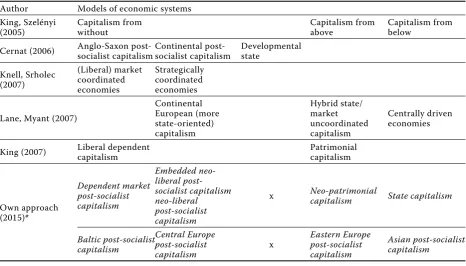
[image:6.595.64.531.461.727.2]In addition to these authors, whilst there appear many others who initially analysed capitalism in the post-socialist countries and who are often called the representatives of the approach of “varieties of capital-ism expansion into the Central and Eastern Europe”. In principle, it is nothing else than the search for new variants of the post-socialist capitalism. Among the authors of this type, we can include e.g. King and Szelényi; Cernat; Knell and Srholec; Lane and King (Table 2).
We have to include King and Szelényi (2005)
among the proponents of the extension of
varie-ties of capitalism in the post-socialist countries.
Lawrence and Szelényi, in their categorization of the post-communist capitalism, involve not only the countries of the Central and Eastern Europe, but also
the Asian post-socialist countries. For this reason, they came to a somewhat unconventional division of the types of capitalism: Capitalism from without (Central Europe countries), capitalism from above (Russia, Romania, Serbia) and capitalism from below (China and Vietnam). This typology is, according to Bluhm (2014: 2), a combination of the emerging new type of ownership with the traditional thinking that indicates the penetration of modern capitalism and
the rational bureaucracy and functional separation
Table 2. Summary of the authors of typology of economic systems models in post-socialist countries
Author Models of economic systems King, Szelényi
(2005)
Capitalism from without
Capitalism from above
Capitalism from below
Cernat (2006) Anglo-Saxon post-socialist capitalismContinental post-socialist capitalism Developmental state
Knell, Srholec (2007)
(Liberal) market coordinated economies
Strategically coordinated economies
Lane, Myant (2007)
Continental European (more state-oriented) capitalism
Hybrid state/ market uncoordinated capitalism
Centrally driven economies
King (2007) Liberal dependent capitalism
Patrimonial capitalism
Own approach (2015)*
Dependent market post-socialist capitalism
Embedded neo-liberal post-socialist capitalism neo-liberal
post-socialist capitalism
x Neo-patrimonial capitalism State capitalism
Baltic post-socialist capitalism
Central Europe post-socialist capitalism
x
Eastern Europe post-socialist capitalism
Asian post-socialist capitalism
*Cihelková (2016)
of the economic from the political system as a basis for innovative modernity. The Central European capitalism from without is characterized as a liberal capitalism (capitalism with a liberal democratic re-gime and a relatively highly developed and rational state capacity) with high FDI inflows, which help to
the rapid liberalization and open markets in Western countries. Mainly the Russian capitalism from above is mainly considered to be a neo-patrimonial, network and oligopolistic form of capitalism, which empha-sizes the continuity of the elites, but without the continuity of power institutions and administrative capacities, hich, on the contrary, has the development in China. China and Vietnam in this sense represent
the capitalism from below.
Cernat (2006) divided the transition economies into three types: The Anglo-Saxon post-socialist capitalism, the Continental post-socialist capital-ism and the developmental state. The main criteria of differentiation are: The dominant type of wage bargaining, the state interventionism, the role of the banking sector and financial institutions, the degree of internal institutional inherence. The Anglo-Saxon capitalism involves only Estonia, the Continental capi-talism includes Poland, Slovakia, Bulgaria, Lithuania and Latvia, the developmental state is represented by Hungary, the Czech Republic and Slovenia. The author is aware that there are institutional
dispari-ties in most countries. Romania was also among the
examined countries of the Continental Europe. A case study describing this country indicated that there is a form of capitalism, which shares the features of two model – the clientelist capitalism of 90s in addition to the Continental type.
Knell and Srholec (2007) share the dichotomous approach – the division to strategically coordinated economies and (liberal) coordinated economies. The distribution patterns of the CEE countries into two groups used the evaluation, not the classification cri-teria – the coordinating index covering social cohesion (GINI, the highest marginal personal rate of income,
government expenditure on final consumption), the
regulation of the labour market (the criteria of the
World Bank), the regulation of business (the World
Bank criteria forthe start-up companies, insolvency, property registration, the stock market in relation to the banking sector in the financial system). We use to include Belarus, Ukraine, Slovenia, Croatia, Romania,
the Czech Republic and Uzbekistan among the strate-gically coordinated countries, whilst Bulgaria, Georgia, Moldova, Poland, Slovakia, Hungary, Estonia and
Russia are being labelled as (liberal) market
coordi-nated countries (Bluhm 2014: 3).
Lane and Myant (2007) divides the post-communist countries into three groups. The first group has al-ready developed the conditions of modern capitalism. It includes the current EU members (Slovenia, the Czech Republic, Poland, Hungary, the Slovak Republic, Estonia, Latvia, Lithuania, Romania, Bulgaria and Croatia). Slovenia, the Visegrad Group and Estonia are the closest to the Continental European – more state-oriented – capitalism. The second group of countries is characterized as a hybrid state/market uncoordinated capitalism, which exists in Russia, Ukraine, Kazakhstan, Georgia and Moldova. These countries are still going through the continual pri-vatization process and the market economy creation, striving for the political, social and psychological
conditions necessary for the support of the modern
capitalism. Additionally, the state-oriented capital-ism should ensure the accumulation of resources. In countries with natural resources, the state should promote the modernization of the economy through
the economic rent resulting from the export-ori-ented sectors. The third group, including Belarus, Uzbekistan and Turkmenistan, has not yet made any significant progress towards capitalism, because the country has been at a relatively very low level of private property. These countries are very reminis-cent of the reminis-centrally driven economy. However, the future will probably lead to an economic model of state capitalism (Horibayashi 2007: 48). To distin-guish these three groups, Lane used the evaluation indicators – the private sector share inthe GDP, the privatization index, the stock market capitalization
and lending, the integration into the global economy, income inequality (Bluhm 2014: 3).
We have to include King (2007) among the supporters of a possible widening of the varieties of capitalism in
of economic control can be established through an alliance between an organized, technocrat-led sate and a mixture of foreign and domestic firms, then ‘liberal dependent’ systems, with open economic relations and high levels of the FDI (foreign direct investment) result, as in the Czech Republic, Hungary and Poland. The trade unions are weak, but the state provides a range of public goods (pensions and other social transfers) for the economy and has a modest steering capacity. In contrast, if the nomenclature retains power, as in Russia, Ukraine, or Romania, it uses its offices to acquire private property, giving rise to ‘patrimonial’ systems in which the economic control (coordination would be a much too strong term) is exercised by the nomenclature and domestic producers through patron-client ownership networks. Foreign direct ownership is weak, and the state is also weak and unable to provide the adequate public goods” (Iankova 2010: 3).
The approach of Bohle and Greskovits does not
belong to the group supporting the possible exten-sion of the varieties of capitalism to the post-socialist countries. Bohle and Greskovits developed a typol-ogy called the post-socialist regimes,2 followed by John Drahokoupil and Martin Myant, who analysed the variants of growth modes of the CEE countries.
Bohle and Greskovits (2007, 2012) are the authors of a typology of the post-socialist regimes, based on the idea of the “so-called ‘double movement’ in the transition from the planned to market economy. The transformation is differentiated according to the reform paths, which means the extent to which the reformers followed the idea of self-regulating markets (movement) a transformational path, meaning the extent to which reformers followed the idea of self-regulating markets (movement) and the extent of the
state policy intervention via industry, labour or social policy (countermovement). Sufficient state capacities to implement and conduct reforms are a decisive precondition” (Bluhm 2014: 6). On this basis, Bohle and Greskovits characterized three types of the post-socialist regimes: Neo-liberal, embedded neo-liberal and neo-corporatist. The neoliberal regime, typical for the Baltic States, has a strict neo-liberal policy of free markets and their consequences: Flexible labour laws, very limited social benefits and the perception of
industrial policy as an illegitimate state intervention. Baltic States can afford this type of market radicalism because it formed the basis of their national political identity, denying the past Soviet heritage of the coun-tries and their Russian minorities. Nation-building is another important source of the political legitimacy, unlike the social compensation and integration. The embedded regime in the Central Europe is built up from the beginning of the transformation also for a rapid liberalization, a declining role of the state and privatization. This mode, however, since the beginning, is trying to balance social costs of this approach by promoting the active labour market policy. It adopts social measures and measures for the political and social integration. In the early stages of transformation, a passive labour market policy played an important role, since it dampens the shocks and contributes to the relatively low rate of employment according to the EU standards. This was the case especially in Hungary, where the employment rate remained among the lowest in the European Union. The neo-corporatist regime is a special type, which is represented by Slovenia. The country has adopted the least radical marketization strategy,3 coupled with a generous and specifically
targeted compensation of the transformation costs in the region (Bluhm 2014: 6–8).
Another special approach to economic systems is the attitude of Drahokoupil and Myant (2010, 2011), who analysed variations among the growth modes in response to the financial crisis in the second half of the first decade of this century. It turned out that the individual CEE countries were hit by the crisis in very different ways. E.g. the Baltic states were affected far more than the Czech Republic and Poland. Poland. The Czech Republic and Slovakia came out of the crisis relatively faster than Hungary, which had to ask for a new rescue package from the International Monetary Fund. The crisis, therefore, suggested that similar varieties of capitalism in the CEE, as examined above, do not lead to similar scenarios in the times of crisis. This situation has sparked a debate about the growth modes that Drahokoupil and Myant divided into five groups:
– Integration through the export of processed prod-ucts with a relatively high value-added in sectors with a high proportion of multinational companies.
2The criterion of this typology are not economic systems as a set of institutions, but the policies as a result of their action.
3Bohle and Greskovits examined and Romania and Bulgaria, which ranked as non-regime type of countries, as
– Integration through the exports in the complex sector without relying on foreign direct investment. – Integration through the exports in a simple
manu-facturing.
– Integration into the global economy through the export of raw materials and semi-finished prod-ucts, which require a less sophisticated business environment.
– Integration through the “financed” growth, where foreign loans support the activities of the public and private sector.
Based on them, then they explained how the respec-tive CEE economy managed to overcome the crisis (Bluhm 2014: 8–9).
VARIETIES OF CAPITALISM AND THE POSSIBILITY OF THEIR USE FOR THE COMPARATIVE ANALYSIS OF ECONOMIC SYSTEMS OF THE POSTSOCIALIST COUNTRIES
As indicated in the introduction, the scope of the varieties of capitalism to post-socialist countries is the subject of a deep controversy. On the one hand, there are authors of proposed typologies of the mod-els of economic systems conforming to “varieties of capitalism expansion into the Central and Eastern Europe” (Table 2) being considered “naive” (given the level of conceptualization). On the other hand, many authors argue that if the theory of the varie-ties of capitalism is an adequate procedure adapted to the realities of the CEE, it will be possible to use this approach in defining the capitalism in the whole region (in this case, it means Europe).
We include Bluhm among the most critical authors. She states that “this was especially the case as the authors tried to measure the gradual increase in pre-market strategic coordination. They included in their analysis almost all post-socialist societies, regardless of the extent of transition already made towards the market economy. The outcomes were highly contra-dictory conceptually, as well as in terms of the various indicators used.” (Bluhm 2014: 2). Specifically, built up on his opinion, the typology of Cernat the Poland is in comparison with other authors dealing with the same issue more liberally, and it can hardly agree with Knell and Srholec who regarded Belarus in the middle of the first decade of the new millennium as
the most strategically coordinated economy in the
Central and Eastern Europe, which was followed by
Ukraine, Slovenia and the Czech Republic, while Hungary, Russia and Estonia were considered as co-ordinated market economies. Likewise, it is the view of David Lane, who sees Russia as an uncoordinated
market economy, which under the Putin’s
govern-ment is developing to a state-coordinated oligopo-listic form of capitalism. In a similar way, K. Bluhm criticizes the approach of the authors who have dealt with models rather than the transforming countries,
in comparisons of the concrete economic systems
(e.g. Estonia and Slovenia, Poland and Hungary). In her view, she identifies two extremes, or several selected economies, it says nothing about the rest of the countries that are somewhere between these two extremes, or for framework models of selected economies. There are many unexplained things and irregularities, in order to confirm the possibility of using the varieties of capitalism approach across the European region (Bluhm 2014: 3).
Unlike the varieties of capitalism approach, Bluhm deems to be an interesting new approach to the ty-pology of the CEE countries, which was presented by Bohle and Greskovits. The main point of the ap-proach is neither a regime of capital accumulation based on a developed credit system, nor a continued rationalization of the production process. It is an ap-proach which is based on a policy that looks at the markets as political structures. This approach is being compared with the varieties of capitalism, underscor-ing the company and coordinatunderscor-ing, havunderscor-ing its own advantages, but these are located in a different area. The access to the post-socialist regimes has made the state and its policies the main criterion of regime. The state capacity and the level of social protection is a more important matter than by the varieties of capitalism. The social protection and development of the welfare state are growing. The analysis of
con-flict processes of the weakening and re-anchoring
of the market highlights the institutional instability and dynamics resulting from the multilevel factors (including the effects of the EU convergence). On the other hand, the post-socialist mode access has, com-pared with the varieties of the capitalism approach, significant disadvantages. In particular, this approach tends to look at institutions as externally defined limits of self-regulatory markets, which is precisely a reason why this approach is appropriate for the conceptualization of countermovement on a market (re-regulation) in the interests of a wider society. Institution-building as a solution of the coordination
as a result of the interactions between the economic
actors, remains outside this view – at least without further assumptions, which would greatly complicate the argumentation. This approach, therefore, severely limits the understanding of institution-building and its dynamics (Bluhm 2014: 7–8).
Similarly sympathetic to Bluhm attitudes are the var-iants of growth regimes, which prepared Drahokoupil and Myant. This hierarchy, however, goes, in our opinion, beyond the classification criteria of economic models examining.
In favour of the extension of the varieties of capital-ism approach on the post-socialist countries, King argued that the application of the varieties of capital-ism to the CEE automatically takes into account the historical and structural features that are common to both parts of Europe. D. Lane then drew attention to the fact that the EE countries, compared with the Western European countries, have a higher proportion of state ownership, share a higher level of the control of the economy and have serious deficiencies in the rate of investment financed from internal resources. Following the judgments of both authors that support the possibility of using the theory of the varieties of capitalism in the transition countries, Iankova (2010: 3–4) argues, that the main problem of the varie-ties of the capitalism expansion to the post-socialist countries is the fact, that respective authors do not realize how different are the CEE countries from the developed economies. E.g. the complementarity and
coordination, as seen in the works of the Western
authors, cannot be applied to the transition countries. These economies as a whole are still characterized by “rather unstable and largely incoherent mixes of
the labour market institutions, financial intermedia-tion and corporate governance. Their evoluintermedia-tionary trajectories are yet unclear” (Iankova 2010: 3). The varieties of capitalism theory is, therefore, necessary to adapt to the reality of the CEE, so the main ques-tion is, how to implement this adjustment?
The author herself is coming with a proposal of three steps that should lead to modifying and gen-eral improving of the varieties of capitalism access (Iankova 2010: 4–5).
The first step refers to those authors who, within their typology of the varieties of advanced capitalism
has dedicated a group of the Central and Eastern
Europe countries. They were, as we know, for in-stance Hancké, Rhodes and Thatcher (2007), Nölke and Vliegenthart (2009), or Heyes, Lewis and Clark (2012). These authors did not identify the CEE as “a
separate variety of capitalism of equivalent analytical status to the rest; they ‘simply wish to indicate by this term their [emerging economies] transitional character and that their respective mixes of modes of coordination (both market and non-market) are embryonic in some cases, more developed in oth-ers, but in all cases still in a process of institutional construction.’” (Iankova 2010: 4). The CEE countries must, therefore, firstly be described as the emerging market economies (EMEs). The EMEs, however, are not only the transforming countries that exist, but the concern is very significant and the developing countries need to be taken into account in any later version of the varieties of the capitalism access.
In the third step, Iankova refers to the most revised and adapted approach to the variants of capitalism elaborated by Hancké, Rhodes and Thatcher, who took note of the role of the state and identified four types of coordination of its relations with the busi-ness sector, and notes that even here the state and corporate sector are seen as “monolithic entities and the relationship per se is presented in a static and simplistic form” (Iankova 2010: 5). The analy-ses should be deeper and identify the varieties of capitalism based on the partial bodies (institutions) both of the public and the business sector, because neither the state nor the business sector is a ho-mogeneous entity. On the other hand, “the state is not just a forum in which competing or conflicting social forces contend for control so that they can use state powers for their own purposes; the state is a relatively independent actor with its own objectives and interests that cannot be reduced to those of any interest group, even one as important as business. In the business – government relationship, the state acts as a legislator, an executive, and a judiciary. The political party dimension of the state is also impor-tant in that regard. Nor is business a homogeneous unit, but has two important dimensions: on the one hand, it can be segregated into capital, sector, and firm (or possessing common, industry-specific, and firm-specific needs and interests) and, on the other, into political organization” (Iankova 2010: 5).
These “corrective” steps are defining the own au-thor’s contribution made in this paper. The auau-thor’s original approach to the typology of the economic models of post-socialist countries is derived from the Table 2, and it can be illustrated by the reality of four different economies – Estonia, Poland, Russia and China. China is, therefore, not considered as a developing economy, despite the fact that most of the international organizations place China among
the developing economies (UNCTAD, World Bank),
or among the emerging and developing countries (IMF). China, however, is not characterized only by
the features typical for the emerging economies, but also by an ability to share a similar economic model –
a socialist command economy – with the economies
in transition. China has undergone and proceeds with
the reform processes continuing in the direction of the monopoly of one party strengthening market relations in the framework of the so-called market socialism. (This group of countries also includes Vietnam, Laos and Cambodia, from which China does not significantly differ as it is being considered
as one of the successor states to the Soviet Union, especially in the Central Asia).
CONCLUSIONS
The main outcome from the analysis of models of economic systems is the recognition that a shift from a single, so-called pure model (pure market or pure command, possibly traditional/customary), is a natural matter of the differentiation of economic
systems based on the multiple ways of organizing
the economic life of society. This differentiation is associated with benefits derived from maintaining the diversity. Diversity allows a detailed characterization of specific features of the selected economic systems and thus emphasizes their individuality and uniqueness in the context of the special historical, philosophical, cultural, political, economic and social development of countries concerned. It also constitutes a basis for assessing the success and viability of economic systems. The evolution of determining factors in time is also a prerequisite for exploring the future development and direction of economic systems on the global level. On the other hand, the diversity of economic systems can also be a limiting factor, since along with the effort to capture the widest sample of economic systems leads to a build-up scale and complexity of comparative analysis. This also does not take into consideration whether the authors actually take into account all of the most important institutions in creating a model
of economic systems, and the extent to which the
selected institutions are linked with each other and with existing environments and policies.
Models of economic systems represent a certain degree of theoretical abstraction to which the real economic systems are more or less similar. Defining this common theoretical framework for the imple-mentation of the empirical research is the main ob-jective of comparative analysis. Models of economic
systems, as a common theoretical framework for the
comparative analysis and its application to study of specific modern economies, are subject to a number of approaches. The common theoretical framework includes mainly those approaches which characterize
the so-called varieties of capitalism, eventually the models that were named based on the clusters of eco-nomic systems of countries with similar institutions. The theory of varieties of capitalism was created in
response to the new situation in the world economy
explicitly formulated, and many other supporters of
the varieties of capitalism developed the framework for the advanced market economies. They wanted to show that entrepreneurial firms’ competitiveness in the global economy can be achieved by various institutional arrangements, which leads to different comparative advantages. The access to the varieties of capitalism presupposes well established and rational capacities designed for the state and law
enforce-ment, but also functional differences between the
policies and the (private) economic sector. Only as an explicit assumption, it is possible to conceptual-ize the strategic coordination, which precedes the market coordination, corporatism, and networks
considered as a productive resource for the global
business competitiveness. Last but not least, it also assumes a non-existent rent-seeking, corruption and clientelism. We can find and list the models that have
been defined for the developing economies with a
certain degree of difficulty. The complexity of iden-tifying economic systems of the developing countries (mostly countries considered to be economically un-derdeveloped), with a lack of the institutional capacity, characterized by a little interest in understanding of their own economic systems (and therefore problems) and by the lack of the reliable and understandable information and comparable economic indicators has led mostly to the emergence of models based on
the clusters of economies with similar institutions, where the above requirements are not a condition. In this context, there is very important the work of
Pryor, who has used case studies having in common
the defined indicators examining not only the OECD
countries, but also the economic systems of many
developing countries, where the distinction is based on the cluster analysis of the relevant models.
Far more works of the proponents of varieties of capitalism can be seen in relation to the post-socialist, transition economies. These economies are taken into account not only in the works of various authors dealing with the typology of advanced economies, but they appeared in studies of a number of authors who initially analysed capitalism in the CEE and were la-belled as the advocates ofthe approach of “varieties of
the capitalism expansion into the Central and Eastern Europe.” There is, however, a debate developed in this context, whether this approach is realizable, justifying and reflecting the reality. The proponents argue that the application of varieties of capitalism to the CEE
automatically takes into account the same histori-cal and structural features of both parts of Europe
(Western and CEE) or different characteristics, like
the different share ofthe state ownership, the rate of investment financed from internal resources, or the level of the state control of the economy. The criticism points out that the main problem of the expansion of
the varieties of capitalism to post-socialist countries is that the respective authors do not realize how sig-nificantly the CEE countries differ from the developed countries. The opponents also criticise the inclusion of almost all post-socialist countries into the defined
patterns, irrespective of the degree of the realization of their transformation. This discourse is resulting
into contradictory concepts, both in the terms of
terminology and in the terms of the used indicators
(classification sets, or evaluation criteria). The other extreme would be then to identify two or a few specific economic systems, but it is not clear whether there are other economies in the post-socialist countries.
REFERENCES
Albert M. (1991): Capitalism against Capitalism (Capital-isme contre capital(Capital-isme.) Whurr Publishers, London. Albert M. (1993): Capitalism vs. Capitalism: How America’s
Obsession with Individual Achievement and Short-Term Prot Has Led it to the Brink of Collapse. Four Walls Eight Windows, New York.
Amable B., Petit P. (2002): La diversité des systèmes sociaux d’innovation et de production dans les années 1990. In: Centre Saint-Gobain pour la Recherche Economique (eds). Institutions et Innovation,Albin Michel, Paris. Amable B. (2003): The Diversity of Modern Capitalism. 1st
ed. Oxford University Press Inc., New York.
Amable B., Barré R ., Boyer R . (1997): Les Systèmes d’innovation à l’ère de la Globalisation. Economica, Paris. Amable B., Cadiou Y., Petit P. (2000): On the Development
Paths of Innovation Systems. Work. package D, TSER-CDIS project, Mimeo CEPREMAP.
Aoki M. (2000): Information, Corporate Governance, and Institutional Diversity. Oxford University Press, Oxford. Becker U. (2011): The Changing Political Economies of
Small West European Countries. Amsterdam University Press, Amsterdam.
Bluhm K. (2014): Capitalism theory in Central and Eastern Europe. A critical review. Employment and economy in Central and Eastern Europe – emecon 1/2014: 1–11. Available at www.emecon.eu/Bluhm (accessed Oct 16, 2015).
Bohle D., Greskovits B. (2007): Neoliberalism, embedded neoliberalism and neo-corporatism: Towards transna-tional capitalism in Central and Eastern Europe. West European Politics, 30: 433–466.
Bohle D., Greskovits B. (2012): Capitalist Diversity on Europe’s Periphery. Cornell University Press, Cornell. Boyer R. (2005): French Statism at the Crossroads. In:
Crouch C., Streck W. (eds): Political Economy of Modern Capitalism. Sage, London: 1–18.
Cernat L. (2006): Europeanization, Varieties of Capital-ism and Economic Performance in Central and Eastern Europe. Basingstoke, Hampshire.
Cihelková E. (2016): Comparative Economy. Manuscript of planned book.
Cooper R. (1994): Capsule Review by Heilbroner R., Al-bert M. (1994): 21st Century Capitalism; Capitalism vs. Capitalism: How America’s Obsession with Individual Achievement and Short-Term Prot Has Led It to the Brink of Collapse. Foreign Affairs, March/April 1994. Djakov S., Glaeser E., Laporta R., Lopez-de-Silanes F.,
Shleifer A. (2003): The new comparative economics. Journal of Comparative Economics, 31: 595–619.
Drahokoupil J., Myant M. (2010). Varieties of capitalism, varieties of vulnerabilities: Financial crisis and its impact on welfare states in Eastern Europe and the Common-wealth of Independent States. Historical Social Research, 35: 266–298.
Drahokoupil J., Myant M. (2011). Transition economies: Political Economy in Russia, Eastern Europe and Central Asia. Wiley &Sons, Hoboken.
Ebbinghaus B. (1999): Does a European social model exist and can it surveve? In: Huemer G., Mesch M., Traxler F. (eds): The Role of Employer Associations and La-bour Unions in the EMU: Institutional Requirements for European Economic Policies. Ashgate, Aldershot: 1–26. [2015-04-10]. Available at http://lssoz3.sowi.uni-mannheim.de/mitarbeiter/ effinghaus/publications/pdf/ ebbinghaus_eumodel_1999/ebbinghaus_eumodel_1999. pdf (accessed Apr 10, 2015).
Gregory P.R., Stuart R.C. (2014): The Global Economy and its Economic Systems. Cengage Learning, South-Western. Hall P., Soskice D. (2001): An Introduction to Varieties of
Capitalism. Varieties of Capitalism: The Institutional Foundations of Comparative Advantage. Oxford Uni-versity Press, Oxford: 1–68.
Hancké B., Rhodes M., Thatcher M. (2007): Beyond Varieties of Capitalism. Conflict, Contradictions, and Comple-mentarities in the European Economy. Oxford University Press, Oxford.
Heyes J., Lewis P., Clark I. (2012): Varieties of Capitalism in Crisis? The Consequences of the ‚Great Recession‘ for Employment and Social Protections and Compara-tive Institutional Analysis. University of Birmingham, Birmingham Business School, Birmingham. Available at http://ilera2012.wharton.upenn.edu/RefereedPapers/ HeyesJason%20 PaulLewis%20IanClark.pdf (accessed Apr 10, 2015).
Horibayashi T. (2007): Book Review: Lane D., Myant M. (eds): Varieties of Capitalism in Post-Communist Coun-tries. Palgrave Macmillan Hampshire, 2007. The Journal of Comparative Economic Studies, 3: 47-55.
Iankova E.A. (2010): Central and Eastern European capital-ism: a critical perspective on the varieties of capitalism approach for its analysis. Employment and economy in Central and Eastern Europe – emecon 1/2010: 1–6. Avail-able at www.emecon.eu/ Iankova (accessed Oct 16, 2015). King L.P. (2007): Central European Capitalism in Compara-tive PerspecCompara-tive. In: Hancké B., Rhodes M., Thatcher M. (eds): Beyond Varieties of Capitalism. Conflict, Con-tradictions, and Complementarities in the European Economy. Oxford University Press, Oxford.
Hand-book of Economic Sociology. Princeton University Press, Princeton: 205–232.
Knell M., Srholec M. (2007): Diverging Pathways in Cen-tral and Eastern Europe. In: Lane D., Myant M. (eds): Varieties of Capitalism in Post-Communist Countries. Palgrave Macmillan, Hampshire, Basingstoke: 40–62. Lane D., Myant M. (2007): Varieties of Capitalism in
Post-Communist Countries. Palgrave Macmillan, Hampshire. Netolický P. (2005). Korporativismus [online]. E-polis.cz,
29. listopad 2005. Available at http://www.e-polis.cz/ clanek/korporativismus.html (accessed Sep 15, 2015). Nicoletti G., Scarpetta S., Boylaud O. (2000): Summary
In-dicators of Product Market Regulation with an Extension to Employment Protection Legislation. OECD Economics Department Working Papers, No. 226. OECD Publishing. Available at http:// dx.doi.org/10.1787/215182844604 (accessed Nov 10, 2015).
Nölke A., Vliegenthart A. (2009): Enlarging the varieties of capitalism. The emergence of dependent market
economies in East Central Europe. World Politics, 61: 670–702.
Pryor F.L. (2005): Market Economic Systems. Journal of Comparative Economics, 33: 25–47.
Pryor F.L. (2006): Economic Systems of Developing Nations. Comparative Economic Studies, 48: 77–99.
Rhodes M., van Apeldoorn E.B. (1997): Capital unbound? The transformation of European corporate governance. Journal of European Public Policy, 5: 406–427. Ščepánová P. (2014): Vývojové trendy ekonomických systémov
– komparácia vybraných krajín. (Development Trends of Economic Systems – The Comparation of Selected Countries.) [Doktorská dizertační práce.] Ekonomická univerzita, Bratislava, No. 15100/D/2014/3374209803. Schmidt V.A. (2002): The Futures of European Capitalism.
Oxford University Press, Oxford.
Schonfield A. (1965). Modern Capitalism: The Changing Balance of Public and Private Power. Oxford University Press, New York.
Received: 14th January 2016 Accepted: 23th March 2013
Contact address:
Eva Cihelkova, Pan-European University in Bratislava, Faculty of Economics and Business, Tematínska 10, 851 05 Bratislava, Slovak Republic