RADIOFREQUENCY ANALYSIS USING OPTICAL
SIGNAL PROCESSING
W. N. Dawber
A Thesis Submitted for the Degree of PhD
at the
University of St Andrews
1991
Full metadata for this item is available in
St Andrews Research Repository
at:
http://research-repository.st-andrews.ac.uk/
Please use this identifier to cite or link to this item:
http://hdl.handle.net/10023/15035
Radiofrequency Analysis Using Optical
Signal Processing
A thesis presented by W. N. Dawber B A(Oxon), MSc
to the
University of St. Andrews in application for the degree of
Doctor of Philosophy April 1991
ProQuest Number: 10166560
All rights reserved
INFORMATION TO ALL USERS
The quality of this reproduction is dependent upon the quality of the copy submitted.
In the unlikely event that the author did not send a com plete manuscript and there are missing pages, these will be noted. Also, if material had to be removed,
a note will indicate the deletion.
uest
ProQuest 10166560
Published by ProQuest LLO (2017). Copyright of the Dissertation is held by the Author.
All rights reserved.
This work is protected against unauthorized copying under Title 17, United States C ode Microform Edition © ProQuest LLO.
ProQuest LLO.
789 East Eisenhower Parkway P.Q. Box 1346
Declaration
I hereby certify that this thesis has been composed by me and is a record of work done by me and has not previously been presented for a higher degree.
This research was carried out in the Physical Sciences Laboratory of St. Salvator's College, in the University of St. Andrews, under the supervision of Dr. A Maitland.
I was admitted to the Faculty of Science of the University of St. Andrews under Ordinance general number 12 in October 1987 and as a candidate for the degree of PhD in October 1988.
Certificate
I certify that W. N. Dawber has spent nine terms at research in the Physical Sciences Laboratory of St. Salvator's College, in the University of St. Andrew's, under my direction, that he has fulfilled the conditions of ordinance No. 16 ( St. Andrews ) and that he is qualified to submit the thesis in application for the degree of Doctor of Philosophy.
Acknowledgements
I would like to tliank Dr. Arthur Maitland for his guidance and encouragement throughout this work and to Peter Hirst and Brian Condon for many helpful discussions. I am particularly grateful to the Admiralty Research Establishment for financial support and to my industrial supervisor Dr. Phil Sutton for his enthusiasm, help and interest in the project.
Dedication
Contents
Abstract...8
G lo ssa r y ... 10
1 Introduction to Acoustooptic Spectrum Analysers... 17
1.1 ACOUSTOOPTIC SIGNAL PROCESSING...17
1.2 THE ACOUSTOOPTIC SPECTRUM ANALYSER... 20
1.3 THEORY OF ACOUSTOOPTIC DIFFRACTION...20
1.3.1 Qualitative treatment...20
1.3.2 Bragg diffraction ( high-Q case ) ...22
1.3.2 Effect of varying the acoustic frequency... 31
1.3.3 Bandwidth for a fixed angle of incidence... 33
1.3.4 Diffraction efficiency as a function of angle of incidence...34
1.3.5 Phase matching diagrams...36
1.3.6 Bragg diffraction in an anisotropic material...37
1.3.7 Theoretical analysis of shallow field ( Raman-Nath ) acoustooptic diffraction ... 39
1.4 EXPERIMENTAL VERIFICATION... 41
1.4.1 Characterisation of a low-Q LiNOb3 Bragg-cell...41
1.4.1.1 Experimental layout...41
1.4.1.2 Diffraction efficiency as a function of radiofrequency power...42
1.4.1.3 Diffraction efficiency as a function of cell misalignment...42
1.4.1.4 Variation in diffraction efficiency with frequency... 42
-Contents__________________________________________________________ ^
1.4.1.5 Comparison of results with theory... 43
1.4.2 Characterisation of a high-Q Bragg-ceU... 45
1.4.2.2 Diffraction efficiency as a function of radiofrequency power... 46
1.4.2.3 Diffraction efficiency as a function of ceU misalignment... 46
1.4.2.4 Variation in diffraction efficiency with frequency...46
1.4.2.5 Comparison of results with theory...47
1.5 REFERENCES... 62
2 Coherent Detection in an Acoustooptic Spectrum Analyser using Optical F i b r e s ...68
2.1 INTRODUCTION - COHERENT DETECTION...68
2.2 DYNAMIC RANGE IN SPECTRUM ANALYSER SYSTEMS USING COHERENT DETECTION. ...71
2.2.1 Free space reference beam... 71
2.2.1.1 Effect of intermodulation...74
2.2.2 Power spectrum analyser... 77
2.2.3 Bragg-cell in reference arm...80
2.3 USE OF OPTICAL FIBRES...82
2.3.1 Introduction...82
2.3.2 Experimental use of singlemode optical fibres in an ...83
2.3.2.1 Experimental results... 83
2.3.2.2 Analysis of results... 84
2.3.4 Conclusion... 89
Contents__________________________________________________________ 3^
3
Wide Bandwidth Acoustooptic Spectrum Analyser using a High-Q cell and
Monochromatic L ig h t...97
3.1 INTRODUCTION...97
3.2 EFFECT OF "Q" ON ACOUSTOOPTIC SPECTRUM ANALYSER PERFORMANCE... 98
3.2.1 Bandwidth...98
3.2.2 Diffraction efficiency...99
3.2.3 Intermodulation... ...99
3.2.4 Resolution... 101
3.2.5 Cross-talk...103
3.4 THE MULTI-SOURCE ACOUSTOPTIC SPECTRUM ANALYSER 106 3.4.1 Description... 106
3.4.2 Experimental verification... 110
3.4.2.1 Experimental arrangement... 110
3.4.2.2 Results... I l l 3.4.2.3 Discussion and comparison with theory...I l l 3.5 CONCLUSION... 112
3.5 REFERENCES... 119
4 Polychromatic Radiofrequency Spectrum Analysers... 120
4.1 INTRODUCTION... 120
4.2 SYSTEM PARAMETERS...122
4.2.1 Bandwidth... 122
4.2.2 Resolution... 122
Contents__________________________________________________________ ^
4.3 POLYCHROMATIC LIGHT SOURCES...127
4.3.1 Introduction... 127
4.3.2 Xenon arc-lamp...127
4.3.2.1 Experimental configuration... 127
4.3.2.2 Experimental results... 128
4.3.2.3 Use of fibre optics for collimation...128
4.3.2.4 Conclusion and comparison with monochromatic system...129
4.3.3 Ultra-high luminescance light emitting diodes ...130
4.3.3.2 Experimental configuration...131
4.3.3.3 Experimental results...131
4.3.3.4 Comparison with theory...131
4.3.3.5 Conclusion... 132
4.3.4 Ultra-short pulse Laser... 132
4.4 REFERENCES... 140
5 Bragg-cell Diffraction in Resonant Cavities...141
5.1 INTRODUCTION... 141
5.2 TWO MIRROR CAVITY... 142
5.2.1 White light rMiofrequency spectrum analyser using the two mirror cavity configuration...146
5.3 FOUR MIRROR CONFOCAL CAVITY CONFIGURATION... 148
5.3.2 Bandwidth, resolution and dynamic range...151
5.4 MULTI CHANNEL FIBRE OPTIC CAVITIES...153
5.5 CONCLUSION... 154
Contents__________________ ^
6
Temporal Analysis of Light Diffracted from Radiofrequency Pulses within
an Acoustooptic Bragg-C ell...164
6.1 INTRODUCTION... 164
6.2 THEORETICAL ANALYSIS... 164
6.2.1 Short pulse case... 166
6.2.2 Long-pulse case... 171
6.3 EXPERIMENTAL VERIFICATION...173
6.3.1 Experimental arrangement... 173
6.3.2 Experimental results... 174
6.4 APPLICATIONS AND CONCLUSIONS...176
6.5 REFERENCES... 199
7 Travelling-wave Electrooptic D iffraction...200
7.1 INTRODUCTION...200
7.2 DESCRIPTION ... 200
7.3 THEORY OF OPERATION...201
7.4 DESIGN EXAMPLE USING BaTiOg... 206
7.5 ALTERNATIVE IMPLEMENTATIONS...207
7.6 A HIGH TIME-BANDWIDTH DESIGN...208
7.7 CONCLUSION...210
7.8 REFERENCES...213
8 An Optical Frequency Division M ultiplexer...217
Contents__________________________________________________________ ^
8.2 PRINCIPLE OF OPERATION...218
8.2.1 Temporal analysis of light diffracted by a Bragg-cell... 219
8.2.2 Optical-fibre transmitter...220
8.2.3 Optical-fibre receiver...220
8.2.4 Cross-talk and bandwidth... 221
8.2.5 Broadband system... 222
8.2.6 Secure transmission... 223
8.3 EXPERIMENTAL VERIFICATION...223
8.3.1 Fibre multiplexer with spatial light modulator... 223
8.3.1.1 Experimental lay-out...223
8.3.1.2 Results... 224
8.3.2 Two channel transmission link...225
8.3.2.1 Experimental architecture...225
8.3.2.2 Experimental results... 226
8.4 CONCLUSIONS... 226
8.5 REFERENCES...232
Appendix 1 High-Speed Photodiode Circuits... 235
A.1.1 INTRODUCTION...235
A.1.2 PHOTODIODE CIRCUIT... 235
A. 1.3 AMPLIFIER CIRCUIT... 236
Appendix 2 Temporal Analysis of light Diffracted from Radiofrequency Pulses within an Acoustooptic Bragg-cell ...240
Contents__________________________________________________________1
_
A.2.2 LONG-PULSE CASE...247
Appendix 3
Abstract
The basic form of conventional electronic and acoustooptic radiofrequency spectrum analysers is described. The advantages and disadvantages of the various systems are discussed with particular reference to radar signal processing in a hostile environment.
Acoustooptic interaction is described using electromagnetic wave theory and also in terms of particle dynamics. A discussion of the various factors which effect Bragg-cell performance is presented, together with experimental results from the characterisation of acoustooptic cells.
Coherent light detection is described when used in conjunction with a Bragg-cell spectrum analyser. Using this approach the dynamic range of the device may be dramatically increased. A novel approach is described which uses optical fibres in the Fourier transform plane and fusion spliced couplers to combine the signal and local oscillator beams. Experimental results are presented using single-mode fibres.
Improvements in diffraction efficiency, reduced material intermodulation and increased frequency resolution are possible in an acoustooptic spectrum analyser if a Bragg-cell with a long transducer is used. However this leads to reduced instantaneous bandwidth in a conventional configuration. Two new approaches are described which allow a long transducer to be used without loss of bandwidth.
Abstract________________________________________________________________9^
magnitude by placing it within a passive cavity. Various cavity configurations are analysed and experimental results are given.
A temporal analysis of light diffracted from radiofrequency pulses within an acoustooptic Bragg-cell is presented. Experimental evidence backs up the theory, which shows a possible means of eliminating the "Rabbit’s Ears" phenomenon.
Conventional acoustooptic Bragg cells have bandwidths limited by the acoustic losses in the crystals used for the cells and impedance matching of the transducer to the driver and crystal. Commercial cells are available with bandwidths of several gigahertz.
Many applications require significantly larger bandwidths than are offered by conventional Bragg cells. We describe a new kind of diffraction cell with a potential bandwidth in excess of fifty gigahertz. The theory of operation and an example design are presented.
Glossary
a(x) Optical cell aperture function
Amplitude of optical signal electric field strength A2 Amplitude of optical reference electric field strength
B System bandwidth
B-j Relative dielectric impermeabilty of crystal
C Capacitance per unit length of TWEOD crystal c Speed of light in vacuum
Cgg Elastic constant relating stress to strain c^ Fourier component
CT^^_£^ Cross talk power between frequency channels f j and f2
D Length of TWEOD crystal in microwave propagation direction Dg System dynamic range
d Grating spacing
d^ (p,t) Fourier transform of phase modulated light entering cell d^(p,co) Transform of phase modulated light entering cell
d2(p,t) Fourier transform of phase modulated Hght entirely within cell
d2(p,co) Transform of phase modulated light entirely within cell
dg(p,t) Fourier transform of phase modulated light leaving cell dg(p,co) Transform of phase modulated light leaving cell Dj j-component of displacement current
Dpoiy Polytone dynamic range with no Hecht intermodulation
e Electronic charge
Glossary______________________________________________________________ IJ.
E ^ (0) Amplitude of un-diffracted field on entering crystal E2 Amplitude of electric field of diffracted optical wave
E2(0) Amplitude of diffracted field on entering crystal Ey Time varying electric field of diffracted optical wave E^ Time varying E-field of un-diffracted optical wave
F Cavity finesse f^ Radiofrequency 1
Î2 Radiofrequency 2
fj^ Focal length of fibre-coupling lens Fi Focal length of collimating lens
c
Fi Focal length of transform lens T.T.
Fi Focal length of input lens in
fg Acoustic frequency
g Single-pass cavity gain
g2 Single-pass cavity gain for ray 2
H Height of acoustic column ( perpendicular to acoustooptic plane ). H^y y-component of time varying magnetic field strength of un-diffracted
optical wave
H^g z-component of time varying magnetic field strength of un-diffracted
optical wave i(t) Photocurrent
Iq Average optical power of incident wave
Optical diffracted power from TWEOD i^ Detector dark current
Incident optical power I^ Optical cavity input power
Glossary_______________________________________________________________
Inti_ 2 Relative Hecht intermodulation between and £ 2
lout Optical cavity output power ighot Shot-noise current
Jjj Bessel function of n ^ order k'^ Un-diffracted optical wavevector
k* Microwave wavevector in TWEOD
Icq Un-perturbed optical wavevector
kj Un-diffracted optical wavevector k2 Diffracted optical wavevector
kg Wavevector of Bragg-diffracted light kg Acoustic wavevector
L ’ Acoustooptic interaction length in acoustic propagation direction 1 Inductance per unit length of TWEOD crystal
L Length of cell in acoustic propagation direction Ig Illumination area of polychromatic source
N Number of channels DN Dynamic range
n Optical refractive index of crystal np Number of resolvable frequencies
P Microwave power in TWEOD crystal
Pq Un-diffracted optical power
P 2 Average un-diffracted optical power
P^(0) Average un-diffracted optical power on entering crystal P 2 _ 2 Hecht intermodulation power between f^ and f2
P2 Average power density of diffracted optical wave
Glossary______________________________________________________________ O
^max Maximum optical power before saturation of detector
?min Optical power for signal-to-noise ratio of unity Pmn Piezo-optic tensor
Pg Average power density of acoustic wave P j Average total acoustic power
P j^ Acoustic power 1 Prp^ Acoustic power 2
Prp Minimum detectable acoustic signal power min
Prp Acoustic power in Bragg cell in reference arm ^ref
Q Dimensionless parameter relating transducer size to optic and acoustic wavelengths
R Detector load resistance ^best Optimum mirror reflectance
r^ Observed linear electrooptic coefficient
S Time varying acoustic strain
s(t) Time-varying applied radioffequency amplitude
S(x,t) Phase modulation on incident plane optical wave passing through cell S/Np^ Signal-to-noise ratio for acoustic power Prp
S ^ Amplitude of acoustic strain
S^ Displacement of diffracted beam in polychromatic spectrum analyser Sgbre Horizontal displacement of input fibre
Sgbre Vertical displacement of input fibre
Smax Maximum electrical input signal power before detector saturation Smin Electrical signal power for signal-to-noise ratio of unity
SNR Signal-to-noise ratio
Glossary M 1
I
T Cell transit time
Tg Equivalent system temperature Tjjj Miixor transmission
tjj Height of TWEOD crystal
t Time
TWEOD Travelling wave electrooptic diffractor V Acoustic velocity
Vg Voltage across TWEOD crystal V Sound velocity in crystal
W Acousic depth -{t
w Acoustic depth where Q'^~ x,y,z Cartesian coordinates
Z Characteristic impedance of TWEOD crystal a Fraction of light directed into reference arm Ô Round-trip cavity loss
Ag Cavity loss at Bragg cell
Ag2 Cavity loss for ray 2 at Bragg cell
Ae e' - e
6F Frequency off-set provided by mirror mis-alignment Afg Frequency resolution
Afg ^ Acoustic frequency bandwidth
1/2
colli
Afg Loss of frequency resolution due to spectrometer grating resolution
Af Loss of frequency resolution due to collimation error ,
collimation 3
'grating
St
Akg Change in acoustic wavevector Ak„ Spread of acoustic wavevector;
H/2
A ^ Cavity loss at a mirror
Glossary______________________________________________________________ 1^
ôparasitic Round-tiip parasitic cavity loss
AcOr f Difference in angular frequency between signal and reference arms
A0 Small angular change
80 Angular mirror mis-alignment
A 01 / 2 Angular spread of acoustic propagation directions
A0^ Small change in propagation angle of acoustic wave
AO Bragg cell rotation angle e Dielectric permitivity of crystal
e' Dielectric constant of perturbed crystal
8q Dielectric permitivity of free-space
(j)(y) Phase-front retardation at y
(j)Q Amplitude of phase-front retardation (j>l Phase delay for signal arm
<t> 1 . ,(j) g Unit amplitude phase terms
(^2 Phase delay for reference arm
(})£ Fibre core diameter (j)g Optical spot diameter
Fy Rate of growth of diffracted optical wave in acoustic propagation direction Rate of growth of un-diffracted optical wave in acoustic propagation direction Fg Rate of growth of acoustic field in acoustic propagation direction
T] Diffraction efficiency per watt of TWEOD T|g Diffraction efficiency per watt of cell
Optical fibre coupling efficiency Detector efficiency
tIt Transmittance due to parasitic loss in reference arm 4 e f
Glossary __________________________________________________________ 16
K Boltzmann's constant
A Acoustic wavelength
X Free space optical wavelength |i Dielectric permeability of crystal p Spatial frequency
Pg Spatial frequency corresponding to acoustic frequency (Og Complex amplitude transmittance
X Pulse duration
tB Time-bandwidth product coj Unperturbed optical frequency
CO2 Optical angular frequency of diffracted wave
cOp Doppler shifted frequency corresponding to position p
cOrP Angular radiofrequency
cOg Acoustic angular frequency
0 Diffraction angle
0 '^ Diffraction angle outside TWEOD crystal 0 j Angle of incidence in crystal j 02 Angle of diffraction in crystal 0y Bragg angle in crystal
Introduction to Acoustooptic Spectrum
Analysers
1.1 ACOUSTOOPTIC SIGNAL PROCESSING
The applications for radiofrequency spectrum analysers, particularly Radar, [1.1, 1.2] often require monitoring a wide band of the electromagnetic spectrum with the ability to recognise desired characteristics of any signal which may appear in that band. By using this information the source and nature of the signal may then be obtained.
A high probability of intercept of transient signals over a broad frequency band, in a wide field of view, and with an environment crowded with many continuous-wave and pulsed signals is desired.
Severe problems arise when the band of interest contains a large number of signals of different frequencies, amplitudes and types of modulation. The signals may also have been modulated in such a way as to deliberately make identification as difficult as possible e.g. by using frequency hopping and spread-spectrum techniques.
Acoustooptic Spectrum Analysers__________________________________________ ^
detection of radiofrequency over a wide dynamic range with 100% probability of intercept. The acoustooptic receiver produces the power spectrum of all the signals in its band simultaneously. The signals can be intermixed, pulsed or continuous-wave and may include broadband signals such as jammers or intrapulse modulated radars.
During the last decade the availability of the laser and of cheap and efficient charged coupled device ( CCD ) detector arrays [1.8] has led to the development of a wide range of special purpose systems capable of performing functions previously accomplished by microwave and lower frequency systems but with order of magnitudes greater speed and capacity. The emmergence of integrated optics and surface acoustic wave ( S.A.W. ) [1.9-1.13] devices has enabled miniature, robust, acoustooptic systems to be produced at relatively low cost.
As well as Fourier transformation, all types of multipoint mathematical multiplication of I real and complex variables may be performed using acoustooptic signal processing
techniques. These include correlations, convolutions and combinations of these with Fourier transforms[ 1.14-1.26]. One or more functions may be inputted, and the output(s) may be in one or two dimensions.
Digital computation has the advantage over optical in that it is easy to re-program, | whereas the "program" of the optical computer is set when the optics are positioned. j
j However the optical processor does what it is designed to do at an extremely high rate.
The main feature of optical processors is that they process a large signal bandwidth in j
Acoustooptic Spectrum Analysers__________________________________________ ^
1.2 THE ACOUSTOOPTIC SPECTRUM ANALYSER
The acoustooptic spectrum analyser is a deceptively simple optical processor. It performs a real time Fourier transform with only four active components; a light source, a Bragg-cell, a lens and a photodetector array.
The basic acoustooptic spectrum analyser is shown in figure 1.1
Light from the laser is expanded and collimated to pass through the acoustooptic cell aperture. The acoustooptic cell consists of a transducer bonded to a block of optically transparent material, as shown in figure 1.2. Radiofrequency signals to be analysed are applied to the transducer, which creates travelling acoustic waves in the block. The waves are absorbed at the other end of the block by sound absorbing putty or similar. The acoustic waves consist of periodic compressions and rarifactions, these create periodic changes in the optical refractive index of the material in the direction of acoustic propagation.
Acoustooptic Spectrum Analysers__________________________________________ ^
1.3 THEORY OF ACOUSTOOPTIC DIFFRACTION
1.3.1 Qualitative treatment
There are many treatments for the solution of acoustooptic diffraction [1.27-1.37]. We will divide the problem into two regimes and solve each separately, with particular emphasis on deriving the characteristics relevant in acoustooptic spectrum analysis.
Consider the case of a uniform plane wave of monochromatic light ( wavelength X/n, where X is the free space optical wavelength and n is the refractive index of the interaction medium ) incident on a column of acoustic waves consisting of sinusoidal index variations (wavelength A ) travelling at right angles to the optical beam.
Since the acoustic velocity is much less than the optical velocity we will first consider the acoustic wave to be stationary.
The light entering regions of compression experience a higher refractive index and have lower phase velocity than the light entering regions of rarefaction. As the light passes through the acoustic column the optical wavefront becomes distorted as shown in figure 1.3. Since the wave elements propagate essentially normal to the local phase front the distortion implies changes of direction for the wave elements. This leads to a redistribution of the light flux which must be considered when analysing deep ( in the direction of optical propagation ) acoustic columns. Significant simplification is possible by using approximations valid in various regions of operation.
Acoustooptic Spectrum Analysers__________________________________________
2) Shallow field ( Raman-Nath ) case. When the acoustic wavelength is comparable in size to the optical wavelength and the amplitude re-distribution may be ignored.
For condition 2 to be valid the amplitude must remain uniform across the optical wavefront. Diffraction will tend to deviate the wavefront from this condition. We shall define an acoustic depth, w, where Hght diffraction from the front of the acoustic column spreads over one cycle of the acoustic wave at the back of the acoustic column. This is shown in figure 1.3.
If the depth of the acoustic column, W, is much greater than w then we will be in the deep field regime. If the width of the acoustic column is much less than w then we are in the shallow field regime.
We define the parameter
27tW
Q w
From figure 1.3 we see w is given by
w 0 = — and 0 = ^
2 2nA
Hence, we have
Q = ^ . 1.0
Acoustooptic Spectrum Analysers__________________________________________2
^
In practice the acoustooptic interaction is found to be predominantly Bragg-like for values of Q greater than about 10.
1.3.2 Bragg diffraction ( high-Q case )
We first analyse the case where the interaction material is isotropic and the acoustic wavefronts are plane. Following the method of Quate et al. [1.30], we shall consider the case of light incident on a column of plane acoustic waves, travelling at angle 0{ with respect to the incident hght, as shown in figure 1.4.
For the high - Q case, the acoustic waves behave very much like a crystal lattice. Light is diffracted from successive planes and diffraction takes place only at certain allowed angles of incidence ( 0{ ) and diffraction ( 0^ ), with just one diffracted beam angle giving constructive interference from successive planes.
It should be noted that the angles 0 are the angles within the material with refractive index n. If the hght enters the cell fi'om free space then the angles 0 outside the ceU will be different due to refraction at the boundaries. For near normal incidence the angles will be approximately larger by a factor of n outside the cell.
Light scattered from a given acoustic wavefront must arrive at the new optical wavefront in phase. This condition requires the angle of incidence to be equal to the angle of diffraction.
Acoustooptic Spectrum Analysers__________________________________________ ^
Light scattered from successive planes must arrive at the new wavefront in phase or with a path difference equal to an integral number of wavelengths. We see from figure 1.5 that the path difference for rays 1 and 2, scattered firom successive planes is
AB + BC = 2Asin0 .
To satisfy the above conditions we require
mA, = 2nAsin0,
where m is an integer. This is the "Bragg condition" for diffraction, when we have m=l.
In figure 1.6 the light is polarized with its E-vector in the plane of incidence. The figure also shows the addition of wavevectors k.2 and kg which are the incident, scattered
and acoustic wave vectors, respectively.
If the field is uniform and we neglect the coupling of the various waves, we can write for the E-field of the electromagnetic wave at angular frequency 0)j[ and travelling in the
positive z-direction as
Ei(z)
E^ = ~~Y~ exp[ i(C0jt - kjzsin0j - k^ycos0j)] + complex conjugate . 1.1
The average power density is
Acoustooptic Spectrum Analysers_____________________________________ 24
and for the wave travelling in the negative z-direction (the reflected wave)
^2(2)
Ey = —2— exp[i(C0 2t + k2zsin0 2 - k2ycos0 2)] + complex conjugate 1.3
and the average power density is
^ 2 “ 2 2% •
The sound wave may be expressed in terms of the strain, S;
S = ^ S^exp[i(0)gt - kgZ)] + complex conjugate . 1.5
The average power density in the sound wave is
P s = 5 ‘=33''sSlSl ’
where we have assumed longitudinal waves. The phase velocity of the sound wave is v^ and C 33 is the elastic constant relating stress to strain along the z axis.
From the principles of conservation of energy and momentum we have
C0i=C02+C0s 1.7
Acoustooptic Spectrum Analysers__________________________________________25
^
k i = k 2 +kg 1 . 8
The vector components of the last equation are
kisin0i+k2sin02 = kg
19
and
kicos0i = k2cos02
1.10
Since we have
cos0 ^ k2
= kj- = 1 ( approximately ), 1 . 1 1
the angle of incidence 0 i can be taken to be equal to the angle of reflection 0 2 and we
can write
(ki+k2)sin0 = ks . 1 , 1 2
This is just the Bragg condition for diffraction described earlier.
Using Maxwell's equations we have
% dHf
Acoustooptic Spectrum Analysers 26
dEf dHfj,
W “ d T 1.13
and
dHfz
dy ' dz e'. 1.14
where e' is the dielectric constant of the perturbed crystal, proportional to the strain produced in the medium by the sound wave.
Using 1.1 and 1.3 in 1.13 and performing a time integration and a spatial differentiation, we have
1 . 1 6 E j d E j 1 ,
2 * kisin0 j ^ 2 + dz ■ 2 expiKco^t - k|Sin0 ^z)) + c.c.
1.15
where we have
CO1 1
which is the velocity of the unperturbed electromagnetic wave.
Acoustooptic Spectrum Analysers__________________________________________ 27
where we have assumed weak coupling,
^ « 1 .
e
We may then neglect the first term in parenthesis in 1.15. This means that the change in amplitude of Ej over a wavelength is small.
From equations 1.14 and 1.15 we have
dEi 1 1
sin0 - 2 ikjE^ exp[i(cOj^t + k2zsin0 - k^ycos0 )] + complex conjugate
■ 1-16
In order to calculate the change in permitivity,
e e
we write the relative dielectric impermeability as
dE-where kg is the unperturbed optical wavevector in the medium and the changes in B due
to strain are given by the piezo-optic tensor in the form
Acoustooptic Spectrum Analysers__________________________________________ 28
ABjj = PijnSn . 1.18
( We may also write the piezo-optic tensor as p ^ where m=ij ).
It is necessary to work with the full photoelastic matrix when one studies the anisotropy of the diffracted light as a function of the polarisation of the incoming light. For polarisation with the E vector in the plane of incidence and for small Bragg angles we can assume that E is parallel to the optic axis. We designate the z direction (100) as 3, the direction normal to the (1 0 0) direction and parallel to the acoustic wavfronts (y) as 2.
For cubic crystals we have the relations
^ ^ 2 ^
8 egP2 3S3 1.19
and, for light polarised in the plane of incidence along the optic axis, we have
^ ^ 1 e
g = '^ P 2 3 ® 3 - ^ - 2 0
Using equations 1.1, 1.3, 1.7, 1.9, 1.10, 1.19 and 1.20 in the right hand side of 1.16, we have
^(Ejf + Eb> = E l g Sjj^ E2
{ ^ - — P23 ■y y }exp[i(cûjt - k jzsin0 - k|^ycos0)] + c.c. + other terms. 1.21
29 Acoustooptic Spectrum Analysers
Equation 1.16 then becomes
dEi kj e S^Eg
W ^ s i n 0 Z % 3 T T • 1.22
Similarly, we can arrive at the equation for E2,
dE/) ko p S-j E-j
E23
If we assume an exponential dependence for the fields on the z-direction of the form
1.24 exp[ Fgdz] and exp[ - F^dz],
then we find
1.25 s 2 sin0
Using equations 1.22, 1.23, 1.25 and the boundary condition that E2(L')=0, we obtain
1.26
and
'2^1 sinh F_(z-L')
Acoustooptic Spectrum Analysers__________________________________________ 30
Therefore, at z=0 we have
^2(0) I
= i - \ I — tan h rX ' . 1.28
Ei(0) 0 )1 s
For small values of F X this becomes
PgCO) I E 2(0) 2
Ej(0) 1.29
where we have approximated by setting
0 )1 = 0 ) 2 and = 0 2 = 0 .
If we further approximate, by setting sin0=0, then we have for the ratio of the diffracted intensity to the incident intensity
P2 ‘‘I , e ,2 1
P2 3 ] 0 2 2 V3C3 3 0
If the acoustic column has dimensions W and H, then, since the light impinges at angle
0 , the interaction length is given by
L' = Wtan0 = W 0, approximately.
Acoustooptic Spectrum Analysers__________________________________________ 3J^
P _ Z r _
and
2
^ 2 e ,2 W
P j - 8 [ P2 3] H v" ’'s'=33
1.3,2 Effect of varying the acoustic frequency
If we vary the acoustic frequency Wg so that kg changes to kg + Akg, the diffracted intensity will change.
Equation 1.8 becomes
ki+k2 = ks+Aks 1.32
( Akg is in the same direction as kg )
and in component form, equation 1.9 becomes
kjsin0j + k2sin02 = k^ + Ak^ . 1.33
We replace equation 1.1 with
1.31
—
Acoustooptic Spectrum Analysers__________________________________________ 32
where we have
Ak„
* '’1 " 1^1 ■ 2SÎÏ0 ’ 135
with a similar expression for Ey. This then leads to a more general form for equations 1.22 and 1.23;
* ^ 1 . . ^ 1 E ^1 %
- ^ + 1 — E i = i ^ ~ P 2 3 - ^ ^ 1.36
0
dE/) Ak k-) p Si El
W - l - f E 2 - l A - P 2 3 T T • 137
0
We assume solutions of the form
exp[Tyz] and exp[ - Eyz], 1.38
then equation 1.25 becomes
= • 1-39
The diffracted power may be obtained as before and equation 1.29 becomes
PjCO) 0 ) 2
P l ( 0 ) t O j + r ^ s i n h ^ F h L ' 1.40
Acoustooptic Spectrum Analysers__________________________________________ 3 ^
Using equation 1.39, 140 becomes
p ,,o , » ,
Pi(0) - „ , ■
1 Ak ^ / Ak ^
l - ( ^ ) ^ + s inh 7 |r , L " ^ )
Ak
For small values of Fg (weak coupling),— ^ can be much greater than unity and we can
2Fg
approximate equation 1.41 by the relation
gAkg Pn(0) (On « s in ^ -^ L ’
( ^ L ' ) 2
1.3.3 Bandwidth for a fixed angle of incidence
From equation 1.42 we see that the FWHM of the diffraction pattern as the acoustic wavevector is changed is given by
But we have
27tf_
Acoustooptic Spectrum Analysers__________________________________________ 3
^
Also we may write
L' = W 0 1.46
and
(ki+k2)sin0 = kg _ 1.47
Therefore, for small 0 we may write
kg
® "2kj 1-48
and
0 = X • 2nA 1.49
From equations 1.45, 1.46 and 1.49 we obtain the instantaneous radiofrequency bandwidth ( FWHM )
2nVj
Acoustooptic Spectrum Analysers__________________________________________ 3 ^
We have found the variation of diffraction efficiency with frequency for a fixed angle of incidence. We now wish to find the variation of diffraction efficiency as the angle of incidence, 0 ^, changes.
As the RF frequency changes, the acoustic wavelength changes and the correct angle of incidence ( equal to the Bragg angle ) changes.
From equation 1.49, we obtain
A0 = - ^ A A 1.51
2nA^
and therefore we can write
Akj = ^ A 0 . 1.52
A.
Equation 1.42 becomes
1.53
From equation 1.53 we see that the FWHM of the diffraction efficiency as a function of Bragg-cell rotation, A0, is
Acoustooptic Spectrum Analysers__________________________________________ 3jS
provided that we have ^0 i/2 « 0 •
The FWHM is just the angular spread in acoustic propagation direction due to acoustic diffraction at the transducer. There is a set of acoustic waves over a range of angles A0 1 / 2 available for diffraction of the optical beam. This is shown on the phase matching
diagram, figure 1.7.
1.3.5 Phase matching diagrams
Phase matching diagrams are a graphical method of representing the Bragg condition ( equation 1.32 ) in momentum space. We shall show that phase matching diagrams may be used to obtain the bandwidth of an acoustooptic spectrum analyser. This is particularly useful for diffraction in anisotropic media ( see 1.3.6 ). Figure 1.7 shows the phase matching condition over the angular spread, A0 ^ , of acoustic wave-vectors.
From figure 1.7, we see that
But from 1.54, we have
A0 ^ = A0 y2 = ^
and, hence, we obtain
2kA
Acoustooptic Spectrum Analysers__________________________________________ 3 ^
But we have
2icf
Vs = l E f 1-37
and
27cAf„
Ak ^ . 1.58
® ''s
From 1.56 and 1.59 we have
2nVg
"^^'1/2 = ^ ’ 1-3^
as before.
1.3.6 Bragg diffraction in an anisotropic material
Figure 1.8 shows the phase matching condition for Bragg diffraction in an anisotropic material. The incident and diffracted wave vectors lie on different index ellipsoids and are of orthogonal polarisation states. The acoustic wavevector is k^. The acoustic vector
does not meet the index ellipsoid tangentially.
Acoustooptic Spectrum Analysers__________________________________________ 3 ^
when the acoustic vector meets the index ellipsoid of the diffracted wave vector tangentially.
The phase matching criterion is then met, approximately, over a range of angles. In this way the usable bandwidth for a given angle of incidence is increased.
Figure 1.10 shows the tangential phase matching condition in an anisotropic material over the angular spread of acoustic wavevectors, A0 ^.
We will assume that the anisotropy is small so that we have Ik^j « Ik2l.
We then obtain
Ak
A0 ^ = k2 ( l “CosA0 ^ ) and tanA0 ^ = - ^ . 1.60
For small we obtain
Akg = '\j2kgk2A0 ^ . 1.61
From 1.54 and 1.61 we have
V
47tk2and from 1.58 and 1.62 the bandwidth is
Acoustooptic Spectrum Analysers__________________________________________ 3 ^
Clearly, can be much larger in this case than in the isotropic case ( 1.50 ),
allowing the usable bandwidth to be limited by the transducer bandwidth rather than the phase matching criterion for a fixed light input angle.
1.3.7 Theoretical analysis of shallow field ( Raman-Nath ) acoustooptic diffraction
In the shallow field ( Q « 1 ) approximation, the amplitude of the optical wavefront remains uniform and we may represent the acoustic field as a complex amplitude transmittance, given by
where (j)(y) is given by
4>(y) = ^ • 1-65
An is the amphtude of the index variation produced by the acoustic wave.
The diffraction pattern produced by the acoustic wave is given by the Fourier transform of the amplitude transmittance ( 1.65 ) with the variable Y = ^ replacing y. Since is
Acoustooptic Spectrum Analysers__________________________________________ ^
A(0) = , 1.66
where c^ is given by
MIX
• 27tnYA cos———expj i())QCOs—^ — I'd Y . L 2tiYA1,,, 1.67
-MIX
By substituting
in equation 1.67, we obtain
^n " ^ ^n (^0^ n = ...-1,0,1,2,... X 1.69
Equation 1.66 represents a series of diffracted waves travelling in the directions 0^
given by
0 „ = ^ . 1.70
This is shown schematically in figure 1.11.
The Fraunhofer diffraction pattern therefore consists of sharp lines in the directions 0^
Acoustooptic Spectrum Analysers__________________________________________41^
This calculation was carried out for an infinite length acoustic column. For finite apertures, the lines will be angle-broadened by diffraction from the aperture.
1.4 EXPERIMENTAL VERIFICATION
1.4.1 Characterisation of a low-Q LiNObg Bragg-cell
1.4.1.1 Experimental layout
The apparatus is shown in figure 1.12. The ccd array is a Reticon 'K' series with 1024 elements on 25 pm centres. The Bragg-cell is a GEC Marconi Research centre Identity Y347251, SRC no.MRQ IS0Q3, driven from a radiofrequency signal generator and amplifier, with a power monitor connected in parallel.
The Bragg-cell is fabricated from LiNbOg with a refractive index, n = 2.2, and acoustic velocity, Vg = 6600 m/s.
The Bragg-cell produces an acoustic column approximately 1mm * 20mm and about
1 0mm thick in the direction of optical propagation.
Acoustooptic Spectrum Analysers__________________________________________ 42
acoustic beam. This provides good matching of the acoustic and optical beams. The beam is then passed through the Bragg-cell. The diffracted light is re-collimated and focused onto the ccd array. The Bragg-cell is mounted on a rotation stage which allowed movement in the 2 axes perpendicular to the optic axis, as well as rotation in the plane of
the acoustic beam.
Rotation of the Bragg-cell is measured by reflecting light from a Gre-Ne laser using a mirror mounted on the cell. The reflected light falls on to a distant graduated scale.
1.4.1.2 Diffraction efficiency as a function of radiofrequency power
The radiofrequency power applied to the cell is varied, having optimised the diffracted beam intensity ( first order ), at 118 MHz. The output is monitored on the oscilloscope,
being careful not to saturate the ccd array, by using graded neutral density filters.
The results are shown in figure 1.13.
1.4.1.3 Diffraction efficiency as a function of ceil misalignment
The experiment is repeated with the radiofrequency power set at 200mW. The cell is rotated in the plane of the acoustic beam and the relative diffracted power, in the first order, measured as before. The results are shown in figures 1.14 and 1.15.
1.4.1.4 Variation in diffraction efficiency with frequency
Acoustooptic Spectrum Analysers__________________________________________ 43
frequency, and then the experiment was repeated holding the Bragg-cell fixed. The results are shown in figure 1.16.
The open squares are the points taken with re-alignment between each reading. The closed squares were taken with the cell optimally aligned at 120 MHz.
1.4.1.5 Variation of resolution with aperture illumination
The output from the ccd array was photographed, with a 'scope camera, with an adjustable stop in front of the Bragg-cell, so that the cell was illuminated by a truncated Gaussian profile. The results are shown in figure 1.17.
Figures 1.17a to 1.17d show the increase in full width at half maximum ( FWHM ) as the aperture is closed down at 120MHz. The side lobe structure also becomes more
pronounced as the aperture is closed. The FWHM with the aperture fully open is approximately 125pm. Figure 1.17e shows the side lobe structure in more detail, with the central maximum off-scale. Figure 1.17f is taken at 70MHz with the aperture open
and has an FWHM of approximately 75pm.
1.4.1.5 Comparison of results with theory
The diffraction efficiency of the cell is approximately linear with the applied
Acoustooptic Spectrum Analysers__________________________________________ 44
The diffraction efficiency as a function of angular misahgnment is given theoretically by equation 1.53, for small A0.
P z C O ) Wn O ' ? j c W
A0] 1.53
This clearly doesn't fit the data in figures 1.14 and 1.15 very well. The central maximum is about the same width as the side lobes, rather than being twice as wide, as implied by the above formula. Equation 1.53 assumes operation in the Bragg regime. We show below that this is not entirely valid for this cell.
If we just take account of the position of the first minimum in the angular distribution
then we obtain a value for the length of the transducer. From equation 1.53 the first minimum occurs at an angular misalignment given by
^®min“ W
We see from figure 1.14 that the first minimum occurs at an angular misalignment of 0.01 rad. Inside the cell the angle AO^^ will be n - times smaller. We have
^9min = ^ > 1-73
and hence we obtain
W = 12 m m .
Acoustooptic Spectrum Analysers__________________________________________ 45
Q = 7,2 .
The value for the cell is therefore operating in a regime which is between the Bragg and
Raman-Nath regimes.
There is little difference between the two sets of results for alignment at the centre frequency and alignment at the operating frequency ( figure 1.15 ). If this cell were used in a conventional acoustooptic radiofrequency spectrum analyser, then the usable
bandwidth would be limited by the piezo-electric coupling efficiency, rather than a lack of
tracking of the Bragg angle.
The frequency resolution in figures 1.15 is consistent with diffraction at the aperture, the width of the central maximum being of the order, A0 = X7D, where D is the illuminated aperture.
1.4.2 Characterisation of a high-Q Bragg-cell
The experimental characterisation procedure has been repeated using a high-Q Bragg-cell.
The Bragg-cell is a "Automates et Automatismes" A.A. DTXIOO, fabricated in TeÛ2
with refractive index n = 2.26 and acoustic velocity v^ ( slow shear wave ) = 800m/s.
Acoustooptic Spectrum Analysers__________________________________________ £6
polarised in the orthogonal state the phase matching is "normal", as described in section 1.3.5. The phase diagram for the "normal" coupling is shown in figures 1.18 and 1.19.
1.4.2.2 Diffraction efficiency as a function of radiofrequency power
Figure 1.20 shows the variation of diffraction efficiency with radiofrequency power.
1.4.2.3 Diffraction efficiency as a function of cell misalignment
Figure 1.21 shows the variation of diffraction efficiency with cell misalignment at 134 MHz.
The angular separation of the maximum and first minimum is 0.005 rad. The FWHM is 3.5 mrad.
1.4.2.4 Variation in diffraction efficiency with frequency
Figures 1.22 and 1.23 show the variation of diffraction efficiency as the radio frequency is changed, with the laser light polarised for "normal" and "tangential" type phase matching, respectively. The Bragg-cell is aligned for optimum diffraction efficiency at 126 MHz.
The Bandwidth ( FWHM ) of the cell for "normal" phase matching is 6.4 MHz
Acoustooptic Spectrum Analysers__________________________________________ 4%
1.4.2.5 Comparison of results with theory
The position of the first minima of diffraction as a function of cell angular misalignment implies a transducer length of ( from 1.70 )
W = 1.74
^®min
W = 2.6 mm
and from equation 1 .0 we have
Q=128
From figure 1.19 we calculate the bandwidth for the "normal" phase matching. Equation 1.55 becomes
and we obtain
Acoustooptic Spectrum Analysers__________________________________________ 48
The measured value for the bandwidth is 6.4 MHz in good agreement. It should be noted that this is half the bandwidth that would have been obtained for an isotropic interaction of the same Q.
1.5 CONCLUSION
The basic form of conventional acoustooptic radiofrequency spectrum analysers has been described.
Acoustooptic Spectrum Analysers 49
detector array beam expander
laser
C3
A O cell
f.L lens
Figure 1.1
incident light
applied radiofrequency signal
transducer
dif fir acted light
transmitted light
Acoustooptic Spectrum Analysers 50
Acoustic wave
Diffracted light from front of acoustic column
Incident
Plane optical phase front
; Back of ; acoustic J column Front of
acoustic column
Transducer
Figure 1.3
Acoustooptic Spectrum Analysers 51
Figure 1.5
diffracted light
acoustic wave
incidrat
Acoustooptic Spectrum Analysers 52
X
2
kAk,
Figure 1.7
Acoustooptic Spectrum Analysers 53
Figure 1.9
A0,
Ak,
Acoustooptic Spectrum Analysers 54
incident light
applied radiofrequency signal
transducer
2nd order
1st order
0th order
Acoustooptic Spectrum Analysers 55
if
n . i filterm i r r o r s
c.c.d. a ray
Brag^ cell rotation sta ge
focussing 1er collimating lens
irror mounted on Bragg cell
se a e
cylindrical lens
He-Ne laser
G re-Ne laser
Acoustooptic Spectrum Analysers 56
2Q
le
0 1 0 0 200 300
R.F. frequency power ( mW )
Figure 1.13
1.0
-- 0.6-
I
O n A-5
o
0.1
0.0
-0.3 -0.2 -0.1 0.0 0.2
Angular misalignment ( rad. )
Acoustooptic Spectrum Analysers 57
I
I
1.2
1.0
0.8
0.6
0.4
0.2
JÜL
0.0
0.1 0.2
0.0
Angular missalignment ( rad. )
Figure 1.15
0.8
-^ 0.6
-0.4
0.2
0.0
40 60 80 100 1 2 0 140
R.F. frequency ( MHz )
Acoustooptic Spectrum Analysers 58
(a) 1.5mm, 120 MHz (b) 3mm, 120 MHz
(c) 5mm, 120 MHz (d) No Stop, 120 MHz
(e) 5mm, 120 MHz (f) No stop, 70 MHz
20um
Acoustooptic Spectrum Analysers 59
Figure 1.18
Ak
Acoustooptic Spectrum Analysers 60
A
y
10 20 30
R.F. power ( mW )
40 50
Figure 1.20
Angular missalignment (mrad)
Acoustooptic Spectrum Analysers 61
120 122 124 126 128 130 132 134
R.F. frequency ( MHz )
Figure 1.22
I
d
u124 126 128 130
R.F. frequency ( MHz )
Acoustooptic Spectrum Analysers__________________________________________ ^
1.5 REFERENCES
[1.1] ’’Antennas and receivers for EW systems" R. Kyle
Conf. proc. Miltary Electronics Defence Expo, 408-13,1978
[1.2] "Acoustooptic spectrum analyser for laser radar applications" C. Williams, M. Jennings
Proc. SPIE Int. Soc. Opt. Eng. (USA) vol. 663, 159-65, 1986
[1.3] "E.W. receivers using acoustooptic and ultrasonic components" J. Tsui, W.Brumfield
IEEE Ultrasonics Symposium Proc. vol. 1, 345-50, 1984
[1.4] "Acoustooptic techniques for real time SAR imaging"
M.Honey, D.Psaltis
Proc. SPIE Int. Soc. Opt. Eng. (USA) vol. 545, 108-17, 1985
[1.5] "Channelised integrating ESM receivers using a Bragg-cell" R. Bowman
lEE Proc. F (GB) vol.132, no.4 , 275-9 July 85
[1.6] "Optical processing of pulsed Doppler and FM stepped radar signals" D. Casasent, F. Casasayas
AO Vol. 14, No. 6, 1364, Jun 75
Acoustooptic Spectrum Analysers__________________________________________6 ^
H. Stark, F. Tutteur, M. Sayar
AO Vol. 10, No. 12,2728, Dec 71
[1.8] "Acoustooptc spectrum analysis of radar signals using an integrating photodetector array"
J. Lee
A.O. vol. 20, No. 4 , 595-600, 15 Feb 81
[1.9] "Acoustooptic interaction for most effective deflection of unguided light via acoustic surface waves"
A. Alippi, A.Palma, L.Palmieri, G.Socino
AO Vol. 15, No. 10, 2400-2404, Oct 76
[1.10] "Surface wave acoustooptic signal processors" N. Berg, J.Lee, B.Udelson
Optical Engineering Vol. 19, No.3, 359-369, May 80
[1.1 1] "Integrated optics: a tutorial review"
P. Layboum, J. Lamb
The radio and electronic engineer. Vol. 51, No. 717, 397-413, Jul 81
[1.12] "Tliin film travelling wave light modulator
A. Attard
Acoustooptic Spectrum Analysers__________________________________________ 64^
[1.13] "Time integrating acoustooptic correlator"
R. Sprague, C. Koliopoulos
A.O. Vol. 15, No. 1, 89-92, Jan 76
[1.14] "Multi channel optical correlator for radar signal processing" D. Casasent, E. Klimas
A.O. vol. 17, No. 13, 2058-2062, July 78
[1.15] "Acoustooptic implementation of real and near real time signal processing" N.Beag, J.Lee, W,Cassaday
Optical Engineering Vol. 18, No. 4, 420-428, Jul 79
[1.16] "Squared signal correlation and a possible acoustoptic implementation"
A. Goutzoulis and V. Vijaya Kumar
AO Vol. 23, No. 6, 798-802, Mar 84
[1.17] "Optical correlation of Fresnel images" G. Meltz, W.Maloney
AO Vol. 7, No. 10, 2091-2099, Oct. 6 8
[1.18] "Optical image correlation using acoustooptic and charge coupled devices" D.Psaltis
Acoustooptic Spectrum Analysers__________________________________________ ^
[1.19] "Fresnel diffraction by a semitransparent straight edge object with acoustically coherence controllable illumination"
Y.Ohtsutka, Y.Mei Cheah
AO Vol. 23, No. 2, 300-306, Jan 84
[1.20] "Frequency multiplexed and pipelined iterative optical systolic array processors" D. Cassasent, J.Jackson,C.Neuman
AO Vol. 22, No. 1, 115-124, Jan 83
[1.21] "Correlator based on an integrated optical spatial light modulator" C.Verber, R.Kenan,J.Busch
AO Vol. 20, No. 9, 1626-1629, May 81
[1.22] "Hybrid time and space integrating processors for spread spectrum applications" G.Silbershatz, D.Cassasent
AO Vol. 22, No. 14, 2095-2103, Jul 83
[1.23] "Adaptive optical processor"
A.VanderLugt
AO Vol. 21, No. 22, 4005-4011, Nov. 82
[1.24] "Systolic time integrating acoustooptic binary processor"
A.Goutzoulis
Acoustooptic Spectrum Analysers__________________________________________ ^
[1.25] "Incoherent spatial filtering with a scanning heterodyne system" G.Inbetouw and Ting-Chung Poon
AO Vol. 23, No. 224,4571-4574, Dec 84
[1.26] "Characteristics of acoustooptic devices for signal processors" I. Chang, D. Hecht
Optical Eng. Vol. 21, No. 1, 076-081 Jan 82
[1.27] "Acoustooptic signal processing" Berg, Lee
Marcel Dekker inc ISBN 0-8247-1667-12
[1.28] "Acoustooptics" J. Sapriel
John Wiley and sons ISBN 0-471-99700-5
[1.29] "Ultrasonic signal processing"
A. Alipi
World Scientific ISBN 9971-50-864-8
[1.30] "Interaction of light and microwave sound"
C.F. Quate, C.D. Wilkinson and D.K. Winslow
AO vol. 53 No. 10, Oct 65.
[1.31] "Electromagnetic propagation in periodic stratified media. I. General theory" P. Yeh, A. Yariv and C. Hong
Acoustooptic Spectrum Analysers__________________________________________ 67^
[1.32] "Optical spectrum analysis of large space bandwidth signals" C. Thomas
AO Vol. 5, No. 11, 1782-1790, Nov 6 6
[1.33] "Optical considerations for an acoustooptic deflector" L.Dickson
AO V ol.ll, No. 10, 2196-2203, Oct 72
[1.34] "Performance and optical characterisation of efficient wideband gallium phosphide Bragg cells"
R.Bonney, O.Zehl, J.Rosenbaum, M.Price AO Vol. 23, No. 16, 2778-2783, Aug 84
[1.35] "Matrix formalism for the analysis of acoustooptic beam steering" R.Pieper, A.Korpel
AO Vol. 22, no. 24, 4073-4081, Dec 83
[1.36] "Bragg-cell diffraction patterns"
A. Vander Lugt
AO Vol. 21, No.6, 1092-1100, 15 Mar 82 .
[1.37] "Simple acoustic modulators" J.Hamer, D.Channin
Coherent Detection in an Acoustooptic
Spectrum Analyser using Optical Fibres
2.1 INTRODUCTION - COHERENT DETECTION
In order to increase the dynamic range of an optical detector, the optical signal to be measured may be heterodyned with a second, reference, signal at a slightly different frequency before falling on to the detector ( see figure 2.1 ). The resultant signal from a power ( square law ) detector will contain a component at the difference frequency. We have for the power at the detector
P = ( E j + E2 ) ( E j + E2 )* 2 . 1
where E%, 5% are the electric fields of the signal and reference beams, given by
Ej = A^expLKcûQt + (j)^] 2 . 2
and
E2 - A2exp[i(cûQt + coj^t + (j)2)] 2.3
and where
A \, A% = amplitude of electric fields.
Coherent Detection______________________________________________________ 69
Then we have for the light power falling on the detector
P ={ A^exp[i(cûQt + 4>i)] + A2exp[i(CDQt + coj^pt + <j)2)] } { A^exp[ - i(coQt + (j)^] +
A2exp[- i(CûQt + Wgpt + ())2)] } 2.4
Which we write as
2 2
P — Aj^ + A2 "t" 2Aj^A2Cos( tOppt + (j)2 - 2.5
The first two terms are the normal "incoherent" terms, proportional to the square of the incident E-fields. The third term is a component at the difference frequency whose magnitude is proportional to the amplitude of the signal E-field.
This has important consequences for pre-detector signal processing in that it allows the dynamic range of a system to be greatly improved. Consider a system using ( square law ) detectors with a dynamic range of DN dB. We have
P
D N =1 0 1o g j f ) ( - ^ ) 2 . 6
m in
where Pmax ^min the maximum and minimum powers measurable by the detectors.
Coherent Detection______________________________________________________ 7 ^
We have
S
D c = 1 0 1 o g , o ( # ^ ) 2.7
"^min
In a system using non-coherent detection, the signal power, S, is proportional to the light power, P, arriving at the detectors ( P a S). If there is enough light to saturate the detectors at large signal powers then we see from 2.6 and 2.7 that the system dynamic
range will be equal to the detector dynamic range,
Dg = DN .
For a system using coherent detection the signal is proportional to the amplitude of the incident light, P a S^, and equation 2.7 for the system dynamic range becomes
Dg = 1 0 1o g ^ o ( - ^ ) 2 . 8
^min or
p
D g = 2 0 1 o g i Q ( : ^ ) 2.9
m i n
If there is sufficient light reaching the detectors to saturate them at large signal powers
then the system dynamic range becomes ( from 2 . 6 and 2.9 ),
Coherent Detection______________________________________________________IJL
We see in the case where the detectors saturate at large signal powers then the system dynamic range is doubled (on a logarithmic scale ) by using coherent detection. For example in a conventional, incoherent, system using detectors with 30dB dynamic range, the maximum achievable system dynamic range is 30dB. The coherent system could have a 60dB dynamic range - an improvement by a factor of one thousand.
We have assumed that the ratios of the minimum to maximum detected signals are the same for the coherent and power detector systems and that there is sufficient light to saturate the detectors at In practice this is not always the case and we must look at
particular systems to evaluate the improvement in dynamic range brought about by using coherent detection.
2.2 DYNAMIC RANGE IN SPECTRUM ANALYSER SYSTEMS USING COHERENT DETECTION
We shall now look at the case where the system using coherent detection does not have enough light to saturate the detectors ( it is found that in practice this is usually the case ). In this situation the dynamic range is not necessarily doubled by incorporating coherent detection.
2.2.1 Free space reference beam
Coherent Detection______________________________________________________ 7 ^
the detector therefore differ in frequency by the applied radiofrequency. There will be a component in the output from the detector at the radiofrequency, proportional to the amplitude of the field from the diffracted beam.
From chapter I we have, for the diffraction efficiency of a Bragg-cell
^ = T[^P
2 3] ' I ^ ■
1-31We write this as
^2 ~ ^ B ^ T ^1 * 2 . 1 0
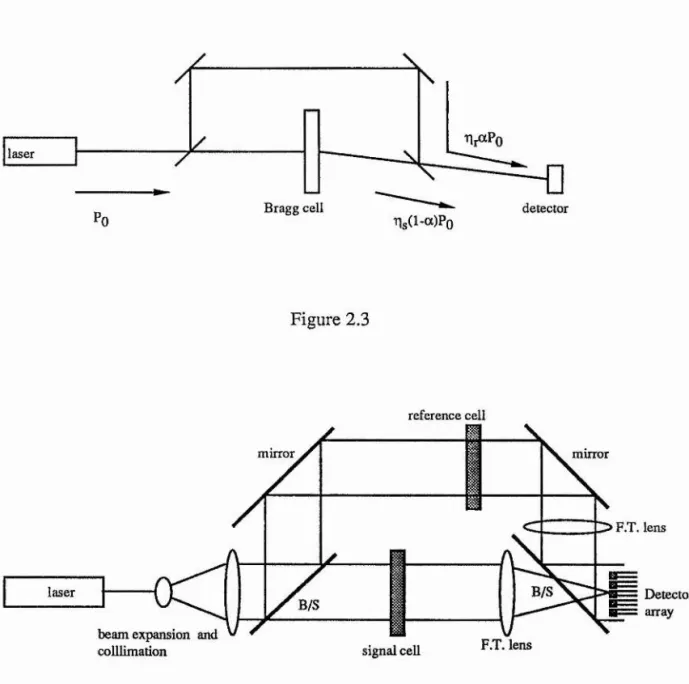
The interferometric spectrum analyser is shown in figure 2.3. The signal and reference arm transmittances are Tjg and T|^, taking into account all losses, and the fraction of light
transmitted to the reference arm is a. Then we have, from equation 2.5, for the power reaching the detectors
= aîij. -H ( 1-a )Tig + 2 [aqj.(l-a)Tig] ^/^cos(Acoj^t + A(])), 2.11
where A co^ is the difference in frequency between signal and reference beams, A()> is the phase difference and Pq is the laser power. The signal strength is given by
Coherent Detection______________________________________________________ 7 ^
where i(t) is the time varying component of the photocurrent, R is the detector load
resistance and is the detector efficiency.
The output current from the photodetectors may be written in the form
where i^ is the dark current. We have assumed the detectors do not saturate for the light
power levels involved.
The signal-to-noise ratio is then given by [2.2]
SNR=- - 'signal >
2 7
R< ighot > + Thermal noise + R<Dark current >
where is the shot noise, i^^^^ = V2eiB , and the thermal noise is 4icTgB, B is the
detector bandwidth, k is the Boltzmann constant, e is the electron charge, i is the photocurrent and T^ the equivalent system temperature. Then from 2.12 we obtain
cos^(A(|))
SNR= p--- ^ . 2.14
2eBR|PQTi^{arij.+(l-a)qg] +1^) + ^^^s®
Where we have assumed the d.c. dark current noise has been filtered-off.
Coherent Detection 7 4
a signal-to-noise ratio of unity when the system integrates the signal for a time 1/B. Equation 2.14 gives the minimum detectable signal arm transmittance, T|g .
min We have
2eBR I PqTI jttll ‘d } + 4kTjB
■'ls„inun„ = „ „ 2 2 i 2.15
and hence we obtain the minimum detectable signal power
2eBR P()T|dO^Tlr+ ^d} + ^kT^B
P'p . = ~— r~ r--- 2.16
' RPoT1d [aB r(l-a)] - 2eBRPQT|j(l-a)lT,BnL
where T|j^ is the transmittance in the signal arm due to parasitic losses only.
If dark current and thermal noise are the dominant sources of noise then equation 2.16 becomes
2eBRL + 4kT^B
P t . = - 9 n --- 2.16a
RPond«Br(l-«)BBBL
2.2.1.1 Effect of intermodulation
Coherent Detection______________________________________________________ 7 ^
If detector saturation does not occur then the maximum signal will be limited by third- order two-tone intermodulation. This effect occurs when two or more signals ( a polytone signal ) are present and produces spurious diffracted beams.
Consider the case where we have two signals present at frequencies f and f2* The light may first be diffracted by fp This diffracted beam may then be diffracted back in to the direction of the incident beam by f2 * This corresponds to a frequency fj- f2* This
doubly diffracted beam is not usually in the frequency region of interest, it may however be diffracted again by f j giving a beam of light corresponding to a frequency 2 fy f2*
This is the third-order two-tone intermodulation. It usually is in the region of interest and is of magnitude
^1 - 2 “ ^ 0 - r j 2.17
This assumes all of the multiple diffraction processes occur at the correct Bragg angle for diffraction and that each takes place over one third of the interaction length, W ( from
equation 1.31 we see that the diffraction efficiency is proportional to W ). In a high "Q" cell the intermodulation term will be smaller due to Bragg angle mis-matches.
The relative intermodulation is given in dB by
Int^ _ 2 “ 2 . 1 8
P i
where P^is the diffraction due to f^^ alone.