Elevating design in the organization
Pietro Micheli1, Helen Perks2, Michael B. Beverland3
Warwick Business School1, Coventry, UK; Nottingham University Business School2, UK; RMIT University3, Melbourne, Australia
Journal of Product Innovation Management (forthcoming) 2017
Address correspondence to:
Elevating design in the organization
Abstract
Following evidence of its positive contribution to innovation and company performance,
many firms are seeking to elevate design to a strategic level. However, little is known as to
how this can be achieved. This study draws on the literatures concerned with elevating
organizational functions and with organizational legitimacy, and aims to unravel and detail
critical practices and potential tensions influencing the elevation of design’s status in firms.
To do so, 53 in-depth interviews were undertaken with key informants, representing a range
of functional specialisms, in 12 companies, including large multinational companies as well
as SMEs. Findings show how six practices – top management support, leadership of the
design function, generating awareness of design’s role and contribution, inter-functional
coordination, evaluation of design, and formalization of product and service development
processes – affect the design elevation process. In contrast with previous studies on raising
the status of organizational functions, this research reveals that the same practive can play
both positive and negative roles, and that there are fundamental tensions, which should be
reconciled if design’s status is to be elevated. Drawing on the concept of organizational
legitimacy, we also examine how design moves beyond being seen as pragmatically useful, to
being identified as a relevant, alternative way of operating, to being regarded as essential for
success. The article concludes by articulating contributions to design and innovation
management theory and practice, and to the body of scholarly work seeking to understand
Introduction
Design is a primary driver of innovation in both manufacturing and services (Luchs, Swan,
and Creusen, 2016; Ostrom, Parasuraman, Bowen, Patricio, and Voss, 2015; Verganti, 2009).
It is critical to differentiation and branding (Noble and Kumar, 2010), and positively affects
companies’ financial and non-financial performance (Gemser, Candi, and van den Ende,
2011; Ravasi and Stigliani, 2012). The business press is rife with examples – from BMW to
PepsiCo, from Herman Miller to Nike – of design’s significant role in achieving these
outcomes, specifically by elevating the design function to a strategic level within the firm
(Bangle, 2001; Borja de Mozota, 2003; Brown, 2008; Verganti, 2009). As former chairman
and CEO of Procter & Gamble, A.G. Lafley, stated:
“Historically, P&G was brand- and product-centric. [More recently] we have used
design to take a different cut at strategy and organizational planning to do things
differently and better. [To do so] we worked hard to grow and develop the design
team—gave them time to grow capabilities, gain experience, and prove their value to
the product and brand teams.” (Lafley, Norman, Brown, and Martin, 2013; p. 5).
Design’s strategic significance is being noticed and acted upon. In recent years
Accenture acquired service design firm Fjord; the Chinese communication group Blue Focus
bought a majority stake in US-based agency Fuseproject; bank holding company Capital One
acquired user experience consultancy Adaptive Path; and McKinsey bought product design
agency Lunar. Also, companies such as Johnson & Johnson, PepsiCo and Philips have
appointed lead designers to their boards (Gardien and Gilsing, 2013; Stuhl, 2014). The
success of design-led firms such as Apple (the world’s most profitable company and most
2007; Borja de Mozota, 2003; Cooper and Junginger, 2011; Gorb, 1990; Noble, 2011).
Drawing on the literature (Karjalainen and Snelders, 2010; Luchs et al., 2016) and on the
empirical research reported in this article, we define “strategic design” as designers’ ability to
influence decisions and set direction over issues that affect the long-term sustainability and
competitiveness of an organization, such as development and communication of a brand’s
core values, positioning, and creation of new markets.
However, how can design be elevated from a functional to a strategic role within the
firm? Extant research highlights the need to elevate design (Luchs et al., 2016; Roper,
Micheli, Love, and Vahter, 2016) for two main reasons: (1) strategic issues such as branding,
innovation, and differentiation benefit from design input, and (2) designers have methods that
can bring unique insights to strategy formation and implementation (Best, Kootstra, and
Murphy, 2010; Brown, 2008). Yet, little is actually known about the ways in which this could
be achieved (Micheli, Jaina, Goffin, Lemke, and Verganti, 2012; Noble, 2011). This gap is
reflected in research priorities concerned with infusing design into organizational processes,
including those of the Marketing Science Institute 2016-2018 (MSI, 2016), Journal of
Product Innovation Management (Biemans and Langerak, 2015), and Journal of Service
Research (Ostrom et al., 2015).
This study investigates how to elevate the status of the design function. It aims to
contribute to current bodies of literature seeking to understand how to elevate the internal
status of an organizational function and draws on organizational legitimacy theory to do so. A
function’s status is defined as its ability to exert power and influence over decision-making
beyond task-related issues (Enz, 1988; Hickson, Hinings, Lee, Schneck, and Pennings, 1971;
Pfeffer, 1981). Higher status has three core benefits: sustained resource attraction, authority
over other functions, and influence over top management team attention and strategy making
contend that obtaining legitimacy is essential to realizing such benefits. Legitimacy is
essentially concerned with ensuring access to resources (Bitektine and Haack, 2015) and
informs and provides the theoretical framing for this study. Specifically, three questions
direct our inquiry: (1) which practices underpin the elevation of design’s status within the
firm? (2) Are there tensions related to the identified practices that may inhibit the elevation
of design and how are they managed? (3) How do the elevation practices relate to seeking
and acquiring legitimacy?
Drawing on an exploratory multiple case study, we contribute to design and
innovation management theory and practice in four main ways. First, this research extends
findings drawn in relation to other functional disciplines and proposes further practices that
enable the elevation of a function’s status. Second, by unraveling tensions in the elevation
practices, it empirically contributes to enduring debates in the innovation management
literature on conflict between formalization and creativity, and between control and
adaptability. Third, by considering the elevation of design as the acquisition of legitimacy,
this study shows not only how to attain pragmatic legitimacy, which draws on calculative
arguments, but also how higher levels of legitimacy – moral and cognitive – could be
achieved. Fourth, given recent interest in a strategic role for design, this research provides
empirical evidence specifically on how to elevate design’s status in organizations.
Literature Review
The elevation of design within the firm
Since Herbert Simon (1969) identified the unique ways in which designers approach problem
solving, researchers have explored how design can contribute to an organization’s
shows that design’s contributions can go beyond traditional aesthetics to include emotional
and functional attributes of products and services (Gemser et al., 2011), as well as workplace
design, communications activities to the firm’s myriad of stakeholders, and corporate identity
development (Borja de Mozota, 2003; Gorb, 1990). Given design’s potential impact on such
a wide set of aspects, various authors have argued that its status should be elevated to the
level of other functions such as marketing, R&D and operations (Roper et al., 2016).
Another argument for increasing design’s status draws on the unique insights that the
methods of design bring to the strategy-making process per se (Chung and Kim, 2011;
Cooper and Junginger, 2011; Martin, 2009). This point of view focuses less on the breadth of
activities where design can add value, in favor of the unique perspectives designers bring to
strategic management, sometimes referred to as “design thinking” (Brown 2008; Liedtka,
2015). Methods associated with design thinking, for example, can address tricky issues in
strategic brand management, such as balancing renewal and reinforcement through new
product development (NPD) (Beverland, Wilner, and Micheli, 2015).
According to this approach, the elevation of design’s status helps infuse a stronger
focus on the future and disrupt accepted marketplace norms. Design follows a constructivist
logic focused on conception, invention, pattern creation, staging and sensemaking that
complements business’ positivist logic (Borja de Mozota, 2003; p. 146). Here design seeks to
challenge long held assumptions and synthesize existing firm capabilities with emergent
opportunities (Beverland et al., 2015). Moreover, authors have emphasized design’s
distinctiveness from natural and social sciences, because of its capacity to question current
states, conceive what does not exist and, therefore, be particularly suitable to address “wicked”
problems (Buchanan, 1992; Martin, 2009). Design can also act as an integrating mechanism,
bringing together seemingly conflicting functional preferences in addressing NPD problems
focused on validity (rather than reliability) (Martin, 2009) or on ‘shape’ (rather than ‘fit’) that
are both essential to NPD success (Beverland, Micheli, and Farrelly, 2016).
Elevating an organizational function’s status
Research on raising the status of a function is relatively rare. Although there is a wealth of
knowledge on how to create a certain orientation – such as market, business process, and
supply chain orientations (Gebhardt, Carpenter, and Sherry Jr., 2006; Lockamy and
McCormack, 2004; Mentzer, 2001) - little is known about how organizational functions can
be elevated to a strategic level. Likewise, studies on intra-organizational power have focused
on the antecedents and benefits of higher status (Enz, 1988; Feng et al., 2015; Welbourne and
Trevor, 2000), but have not empirically investigated how such elevation is attained.
Yet, scholars and practitioners, especially within the disciplines of human resource
(HR) management and marketing, have called for an enhanced strategic role for their
functions, drawing on similar arguments to those put forward for design. For example, there
is an appeal for HR issues to be addressed by top management teams and for HR
professionals to influence strategic decisions (Jackson, Schuler and Jiang, 2014). In
marketing, although rare, arguments for raising the function’s status are based on
demonstrating its importance to performance outcomes (Feng et al., 2015; Homburg,
Vomburg, Enke and Grimm, 2015). Indeed, both disciplines lament their declining internal
status despite their influence on performance related outcomes (Homburg et al., 2015;
Jackson et al., 2014).
Notwithstanding calls for further research, only a few studies have examined how the
status of either HR or marketing could be elevated. Two main related issues have been
control and standardization of efficiency-driven organizations (Ulrich, Younger and
Brockbank, 2008). Homburg et al. (2015) also posit that the lack of CEOs with a marketing
background may also lead to misalignment. Alignment is critical since top management
team’s perceptions of value congruity (i.e., the extent to which the top management team
perceives functional heads to share their strategic goals) are critical to enhanced functional
power and internal status (Enz, 1988). This lack of alignment is also driven by poor internal
image. For example, Homburg et al. (2015) speculate that lower status is a function of an
inability to communicate value-adding activities, indirect relationships between activities and
outcomes, the poor quantification of marketing effectiveness, and poor message framing.
Similar themes have been suggested in relation to raising the internal status of design.
For example, managers often lack appreciation of design (Song et al., 1997), designers may
have different mental models than other functional experts’ (Micheli et al., 2012), and
designers struggle to measure and account for their contribution to organizational
performance (Lockwood, 2007). However, such ideas are frequently construed as outcomes
or states, rather than practices introduced by employees, such as designers and managers.
Hence, although scholars proffer typologies identifying an extended strategic role for design
(Best et al., 2010), and practitioners advocate a more strategic role for the design function
(Brown, 2009), little is known regarding which practices help elevate design’s internal status
(Luchs et al., 2016; Ravasi and Stigliani, 2012). Therefore, in this study we focus on
unraveling those organizational practices - defined as routinized and repeated sets of
activities performed by organizational actors - which are critical to design’s status elevation.
This leads to our first research question:
A related, but unexplored question is whether tensions emerge within the elevation process:
are the practices necessarily playing a positive role? For example, some scholars have
speculated that strong top management support is required to elevate a function’s status
(Webster, 2005), but is such support inevitably conducive to design acquiring higher status?
Also, new product development (NPD) research has long stressed the need to plan and
structure disciplined and formalized processes, alongside the need to support the conflicting
demands of experimentation, boundary spanning and novelty (Bruce, Daly, and Kahn, 2007;
Gilson, Mathieu, Shalley, and Ruddy, 2005). However, the two have often been regarded in
opposition; for example, while controlling a function can enhance timely project completion,
it can also limit problem solving and creativity (Rijsdijk and van den Ende, 2011). Therefore,
the decision to formalize processes and systems to promote a more strategic use of design
could either result in elevating its status, as intended, or, on the contrary, in limiting its scope
and influence. Hence, we seek to unpick such tensions by exploring the way elevation
practices are implemented and investigating how they are managed. This leads to our second
research question:
2. Are there tensions related to the identified practices that may inhibit the
elevation of design, and how are they managed?
Legitimacy and Functional Status
In this article we utilize the concept of organizational legitimacy to make sense of the way
practices operate to elevate design’s status. Organizational theory scholars have emphasized
that obtaining legitimacy is essential for any entity (be it an organization or a function) to
are desirable, proper, or appropriate within some socially constructed system of norms,
values, beliefs, and definitions” (Suchman, 1995, p.574). Specifically, Suchman (1995)
identifies three primary forms of legitimacy: pragmatic, moral, and cognitive. The first is a
rational kind of legitimacy that “rests on the self-interested calculations of an entity’s most
immediate audiences” (Suchman, 1995: 578). The second involves questions of values and
beliefs about how to best operate (Thomas and Lahm, 2012). The third, cognitive legitimacy,
means that an entity’s capacity to create value is taken-for-granted and it is considered a
necessary part within a socially constructed environment (Tost, 2011).
When studying how organizational entities acquire legitimacy, scholars have tended
to adopt two different perspectives - strategic and institutional (Suchman, 1995). In this study
we focus on intra-organizational dynamics and consider legitimacy from a strategic point of
view, i.e., legitimacy can be purposefully acquired and manipulated within the firm by
employing appropriate practices, rituals and symbolisms (Oliver, 1991; Suchman, 1995).
Such intra-organizational legitimacy has recently garnered much attention (Ashworth,
Harrison and Corley, 2008; Drori and Honig, 2013). For example, Bunduchi (2017) focuses
on the tactics through which innovation managers ensure ongoing support for their initiatives
with other business units. She finds that ongoing support for innovation initiatives requires
moving beyond short-term calculative, rational appeals about the benefit of a particular
project (consistent with pragmatic legitimacy) to include normative beliefs about how best to
operate and enshrine innovation into the identity or fabric of the firm (i.e., moral and
cognitive legitimacy). To do so, Bunduchi, along with Galang and Ferris (1997), emphasizes
that symbolic impression management practices targeted at stakeholders are essential to
achieving lasting legitimacy and therefore elevating functional status.
In summary, from a legitimacy point of view, arguments put forth in the literature for
strategically can lead to better outcomes and more innovative solutions to enduring
challenges. In contrast, researchers examining internal legitimacy and the elevation of
functional status suggest there are limits to this approach, and highlight the need to propose
moral and cognitive legitimacy arguments that relate to how organizational actors operate,
but have not investigated specific practices and potential tensions related to this.
This gives rise to the third research question:
3. How do the elevation practices relate to seeking and acquiring legitimacy?
Methodology
Sampling and data collection
A qualitative, multiple case study method was chosen to address the three research questions.
Case study research provides rich data and is suitable for investigating deep processes that
emerge and change over time (Bluhm, Harman, Lee and Mitchell, 2011), and multiple case
studies allow for rigor in identifying patterns across the data (Eisenhardt, 1989). Given the
focus on elevating a function, the sampling strategy was both theoretically driven and aimed
at achieving maximum variation (Patton, 1990). In so doing, we sampled firms based in the
United Kingdom that were of different sizes, yet large enough to have functional structures
(including a separate design department). These firms operate in sectors where design would
be commonly expected to play a major role (e.g., furniture and automotive) and in sectors
where it would not (e.g., financial services and logistics). Interviewees confirmed the role
that design was playing in their industry. For example, the chief design officer of Company
C, a large financial services firm stated: “the future of the financial services industry all
different industry.” The choice of involving different companies was motivated by our quest
to identify practices and potentially related tensions that were neither industry-specific nor
related to the degree of embeddedness of design in a particular sector.
In the case sampling stage, key informants, namely designers working in various
firms, design experts and consultants, were contacted. Publicly available documentation
(including annual reports, trade magazine articles and design awards) was also gathered in
relation to several organizations’ prevalent use of design. This stage resulted in identifying
and gaining access to 14 private companies. Data gathered from the key informants provided
initial evidence that all chosen organizations had considered utilizing design not simply in a
functional way but were explicitly endeavoring to either elevate it to a more strategic role or
to sustain it. Following initial interviews at company sites the sample was reduced to 12, as it
was found that two firms had never attempted to elevate design’s role beyond a purely
functional one (e.g., in both cases the design function had never been properly resourced).
Multiple sources of evidence – in-depth interviews and documentation – were
collected. This was to add breadth and depth to data collection and to contribute to the
validity of the research (Eisenhardt, 1989). A total of 53 interviews were undertaken, lasting
60 minutes on average and involving key actors working at different hierarchical levels and
in various functional areas. In all companies we interviewed at least three individuals. In all
cases one was the lead designer1, whereas the others were relevant personnel, as indicated by
the lead designer2, typically operating at director level in marketing and product
development. When design was mainly undertaken in collaboration with design agencies, at
least one external designer was also interviewed. Such diversity of respondents was necessary
1 The only exception was company G where the lead designer was our initial contact, but eventually declined to
be interviewed because of company changes happening during the period of data collection. The brand director, who had worked extensively with the design director, replaced him as our main informant and contact point.
2 In some companies the lead designer had the title of Chief Design Officer, and sat at Board level; in others it
as interviewees might lack required knowledge to answer all questions, and diverse
viewpoints could be expressed (Voss, Tsikriktsis and Frohlich, 2002).
Interviews consisted of three main parts. They started with grand tour questions,
allowing interviewees to answer freely, with specific follow-up probes to explore the
organizational context and new product and service development processes. In the second
part of the interviews, respondents were asked about past and current investments in design,
and reasons for such investments. Subsequent questions centered on the roles of design; for
example, informants were asked whether and how design was acquiring a more or less
legitimated position in the organization, and what the barriers were to its adoption and use.
Further questions examined the dynamics, changes and adjustments, which had occurred over
time, delving into events, activities and behaviors that accompanied such changes. Finally,
questions were posed on specific projects, querying the dynamics of their progression.
Respondents were asked to identify at least two projects – one successful, and one less
successful (success was identified by the respondents, usually in terms of either
innovativeness or business performance). For each project, the researchers investigated
reasons for success or failure; changes and differences over time; the roles design had played;
the main enablers and barriers to shifts in roles; and main outcomes.
Data were collected over a nine-month period. All interviews were recorded and
professionally transcribed. The first author and a trained assistant were involved in the
collection and initial analysis of data. The first two authors then further interpreted the data,
offering new insights. For validation, draft reports were sent to the case companies, and two
presentations were delivered at events where research participants and colleagues had been
Characterization of design’s roles within the case sample
An important feature of the case sample is the denotation of the role of design within each
organization. Although this was primarily unraveled during data collection and analysis, it is
reported here to provide a complete picture of the case organizations and their use and
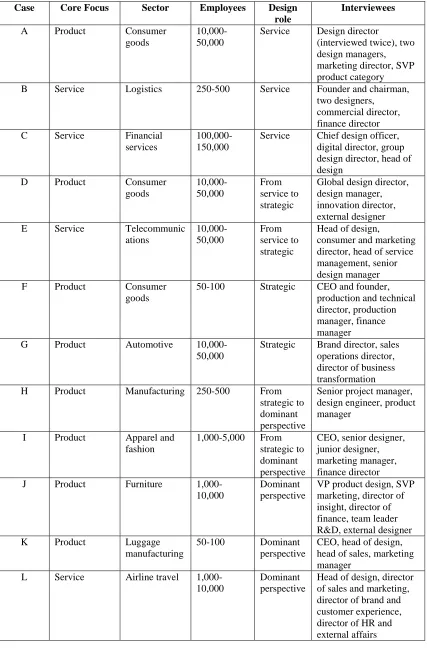
positioning of design. Table 1 reports details about the selected companies3, the interviewees,
and the main role design played. Design roles were derived according to three main criteria:
(1) the nature of design activities, which was identified by investigating the tasks designers
generally undertook (Perks, Cooper and Jones, 2005); (2) the scope of design’s influence in
decision-making processes in the firm; and (3) level of design’s impact, which was derived
by asking interviewees about the development of specific products or services. Sometimes
categorization was not clear-cut, as some firms appeared to be in a transitional stage, moving
from one role to another.
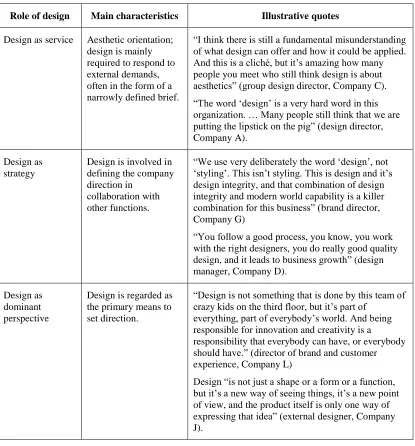
From this analysis the case studies were categorized into, or in transition towards,
three main roles: design as service, design as strategy, and design as dominant perspective.
These are illustrated in Table 2 and explained below.
Insert Tables 1 and 2 about here
Initial interviews confirmed that in all selected organizations the CEO or senior management
team had invested in establishing a design function and attempted to utilize design
strategically. However, in three cases design was still utilized mainly as a “service”. For
example, at Company A, the design director recalled: “the biggest alliance, when I was hired,
was the CEO himself. He was believing in the power of design and he was supporting me, he
was putting me on a pedestal in the organization.” However, five years after appointing a
design director and transferring powers from other business units to a newly constituted
design function, design was still “seen somewhat as a service function supporting the overall
marketing effort” (marketing director). A global design manager confirmed: “[here] design
becomes a service, because that’s what we are. In many projects, we are a service industry.
… I think we’re missing opportunities. We’re missing breakthrough.”
In cases where design is used as a service, its influence is tightly defined and bounded
to cost control, strengthening existing brands and enhancing product recognition. The
organization does not trust design’s capacity to extend its role, such as proposing something
new to the market. Its main activity therefore is to respond to specific briefs and information
developed in other departments, with low involvement in cross-functional work. In this role,
designers are also heavily reliant on customer feedback generated by other departments.
Some of them expressed dissatisfaction and frustration with this situation: “you’re not recognized, you’re not appreciated as a … valuable function. People still see you as … a
‘design waitress’. I tell you what I want and you need to organize it for me” (design director,
Company A).
In several of the other sampled companies, design is elevated, or in the process of
being elevated, to a strategic level. Here design informs strategic product decision-making,
such as product branding, positioning, and creation of new markets. Its impact is perceived as
organization-wide and as a critical way to attract customers and achieve competitive
advantage. At Company G, for example, design emerged as the primary means of creating a
new and uncontested market space, particularly significant as the company operates in a
relatively saturated market: “we identified a white space opportunity. … We used design ...
as a major factor for that product to make sure it was basically creating a segment” (director
In the third role, dominant perspective, design leads not just in product or service
development, but in everything the organization does. For example, at Company L, a large
airline, design was regarded as the main way of operating: “What you are embedding is the
important bit. Are you embedding design and the design team? Or are you embedding a point
of view?” (head of design, Company L). Such a stance means that the organization does not
consider design as a discrete unit; instead, it is part of the mindset of the organization: “the
[internal] design team is really just a problem solving function, a creative problem solving
function, expert in human behavior, so: how we see ourselves and understand the things that
make people tick” (head of design, Company L). Fundamentally, what distinguishes this
approach from the previous two is that design’s influence and impact permeate the
organization.
Data analysis
Data analysis was conducted in four main steps, following the process proposed by Gioia,
Corley and Hamilton (2012) (see also Pratt, Rockmann, and Kaufmann, 2006). The initial,
first-order analysis – similar to Corbin and Strauss’ (2008) notion of open coding – led to the
identification of many codes, which were labeled using respondent-centric terms.
Second-order categories were then obtained through axial coding (Corbin and Strauss, 2008). This
helped reduce the initial codes to a smaller number, and researcher-centric concepts, either
drawn from the literature or emerging from the data, were utilized. In the third step, the
aggregate theoretical dimensions were identified. These categories (e.g., top management
support, leading role of the design director) were defined in order to explain practices
affecting the design elevation journey (Gioia et al., 2012). The authors iteratively
re-elaborated and refined them to ensure that their understandings were sufficiently aligned
non-designers to make them aware of what design can help achieve: “over time what we've
done is educate the business to say: design … stands the opportunity to make a strategic
difference with a lot more than just the packaging” (global design director, Company D) (see
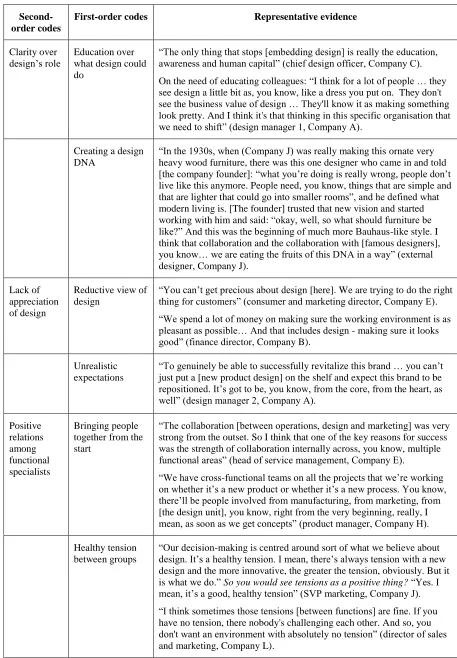
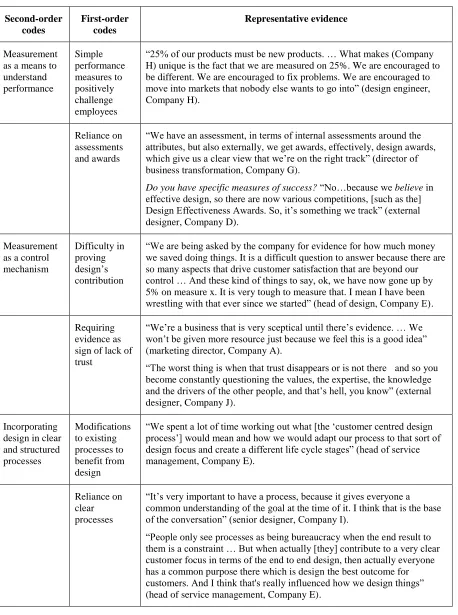
also quotes from interviews conducted at Company C in both the text and Table 3). These
passages were coded as ‘education over what design could do’. Subsequently, this was
regarded as an instance of the wider category ‘clarity over design’s role’. Finally, this
category and ‘lack of appreciation of design’ were brought together under the aggregate
dimension of ‘generating awareness of design’s role and contribution.’
Finally, adopting a dynamic perspective, the findings were mapped against the
elevation routes undertaken and main patterns were identified along these journeys. Figure 1
shows the first-order codes, second-order categories, and aggregate theoretical dimensions.
Table 3 presents representative evidence in relation to the main categories identified.
Insert Figure 1 and Table 3 about here
Findings
The findings consist of two sections. In the first one, practices that underpin the elevation of
design are presented and discussed. In doing so, each practice is first described and then
tensions that arise in relation to such practices are unraveled in detail, as we show how each
practice has the potential not only to facilitate but also to inhibit the elevation of design.
Specifically, we demonstrate how the identified practices influence the elevation journey
with reference to cross-case patterns (see Table 4) and how some firms were able to manage
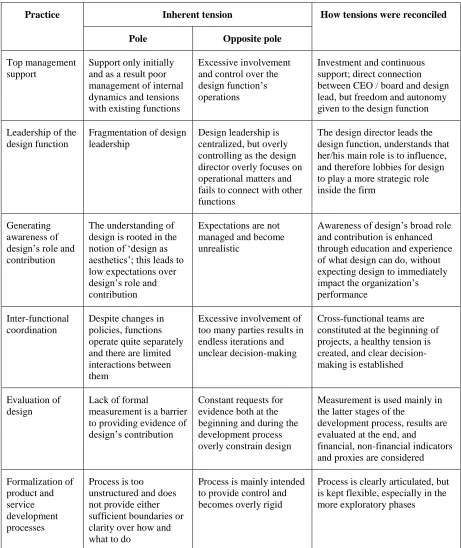
and reconcile the identified tensions (Table 5). Importantly, although all companies had
role. Other cases, where tensions were reconciled, demonstrated progression in making
design more relevant to the point sometimes of becoming the dominant perspective across the
organization. The second part of the findings frames the elevation of design as the acquisition
of different forms of legitimacy, and shows how some case companies were able to attain not
only pragmatic, but also moral and cognitive legitimacy.
Insert Tables 4 and 5 about here
Practices underpinning the elevation of design and related tensions
Six major practices emerged as critical in influencing the elevation of design’s status in the
firm: top management support, leadership of the design function, generation of awareness of
design’s role and contribution, inter-functional coordination, evaluation of design, and
formalization of product and service development processes. The findings suggest such
practices appear to be relevant both in sectors where design is expected to play a major role
and in sectors where it is not, and in both manufacturing and service-based organizations.
Except for the importance of the CEO and the presence of less formalized processes in
SMEs, no other major differences were found in relation to company size.
Although some of these practices have been previously reported as influencing the
elevation of a function, our study identifies novel ones and develops new insight by digging
deeper into each practice. In so doing we unravel inherent tensions by showing how the way
the same practice is implemented can act as either an enabler or a barrier in elevating
design’s status (see Tables 4 and 5). Specifically, in those firms where design was regarded
as a service, the manner in which such practices were implemented frequently had adverse
effects on the elevation of design’s status. For example, in Company B the CEO’s support
room for design to acquire greater autonomy and relevance, or for the lead designer to engage
in strategic conversations. Also, insufficient awareness of design beyond mere aesthetics (see
Table 3) was generated inside the company and this limited its role. In organizations where
design was transitioning from service to strategic level, many of the identified practices were
starting to be implemented in such a way as to play a positive role, but some practices were
still having an adverse effect. For example, in telecommunication Company E, top
management support was present and considerable changes had been made to the service
development process, but clear design leadership had not been established.
In companies where design was used either strategically or as a dominant perspective,
companies were able to manage the identified tensions and the six practices helped elevate or
sustain design’s status. At Company G, for instance, design had progressively acquired
strategic relevance thanks to the influential work of the lead designer (recently appointed to
the board) in clarifying and emphasizing design’s role, and to structural changes that had
made design a more integral part of the NPD process. At Company J, where design had been
considered the dominant perspective for decades, there was constant positive support from
senior management; awareness of design’s role was kept high across functions; the NPD
process was sufficiently structured, but not to the point of constraining creativity; and design
was evaluated both qualitatively and quantitatively at the end of projects. In the next section
we examine each practice, identify the nature and sources of tensions, and then examine ways
in which such tensions were overcome.
Top management support
Top management support was present in all organizations in the sample. The majority of
the head of design stated: “[the chief design officer] personally has a strong relationship with
our CEO. ... That’s been incredibly helpful to the whole team ... [The CEO] gets it. He
understands the value of customer experience starting with the customer and good design.”
At Company H, a medium-sized enterprise, strategic design was only possible thanks to the
Chairman’s belief in design as a means to create and sustain the business in the long-term
(Table 3).
However, this study finds that having a direct link with the CEO or the Board is not
always positive. Indeed, issues were clearly recognizable in situations where increased top
management support ended up weakening design’s influence and impact. For example,
several respondents cited examples of the company CEO or Board interfering and hanging
onto an existing, unsuccessful service or product, and determining its design. At Company B,
the commercial director discussed details of an unprofitable product, to which the Board felt
so attached that they had become involved in its actual design, leaving designers with no
freedom to act: “the internal designers have reworked it probably eight or nine times, and [the
CEO and customers have] always came back with: “no, we don’t want to change it.” … So
we have tried redesigning it lots of times and none of them have come to fruition, so it’s a
complete waste of time.” In other cases, top management support translated into the fairly
abrupt, top-down decision of creating a centralized design function, which resulted in other
departments eventually developing a negative perception of design that then impeded its
acceptance and integration. For example, at Company A, the CEO and CMO somewhat
imposed the introduction of the design unit, and designers soon began to feel “resentment
within the organization”, as identified in Table 3.
Several case organizations appeared capable of resolving the tension between initial
endorsement, but lack of sustained support, and excessive involvement in two main ways.
and a positive view of design. For example, at Company C the shift to a strategic use
appeared to be greatly influenced by the CEO’s previous successful experiences with design.
At Company K, the elevation of design to dominant perspective in the organization was
driven by the CEO’s background in product design: “being the CEO with design training, it’s
all about problem solving and looking at things differently. Why do we do things that way? Is
there a better way of doing it? So, that thinking has been applied across the business rather
than just in the product” (CEO and founder, Company K).
Second, sufficient autonomy for the design function coupled with a direct link with
the top management team was identified as crucial. For example, the head of design at
Company L stated: “you can be the best designer in the world and have great ideas, but
unless you have directness and linkage and a common point of view, you often fail”. At
Company I, the CEO clearly attributed importance to design: “for us I would say that design
is everything, because without it we have no business.” However, as a designer stated: “here
there’s a lot more freedom than where I used to work, because you’d have the owner of the
company looking over your shoulder, seeing what you were doing, kind of thing, whereas
here it’s not like that.”
Leadership of the design function
In several cases, the decision to invest in design was followed by appointing a director of the
design function. However, how this role was carried out emerged as critical. In some
companies leadership of the design function was perceived as weak and fragmented. For
example, Company E appointed a head of design, but the design team remained dispersed:
“[Here designers] do work together but not all in one team … Really we should all be sitting
organization], but particularly high, who champions and has enough influencing power to
drive an organization more powerfully towards design” (head of design, Company E).
Conversely, in some companies design directors adopted an overly centralized and
controlling approach, which resulted in them focusing principally on operational issues, thus
failing to support the elevation of design. At Company A, for example, “I have to say quite a
bit of [the design director]’s time has been diverted into systems and processes and budgets
and policeman and all that kind of stuff” (marketing director).
A distinctive characteristic of organizations utilizing design more strategically was
their capacity to reconcile the tension between fragmented and centralized approaches to the
leadership of the design function. This was achieved by having design directors who
concentrated their efforts in promoting design inside the company. For example, the global
design director at Company D argued, “if we only talk to people on the financial level, then
we’re completely missing the boat. Of course we have to talk the language of business, and
finance, and return on investment ... but it is also our job as leaders of design within
organizations to help people understand the thinking behind it”. At Company G, the design
director’s capacity to engage with strategic matters such as long-term planning and product
positioning was valued by colleagues and this led to his appointment to the board:
“previously in our business we had the design director working for the engineering director.
We deliberately don’t have that. The design director is at the same level as the engineering
director, and I think that is hugely important, because that helps to demonstrate the
importance we associate with design” (brand director).
Generation of awareness of design’s role and contribution
The practice of raising awareness in the organization about what design could do was
awareness can act as a formidable barrier to design’s elevation. On the one hand, some
interviewees complained about lack of appreciation within the organization, as design was
still regarded by many as a mere means to “make things look good” (see Table 3). Also, as
the group design director of Company C stated: “things go wrong [when] you have designers
and design working with people who are not design literate, who are uncomfortable with the
design process”. On the other hand, problems emerge when the benefits of design are
overemphasized, whereby there is an overemphasis on design myths and promises of
unattainable outcomes. This can create unrealistic expectations, for example in relation to
brand repositioning (see Table 3), and actually impede design’s elevation. Too high
expectations can also inhibit the development and integration of common goals between
professional groups, which are necessary for design to fulfill a more strategic role. For
example, when reflecting on the interface between marketing and design, the design director
at Company A stated: “I always call [marketers] unconsciously incompetent [as] they think
that the physical world is something like an advertising storyboard and you can change it
every other hour.”
This tension between low and unrealistic expectations was mainly resolved by
purposefully exposing non-designers to design processes and practices. For example, at
Company F the CEO recalled the importance of a design program run by an external agency
to “create knowledge and awareness of design and what it could do.” Similarly, financial
services Company C had started an education program in various business units: “If you look
at the [name of unit], they just have no orientation around design at all. So, I spent last week
in New York City … and they are extremely finance driven. … However, with education at
the most senior levels here ... plus the success of [recently launched product], they all now
widely understood in the organization and that it had become “a fundamental part of our
DNA. There is a real strong recognition that innovation and design is what makes our brand
strong” (director of brand and customer experience, Company L). Here all interviewees were
taking for granted that design was playing a unique and critical role.
Inter-functional coordination
The coordination of functions emerged as a dominant practice underpinning the elevation of
design. At various case companies, examples emerged of conflict among functions in the
initial phases of product or service development, which led to inadequately developed and
disagreed briefs, and, eventually, to failure: “when the design team and the brand team aren’t
in full agreement with what the brief is, that’s when it doesn’t work … it goes into a … bit of
a car crash” (external designer, Company D).
As part of their efforts to elevate design, several firms were trying to reduce “silo
mentality” by “bringing the organization together – business, technology, control functions –
all together, centered and anchored on the customer or the client through human-centered
design” (group design director, Company C). However, excessive inter-functional
coordination can entail involving too many parties and going through unnecessary iterations.
This proved ineffective, especially when coupled with unclear decision-making processes,
and led to ‘design by committee’ (see also Table 3): “the project took a very long time, and it
went through multiple iterations of everyone having their say, everyone wanting to see
different versions. So the design agency went through something like 26 stages … too many
iterations that led to sort of dilution” (global design director, Company D).
Reconciliation of the two extremes was achieved by creating cross-functional teams at
the beginning of projects and “healthy tensions” among functional groups in the product or
increased tension in the process is really fascinating creatively because it makes you think
harder” (design manager, Company D). At automotive company G, the sales and operations
director talked about a “healthy debate ... between manufacturing, engineering and design, in
terms of the purest what we want, to what feasibly can we deliver in a volume way, in a
quality way, in a cost effective way.” To do so, different agendas and plans were developed
coherently from the beginning. For example: “I’ve been in this position three years ago, and I
made up my mind very early on that it was really important that my role and [the chief
designer’s] role were very, very close and I think the design agenda and the brand agenda are
the same agenda. And historically that hasn’t been the case, you know, they’ve been miles
apart” (brand director, Company G).
Evaluation of design
The cases exhibit great diversity in the ways organizations evaluate design’s contribution to
innovation and business performance. As expected, the sampled SMEs tended to rely more
on informal evaluation rather than on performance targets and indicators. In the larger firms
practices varied.
Nonetheless, a tension emerged between lack of evaluation of design’s impact on one
hand, and excessive emphasis on measurement on the other. Indeed, some interviewees
lamented their incapacity to quantify design’s contribution and impact to organizational
success, as indicated by the head of design at Company E (see Table 3). However,
dysfunctional consequences also arose when organizations attempted to accurately and
precisely quantify the effects of design, both during development phases and after launch:
“we will, you know, over time decompose [the project] with econometric modeling and
concept board, that's the first step in the innovation which has a product idea on it, a price on
it, and short description. Then you can test this is an online environment … and it is
measured against a database … It may tell you that you're in a plus 25% top box, so you
know that, okay, that's something I can move forward with. … So my incentive is on two
times 25 million [net revenue], two ideas that are 25 million or higher, which is huge. …
Nobody, and even less so in this day and age, is rewarded for taking risks. You’re rewarded
for success. You are probably fired for failures, but that breeds a certain culture”. A paradox
therefore emerges: the greater the requirement for design to prove its contribution through
detailed analysis early on, the more conservative the design approach taken. As further quotes
in Table 3 exemplify, constantly monitoring and challenging design to provide evidence may
reflect a lack of trust in the organization and eventually make design’s impact negligible.
Organizations where design’s status was higher were capable of managing the tension
between lack of measurement and excessive emphasis on it by conducting evaluations at the
end of projects, often through the use of non-financial measures such as customer satisfaction
and time to market, or performance proxies, such as design and innovation awards (see
quotes in Table 3). In other cases, relatively simple measures of success were introduced. For
example, the Director of HR and external affairs at Company L explained that, when
assessing newly designed services, “we do look at our employees’ engagement and we look
at our customer satisfaction – I think those are the two things that will tell you whether you’re
getting it right”. Furthermore, in organizations where design was utilized as dominant
perspective, financial targets were only considered at later stages in the NPD process:
“Initially, [sales targets] are not even considered at all. I think the initial discussion is: what
ideas are there? It doesn’t matter whether they’re good or bad. … A lot of things, like profit
margins [are] not really necessarily considered initially because you’re just trying to get a
fewer and fewer” (head of design, Company K).
Formalization of product and service development processes
In most of the cases, changes to processes and routines were needed to increase design’s
scope and impact. When this did not happen, design struggled to play a strategic role. For
example, at Company C, a financial services firm which had recently set up a design unit, the
digital director lamented that sometimes “the business rather engaged through known
processes” and did not involve the designers. The design director reiterated this point by
complaining that in the firm “there’s no real, well executed and documented design process
yet. We’re definitely focused on that and understand the need for it, we don’t have it today.”
Indeed, firms using design more strategically appeared to benefit from formalized processes
where design was an integral component. For instance, Company G had recently established
a new NPD process where design was given more prominence. This was regarded as an
important contributor to one of the firm’s major successes: “I think the process that we’ve
created … is producing winners. And the process itself, I wouldn’t say it guarantees, but they
will always be very good designs” (director of business transformation).
However, a tension emerged in the case sample between insufficient and excessive
formalization. In some instances, over-formalization led to rigid processes and suboptimal
results. This is exemplified in situations where too many stakeholders were involved,
resulting in ‘design by committee’ (see Table 3). In other cases, the lack of a sufficiently
codified process, because of either overconfidence or the belief that process could hinder
creativity, led to project failure. For example, the CEO of Company F explained a poor new
product introduction as the result of a weakly structured process: “we probably missed some
Weak structuring of process was also evident in cases where users were not involved, and
this was often attributed to overconfidence: “what went wrong was: in that design and
innovation process, for a very innovative product we weren’t testing it and embedding it and
listening to the users of that product enough. … It’s an example where we’ve almost tried to
over-innovate without taking our consumers along that journey with us” (finance director,
Company I). Similar complaints were made in relation to poorly developed briefs: “Not
putting enough time into the brief … tends to create lots of re-works in the project. … You
end up with a weak design that is not going to change anything” (marketing director,
Company A).
Striking the right balance between flexibility and formalization is not simple;
however, some organizations succeeded in introducing clear processes that were not overly
rigid, especially in the more exploratory phases. At company E, the introduction of a
structured, but sufficiently flexible process enabled the organization to have a “very clear
customer focus” (see Table 3). At furniture Company J: “there is an extensive vetting process
that we go through before a design firm is granted a project to work with us” (director of
insight). However, its development process is rather exploratory and open-ended: “Find a few
really good designers … then trust them … We kind of go: ‘Well, here’s a problem to solve.
Send it out to the designers and see what they bring back’” (director of finance, Company J).
At Company J, the open-endedness of the process and the trust placed in external designers
was clearly reflected in designers’ freedom to challenge briefs.
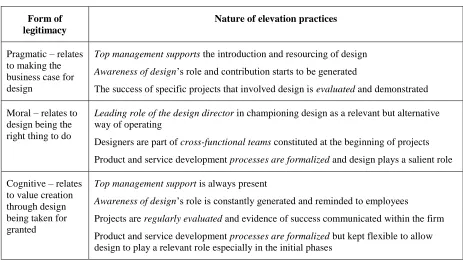
Elevation of design as seeking and acquiring legitimacy
After examining the six practices and related tensions, we further analyzed the data
considering the elevation of design’s status from an organizational legitimacy perspective. In
(Suchman, 1995) – were acquired across the cases and highlight differences according to how
the practices were deployed (Table 6).
Insert Table 6 about here
Pragmatic legitimacy
In this study, pragmatic legitimacy was often expressed in terms of “making the business
case” for design and proving its effectiveness. Attempts to acquire pragmatic legitimacy were
most evident in companies attempting to elevate design from service to a strategic level. At
Company C, the head of design asserted: “once we prove ourselves with multiple product
launches, get great customer feedback, make lots of revenue off of those ... and the design
around it becomes something that people talk about, then all of a sudden, the message is a
hell of a lot easier to sell throughout the group.” Other interviewees stressed the importance
of demonstrating design’s value to internal stakeholders as early as possible through
commercial successes and of sustaining it over time: “Our board of directors on an annual
basis reviews our design output. [The design director] creates a very large space … where he
sets up an extraordinary showcase of the work that’s been done in the previous 12 months.
And everyone in the company files through that space, but particularly, you know, it is the
real focus and attention of our board of directors” (innovation director, Company D).
Conversely, the global design director at Company A, discussing the difficulty of elevating
design’s status within the firm, reflected: “when I started in this position I maybe made the
mistake, I don’t know, to not lead by example. So, take five projects, do them very well, hope
that they will be successful in the market and then the success will lead other people into
and it’s almost funny, yes, we think we can do design in six weeks’ time because nobody
understands what design is and what it’s about and what the final deliverable will be.”
Moral legitimacy
While pragmatic legitimacy was recognized as necessary, various interviewees working at
firms where design was in the process of or already being utilized strategically argued for
design’s role as morally legitimate, intended as “design is the right thing to do.” For instance,
the design director at Company D stated: “the funding of design is based on the belief that
we’ll make a difference. So the data that makes a difference, but [it is] the belief that it makes
a difference, backed up by data, and the importance that people place on doing it.” Such
“belief” derived not only from continued evidence of success, but also from the wider
appreciation of designers’ ways of working, and their alternative perspective on business
challenges. At automotive Company G, the global brand director exemplified: “We’re going
through a pitch process for our motor shows … we spend literally tens of millions of pounds,
and the design of the motor show stand is really important. And I could quite legitimately not
involve [the design director] in any of that, but I actually very, very deliberately do involve
him in that process because he has a designer’s eye. … He’s the most creative person we’ve
got … and he has a point of view on how we should present our cars and he’s probably much
better able than I am to judge a stand design and whether that would be a good environment
in which to present our cars. So I kind of work very, very hard to involve him in more than
being just a car designer.”
Cognitive legitimacy
When design was being elevated to or already being used as the dominant perspective, it was
was taken for granted; for example: “as far as I’m concerned, everybody [in the company] is
responsible for design in some shape or form” (project manager, Company H). Discussing
how cognitive legitimacy was being attained at Company H, a design engineer emphasized
the formalization and, at the same time, flexibility of their NPD process: “it can be anything
from a very very well put together brief which will identify what the problem is, what the
potential customers are, it will identify the volumes that we might be looking to sell, the
market price, the competitors. [But,] you know, we are fairly flexible. Sometimes we have
done a project and it is only at the end of the project that we have actually had the design
brief.” In other companies where design was utilized as dominant perspective, several
respondents spoke of the founders’ approach to design and of the need to keep this relevant in
the firm: “the founders are present in the culture, and that story is told over and over and
over.... and embedded, you know” (director of finance, Company J). Another major
explanation of how cognitive legitimacy was attained and sustained relates to the deeper
understanding of design’s nature and benefits acquired over time; as an external designer
working for Company J stated: “it’s because [employees] have experienced it and
experienced it positively over time, so much so that they’ve come to understand [design] as a
positive practice.”
Discussion
This study explores the elevation of design within the firm and identifies six practices that
underpin the enhancement of design’s status (research question 1). Importantly, this research
shows that there are fundamental tensions, which should be identified and addressed if design
is to be elevated to a strategic level, since the same practice can play both positive and
tensions emerge more prominently in those organizations that have recently started to invest
in design. For example, companies C, D and E clearly experienced tensions in relation to
formalization of processes and evaluation of design (see Table 4).
The investigation of six major practices unravels tensions that need to be managed if
design’s status is to be elevated. Hence, this study shows that support from top management
is required to trigger investment in design (Homburg et al., 2015). However, it may also
hamper the work of designers, because of either lack of sustained backing over time or
excessive involvement in design activities. Therefore, a direct and continued connection with
the design function appears essential, but sufficient autonomy should also be granted.
Similarly, the appointment of a design director can act as a catalyst in the design elevation
process, but only if the design director is able to play a leading role, lobbying and effectively
communicating design’s value. Generating design awareness emerges as another key enabler,
but only as long as expectations over design’s contribution do not become unrealistic. The
promotion of inter-functional coordination also helps elevate design to a strategic level, as it
can promote collaboration and mutual appreciation of different functions’ processes and
mindsets (Beverland et al., 2016). However, balance needs to be stuck between too loose
connections among functions and consensus-based decision-making among many
stakeholders, as both can act as barriers and lead to suboptimal results. Evaluation of design
effectiveness emerges as another important practice, but it appears to play a positive role only
when measurement is used either retrospectively or mainly in the latter stages of the product
or service development process. Finally, the formalization of the development process
supports the elevation of design when design is an integral component and when the process
is clearly structured, but kept sufficiently flexible, especially in the initial phases.
This research also shows that the six practices should not be considered in isolation,
the strategic use of design. For example, although top management support aids design’s
elevation, the concurrent reconfiguration of processes is also required. Furthermore, the
progressive introduction of a clear process and the constitution of cross-functional teams at
the beginning of projects can offset initial lack of organizational awareness of design.
Similarly, newly appointed design directors may be capable of playing an influencing role in
organizations if top management supports them without either excessive interference or
constant monitoring. Moreover, by unraveling the dynamics of the cases, this study shows
how time is an important dimension in relation to the elevation of a function’s status. It is the
interplay of several practices, over time, which can increase a function’s relevance and
effectiveness, making the transition from strategic to dominant perspective possible. Indeed,
sufficient time is required to modify or introduce new processes, create awareness of what a
function can do, and, ultimately, foster a culture where a function is embedded. Therefore,
this research warns against potential oversimplification and static consideration of facilitating
practices and related tensions.
Findings show how the elevation of design’s status relates to seeking and acquiring
legitimacy (research question 3). In particular, pragmatic legitimacy appears to be a
necessary, but not sufficient condition for status elevation. Indeed, calculative, rational
appeals and a constant focus on demonstrating design’s effectiveness may eventually act as
barriers to elevating design. The acquisition of moral legitimacy appears to be a discriminant
factor between organizations where design was regarded as a service and those that were
utilizing design strategically. Design as dominant perspective corresponds to a high level of
cognitive legitimacy, whereby design is widely utilized as the main explanation for the
This study makes four main theoretical contributions. First, it extends the body of literature
intent on identifying the practices that explain a function’s enhancement of status. Broader
debates on the importance of elevating particular functions to a more strategic level – in areas
such as marketing (Feng et al., 2015; Homburg et al. 2015) and HR (Jackson et al., 2014;
Ulrich et al., 2008) – are relatively few and largely silent about how this is done. This
research provides richer insight to extant preliminary findings drawn in relation to other
functional disciplines and proposes further practices. Marketing and HR management
scholars have identified alignment with organizational goals and internal image as two
critical issues (Homburg et al., 2015; Ulrich et al., 2008). This study supports this finding by
highlighting the fundamental role of generating design awareness across the organization and
support by top management in raising and sustaining design’s status. However, it also shows
the importance of appointing a design director who plays a leading role, promoting
inter-functional coordination, evaluating and communicating design’s contribution, and embedding
design in structured business processes.
Secondly, the examination of the last two practices in particular provides an
empirically based perspective on two enduring debates in the innovation management
literature, between formalization and creativity (Gilson et al., 2005; Leenders, van Engelen
and Kratzer, 2007), and between control and adaptability (Rijsdijk and van den Ende, 2011).
The first conflict emerges between the requirement to ensure clarity and accountability, often
through the use of measurement systems, and the importance of delegation and trust. Here,
the findings show that positive results can be attained by communicating clear direction at the
beginning and evaluating performance at the end, while leaving sufficient discretion to the
design function (or to external design agencies) during the development process. By delaying
questions about design’s potential contribution in the NPD process, its influence and impact
followed by constant monitoring proves particularly dysfunctional.
The second conflict relates to the seemingly incompatible need for systems and
processes to guide design tasks and innovation more broadly, but also to the autonomy and
slack necessary for ‘designerly ways of working’4. The findings suggest that organizations
may be able to address this conflict, at least in part, by creating clear processes that ensure the
alignment and coordination among functions necessary for NPD success, but also
accommodate design practices (Beverland et al., 2015). Instead, when processes become
overly structured and rigid, or excessively loose and chaotic, companies are likely to
experience failure, because of either insufficient innovativeness or disregard of fundamental
elements (e.g., lack of customer focus).
Thirdly, considering the elevation of design from a legitimacy point of view, higher
status can be seen as deriving from greater legitimacy, as a function is increasingly perceived
“not only as more worthy, but also as more meaningful, more predictable, and more
trustworthy” (Suchman, 1995; p. 575). In marketing and HR management studies, arguments
for elevating a function to a strategic level mainly focus on demonstrating its importance to
performance outcomes, namely to acquire pragmatic legitimacy. Similarly, design scholars
have often framed their arguments in pragmatic terms and considered the link between design
and organizational performance (see, e.g., Lockwood, 2007; 2012). While these are
necessary, they are insufficient to achieve long-term legitimacy. This study shows that when
design is proposed - and eventually understood by non-designers - as a relevant, but
alternative way of operating, it can lead to the acquisition of moral legitimacy, i.e.,
“judgments about whether the activity is the ‘right thing to do’” (Suchman, 1995; p. 579),
rather than decisions made purely on the basis of calculated returns. The attainment of
the firm – is not only an outcome of moral legitimacy over time, but it can be facilitated by
strategic approaches, whereby “managers must go beyond simply selecting among existing
cultural beliefs; they must actively promulgate new explanations of social reality” (Suchman,
1995; p. 591). This was apparent in cases where design was persistently communicated as the
principal way of operating and regarded as the main success factor to the point of being
perceived as indispensable (Tost, 2011).
Finally, given the interest in design-driven innovation and a strategic role for design,
the contextual focus of this study makes a contribution to the field of NPD by moving beyond
the recognition that design can play different roles in organizations (Perks et al., 2005) to
understanding how to elevate design’s status in organizations (Beverland and Farrelly, 2007;
Noble, 2011). Moreover, it relates to debates on design thinking and shows that, rather than
relying on simplistic messages (e.g., “we all need to think like designers” (Brown and Katz,
2011, p. 382)), for design to become the dominant perspective, pragmatic and moral
arguments should be put forward consistently and over time, so that design becomes integral
part of what an organization does and its contribution to value creation is taken for granted.
Managerial implications
In contrast to existing design research, which tends to be framework-driven (Best et al., 2010;
Danish Design Centre, 2003), this study derives its findings from deep insight into
managerial decision-making and practices, which suggest specific pathways for practitioners
intent on raising design’s status. Undoubtedly, senior management support is necessary to
facilitate and sustain the transition from design as service to a more strategic level. However,
senior managers should develop clear signposts early on of how the organization is going to
benefit from design and, progressively, grant autonomy to the design function. The