A PBIL for Load Balancing in Network Coding based
Multicasting
Huanlai Xing1,*, Ying Xu2, Rong Qu3, Lexi Xu4
1
School of Information Science and Technology, Southwest Jiaotong University, Chengdu, P. R. China
College of Computer Science and Electronic Engineering, Hunan University, Changsha, P. R. China
3
School of Computer Science, University of Nottingham, Nottingham, UK 4
Department of Network Optimisation and Management,
China Unicom Network Technology Research Institute, Beijing, P. R. China
Abstract. One of the most important issues in multicast is how to achieve a balanced traffic load within a communications network. In the context of mul-ticast with network coding, this paper formulates a load balancing optimization problem and proposes a modified population based incremental learning (PBIL) algorithm for tackling it. A novel probability vector update scheme is developed to enhance the global exploration of the stochastic search by introducing extra flexibility when guiding the search towards promising areas in the search space. Experimental results demonstrate that the proposed PBIL outperforms a number of the state-of-the-art evolutionary algorithms in terms of the quality of the best solution obtained.
Keywords: load balancing; multicast; network coding; population based incre-mental learning
1
Introduction
always have the theoretical maximal throughput achieved and hence becomes an ideal technique for point-to-multipoint data transmission [2].
Load balancing is an issue inherited from the adaption of network resource alloca-tion. Network service providers are eager to make use of the network infrastructure as fully as possible so as to accommodate more users with different QoS guarantees. Undoubtedly, a more balanced traffic load helps make use of the remaining network resources functioning more efficiently. Hence, load balancing has been a hot spot in the field of communications for many years [3]. There are some research efforts dedi-cated to the load balancing in network coding based multicast (NCM). A NCM algo-rithm was presented and compared with two traditional multicast routing algoalgo-rithms with respect to the achievable throughput and load balancing [4]. A reliable data dis-semination protocol, which adapts network coding for decreasing the broadcast traffic in code updates, was developed in [5]. In [6], the problem of exploiting the abilities of next generation terminals in satellite systems with network coding was investigated. In multi-hop wireless networks, a flexible energy-efficient multicast routing algorithm with network coding was put forward [7]. However, all work above assumes that coding recombination has to be executed at all coding-possible nodes within a net-work, which would consume serious network computational and buffering resources as coding incurs expensive computational overhead [8-10]. Since coding might only be necessarily performed at a limited number of coding-possible nodes, it is of vital importance to consider the load balancing issue in NCM, where coding is to be per-formed when needed. However, this issue has received little attention.
Population based incremental learning (PBIL) is an estimation of distribution algo-rithm, incorporating competitive learning concept into genetic algorithm (GA). PBIL builds a probability model and evolves it to lead the search towards promising areas in the search space. Due to the simplicity and efficiency, the algorithm has applied to a wide range of optimization problems, including the stabilizer design problem in power system [11], the dynamic optimization problem [12], the robot soccer system optimization [13], the antenna design problem [14], the network coding resource min-imization problem [15,16], etc.
In this paper, a load balancing optimization problem in the context of NCM is for-mulated, where coding is performed only when necessary. A modified PBIL with a new probability vector update scheme is adopted to optimize the problem above. The new scheme maintains a set of best-so-far samples obtained during the evolution. At each generation, a proportion of samples in the set are randomly selected and used to update the probability vector, which to a certain extent, helps improve the global ex-ploration. Performance comparisons show that the proposed PBIL is superior to a number of state-of-the-art evolutionary algorithms (EAs) with respect to the solution quality.
2
Problem Formulation
Assume every link in G is numbered and let ei∈E denote link i, where ei is associated
with a maximum bandwidth Bi max
and a currently consumed bandwidth Bi csmd
, where Bimax ≥ Bicsmd. There is a source node s∈V, a set of receivers T = {t1,…, td}, tk∈V, k =
1, …, d, and an expected bandwidth Rs→T from s to each receiver in T [8,9].
We call an intermediate node in G as a merging node if it is source, non-receiver and has multiple incoming links. Only merging nodes can perform coding operations. So, all coding-possible nodes in G are merging nodes. Given a NCM re-quest, the task is to find a connected subgraph (i.e. sub-network) in G to deliver NCM data traffic [9]. We refer to such subgraph as NCM subgraph and denote it by Gs→T. A
NCM subgraph consists of multiple paths, with each path originating from source s and terminating at a receiver. We refer to link-disjoint paths as paths which do not have any common link. More details can be found in [9].
In this paper, identical bandwidth consumption, denoted by Bs→T, incurs in each
link occupied by the NCM subgraph. So, R link-disjoint paths to the same receiver will incur R·Bs→T bandwidth consumption, where R is an integer. Let ωi be the
band-width utilization ratio in ei∈E, Φ be the number of link-disjoint paths to each receiver
in Gs→T, and Ωz(s→tk) be path z from s to tk in Gs→T, z=1, …, Φ, respectively. Let
ρz(s→tk) and r(s→tk) denote the link set of Ωz(s→tk) and the achievable bandwidth
from s to tk∈T in Gs→T, respectively.
In a communications network, each link is associated with a bandwidth utilization ratio (BUR) which reflects the percentage of how much bandwidth has been used. The task of this paper is to find a NCM subgraph in G, with the average BUR mini-mized and a number of constraints met. A smaller average BUR implies a more bal-anced traffic load in G.
Minimize: 𝜔 (1)
where,
𝜔̅ = (∑𝑖∈|𝐸|𝜔𝑖) |𝐸|⁄ (2)
𝜔𝑖= (𝐵𝑠→𝑇∙ 𝑐𝑖+ 𝐵𝑖𝑐𝑠𝑚𝑑)/𝐵𝑖𝑚𝑎𝑥 (3)
𝑐𝑖= {1, 𝑒0, 𝑜𝑡ℎ𝑒𝑟𝑤𝑖𝑠𝑒𝑖∈ 𝐺𝑠→𝑇 (4)
Subject to:
𝐵𝑠→𝑇+ 𝐵𝑖𝑐𝑠𝑚𝑑≤ 𝐵𝑖𝑚𝑎𝑥, ∀𝑖 = {1, … , |𝐸|} (5)
𝑟(𝑠 → 𝑡𝑘) = 𝛷 · 𝐵𝑠→𝑇, ∀𝑡𝑘 ∈ 𝑇 (6)
The objective of the problem concerned is to minimize the average BUR, which is shown in Eq. (1). Eq. (2) defines the average BUR. The BUR value associated with each link is calculated based on Eq. (3). Eq. (4) defines the coefficient ci. Constraint
(5) explains the bandwidth constraint. The achievable bandwidth r(s→tk) is Φ times
larger than Bs→T because Φ link-disjoint paths from the source to each receiver are to
be constructed, which is shown in Constraint (6). Constraint (7) reflects that any two paths in Gs→T, cannot have common link, as long as they terminate at the same
receiv-er.
3
The Proposed PBIL
This section first introduces the new probability vector (PV) update scheme and then describes the overall procedure of the proposed PBIL in detail.
3.1 New PV update scheme
In the original PBIL, best-so-far sample (i.e. solution/individual) is used to update PV. But this update scheme may cause serious prematurity very easily, which is be-cause depending on a single sample might lead the search to local optima quickly. A number of improved PV update schemes are thus developed including the famous Hebbian-inspired rule [17]. This rule defines that PV should be updated by a set of samples obtained during the evolution rather than a single sample and to some extent helps maintain a relatively high level of diversity.
The new PV update scheme is based on the Hebbian-inspired rule. Different from other variants, the proposed scheme operates an external population (EP) which only records the best-so-far samples obtained during the evolution. At each generation, a subset of samples is randomly selected from EP and their statistical information is then extracted and used to update PV.
Let P(t) and N denote the PV at generation t and the number of samples generated at each generation, respectively. Let SSEP = {B1, …, BM} be the subset of samples
randomly selected from EP, where M is smaller than N and Bi is the i-th selected
sam-ple, i = 1, …, M. Denote the probability distribution of all samples in SSEP and the learning rate by PSS and α, respectively. The update of P(t) is defined in Eq. (8) and
Eq. (9).
𝑷(𝑡) = (1.0 − 𝛼) ∙ 𝑷(𝑡 − 1) + 𝛼 ∙ 𝑷𝑆𝑆 (8)
𝑷𝑆𝑆=𝑀1∑𝑀𝑘=1𝑩𝑘 (9)
3.2 The Overall Procedure of the Proposed PBIL
In the literature, the binary link state (BLS) individual representation has been widely adopted when tackling network coding related optimization problems [9,10,15,16,18,19]. The proposed PBIL is also based on BLS encoding. Details can be found in [9,10].
Assume there is an individual (sample) X. In terms of fitness evaluation, we first check the feasibility of X. We call X feasible if it results into a valid NCM subgraph Gs→T(X) and infeasible otherwise. If X is feasible, its fitness value is set to the average
BUR in G; otherwise, its fitness value is set to a sufficiently large number (100% in this paper since BUR is in the range [0, 100%]). Note that a feasible individual re-quires more time than infeasible ones for evaluation since those feasible not only undergo feasibility checking but also NCM subgraph construction. And constructing a NCM subgraph consumes more time than feasibility checking.
Initialization
1. Set t = 0
2. Set P(t) = {0.7,...,0.7}
3. Generate N samples by sampling P(t) and put them in set H(t) 4. Put the N samples into EP
repeat
5. Set t = t + 1
6. Evaluate all samples in H(t-1)
7. Update EP by finding N best samples from H(t-1) and EP
8. Randomly select M samples from EP and put them into SSEP
9. Update P(t) by using the proposed PV update scheme in Sub-section 3.1
10. Mutate P(t) by Eq.(10) 11. Generate N samples by P(t)
until termination condition is met
Fig. 1. Overall procedure of the proposed PBIL
The overall procedure of the proposed PBIL is shown in Fig. 1. PV P(t) is initial-ized as {0.7,…,0.7}, meaning the probability of generating ‘1’ at each position in P(t) is 0.7. This helps guide the search to explore promising areas in the search space. Set H(t) is the sampling set generated by PV at each generation. Note that an all-one indi-vidual is inserted into H(t) to guarantee that the search begins with a feasible sample [10]. The initial N samples are copied into EP to form the external population. In the main loop, each sample in H(t-1) is evaluated and associated with a fitness value. Then, EP is updated. Later on, M random samples are picked up from EP and used to update P(t) (M = N/2 in this paper).
number (either 0.1 or 1.0, both with a probability of 0.5). If RNDk < pm, Pk is mutated
by Eq. (10)
𝑃𝑘= (1.0 − 𝜎) ∙ 𝑃𝑘+ 𝑅𝑁𝐷𝑘∙ 𝜎 (10)
The termination criterion is that the evolution reaches a predefined number of gen-erations.
4
Performance Evaluation
This section evaluates the proposed PBIL by comparing it with a number of state-of-the-art EAs with respect to the solution quality.
4.1 Test Instances
First of all, test instances are introduced briefly. We consider 12 benchmark instances including 2 fixed and 10 randomly generated directed networks. These instances have been widely adopted for performance evaluation when handling with network coding related optimization problems [8-10,15,16,18-20]. The two fixed networks are F1 (i.e. 7-copy) and F2 (i.e. 15-copy) networks, where each copy is a modified butterfly net-work and x-copy network is constructed by cascading a number of identical copies [18]. As for the random instances, the network scale is from 20 to 60 nodes.
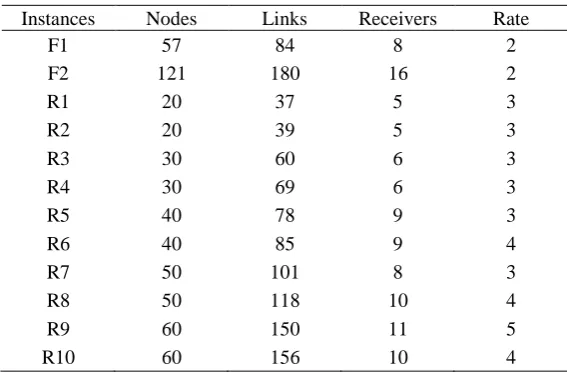
Table 1 shows all instances for performance comparison. In all experiments, each link is with an identical maximum bandwidth, i.e. 100Mbps. The consumed band-width of link ei∈E prior to NCM is randomly generated in the range [1, 50] Mbps
with a uniform distribution. The bandwidth consumption of each link in NCM sub-graph is set to 30 Mbps. As mentioned in Section 2, the single objective of the prob-lem concerned in the paper is to minimize the average BUR. A smaller average BUR represents a better network load balancing performance. All experiments were run on a Windows XP computer with Intel(R) Core(TM) E8400 3.0GHz, 2G RAM. For per-formance comparison, each algorithm is run 20 times on each instance.
4.2 Overall Performance Evaluation
In this subsection, performance comparison is carried out among a number of state-of-the-art EAs on 12 benchmark instances. The following lists all algorithms for compar-ison.
- GA1: GA with BLS representation [9].
- GA2: GA with block transmission state (BTS) representation [10].
Table 1. Benchmark instances for performance comparison
Instances Nodes Links Receivers Rate
F1 57 84 8 2
F2 121 180 16 2
R1 20 37 5 3
R2 20 39 5 3
R3 30 60 6 3
R4 30 69 6 3
R5 40 78 9 3
R6 40 85 9 4
R7 50 101 8 3
R8 50 118 10 4
R9 60 150 11 5
R10 60 156 10 4
-QEA1: Quantum-inspired evolutionary algorithm (QEA) [22]. Based on BLS representation, QEA1 adopts rotation angle step (RAS) and quantum mutation proba-bility (QMP) to update individuals, where RAS is randomly generated and QMP is based on the current fitness value of the associated individual.
- QEA2: Another variant of QEA [23]. Different from QEA1, QEA2 modifies the values of RAS and QMP according to the current and previous fitness values of the associated individual.
- PBIL1: PBIL devised for the network coding resource minimization problem [16].
- PBIL2: The proposed PBIL with the novel PV update scheme in Section 3. All EAs above uses BLS representation except GA2. The population size and the number of iterations are set to 20 and 200 for each algorithm, respectively. We adopt suggested parameter settings for GA1, GA2, UMDA, QEA1, QEA2, and PBIL1 [9,10,21-23,16]. In PBIL2, we set the learning rate α = 0.1, the mutation probability pm = 0.02, and the probability variance at each position σ = 0.05, respectively. The
number of random samples selected at each generation from EP is 10. All results are collected by running each algorithm 20 times.
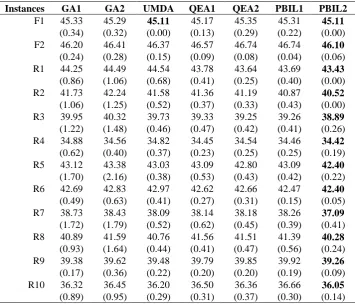
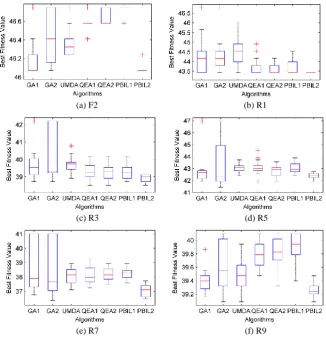
PBIL2 has more opportunity to reach the global optima and thus obtains the best per-formance. Fig. 2 shows the box plots of the seven algorithms in six selected instances including F2, R1, R3, R5, R7, and R9. One can find that PBIL2 always outperforms the rest of the EAs for comparison.
Table 2. Results of mean value (%) and SD (Best results are in bold)
Instances GA1 GA2 UMDA QEA1 QEA2 PBIL1 PBIL2 F1 45.33
(0.34) 45.29 (0.32) 45.11 (0.00) 45.17 (0.13) 45.35 (0.29) 45.31 (0.22) 45.11 (0.00) F2 46.20
(0.24) 46.41 (0.28) 46.37 (0.15) 46.57 (0.09) 46.74 (0.08) 46.74 (0.04) 46.10 (0.06) R1 44.25
(0.86) 44.49 (1.06) 44.54 (0.68) 43.78 (0.41) 43.64 (0.25) 43.69 (0.40) 43.43 (0.00) R2 41.73
(1.06) 42.24 (1.25) 41.58 (0.52) 41.36 (0.37) 41.19 (0.33) 40.87 (0.43) 40.52 (0.00) R3 39.95
(1.22) 40.32 (1.48) 39.73 (0.46) 39.33 (0.47) 39.25 (0.42) 39.26 (0.41) 38.89 (0.26) R4 34.88
(0.62) 34.56 (0.40) 34.82 (0.37) 34.45 (0.23) 34.54 (0.25) 34.46 (0.25) 34.42 (0.19) R5 43.12
(1.70) 43.38 (2.16) 43.03 (0.38) 43.09 (0.53) 42.80 (0.43) 43.09 (0.42) 42.40 (0.22) R6 42.69
(0.49) 42.83 (0.63) 42.97 (0.41) 42.62 (0.27) 42.66 (0.31) 42.47 (0.15) 42.40 (0.05) R7 38.73
(1.72) 38.43 (1.79) 38.09 (0.52) 38.14 (0.62) 38.18 (0.45) 38.26 (0.39) 37.09 (0.41) R8 40.89
(0.93) 41.59 (1.64) 40.76 (0.44) 41.56 (0.41) 41.51 (0.47) 41.39 (0.56) 40.28 (0.24) R9 39.38
(0.17) 39.62 (0.36) 39.48 (0.22) 39.79 (0.20) 39.85 (0.20) 39.92 (0.19) 39.26 (0.09) R10 36.32
(0.89) 36.45 (0.95) 36.20 (0.29) 36.50 (0.31) 36.36 (0.37) 36.66 (0.30) 36.05 (0.14)
(a) F2 (b) R1
(c) R3 (d) R5
[image:9.595.126.453.151.492.2](e) R7 (f) R9
Fig. 2. Box plot of 6 selected instances
5
Conclusions
communica-tions, e.g. traffic control and network configuration in Long Term Evolution (LTE) cellular systems [24,25].
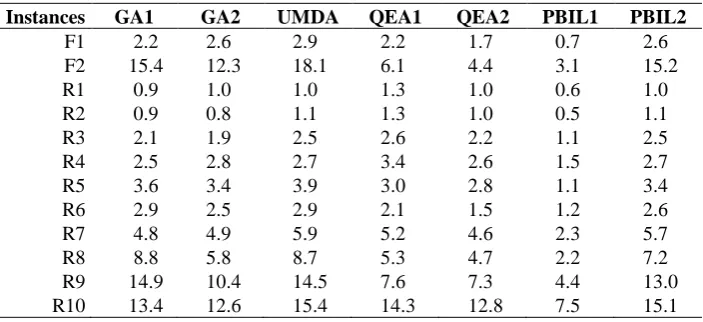
Table 3. Results of ACTs (sec.)
Instances GA1 GA2 UMDA QEA1 QEA2 PBIL1 PBIL2
F1 2.2 2.6 2.9 2.2 1.7 0.7 2.6
F2 15.4 12.3 18.1 6.1 4.4 3.1 15.2
R1 0.9 1.0 1.0 1.3 1.0 0.6 1.0
R2 0.9 0.8 1.1 1.3 1.0 0.5 1.1
R3 2.1 1.9 2.5 2.6 2.2 1.1 2.5
R4 2.5 2.8 2.7 3.4 2.6 1.5 2.7
R5 3.6 3.4 3.9 3.0 2.8 1.1 3.4
R6 2.9 2.5 2.9 2.1 1.5 1.2 2.6
R7 4.8 4.9 5.9 5.2 4.6 2.3 5.7
R8 8.8 5.8 8.7 5.3 4.7 2.2 7.2
R9 14.9 10.4 14.5 7.6 7.3 4.4 13.0
R10 13.4 12.6 15.4 14.3 12.8 7.5 15.1
Acknowledgements
This research was supported in part by NSFC (No.61401374), the Fundamental Re-search Funds for the Central Universities (No. 2682014RC23), the Project-sponsored by SRF for ROCS, SEM, P. R. China and University of Nottingham, UK.
References
1. Benslimane A.: Multimedia multicast on the internet. ISTE (2007).
2. Li, S.Y.R., Yeung, R.W., Cai, N.: Linear network coding. IEEE Trans. Inform. Theory 49(2) (2003) 371-381
3. Wang N., Pavlou G.: Traffic engineered multicast content delivery without MPLS overlay. IEEETrans. Multimedia, 9 (3) (2007) 619-628.
4. Chi K., Yang C., Wang X.: Performance of network coding based multicast. IEE Proc.- Commun. 153 (3) (2006) 399-404.
5. Hou I.H., Tsai Y.E., Abdelzaher T.F., Gupta I.: AdapCode: adaptive network coding for code updates in wireless sensor networks. In: Proc. INFOCOM. (2008)
6. Vieira F., Lucani D.E., Alagha N.: Codes and balances: multibeam satellite load balancing with coded packets. In Proc.ICC. (2012)
7. Jiang D., Xu Z., Li W., Chen Z.: Network coding-based energy-efficient multicast routing algorithm for multi-hop wireless networks. The Journal of Systems and Software 104 (2015) 152-165.
9. Kim, M., Médard, M., Aggarwal, V., O’Reilly, V., Kim, W., Ahn, C.W., Effros, M.: Evo-lutionary approaches to minimizing network coding resources. In: Proc. INFOCOM. (2007)
10. Kim, M., Aggarwal, V., O’Reilly, V., Médard, M., Kim, W.: Genetic representations for evolutionary minimization of network coding resources. In: Proc. EvoCOMNET. (2007) 11. Folly K.A.: Multimachine power system stabilizer design based on a simplified version of
genetic algorithms combined with learning. In Proc.ISAP2005. (2005)
12. Yang S., Yao X.: Population-based incremental learning with associative memory for dy-namic environments. IEEE Trans. Evolut. Comput. 12 (5) (2008) 542-561.
13. Kim J. H., Kim Y. H., Choi S. H., Park I. W.: Evolutionary multi-objective optimization in robot soccer system for education. IEEE Comput. Intell. Magazine 4 (1) (2009) 31-41. 14. Ho S.L., Yang S., Bai Y., Huang J.: A robust metaheuristic combing clonal colony
optimi-zation and population-based incremental learning methods. IEEE Trans. Magnetics 50 (2) (2014). DOI: 10.1109/TMAG.2013.2283886.
15. Xing H., Qu R.: A population based incremental learning for network coding resources minimization. IEEE Commun. Letters 15 (7) (2011) 698-700.
16. Xing H., Qu R.: A population based incremental learning for delay constrained network coding resource minimization. In Proc. EvoApplications. (2011)
17. Gonzalez C., Lozano J.A., Larranaga P.: Analyzing the population based incremental learning algorithm by means of discrete dynamical systems. Complex Systems 12 (2000) 465-479.
18. Ahn C. W., Yoo J. C.: Multi-objective evolutionary approach to coding-link cost trade-offs in network coding. Electronics Letters 48 (25) (2012) 1595-1596.
19. Xing H., Qu R.: A nondominated sorting genetic algorithm for bi-objective network cod-ing based multicast routcod-ing problems.Inform. Sciences 233 (2013) 36-53.
20. Xing H., Qu R., Bai L., Ji Y.: On minimizing coding operations in network coding based multicast: an evolutionary algorithm. Applied Intelligence 41(3) (2014) 820-836.
21. Lozada-Chang L.V., Santana R.: Univariate marginal distribution algorithm dynamics for a class of parametric functions with unitation constraints. Inform. Sciences 181 (11) (2011) 2340-2355.
22. Xing H., Ji Y., Bai L., Sun Y.: An improved quantum-inspired evolutionary algorithm for coding resource optimization based network coding multicast scheme. AEUE 64 (12) (2010) 1105-1113.
23. Ji Y., Xing H.: A memory-storable quantum-inspired evolutionary algorithm for network coding resource minimization. In Kita E. (Ed.), Evolutionary Algorithm, InTech 363-380. (2011)
24. Xu L., Chen Y., Chai K. K., Schormans J., Cuthbert L.: Self-organising cluster-based co-operative load balancing in OFDMA cellular networks. Wiley Wireless Commun. Mobile Comput. 15 (7) (2015), 1171-1187.