See discussions, stats, and author profiles for this publication at: https://www.researchgate.net/publication/283258850
Characterization Of Oil/ Gas Flow Pattern In
Vertical Pipes Using Electrical Capacitance
Tomography
Article in European Journal of Scientific Research · March 2015
READS
96
1 author:
Lokman Aziz Abdulkareem
University of Zakho
49PUBLICATIONS 170CITATIONS SEE PROFILE
All in-text references underlined in blue are linked to publications on ResearchGate, letting you access and read them immediately.
http://www.europeanjournalofscientificresearch.com
Characterization of Oil / Gas Flow Pattern in Vertical Pipes
using Electrical Capacitance Tomography
Lokman A Abdulkareem
Corresponding Author: Department of Petroleum Engineering University of Zakho, Zakho city, P O Box 12, Northern Iraq
Email: [email protected] Tel: 009647504570194
B.J. Azzopardi
Department of Chemical and Environmental Engineering Faculty of Engineering, University of Nottingham
University Park, Nottingham NG7 2RD, U.K
Sarbast A Hamid
Duhok Polytechnic University, Zakho Technical Institute Petroleum Department, Zakho City Northern Iraq
M Abdulkahdir
Department of Chemical Engineering
Federal University of Technology,PMB 65, Minna, Nigeria
Abstract
Electrical Capacitance Tomography provides the opportunity to visualize the contents of a process of many applications such as pipeline and obtain information on the flow configuration. Multiphase flow is an extremely complex field of fluid mechanics; the characteristics of the operations of many equipment in different areas of industry such as oil and power generation are determined by the nature of flow of two phase or multiphase. In this study, a twin plane Electrical capacitance tomography (ECT) electrode was designed, fabricated and used to image and characterize oil/gas flow in 67 mm pipe. The experiments were carried out in inclinable facility in the Department of Chemical Engineering at Nottingham University, UK. Conditions used are gas superficial velocities of 0.05 to 5.52 m/s and liquid superficial velocities of 0 to 0.54 m/s. The cross-section averaged void fraction and its variation in time were measured using electrical capacitance tomography. Also, Probability Density Functions are demonstrated and the structure velocity of flow is presented as well. In this project, Bubbly, slug, and churn flow configurations was observed. In addition, high speed video images of flow were obtained simultaneously and compared with tomographic images of the ECT system.
Characterization of Oil / Gas Flow Pattern in Vertical Pipes using
Electrical Capacitance Tomography 161
1. Introduction
Research in the field of multiphase flow is of high importance from engineering and economical point of view to improve safety, reliability, sustainability, efficiency and significant decreasing maintenance frequency of multiphase flow application; for example the petroleum and chemical industry Azzopardi (2006). Hence, as stated, multiphase flow study has become a very important topic to industry. Most of the work in this field began by using non-tomographic techniques in vertical flow. Identification of two phase flow patterns have been studied by a number of researchers such as Wallis (1969), Spedding and Kang (1982), Mishima and Ishii (1984), Hewitt and Hall-Taylor (1970), McQuillan and Whalley (1985), Bilicki and Kersten (1985) and Azzopardi (2006).This has provided considerable amount of knowledge about the behaviour of multiphase flow in these particular situations. However, no complete description of the structure of two-phase flow has been achieved. The literature review reveals that enormous amount of work has been done to predict the distribution of the phase about the flow; but, few work has been reported regarding tomographic techniques, in past few years; some of tomographic techniques and sensors such as x-ray tomography, magnetic imagine, ultrasonic system electrical tomography etc. have been used to make graphical representations of cross-sectional flows and have successfully developed into powerful instruments for study flow configurations, Gamio et al. (2005); he showed that the ECT offers a non intrusive efficient technique for imagine mixtures of electrically non conducting substances, going on further to state; it is the most promising application for visualization of gas-liquid flows. Hasan et al (2007) showed that ECT can also show great capability for visualization of two–phase liquid-liquid flows. More recently, Szalinsky et al. (2010) have reported insightful detail of two-phase flow applying advanced instrumentation on different gas-liquid mixtures, for vertical flow. Abdulahi et al. (2011) reported data for two-phase flow characteristics at 10 degrees from both horizontal and vertical, while Abdulkareem at al. (2011) reported data for inclined for the whole range of inclination angles. Also, recently L A Abdulkareem et al (2013) has successfully used ECT for identification flow pattern in inclined risers. This paper brings together insightful data for different two phase flow parameters, such as void faction, structure velocity and frequency using tomographic technique; which is electrical capacitance tomography.
2. Flow Facility
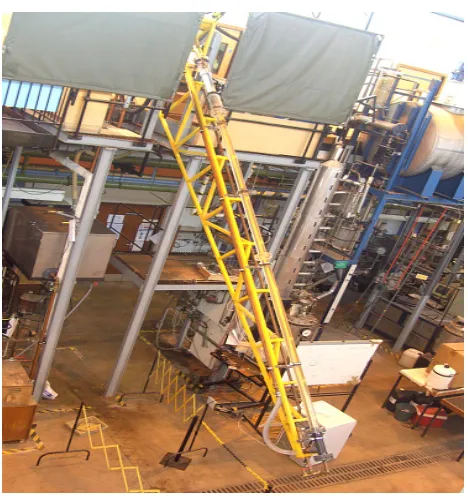
Figure 1: photo of the Flow Facility
3. Fluids Used
[image:4.612.182.416.70.318.2]For this research; two fluids have been used at atmospheric conditions. The Table (1) below shows the summary of physical properties of the fluids used in this study.
Table 1: Fluids Used in the Project
Parameter Air Silicone oil Unit
Relative permittivity 1 2.7 -
Density 1.224 925 kg/m³
Viscosity 0.018 5.25 mPa⋅s
4. Electrical Capacitance Tomography
Characterization of Oil / Gas Flow Pattern in Vertical Pipes using
[image:5.612.249.377.91.272.2]Electrical Capacitance Tomography 163
Figure 2: Photo of the Electrical Capacitance Tomography (ECT)
5. Results and Discussion
5.1. Flow Configurations
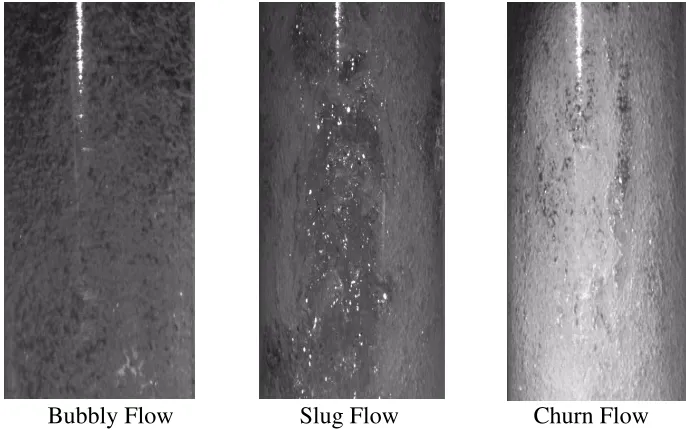
Several flow patterns can be observed during the operation of a two phase flow in in oil industry. In this study, various flow patterns such as bubbly, slug and churn flow were observed with the aid of high speed video camera at a different liquid and gas superficial velocities. The flow pattern is of paramount importance to characterise the two-phase mixture, as most models and correlations are developed for a particular flow pattern. Figure (3) shows the typical visual representation of flow patterns observed in the present project. As can be seen, at the low gas superficial velocity, the flow is characterised by bubble of different sizes moving up in liquid continuum. This flow identified and called bubbly flow. By turning up the gas flow rate more the flow is characterised by slug flow which approximate to the pipe diameter followed by non-aerated liquid slugs. As gas superficial velocity increases more; churn flow was appeared.
Figure 3: High speed camera footages of the flow for different flow pattern; a-bubbly, b- cup bubble, c- slug flow and d- churn flow
[image:5.612.140.483.523.738.2]5.2. Void Fraction
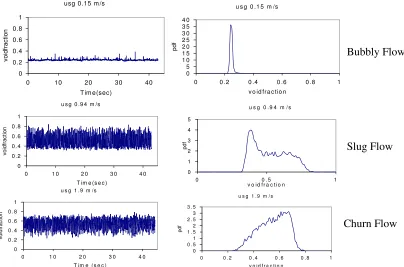
[image:6.612.173.433.240.401.2]One of the most general parameter that can be used to qualitatively describe a two-phase mixture is the mean void fraction. Therefore, flow identification based on the analysis of void fraction was carried out by Jones and Zuber (1975); the void fraction of output signals of ECT obtained at different flow conditions and are presented in Figure (4), the figure shows and demonstrated the void fraction increases when the superficial velocities of gas is increases. In addition, one of the most common methods of flow pattern identification is the Probability Density Function (PDF) method. It has been used by several authors Costigan and Whaley (1997) for vertical flow. Application of the PDF method to the cross-sectional averaged data of electrical capacitance tomography output has been determined and plotted. Figure (5) shows, a typical example of the flow patterns observed in this study.
Figure 4: Main Void Fraction as Function of Gas Superficial Velocity for Different Oil Superficial Velocity.
0 0.1 0.2 0.3 0.4 0.5 0.6 0.7 0.8 0.9 1
0.0 1.0 2.0 3.0 4.0 5.0 6.0 7.0
Gas superficial velocity(m/s)
o v e ra ll v o id fr a c ti o n
0.052 0.079 0.1 0.157 0.314 0.419
Liquid superficial velocity (m/s)
Figure 5: Time Series Void Fraction and Probability Density Function (PDF) for Liquid Superficial Velocity = 0.54 m/s and Different Flow Rate of Gas.
u s g 1 . 9 m / s
0 0 . 5 1 1 . 5 2 2 . 5 3 3 . 5
0 0 . 2 0 . 4 0 . 6 0 . 8 1
v o i d f r a c t i o n
p
d
f
u s g 0 .1 5 m /s
0 5 1 0 1 5 2 0 2 5 3 0 3 5 4 0
0 0 .2 0 .4 0 .6 0 .8 1
v o id fra c tio n
p
d
f
usg 0.15 m /s
0 0.2 0.4 0.6 0.8 1
0 10 20 30 40
Tim e(sec) v o id fr a c ti o n
u s g 1 . 9 m /s
0 0 . 2 0 . 4 0 . 6 0 . 8 1
0 1 0 2 0 3 0 4 0
T im e ( s e c )
v o id fr a c ti o n
u s g 0 . 9 4 m / s
0 1 2 3 4 5
0 0 . 5 1
v o id f r a c t io n
p
d
f
u s g 0 .9 4 m /s
0 0 .2 0 .4 0 .6 0 .8 1
0 1 0 2 0 3 0 4 0
T im e (s e c )
[image:6.612.98.502.453.720.2]Characterization of Oil / Gas Flow Pattern in Vertical Pipes using
Electrical Capacitance Tomography 165
5.3. Frequency
As stated above, in oil industry in particular pipelines different flow configuration occur at different flow conditions. This intermittent behaviour can be characterized by the structure dominant frequency. In Figure (6), the dominant frequency is plotted as function of gas superficial velocity. This dominant frequency has been determined by applying the Power Spectrum Density (PSD) technique. Details can be found in Azzopardi (2006). The figure shows there are three zones which are related to the change in flow pattern with increasing gas superficial velocity.
Figure 6: Dominant Frequency as Function of Gas Superficial Velocity for Different Oil Flow Rates.
5.4. Structure Velocity
Structure velocity of flow has been calculated using cross correlation technique, and plotted against mixture velocity of flow, detail of the calculation can be found in L A Abdulkareem (2011). Figure (7) demonstrated that the structure velocity increases as a linear function of the mixture velocity, which is sum of oil superficial velocity and gas superficial velocity. Also, the correlation proposed by Nicklin et al. (1962) been used to calculate the structure velocity for slug flow and compered with present work data. As can be seen, from the figure the initiation of deviation from Nicklin equation shifts to higher velocity gas with increasing superficial velocity of oil.
5.5. Data Validation and Reconstruction Images
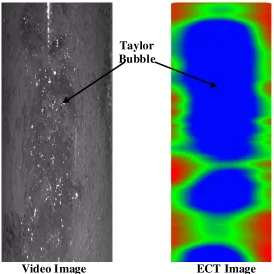
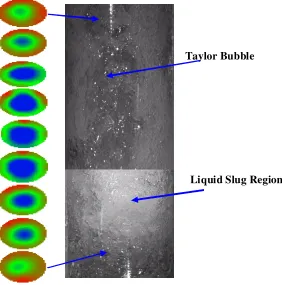
[image:8.612.162.436.191.465.2]As stated above footages using high speed video camera have been made and synchronised with collection of (ECT) measurements, Figure (8). The video footage are satisfactory enough to identify general slug flow from bubbly flow, however the imaging quality does not give much information about the inside shape of the slug. For instance, a side camera has obvious difficulties to differentiate between a near annular flow and a proper slug flow, because the camera can only look at the side of the flow-pattern. Instead of the higher resolution available with the tomographic system.
Figure 8: Visualization of ECT and high speed image for slug flow in vertical pipe.
ECT Image Video Image
Taylor Bubble
Characterization of Oil / Gas Flow Pattern in Vertical Pipes using
[image:9.612.169.451.107.392.2]Electrical Capacitance Tomography 167
Figure 9: Estimated Sliced View of Slug Flow a- Electrical Capacitance Tomography (ECT) Images (Left) ,
b- High Speed Camera Picture (Right).
Liquid Slug Region Taylor Bubble
6. Conclusion
It can be concluded that the Electrical Capacitance Tomography technique has been successfully employed in the measurement of flow parameters in vertical pipes. ECT has the capability to measure structure velocity of flow non-intrusively, and it is able to show detailed void fraction of flow. Probability Density Function (PDF) plot is in agreement with proposal by Jones and Zuber (1975). Also, from PDF plots and high speed camera footages three flow patterns (bubbly, slug and churn) have been observed. The significance of dominant frequency of flow was established with identification of flow configuration on frequency versus gas superficial velocity. In addition, the equation suggested by Nicklin et al (1962) for structure velocity of flow is in reasonable agreement with experimental results of this project.
References
[1] Azzopardi, B.J., (2006), “Gas liquid flows”, Begell House Inc., New York
[2] Wallis, G.B. (1969) "One-Dimensional Two-Phase Flow," McGraw-Hill Book Company. [3] Spedding, P. L., et al (1982), “Pressure Drop in Two Phase Gas-Liquid Flow in Inclined Pipes”,
International Journal of Multiphase Flow, Vol. 8, No. 4, pp. 407-431.
[4] Mishima, K. and Ishii, M., (1984) "Flow Regime Transition Criteria for Upward Two-Phase Flow in Vertical Tubes," Int. J. Heat Mass Transfer, Vol. 27, pp. 723-737.
[5] Hewitt, G.F. and Hall-Taylor, N.S. (1970) "Annular Two-Phase Flow," Pergamon Press Ltd., Oxford.
[7] Bilicki, Z. and Kerstin, J. (1985), “Transition Criteria for Two-Phase Flow Patterns in Vertical Upward Flow”, International Journal of Multiphase Flow, Vol. 13, No. 3, pp. 283-294.
[8] Gamio, J. C., et al (2005), “Visualisation of Gas-Oil Two-Phase Flows in Pressurised Pipes using Electrical Capacitance Tomography”, Flow Measurement and Instrumentation, Vol. 16, pp. 129 134.
[9] Hasan, N.M. & Azzopardi, B.J. (2007) ‘Imaging stratifying liquid-liquid flow by capacitance tomography’ Flow Meas. Instr. Vol. 18, 241-246.
[10] Szalinski, L, Abdulkareem, L.A., Da Silva, M.J., Thiele, S., Beyer, M., Lucas, D., Hernandez Perez, V., Azzopardi, B.J., Hampel, U. (2010) ‘Comparative study of gas-oil and gas-water two-phase flow in a vertical pipe’ Chem. Eng. Sci. Vol. 65, 3836-3848.
[11] Abdulahi, A., Abdulkareem, L. A., Sharaf, S., Abdulkadir, M., Hernandez Perez, V. & Azzopardi, B.J. (2011) ‘investigating the effect of pipe inclination on two-phase gas-liquid flows using advanced instrumentation, Proceedings of the ASME / JSME 8th Thermal Engineering Joint conference, March 13-17, Honolulu, Hawaii, USA, AJTEC2011- 44239; [12] L A Abdulkareem (2011), “Tomographic investigation of gas-oil Flow in Inclined riser”, Ph.D.
Thesis, The University of Nottingham, UK.
[13] L.A. Abdulkareem1 and B.J. Azzopardi2 A. Hunt (2013) ‘Tomographic Investigation of Gas-Oil Flow in Inclined Pipes’ proceeding of 8th Intel Conf.on Multiphase Flow (ICMF 2013), Jeju, Korea.
[14] Abdulkareem, L. A., Hernandez-Perez, V., Sharaf, S. and Azzopardi, B.J., (2011) ‘Characteristics of Air-Oil Slug Flow in Inclined Pipe Using Tomographic Techniques’
Proceedings of the ASME / JSME 8th Thermal Engineering Joint conference, March 13-17, Honolulu, Hawaii, USA, AJTEC2011-44546.
[15] Geraci G., Azzopardi, B.J. & van Maanen H. R. E., (2007), ‘Effect of inclination on circumferential film thickness variation in annular gas/liquid flow’ Chem. Eng. Sci. 62, 3032-3042.
[16] Hernandez Perez, V., (2008), “Gas-Liquid Two-Phase Flow in Inclined Pipes”, Ph.D. Thesis, The University of Nottingham, UK.
[17] Thiele, S., et al (2008) “High-Resolution Oil-Gas Two-Phase Flow Measurement with a New Capacitance Wire-Mesh Tomography” 5th International Symposium on Process Tomography
in Poland, Zakopane.
[18] B. J. Azzopardi, K. Jackson, J.P. Robinson, R. Kaji, M. Byars, A. Hunt, (2008) ‘Fluctuations in dense phase pneumatic conveying of pulverised coal measured using electrical capacitance tomography,Chemical Engineering Science, Vol. 63, pp 2548-2558.
[19] Jones, Jr. O. C. & Zuber, N., (1975), The interrelation between void fraction fluctuations and flow pattern in two-phase flow. Int. J. Multiphase Flow, Vol. 2, 273-306.
[20] Costigan, G. & Whalley, P. B. (1997) ‘Slug flow regime identification from dynamic void fraction measurements in vertical air-water flows’ Int. J. Multiphase Flow, Vol. 23, pp. 263-282.