Chain reaction final report
BYRNE, Eleanor <http://orcid.org/0000-0003-1976-0897>, BOOTH,
Josephine, BEVINS, Stuart <http://orcid.org/0000-0001-7139-1529> and
BULLOUGH, Andy <http://orcid.org/0000-0002-4533-8174>
Available from Sheffield Hallam University Research Archive (SHURA) at:
http://shura.shu.ac.uk/15080/
This document is the author deposited version. You are advised to consult the
publisher's version if you wish to cite from it.
Published version
BYRNE, Eleanor, BOOTH, Josephine, BEVINS, Stuart and BULLOUGH, Andy
(2017). Chain reaction final report. Project Report. SCIENTEX.
Copyright and re-use policy
See
http://shura.shu.ac.uk/information.html
FINAL REPORT
Grant Agreement number: 321278 Project acronym: CHREACT Project title: Chain Reaction
Funding Scheme: FP7-SCIENCE IN SOCIETY-2013-1 Period covered: From 01/12/2014 to 30/05/2016
1
Contents
Page
1. Publishable summary 2
2. Project objectives for the period 11
2.1 Overview 11
2.2 Project Objectives for the period (01/06/13-30/11/14) 11
2.3 Follow-up of previous review 11
3. Work progress and achievements during the period 12
3.1 Progress overview and contribution to the research field 12
4. Work packages progress 12
4.1 Work Package 1 - Project Management 12, 84
4.2 Work Package 2 - Website Development 12
4.3 Work Package 3 - Technical Board (TB) Role 19
4.4 Work Package 4 - National EUPRB Development and annual revision 21
4.5 Work Package 5 - Teacher IBSE/EUPRB Briefing 26
4.6 Work Package 6 - In school delivery 33
4.7 Work Package 7 – Conferences 41
4.8 Work Package 8 - Impact and Dissemination 49
4.9 Work Package 9 – Evaluation 72
5. Deliverables and milestones tables 79
5.1 Deliverables 79
5.2 Milestones 80
6. Project management 83
6.1 Management activities 83
6.2 Dissemination and use of the knowledge 87
7. Explanation of the use of the resources 88
7.1 Planned versus Actual effort 89
8. Financial Statements – Form C and Summary Financial Report 90
8.1 Certificates on the Financial Statements 90
2 Publishable summary
A summary description of the project context and the main objectives.
Chain Reaction was a three-year project funded by the European Commission. Its key aim was to develop Inquiry Based Science Education (IBSE) across twelve partner countries—United Kingdom, Italy, Slovakia, Turkey, Bulgaria, France, Slovenia, Germany, Greece, Ireland, Jordan, Georgia. The key underpinning element of the project was the development and deployment of interactive and engaging professional development for science teacher educators from each participating country. The science teacher educators involved were introduced to ‘tried and tested’ inquiry-themed science resources and worked collaboratively with project members to gain a clear understanding of the philosophy and mechanisms involved in designing and facilitating inquiry in the science classroom. Once fully cognisant in the use of the resources the science teacher educators, from each partner, designed and delivered a dedicated professional development course for participating science teachers. The specific nature of each professional development event varied from partner to partner but was consistent in its aim to develop participating teachers’ confidence and skills in using the resources with their science students. Following the professional development sessions in each country, science teachers were able to deliver a series of inquiry-based sessions.
Students in the 14-16 age groups worked in project groups to research scientific scenarios using critical thinking, reasoning and problem solving skills. This inquiry approach enhanced the students’ understanding and
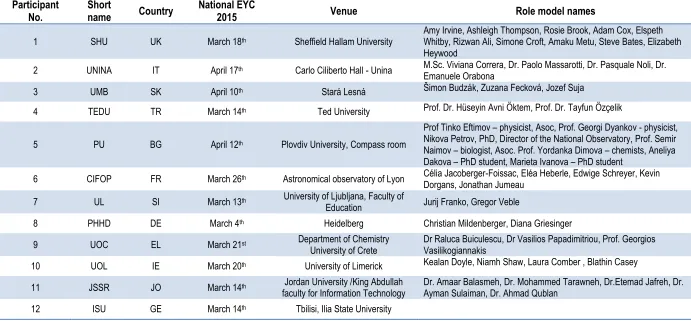
awareness of scientific process and offered an insight into the practice of professional scientists. In an attempt to increase the impact of this element of the project we recruited ‘science role models’ (early year science professionals or PhD students) to support the work of the students in school and to act as conference chairs during national celebration events. Each role model was assigned a school to work with and, through negotiation with the participating science teacher, planned a programme of support that aimed to add to the student
experience. Typically, a role model would support the development of student inquiries in the science classroom, deliver lectures and discussions about science and science careers, and attend national and international
student celebration events.
Participating students’ work was summarized in presentations and shared at national student celebration events. These annual national events took place in each partner country and celebrated science and the work completed by the students. The student presentations encouraged students to detail the inquiry processes they engaged in and share findings whilst being creative and imaginative through their presentations. A significant feature of the structure of the celebration events was that they were organised to reflect typical scientific research conferences in an attempt to provide participating students with an understanding of how professional scientists communicate their work. So, conference programmes were produced that contained abstracts for each presentation, names of presenters and an area for poster presentations was designated. Students engaged in presentations of no more than ten minutes with a further five minutes given for audience questions. During breaks, students were
encouraged to discuss the work presented with their peers and to engage with the wider audience.
Three annual ‘Express Yourself’ Conferences were held at the end of each year of the project and were hosted by—Sheffield Hallam University (year one), Teacher Education University, Heidelberg (year two), and the University of Plovdiv (year three). The international conferences were also structured to reflect a professional science conference and engaged one group of students from each participating country (twelve presentations).
3 Key achievements
Express Yourself Conferences
Since the beginning of the project each participating partner contributed to the professional development of 565 teachers from schools across twelve countries. Each partner designed and delivered a National Express Yourself conference involving more than 4775 students. Three International Express Yourself conferences, with over 1190 delegates, were held at Sheffield Hallam University (2014), the Teacher Education University of Heidelberg (2015), and the University of Plovdiv (2016). Each of these conferences included a high profile key note address from an eminent science professional, interactive workshops and presentations by teams of students.
EUPRB
The project began with 11 existing EUPRB (European Union Pupil Research Briefs) resources. However, each participating partner country was involved in the translation and adaptation of the briefs and a number of teachers took the original template and designed and published their own EUPRB—the project website hosts 14 EUPRBs. The additional resources go beyond the Earth and Space Science context originally offered and cover a range of subject and inquiry topic matter including Obesity and Energy.
Project Website
A main project website was developed with 12 partner websites working alongside this. In addition a number of the consortium partners actively engaged in social media with the creation of dedicated Chain Reaction
Facebook (FB) pages. These have been particularly successful in Jordan and Turkey, with the Turkish FB page reaching 1,014 ‘likes’. The main project website has become a crucial legacy and dissemination tool now the project has been completed. The website has a user friendly platform and hosts all the EUPRB resources, inquiry tool kit, details of the project and partner information as well as a detailed description of the philosophy and mechanics of inquiry based science education. The website also hosts a student guide to delivering conference presentations. All of these resources are available for download free of charge. The website also offers teachers the opportunity to share ideas and experiences with other participant and non-participant teachers through a section of the site dedicated to encouraging teacher interaction.
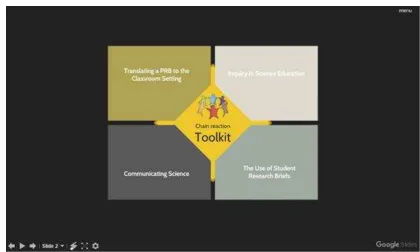
Inquiry Tool Kit
Consortium members collaborated in the designĽ construction and publication of an ‘inquiry tool kit.’ The tool kit was designed to enable classroom teachers to use the whole kit to support development of their own inquiries or to dip in to individual sections as they perceive a need. Teachers can learn about:
using an EUPRB in their classroom setting and context the use of student research briefs
inquiry as an approach to science education communicating science
The Chain Reaction tool kit provides a practical guide for teachers to develop and deliver effective inquiry based science education and can be supported by a range of existing inquiry briefs also hosted on the website.
Dissemination
4 Summary of key academic talks and papers
Part no. / short name
Title or conference Journal / date of conference/location
Part. 1 / SHU
Using guided inquiry in science classrooms in England:
potential versus reality (Bevins et al. Under review
Internal seminar at a Post-doctoral Forum 21st January 2016, Sheffield Institute of Education - Stuart Bevins
Internal seminar
Sheffield Institute of Education on 24th January 2016. Given by Stuart Bevins, Josephine Booth and Eleanor Byrne
Poster presentation European Science Education
Research Association (ESERA) Conference Helsinki 28th of August to the 2nd of September
Chain Reaction - a sustainable approach to Inquiry based science education
Association of Science Education conference, 06 – 09 January 2016, University of Birmingham
Chain Reaction
Sheffield Hallam University Internal seminar at a Post-doctoral Forum, 24th January 2016
Part. 1, 4 and 12 /
SHU, TEDU, ISU
Chain Reaction Teacher Seminar
Chain Reaction Teacher Workshop, 10th May 2015, Plovdiv Bulgaria
Part. 2/ UNINA
(1)Secondary students’ views about scientific inquiry (2)Science teachers’ transformations while implementing inquiry-based teaching-learning sequences.
Submitted: Proceedings of GIREP-MPTL 2014.
The Chain Reaction project -presentation ESERA, Finland 2015
Part. 3 / UMB
Conference presentation and a paper published in the
conference proceedings PrešovĽ 30. 9 – 2. 10. 2015
Part. 4 / TEDU
Conference Presentation 12th Good Practices in
Education Conference Istanbul April 11, 2015
Conference Presentation (1st Regional Forum on Science
Education in the Arab Curricula) Carthage, Tunisia on April 7-8, 2015
Conference Presentation - 13th Good Practices in
Education Conference Istanbul April 2, 2016
Conference Presentation (Argumentation-Based Inquiry [ABI] Conference)
5 Washington, United States on
August 5-7, 2015
Part. 5 / PU
(1) Possibilities of the inquiry based approach to build motivation for studying sciences.
(2) Application of the ISBE in Language School "Plovdiv", Plovdiv.
Bulgarian Chemical
Communications, Volume 42 (pp. 1– 6) 2015
Bulgarian Chemical
Communications, Volume 42 (pp. 6-11) 201
An Attempt to Implement the Inquiry Based Science Education Approach in Physics Education in the Study of Light Sources in Secondary School”Ľ by Zhelyazka Raykova, Kostadina
Katsarova ( ChReact teacher), Ganka Lavcheva (ChReact teacher)
43th National conference for Physics Education, Blagoevgrad, 2-5 April, 2015
EU Project Chain Reaction – good practices for using IBSE 44th National Conference for Physics Education, Yambol, 7-10 April 2016
Possibilities for using IBSE in informal education 44th National Conference for Physics Education, Yambol, 7-10 April 2016
Chain Reaction and the NEYC for 2014 and 2015
In-service Physics Teacher training seminar, organized by Ministry of Education, The municipality centre for working with children, 16.04. 2015
IBSE and the Chain Reaction project
In-service Physics Teacher training seminar, organized by Ministry of EducationĽ “Compass Hall”Ľ Plovdiv University,
12.05.2016 (14.00-18.00)
Part. 8 / PHHD
(1)Chain Reaction – a sustainable approach to Inquiry Based Science Education. In: S. Bernholt (Hrsg.), Heterogenität und Diversität - Vielfalt der Voraussetzungen im
naturwissenschaftlichen Unterricht.
http://www.gdcp.de/images/tb2015/TB2015_384_Marme.pdf (2) First degree exam with the title “To implement inquiry-based science education in everyday teaching by selected
teachers”.https://sslaccount.com/cloud.chainreact.eu/index.php/ s/MjwCDymDBzITxMQ
6 Part. 9 /
UOC
Approaches of Inquiry Based Science Learning in Secondary Education Kallia Katsampoxaki,
1st International Conference on: New Developments in Science and Technology Education (NDSTE 2014), 29-31 May 2014, Corfu, Greece
(http://ndste2014.weebly.com/ )
IBSE Case Study: Student perceptions of science and inquiry after a two year IBSE project In a Greek secondary school Kallia Katsampoxaki and Nikos Chaniotakis,
Scientix National Conference: Inquiry based learning and Creativity in Science Education, 9-10 October 2015, Athens, Greece
(http://www.scientix.ea.gr/ )
Evaluation and implementation of teaching approaches small research / exploratory learning for secondary school teachers and students, Maria Fouskaki,
Conference: Mediterranean - Waterline: Posing interdisciplinary questions in teaching, 4-8 December 2015, West Crete, Greece
(http://mediterraneanmappingunkow nedu.weebly.com/ )
Interactive Learning in Science and Engineering Education Nikos Chaniotakis,
International Conference: Mediterranean Sea Connects Us: Progress in Education with Local Communities, 9-13 December 2015, West Crete, Greece
Kallia Katsampoxaki-Hodgetts, Maria Fouskaki, Katy Siakavara, Roumpini Moschochoritou, Nikos Chaniotakis (2015). Student and Teacher Perceptions of Inquiry Based Science Education in Secondary Education in Greece.
American Journal of Educational Research, 3(8), 968-976.
Part. 10 / UOL
Chain Reaction: Promoting a Sustainable Approach to the use of Scientific Inquiry in the Chemistry Classroom (in
progress) Chemistry in Action
Poster presentation European Science Education
Research Association (ESERA) Conference Helsinki: 28th of August to the 2nd of September
Presentation - Galway, March 2014 (not reported in 18
month report) Irish Science Teachers Association
(ISTA) Conference
Part. 11 / JSSR
Chain Reaction Develops Jordanian Student Inquiry Skills as Perceived by Participating Teachers:
https://dub128.mail.live.com/mail/ViewOfficePreview.aspx?mes sageid=mgY04vaBAw5hGWididZ1xuSA2&folderid=flsent&attin dex=0&cp=-1&attdepth=0&n=94438187
7 Part. 12 /
ISU
Inquiry based science education and project chain reaction in Georgia
ESERA 2015 Conference, Helsinki, Finland, 31.08.15 – 4.09.15
Inquiry based science education and project chain reaction in Georgia
International Conference IOSTE - International Organization for Science and Technology Education Istanbul, Turkey, 24 – 26 April, 2015
Inquiry based science education and project chain reaction in Georgia
International
Conference ’’Science
Education and Green
Chemistry for a Sustainable
Future’’HaifaĽ IsraelĽ 2.12.15
–
3.12.15
Inquiry based science education and project chain reaction in Georgia
LeLa Tagung Saarbrücken, Germany, 13-15 March, 2016
Sustainability
Sustainability of the project is crucial and a range of actions have taken place through each partner country to ensure that maximum sustainability has been reached:
Turkey - alignment with the national curriculum was achieved during the teacher training, EUPRB development and in-school delivery. The Turkish partners were also involved in the Amgen Teach Project which allowed them to deliver a 3 day pre-training (baseline) workshop which focused on teaching, learning, inquiry and
misconceptions. There was a big focus on changing the epistemological orientations of the teachers.
Bulgaria - Bulgarian partners involved pre-service teachers within the project and offered training workshops to pre-service teachers within Plovdiv University. The Bulgarian partners also founded a society for teachers to allow for regular meetings and discussions that will encourage reflection and sharing focused on inquiry based science education beyond the project’s completion.
Germany -the German partners focused on facilitating pre-service teachers in developing inquiry based practices. They have also been involved in supporting a network within the project which they hope to continue and encourage teachers beyond the project to become members.
8 Slovenia - the Slovenian partners have focused on the use of technology in promoting the Chain Reaction project and believe that training can allow for a positive alignment between the use of technology and the act of inquiry in the science classroom.
Greece –A need to change science teachers’ beliefs and culture regarding inquiry dominated the Greek approach to sustainability through PD events. They have also issued formal certificates to in-service and pre-service teachers to acknowledge their involvement in the Chain Reaction project and encourage further involvements.
France - in France the partners focused on the use of peer to peer teaching to support the professional
development of in-service teachers. The main aim here was to establish reflection between teaching colleagues as a way of developing a culture of inquiry in science education.
UK - the UK used existing science learning centres to support the dissemination of the project. Similar to other partner countries, they have focused on initial teacher training as part of the sustainability of inquiry based practices.
Georgia - Georgia organised events such as the “Science Picnic” which promotes the place of science in society. They also developed a curriculum portal which contains activities related to the key features of inquiry.
Italy - the Italian partners also involved pre-service teachers and provided certification to participating teachers. They also developed a Chain Reaction Italy Facebook page and through this they have disseminated spam emails which contain Chain Reaction FB resources.
Ireland - the Irish partners focused on involving national bodies such as the NCCA and the PDST in promoting the Chain Reaction project. Ireland established a new curriculum in 2015 and included the Chain Reaction model within the new framework. Ireland also provided teacher training as part of the Amgen project. They also
developed a professional development folder for teachers to keep track of their learning. This folder also provides a record to policy makers of their involvement in school self-evaluation (SSE) which is a new initiative that schools must abide by.
The Chain Reaction Consortium
The Chain Reaction consortium has grown in strength over the project duration. All partners achieved their anticipated outputs but have gone beyond expectations in terms of learning and understanding of inquiry based science education and its pragmatic use by teachers in school science. The consortium developed a ‘family’ spirit which enabled a collaborative approach to problem-solving and sharing new ideas. Members have already begun discussions on how to sustain the consortium post-Chain Reaction and how we might develop the shared learning from the project.
Participant No Participant organisation name Country
1
(Coordinator) Centre for Science Education, Sheffield Hallam University United Kingdom 2 Physical Sciences Department, Naples University Federico II Italy
3 Faculty of Natural Sciences, Matej Bel University Banska Bystrica Slovakia
4 Education Department, TED Universitesi, Ankara Turkey
9
6 Centre International de Formation Pédagogique France
7 University Ljubljana Slovenia
8 University of Education, Heidelberg Germany
9 Department of Chemistry, University of Crete Greece
10 Department of Education & Professional Studies, University of Limerick Ireland
11 Jordan Society Of Scientific Research, Amman Jordan
12 Ilia State University, Tbilisi Georgia
Public website address: www.chreact.eu
Chain Reaction Partner websites:
Partner website address
10 Partner 5 (PU) http://chainreact.dipseil.net
Partner 6 (CIFOP) www.chreact.fr Partner 7 (UL) www.chreact.si Partner 8 (HUED) www.chreact.de Partner 9 (UOC): www.chreact.gr
Partner 10 (UOL) http://www.ul.ie/chainreaction/ Partner 11 (JSSR) www.chreact.jo
11 2. Project objectives
2.1 Overview
This final report is structured to tell the story of the Chain Reaction project from inception, through delivery and completion. It details, with examples, the model and philosophy, achievements, difficulties and development of the project over its 3-year period.
Chain Reaction established and delivered an Inquiry Based Science Education (IBSE) approach through twelve partner countries over a three-year period. The project provided interactive and engaging IBSE professional development to teacher education professionals from each participating nation using tried and tested inquiry based science resources originally called Earth and Universe Pupil Research Briefs (EUPRBs). These EUPRBs presented realistic scenarios to reflect real world professional science, support inquiry based teaching and learning of science and involve engaging topics designed to appeal to both genders.
The project model briefed participating teachers through a dedicated course in each partner country. Once fully confident with the IBSE model and the resources (EUPRBs) provided, the participating teachers delivered a series of exciting and student- focussed lessons which explored the research projects offered through the EUPRBs. Using critical thinking, reasoning and problem solving skills, students in the 14-16 age groups worked together to research scientific scenarios. Their work was summarised in presentations that were shared at national student celebration events. These annual national events took place in each partner country and celebrated science and the work completed by the students. The student presentations encouraged students to detail the inquiry processes they engaged in and share findings whilst being creative and imaginative through their presentations. The national events also engaged practising scientists (early year science professionals or PhD students) who acted as role models for the students and shared their work to inform and encourage young people to consider a career in science related fields. Practising scientists were recruited from local industry and research institutions early on in the project. National conferences were followed by an international conference which a number of students from each national conference were selected to attend. Acting in assessment teams with participating teachers, the role model scientists identified students to participate in the annual International Conference.
2.2 Project Objectives
Chain Reaction had seven key objectives:
1. Adapt and disseminate a set of themed inquiry based science resources (EUPRBs), that meet each partner’s cultural and curricular needsĽ to be used for briefing teachers and in the classroom 2. Promote the use of IBSE in secondary schools across the 12 partners via a programme of teacher
development which will engage young people in science through student-led inquiry based research 3. Help bridge the existing gap between science teachers and the science education community 4. Promote a European teacher network
5. Engage in effective dissemination of resources (EUPRBs) and effective practice 6. Design and deliver effective evaluation and reporting models
7. Hold 36 national and three international celebration events for teachers and students.
2.3 Follow-up of previous review
12 However some recommendations were made:
The evaluators were unclear about the reporting of deliverables as these were not considered to be sufficiently detailed. More information was required regarding activity across the consortium and more systematic reporting was encouraged
Issues were outlined relating to the project websites, including missing information
3. Work progress and achievements
3.1 Progress overview and contribution to the research field
Chain Reaction has continued to be successful. The consortium is strong and the milestones and deliverables for the project have been met.
Since the submission to the Chain Reaction 18 month report the project has:
Used strong management procedures and structures across the consortium Updated the project resources to suit national contexts, and translated as necessary held regular project management board meetings
Re-launched the main project website and some partner websites
continued to brief teachers across all partners in IBSE approaches and the project resources supported teachers and schools in the delivery of IBSE
delivered 24 national conferences (12 in 2015, 12 in 2016)
held two international conferences, in Heidelberg, Germany in 2015, and Plovdiv, Bulgaria in 2016 held pupil inquiry days after the international conferences
produced a "toolkit" guide to IBSE as a project legacy
held a teacher workshop in Plovdiv, Bulgaria as part of the international conference which involved teachers from all three years of the project from all partners
involved early year scientists in both schools and the conferences been subject to evaluation
4. Work packages progress
4.1 Work Package 1 - Project Management
Please see Management Section
4.2 Work Package 2 - Website Development
This work package was led by the University of Crete, Greece (Partner 9).
Predicted start and end dates for WP2
Start Month 2 End Month 36
Actual start and end dates for WP2
13 Objectives
Produce one main website for general information about the project Produce 12 partner state sites which are linked to the main website Maintain and update each site at regular intervals
Progress
[image:15.595.67.387.235.421.2]The main site was launched on December 10th 2013 and can be found at www.chreact.eu.
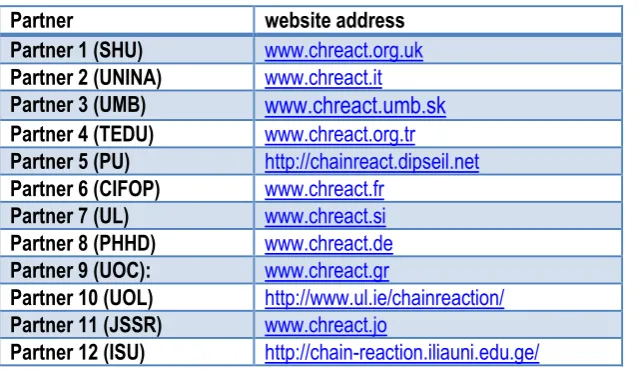
Table 4.2.1 - Domain names for Chain Reaction Partner websites
Partner website address
Partner 1 (SHU) www.chreact.org.uk Partner 2 (UNINA) www.chreact.it Partner 3 (UMB)
www.chreact.umb.sk
Partner 4 (TEDU) www.chreact.org.tr Partner 5 (PU) http://chainreact.dipseil.net Partner 6 (CIFOP) www.chreact.fr
Partner 7 (UL) www.chreact.si Partner 8 (PHHD) www.chreact.de Partner 9 (UOC): www.chreact.gr
Partner 10 (UOL) http://www.ul.ie/chainreaction/ Partner 11 (JSSR) www.chreact.jo
Partner 12 (ISU) http://chain-reaction.iliauni.edu.ge/
Significant Results
The WP leader maintained and updated a comprehensive project website alongside twelve partner sites. Partner sites include links to social media, information regarding participants (including role model biographies), picture galleries and information about the national delivery including high quality videos.
Feedback provided at the project's 18 month review meeting along with partner comments at the PMB in Month 24 lead the consortium to identify that the project website was insufficient in both its overall appearance and content. The original website template had been designed primarily to make structuring information easy for all partners, regardless of language or cultural differences. It served its purpose and helped considerably in coordinating the type of content that we felt should be available online to all stakeholders. However as the content grew we quickly identified the need to cater more efficiently to a larger, more diverse audience and moved forward with a major redesign, for increased appeal to first-time visitors and interested schools, teachers and policy makers from the education community. The new design simplified the overall structure and improved visitor interaction by consolidating similar categories. After its initial testing and deployment on the main project website, the new template was made available to all partners with detailed instructions on how to deploy it with their national websites. While most partners adopted the new design, some struggled to find the time and/or web trained staff to make the suggested changes and as such the PU, UL, PHHD, UOL and ISU sites remained in the old format. Jordan adopted an Arabic (Right-To-Left) template that was slightly different in order to more
efficiently cater to its main audience.
The main project website
14 Reaction sites was safely maintained inside a climate controlled server room with access restricted to authorized personnel only. Every measure was taken to ensure the equipment’s uninterrupted operationĽ including the purchase and deployment of a separate Uninterruptible Power Supply (UPS) unit solely for the Chain Reaction hardware within the Server Room.
Our dedication to usability extended to testing both the old and new templates for mobile-friendliness, making sure that all visitors had unimpeded access from all devices (i.e. desktop computers, laptop computers, tablets, and smartphones). The work that went into assuring a mobile-friendly design directly transferred to all partners who opted to use the templates, which provided a uniform experience across our network.
The most important and frequently visited section of the main Chain Reaction website was the page dedicated to Teacher Resources. These were updated and modified as necessary to bring them in line with the most current research outputs, curriculum developments and local contexts. The Research Briefs that are now permanently hosted on the website are:
Collision course Cosmic website ET phone earth Feed the world Green heating Green light Mars-ology
Out of sight, out of mind Ozone conference
PHEPPS
Where is Ethanol Plants in space Energized Obesity
15 Figure 4.2.1: The Chain Reaction Toolkit, an interactive presentation regarding Inquiry Based Science Education
Dissemination and Networking through the website
First and foremost the project website is a dissemination platform attempting to reach all stakeholders in an appealing and efficient manner. After the site redesign, we transitioned from a platform tailored to the needs of our partners and collaborating teachers to one aimed at a wider audience of students and teachers interested in recent advancements in the field of Inquiry Based Science Education.
An important part of Chain Reaction was networking among educators, IBSE researchers and even aspiring science teachers. During the final yearĽ the Project’s website was transitioned to better facilitate this. The forum was built from the ground up to serve as a platform for teachers to interact, exchange information, pose questions and have them answered. It is also a convenient repository for information from our partner teachers aimed at their colleagues in a direct and unmediated fashion. Additional networking opportunities stem from our Project listing on the Scientix.eu website. Scientix is a prominent community for science education in Europe where we have outlined some key information on our work and to which we’re actively linking from every page of our website, in an attempt to promote awareness of other STEM-related projects and attract collaborators alike.
Upon the Project’s completion we had accumulated a range of invaluable data which touched directly on the potential impact of Chain Reaction on IBSE policies throughout the European Union. As a result, we chose to compile a paper which will be useful to policy makers, education professionals and researchers focused on IBSE. The paper is prominently displayed within the main website, since we expect it to serve as an indispensable reference to interested parties throughout the European Research Area and beyond.
The 12 Partner Websites
The variable needs of each partner regarding the national websites and their intended target audience
manifested during the first 18 months of the Project. Considerable effort was made to strike the perfect balance between a common uniform branding and individual customization.
16 their own strategy to better suit their own needs and target audience. That led to an interesting mix of social media engagement, blogging, video sharing and other web services.
Particular examples of note are the following:
Blogging
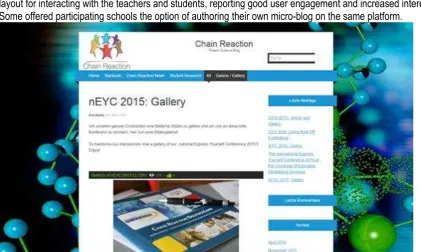
The web platform we chose allowed for several different ways to present information, including a blog format, which has become popular as a more direct and less formal dissemination medium. Some partners chose a blog layout for interacting with the teachers and students, reporting good user engagement and increased interest. Some offered participating schools the option of authoring their own micro-blog on the same platform.
[image:18.595.73.495.176.428.2]Figure 4.2.2: A blog hosted on the German partner website, the most prominent user of the format
Social Media
Several partners opted to complement their web presence by employing established social media such as Twitter and Facebook. The importance of social media accounts varied greatly among partner countries. It was deemed unnecessary to force this approach on partners where their impact would be negligible, but it was reported by some as a useful addition to the more formal communication through their actual website.
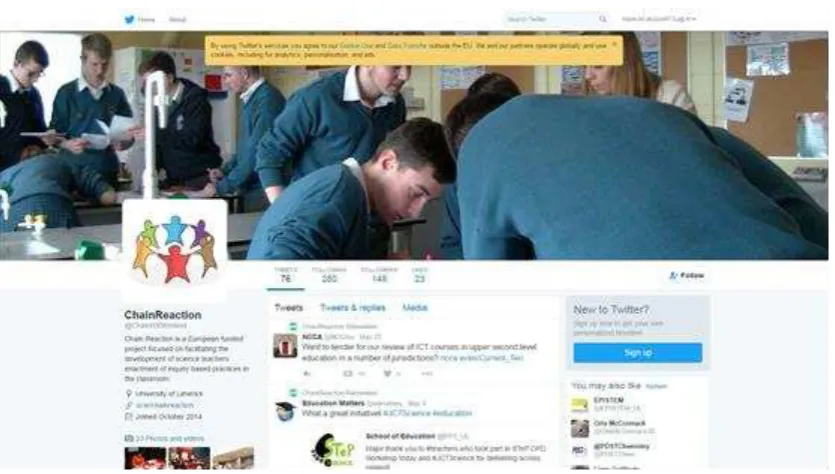
17 Figure 4.2.4: The Irish partner Twitter account
Twitter was a popular choice, with a feed embedded in some national sites. It served primarily as a means to post quick news related to the national team activities. UnderstandablyĽ it wasn’t deemed very useful as a medium for two-way communication.
Video sharing
Virtually all partners created and shared video content through the national websites. The most frequently used video hosting sites were YouTube and Vimeo, but some partners also opted to store the content on their own servers. Video content provides high impact and promotes user engagement, which explains why it was employed throughout our consortium.
Figure 4.2.5: UK Partner website, with embedded video hosted on Vimeo, a popular video hosting platform The Future of the Website
18 Furthermore, we have arranged for the main website domain name to be active until at least 2023, acting as a central repository of information for innovative educators and inquisitive students. We intend to build on the knowledge acquired during the Project’s funded run, sporadically updating the content into the foreseeable future, as new information becomes available or relevant research papers are published by partners.
Resources: WP2 (Months 1-18)
Partner 1 2 3 4 5 6 7 8 9 10 11 12 Total
SHU UNINA UMB TEDU PU CIFOP UL PHHD UOC UOL JSSR ISU
Actual for
months 1 - 18 1.9 3.03 2.14 3.53 2.1 1.96 1.1 5.26 12.29 0.75 3.01 3.74 40.81
Resources: WP2 (Months 19-36)
Partner 1 2 3 4 5 6 7 8 9 10 11 12 Total
SHU UNINA UMB TEDU PU CIFOP UL PHHD UOC UOL JSSR ISU
Planned for
months 19-36 1.5 2.75 3.5 2.75 2.25 2.5 2.5 3.75 5 3.25 3.25 3.5 36.5
Actual for
months 19-36 1.7 1.75 2.96 3.12 3.1 1.09 1.6 4.11 12.31 1.92 3.54 3.13 40.33
Resources: WP2 (Months 1-36) TOTAL
Partner 1 2 3 4 5 6 7 8 9 10 11 12 Total
SHU UNINA UMB TEDU PU CIFOP UL PHHD UOC UOL JSSR ISU
Planned for
months 1-36 3 5.5 7 5.5 4.5 5 5 7.5 10 6.5 6.5 7 73
Actual for
months 1-36 3.6 4.78 5.1 6.65 5.2 3.05 2.7 9.37 24.6 2.67 6.55 6.87 81.14
Resources: WP2 (Months 37-38) Reporting period
Partner 1 2 3 4 5 6 7 8 9 10 11 12 Total
SHU UNINA UMB TEDU PU CIFOP UL PHHD UOC UOL JSSR ISU
Actual for
months 37-38 0.1 0 0 0 0 0 0 0 0 0 0 0 0.1
19 4.3 Work Package 3 - Technical Board (TB) Role
This is led by Sheffield Hallam University, UK (Partner 1).
Predicted start and end dates for WP3
Start Month 1 End Month 4
Actual start and end dates for WP3
Start Month 1 End Month 36
Objectives
Deliver high quality IBSE/EUPRB briefing to all members of TB
Ensure all members of TB feel adequately equipped to modify EUPRBs for use within own national education system
Ensure all members of TB feel adequately equipped to design IBSE/EUPRB briefing for their own teacher briefing sessions
Ensure TB support is provided throughout length of project from project Technical Manager
Significant Results
This Work Package was scheduled to come to an end in month 4, however it soon became evident that time would be required throughout the full life span of the project for updating and modifying TB support and training. Some partners chose to drip feed the EUPRBs to their TB and schools over the course of the three years and as such support for the TB was ongoing. This meant that the support given to and provided by the TB was able to improve and evolve based on feedback and national/local demands. All deliverables associated with this WP were delivered on time.
After the initial briefing sessions hosted by SHU partners took the training model and applied it in varying ways to meet their own needs and contexts. An example taken from the Greek experience demonstrates this well:
The Greek Technical Board invited participating teachers to attend an eight-hour dissemination event as part of their Chain Reaction training. During this workshop they attended lectures regarding the project’s requirements and IBSE practices around the world. They were given the chance to explore the materials required for the experiments suggested in the student worksheets and devise an initial plan of action regarding one case-scenario after discussion and elaboration with peers. During the project, they were given guidelines and supporting material regarding IBSE practices and they were free to collaborate or ask for support from an appointed project science teacher whose main role was to provide peer mentoring. Peer mentors’ tasks did not include evaluation of the practices reported. Peer mentors were acting as facilitators developing ideas for more experiments and school field trips.
Reaction to the training was highly positive (78% of teachers described the training as excellent). However, a lack of time put great pressure on all participants, and what teachers did not like as much with regards to the Greek training programme was the fact that there was no set time-schedule including itemised tasks and objectives. They wanted something more concrete than mere scenarios. They also asked for an extended list of suggested experiments for each theme (EUPRB) and specific instructions as to how to facilitate experimentation in compliance with IBSE. Another recurring issue was that of students’ knowledge gap and students’ initial hesitation to conduct research on their own (with minimal teacher intervention). The Greek Technical Board was able to identify some specific issues relating to Student engagement with the project:
Students (just like their teachers) did not know exactly what to do in the beginning. Students had not realised how complex research can be.
20 Students could not understand University level papers provided. Students initially struggled to make
working associations between theory and experiment
Students initially struggled to apply the inquiry method in a reliable way.
Despite the challenges however, when asked whether they would participate in this project again, the vast majority of teachers (78%) and (teacher) peer mentors (100%) responded in a positive way and were eager to take in the same project again in the future.
Elements of the programme that changed
Year 1 Years 2 and 3
Source of training input input given to teachers by two Peer mentors assigned by Technical Board Leaders over the phone, monthly visits and by email.
input given to teachers through an asynchronous, accessible to all forum in which peer mentors included colleagues that implemented the project the previous year and the TB Training
Transparency of feedback and communication
No significant feedback produced Identification of congruent perceptions of the Nature of science among teachers of different disciplines, knowledge gaps and misconceptions are already apparent using the Forum. Timetable:
guidelines and deadlines
1 Role Model Visit and National Conference
Teachers had to discuss every week reported difficult issues well before these actually happened:
Organising group work, group dynamics and students norms for civil discussions Critical thinking skills and six
thinking hats Identifying Students’
knowledge gap and what to do next
How to design lessons so as to enable students to identify reliable resources
Experimental method: In what ways can teacher’s help students understand the method, variables and control and held them apply it in their context?
Field trips: supporting teachers plan and organise them.
Support
More experiments to supplement the existing ones given in EUPRBS
None or one in each EUPRB Next to each EUPRB link (on our Website), there is a list of related experiments and instructions Teacher’s knowledgeĽ skills gap Little reflection from teachers
encouraged
Through the Forum, teachers ask or give substantive feedback to their colleagues.
Role Models Visit Later in the project Earlier in the project
Action Research Optional and teacher initiated Teachers are invited and provided with guidelines as to how they can research issues relevant to IBSE.
21 Resources: WP3 (Months 1-18) TAKEN FROM INTERIM REPORT
Partner 1 2 3 4 5 6 7 8 9 10 11 12 Total
SHU UNINA UMB TEDU PU CIFOP UL PHHD UOC UOL JSSR ISU
Actual for
months 1 - 18 1.2 3.31 3.09 4.85 2.5 2.29 3.5 3.84 5.6 2.92 2.46 3.98 39.54
Resources: WP3 (Months 19-36)
Partner 1 2 3 4 5 6 7 8 9 10 11 12 Total
SHU UNINA UMB TEDU PU CIFOP UL PHHD UOC UOL JSSR ISU
Planned for
months 19-36 4 2.5 2.5 2.5 2.5 2.5 2.5 2.5 2.5 2.5 2.5 2.5 31.5
Actual for
months 19-36 0.3 0.429 1.73 0.6 4 0.33 2.1 1.87 2.4 3.26 2.57 0.96 20.549
Resources: WP3 (Months 1-36) TOTAL
Partner 1 2 3 4 5 6 7 8 9 10 11 12 Total
SHU UNINA UMB TEDU PU CIFOP UL PHHD UOC UOL JSSR ISU
Planned for
months 1-36 8 5 5 5 5 5 5 5 5 5 5 5 63
Actual for
months 1-36 1.5 3.739 4.82 5.45 6.5 2.62 5.6 5.71 8 6.18 5.03 4.94 60.089
The resource usage tables show the person months over the course of the project, and per 18-month period, as well as the actual time spent per partner on WP3. As is evident from the Total table (in red) WP3 required 2.911 fewer person months than initially predicted. This was in large part due to the under spend of time from partner 1. The support requirements placed on the Technical Manager (located within Partner 1’s PMB) were much smaller than initially predicted as once the partners were familiarised with the briefing materials they felt confident in delivering all of the support required to their national TB. As suchĽ the Technical Manager’s role was much smaller than had been initially designed.
4.4 Work Package 4 - National EUPRB Development and annual revision
This work package is led by University Ljubljana, Slovenia (Partner 7).
Predicted start and end dates for WP4
Start Month 1 End Month 5
Actual start and end dates for WP4
Start Month 1 End Month 36
Objectives:
22 Significant Results
[image:24.595.45.563.323.621.2]All partners were provided with eleven EUPRBs at the beginning of the project. Some partners chose to adapt and translate all of the resources immediately whereas others decided to adapt and translate them gradually over the course of the three years allowing their TB to introduce new ones year on year.
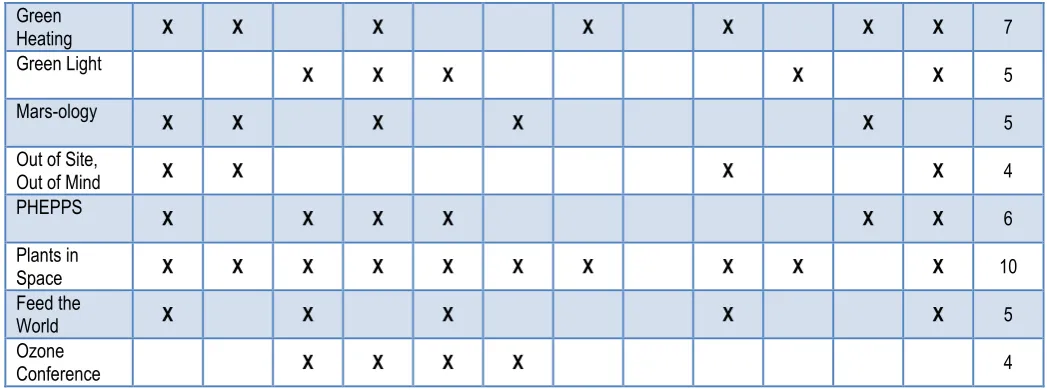
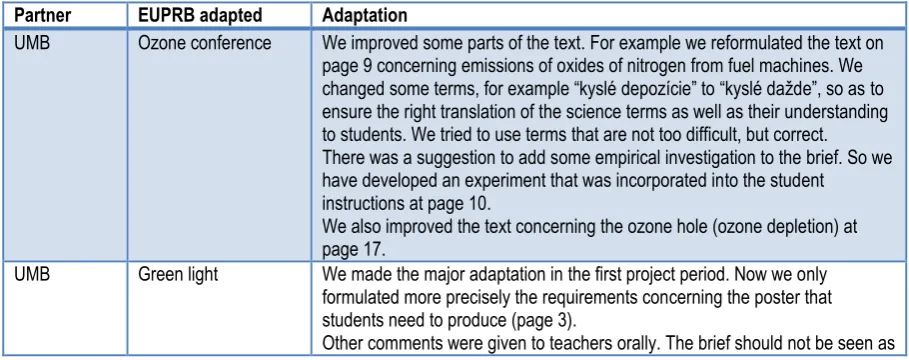
Table 4.4.1a, 4.4.1b and 4.4.1c illustrate the EUPRBS used with schools in years 1, 2 and 3. As can be seen, Plants in Space and Green Light were the most commonly used resource across the consortium with most partners using them year on year. During the second half of the project (months 19-36) more partners began to design and implement their own EUPRBS. Table 4.4.2 demonstrates the work undertaken by UOL, PHHD and UL in producing new resources whereas table 4.4.3 lists the adaptations made by UMB, UOL, CIFOP, PU, PHHD, UOC and UL to the original EUPRBs.
[image:24.595.44.564.665.767.2]This Work Package was scheduled to come to an end in month 5, however, it was decided that the EUPRB revisions would be required annually to allow for new resources to be developed and existing resources to evolve based on feedback.
Table 4.4.1a - EUPRBs used by partner in Year 1
Partner 1 2 3 4 5 6 7 8 9 10 11 12 Total
SHU UNINA UMB TEDU PU CIFOP UL PHHD UOC UOL JSSR ISU
Collision
Course X X X X X X X 8
Cosmic Web
Site X X 2
ET Phone
Earth X X X 3
Green
Heating X X X X 4
Green Light
X X X X X X X X 8
Mars-ology
X X X X 4
Out of Site,
Out of Mind X X X X 4
PHEPPS
X X X 3
Plants in
Space X X X X X X X X X 9
Feed the
World X X X X 4
Ozone
Conference X X X X 4
Table 4.4.1b - EUPRBs used by partner in Year 2
Partner 1 2 3 4 5 6 7 8 9 10 11 12 Total
SHU UNINA UMB TEDU PU CIFOP UL PHHD UOC UOL JSSR ISU
Collision
Course X X X X X 5
Cosmic Web
Site X X X X 4
ET Phone
23 Green
Heating X X X X X X X 7
Green Light
X X X X X 5
Mars-ology
X X X X X 5
Out of Site,
Out of Mind X X X X 4
PHEPPS
X X X X X X 6
Plants in
Space X X X X X X X X X X 10
Feed the
World X X X X X 5
Ozone
[image:25.595.41.565.71.266.2]Conference X X X X 4
Table 4.4.1c - EUPRBs used by partner in Year 3
Partner 1 2 3 4 5 6 7 8 9 10 11 12 Total
SHU UNINA UMB TEDU PU CIFOP UL PHHD UOC UOL JSSR ISU
Collision
Course X X X X X X 6
Cosmic Web
Site X X X X 4
ET Phone
Earth X X X X X X 6
Green
Heating X X X X X X X X X 9
Green Light
X X X X X X X 7
Mars-ology
X X 2
Out of Site,
Out of Mind X X X X X 5
PHEPPS
X X X X X 5
Plants in
Space X X X X X X X X 8
Feed the
World X X X X X 5
Ozone
Conference X X X 3
Table 4.4.2 - new EUPRBs developed Partner New EUPRB developed UOL Badger Conservation UOL Induction Hobs
UOL The physics of parachutes UOL The effect of drugs on living things PHHD Das Sinnesprojekt (The Sense Project)
[image:25.595.41.563.315.615.2]24 PHHD Modell eines Aufwindkraftwerkes (Model of a solar updraft power plant)
PHHD Aufwindkraftwerke – eine alternative regenerative Energiequelle? (Solar updraft power plants – an alternative regenerative energy source?)
PHHD Bau eines MultiChAcc (Construction of a multi chargable accumulator)
PHHD Messung der Hautfeuchtigkeit über den elektrischen Widerstand (Measurment of skin moisture via electrical resistance)
PHHD Messung der Hautfeuchtigkeit über den elektrischen Widerstand (Measurment of skin moisture via electrical resistance)
PHHD Handy-Tankstelle – Netzunabhängige Stromquelle für Kleinelektronik (Mobile fuelling station – network-independent power source for small electrical devices)
PHHD Obsttreibstoff – die Alternative für den Treibstoff der Welt (fruit fuel – the alternative fuel for the world) PHHD Myoelektrische Handprothesen (myoelectrical hand prosthesis)
PHHD Modell zur Nutzung des Aufwindes (Model for usage of updraft power) PHHD Düngereffizienz (Fertilizer efficiency)
PHHD Solar works © (solar works © – Construction of a low-budget solar panel) PHHD Green Gym (Green Gym – Usage of exercise machines for power generating) PHHD Der beste Schutz vor dem Austrocknen (The best defence against skin dehydration) PHHD Energiegewinnung aus Ton (Energy production from sound)
PHHD Green Lantern (Green Lantern – Light energy analysis of a school) UL Smart electric car
UL Efficiency of water turbines UL Effectiveness of wind turbines
PHHD “Im Aufwind” (Solar chimney power plant) PHHD Marmetics (cosmetics)
UL Smart e-cars
UL Efficiency of water turbines UOL Obesity
UOL MND
UOL Ebola
UOL Forces
UOL Badger Culling
UOL Functions and Expressions in Physics UOL Induction Hob
[image:26.595.65.520.581.761.2]The process of EUPRB development for specific national contexts was undertaken in different ways across the consortium:
Table 4.4.3 - original EUPRBs adapted
Partner EUPRB adapted Adaptation
UMB Ozone conference We improved some parts of the text. For example we reformulated the text on page 9 concerning emissions of oxides of nitrogen from fuel machines. We changed some termsĽ for example “kyslé depozície” to “kyslé dažde”Ľ so as to ensure the right translation of the science terms as well as their understanding to students. We tried to use terms that are not too difficult, but correct. There was a suggestion to add some empirical investigation to the brief. So we have developed an experiment that was incorporated into the student
instructions at page 10.
We also improved the text concerning the ozone hole (ozone depletion) at page 17.
UMB Green light We made the major adaptation in the first project period. Now we only formulated more precisely the requirements concerning the poster that students need to produce (page 3).
25 an advertisement of one light source but treated more openly to enable open-ended investigations to be performed and a comparison of the light sources from various perspectives. Disadvantages of the “green” light sources should be taken into the consideration as well.
UMB Green heating It is a newly translated and adopted brief introduced to teachers in Year 3. Besides the adopting they used terminology to enable a suitable fit with the Slovak science curricula we added information on photovoltaic panels (student instructions, p. 8) so that students understand they are different from solar panels. We divided the proof of the hypothesis (p. 11) into two parts.
UOL Green Light Focus on using the Jigsaw method to deliver the lesson. Changed some of the costings to reflect the standard price in Ireland.
Included focus on LED lights.
UL Plants in Space We changed the plant (from pondweed to chicory), the new activities include the construction of a small greenhouse. They also included a light system with LED diodes. Students were changing parameters of the greenhouse in dependence of their research, observing and measuring the growth of the plants.
CIFOP Collision Course An invitation to a comparison to numerical simulations has been added in. CIFOP Ozone Conference An experiment using tobacco plants to measure ozone concentration has been
added
PU Plants in Space Introduced the use of worms to the experiments PU Green Light (2014,
2015, 2016)
In addition, there were some LED light sources being analyzed. Some of the light characteristics of the light sources that were examined had to be additionally taught to the students. (2014 and 2015)
PU Green Heating (2016) They assembled a model of the school in an appropriate scale and the roof was made by photo panels. This was in line with the student’s profile of education- construction engineering. (2016)
PU Out of Site, Out of Mind (2016)
The team of LS “Bertold Brecht”Ľ Pzardjik chose the topic “Out of Site, Out of Mind ”Ľ because it offered a solution for a pressing problem for the community. For quite some time the residents of Pazarjik town and the nearby villages have suffered from a smog that resulted from exhaust fumes coming from the local landfill.
The students were a small group of researchers. They learned the rules for taking and analysing soil samples, and various types of soils. For the migration of heavy elements from the soil to the plants and for the requirements set by the EU for the landfills. They also Explored and offered opportunities to profit from selling lavender oil. These means would allow maintaining the monitoring of the landfill.
PHHD PHEPPS Content modifications and addition of new turbine experiments UOC Green Heating Explicit design models of solar panels added (see the link below
http://www.chreact.gr/?q=node/53). Teachers provided with a list of suggested experiments on this topic.
UOC Ozone Conference Researchers in Chemistry Departments that worked in the field were contacted for support. They contributed by providing papers in Greek for the EUPRBs. Thus, regarding the first strand of the EUPRB, that is, tropospheric ozone, summaries of papers, tables and graphs of recently measured man induced sources of Ozone emissions in a major Greek city, Patras, according to the 2nd Newsletter of INTERREG “European Ground Cooperation between Greece and Italy, June 2013) were added. Other major modifications entailed the provision of the latest measurements of the two monitoring venues in Greece, Finokalia (Crete) and Aliartos (Evia) so that students can make comparative tables of current ozone values on the same day and time. As well as providing students with feedback regarding latest ozone values, the EMEP link ( http://www.nilu.no/projects/ccc/emepdata.html) was provided which offers a direct link to ozone and pollution emission and measurement data in Europe.
26 Resources: WP4 (Months 1-18)
Partner 1 2 3 4 5 6 7 8 9 10 11 12 Total
SHU UNINA UMB TEDU PU CIFOP UL PHHD UOC UOL JSSR ISU
Actual for
months 1 - 18 0.1 3.17 3.68 4.08 0 1.67 4.2 4.01 1.64 1.28 2.1 5 30.93
Resources: WP4 (Months 19-36)
Partner 1 2 3 4 5 6 7 8 9 10 11 12 Total
SHU UNINA UMB TEDU PU CIFOP UL PHHD UOC UOL JSSR ISU
Planned for
months 19-36 0.5 2 2 2 2 1.5 2.5 2 1.5 2 2 2 22
Actual for
months 19-36 0 0.286 2.13 0.6 5 0.08 5.69 0.79 0 4.01 1.79 0.83 21.206
Resources: WP4 (Months 1-36) TOTAL
Partner 1 2 3 4 5 6 7 8 9 10 11 12 Total
SHU UNINA UMB TEDU PU CIFOP UL PHHD UOC UOL JSSR ISU
Planned for
months 1-36 1 4 4 4 4 3 5 4 3 4 4 4 44
Actual for
months 1-36 0.1 3.456 5.81 4.68 5 1.75 9.89 4.8 1.64 5.29 3.89 5.83 52.136
The resource usage tables show the person months over the course of the project, and per 18-month period, as well as the actual time spent per partner on WP4. As is evident from the Total table (in red) WP4 required 7.136 more person months than initially predicted. This was due to the time required during the first 18 months of the project to translate and adapt the EUPRBs to suit local/national demands.
4.5 Work Package 5 - Teacher IBSE/EUPRB Briefing
This work package is led by the University of Plovdiv, Bulgaria (Partner 5).
Predicted start and end dates for WP5
Start Month 1 End Month 35
Actual start and end dates for WP5
Start Month 1 End Month 35
Objectives
Provide high quality TB lead briefing for teachers on IBSE, conference research presentations and the EUPRBs
27 Significant Results
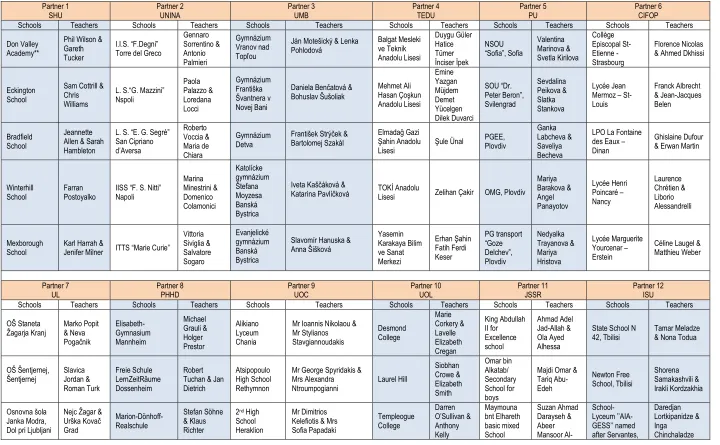
The Chain Reaction Project aimed to train teachers in how to develop and implement IBSE and EUPRBs. Each participating school was identified by the PMB and the TB and two science teachers from each school attended a training session with the TB. The location of the training was within the partner’s institution. At the training session each teacher was introduced in full to the concepts behind IBSE, Chain Reaction and to the EUPRBs. The training also included sessions on preparing students for conferences. This included information about writing research papers based on the investigations completed within the EUPRBs and issues relating to confident public speaking.
The TB provided ongoing support for all participating teachers after training was completed. This included support for in-school delivery with students, colleague workshops and conference preparation and all additional training materials designed by the TB were added to the member state website so that teachers could easily access them at a later date. The TB also visited the participating schools as necessary to support teachers in delivering the materials and approaches.
The IBSE Training
The training was delivered at a national level by the Technical Board (TB) of each partner state. Timescales and duration for training were the responsibility of the individual partners. The training was comprehensive among all the partners in terms of teaching how to use the materials provided, background to the IBSE approach, and introduction of the materials effectively to help teachers to support the development of students' inquiry skills.
The training also sought to create an environment for teachers to engage in IBSE as learner and/or facilitator which was deemed necessary for them to effectively implement IBSE in their own teaching.
A range of examples are set out below to highlight how training sessions were designed and delivered by the partners:
In Italy over the course of the three year project the teacher training was delivered as follows:
YEAR 1: 9 workshops of approximately 3 hours each, from October 2013 to January 2014 YEAR 2: 9 workshops of approximately 3 hours each, from November 2014 to January 2015 YEAR 3: 7 workshops of approximately 3 hours each, from October to December 2015 During the workshopsĽ teachers were introduced to scientific inquiry through an “experimental” approach. Teachers were engaged in the same activities as their students. In small groups they read the materials, designed a suitable research project, performed the experiments, and analyzed the data. This approach enabled them to more easily recognize possible difficulties their students were encountering when engaging in their projects. In this phase, seven EUPRBs were presented to them. The University staff helped the teacher in implementing the experiment and showed how to integrate the IBSE approach in their practice.
In Slovakia the briefing programme consisted of three one-day sessions held in the Faculty of Natural Sciences
Matej Bel University Banská Bystrica. The sessions ran as follows:
Session 1. Initial teacher briefing,
Session 2. Networking meeting of teachers, Session 3. Final evaluation meeting.
28
In Greece the briefing consisted of four sessions:
a. Description of Chain Reaction objectives and 3-year plan b. Lecture on IBSE
c. Presentation of four EUPRBs and discussion of implementation issues or problems
d. Workshop: How to design my own IBSE materials from scratch. In this session teachers in groups designed a preliminary plan of a project on Ozone. Then the TB members would present participants teachers with the respective EUPRB. The main objective of this session is to make all teachers realise that they are free to design or adapt their own material based on the IBSE model if they wish and increase overall teacher confidence
The main objective was to introduce the content and methodology of EUPRBs and create a bank of interested teachers willing and eager to implement the material (even if they were not selected to take part in the Chain reaction project due to number restrictions or other parameters).
Following dissemination, briefing and training event, teacher educators had four two-weekly meetings with the participants on the onset, followed by three monthly meetings:
designing and adapting the material
Providing support regarding student presentation skills/ web log design skills/ research paper writing skills.
Organising a visit by a Young scientist Organising teacher get-togethers Assessing progress
In Ireland the first briefing took place with a one day workshop held in early October. The second briefing took
place in February with a one day workshop. Both briefing sessions were held at the University of Limerick. In total, the workshops last two full days. The workshops begin by teachers sharing what they believe inquiry to look like in practice.
Day One
Working in groups, teachers discussed what they think inquiry is and what it looks like; from the perspective of the teacher and the student. Teachers reflected on the elements of inquiry that they are already implementing in their classrooms as well as features of inquiry that they would like to implement in future teaching. This gathered evidence of existing practice and allowed the teachers to reflect on improvements/developments that they could make to their own professional practice. Educational theory is constituted by the practitioners’ (teachers’) public description and explanations of their own practice (Whitehead 1989).
TeachersĽ in pairsĽ discussed the questions “How do you ‘do’ scientific inquiry in your teaching?” and “What does the inquiring student look like?” in order to create a shared understanding of what inquiry is understood to mean. Teachers placed their thoughts on post it notes that were then placed on the board. These became the talking point for discussion and debate. This process allowed for the co-construction of shared meaning for IBSE between all teachers.
The next part of the workshop focuses on vocalizing the teachers concerns and perceived barriers inhibiting their practice of IBSE in the classroom
All of the above were mapped out on mind maps and posters and are available in the workshop summary report attached.
After discussing their understanding of IBSE and identifying their concerns about implementing IBSE, the professional learning community (PLC) outlined their expectations for Chain Reaction 2015-16.
The PLC expectations for 2015-16:
To make Science funĽ engaging and excitingĽ change pupils’ expectations of Science class-make Science class more like real Science
Expectation of Support: from the UL Technical Board and school structures (management and peers) The UL Technical Board will make arrangements with each school / teacher to visit the schools to
29 of the PRBs.
To be recognised for participation and learning in this CPD
To develop and improve practice: learn practical pedagogies and develop new skills by being open to new ideas and fresh approaches.
To support each other on the Edmodo forum
They then engaged in a lesson study using the Green Light PRB. The purpose of a lesson study is to allow teachers to experience what students may be experiencing within the classroom. It puts the teachers into the role of the student to understand the possible frustrations, fears and eventual understanding that students may experience. There was then a de-brief after the lesson study to understand the teachers thoughts on the experience. This was portrayed on a mind map and is attached in the summary report from the workshop.
The end of the day focuses on preparing the teachers to bring their newly developed understanding of IBSE back into the classroom. The day also looks at additional teaching methodologies that can be used in line with inquiry, e.g. the Jigsaw method (which they experienced in the lesson study the day before) and the use of concept maps (they were given a PowerPoint presentation on this).
Day Two
This day began by having the teachers reflect on the inquiry experience, in terms of understanding what they did in the classroom and what the nature of students learning was. Next the workshop looked at the new Junior Cycle Specification, which is being disseminated in Ireland in September and looked specifically on how the inquiry experience aligns with the new Specification. After this a presentation was given on the 5 e model of inquiry and more specifically on the “engage” feature of the 5 E model. With this, members of the TB showed demonstrations which, it is considered, can help engage students in the inquiry experience. The workshop then moved on to show the teachers another pedagogical strategy called assertive questioning that can be used with inquiry. The workshop ended with a reflection on Inquiry- What are the constraints? What does the Inquiring Teacher/ Inquiring Student look like? The PowerPoints on this from the first workshop were used as a guide to compare the teachers new believes.
All of the teachers participating in the Chain Reaction project required some form of ongoing support from the TB. This varied from partner to partner. Some examples are included below:
In the UK participating teachers attended an initial briefing twilight session (3 hours) which introduced them to the concept of inquiry in the science classroom in an attempt to situate the Chain Reaction approach in a wider context. Through an interactive session teachers discussed and debated the concept and related their experiences of it in their classroom to the wider group. Following this discussion, the teachers were introduced to the briefs and given time to digest the material, to ask questions and formulate draft plans to build upon back in their schools. Teachers were also able to sample some simple experimental work in labs to give them a flavour of what might be possible.
The Tb offered support via visits, and also on the telephone as necessary. The Project managers and the coordinator also visited schools to give advice and guidance.
The level of support needed was generally quite low as teachers in the UK are reasonably familiar with IBSE, although very few use it. More support was needed for preparation for the National and international
conferences, in terms of the format of posters, and the content of presentations as teachers were less likely to be familiar with these types of events.
InItaly there was a requirement forfull support in implementing the proposed EUPRBs. The main reason is that
when implementing IBSE approaches teachers:
found significant differences with their usual teacher-centred practice in implementing them held contradictory beliefs with respect to inquiry pedagogy
30 Because of this significant support was given to teachers in school which included regular visits from TB
members and role models.
In Slovakia the TB offered teachers various types of ongoing support – consultation by email, by phone, school
visits and role models at schools etc. The level of support needed was dependant on individual teachers and the selected EUPRB. Most of the teachers were very experienced, enthusiastic and creative. Project members used their expertise in the following project year during the initial briefing of the next cohort of teachers and during the conference. But even these experienced teachers were keen to invite role models and TBs to work with students as they found this aspect very motivating and helpful to both themselves and their students.
InBulgaria the teachers had little experience on how to cond