Changes in cognition over a 16.1 km cycling time trial
using Think Aloud protocol : preliminary evidence
WHITEHEAD, Amy E., JONES, Hollie S., WILLIAMS, Emily L., DOWLING, Christopher, MORLEY, David <http://orcid.org/0000-0002-4389-8573>, TAYLOR, Jamie A. and POLMAN, Remco C.
Available from Sheffield Hallam University Research Archive (SHURA) at:
http://shura.shu.ac.uk/15401/
This document is the author deposited version. You are advised to consult the publisher's version if you wish to cite from it.
Published version
WHITEHEAD, Amy E., JONES, Hollie S., WILLIAMS, Emily L., DOWLING,
Christopher, MORLEY, David, TAYLOR, Jamie A. and POLMAN, Remco C. (2017). Changes in cognition over a 16.1 km cycling time trial using Think Aloud protocol : preliminary evidence. International Journal of Sport and Exercise Psychology, 1-9.
Copyright and re-use policy
See http://shura.shu.ac.uk/information.html
1
Changes in Cognition over a 16.1 km Cycling Time Trial using Think
Aloud Protocol: Preliminary Evidence.
Objectives: This study investigated cognitions of cyclists during a competitive time trial (TT) event using Think Aloud (TA) protocol analysis. Design: Single group, observational design. Method: Fifteen male and three female cyclists from the North West of England verbalised their thoughts throughout an outdoor competitive 16.1 km cycling time trial (Level 2 TA). Verbalisations were recorded using iVue Horizon 1080P camera glasses. Data was transcribed verbatim, analysed using deductive content analysis and grouped into themes: (i) Pain And Discomfort (Fatigue, Pain), (ii) External Feedback (Time, Speed, Heart Rate), (iii) Environment (Surroundings, Traffic and Other Cyclists), (iv) Pace and Distance (Pace, Distance). The number of
verbalisations within each theme were analysed by distance quartile using Friedman tests to examine changes in cognitions over time. Results: Associative themes,
including Fatigue and Pain, were verbalised more frequently in the earlier stages of the TT and less in the final quartile, whereas verbalisations about Distance significantly increased in the last quartile. Conclusions: This study demonstrates how a novel data collection method can capture in-event cognitions of endurance athletes. It provides an important extension to previous literature, showing how individuals may process and attend to information over time during an exercise bout. Future research should establish the relationship between performance and cognitive processes.
Keywords: Think Aloud Protocol, Cycling, Endurance, Pacing, Decision Making, Cognition.
Introduction
Within the last decade, research has started to investigate athletes’ cognitions during
performance. Verbal data is collected concurrently as an individual performs, for example in
self-paced closed skill sports such as golf (Whitehead, Taylor & Polman, 2015; Whitehead,
Taylor & Polman, 2016), and trap shooting (Calmeiro, Tenenbaum & Eccles, 2010), using a Think Aloud protocol (TA) to capture participant’s cognitions and decisions. TA involves
2 task. Three levels of verbal report protocols have been identified, each requiring the
participant to verbalise different depths of detail (Ericsson & Simon, 1993). Level 1 is simply
the vocalization of inner speech where the individual does not need to make any effort to
communicate his or her thoughts. Level 2 is most predominantly used within sport
psychology research and involves the verbal encoding and vocalization of an internal
representation that is not originally in verbal code. Level 3 verbalization requires the
individual to explain his or her thoughts, ideas, hypotheses, or motives (Ericsson & Simon,
1993).
Recently, more focus has been directed towards examining decision-making and athletes’ thought processes during endurance events. Methods for collecting this cognitive
data do seem to be mainly retrospective in nature (Baker, Côté, & Deakin, 2005; Williams et
al., 2015), for example, via the use of video footage to assist with the recall of cognitive
information (Morgan & Pollock, 1977), or post trial interviews to highlight key thought
processes during an event (Morgan & Pollock, 1977). However, such methodologies have
significant limitations given that retrospective recall is associated with memory bias and
added meaning (Whitehead et al., 2015).
Only a limited amount of research has examined in-event decision-making processes
during endurance sports. This work has made comparisons between skilled and less skilled athletes’ thought processes (Baker et al., 2005). It has previously been highlighted how elite
runners are more focused on associative thoughts during their event, such as
performance-related issues including tempo and relaxation, whilst non-elite runners focused on
dissociative thoughts, such as the scenery (Morgan & Pollock, 1977). Although not stated as
a TA protocol, researchers also assessed associative/dissociative thinking and perception of
3 on a small tape recorder (Schomer, 1987).
More recently, real time thought processes of runners during a long distance run were
examined using TA (Samson, Simpson, Kamphoff & Langlier, 2015). This study identified
three major themes; Pain and Discomfort, Pace and Distance, and Environment. Findings
demonstrated that thoughts relating to Pace and Distance were associated with changes in the
Environment. Although key factors that influence cognitions and pacing during the event
were observed via the use of this novel TA protocol, it has not yet been identified how these
themes may change over the duration of an exercise bout.
Using TA to capture in-event information from participants has the potential to
provide an invaluable and unique insight into the theoretical understanding of how
individuals make decisions regarding their pace during an endurance event. Pacing behaviour
is thought to be a voluntary distribution of effort developed on the basis of afferent/efferent
communication in the brain, to avoid excessive fatigue sensations and ensure task completion
(Noakes, 2011). It is important that the dynamic thought processes which underpin this
voluntary behaviour are examined in more detail during an exercise bout. Research suggests
that performers may ignore associative information relating to fatigue during the final part of
a race, in order to maintain performance and produce an end spurt (Edwards & Polman,
2012). A possible reason for the lack of empirical TA research within endurance sports could
be due to the suggested challenges athletes may face in concurrently thinking aloud during an
aerobically challenging event (Nicholls & Polman, 2008). Therefore, it is important for
research to identify whether TA can be used as a viable method for measuring cognitions
during an exertive endurance task.
As discussed, research examining cognitions within endurance sports has typically
4 there is a scarcity of research that has examined how cognitions fluctuate over time and
distance within an endurance event. The different cognitions experienced between laboratory
and field environments need further consideration. For example, environmental cues such as
traffic are important in outdoor events but non-existent in laboratory settings (Sampson et al.,
2015). With this information, athletes, coaches and sport psychologists can examine the
effect of time-varying cognitions in order to develop better interventions for endurance
performance. This in turn could also aid understanding of the underlying cognitions that
inform pacing decisions, exercise regulation, and decision making. Therefore, the aim of this
study was to examine the thought processes of cyclists over a 16.1 km time trial (TT),
through the use of a real-time, concurrent, TA protocol. It was predicted that cyclists would
verbalise themes based on pacing, pain and discomfort, their environment (Samson et al.,
2015) and external performance-related feedback (Jones et al., 2013). Furthermore, it was
hypothesised that the frequency of verbalisations within these themes would change over the
duration of the TT.
Method
Participants
Participants consisted of 15 male and three female cyclists from a cycling club in the North of
the UK. Participants ranged from 18-62 years of age (Mean = 40.9, SD = 11.5) and had 1-40
years of cycling experience (Mean = 11.2, SD = 12.9). As the Time Trials are club-based,
there was a broad spectrum of riders participating in the trials, ranging from recreational to
competitive. Participant times ranged from 19.06 – 26.48 minutes for the time trial that was
completed. Institutional ethical approval was secured and informed consent was obtained
from all participants.
5 iVUE Horizon 1080P glasses were worn by the cyclists during the TT to record all audio that
was verbalised.
Procedure
The Time Trial was organised by a conglomerate of cycling clubs under the
jurisdiction of the Cycling Time Trials association in England. A series of 12 separate Time
Trials were advertised to riders, with times being recorded and logged onto a national
database that some individual riders used to gain qualification into regional and national
competitions. One week prior to the event, participants were sent a TA exercise where they
watched a pre-filmed cycling video, which provided an example of thinking aloud whilst
cycling. A muted video was also provided and participants were asked to practice thinking
aloud. Participants were asked to attend the TT one hour before the start of the event to be briefed further using Ericsson and Kirk’s (2001) adapted direction for giving TA verbal
reports, which required participants to provide verbal reports during a warm-up task
containing non-cycling problems (Eccles, 2012). Participants were then fitted with the iVue
camera glasses and practiced giving verbal reports with feedback for approximately 30
minutes. Once participants were familiar with the task of thinking aloud, they were instructed
to use level 2 TA and to verbalise as much as they naturally could throughout the 16.1 km
TT. Stickers were also placed on visible areas of their bicycle, which stated, “Please think aloud”.
All participants took part in this TT on the same occasion and in dry weather
conditions with a temperature of approximately 15 degrees Celsius. The wind was
approximately 14km/h and the road surface was standard asphalt material.
Data Analysis
Each participant’s verbal reports from TA were transcribed verbatim. The transcripts
6 thought processes across distance. Following checks for relevance and consistency, each
transcript was subjected to a line-by-line content analysis. The first author identified
verbalisations based on a coding scheme, which was adapted from Samson et al. (2015) and
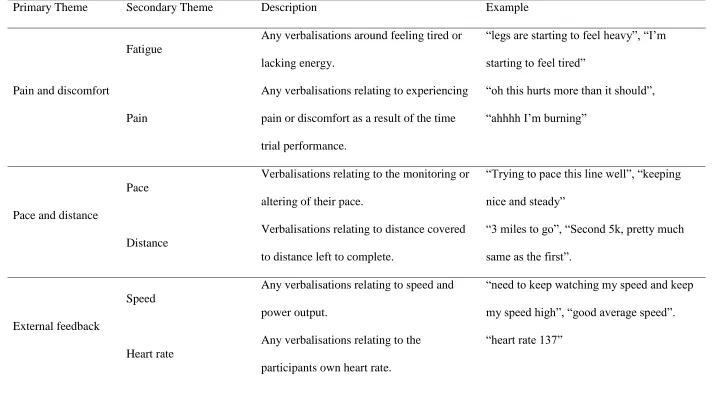
developed for this study (Table 1). The second author coded a random sample of verbal data;
the inter-rate agreement was 90%. The number of thoughts verbalised were analysed for each
theme over distance quartile using a Friedman Test due to a non-normal distribution of the
data. Post hoc analyses for any significant effects were conducted using Wilcoxon Signed Rank Tests and δ effect sizes were calculated to establish the magnitude of differences
between themes (Cohen, 1994).
INSERT TABLE 1 HERE
Results
Total Verbalisations
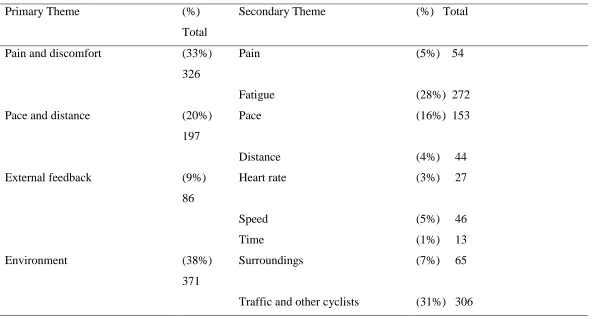
Table 2 provides the overall percentages of themes verbalised in the TT, demonstrating that
Traffic and Other Cyclists, and Pain and Discomfort were the most prominently verbalised
primary themes.
INSERT TABLE 2 HERE
A within-subject comparison of primary themes verbalised over quartile
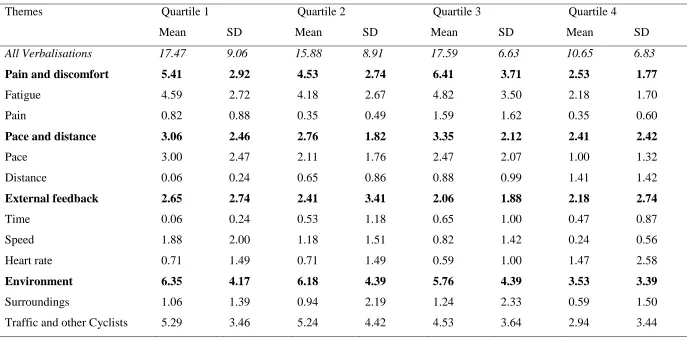
Mean (SD) values of the primary and secondary themes verbalised across distance quartile of
the TT are displayed in Table 3. Analysis to explore differences in themes over distance quartile
revealed that there was a significant difference in the number of verbalisations of the primary
theme Pain and Discomfort (X2(3, n = 17) = 16.17, p = 0.001). Post hoc analysis showed there
7 δ = 1.33). There were no significant differences across quartile in the number of verbalisations
for the other primary themes of Pace and Distance (X2(3, n = 17) = 2.47, p = 0.48), External
Feedback (X2(3, n = 17) = 1.02, p = 0.80) or Environment (X2(3, n = 17) = 6.47, p = 0.09).
A within-subject comparison of secondary themes verbalised over quartile
Fatigue: There was a significant difference in the number of verbalisations of the secondary
theme Fatigue over quartile (X2(3, n = 17) = 11.67, p = .009). Post hoc analysis indicated there
were significantly less verbalisations in quartile 4 than quartile 1 (Z = -2.66, p = 0.008, δ =
1.06), quartile 2 (Z = -2.68, p = 0.007, δ = .86) and quartile 3 (Z = -2.79, p = 0.005, δ = 1.33).
Pain: Significant differences were found in the number of verbalisations of the secondary
theme Pain over quartile (X2(3, n = 17) = 13.60, p = 0.004), where there were significantly less
verbalisations in quartile 4 than both quartile 1 (Z = -1.99, p = 0.046, δ = .62) and quartile 3 (Z
= -2.57, p = 0.01, δ = 1.01). Furthermore, fewer verbalisations were recorded during quartile 2
than both quartile 1 (Z = -2.13, p = 0.033, δ = .65) and quartile 3 (Z = -2.69, p = 0.007, δ =
1.03).
Pace: There was a significant difference in the number of verbalisations of the theme Pace over
quartile (X2(3, n = 17) = 15.16, p = 0.002), with significantly less verbalisations in quartile 4
than quartile 1 (Z = -2.54, p = 0.011, δ = 1.00), quartile 2 (Z = -2.26, p = 0.023, δ = .71) and
quartile 3 (Z = -2.45, p = 0.014, δ = .84).
Distance: For the theme Distance, a significant difference was found in the number of
verbalisations over quartile (X2(3, n = 17) = 17.68, p = 0.001). There were significantly less
verbalisations in quartile 1 than quartile 2 (Z = 2.31, p = 0.021, δ = .93) and quartile 3 (Z = -2.91, p = 0.004, δ = 1.13) and quartile 4 (Z = -2.97, p = 0.003, δ = 1.32). Furthermore, there
were significantly less verbalisations in quartile 2 than quartile 3 (Z = -2.69, p = 0.007, δ =
8
Heart Rate: There was a significant difference in the number of verbalisations of the
secondary theme Heart Rate over quartile (X2(3, n = 17) = 9.00, p = 0.029), where there were
significantly more verbalisations in quartile 4 than quartile 1 (Z = -2.26, p = 0.024, δ = .66),
quartile 2 (Z = -2.26, p = 0.024, δ = .66).
Speed: A significant difference in the number of verbalisations of the secondary theme Speed
was found over quartile (X2(3, n = 17) = 13.25, p = 0.004). Post hoc analysis showed there
were significantly more verbalisations during quartile 1 than quartile 3 (Z = -2.16, p = 0.030, δ = .61) and quartile 4 (Z = -2.71, p = 0.007, δ = 2.56). Furthermore, speed was verbalised more
in quartile 2 than quartile 4 (Z = -2.54, p = 0.011, δ = .82).
Time, Surroundings, and Traffic and Other Cyclists: No significant differences were found
over quartile in the number of verbalisation for the secondary themes Time (X2(3, n = 17) =
4.48, p = 0.21), Surroundings (X2(3, n = 17) = 3.13, p = 0.37) or Traffic and Other Cyclists
over quartiles (X2(3, n = 17) = 4.65, p = 0.20).
INSERT TABLE 3 HERE
Discussion
The main findings of this study show that TA protocol is a viable method to measure
real-time, concurrent thought processes of cyclists during an outdoor, competitive 16.1 km TT. Cyclists’ thought processes comprised four major themes: Pain and Discomfort, Pace and
Distance, External Feedback and Environment. The number of verbalisations for the primary
themes were found to vary over the distance of the TT. Furthermore, significant differences
over time were found within the secondary themes Fatigue, Pain, Pace, Distance, Speed and
Heart Rate. There were significantly less verbalisations of the themes Pain and Discomfort,
9 verbalisations relating to Pace also followed this pattern, whereas verbalisations of Distance,
Speed and Heart Rate increased over the duration of the TT. The findings from the present study therefore suggest that the nature of cyclist’s cognitions change over the course of a
real-time, outdoor TT.
Overall, more thoughts were verbalised during the first quartile of the TT in
comparison to the final quartile. Being able to pace an event correctly is generally at the
forefront of a performer's thought process, especially during the start of an event (Zakowski
et al., 2001). In addition, other factors unaccounted for may have contributed to this higher
number of verbalisations earlier in the race. For example, the perceptions of stressors could
result in certain verbalisations being more evident in earlier stages. The perceived importance
of the event may have contributed to these findings (Nicholls et al., 2011); given that this was
a real-life TT event, it could be suggested that this was perceived as more important than
other training events or a laboratory-based study. The initial verbalisations could be the result
of a stress response, however as the TT progresses, participants may employ specific coping
strategies and develop perceptions of control over the event (Billat et al., 2001). This also
supports the proposal that there is less uncertainty relating to performance and pacing
optimisation towards the end of exercise (St Gibson et al., 2006) and that the number of
verbalisations decreases as the level of complexity of a task decreases (Arsal et al., 2016). Our study suggests that cyclists’ cognitions change over the duration of a TT and therefore
should be considered in the exploration of how an athletes’ conscious decision-making will
influence pacing during an event.
Our results showed that in the first quartile of a TT, cyclists’ verbalisations centred
on Fatigue, and Traffic and Other Cyclists. Verbalisations of fatigue in the early stage of the
TT is perhaps surprising, as athletes often feel more fatigued towards the end of an event,
10 However, verbalisations such as, “my legs feel full (of lactic acid) already” and “I’m feeling
a little tired already”, are consistent with a cyclist’s initial assessment of their physiological
conditions based on afferent feedback (Billat, Slawinski, Danel, & Koralsztein, 2001).
During the initial phase of the race, cyclists may experience feelings of uncertainty, which
occur immediately following any change in muscular work rate (Billat et al., 2001). It has
been suggested that, especially amongst novices, inappropriate pacing can lead to
overestimations of individual capabilities and result in an optimistically high initial power
output (Edwards & Polman, 2012). Therefore, the cyclists may think more associatively
about the pain and fatigue related to the metabolic disturbance in relation to how this may
affect their overall pacing strategy and ability to perform the remaining distance of the TT at
an optimal intensity. This also supports the proposal that athletes self-regulate performance in
an anticipatory manner in order to prevent premature fatigue and an associated reduction in
work-rate (Tucker, 2009). However, without performance data such as speed and power
output, we are unable to determine whether verbalisations influenced pacing strategies.
Verbalisations relating to distance were found to increase over time, which is
especially interesting given that overall verbalisations decrease over quartiles. This may indicate that cyclists focus more on distance information near the end of a race, e.g. “2.5 km
to go”, and “the end is in sight, last push”, which could be a strategy to suppress pain or
fatigue-related thoughts. Alternatively, athletes may base their pacing decisions on metabolic ‘set point’ values, where the brain will calculate the degree of response required to prevent
excessive homeostatic disturbance throughout an event (Billat et al., 2001). If the distance or
duration of the task is known, athletes will regulate physiological systems to keep them within ‘norms’. If a cyclist is familiar with the task and has distance ‘set points’, then
distance may be important in a cyclists thought processes, especially in the later stages of a
11 Whilst the number of verbalisations within the theme Environment did not
significantly change over time, this was the most frequently verbalised theme overall.
Patterns in other verbalisations further support that thoughts relating to internal and external
cues vary in dominance over the course of the TT, with more internal cues (Pain, Fatigue)
verbalised initially and more task-related external cues (Distance) verbalised towards the end.
These findings build on the laboratory based work of Bertollo et al. (2015) who found that
internal focused attention can be functional if the attentional focus is directed toward the core
component of action (e.g. pedalling rate) instead of fatigue or muscle pain. The present study
extends this work since it examines changes in thoughts during a field based time trial using
TA rather than prescribing an attentional focus strategy.
The limitations of this study should be acknowledged in the consideration of the
findings. As no performance data was collected within this study, it is not possible to
determine whether a participants’ verbalisations were directly associated with physiological
responses or performance parameters, such as speed, cadence or power output. Furthermore,
it is important to acknowledge that the effect of thinking aloud on cycling performance is
unknown, however all participants were thoroughly briefed and asked to terminate thinking
aloud if they felt that the process hindered them in any way. Further research needs to
incorporate other performance measures in order to fully examine the relationship between
cognitions and pacing behaviour.
Another area for development within this research could be the difference between
male and female cognitions. Kaiseler, Polman and Nicholls (2013) were able to use TA to
identify cognitive differences in stress and coping between males and females, therefore it
would be of great interest to investigate cognitive differences between males and females
within cycling and pacing. Furthermore, whilst the wide range of experience and age among
12 differences in cognitions within the sample based on these criteria. Differences in the skill
level of a performer also needs to be taken in to consideration within future work, since
previous research using TA in golf has established that cognitions differ based on the skill
level of a performer (Whitehead et al., 2016).
Finally, the coding scheme used within this study only took into account task specific
information and verbalisations deemed irrelevant were not coded. Brick, Macintyre and
Campbell (2014) published a review of attentional focus in endurance activity and
highlighted how ‘unimportant’ information could be interpreted as an external dissociation
strategy. Future research using TA protocol should take into account all verbalisations, not
just those deemed task relevant.
The findings of this study extend previous research utilising TA and have
allowed for the examination of thoughts during a real-time endurance event, therefore
providing support for TA as a viable method. It has evidenced that thought processes change
continuously during exercise, with different thoughts becoming more prominent at different
times. Such findings can be used to inform coaches, athletes and psychologists in aiding the
development of appropriate interventions to optimise performance by allowing the
examination of a performer’s cognition during an endurance exercise.
References
Arsal, G., Eccles, D.W., & Ericsson, K.A. (2016). Cognitive mediation of putting:
Use of a think-aloud measure and implications for studies of golf-putting in the laboratory.
13 Baden, D., Warwick-Evans, L.A., & Lakomy, J. (2004). Am I nearly there? The effect
of anticipated running distance on perceived exertion and attentional focus. Journal of Sport
Exercise Psychology, 27, 215–31.
Baker, J., Côté, J., & Deakin, J. (2001). Expertise in ultra-endurance triathletes: early
sport involvement, training structure, and the theory of deliberate practice. Journal of Applied
Sport Psychology, 71(1), 64–79.
Bertollo, M., di Fronso, S., Filho, E., Lamberti, V., Ripari, P., Machado Reis, V.,
Comani S., Bortoli, L., & Robazzo, C. (2015). To Focus or Not to Focus: Is Attention on the
Core Components of Action Beneficial for Cycling Performance? The Sport Psychologist, 29,
110-119.
Billat, V., Slawinski, J., Danel, M., Koralsztein, J.P. (2001). Effect of free versus
constant pace on performance and oxygen kinetics in running. Medicine and Science in
Sports and Exercise, 33(12), 2082–2088.
Brick, N., MacIntyre, T., & Campbell, M. (2014). Attentional focus in endurance
activity: new paradigms and future directions. International Review of Sport and Exercise
Psychology, 7(1), 106-134.
Calmeiro, L., Tenenbaum, G., & Eccle, D. (2010). Event-sequence Analysis of
Appraisals and Coping during Trapshooting Performance. Journal of Applied Sport
Psychology, 22, 392-407.
Cohen, J. (1994). Statistical Power Analysis for the Behavioural Sciences. 2nd Ed,
Hillsdale, NJ: Lawrence Erlbaum Associates Publishers.
Eccles, D.W. (2012). Verbal reports of cognitive processes. In G. Tenenbaum., RC,
Eklund., & A, Kamata. Measurement in Sport and Exercise Psychology (pp. 103-117).
14 Edwards, A., & Polman, R. (2012). Pacing in sport and exercise: A
psychophysiological perspective. New York: Nova Science Publishers, Inc.
Ericsson, K.A., & Kirk, E. (2001). Instructions for giving retrospective verbal reports.
Unpublished manuscript, Department of Psychology, Florida State University, Tallahassee,
Florida, USA.
Ericsson KA & Simon HA. (1993). Protocol analysis: Verbal reports as data.
Cambridge, MA: Bradford Books/MIT Press.
Kaiseler, M., Polman, R.C.J., & Nicholls, A.R. (2013). Gender differences in stress,
appraisal, and coping during golf putting. International Journal of Sport and Exercise
Psychology, 11(3), 258-272.
Morgan, W.P., & Pollock, M.L. (1977). Psychologic characterisation of the elite
distance runner. Annals of the New York Academy of Sciences, 301(1), 383-403.
Noakes, T.D. (2011). Time to move beyond a brainless exercise physiology: the
evidence for complex regulation of human exercise performance. Applied Physiology,
Nutrition and Metabolism, 36(1), 23–35.
Nicholls, A.R., & Polman, R.C. (2008). Think aloud: acute stress and coping
strategies during golf performances. Anxiety Stress Coping, 21(3), 283–294.
Nicholls, A.R., Levy A.R., Jones, L., Rengamani, M., & Polman, R.C.J. (2011). An
exploration of the two-factor schematization of relational meaning and emotions among
professional rugby union players. International Journal of Sport and Exercise Psychology,
9(1), 78-91.
Samson, A., Simpson, D., Kamphoff, S., & Langlier, A. (2015). Think aloud: An examination of distance runners’ thought processes. International Journal of Sport and
15 Schomer, H.H. (1987). Mental strategy training programme for marathon runners.
International Journal of Sport and Exercise Psychology, 18, 133- 151.
St Clair Gibson, A., Lambert, E.V., Rauch, L.H.G., Tucker, R., Baden, D.A., Foster,
C., & Noakes, T.D. (2006). The role of information processing between the brain and
peripheral physiological systems in pacing and perception of effort. Sports Medicine, 36(8),
705–722.
Tucker, R. (2009). The anticipatory regulation of performance: the physiological basis
for pacing strategies and the development of a perception-based model for exercise
performance. British Journal of Sports Medicine, 43(6), 392–400.
Whitehead, A.E., Taylor, J.A., & Polman R.C.J. (2015). Examination of the suitability
of collecting in event cognitive processes using Think Aloud protocol in golf. Frontiers in
Psychology, 6, 1083.
Whitehead A.E., Taylor, J.A., & Polman R.C.J. (2016). Evidence for Skill Level
Differences in the Thought Processes of Golfers During High and Low Pressure Situations.
Frontiers in Psychology, 6, 1974.
Williams, E.L., Jones, H.S., Sparks, S.A., Midgley, A.W., Marchant, D.C., Bridge,
C.A., & McNaughton, L.R. (2015). Altered Psychological Responses to Different
Magnitudes of Deception during Cycling. Medicine and Science in Sports and Exercise,
47(11), 2423-2430.
Zakowski, S.G., Halls, M.H., Klein, L.C., & Baum, A. (2001). Appraised control,
coping and stress in a community sample: a test of the goodness-of-fit-hypothesis. Annals of
16 Table 1. Coding framework used to analyse verbalisations during the time trial.
Primary Theme Secondary Theme Description Example
Pain and discomfort
Fatigue
Any verbalisations around feeling tired or
lacking energy.
“legs are starting to feel heavy”, “I’m
starting to feel tired”
Pain
Any verbalisations relating to experiencing
pain or discomfort as a result of the time
trial performance.
“oh this hurts more than it should”,
“ahhhh I’m burning”
Pace and distance
Pace
Verbalisations relating to the monitoring or
altering of their pace.
“Trying to pace this line well”, “keeping
nice and steady”
Distance
Verbalisations relating to distance covered
to distance left to complete.
“3 miles to go”, “Second 5k, pretty much
same as the first”.
External feedback
Speed
Any verbalisations relating to speed and
power output.
“need to keep watching my speed and keep
my speed high”, “good average speed”.
Heart rate
Any verbalisations relating to the
participants own heart rate.
17 Time
Any verbalisations relating to the timing
within the event.
“13.30 and half way”, “only a few minutes
left”
Environment
Surroundings
Verbalisations relating to the wider
environment and the visual picture of the
surroundings.
“not a bad profile in the sun”
Traffic and other cyclists
Verbalisations relating to other vehicles on
the road.
“these cars are coming too close”, “I’m
18 Table 2. Percentage and total frequency verbalisations for primary and secondary themes.
Primary Theme
(%) Total
Secondary Theme (%) Total
Pain and discomfort (33%) 326
Pain (5%) 54
Fatigue (28%) 272 Pace and distance (20%)
197
Pace (16%) 153
Distance (4%) 44 External feedback (9%)
86
Heart rate (3%) 27
Speed (5%) 46 Time (1%) 13 Environment (38%)
371
Surroundings (7%) 65
19 Table 3. Mean (SD) number of verbalisations by theme over distance quartile of the time trial.
Themes Quartile 1 Quartile 2 Quartile 3 Quartile 4
Mean SD Mean SD Mean SD Mean SD
All Verbalisations 17.47 9.06 15.88 8.91 17.59 6.63 10.65 6.83
Pain and discomfort 5.41 2.92 4.53 2.74 6.41 3.71 2.53 1.77
Fatigue 4.59 2.72 4.18 2.67 4.82 3.50 2.18 1.70
Pain 0.82 0.88 0.35 0.49 1.59 1.62 0.35 0.60
Pace and distance 3.06 2.46 2.76 1.82 3.35 2.12 2.41 2.42
Pace 3.00 2.47 2.11 1.76 2.47 2.07 1.00 1.32
Distance 0.06 0.24 0.65 0.86 0.88 0.99 1.41 1.42
External feedback 2.65 2.74 2.41 3.41 2.06 1.88 2.18 2.74
Time 0.06 0.24 0.53 1.18 0.65 1.00 0.47 0.87
Speed 1.88 2.00 1.18 1.51 0.82 1.42 0.24 0.56
Heart rate 0.71 1.49 0.71 1.49 0.59 1.00 1.47 2.58
Environment 6.35 4.17 6.18 4.39 5.76 4.39 3.53 3.39
Surroundings 1.06 1.39 0.94 2.19 1.24 2.33 0.59 1.50