The development of a low cost 3D surface imaging system
to measure breast volume: defining minimum standards
using an adapted Delphi consensus study
PROBST, H <http://orcid.org/0000-0003-0035-1946>, CHOPPIN, S <http://orcid.org/0000-0003-2111-7710>, HARRISON, M and GOYAL, A Available from Sheffield Hallam University Research Archive (SHURA) at: http://shura.shu.ac.uk/10914/
This document is the author deposited version. You are advised to consult the publisher's version if you wish to cite from it.
Published version
PROBST, H, CHOPPIN, S, HARRISON, M and GOYAL, A (2015). The development of a low cost 3D surface imaging system to measure breast volume: defining
minimum standards using an adapted Delphi consensus study. Journal of Plastic, Reconstructive and Aesthetic Surgery, 68 (12), 1770-1772.
Copyright and re-use policy
See http://shura.shu.ac.uk/information.html
The development of a low cost 3D surface imaging system to measure breast volume: defining minimum standards using an adapted Delphi consensus study
Authors
H Probst1 PhD, MA, BSc(HONS), S B. Choppin1, PhD, MA, BSc(HONS), J S. Wheat1PhD, BSc(HONS), M Harrison2RGNm BA(HONS) PGCE, A Goyal3 MS, MD, FRCS
1
Sheffield Hallam University, Faculty of Health and Wellbeing, 2Sheffield Teaching Hospitals NHS Foundation Trust and Macmillan Cancer Support, 3Royal Derby Hospital
This material has not been presented at any meetings.
Corresponding Author
Heidi Probst
Professor of Radiotherapy and Oncology, Robert Winston Building, 11-15 Broomhall Road, Collegiate Crescent Campus, Sheffield Hallam University, S10 2BP
Background
Breast reconstructive surgery has become an accepted part of the patient pathway for
breast cancer patients requiring mastectomy. Yet the UK National Mastectomy and
Breast Reconstruction Audit (2011)(1) identified that one in four women were not
satisfied with how their unclothed breasts looked after delayed reconstructive surgery.
Women with an intact breast after surgery are generally referred for whole breast
irradiation, radiotherapy increases the risk of these women developing breast oedema.
Difficulties in diagnosing breast oedema mean many patients live unnecessarily with its
dehabilitating, long-term effects.
Three-dimensional (3D) imaging technologies provide non-contact measurements of the
breast which are important for breast reconstruction and breast oedema diagnosis
(distances, volumes etc.). Current commercial systems are prohibitively expensive and
not in widespread use. The manual measurements which are often used to plan
reconstructive surgery and assess breast oedema development can result in unsatisfactory
reconstruction and mis-diagnosis.
The aim of this project was to develop consensus on the minimum requirements of a 3D
surface imaging system from key stakeholders in breast cancer treatment – providing a
specification for future system development.
This consensus study focussed on the following questions:
1. What is an acceptable cost?
3. What type of data would be useful for practitioners and patients to maximise patient
outcomes?
4. What accuracy is required to be useful in clinical practice?
Method
An adapted Delphi consensus method was employed to elicit views of key professionals
and user representatives. Using a questionnaire based approach, consenting participants
were asked to provide opinions on product and data requirements of a 3D surface
imaging system for use in breast reconstruction and breast oedema diagnosis. Two
questionnaire rounds were used. A Delphi approach is useful for structuring group
communication and developing consensus and has been used in multiple cancer studies
(2-4)
. Theycan be small, medium or large with sample sizes ranging from n=15 to n=62
reported in the health literature(2-5).
Round 1 was information generating; the outcomes of the first questionnaire were used to
develop a series of statements for respondents to rate in round 2. Each question had fixed
responses as well as the opportunity to provide free text ensuring responses reflected the
participants’ views. The round 1 survey was pilot tested using staff from the Host
Institution. The round 1 panel (n=36) was a purposive sample of professionals with
expertise in breast cancer care, including:
Lymphoedema specialists (n=7)
Lymphoedema services manager (n=1)
Radiation therapists in a breast cancer role (n=9)
Oncoplastic breast surgeons (n=10)
Plastic surgeons (n=1)
Service users (n=7)
Round 2 focussed on professionals with expertise in surgery and lymphoedema (i.e.
oncoplastic breast surgeons, plastic surgeons and lymphoedema specialists n=16) to
ensure that the panel had knowledge of the importance and desirability of specific
product specifications. A 5-point Likert scale was used with 22 items across 3 criteria
(Design Characteristics (DC), Accuracy (A), and Patient Positioning (PP)). Participants
were asked to rate each item for importance, desirability and feasibility.
Ethics
The study was approved by Sheffield Hallam University health and social care research
ethics subcommittee.
Data Analysis
The importance, feasibility and desirability scores were summed as the starting point for
round 2 analyses. This allowed a more detailed analysis to be undertaken even though
this involved handling nominal level data as interval data. The mean score provided an
opportunity to prioritise those items that were considered by the 2nd panel to be critical.
Consensus was assessed using measures of internal consistency (Cronbach Alpha) and
assessment of agreement (intra-class correlation). Product specifications were prioritised
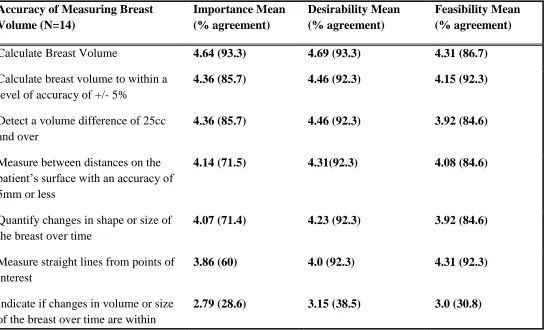
using the mean score for importance, desirability and feasibility (see Table 1). Items
considered most important/desirable for product development were identified using these
Results
Table 1 shows individual criteria in order of priority (as determined by the mean scores
for importance and desirability) across the three criteria (DC, A, and PP). The intra class
correlation coefficients show good agreement between panel members for importance of
measurement characteristics, importance, desirability and feasibility of practicality
characteristics and positioning points.
Conclusions
This consensus study has been used to develop a product specification for a low cost 3D
surface imaging system. Using the mean scores as a way of prioritising characteristics, a
system should be able to:
Calculate breast volume with an accuracy of +/- 5%
Detect a volume difference of 25cc and over
Measure distances with an accuracy of ≤5mm
Be capable of capturing marks placed on the nipple, base width of the breast,
lateral edges of the breast, the mid-line of the sternum, inframammary fold, and
superior pole of the breast.
Cost less than £10,000
Fit a space <4m2 and
Produce 3D images that are easily manipulated without much prior experience.
Funding: Internal University funding was provided by Sheffield Hallam University, the
funder had no role in the design, implementation or conduct of the study
References
1. National Centre for Information. A national audit of provision and outcomes of
mastectomy and breast reconstruction surgery for women in England Fourth Annual Report 2011.
2. Coggin C, Shaw-Perry M. Breast cancer survivorship: expressed needs of black women.
Journal of psychosocial oncology. 2006;24(4):107-22.
3. Stevenson L, Campbell NC, Kiehlmann PA. Providing cancer services to remote and
rural areas: consensus study. British journal of cancer. 2003;89(5):821-7.
4. Broomfield D, Humphris GM. Using the Delphi technique to identify the cancer
education requirements of general practitioners. Medical education. 2001;35(10):928-37.
5. Gagliardi G, Wright FC, Quan ML, McCready D. Evaluating the organisation and
delivery of breast cancer services: use of performance measures to identify knowledge gaps.
8
Table 1 Accuracy, Design Characteristics and Positioning Points Required
Accuracy of Measuring Breast Volume (N=14) Importance Mean (% agreement) Desirability Mean (% agreement) Feasibility Mean (% agreement)
Calculate Breast Volume 4.64 (93.3) 4.69 (93.3) 4.31 (86.7)
Calculate breast volume to within a level of accuracy of +/- 5%
4.36 (85.7) 4.46 (92.3) 4.15 (92.3)
Detect a volume difference of 25cc and over
4.36 (85.7) 4.46 (92.3) 3.92 (84.6)
Measure between distances on the patient’s surface with an accuracy of 5mm or less
4.14 (71.5) 4.31(92.3) 4.08 (84.6)
Quantify changes in shape or size of the breast over time
4.07 (71.4) 4.23 (92.3) 3.92 (84.6)
Measure straight lines from points of interest
3.86 (60) 4.0 (92.3) 4.31 (92.3)
Indicate if changes in volume or size of the breast over time are within
9 normal menstrual cyclical differences
Cronbach Alpha/av ICC for Breast Volume
0.81 0.638 0.688
Design Characteristics (n=14) Importance Mean (% agreement)
Desirability Mean (% agreement)
Feasibility Mean (% agreement)
Be Purchased for under £10,000 4.5 (78.5) 4.62 (100) 4.17 (76.9)
Fit a space < 4m2 4.5 (85.7) 4.46 (92.3) 3.75 (69.3)
Produce 3D images that can be easily manipulated without much prior experience
4.14 (78.6) 4.08 (92.3) 3.75 (76.9)
Be portable 4.07 (71.4) 4.38 (84.6) 3.58 (61.6)
Be folded for storage 4.0 (78.6) 4.23 (77.0) 3.67 (58.3)
Be used by health care staff in a clinic with minimal training
4.0 (78.6) 4.08 (84.6) 3.58 (69.2)
Cronbach Alpha/av ICC for Practicality
0.816 0.915 0.923
Positioning Points for Scanning (N=13) Importance Mean (% agreement) Desirability Mean (% agreement) Feasibility Mean (% agreement)
10 size the scanner needs to be capable
of…
capturing marks placed on the nipple 4.54 (92.3) 4.62 (100) 4.46 (92.3)
capturing marks placed on Base width of the breast
4.54 (92.3) 4.46 (92.3) 3.85 (61.6)
capturing marks placed on Lateral edges of the breast
4.46 (92.3) 4.54 (100) 4.08 (92.3)
capturing marks placed on mid line of the sternum
4.46 (92.3) 4.54 (100) 4.38 (92.3)
capturing marks placed on Inframammary fold
4.31 (84.6) 4.38 (92.4) 4.0 (69.3)
capturing marks placed on superior pole of the breast
4.31 (92.3) 4.46 (92.3) 4.0 (76.9)
imaging the patient while standing 3.92 (71.5) 4.31 (100) 4.31 (84.7) capturing marks placed on
Suprasternal notch
3.85 (76.9) 4.23 (84.7) 4.38 (92.4)
capturing marks placed on mid point of the shoulder
11
Likert scale scores 1-5 (Importance 5=very important to 1=most unimportant, Desirability 5= Highly desirable to 1= Highly undesirable, Feasibility 5=Definitely Feasible to 1=Definitely infeasible) % agreement refers to the percentage of panel
members that selected 4 or 5 on the likert scale for each criteria. Cronbach Alpha/av ICC for
Positioning Marks