1
Does Knowledge Retrieval Improve Work Efficiency?
An Investigation under Multiple Systems Use
Abstract: Organizations encourage active knowledge retrieval from knowledge management systems; however, this does not always lead to higher work efficiency. Anchoring on uses and gratifications
theory and psychology of sunk cost, this study investigates knowledge workers’ knowledge retrieval
behavior and its subsequent impact on their work efficiency under three knowledge management
systems, which differ in the creators of the systems and their related contents. Survey and interview
data were collected from an IT call-center company. The results show knowledge workers who
actively retrieved knowledge from the organization-created system that contains self-created content
exhibited higher work efficiency. The results also show they obtained gratifications from actively
retrieving knowledge from a self-made system; however, due to the workers’ biased perceptions
toward that system, knowledge retrieval from a self-made system did not induce higher work
efficiency. The findings provide organizations suggestions for designing knowledge management
systems and their related contents.
2
1.
INTRODUCTION
Even when an organization mandates the use of a specific IT application, individuals retain
considerable discretion regarding use of the application in accomplishing their work activities
(Hartwick & Barki, 1994). This behavior is called post-adoptive behavior, which is the myriad
feature-use behaviors and feature extension behaviors of individual feature-users after an IT application has been
made accessible to them (Jasperson, Carter, & Zmud, 2005). Among the commonly researched IT
applications for its post-adoptive behavior is the knowledge management system (KMS) (Alavi &
Leidner, 1999). The extremely challenging proposition faced by knowledge workers in contributing
their knowledge to the KMS has led many organizations to auto-populate the content of their KMS.
Even so, organizations still face challenges in persuading knowledge workers to retrieve knowledge
from the KMS. After so much effort populating knowledge to the KMS, if the knowledge stored is not
being retrieved and used in daily work activities, it is of no value.
Previous studies provide suggestions to organizations on how to motivate knowledge retrieval from the
KMS. For instance, motivation may come through the bottom-up social influence across hierarchical
levels (Wang, Meister, & Gray, 2013), by establishing collaborative norms in the organization (Bock,
Kankanhalli, & Sharma, 2006), and by ranking the knowledge stored in the KMS (Sutanto & Jiang,
2013). The commonality of these studies is that they examined knowledge retrieval behavior in the
context of a specific KMS provided by the focal organizations. Knowledge workers also store
knowledge, such as information about customers, marketing research and plans, and knowledge about
company products and services, by creating folders and files in local storage (e.g., local drives, thumb
drives, etc.), and these local storages are accessed when particular knowledge is needed. When
researching about knowledge retrieval, researchers should investigate not only the organization-created
KMS but also the employees’ self-created KMS.
In fact, there are two main components of a KMS: the system and the content. Considering system
creation and content creation, we can distinguish three types of KMS: 1) the organization-created
system with auto-populated knowledge content and/or knowledge stored by employees other than the
target knowledge seekers; 2) the knowledge seekers’ self-created systems and content; and 3) the
organization-created system that contains knowledge stored by the knowledge seekers themselves.
Most studies have examined knowledge retrieval from the first or third type of KMSs, and the impact
of such KMS usage on work efficiency has not always been found to be positive (Ko & Dennis, 2011).
Having access to alternative KMS is important to identify those systems and holistically examine the
impacts of knowledge retrieval activities on work efficiency from the different types of KMSs.
Building on uses and gratification theory (Rubin, 1985) and psychology of sunk cost (Arkes &
3 from the different types of KMSs and their impacts on knowledge seekers’ work efficiency.
According to uses and gratification theory, individuals continue using a medium because they derive
process and content gratifications from using it. One of the important process gratifications from
retrieving knowledge from a KMS is the simplicity in doing so (Watson & Hewett, 2006). Content
gratification, on the other hand, concerns the satisfaction with the knowledge retrieved from the KMS
(He, Fang, & Wei, 2009a; Kankanhalli, Tan, & Wei, 2005). When the process of retrieving
knowledge from a KMS is straightforward and the resultant knowledge search is satisfactory,
knowledge workers should be motivated to continue seeking knowledge from that particular KMS.
However, because the gratifications derived from a KMS are subjective, according to the psychology
of sunk cost, there is a tendency to continue an endeavor once an investment in effort and time has
been made (Arkes & Blumer, 1985). Therefore, although in reality, the process of retrieving
knowledge from the self-created KMS may not be simple and the resultant knowledge search may not
be satisfactory, the knowledge workers may perceive it as simple to use and as producing satisfactory
results and thus continue retrieving knowledge from their self-created KMS in their daily work
activities.
To achieve the study objective, which is to holistically examine the extent of knowledge retrieval
activities from the different types of KMSs and their effects on the knowledge seekers’ work
efficiency, we collaborated with an IT call-center company. The company had implemented two
KMSs, hereby referred to as KMSone and KMStwo. KMSone is embedded in the call-center’s
employees’ daily work activities, such as the employee having to login into the system every day and
insert customer complaints in the system’s predefined fields. These inputs serve as knowledge
contributions to KMSone. Hence, KMSone is an organization-created KMS that contains knowledge
stored by the knowledge seekers themselves. In contrast, the knowledge stored in KMStwo is entered
by the second-level support employees, who have received forwarded unsolved customer complaints
from the call-center employees. The motivation behind the implementation of KMStwo is to provide
the call-center employees access to more advanced knowledge to minimize the amount of call
forwarding. Hence, KMStwo is an organization-created KMS that contains knowledge stored by
employees other than the target knowledge seekers. In addition to these two types of
organization-created KMSs, each call-center employee creates and maintains their own localized KMS in their local
drives, hereby referred to as LocalKMS. These LocalKMSs, range from a Notepad file to sorted
folders of Word-document files, are knowledge seekers’ self-created KMSs and contents.
We surveyed 158 center employees and followed that with interviews and focus groups. The
call-center company is a unique setting where the employees’ work is time-critical, and their work
efficiency is closely dependent on the sources they use to obtain the knowledge needed to answer
customers’ questions. Under that circumstance, the following questions were asked: Why do they
4 KMS actually improve their work efficiency? The answers to these questions can reveal whether there
is a personal bias with respect to the self-created KMS and/or self-created knowledge content that
leads to continuous knowledge retrieval, even though the choice may not actually improve the
employees’ work efficiency.
We found that both the perceived process and content gratifications of a KMS affected the extent of
knowledge retrieval activities from the respective KMS. Moreover, we found that only the degree of
knowledge retrieval from KMSone led to higher work efficiency. We discovered that most of the time,
the knowledge workers were searching and retrieving knowledge from KMSone and LocalKMS. They
very rarely retrieved knowledge from KMStwo. Altogether, the findings from the survey which were
corroborated with follow-up interviews and focus groups imply two things. First, the content and
process gratifications in using an organization-created KMS that contains knowledge stored by
employees other than the target knowledge seekers (i.e., KMStwo) are the lowest. Second, although
the gratifications in using LocalKMS are higher than KMStwo, searching knowledge from LocalKMS
was not always associated with improved work efficiency. Hence, we found evidence of psychological
sunk cost in the continued use of a self-created system and content.
This paper is structured as follow. In the next section, we will summarize the extant literature on
knowledge retrieval from KMS, identify the research gaps, and highlight how our study contributes to
the identified gaps. Subsequently, we will explain the theoretical foundations of our study, i.e., uses
and gratifications theory and psychology of sunk cost. This is followed by a presentation of our
research model and research methodology. In the following sections, we will describe and discuss our
findings and conclude the paper by highlighting how our study contributes to research and what the
implications of our findings to practitioners.
2.
LITERATURE REVIEW
Knowledge retrieval is an important aspect of effective knowledge management (Alavi & Leidner,
2001). Prior studies have examined the determinants of retrieving knowledge from a KMS and
provided suggestions to organizations on how to motivate knowledge retrieval from a KMS.
Knowledge seekers' perceptions toward the characteristics of KMS affect their retrieval behavior. Perceived ease of use (Lai J.-Y. , 2009; Phang, Kankanhalli, & Sabherwal, 2009; Su & Contractor,
2011) and perceived usefulness (Chen, Hsieh, Van de Vliert, & Huang, 2015; Choi & Durcikova,
2014; Lai J.-Y. , 2009; He, Fang, & Wei, 2009a) of KMS is positively related to the intention of
knowledge use and retrieval. To be more specific, perceived searchability, actionability (Durcikova &
Fadel, 2016), capability (Kankanhalli, Lee, & Lim, 2011), and usability (Phang, Kankanhalli, &
Sabherwal, 2009) positively affect the knowledge retrieval behavior. The quality of the knowledge in a
KMS is also essential: it has been found that perceived output quality (Kankanhalli, Tan, & Wei, 2005;
5 recognition of contributors (Su & Contractor, 2011), visibility, and result demonstrability (Hester,
2011) are positively related to knowledge retrieval. Thus, implementing rating-based knowledge
rankings to recognize high quality knowledge could also positively influence knowledge retrieval
(Sutanto & Jiang, 2013). However, even when the quality of knowledge content in a KMS can be
assured, knowledge seekers’ perceived task-technology fit also affects their retrieval behavior (Lin &
Huang, 2009). In order to encourage knowledge retrieval from a KMS, the value of a KMS should be
demonstrated (Wang, Meister, & Gray, 2011; Watson & Hewett, 2006), and knowledge seekers’
satisfaction should be guaranteed (Lai J.-Y. , 2009; He, Fang, & Wei, 2009a).
Knowledge seekers’ characteristics also affect their retrieval behavior. Intrinsic motivation is positively related to knowledge retrieval (Kankanhalli, Lee, & Lim, 2011). Knowledge seekers with
strong learning orientations or facing intellectual demands will engage in knowledge retrieval (Gray &
Meister, 2004; Gray & Durcikova, 2005). Their self-efficacy of KMS (Lin & Huang, 2008; Lin &
Huang, 2009; Bock, Kankanhalli, & Sharma, 2006) and personal outcome expectations (Lin & Huang,
2008) also positively affect their knowledge retrieval. However, risk-averse knowledge seekers (Gray
& Durcikova, 2005) and knowledge seekers who perceive image loss when seeking knowledge from
others (Wang, Meister, & Gray, 2011) will not actively engage in knowledge retrieval.
Social influence can also affect knowledge retrieval behavior (Su & Contractor, 2011). Knowledge-seeking intention is based on the subjective norm of knowledge Knowledge-seeking, which is influenced by
community identification (Lai, Chen, & Chang, 2014). In addition to the social pressure from the
community or the company, knowledge seeking by peers and subordinates can also motivate
knowledge retrieval, which suggests the positive effect of bottom-up social influence across
hierarchical levels (Wang, Meister, & Gray, 2013). Moreover, social relationships among KMS users
are positively related to KMS usage (He, Qiao, & Wei, 2009b). Establishing collaborative norms in the
organization is beneficial for motivating knowledge retrieval (Bock, Kankanhalli, & Sharma, 2006).
Management and organizational supports can facilitate knowledge retrieval by incentivizing or rewarding KMS use, in general, and knowledge retrieval, in particular (Kankanhalli, Tan, & Wei,
2005; Lai J.-Y. , 2009). Providing training and management support for users can also encourage
knowledge retrieval from the KMS (Watson & Hewett, 2006; He & Wei, 2009; Bock, Kankanhalli, &
Sharma, 2006). However, time and work pressures experienced by users have detrimental effects on
their knowledge retrieval behavior (Gray & Durcikova, 2005).
Organizations encourage users to retrieve knowledge from KMSs because KMS use is positively
related to work efficiency (Kankanhalli, Lee, & Lim, 2011; McCall, Arnold, & Sutton, 2008; Teo &
Men, 2008; González, Giachetti, & Ramirez, 2005). For instance, deep structure use of a KMS
positively affects job performance of the users (Zhang, 2017). But the efficiency benefit could be
6 relationship is contingent by several factors. For example, the benefit could be higher for nonroutine
tasks, higher levels of absorptive capacity from the users, and higher levels of transformational
leadership from organizations (Zhang, 2017). In addition, the benefit could be higher when task
intensity is greater, and it could be lower when task environments demand rapidly changing
information and knowledge (Kim, Mukhopadhyay, & Kraut, 2016).
Existing literature explored the determinants of knowledge retrieval and the effect of knowledge
retrieval on users’ performance separately, which prevents us from further observing the causes of
different work performance obtained from using KMS. Moreover, prior studies have investigated
users’ knowledge retrieval behaviors from a particular KMS, but most of these studies focused on
organization-created KMS. Users’ knowledge retrieval behavior and related performance benefits
could be affected when they can access alternative knowledge sources (Kim, Mukhopadhyay, & Kraut,
2016). In accessing knowledge content from an organization-created KMS, knowledge workers can
also access the knowledge content from folders and files created in their local storages. This study
distinguishes three types of KMSs based on who creates the system and populates the content: 1) an
organization-created system with auto-populated knowledge content and/or knowledge stored by
employees other than the target knowledge seekers; 2) a knowledge seekers’ self-created system and
content; and 3) an organization-created system that contains knowledge stored by the knowledge
seekers themselves. Building on uses and gratifications theory and psychology of sunk cost, we
holistically examine knowledge workers’ perceptions of these systems and their respective content,
their extent of knowledge retrieval behaviors from each system, and the effect on their work
efficiency. In the following section, we explain the theoretical foundations of the study.
3.
THEORETICAL FOUNDATIONS
3.1 Uses and Gratifications TheoryUses and gratifications theory (UGT) originates from researches in traditional mass media
communication contexts, such as radio and television (McGuire, 1974; Rubin, 1985). In these
contexts, it is used to understand consumers’ motivations and concerns in order to explain why they
become involved in particular types of media and what gratifications they receive from that
involvement (Ku, Chen, & Zhang, 2013; Ruggiero, 2000). In past decades, UGT has been used to
examine the use of new forms of media and applications in the Internet context, such as online
websites (Ebersole, 2000), social networking services (Cheung, Chiu, & Lee, 2011), mobile
applications (Sutanto, Palme, Tan, & Phang, 2013), online games (Wu, Wang, & Tsai, 2010), and
virtual communities (Sangwan, 2005).
UGT posits that users use a medium either for the experience of the process itself, which is
categorized as process gratification (Cutler & Danowski, 1980), or for the content it conveys, which
7 and content gratifications should be defined in context with operational definitions and resulting
measures that are specific to the medium (Stafford, Stafford, & Schkade, 2004). For example,
aimless surfing on websites is an Internet characterization of process gratification, whereas
bookmarking a site might be more representative of motivations arising from content gratifications
(Stafford & Stafford, 2001). Thus, process gratification has been measured by the frequency of
logging into a system (Venkatesh, Speier, & Morris, 2003) or the frequency of launching the
application (Sutanto, Palme, Tan, & Phang, 2013), and content gratification has been measured by
the frequency of saving the application’s contents (Sutanto, Palme, Tan, & Phang, 2013) or the
frequency of bookmarking the sites (Stafford & Stafford, 2001).
Relating to our context of KMSs, knowledge workers may enjoy the process of knowledge retrieval
from the KMS or the quality of retrieved knowledge. The gratifications derived could motivate them
to continuously retrieve knowledge from the KMS. However, it is important to note that such
gratifications are perception based and could be biased because of sunk cost.
3.2 Psychology of Sunk Cost
Sunk cost refers to a psychological commitment that may influence an individual’s intention to
continue a current action, even if it is contrary to rational cost benefit analysis (Samuelson &
Zeckhauser, 1988). Since the individual desires to justify previous commitments to an action, the
psychology of sunk cost motivates a status quo bias, which can explain user behavior of adoption
and resistance toward the systems (Kim & Kankanhalli, 2009; Samuelson & Zeckhauser, 1988).
Sunk cost affects an individual’s acceptance of the new information systems because it is a part of
switching costs, which reduce the value of a new information system (Kim & Kankanhalli, 2009).
When individuals adopt new information systems, they may perceive higher levels of sunk costs
compared with the incrementally improved versions of the current information systems (Lee &
Joshi, 2016). The psychological commitment derived from sunk costs may prompt them to resist an
information system (Polites & Karahanna, 2012).
Sunk cost has been measured as the amount of time and effort to learn to use the current information
systems, which influences perceived ease of use and relative advantage. Thus, users’ learning
efforts, experience, and expertise in the current information systems would represent sunk costs of
adopting new information systems (Polites & Karahanna, 2012). Although the role of sunk cost in
studying user behavior toward the systems has been identified, only a few studies have empirically
examined or even addressed sunk costs (Lee & Joshi, 2016). For instance, the perceived effort and
time required affects the adoption of online social network services (Hu, Poston, & Kettinger, 2011),
and even after the adoption of these services, usage intention can be lowered due to high
8 found user’s intention to switch from traditional IT services to cloud computing services was
negatively influenced by the expected switching costs, whose antecedents are satisfaction with the
traditional IT services, even when in reality, it was more beneficial to switch to cloud computing
services (Park & Ryoo, 2013).
4.
HYPOTHESES DEVELOPMENT
Our thesis is as follow:The perceived search simplicity and content quality of a KMS affect knowledge workers’ retrieval
behavior, which leads to higher work efficiency when their perceptions toward a KMS is not biased by
their previous time and effort investments.
According to UGT, knowledge workers may retrieve knowledge from a particular KMS for the
experience of the process itself (Cutler & Danowski, 1980). These users could receive gratification
mainly from the process of retrieving the knowledge (Cutler & Danowski, 1980), which indicates that
a psychological need is gratified by the system usage process rather than from the knowledge stored in
the KMS (Chen G. , 2011). Process gratification has been studied in the Internet context. For example,
active Twitter users gratify the need to connect with others on Twitter (Chen G. , 2011) and use
Twitter for fun (Liu, Cheung, & Lee, 2010), which lead to their satisfaction and use of Twitter (Liu,
Cheung, & Lee, 2016). In another example, users are gratified by the personalization feature in a
mobile application, which leads to active usage of the application (Sutanto, Palme, Tan, & Phang,
2013).
Since process gratification concerns the actual use of the medium itself (Cutler & Danowski, 1980),
several dimensions related with process gratifications have been identified in the Internet context, such
as searching and surfing (Stafford, Stafford, & Schkade, 2004). Among these dimensions, searching is
the most important indicator for process gratification (Stafford, Stafford, & Schkade, 2004). In other
studies, ease of use has been identified as one important dimension for browsing commercial websites
(Eighmey, 1997). In the context of KMSs, knowledge searching is the core process for knowledge
retrieval. When searching for the relevant knowledge in a KMS, knowledge workers may enjoy the
simplicity of the searching process, and this process gratification may increase their active usage of
KMS. Accordingly, we hypothesize
:
H1: Perceived search simplicity increases the extent of knowledge retrieval from a KMS.
In KMS, perceived knowledge quality also affects knowledge retrieval behavior (Kankanhalli, Tan, &
Wei, 2005; Durcikova & Gray, 2009). Based on UGT, content gratification is the purposeful use of a
9 have been identified in the Internet context, such as learning, knowledge, and information (Stafford,
Stafford, & Schkade, 2004). Users may be gratified by the content carried by a medium and become
involved in that medium. For example, content gratification of Twitter resides in the information
content carried through Twitter, which affects users’ satisfaction and continuous use of Twitter (Liu,
Cheung, & Lee, 2016). In the context of KMSs, the gratification of the content quality in KMS may
lead knowledge workers into actively retrieving knowledge from the KMS. Thus, we hypothesize:
H2: Perceived content quality increases the extent of knowledge retrieval from a KMS.
KMS knowledge retrieval has been found to positively affect knowledge workers’ work efficiency
(Kankanhalli, Lee, & Lim, 2011; McCall, Arnold, & Sutton, 2008; Teo & Men, 2008). However, the
degree of knowledge retrieval from a KMS may not lead to better efficiency due to a knowledge
worker’s biased perceptions toward the KMS. According to the psychology of sunk cost, knowledge
workers could be committed to their self-created system and content because of their previous efforts
and time investment in it, which in turn bias their perceptions of the simplicity of retrieving knowledge
from the self-created KMS and the satisfaction of the knowledge retrieved from their self-created
content. Consequently, the extent of knowledge retrieval from a self-created KMS may be less
impactful on their work efficiency compared to the extent of knowledge retrieval from an
organization-created KMS. Therefore, we hypothesize:
H3: Compared with a self-created KMS, the extent of knowledge retrieval from an
organization-created KMS has greater impacts on knowledge worker’s efficiency.
5.
RESEARCH METHODOLOGY
5.1 Research Site
To test the hypotheses, we collaborated with the customer service department of a large technology
provider. The customer service department under study provides support for customers’ technical
problems. It is common for the customer service department to cover countless technology-related
products and services, such as software, hardware, or network-related issues. Given that the
complexity of IT infrastructures has significantly increased in the last years, customers may encounter
a wider range of technical problems that require increasingly complex solutions. Consequently,
customers may often need to wait considerably longer or even contact customer service specialists
several times before their enquiries are adequately addressed. The customer service department under
study faces two important challenges in responding to customers’ enquiries. First, the customer service
department is the customer’s first contact point for support, and customers expect instant answers to
their questions from its workers. Second, an important goal for the customer service department is to
10 develop mechanisms that enable customer service specialists to solve the overwhelming customer
enquiries.
The organization created and implemented two KMSs, namely KMSone (see Figure 1) and KMStwo
(see Figure 2). These KMSs are deeply embedded in the customer service department’s daily work.
When responding to customer enquiries, the customer service specialists will normally attempt to find
the answers to the enquiries using KMSone. If, in terms of actionable knowledge, answers cannot to be
found in KMSone, the customer service specialists can alternatively gain in-depth knowledge with the
help of KMStwo. Although these two systems were designed to complement each other in the
customer service practice, it appears that the customer service specialists have repeatedly encountered
difficulties in applying relevant knowledge from these two systems when dealing with customer
enquiries. In this sense, a significant proportion of customer specialists have been employing custom
methods to help them compensate for the shortcomings of these KMSs. They have created and
maintained their own localized KMS, such as a Notepad file or sorted folders of Word-document files,
[image:10.595.84.546.370.619.2]on their hard drives and use self-created Java-based search tools to search for the knowledge.
11 Figure 2: Screenshot ofKMStwo (blurred for anonymity)
5.2 Data Collection
We collected two rounds of data (i.e., a survey and interviews/focus groups). Findings from the
interviews/focus groups are also triangulated to add richness to the survey’s findings.
The main variables for the survey are knowledge search simplicity, quality of the retrieved knowledge,
extent of knowledge retrieval, and work efficiency. Regarding the control variables, we considered the
factors that have been previously shown in the literature to affect knowledge retrieval and work
efficiency. We included the demographic variables of survey respondents, such as gender, age,
experience in the current position, and experience in the current area, as well as the variables
characterizing the work environment, such as job stress level, training received, sourcing from
colleagues, and task analyzability (Kim, Mukhopadhyay, & Kraut, 2016).
Two main variables, i.e., knowledge search simplicity and work efficiency, have a single measure. The
weakness of single item measures is the inability to validate whether the variable is accurately
captured; however in some situations, single item measure is the most appropriate (Straub et al. 2004).
For example, in their MISQ paper, Siponen and Vance (2010) utilized some single item measures. The
collaborating organization required us to minimize the number of survey questions. Before conducting
the survey, we assessed the conceptual validity of the items by adopting Moore and Benbasat’s
procedure (Moore & Benbasat, 1991). The conceptual validation was carried out using structured
sorting (with variable category labels). The goal was to gain a clear indication that the survey items are
indeed measuring what they are supposed to measure. A set of five judges (researchers with substantial
12 items. Based on the sorting results, we revised the scales and conducted another round of sorting to
confirm the construct validity. Following this positive result, we distributed the survey to the customer
service specialists. The customer support specialists have clear time targets that need to be achieved,
and they need to efficiently address questions from customers. On a daily basis, they receive
up-to-date summaries of their efficiency of the previous day and the whole week. Thus, we cross-checked
their responses with summaries of their work efficiency to ensured that the self-reported work
efficiency reflected their actual work efficiency. Unfortunately, we could not use the objective
efficiency data in our study because the company prevented us from “exporting” the data outside of
the company premises. An overview of the survey items is presented in Table 1.Six-point Likert
scales from strongly disagree to strongly agree (never to very frequently for the knowledge retrieval
variable) was used. A total of 158 survey responses (102 male and 56 female) were returned. The
[image:12.595.77.540.310.774.2]descriptive characteristics of the respondents are also shown in Table 1.
Table 1: Survey Items
Construct Reference Items Mean (S.D.)/
Frequency Search Simplicity (SS_KMSone) (Phang, Kankanhalli, & Sabherwal, 2009)
1: Searching for content in KMSone is simple. 4.487(1.173)
Search Simplicity (SS_KMStwo)
1: Searching for content in KMStwo is simple. 2.557(1.265)
Search Simplicity (SS_LocalKMS)
1: Searching for content in LocalKMS is simple. 4.158(1.280)
Knowledge Quality (KQ_KMSone) (Durcikova & Gray, 2009)
1: The content in KMSone meets my needs; 2: I am satisfied with the content in KMSone; 3: The overall quality of content in KMSone is high.
4.114(1.136) 3.943(1.254) 3.892(1.215) Knowledge Quality (KQ_KMStwo)
1: The content in KMStwo meets my needs; 2: I am satisfied with the content in KMStwo; 3: The overall quality of content in KMStwo is high.
3.025(1.248) 3.019(1.275) 3.070(1.317) Knowledge Quality (KQ_LocalKM)
1: The content in LocalKMS meets my needs; 2: I am satisfied with the content in LocalKMS; 3: The overall quality of content in LocalKMS is high.
4.070(1.228) 3.880(1.208) 3.804(1.250) Knowledge Retrieval (KR_KMSone) (Phang, Kankanhalli, & Sabherwal, 2009)
1: To what extent do you use knowledge from KMSone when solving a customer case?
2: When working on a customer case, to what extent do you look in KMSone to find solutions to similar cases?
4.728(1.017) 4.709(1.039)
Knowledge Retrieval (KR_KMStwo)
1: To what extent do you use knowledge from KMStwo when solving a customer case?
2: When working on a customer case, to what extent do you look in KMStwo to find solutions to similar cases?
2.285(1.191) 2.329(1.290)
Knowledge Retrieval
(KR_LocalKMS)
1: To what extent do you use knowledge from LocalKMS when solving a customer case?
2: When working on a customer case, to what extent do you look in LocalKMS to find solutions to similar cases?
4.127(1.330) 4.120(1.398) Sourcing from Colleague (SC) (Gray & Durcikova, 2005)
1: To what extent do you discuss problems with colleagues when you need to improve your knowledge on a topic or issue related to work?
4.943(0.936)
13 2: When you work on a challenging case, to what extent
do you communicate with your colleagues who may have encountered similar issues?
Task
Analyzability (TA)
(Nidumolu, 1995)
1: To what extent is there a clearly known way to solve a customer case?
2: To what extent are there precise instructions that can be followed when solving customer cases?
3: To what extent are there common practices to work on customer cases?
4.519(0.832) 4.259(0.887) 4.342(0.891)
Job Stress (JS) (Shigemi,
Mino,
Ohtsu, & Tsuda, 2000)
1: To what extent is there too much trouble at work? 2: To what extent is there too much work to handle? 3: To what extent is there pressure on subordinate employees?
3.930(1.038) 4.234(0.982) 4.342(0.953)
Training (TR) (Chen &
Huang, 2009)
1: To what extent are training activities available for new employees?
2: To what extent do training programs exist?
3.949(1.036) 3.766(0.922)
Efficiency (EF) (Henderson
& Lee, 1992)
1: To what extent are you able to operate efficiently when solving customer cases?
(Note: we cross-checked the responses with summaries
of their efficiency on the previous day and previous week; we found that their responses were consistent with their actual work efficiency.)
4.759(0.783)
Age 21 and under
22 to 34 35 to 44 45 to 54 55 to 64 65 and above
2 100 38 13 5 0
Gender Female
Male
56 102 Experience
Current Position
How long have you been employed in the current position?
< 4 months 4 months–1 year 1 to 2 years 2 to 5 years 5 to 10 years > 10 years
15 32 27 44 32 8 Experience Current Area
How long have you been working in customer service? < 4 months
4 months-1 year 1 to 2 years 2 to 5 years 5 to 10 years > 10 years
8 18 16 44 54 18
To gain a better understanding of knowledge workers’ (perception-based) gratifications toward the
organization-created KMS, interviews and focus groups with a total of 45 customer service specialists
were conducted. During the interviews, we specifically asked about the functionalities and the usage
behavior of the KMS. A comprehensive understanding of knowledge retrieval practices in the
customer service department was obtained from the interviews, which adds richness to the findings.
6.
FINDINGS
Based on the descriptive statistics of the survey items shown in Table 1, it seems that the respondents’
14 populated content) are much lower compared to KMSone (organization-created system, customer
service specialists-created content) and LocalKMS (customer service specialists-created system and
content). Moreover, it seems that they retrieved knowledge more frequently from KMSone and
LocalKMS. Partial least squares (PLS) modeling technique and SmartPLS v.3 were used for our data
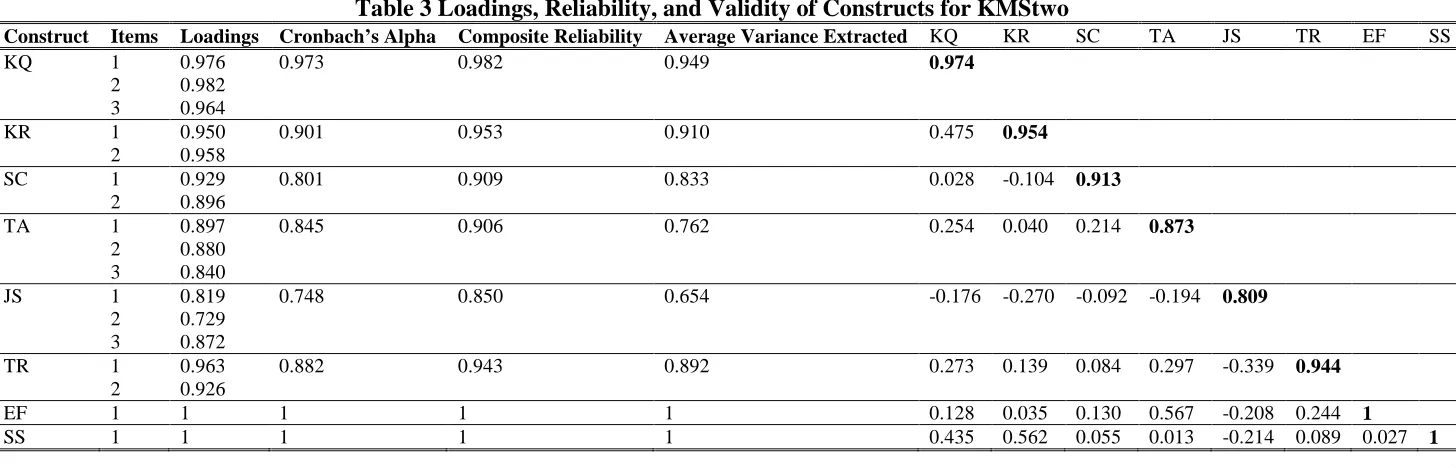
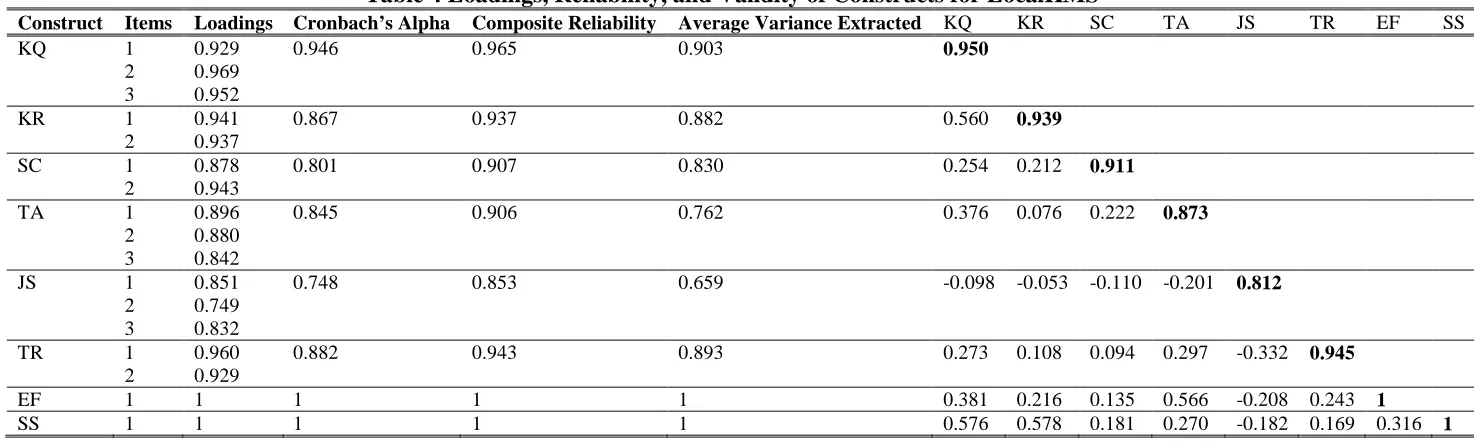
analysis. The item loadings and the results of reliabilities and validities are shown in Table 2
(KMSone), Table 3 (KMStwo), and Table 4 (LocalKMS). The values of Cronbach’s alpha and
composite reliability, which are greater than 0.70, and the values of Average Variance Extracted
(AVE), which are greater than 0.50, indicate the satisfactory reliability and convergent validity for all
these constructs.The discriminant validity is also satisfactory, as the square roots of the AVE are
greater than any of the inter-construct correlations. Given the satisfactory measurement model, our
hypotheses could then be tested by examining the structural model.
As shown in Table 5, all values of Variance Inflation Factor (VIF) are smaller than 5; this reduces the
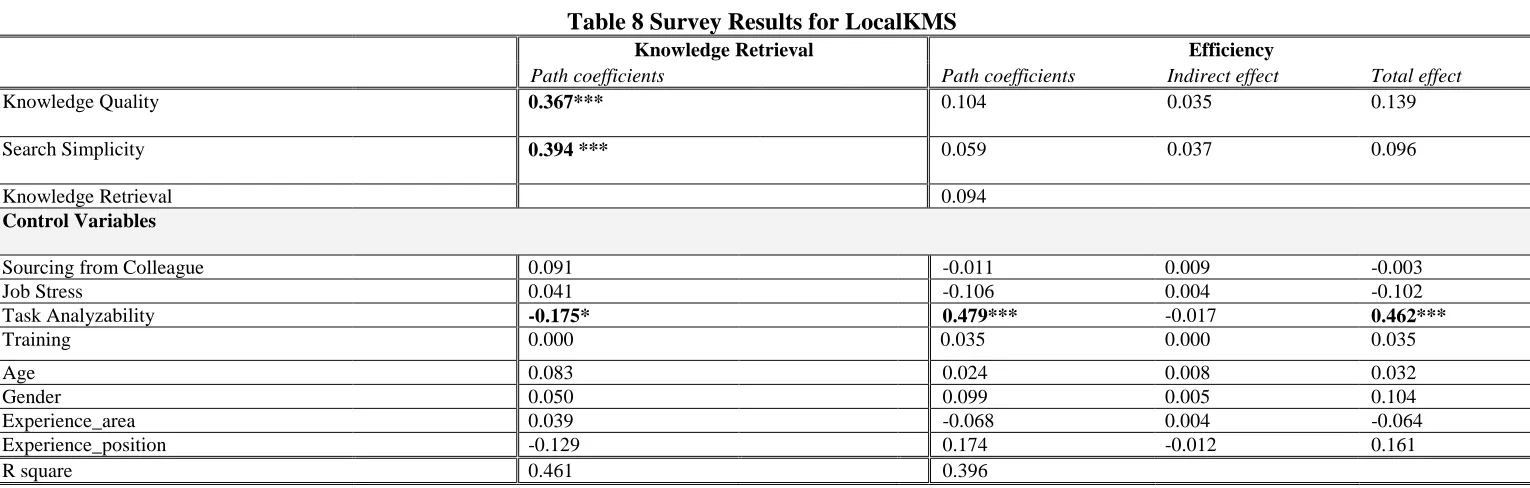
concern of multi-collinearity among predictors. Tables 6 to 8 show the results of the analysis.
Concerning KMSone (Table 6), we find that knowledge quality (coefficient = 0.341, p < 0.001) and
search simplicity (coefficient = 0.212, p < 0.001) positively affect knowledge retrieval, which
subsequently leads to higher work efficiency (coefficient = 0.303, p < 0.001). For the other two KMS,
knowledge quality (coefficient = 0.317, p < 0.001; coefficient = 0.367, p < 0.001) and search
simplicity (coefficient = 0.383, p < 0.001; coefficient = 0.394, p < 0.001) also positively affect
knowledge retrieval. Thus, H1 and H2 are supported. However, knowledge retrieval in KMStwo
(coefficient = 0.008, p > 0.05) or LocalKMS (coefficient = 0.094, p > 0.05) does not lead to higher
efficiency. Thus, H3 is partially supported.
Regarding the control variables, task analyzability positively affects knowledge workers’ efficiency
(coefficient = 0.489, 0.541, and 0.462, respectively, p < 0.001), which is expected because
less-complex customer enquiries should lead to better work efficiency. Moreover, task analyzability
negatively affects knowledge retrieval only for LocalKMS (coefficient = -0.175, p < 0.05). Interpreting
this finding together with the finding that knowledge retrieval from LocalKMS has no effect on work
efficiency means that there is a serious issue of a positive bias toward the LocalKMS.
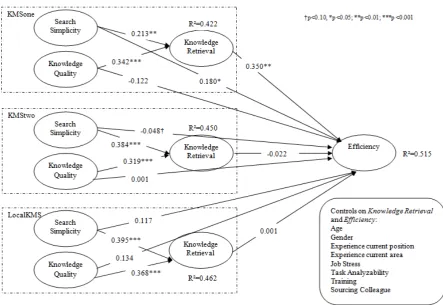
A combined structural equation modeling that contains the degree of knowledge retrievals from the
three types of KMS is shown in Figure 3. The results are consistent: compared with a self-created
KMS (LocalKMS), the extent of knowledge retrieval from organization-created KMS (KMSone) has a
significantly greater impact on knowledge worker’s efficiency; but, this is not the case for
organization-created KMS whose content is not populated by the knowledge workers themselves
15
Table 2 Loadings, Reliability, and Validity of Constructs for KMSone
Construct Items Loadings Cronbach’s Alpha Composite Reliability Average Variance Extracted KQ KR SC TA JS TR EF SS
KQ 1
2 3
0.940 0.961 0.936
0.941 0.962 0.895 0.946
KR 1
2
0.949 0.948
0.889 0.947 0.900 0.573 0.949
SC 1
2
0.915 0.911
0.801 0.909 0.834 0.136 0.248 0.913
TA 1
2 3
0.896 0.882 0.839
0.845 0.906 0.762 0.572 0.445 0.216 0.873
JS 1
2 3
0.875 0.765 0.792
0.748 0.853 0.659 -0.210 -0.173 -0.115 -0.206 0.812
TR 1
2
0.949 0.942
0.882 0.944 0.895 0.375 0.268 0.087 0.299 -0.323 0.946
EF 1 1 1 1 1 0.428 0.516 0.132 0.566 -0.206 0.240 1
[image:15.842.67.795.303.537.2]SS 1 1 1 1 1 0.507 0.474 0.215 0.274 -0.175 0.266 0.424 1
Table 3 Loadings, Reliability, and Validity of Constructs for KMStwo
Construct Items Loadings Cronbach’s Alpha Composite Reliability Average Variance Extracted KQ KR SC TA JS TR EF SS
KQ 1
2 3
0.976 0.982 0.964
0.973 0.982 0.949 0.974
KR 1
2
0.950 0.958
0.901 0.953 0.910 0.475 0.954
SC 1
2
0.929 0.896
0.801 0.909 0.833 0.028 -0.104 0.913
TA 1
2 3
0.897 0.880 0.840
0.845 0.906 0.762 0.254 0.040 0.214 0.873
JS 1
2 3
0.819 0.729 0.872
0.748 0.850 0.654 -0.176 -0.270 -0.092 -0.194 0.809
TR 1
2
0.963 0.926
0.882 0.943 0.892 0.273 0.139 0.084 0.297 -0.339 0.944
EF 1 1 1 1 1 0.128 0.035 0.130 0.567 -0.208 0.244 1
16
Table 4 Loadings, Reliability, and Validity of Constructs for LocalKMS
Construct Items Loadings Cronbach’s Alpha Composite Reliability Average Variance Extracted KQ KR SC TA JS TR EF SS
KQ 1
2 3
0.929 0.969 0.952
0.946 0.965 0.903 0.950
KR 1
2
0.941 0.937
0.867 0.937 0.882 0.560 0.939
SC 1
2
0.878 0.943
0.801 0.907 0.830 0.254 0.212 0.911
TA 1
2 3
0.896 0.880 0.842
0.845 0.906 0.762 0.376 0.076 0.222 0.873
JS 1
2 3
0.851 0.749 0.832
0.748 0.853 0.659 -0.098 -0.053 -0.110 -0.201 0.812
TR 1
2
0.960 0.929
0.882 0.943 0.893 0.273 0.108 0.094 0.297 -0.332 0.945
EF 1 1 1 1 1 0.381 0.216 0.135 0.566 -0.208 0.243 1
SS 1 1 1 1 1 0.576 0.578 0.181 0.270 -0.182 0.169 0.316 1
Table 5 Collinearity Check
KMSone KMStwo LocalKMS
Construct Knowledge Retrieval Efficiency Knowledge Retrieval Efficiency Knowledge Retrieval Efficiency
Knowledge Quality_KMSone 1.995 2.197
Knowledge Quality_KMStwo 1.453 1.636
Knowledge Quality_LocalKMS 1.737 1.987
Search Simplicity_KMSone 1.452 1.530
Search Simplicity_KMStwo 1.360 1.627
Search Simplicity_LocalKMS 1.550 1.839
Knowledge Retrieval 1.733 1.817 1.855
Sourcing from Colleague 1.141 1.164 1.104 1.154 1.157 1.172
Job Stress 1.218 1.219 1.247 1.288 1.232 1.235
Task Analyzability 1.567 1.608 1.229 1.233 1.305 1.362
Training 1.293 1.294 1.257 1.257 1.235 1.235
Age 1.462 1.473 1.429 1.431 1.453 1.466
[image:16.842.30.817.344.534.2]17
Experience_area 1.855 1.868 1.891 1.912 1.872 1.875
Experience_position 1.909 1.924 1.911 1.915 1.899 1.930
Table 6 Survey Results for KMSone
Knowledge Retrieval Efficiency
Path coefficients Path coefficients Indirect effect Total effect
Knowledge Quality 0.341*** -0.117 0.103** -0.014
Search Simplicity 0.212** 0.227** 0.064* 0.291***
Knowledge Retrieval 0.303***
Control Variables
Sourcing from Colleague 0.113 -0.051 0.034 -0.016
Job Stress -0.018 -0.067 -0.006 -0.073
Task Analyzability 0.154 0.443*** 0.047 0.489***
Training 0.024 -0.003 0.007 0.004
Age 0.080 -0.009 0.024 0.015
Gender -0.044 0.143* -0.013 0.130
Experience_area 0.087 -0.118 0.026 -0.091
Experience_position -0.094 0.156 -0.028 0.127
R square 0.423 0.478
[image:17.842.34.827.382.526.2]Note: Significant relationships are in bold. *p < 0.05; **p < 0.01; ***p < 0.001.
Table 7 Survey Results for KMStwo
Knowledge Retrieval Efficiency
Path coefficients Path coefficients Indirect effect Total effect
Knowledge Quality 0.317*** -0.061 0.003 -0.058
Search Simplicity 0.383*** 0.032 0.003 0.035
Knowledge Retrieval 0.008
Control Variables
Sourcing from Colleague -0.167* 0.032 -0.001 0.031
18
Task Analyzability -0.044 0.542*** 0.000 0.541***
Training 0.004 0.069 0.000 0.069
Age 0.034 0.061 0.000 0.062
Gender -0.144 0.135* -0.001 0.134*
Experience_area -0.107 -0.086 -0.001 -0.087
Experience_position 0.046 0.146 0.000 0.146
R square 0.450 0.362
[image:18.842.42.807.182.426.2]Note: Significant relationships are in bold. *p < 0.05; **p < 0.01; ***p < 0.001.
Table 8 Survey Results for LocalKMS
Knowledge Retrieval Efficiency
Path coefficients Path coefficients Indirect effect Total effect
Knowledge Quality 0.367*** 0.104 0.035 0.139
Search Simplicity 0.394 *** 0.059 0.037 0.096
Knowledge Retrieval 0.094
Control Variables
Sourcing from Colleague 0.091 -0.011 0.009 -0.003
Job Stress 0.041 -0.106 0.004 -0.102
Task Analyzability -0.175* 0.479*** -0.017 0.462***
Training 0.000 0.035 0.000 0.035
Age 0.083 0.024 0.008 0.032
Gender 0.050 0.099 0.005 0.104
Experience_area 0.039 -0.068 0.004 -0.064
Experience_position -0.129 0.174 -0.012 0.161
R square 0.461 0.396
19
Figure 3: Combined Model
The interviews and focus groups indicated a vastly unexploited potential of search functionalities in
both KMSone and KMStwo. On the one hand, a search in KMStwo appears to be difficult to use and
is by far not exploited at its full potential: the customer service specialists are not fully aware of how
to refine search results and thus prefer to avoid using KMStwo for solving customer cases. On the
other hand, KMSone does not offer suitable support for refining the output of the search, but it does
appear to contain more comprehensive applicable knowledge than KMStwo. The interviews further
revealed that KMStwo contains too much content, which prevents the time-pressured customer
service specialists from using it, and thus they look for knowledge from alternative resources. In
addition to using KMSone, the customer service specialists prefer to use their own LocalKMS. A
summary of all the issues identified following our interviews is presented in Table 9.
Table 9: Summary of interview insights
Aspects Summary of
findings Interview quotations
Knowledge Retrieval
from KMSone
The search engine in KMSone is very sensitive to the keywords that are typed in
"In KMSone if I use the wrong word I might get no
[image:19.595.77.513.654.757.2]20 The search in
KMSone is not fast enough
"I think [that the search in KMSone] could be faster. […] it would be easier if it would be like a Wiki, Wikipedia type of solutions or something like that and the searches would be fast"
Knowledge Retrieval
from KMStwo
The search in KMStwo provides many irrelevant answers
"The organisation [in KMStwo] is so bad […]. In KMStwo I might have like a thousand answers. And then I start clicking. And at the same time I have a customer waiting for an answer …";
"It's like you [type in a query] and you search … and the KMStwo offers you … any possible kind of answer" Knowledge Retrieval from LocalKMS Development of customer-enquires’ guides, as alternative to KMSone and KMStwo
"[…] we have also made for ourselves like a guide, where you can find all the [customer specific] information. And if the information is not there, and we find an answer to that question, we just add it in that guide."
"Sometimes we use the guide that we have. We have the most [frequent problems described] there. [...]. And it takes about minute or two to find all the needed information from this guide. [...] the simplest way, and the fastest way is to use this guide, where we can find all the information."
"We have created Excel files where there are certain problems or programs [described]. What to do in case of if the password is locked... So we can first look at the Excel file"
The insights from the interviews and focus groups provide us some possible explanations for the
findings from the survey. Most of the customer service specialists are grateful for the opportunity to
use the LocalKMS to a great extent. Two of them mentioned that:
We have the most [frequent problems described] there. [...]. And it's it takes about minute or two to
find all the needed information from this guide. [...] the simplest way, and the fastest way is to use
this guide, where we can find all the information.
We have also made for ourselves like a guide, where you can find all the [customer specific]
information.
The perceived ease of use and relative advantage of the LocalKMS are probably induced by the
amount of time and effort to create and use it. A customer service specialist mentioned:
We don’t often use [KMSone] and we have our own network drive and all the instructions are there
…we have about 90 customers and …have all the instructions there…most of them are word
21
It appears from the interviews and focus groups that the sunk costs of creating LocalKMS increases
the switching cost to use organization-created KMS (Polites & Karahanna, 2012) when handling
customers’ inquires. The customer service specialists also emphasized that search simplicity is the
most prevalent system feature, which is probably because of their work time constraints. The
customer support specialists have clear time targets that need to be achieved, and they need to
efficiently address questions from customers. They are constantly under time pressures, and the daily
summaries of their work efficiency make it worse as the summaries even rank their work efficiency
compared to others.
6.1 Additional Findings
Based on the interviews and focus groups’ insights, we did another test to check whether the extent of
knowledge retrieval from LocalKMS negatively moderates the effect of knowledge retrieval from
KMSone on work efficiency. We found that it does have a negative moderating effect on knowledge
retrieval from KMSone (see Figure 4). Because only knowledge retrieval from KMSone positively
improves work efficiency and there is a vastly unexploited potential of search functionalities in
[image:21.595.83.536.377.679.2]KMSone, this additional finding heightens the concern of a positive bias on self-created KMS.
22
7.
DISCUSSIONS AND IMPLICATIONS
This study aims to examine knowledge worker’s retrieval behavior in three types of KMSs: 1) an
organization-created system and content, 2) an organization-created system whose content is inputted
by the knowledge workers themselves, and 3) a self-created system and content. The study also aims
to examine whether frequent knowledge retrieval from these different types of KMSs leads to higher
work efficiency. The call-center company that we collaborated with for this research is a unique
setting in which the employees’ work is time critical and their work efficiency closely depends on the
way they source the knowledge needed to answer customers’ questions.
According to UGT, users’ process and content gratifications lead to more frequent knowledge
retrieval from a KMS, which subsequently leads to higher work efficiency (Kankanhalli, Lee, & Lim,
2011). However, according to the psychology of sunk cost, users may continue retrieving knowledge
from self-created KMS because of positive bias in their perceived gratifications. Thus, knowledge
retrieval from self-created KMS does not necessarily translate into work efficiency. We found that
both perceived process gratification (reflected by search simplicity) and content gratification
(reflected by content quality) with the KMS led to more frequent knowledge retrieval from the
respective KMS. Moreover, although frequent knowledge retrieval from KMSone (an
organization-created system whose content is inputted by the knowledge workers themselves) led to higher work
efficiency, knowledge retrieval from KMStwo (an organization-created system and content) or
LocalKMS (a self-created system and content) had negligible impact on knowledge workers’ work
efficiency. Concerning KMStwo, knowledge workers had relatively low content and process
gratifications, which discouraged them from retrieving knowledge from KMStwo. For the
LocalKMS, knowledge workers perceived high process and content gratifications, which encouraged
them to retrieve knowledge from it frequently. However, their work efficiency was not highly
improved along with the frequent knowledge retrieval from the LocalKMS. Evidently, their
psychological commitments toward the LocalKMS, due to their previous investment in effort and
time, induced them to continue using the LocalKMS (Kim & Kankanhalli, 2009; Samuelson &
Zeckhauser, 1988), although, in reality, retrieving knowledge from the LocalKMS did not
significantly improve their work efficiency. Moreover, we found that the frequent use of the
LocalKMS due to the knowledge workers’ positive bias negatively moderated the effect of their use
of KMSone on their work efficiency.
Although surveys and interviews allowed us to obtain an in-depth understanding of the effects of
multiple KMSs on customer service specialists’ work efficiency, and we cross-checked their
responses against objective reports when we were onsite, we could not export these objective data for
analytic purpose due to confidentiality issues. Hence, findings of this study should be viewed in light
of the limitation of the study. Nevertheless, this study offers several contributions to research and
23 7.1 Contributions to Research
This study contributes to post-adoption literature of information ystems by examining
organization-created KMS in conjunction with knowledge workers’ self-made local KMS. Users’ knowledge
retrieval behavior from an organization-created KMS and related work efficiency are affected by
alternative accessible knowledge sources users, such as colleagues, physical knowledge sources, or
data warehouses (Kim, Mukhopadhyay, & Kraut, 2016). However, these alternative sources have
significant differences compared with organization-created KMSs. For instance, knowledge in
physical sources cannot be searched automatically via keywords, and data warehouses contain too
much irrelevant content compared with specific KMSs. Through managing local folders, knowledge
workers can maintain specific knowledge and accordingly customize the search function. Regardless
of the strengths and weaknesses of the “other KMSs,” these available alternatives, especially the
self-developed alternatives, may discount the use of an organization-created KMS.
This study also contributes to the knowledge management literature in several ways. Knowledge
retrieval from KMSs has been found to positively affect users’ work efficiency (Kankanhalli, Lee, &
Lim, 2011; McCall, Arnold, & Sutton, 2008). But the level of performance benefit depends on other
factors, such as user experience (Ko & Dennis, 2011) and task characteristics (Kim, Mukhopadhyay,
& Kraut, 2016). More importantly, the capability of a KMS is decisive on whether users’ work
efficiency could be improved through frequent knowledge retrieval (Kankanhalli, Lee, & Lim, 2011).
However, the existing knowledge management literature has mainly focused on perceived output
quality of KMSs (Kankanhalli, Tan, & Wei, 2005; Durcikova & Gray, 2009). We posit that the
perceptions toward a particular KMS could be biased due to users’ psychological commitments to
other KMSs. Thus, frequent knowledge retrieval from a particular KMS that users perceive to contain
high content quality may not necessarily lead to improved work efficiency. By examining knowledge
workers’ perceptions of three types of KMSs (an organization-created system and content, an
organization-created system whose content is inputted by the knowledge workers themselves, and a
self-created system and content) on their work efficiency, we confirm that knowledge workers’
perceptions toward self-created KMS are biased. The knowledge workers have a positive bias on the
search simplicity and content quality of their self-created KMSs, which leads them to frequently
retrieve knowledge from their self-created KMSs, although, in reality, it does not significantly
improve their work efficiency. This illusion of superiority of the self-created KMS may inhibit the
knowledge workers from realizing the full potential of organization-created KMS that can actually
improve their work efficiency.
7.2 Implications to Practice
Organizations should not go the extra miles of populating content into the organization-created KMS.
24
ownership of the auto-populated content. Consequently, they may have a negative bias toward such a
KMS. Second, the organization-created KMS should be integrated into the daily work activities of the
knowledge workers in a way that, while doing their work, the knowledge workers are contributing
knowledge to the KMS. For example, the call-center company embeds KMSone in the customer
service employee’s daily work. When responding to the customers’ enquiries, the customer service
specialists must type the enquiries and their responses into KMSone; hence, they routinely populate
knowledge into KMSone.
Self-created KMS is unavoidable. It is not possible for organizations to prevent their knowledge
workers from creating their own local knowledge repositories. Also, it is not possible for
organizations to prevent knowledge workers from preferring their local knowledge repositories
because of the positive bias of their self-created KMSs. What can be done is to integrate the
knowledge workers’ local knowledge repositories into the organization-created KMSs and maybe
implement a ratings-based knowledge ranking as mentioned in Sutanto and Jiang’s (2013) study.
Therefore, the knowledge workers will access only one system when retrieving knowledge and the
ranking system will help them access the best knowledge content that matches their needs. Over time,
when the knowledge workers realize that the content of their local knowledge repository is inferior
compared to the content of the organization-created KMS, they may no longer want to spend time
creating local knowledge repositories.
8.
CONCLUSION
Knowledge seekers are encouraged to actively retrieve knowledge from KMSs to obtain higher work
efficiency. However, their knowledge retrieval activities from KMSs and subsequent effects on their
work efficiency could vary depending on different types of KMSs. This study investigates knowledge
seekers’ knowledge retrieval activities and the work efficiency obtained from three types of KMSs: 1)
an organization-created system that contains knowledge stored by the knowledge seekers themselves
(KMSone); 2) an organization-created system with auto-populated knowledge content (KMStwo);
and 3) a knowledge seeker’s self-created system and content (LocalKMS). Knowledge seekers’
content and process gratifications toward KMSone and the LocalKMS motivate them to actively
retrieve knowledge from these KMSs. However, compared to KMSone, their positive perceptions of
the LocalKMS are biased by their sunk costs of creating the LocalKMS, which, in turn, lead to
frequent knowledge retrieval from the LocalKMS, although it does not necessarily translate into work
efficiency. This study encourages future research to examine how to de-bias the perceptions of
self-created systems. Moreover, the results of this study provide insights for organizations on KMS design
25 REFERENCES
Alavi, M., & Leidner, D. (1999). Knowledge management systems: issues, challenges, and benefits. Communications of the AIS, 1(2), Article 7.
Alavi, M., & Leidner, D. (2001). Knowledge Management and Knowledge Management Systems: ConceptualFoundations and Research Issues. MIS Quarterly, 25(1), 107-136.
Arkes, H., & Blumer, C. (1985). The psychology of sunk cost. Organizational Behavior and Human Decision Processes, 35(1), 124-140.
Bock, G., Kankanhalli, A., & Sharma, S. (2006). Are norms enough? The role of collaborative norms in promoting organizational knowledge seeking. European Journal of Information Systems, 15(4), 357-367.
Chen, C., & Huang, J. (2009). Strategic human resource practices and innovation performance—The mediating role of knowledge management capacity. Journal of business research, 62(1), 104-114.
Chen, G. (2011). Tweet this: A uses and gratifications perspective on how active Twitter use gratifies a need to connect with others. Computers in Human Behavior, 27, 755-762.
Chen, L., Hsieh, J.-A., Van de Vliert, E., & Huang, X. (2015). Cross-National Differences in Individual Knowledge-Seeking Patterns: A Climato-Economic Contextualization. European Journal of Information Systems, 24(3), 314-336.
Cheung, C., Chiu, P.-Y., & Lee, M. (2011). Online social networks: Why do students use facebook? Computers in Human Behavior, 27, 1337-1343.
Choi, M., & Durcikova, A. (2014). Are Printed Documents Becoming Irrelevant? The Role of Perceived Usefulness of Knowledge Repositories in Selecting from Knowledge Sources. Communications of the Association for Information Systems, 34, 751-774.
Cutler, N., & Danowski, J. (1980). Process Gratification in Aging Cohorts. Journalism Quarterly, 57, 269-277.
Durcikova, A., & Fadel, K. (2016). Knowledge Sourcing from Repositories: The Role of System Characteristics and Psychological Climate. Information & Management, 53(1), 64-78.
Durcikova, A., & Gray, P. (2009). How Knowledge Validation Processes Affect Knowledge Contribution. Journal of Management Information Systems, 25(4), 81-107.
Ebersole, S. (2000). Uses and Gratifications of the Web among Students. Journal of Computer-Mediated Communication, 6(1).
Eighmey, J. (1997). Profiling user responses to commercial web sites. Journal of Advertising Research, 37, 59-66.
26
Gray, P., & Durcikova, A. (2005). The Role of Knowledge Repositories in Technical Support Environments: Speed Versus Learning in User Performance. Journal of Management Information Systems, 22(3), 159-190.
Gray, P., & Meister, D. (2004). Knowledge Sourcing Effectiveness. Management Science, 50(6), 821-834.
Hartwick, J., & Barki, H. (1994). Explaining the Role of User Participation in Information System Use. Management Science, 40(4), 440-465.
He, W., & Wei, K. (2009). What drives continued knowledge sharing? An investigation of knowledge-contribution and -seeking beliefs. Decision Support Systems, 46, 826–838.
He, W., Fang, Y., & Wei, K.-K. (2009a). The role of trust in promoting organizational knowledge seeking using knowledge management systems: An empirical investigation. Journal of the Association for Information Science and Technology, 60(3), 526-537.
He, W., Qiao, Q., & Wei, K.-K. (2009b). Social relationship and its role in knowledge management systems usage. Information & Management, 46(3), 175-180.
Henderson, J., & Lee, S. (1992). Managing I/S Design Teams: A Control Theories Perspective. Management Science, 38, 757-777.
Hester, A. (2011). A Comparative Analysis of the Usage and Infusion of Wiki and Non-Wiki-Based Knowledge Management Systems. Information Technology and Management, 12(4), 335-355.
Hu, T., Poston, R., & Kettinger, W. (2011). Nonadopters of online social network ser vices: is it easy to have fun yet? Communications of the Association for Information Systems, 29, 441-458.
Jasperson, J., Carter, P. E., & Zmud, R. W. (2005). A comprehensive conceptualization of post-adoptive behaviors associated with information technology enabled work systems. MIS Quarterly, 29(3), 525-557.
Kankanhalli, A., Lee, O., & Lim, K. (2011). Knowledge Reuse through Electronic Repositories: A Study in the Context of Customer Service Support. Information & Management, 48(2-3), 106-113.
Kankanhalli, A., Tan, B., & Wei, K. (2005). Understanding seeking from electronic knowledge repositories: An empirical study Authors. Journal of the Association for Information Science and Technology, 56(11), 1156-1166.
Kim, H., & Kankanhalli, A. (2009). Investigating user resistance to information systems implementation: a status quo bias perspective. MIS Quarterly, 33, 567-582.
Kim, S., Mukhopadhyay, T., & Kraut, R. (2016). When Does Repository KMS Use Lift Performance? The Role of Alternative Knowledge Sources and Task Environments. MIS Quarterly, 40(1), 133-137.
27
Ku, Y.-C., Chen, R., & Zhang, H. (2013). Why do users continue using social networking sites? An exploratory study of members in the United States and Taiwan. Information & Management, 50(7), 571–581.
Lai, H.-M., Chen, C.-P., & Chang, Y.-F. (2014). Determinants of knowledge seeking in professional virtual communities. Behaviour & Information Technology, 33(5), 522-535.
Lai, J.-Y. (2009). How Reward, Computer Self-Efficacy, and Perceived Power Security Affect Knowledge Management Systems Success: An Empirical Investigation in High-Tech Companies. Journal of the American Society for Information Science & Technology, 60(2), 332-347.
Lee, K., & Joshi, K. (2016). Examining the use of status quo bias perspective in IS research: need for reconceptualizing. Information Systems Journal, forthcoming.
Lin, T.-C., & Huang, C.-C. (2008). Understanding Knowledge Management System Usage Antecedents: An Integration of Social Cognitive Theory and Task Technology Fit. Information & Management, 45(6), 410-417.
Lin, T.-C., & Huang, C.-C. (2009). Understanding the Determinants of EKR Usage from Social, Technological and Personal Perspectives. Journal of Information Science, 35(2), 165-179.
Liu, I., Cheung, C., & Lee, M. (2010). Understanding Twitter Usage: What Drive People COntinue to Tweet. PACIS 2010 Proceedings, (p. 92).
Liu, I., Cheung, C., & Lee, M. (2016). User Satisfaction With Microblogging: Information
Dissemination Versus Social Networking. Journal of The Association for Information Science and Technology, 67(1), 56-70.
Maier, C., Laumer, S., Weinert, C., & Weitzel, T. (2015). The effects of technostress and switching stress on discontinued use of social networking services: a study of Facebook use.
Information Systems Journal, 25, 275-308.
McCall, H., Arnold, V., & Sutton, S. (2008). Use of Knowledge Management Systems and the Impact on the Acquisition of Explicit Knowledge. Journal of Information Systems, 22(2), 77-101.
McGuire, W. (1974). Psychological Motives and Communication. In J. Blumler, & E. Kaatz, The Uses of Mass Communications: Current Perspectives on Gratifications Research (pp. 167-196). Beverly Hills, CA: Sage Publications.
Moore, G., & Benbasat, I. (1991). Development of an Instrument to Measure the Perceptions of Adopting an Information Technology Innovation. Information Systems Research, 2(3), 192-222.
Nidumolu, S. (1995). The Effect of Coordination and Uncertainty on Software Project Performance: Residual Performance Risk as an Intervening Variable. Information Systems Research, 6(3), 191-219.
Park, S., & Ryoo, S. (2013). An empirical investigation of end-users’ switching toward cloud
28
Phang, C., Kankanhalli, A., & Sabherwal, R. (2009). Usability and Sociability in Online
Communities: A Comparative Study of Knowledge Seeking and Contribution. Journal of the Association for Information System, 10(10), 721-747.
Polites, G., & Karahanna, E. (2012). Shackled to the status quo: the inhibiting effects of incumbent system habit, switching costs, and inertia on new system acceptance. MIS Quarterly, 36, 21-42.
Rubin, A. (1985). Uses and Gratifications: Quasi-Functional Analysis. In J. Dominick, & J. Fletcher, Broadcasting Research Methods (pp. 202-220). Boston: Allyn and Bacon.
Ruggiero, T. (2000). Uses and Gratifications Theory in the 21st Century. Mass Communication and Society, 3(1), 3-37.
Samuelson, W., & Zeckhauser, R. (1988). Status quo bias in decision making. Journal of Risk and Uncertainty, 1, 7-59.
Sangwan, S. (2005). Virtual Community Success: A Uses and Gratifications Perspective. Proceedings of the 38th Annual Hawaii International Conference on System Sciences.
Shigemi, J., Mino, Y., Ohtsu, T., & Tsuda, T. (2000). Effects of perceived job stress on mental health. A longitudinal survey in a Japanese electronics company. European Journal of Epidemiology, 16(4), 371-376.
Siponen, M., & Vance, A. (2010). Neutralization: New Insights into the Problem of Employee Information Systems Security Policy Violations. MIS Quarterly, 34(3), 487-502.
Stafford, M., & Stafford, T. (1996). Mechanical Commercial Avoidance: A Uses and Gratifications Perspective. Journal of Current Issues and Research in Advertising, 18, 27-38.
Stafford, T., & Stafford, M. (2001). Investigating Social Motivations for Internet Use. In O. Lee, Internet Marketing Research: Theory and Practice (pp. 93-107). Hershey, PA: Idea Group Publishing.
Stafford, T., Stafford, M., & Schkade, L. (2004). Determining Uses and Gratifications for the Internet. Decision Sciences, 35(2), 259-288.
Straub, D. W., Boudreau, M., and Gefen, D. (2004). Validation Guidelines for IS Positivist Research. Communications of the Association for Information Systems, 13(24), 380-427.
Su, C., & Contractor, N. (2011). A Multidimensional Network Approach to Studying Team Members' Information Seeking from Human and Digital Knowledge Sources in Consulting Firms. Journal of the American Society for Information Science & Technology, 62(7), 1257-1275.
Sutanto, J., & Jiang, Q. (2013). Knowledge seekers’ and contributors’ reactions to recommendation mechanisms in knowledge management systems. Information & Management, 50(5), 258– 263.