Energy Optimization in Wireless Sensor Networks Using Trust-Aware
Routing Algorithm
Rohit Dhanvijay
1, Mukul Pande
2, Sarvesh Wajurakar
31
RTMNU University, Nagpur Maharashtra
1,2,3
Tulsiramji Gaikawad-Patil Collage of Engineering & Technology, Nagpur
---***---Abstract -
Wireless sensor networks for monitoring of the remote distributed environments. As one of the main technologies used in WSNs, nodes fault detection is indispensable in most WSN applications. It has been seen that the fault detection in distributed system finds out the failed nodes by exchanging data and mutually testing among neighbor nodes in this network., but the fault finding correctness has decrease rapidly when there is number of neighbor nodes to be detect as small and the failure is high. The corrected system is proposed for new detection system. Simulation give the improved system performs well for the problem and can increase the fault detection accuracy greatly. wsn-actor networks, sensors detect their surroundings and gives their data to next nodes. Actors collaboratively respond to achieve predefined application mission. So the actors have to communicate with the operation, it is used to maintain a good connected network at all times. Moreover, the length of the inter-actor communication paths maybe constrained to meet latency requirement. Cost Aware Secure Routing protocol to consist these two problem issues through two node parameters energy balance control and probabilistic based random walking. CASER is used for routing excellent performance in terms of energy balance and routing path distribution for routing path security. The proposed is for energy non uniform deployment system to longest the sensor network lifetime. Our analysis and simulation will showing that we can increase the lifetime and the number of messages that can be delivered under then on-uniform energy deployment by more than four times. CASER has flexibility to support multiple routing. The used to have a network which gives conformation of packet delivery and give the node time to regain its so that it will be able to carry further load Packets on the network. This can be done by using shortest path. Prior work relies on maintaining multi hop neighbor lists and predetermines some criteria for the node’s involvement in the recovery. Multi hop based schemes often impose high node repositioning overhead and the repaired inter actor topology using two hop schemes may differ significantly from its prefailure status.Key Words: WSN, CASER, EBC, Security, multi hop,
topology.
1. INTRODUCTION
Wireless sensor networks are composed of massive, small and low-cost sensor nodes deployed in a monitoring region, forming a multi hop self organized network system through wireless communication. The target is to cooperatively sense, collect and process the information about objects in the node failure, and then send it to the observer for processing and analyzing. The sensors used as wsn data acquiring devices for the more effective actor nodes that process the sensor readings and put forward an appropriate response a failure of an actor may cause the network to partition into disjoint blocks and would thus violate such a
connectivity requirement. The remote setup in which Wireless has often serve makes the application of additional resources to overcome failed actors impractical, and repositioning of nodes becomes the best recovery option When a node fails, its neighbors will individually consult their possibly incomplete routing table to decide on the appropriate course of correction and give their role for the recovery. If the node which is failed critical to the network communication, when the node got failure effect the network to the neighbor that belongs to the smallest block reacts. Require every node to maintain a list of their multi-hop neighbors and determine the scope of the recovery by checking whether the failed node. Cost Aware Secure Routing system for WSNs to energy consumption balance and improve network lifetime. CASER has the flexibility to support multiple routing strategies in message forwarding to extend the lifetime while increasing routing security. Both theoretical analysis and simulation results show that CASER has an excellent routing performance in terms of energy balance and routing path distribution for routing path security. The non-uniform energy deployment System to longest the sensor network lifetime. Our analysis and simulation results show that we can increase the lifetime and the number of messages that can be delivered under the non-uniform energy deployment by more than four time. The main aim is to detect the failure node using shortest path to send the data and recover the failure node and also maximize the sensor network lifetime, due to this the traffic load is on the single node which cause the bottleneck in the network traffic. it give the energy usage of all sensor grids are balanced. To achieve a high message delivery ratio, our routing protocol should try to avoid message dropping by multiple node path when an alternative routing path exists and recover.
It ensures balanced energy consumption of the entire sensor network so that the lifetime of the WSNs can be maximized.
CASER protocol supports multiple routing strategies based on the routing requirements, including fast/slow message delivery and secure message delivery to prevent routing
The back attacks and malicious traffic conjection attacks in WSNs.
The randomly deployed sensor nodes are within the sensor domain. Every sensor node gives limited and energy resource non-replenishable.
Through a multi-hop routing strategy. The sink node is the only destination for all sensor nodes to send messages by hoping.
For This type of problem with collocated node failure is more complex and challenging in nature. To investigate this issue. Also includes factoring in coverage and ongoing application tasks in the recovery process and developing a for evaluating the various failure recovery schemes.
Detecting and data processing are important in wireless have many more nodes and are more densely deployed Hardware must be cheap nodes are more prone to failures WSNs operate under very strict energy constraints
Node failures detection are very difficult for unless a part of the deployment region which has parts in coverage and ongoing application tasks in the recovery process and developing a test bed for evaluating the various failure recovery schemes. The chances of multiple nodes will fail at the same time is so small and which will not thing to worry the smallest block inward toward the failed node; it may negatively affect the node coverage. The restoration of connection problems are to be path length values. Normally , in the applications, such as robotic networks and search-and-rescue operation, timely coordination among the actors is required, and extending the shortest path between two actors as a side effect of the recovery process would not be acceptable. The system, which interaction among actors in a operation would needs timeliness to correct track and attack a fast moving system.
A novel approach is proposed. It relies on the local view of a node about the network to relocate the least number of nodes and ensure that no path between any pair of affected nodes is extended relative to its prefailure status. A novel protocol should try to avoid message dropping and create alternate path for massage forwarding and repair the faulty nodes
2. PROPOSED WORK
To avoid the excessive state-update overhead and to expedite the connectivity restoration process, prior work relies on maintaining multi-hop neighbor lists and predetermines some criteria for the node’s involvement in the recovery.
Multi-hop-based schemes often impose high node repositioning overhead, and the repaired inter-actor topology using two-hop schemes may differ significantly from its prefailure status.
i. Number of deployed actors (N): This parameter affects the node density and the WSAN connectivity.
Increasing N makes the WSAN topology highly connected.
ii. Communication range: All actors are assumed to have the same communication range.
iii. The value of affects the initial WSAN topology. While a small creates a sparse topology, a large boosts the overall connectivity
iv. Total travelled distance: reports the distance that the involved nodes collectively travel during the recovery. This can be envisioned as a network-wide assessment of the efficiency of the applied recovery scheme.
v. Number of relocated nodes: reports the number of nodes that moved during the recovery. This metric assesses the scope of the connectivity restoration within the network.
vi. Number of exchanged messages: tracks the total number of messages that have been exchanged among nodes. This metric captures the communication overhead.
vii. Number of extended shortest paths: reports the total number of shortest paths between pairs of nodes. That get extended as a result of the movement-assisted network recovery. Shortest paths are calculated.
viii. Shortest paths not extended: reports average number of shortest paths that are not extended per topology: This metric assesses how serious the potential path extension.
ix. The messaging overhead dramatically grows as the node count increases. On the other hand, requires maintaining one-hop neighbor information for performing the recovery. Thus, an extra N message overhead is considered for to exchange information initially at the network startup.
Sample paragraph Define abbreviations and acronyms the first time they are used in the text, even after they have been defined in the abstract. Abbreviations such as IEEE, SI, MKS, CGS, sc, dc, and rms do not have to be defined. Do not use abbreviations in the title or heads unless they are unavoidable.
After the text edit has been completed, the paper is ready for the template. Duplicate the template file by using the Save As command, and use the naming convention prescribed by your conference for the name of your paper. In this newly created file, highlight all of the contents and import your prepared text file. You are now ready to style your paper.
3. Methodology
distribution for routing path security. We also proposed a non-uniform energy deployment scheme to maximize the sensor network lifetime. CASER support secure delivery to prevent routing trackback attack and malicious traffic jamming attack in Wireless Sensor Network. This combinational technology helps to improve the recovery scheme
Step 1: Network creates and forward the data
Step 2: Check the node is active or not
If Ea>NA
Send the data from the path
Else if Ea< NA
Then node is fail &applies the recovery scheme send the data
Else If faulty nodes repair
Then Active the previous path
Else nodes fail
Step 3: Update the routing table and select the shortest path for data transfer
Step 4: Stop
Since Ea(A) is defined as the average energy level of the nodes in NA.NA is the selected hop grid from the network
node.
This can happen due to changes in the topology caused by node mobility or due to the fact that a subset of actors do not need to interact and that a route has yet to be discovered. In general, a partially populated SRT can raise the following three issues or a distributed implementation
1) A potential BC actor does not realize that its failed neighbor is a critical node.
2) Every neighbor of the faulty node assumes that it is not part of the smallest block leaving the network topology unrepaired.
3) more than one neighbor in different blocks step forward
[image:3.595.318.551.71.278.2]If the process start it maintain the routing table and generate the routing list. As per the implementation of caser it analyze the failure nodes and using shortest routing path send the data and balance the load. It also recover the failed node send the another data from the node.
Fig 1 Routing Generation
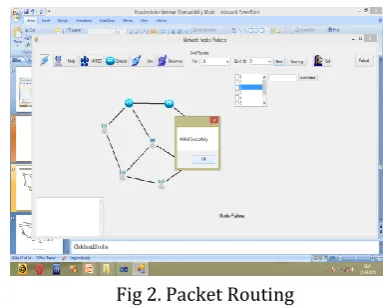
This scenario select the nodes for transmission i.e. node 0, node 1, node 2 and node3 using shortest path. The select the node for transmission the node 0 then transfer to the node 1 forward the packet to node 2 then transfer to node 3. The routing path are generate from node 0 to node 1 to node2 and node 3. So data transfer from this routing path. For the data transmission generate the routing path for the routing path generation need to add the selected nodes from the routing table. To select the node from the routing table and add to the routing path generation.
Fig 2. Packet Routing
[image:3.595.331.523.439.593.2]Fig 3.The repair the failure nodes
This scenario shows the repair the failure nodes. Due to applying the recovery scheme the failure nodes giving the time for regain, so that they are able to transmit the data. The figure show the repairing of the failure nodes. It have a time for regain the failure nodes so that it is in repair state so that the data is transfer from the previous routing path. The failure nodes are node1 and node2 have a time to regain, So that the data send from the previous routing path. The repair the node by the combinational methodology.
The proposed algorithm has been carried out using the network simulator
.net. To improved the version of recovery Scheme.
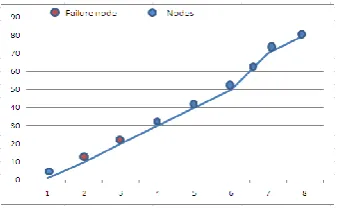
Fig 4. Multiple Nodes fail detection
The figure Multiple Node fail detection to detection of the failure nodes. The propose protocol detect the multiple failure nodes at a time. In routing path1 having8 nodes detects the 2 failure nodes, routing path2 having the15 nodes detects 3 failure nodes and routing path 3 having 25 nodes to detects 5 failure nodes. The propose protocol detects the more failure nodes very quickly. The propose protocol detection 80% failure node. The technique detect faster failure detects as compare to previous technique.
3. CONCLUSION
In this project, to propose a secure and efficient Cost-Aware Secure Routing protocol for WSNs to balance the energy consumption and increase network lifetime. Our analysis and simulation to showing that we can increase the lifetime of wireless sensor network and to maintain a list of their multi-hop neighbours and determine the scope of the
recovery by checking whether the failed nodes. It also provide the assurances to packet delivery. CASER has flexibility to support multiple routing. The main objective to have a network which gives assurance of packet delivery and give the time to the nodes for regain, so that it will be able to carry further load Packets on the network. This can be done by using shortest path. Prior work relies on maintaining multi-hop neighbour lists and predetermines some criteria for the node’s involvement in the recovery. Multi-hop-based schemes often impose high node repositioning overhead and the repaired inter-actor topology using two-hop schemes may differ significantly from its prefailure status.
REFERENCES
[1] D. Kornack and P. Rakic, “Cell Proliferation without
Neurogenesis in Adult Primate Neocortex,” Science, vol.
294, Dec. 2001, pp. 2127-2130,
doi:10.1126/science.1065467.
[2] M. Young, The Technical Writer’s Handbook. Mill Valley,
CA: University Science, 1989.
[3] R. Nicole, “Title of paper with only first word
capitalized,” J. Name Stand. Abbrev., in press.
K. Elissa, “Title of paper if known,” unpublished.
[1]Hong Guo, Gangxiang Shen, Senior Member, IEEE, Sanjay K. Bose, Senior Member, IEEE et al “Routing and Spectrum Assignment for Dual Failure Path Protected Elastic Optical Networks”, 2169-3536 (c) 2016 IEEE. Translations[2]K.Akkaya.A.Thimmapuram,F.Senel,amd
S.Uludag.,”Distributed recovering of actor failuresin wirelesssensor and actor networks”, in Proc Workshop FedSenS, Istanbul, Turkey, Jul. 2011.
[3] O. Gerstel, M. Jinno, A. Lord, and S. B. Yoo, “Elastic optical networking: A new dawn for the optical layer?” IEEE Communications Magazine, vol. 50, no. 2, pp. s12-s20, Feb. 2012.
[4] Y. Wei, G. Shen, and S. K. Bose, “Applying ring cover technique to elastic optical networks,” in Proc. ACP, 2013, pp. AF1I-4.
[5] Y. Wei, G. Shen, and S. K. Bose, “Span-restorable elastic optical networks under different spectrum conversion capabilities,” IEEETransactions on Reliability, no. 63, vol. 2, pp. 401-411, Jun. 2014.
[6] J. Wu, Y. Liu, C. Yu, and Y. Wu, “Survivable routing and spectrum allocation algorithm based on p-cycle protection in elastic optical networks,” Optik-International Journal for Light and ElectronOptics, vol. 125, no. 16, pp. 4446-4451, Aug. 2014.
[7] F. Ji, X. Chen, W. Lu, J. J. Rodrigues, and Z. Zhu, “Dynamic
p-cycle configuration in spectrum-sliced elastic optical networks,” in Proc. GLOBECOM, 2013, pp. 2170-2175.
[image:4.595.76.245.430.538.2]IEEE/OSA Journal of Optical Communications and Networking, vol. 6, no. 10, pp. 901-910, Oct. 2014.
[9] X. Chen, S. Zhu, L. Jiang, and Z. Zhu, “On spectrum efficient failure-independent path protection p-cycle design in elastic optical
networks,” IEEE/OSA Journal of Lightwave Technology, vol. 33, no. 17, pp. 3719-3729, Sep. 2015.
[10] H. M. N. S. Oliveira and N. L. S. da Fonseca, “Algorithm for FIPP p-cycle path protection in flexgrid networks,” in Proc. GLOBECOM,
2014, pp. 1278-1283.
[11] M. Klinkowski and K. Walkowiak, “Offline RSA algorithms for elastic optical networks with dedicated path protection consideration,” in Proc. ICUMT, 2012, pp. 670-676.
[12] M. Klinkowski, “A genetic algorithm for solving RSA problem in elastic optical networks with dedicated path protection,” in Proc. CISIS, 2013, pp. 167-176 [13] M. Klinkowski, “An evolutionary algorithm approach for