,
ESEiS
irSll
JliL
!
5
SCIENCE &
S!g
CHNOLOGY
January,
1971
Vol.
20,
No.1
CD
~---~~---P
ER
I
O
DIC
A
LS SEC 126
3
399045
. . .
01
0
4
1
80 W
SAN C
A
RLO
S ST
*
0
1271
S
A
N
J
OSE
C
A
95113
Computer
Chooses
Now. A monolithic memory lets you
forget stop-and-go keypunching.
IBM announces a keypunch that isn't
stop-and-go. It's another reason we're the company behind
the computer.
We have a keypunch that's designed to help your people
become more productive.
It's called the IBM 129 Card Data Recorder.
It comes in models that both punch and verify cards.
And it lets your operators key data into a
monolithic
memory that serves as a buffer before the cards are punched.
What does this new technology mean to you?
It means that your operators can key data
continuollsly.
Even while another card is being punched and stacked.
It means that thev can make corrections before a card is
punched. Which in
tu~
means that an entire card won't have
to be repunched because of a single mistake.
It
means that your operators can work at their fastest
speed.
'
The
U9's
monolithic memory will store up to six different
card formats so your operators can change them easily
without interrupting their work flow.
Exclusive options: An "accumulate" feature will total
selected card fields. Another feature provides a count of
keystrokes and cards.
It
has all these new advantages. Yet it has the same
familiar keyboard. So your operators won't have to be
retrained to use it.
We believe our job is to help you get the most out of your
computer.
And that is another reason we're the company behind
the computer.
The New York Times and
Computers and Automation
announce a practical guide to
the most elusive components in
computers and data processing ...
PEOPLE
Who they are ...
What they do ...
Where they do it ...
Until now, it has been well-nigh
im-possible to keep track of the
thou-sands of highly skilled professionals
engaged in the world's fastest
grow-ing profession.
The painstaking task required
t
ventory the qualifications and 1
grounds of the 15,000 most
01sary professionals in every bran(
the computer field has now beel
complished. The oldest magazit
the field,
Computers and Aut(
tion, and the information retr]
services of
The New York Tl
have pooled their resources to
duce the Fifth Edition of
WHO'S WHO IN
COMPUTERS AND
DATA
PROCESSIN
This is the most extensive registe:
computer professionals ever p'
lished - the first of its kind in se'
years.
It
is arranged for your c
venience in three volumes:
1.
Systems Analysts and Progra
mers
2. Data Processing Managers
Directors
3. Other Computer Professioi
(from professors of computer
ence to attorneys versed in
computer field)
Each of the more than 15,000
I
cialists is covered by a separate ,
sule biography detailing:
Birth L
... Education . .. Year Entered C
puter Field . .. Title . .. Honors
Memberships . .. Special Skills
(f
applications to logic to sales)
PL US both home and business
ad-dresses. For example:
CHAPIN, Ned / consultant / born: 1927 /
pilll€'· Phn
TIT· MIl 4 T T~; •• _cro'.·
.
C
r,")
1
fJ:.J
,~., ~~ r'~
T'
i'l 1..,/ ,. ... .; .... ,:", •
J.\I.UAlt'f
AaD
:):!
!J·/l
teduced Pre-publication Price.
. 'he reservation form below
will
bring
JU
the 3-volume set at the reduced
rice of $60 ... an immediate
sav-19
of $15 from the regular price of
75.
There is no risk involved.
10-ay Free Examination.
rHO'S WHO IN COMPUTERS
ND DATA PROCESSING
iited by Edmund
C.
Berkeley
volumes in durable hard-cover
'1dings
~tail
price $75 the set
~e-Publication
Price $60
'---_.,
a
Processing,
60
N COMPUTERS AND DATA
60 (regularly $75).
You
will bill
thin 10 days if not fully satisfied.
fE
&ZIP
-P.O.
#
(IF COMPANY ORDER)I
t
Comprehensive geographical
list-ircial time-shared services, courses
,ftware, campus computer centers,
n 2,000 applications of computer
JS -
alld more! Order now at $20
,
l ___________
C~Vol. 20, No.1
January,
1971
Editor
Edmund C. Berkeley
Assistant Editors
Linda Ladd Lovett
Neil D. Macdonald
Software Editor
Stewart B. Nelson
AdzJertising
Director
Bernard Lane
A,'! Directors
Ray W. Hass
Daniel T. Langdale
Contributing
Editors
Adzlisory
Committee
Fulfillment
Manager
Adz'atising
Contact
Edilol'ialOffices
John Bennett
Moses M. Berlin
Andrew D. Booth
John W. Carr III
Ned Chapin
Alston S. Householder
Leslie Mezei
Ted Schoeters
Richard E. Sprague
James J. Cryan
Alston S. Householder
Bernard Quint
William
J.
McMillan
THE PUBLISHER
Berkeley Enterprises, Inc.
815 Washington St.,
Newtonville, Mass. 02160
617-332-5453
Berkeley Enterprises, Inc.
815 Washington St.,
Newtonville, Mass. 02160
617-332-5453
Computers and Automation is published monthly
(except two issues in November) at
815Washing·
ton St., Newtonvi lie, Mass.
02160,by Berkeley
Enterprises, Inc.
Printed in U.S.A.
Subscription
rates:
United States,
11monthly
issues and two issues in November (one of which
is a directory issue) -
$18.50for
1year,
$36.00for
2years;
12monthly issues (without directory
issue in November) -
$9.50for
1year;
$18.00for
2
years.
Canada, add
SO¢a year for
po,tagei
foreign, add
$3.50a year for postage. Address
all U.S. subscription mail to: Berkeley Enterprises,
Inc.,
815Washington
St.,
Newtonville,
Mass.
02160.
Second Class Postage paid at Boston, Mass.
Postmaster: Please send ail forms
3579to Berkeley
Ent€rprises, Inc.,
815Washington St., Newtonville,
Mass.
02160.©
Copyright
1971,by Berkeley
En-terprises, Inc.
Change of
address:
If your address changes,
please send us both your new address and your old
address (as it appears on the magazine address
imprint and allow three weeks for the change to
be made.
4
CDlTlputers
and automation
The Cornpnter Industry
14 THE EDP MANAGER -
AND THE COMPUTER PROFIT DRAIN [A]
by Walter J. Schroeder, Principal, A. T. Kearney
& Co., Inc.
Why have the predictions of the 1960's regarding the use of
computers in making management decisions, and the movement
of EDP managers into company presidencies, failed to
materi-alize?
9
NATIONAL ASSOCIATION FOR
STATE INFORMATION SYSTEMS
by Daniel B. Magraw
A progress report, on the work of this association.
[F]
10 THE IEEE COMPUTER SOCIETY
[FJ
by John
L.
Kirkley and E. J. McCluskey
Some comments on the implications of the changing of the
name of the Computer Group of the Institute of Electrical and
Electronic Engineers, Inc., to the IEEE Computer Society.
10 THE INTERACTIVE TIME·SHARING MARKET
by Joseph Levy
Some highlights of a recent analysis and forecast.
10 CALL FOR
PAPERS-IEEE COMPUTER SOCIETY CONFERENCE 1970
13 "COMPUTERS AND AUTOMATION" -
SOME VIEWS
by Michael Richter, Arthur E. Gardner, and the Editor
C01nputel's (( Ild the Philosophu of Science
[F]
[F]
6
BOOKS, COMPUTERS, AND THE GREAT FUTURE
[EJ
by Edmund
C.
Berkeley, Editor, Computers and Automation
The day will come when computers, like books, will be valued
for the data and ideas they contain, rather than their
hard-ware shells.
21
OPPOSITION TO NEW IDEAS
[AJ
by Neil Macdonald, Assistant Editor, Computers and Automation
This article, first published twelve years ago, lists some of the
devices used by people to avoid considering new ideas -
and
has major implications regarding past and future progress in
the computer industry.
C01nzmte1's ((nd G01)eJ'unwnt
19 TAX RETURN FILING BY COMPUTER
[AJ
by Mark E. Battersby, Tax Consultant
An analysis of a new I.R.S. procedure which allows employers
to file both their Annual Wage and Tax Statements and their
Earnings Reports for the Fourth Quarter on one magnetic tape
-
and which wi II satisfy the flli ng requirements of both the
I.R.S. and the Social Security Administration.
The magazine of the design, applications, and implications
of information processing systems.
Computers and Society
8
"RESPONSIBLE JOURNALISM" -
COMMENT
[F]
by Clark Squire
A strong statement supporting the credibility of the article by
Joe Hanlon, "The Life and Times of Clark Squire: Computer
Programmer, Black Panther, Prisoner," which was published
in the Nov. 1970 issue of "Computers and Automation."
13
ACCESS TO ONE'S OWN RECORDS
[F]
by Bruce Madsen
In response to the article "Regulations for Information Systems"
(Sept. 1970 issue) a reader raises the question: Who is qualified
to judge what another individual should not know?
Computers, Science, and Assassinations
45
THE DEATH OF WALTER REUTHER:
ACCIDENTAL OR PLANNED?
[A]
by Edmund
C.
Berkeley and Leonard Walden
The pattern of political assassinations in this country makes it
appear necessary to raise -
and to try to answer -
some
sig-nificant questions about the plane crash in May 1970 in which
Walter Reuther was killed.
Computers and Games
9
"INSTANT INSANITY" -
MORE COMMENTS
[F]
by M. B. Bakkevej
Another reader describes his approach to solving the "Instant
Insanity" puzzle.
62
NUMBLES
[C]
by Neil Macdonald
62
PROBLEM CORNER
[C]
by Walter Penney, COP
Reference Information
23
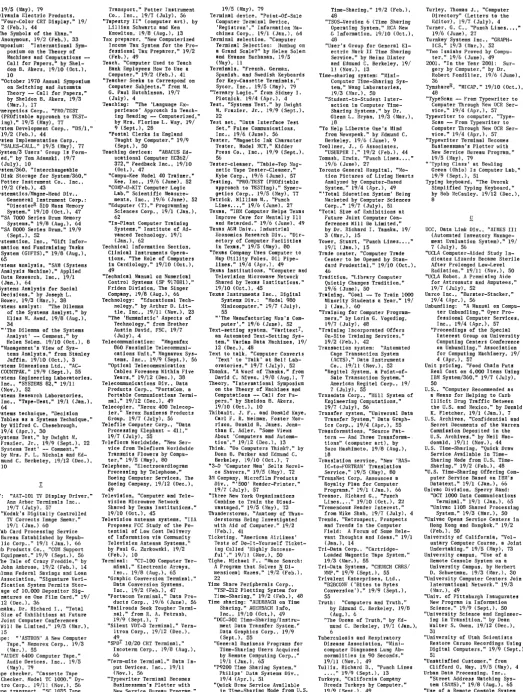
ANNUAL INDEX FOR
VOL. 19 (1970) OF "COMPUTERS AND AUTOMATION"
[R]
A thorough index by author, title, and subjects, of all
informa-tion published in the 1970 issues of C&A, except the 1970
Computer Directory issue.
25
THE 1970 ISSUES OF "COMPUTERS AND AUTOMATION"
[E]
Some comments on C&A's editorial philosophy and changes in
1970.
24 "COMPUTERS AND AUTOMATION" IN 1970:
TWO NEW ARTICLE SERIES
[R]
Articles and some other information related to "Computers and
Society: 'The House Is on Fire'" and "Computers, Science, and
Assassinations" published during 1970.
41
Announcements re: "WHO'S WHO IN
COMPUTERS AND DATA PROCESSING," and the
"1970 COMPUTER DIRECTORY AND BUYERS' GUIDE"
[R]
Current news on the publication and availability of these
ref-erence volumes.
This Month's Cover
The decision to grow the
carnations shown on the front
cover was "made" by a
com-puter program. Burgett Floral
Co., Cloudcroft, New Mexico,
used an IBM 1130 computing
system to analyze cyclical
sales patterns, costs,
produc-tion rates, disease factors, and
spoilage rates. The computer
"concluded" that carnations
and roses were in greatest
de-mand, and most profitable,
for the company to grow. The
company also uses its
compu-ter to monitor temperature
and humidity control devices
and to remind company
offi-cials when to order, plant,
fertilize and top flowers.
Bur-gett annually produces five
million flowers.
Departments
49 Across the Editor's Desk
49
Applications
50
Education News
51
Research Frontier
51
Miscellany
63
Advertising Index
42
Calendar of Coming
Events
63
Classified Advertisements
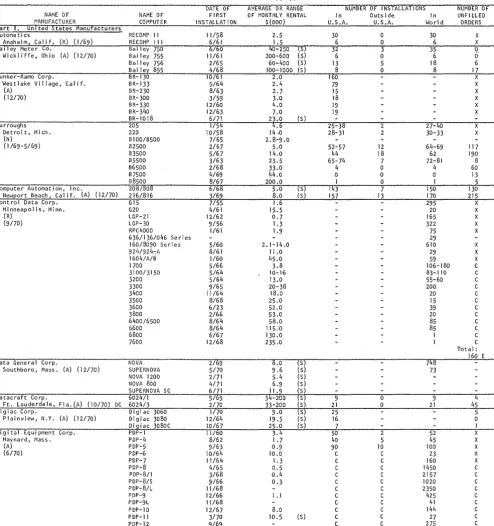
59 Monthly Computer
Census
57
New Contracts
58
New Installations
52
New Products and
Services
8
Readers' Forum
Key
[A] ---.- Article
[C] -
Monthly Column
[E]
~
Editorial
[F] -
Readers' Forum
[R] -
Reference Information
EDITORIAL
Books, Computers, ,and the Great Future
One way of thinking of a computer is to think of it as a
kind of book.
Output.
A book (for example, in Russian) contains
in
forma tion which you can read, provided you know the
spoken language (Russian), the alphabet (of Russian), and
can pronounce the alphabetic signs (in context) which spell
the designated words. In the same way a computer contains
information which can be output usefully, provided you
know the set of operations by means of which the
computer will produce the information you desire.
Input.
You can put information into a book. For a
simple example, you can make entries in your date book, or
put notes into a notebook, or even write a manuscript
which a publisher will print as a book. In the same way,
you can put information into a computer - give it data and
programming by means of which later you can get useful
information out.
Storage.
You can store information in a book. In fact, a
book is a magnificent way of storing information. The
sheets of paper it comprises can be easily impressed with
marks that will stay a few days or a few centuries. The
sheets of paper with their marks can be easily duplicated in
quantity and spread all over the world. You can store
information in a computer, not as well all in all, but
effectively. Of course, most of the time the storage cannot
be sensed by human beings; only by magnetic changes and
electronic pulses can human beings find out the
information stored in the computer. But the techniques are
becoming so widespread thai one nowadays hears few
complaints that "you cannot see what is in the computer."
Calculation.
You can calculate with a book. Books are
full of tables of results -
for many varieties of
combinations of many kinds of data. In this way they
effectively provide many calculations that exactly fit the
requirements. A great many more calculations than those
stored in books can be done by a man with a book of
factors in his pocket and some rules for estimating stored in
his brain. In this way the man may be ready to inspect, and
approve or disapprove, all kinds of calculated results.
However, a computer really comes into its own when it
is a matter of calculating and deciding about more elaborate
cases than can ever be tabulated in books or decided by
educated inspection.
Ideas.
But when we think of ideas, of knowledge, we
think of books.
The knowledge written down and printed in books is
still the foundation of all present-day civilization. This is
true for many reasons. First, quantity: The amount of
useful information recorded in print is enormously greater
than the amount of useful information expressed in all the
other ways put together. Any story, epic, adventure, idea,
principle, science, philosophy, art, technique, discovery,
technology, once written down and printed, can be read,
studied, and learned from books. Second, accessibility:
It
is
quite easy and cheap to get or borrow a copy of almost any
6
book on almost any subject whenever you want to read it
-far easier and cheaper than to obtain access to a computer
and communicate with it. Third, convenience: You can
take what the book says into your own mind at your own
time at your own speed: if you want to hurry and skip, you
can; if you want to read it over and over until you know it
by heart, you can; if you want to read it on a commuting
train in the morning, you can. In a book you can
communicate with another mind, not at his speed or
convenience but at your own. Fourth, quality: In books,
the greatest men who have ever lived, the best experts, the
most informed authorities, can offer you answers for your
questions, instruction in the subjects you are most
concerned with, guidance in the problems that rack your
spirit, and far more. Fifth, vicarious experience: You and I
will probably never climb Mt. Everest, or survive the sinking
of an ocean liner, or look through a porthole at' a kind of
starfish seven miles down in the Pacific Ocean. We shall
certainly never flee from Pompeii while Vesuvius erupts, or
accompany Charles Darwin on the survey shi p Beagle
around South America. Yet reading a book at our leisure,
we can become oblivious to the real world around us and
feel and imagine ourselves having such experiences. The
treasury of the wisdom and knowledge of the world is in
books. And the gateway is open to anyone who can read.
The computer field is still enormously involved with
machinery, circuits, equipment, optical character reading,
interfaces, modems, maintenance, etc., etc., etc. But we can
predict that as the years pass, all this will fade into the
background, and the foreground of attention will be the
content and ideas of computer programs and data bases, the
knowledge they contain, and the power to answer questions
which they express.
Which is more important - the manufacture of books or
the content of books? - the manufacture of computers or
the content of computers? The answers are obvious.
So we can confidently predict that the computer field in
the future will be something like an automatic social mind
containing concepts, ideas, programs, systems, and other
intellectual constructs by means of which almost all
knowledge, and records. of experiences of almost all kinds,
can be studied, investigated, manipulated, summarized, and
communicated to individual human minds. The treasury of
the knowledge of the world will become automated.
Here is where the future lies.
This view outward bound is very exciting. This
development may even contain the solutions to many giant
problems which human beings of today, with their own
little abilities, and their even more limited memories, and
their slowly accessible, passive, storehouses of books called
libraries, cannot be expected to solve.
e-~C.~
Editor
\
Are you keeping pace with the
giant strides in computer science?
(retail prices shown)
74760. RPG I AND RPG II PROGRAMMING:
System/3 and System/360. Richard W.
Brightman and John R. Clark.
An expert,
thorough and lucid description of the new
Report Program Generator languages. Perfect
for self-tuition, reference or classroom use.
$10.95
70760. PROJECT CONTROL STANDARDS.
Dick H. Brandon and Max Gray. Gives
data-processing managers the dollars-and-cents
technical information they need in order to
keep projects on schedule and within budget.
$10.00
32270. ADVANCED PROGRAMMING. Harry
Katzan,
Jr. A high-octane boost toward
ad-vancement for anyone with a knowledge of
programming fundamentals. Assemblers,
compilers, list processing, time-sharing - a
few of the subjects covered.
$13.95
82660. TELECOMMUNICATIONS AND THE
COMPUTER. James Martin. I BM researcher
Martin's big, 470-page book covers
thor-oughly ttte entire field of long distance data
transmittal.
$14.00
60950. MATHEMATICAL METHODS FOR
DIGITAL COMPUTERS. Volume I. Edited by
Anthony Ralston and Herbert S. Wilf. Provides
a crystal clear picture of the
interrelation-ships between numerical analysis, computer
capability and coding procedures. Many
de-tailed programs included.
$11.95
60960. MATHEMATICAL METHODS FOR
DIGITAL COMPUTERS. Volume II. Edited by
Anthony Ralston and Herbert S. Wilt. Covers
the breathtaking advances in the field of
numerical analysis and computer applications
since the publication of Volume I.
$13.50
84210. 360 PROGRAMMING IN ASSEMBLY
LANGUAGE. Ned Chapin. A unique
ex~ositionof the basic symbolic language that puts the
programmer close to the computer. $12.50
77670. SEMANTIC INFORMATION PROCES·
SING. Edited by Marvin Minsky. Exciting de·
scription of the latest advances in the
creation of "artificial intelligence"-machines
which think.
$15.00
40010. THE COMPUTER SAMPLER. Edited by
William
F. Boore and Jerry R. Murphy. Arti·
cles from about two dozen diverse manage·
ment and computer publications on the op·
portunities and problems of using computers
in business.
$5.95
56120. INTRODUCTORY COMPUTER METH·
ODS AND NUMERICAL ANALYSIS. Second
Edition. Ralph H. Pennington. This excellent
computer·oriented work succinctly describes
the mathematics of programming and also
It
isn't easy. But The Library of Computer and Information Sciences helps
you tune in with what's happening. By providing you with the most
ad-vanced, most essential, most significant books in the exploding world of
computer
science~Each month, the Library carefully screens hundreds of manuscripts, and
chooses only the most informative and most important. Books on
program-ming. Software. Hardware. Theory. Management uses of the computer. Books
that help thousands of executives, EDP managers, programmers and
techni-cians keep up-to-date. And move ahead in their careers.
All books are yours at discounts of up to 30% (sometimes more). And for
each four books you buy, you get your choice of a fifth-a free bonus book.
The strides computer techllology is taking daily are boundless. No matter
how alert you are, it's tough to keep
in
step. Unless you take advantage of this
special introductory offer-now.
61330. THE MATHEMATICAL SCIENCES.
Edited
by the National Research Council's
Committee
on Support of Research in the
Mathematical Sciences. With the collaboration
of George A. W. Boehm. Highly original con·
tributions on various topics in mathematics:
Non·Euclidian Geometry, Prospects of Com·
puter Science, QuadratiC Equation on a Com·
puter, The Continuum Hypothesis, and much,
much more.
$8.95
54360. HYBRID COMPUTATION. George A.
Bekey and Walter J. Karplus. Complete
over-view of theory, mechanization, and applica·
tions. Ideal for industrial and academic users.
$13.95
82560. TECHNIQUES OF SYSTEM ENGl·
NEERING. Stanley M. Shinners. The most
complete and up-to-date presentation
avail-able on one of the fastest changing fields
today.
$14.00
43440. THE ECONOMICS OF COMPUTERS.
William
F.
Sharpe. The first book devoted to
the economics of computers. Among the
highlights: a concentrated course in
univer-sity economics and a thorough survey of the
42170. DIGITAL COMPUTER SYSTEM PRIN·
CIPLES. Herbert Hellerman. A unified and
authoritative overview of the principles of
digital computer systems, many of which are
common to programming, machine design,
and problem description.
$13.50
39940. COMPUTERS, SYSTEM SCIENCE,
AND EVOLVING SOCIETY: The Challenge of
Man·Machine Digital Systems. Harold
Sack-man. Big, 63B-page volume that takes a close
look at the computer revolution.
$14.50
73520. REAL·TIME DATA·PROCESSING SYS·
T~MS.
Saul
Stim/er. A practical 'shirtsleeve'
treatment of real·time systems-presenting a
vital guide for designing them and
optimiz-ing their per-dollar performance.
$13.50
56490. INTRODUCTION TO COMPUTA·
TIONAL LINGUISTICS. David G. Hays.
Com-prehensive work in an exciting new field. Ideal
for self·tuition.
$9.75
48760. FORTRAN PROGRAMMING. Frederic
Stuart. How to communicate with the
com-puter in the most widely used language,
presented in statements of progressive
com-plexity. Contains 120 practice programming
exercises.
$7.95
86710. WHAT IS MATHEMATICS? An Elemen·
tary Approach to Ideas and Methods. Richard
Courant and
Herbert Robbins. For beginners
and scholars, for students and teachers, for
philosophers and engineers. A classic among
classics.
$10.95
Trial Membership Application
The Library of Computer and Information Sciences Riverside, N.J. 08075
7-349
Upon acceptance of this order. please enroll me as a trial member and send the 3 books whose numbers I have indicated. Bill me just $3.00 fOr all 3 plus shipping and handling. If not delighted.
I wlll return them within 10 days and my mem-bership will be cancelled. As a trial member. I need accept only 3 more selections during the next 12 months. all at reduced member prices plus shipping and handling. I understand that savings range up to :1O%. and occasionally more. Each month. I ·will receive advance reviews de-scribing forthcoming selections. along with a convenient form for requesting alternate selec-tions or no book at all. For every 4 selections purchased. I may choose a bonus book. (Introductory offers counts as the first selection) .
3 books for only $1 each
(write in numbers)
NAME ...•.•...•..•..•..••... ADDRESS ...•...•..•...•
CITy ...•... STATE ... ZIP ... .
Books bought for professional purposes may be a tax·deductible expense. (Otter good in continental