Everybody talks about tape transport reliability.
When we say reliability we mean one billion stop/start
operations without replacing a single part.
Reason? A simple (but revolutionary) single capstan drive concept that eliminates the rollers that pinch, the critical adjustments-all of the things that have previously made the transport the weak link in a computer system. Heart of the new concept is a single capstan drive and a low-friction tape path. The tape is held in contact with the capstan at all times by uniform tension derived from vacuum columns. Regardless of variations in the friction properties of the tape or mechanism, tape motion over the read/write head directly follows the servo-controlled motion of the capstan surface. The idea is simple. The results are extraordinary. The Ampex single-capstan-drive concept provides a previously-unhear~-of MTBF of more than 2000 hours. It delivers 10Q
start/stop operations before minor replacement parts are needed in the drive mechanism.
In tests with data, 33 data blocks of 1024 bits (all "l's" in IBM format) were recorded at 800 bpi and re-read cyclically.
More than 160,000 passes of this one section of tape were made without a single bit error. Everybody talks about "state-of-the-art" in tape transports. Ampex has delivered it. The new Ampex single-capstan transports are available in two configurations:
The high-speed TM-ll operates at electronically selectable speeds up to 120 ips, and densities of 200 / 556/800
bpi. The TM-ll meets all data formats. Plug-in 7 or 9 channel heads are available (ASCII compatible with IBM 360). Operator control panel and parity checking are optional. Militarized version available.
The medium-speed TM-7 is completely compatible with IBM tape formats and with other Ampex equipment. Packing density is 200, 556 and 800 bpi. Tape speed is electronically selectable up to 45 ips. Incre-mental and military versions currently under development. For complete specifications or demonstration, write Ampex Corp., Redwood City, California
~AMPEX CORP. 1965
CIRCLE ION' READER CARD
c'
'_._--o
2CC
the only computer designed
AMBI LOG
especially for signal processing
Using the best of both analog and digital techniques, the AMBILOGHI 200 Stored Program Signal Processor is designed from the ground up to handle the "floods of data" generated in test and research programs. Although such programs cover many fields - biomedical monitoring, geophysical research, test stand instrumentation, automatic weapons checkout, speech analysis - all require complex signal
processing: multiple input acquisition and output distribution, monitoring, editing, arithmetic, analysis, recording and display. Because of its high processing speed and extensive
input/output for both analog and digital data, AMBILOG 200 is ideally suited for such tasks. Here are some examples.
Real Time Waveform Measurement
Peak v·alues, axis crossings, ratios of successive differences, and other characteristics of analog signals are measured in real time. Incoming signals are monitored for events of interest, using comple> programmed detection criteria. In a typical biomedical application, the result is a 100-to-1 reduction in the bulk of magnetic tape output records.
Spectrum Analysis
Parallel hybrid multiplication and summing, 2 microsecond 30-bit digital storage, and a flexible instruction format providing efficient list processing combine to make the AMBILOG 200 powerful in statistical signal analysis techniques such as Fourier transformation auto and cross correlation, power spectrum density analysis, and generation of histograms of amplitude spectra,
Digitizing and Recording
Multiple inputs, from up to several hundred sources, are routed through a multiplexer switch array under stored program control. At no penalty in sampling rates over conventional systems, the AMBILOG 200 converts incoming data to engineering units for recording or monitoring. An analog-to-digital converter performs a complete 15-bit conversion in 4 microseconds for digital storage, recording or outputing.
Display Generation·
Multiple analog outputs facilitate close man-machine relationships in systems involving visual displays. Points of an image stored in memory are rotated through three space angles and projected on a CRT at a 50 Kc rate. Co-ordinate transformation is accomplished simultaneously with digital-to-analog conversion.
For technical reports describing in detail these and similar AMBILOG 200 applications, write I. R. Schwartz, Vice President.
CIRCLE 4 ON READER CARD
?/)~::'~
QMoore forms
engineered to
your machine
MOORE SPEEDIFLEX and Speediflo are narrow-carbon constructions assuring precise feeding on all types of printers and output equipment.
HIGH-SPEED PRINTERS get optimum output when Moore's continuous Speediflex, Speediflo, Fanfold or Tab Cards are used_
Whatever machine you use, for whatever use-your resu Its are no better than use-your form.
The finest precision equipment-from a type-writer to the latest electronic reader-is no more effective than the paper it uses.
Because faulty forms cost far more than you pay for them initially, it is'the best kind of insur-ance to use forms that help give you the lowest total cost of the overall operation.
This avoids dollar .Iosses in ... downtime de-lays, unreadable copies, idled men and machines, higher running costs and system failure.
Moore engineers your form to your machine. You are surer with Speediflex, Speediflo, Fanfold and Tab Card forms that promise efficient handling throughout.
You are surer with Moore's precision printing for perfect part-to-part register and legibility, its perfectionist manufacture, its high-grade paper, ink, and other ingredients.
BOOKKEEPING MACHINES using Moore Carbon-Ready Statements and Ledger Cards speed entries and assure legible entries.
TYPEWRITERS with the Moore Formaliner attachment offer continuous production, using Moore narrow-carbon Speediflex, Speediflo or marginal punched Fanfold forms.
Moore's construction know-how takes into ac-count machine characteristics and differences-writing speeds, types of feed, manifolding require-ments, refolding, etc. You get the form that is right for your equipment.
The Moore value you buy comes from overall Moore facilities-specially built presses; highly developed skills; carefully trained' representatives; thorough system know-how; 32 modern plants pro-ducing almost unlimited constructions, with ser-vice before and after you buy.
If you work with forms, we can show you how to make forms work for you.
IWOORE BUSINESS FORIWS, INC.
'The right business form for every torm of business' • Niagara Fa,s, New York· Park Ridge, Illinois· Denton, Texas· Emeryville, Calif. • Over 500 offices and factories in North America
TELETYPEWRITERS using Moore forms achieve uninterrupted work flow because all Moore forms are a product of precision manufacture.
4
PRODUCTION REPORTING
u@
i11~~ ~~@f
~vf@JJj~IQYA\
if
fA"~'PRIDTAPUD[H@
tight, portable, easily operated by non-specialists. Punches and interprets up to 12 columns per hand-lever operation.
Pre-setting of punch fields via program bar.
Accommodates all columns of standard 51/80 column tab cards.
\' .. 'JiL~ IMU@; \'~Jml <.ili1lil1i.R.i{!fiJ.1~wa~[!Jil IHlI1i@ li1lililillffil rm!lii)U
1~1ji f~I~liif~l~.YJl@~1 WJil§I~ ij,@ !i1!l!t!Iil I~J ci1i \.U@ 1§1!l!1T.e@
@htl ~!lili1!1 fiit:l!nml~fi§tHilil!Jt?J @ffi) <!I!It!Hn~ c3i1!J tiliI!l!fJf:lli1L~
I~t;:l~ t?l~ I~lfti ft., ~1I!l1il.ttUmU, U!W)@!la!til!l!lmll!1i)t@M!f(t@('ililID til!n!liit:1mlit Il~H!J1til~ ~liiLOlliliL~illJ.' (!(~ l!{!Jl!Jiilil t!Hl=lrJmm.
I"~l!J~!l.m \WIil!t!'WI \!J;JilH[!fJUmt Um ... 4r!Ji~i.;C"1 l!liltiliillll'\:li!l!H IIi~W cilitil liilim~ t!ml~' ri~.l.P:liOit;t~,) (~;t.i tiW I.H@ 'fiI!\~~ (!'liI fmU~hif.MU!I~@~1 r~Ji[H (H~!ILU~ U!li \~!lH1:1.~11 Ii"<!]r Il!lIIl1j't!Jii1}iJ ijl!li, 1'.'IiUfI It!li Ijl;\W l!t~'!!ril!m!.lfll!li:'!t~it!flH, (!)i (!f:1II
DASHEW BUSINESS MACHINES 1919 Vineburn Avenue • Los Angeles, California • 223·4111
CIRCLE 6 ON READER CARD
august
1965
volume 11President Publisher
Editor
number 8
FRANK D. THOMPSON GARDNER F. LANDON
Managing Editor & Art Director
Associate Editors
ROBERT B. FOREST CLEVE MARIE BOUTELL EDWARD K. YASAKI WILLIAM J. ROLPH HEIDE E. HESS ANGELINE PANTAGES CHARLES WHITE HOWARD BROMBERG JAMES McCROHAN ROBERT L. PATRICK DANIEL D. McCRACKEN LOWELL AMDAHL E. H. HERRON, JR.
Assistant Editor Eastern Editor European Editor Contributing Editor Washington Reporter Editorial Adviser Technical Consultants
Production Manager· Circulation Mgr.
Eastern District Managers
New England District Manager
& Vice President
Midwest District Manager
MARILEE PITMAN ALGENE TRAI NA
JAMES M. MORRIS WARREN A. TIBBETTS FELIX CHARNEY
141 E. 44th St., New York N.Y. 10017 [212] MUrray Hill 7-5180
WARREN A. TIBBETTS
112 West Haven Rd., Manchester, N.H., [603] NAtional 5-9498
JOHN BRENNAN
205 West Wacker Drive, Chicago, III. 60606 [312] Financial 6-1026 Western District Manager HAMILTON S. STYRON
& Vice President 1830 W. Olympic Blvd., Los Angeles, Cal., 90006 [213] 385-0474
EDITORIAL OFFICES 1830 WEST OLYMPIC BLVD. LOS ANGELES, CALIF. 90006
Circulation audited by
Business Publications Audit American Business Press, Inc. Member,
Microfilm copies of DATAMATION may be. obtained from University Microfilms, Inc., 313 No. First St., Ann Arbor, Michigan. DATAMATION is published monthly on or about the tenth day of every month by F. D. Thompson Publications, Inc., Frank D. Thompson, President. Executive, Circulation and Advertising offices, 141 East 44th Street, New York, New York 10017 (MUrray Hill 7-5180). Editorial offices, 1830 W. Olympic Blvd., Los Angeles, California 90006. Published at Chicago, III. DATAMATION is circulated without charge by name and title to individuals who qualify by our standards and are employed by manufacturers or users of automatic information-handling equipment in all branches of business, industry, government and the military. Available to others by subscription at the rate of $15.00 annually; single issues (when available) $1.50. Annual rate for students: $7.50. Foreign sub-scriptions are on a paid basis only at a rate of $25.00 annually. No subscription agency is authorized by us to solicit or take orders for subscriptions. Controlled circulation paid at Columbus, O. Form 3579 to be sent to F. D. Thompson Publications, Inc., 205 W. Wacker Dr., Chicago, III. 60606. Copyright 1965, F. D. Thompson Publications, Inc.
Printed by Beslow Associates, Inc.
THIS ISSUE 58,702 COPIES
DRTRMATION
( \
John McNamara's thumb
is tougher on forms than
your high speed printer is.
Any high speed printer is tough on
forms. But not as tough as John McNamara's thumb.
His job is to make sure our Machine Mated forms are made
right. And
if
they fail to meet specifications?
It's thumbs down and throw them out.
The specifications are tough and precise. They're
based on getting the most out of your printer.
We work with the people who make the printer. And with you.
So we can develop accurate, exacting standards for a whole
range of forms to meet your needs. Standards for
papers, sizes, plies, carbons, punching,
alignment, copy, feeding, handling, and fastenings.
High standards and a tough taskmaster like John produce a better form.
And that means uninterrupted runs. With no downtime.
Why not see our representative? Or write us at
Standard Register, Dayton, Ohio 4540l.
Now you know about McNamara's thumb. And where to
put your finger on Machipe Mated forms.,
6
AN OFF-BIT HISTORY OF MAGNETIC TAPE ... #7 of a series
by
Computape*
Once upon a time, there was an Emperor who kept 3,007 concubines to cheer his leisure hours.
In fact, there were so many Chinese cookies around, the Palace came popularly to be known as "The Bakery". The Emperor was a fanatically suspicious man - so much so, he had a special bank of computers installed just to keep track of his harem. (Information as to the precise whereabouts of each of his charges was con-tinuously fed onto reels of magnetic tape.)
Yet all his precautions did not prevent his very favorite morsel, Lotus Lovely, from running away, one moonless night, with the milkman.
·Reg. T.M. Computron Inc.
© Computron Inc. J 965
Pity the poor Emperor. He might have known that with ordinary magnetic tape you're bound to have a dropout problem. Which is why he switched to Computape.
One of a series of documentaries made possible by COMPUTRON INC., a company even more interested in making history than fracturing it. Our Computape is so carefully made that it delivers 556, 800 or 1,000 bits per inch - with no dropout. Available with 7, 8, 9, 10, 16 channel or full-width certification to meet your systems requirements.
Now - if Computape can write that kind of computer tape history - shouldn't you be using it?
(+)
CDMPUTRDN INC.
'" ,.~
MEMBER OF THE rnbl~W GROUP
122 CALVARY STREET, WALTHAM, MASSACHUSETTS
COMPUTAPE - product of the first company to manufacture magnetic tape for computers and instrumentation, exclusively.
CIRCLE 8 ON READER CARD
DRTRMRTION
,."
0
august
1965
volume 11 number 8
automatIc
information'
prOcessIng
for business
industry &science
®
24 THE RAND SYMPOSIUM. Part I covers discussions of amateurism vs. profes-sionalism, what students and decision-makers should know about computing, and implications of time-sharing.
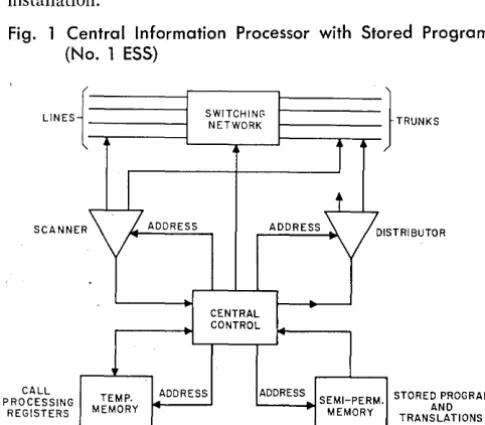
31 TELEPHONE SWITCHING BY COMPUTER, by
Dr. Erna
S.Hoover.
Stored-program technique in phone sWitching facilitates addition of normal and special services for subscribers of Bell System.
37 CHOOSING A SET OF COMPUTERS, by
Alan
C.Bromley.
Article describes studies that led to recommendation for next step in computers for a largecorporation. "
41 THE MARGINAL UTILITY OF INFORMATION, by
Donald
V.Etz.
This economic concept is explained and applied to the present-day output of computers.44 WESCON 65. Western electronics conference features some interesting com-puter-oriented sessions.
45 ACM NATIONAL CONFERENCE. Three-day meeting in Cleveland features almost 50 papers, seven panel sessions.
48 PESSIMUM PROGRAMMING, by
R. Thogonal.
Inept programmers, arise! We've found your leader.49 THE B8500 FROM BURROUGHS, by
John
T.
Lynch.
Computer with thin film main memory and monolithic IC's has memory cycle times of ·0.1 through 0.5 usec.51 IN-HOUSE TAPE REHABILITATION, by
J. J.
DeJianne.
A user reportson savings made by rehabilitating mag tape.
58 PROGRAMMERS & CHEAP COMPUTING, by
T.
B.Steel Jr.
The effects of batch fabrication and advancing hardware technology may be a programmer's heaven.10 Calendar
13 Letters to the Editor
17 Datamation in Business & Science
21 Washington Report
23 . The Editor's Readout
69 World Report
71 News Briefs
79 New Products
82 New Literature
88 People in Datamation
99 The Datamart
101 Books in Datamation
107 Advertisers' Index
"! I
Get fast,
low-cost access
to your
computer files.
With IBM's new 2260 Display
Station.
Easier to use than a typewriter.
Eliminates paper and filing cards.
Fi ts on a desk top.
And it offers you access to
al-most unlimited storage capacity.
You can record daily sales
ac-tivity and production reports. You
can see your profit and loss
state-ments at a glance.
You can also see the results of
business and scientific
calcula-tions. Or customer lists, inventory
data, insurance records and
reser-vation lists.
You can plug
one-or one
hun-dred
Display Stations into
one
SYSTEM/360 (Models 30 through
75) . These Stations can be located
in one building-or they can be
thousands of miles away.
You simply "type'" your
infor-mation on a Display Station's
nu-meric or alphanunu-meric keyboard.
As you "type," your information
appears as an image on the CRT
screen.
You check the data. Or you
edit it.
Then you press
a
control key
and your data is fed into the
cen-tral file of SYSTEM/360. Almost
in-stantly, the screen displays your
solution.
Or you can retrieve
informa-tion from the computer. Update
it. Change it. Then send, it back
into storage.
You can choose an IBM Display
Station that has a 240 ... 480 ... or
960 character buffer.
Each 2260 has 64 different
dis-play characters-both letters and
CIRCLE 9 ON READER CARD
. numbers. Twenty-three of these
are special symbols. When directly
connected to a computer channel,
IBM's 2260 Display Station has a
data rate of up to 2560 characters
per second.
On a telephone line, its data
rate is 120 or 240 characters per
second-depending on the data set
used.
The 2260 offers you fast access
to all kinds of files. It's
inexpen-sive: as low as $89.00 a month.
Wherever you use typewriters,
files, or paper-you can use an IBM
2260 Display Station. It will save
you money ... time ... and space.
It's another new device to help
your SYSTEM/360 grow as you
grow.
EVERYTHING
from
atod
II
II!
Now you
rs
from
EECO
in
2
complete converter lines
Series 761
Series 760A
Take your pick - lower cost EECO 761 models with some quality features even high priced units don't have ... or the greater speed, accuracy and sophistication of EECO 760A instruments. .
Starting at $1,800, EECO 761 models provide all. solid-state con-struction .... 15,000 to 25,000 conversions/sec ... choice of output-binary (up to 11 bits) or BCD (to 3 decimal digits and sign), parallel or serial .. ~ automatic and external command modes ... and much more. For higher speed systems, select an EECO 760~ model with greater resolution and' speeds of 44,000 to 60,000/sec ... Inc~eased accuracy. The big news is versatility ... with selection from literally hundreds of models.
By
changing circuit ca~ds. or addin~ modules, ~ECO. can provide exactly what you want - within ~our price range. With either series you can get: sample and hold with 100 nanosec aperture ... capability to measure low-Ievelsignals ... input il1!ped.ence to 100 megs ... and a second output register for added buffering Into your system. And, in 760A models, you can also have multiplexing or digital-to;.analog conversion built right into the unit.Want versatility and value in A-to-p converters? Look to EECO for a wide range' of data handling equipment' (multiple~ers, convert~rs,
memories, buffers) ... timing products ... automatic pr?g~ammlng
equipment ... test instrumentation ... and complete timing and data systems.
10
See us at WESC9N, Booth
3113~14Electronic Engineering Company
of California
1601 East Chestnut Avenue • (Box 58) Santa Ana. California 92702 Phone: Kimberly 7·5501 Area Code 714 ~ TWX: 714·531·5711
CIRCLE 10 ON READER CARD
DDD
DDDDDDD
' . Fall national symposium of the Society for Information Display will be held Sept. 29-301 Commodore Hotel, New York City.
• International Federation for Docu-mentation will hold their meeting Oct. 10-15, in Washington, D.C, for docu-mentalists, librarians and other infor-mation specialists.
• Users of Automatic Information Display Equipment will hold their an-nual meeting Oct. 11-14, Holiday. Inn, New York City: Meeting will present latest advanc~s in programs and tech-niques.
• Course in use of the MILITRAN
simulation language, Oct. 11-15, Is.:. land Inn, Westbury, Long Island, N.Y. Sponsor is Systems Research Group Inc., Mineola, N.Y. Fee: $200. • Series of symbolic control semi-nars is Jeing offered by IIT Research
Institute, Chicago, Ill.-"Introduction to Symbolic Control," Oct. 19, "N/C Management," Nov. 2, and "APT Part Programming," Nov. 15-19. Fees: $35-200.
• Symposium on economics of edp is scheduled Oct. 19-22 in Rome, italy. Sponsor is International Com-putation Centre.
• The H-800 Users Assn. will hold its fall conference at the Jung Hotel, New Orleans, La., Oct. 20-22.
• The national electronics confer-. ence will be held at Chicago's
Mc-Cormi~k Place, Oct. 25-27, . • Computer workshop for civil en-gineers is scheduled for Oct. 25-27, Purdue Univ., Lafayette, Ind. Co-sponsor is American Society of Civil Engineering.
.. . Courses on "EDP Audit and Con-trols" will be held Oct. 25-29, Doric DinkIer Motor Hotel, Los Angeles. Courses are sponsored by the Auto-mation Training Center, Phoenix, Ariz.
• Electronic Associates Inc. is offer-ing the followoffer-ing courses: "Hybrid
Comp~tation," Oct. 25-30, Princeton Computation Center; "Digital putation,'" Oct. 4-8, Los Angeles Com-putation Center, Nov. 29-Dec. 3, Princeton Comp Center; "Modern Methods in Analog Simulation," Oct. 18-23, Princeton Center. Fees are from $200-275.
DRTRMATION
'·1
(\.
8
steps
to acquiring
a better memory ...
*
Disc
mass
*
memory,
that is.
For "time-sharing" and other applications where various computer systems must draw upon one large-capacity, central memory file designed for continuous and virtually instanta-neous information processing, the Series L-4800 large-scale disc fil~ produced by Librascope Group of General Precision, Inc., offers many remarkable new features. Con-sider the following before you buy or specify:
Step 1. Consider Capacity:
Where an extremely large amount of data must be stored, the memory element of an L-4800 large-scale disc file has an initial capacity of 400 million bits of information with expansion
eliminated and simultaneous off-line search is permitted. The L-4800 can be easily incorpo-rated into time-sharing computer networks.
Step 3. Consider Flexibility:
L-4800 large-scale disc files can be used with any data processing system, whether already in use or scheduled to be installed in the future to provide faster, more accurate, more reliable operation with greater storage capacity.
Step 4. Inquire About High Transfer Rates:
The Series L-4800 disc files can be organized to transfer data at rates from 1 million up to 160 million bits per second. This is accom-plished through multiple-head read/write oper-ations. (The L-4800 discs have one head for every data track) Through adaptation of spe-cial electronics, data rates approaching 1 bil-lion bits per second are possible for special applications.
Step 5. Ask About The Manufacturer's Experience:
. capability to 6.4 billion bits on a single trunk line.
Behind the L-4800 is the extensive background and 28-year history of Librascope Group of General Precision, Inc., in computer equipment and components.
12
Step 2. Inquire About Access and "Time Sharing":
The technique of information retrieval used by the random-access L-4800 is either fixed-address or record-content search, depending on the master-control electronics used. Aver-age access time is 35 milliseconds. Search by record-content is an exclusive technique that permits any desired field to be used as the access key so that where the data is stored need not be known;QnTYwhat information is needed. Costly flagging and table look-up are
CIRCLE 12 ON READER CARD
'"
~::.:; ~~:t
"'$- 'It
Step 6.
Check The Equipment's Performance Record:
L-4800 disc files are a key part of a General Precision / Librascope data processing system in Headquarters USAF's 473L command-and-control system in the Air Force Command Post at the Pentagon. More than a million headbar hours have been logged without a single head-bar failure. And, a scheduled installation for a scientific laboratory will provide a common data base for eight powerful computers, ena-bling many scientists and engineers to "share" the system on virtually a simultaneous basis. The L-4800, in this instance, will help replace magnetic-tape equipment twelve times more costly and which must now be manually moni-tored to provide the data base.
Step 7.
Request Detailed Information:
Write today for our brochure showing appli-cations, typical configurations, and complete specifications.
Step 8. Call or Write Us:
The quickest and surest way to acquire a bet-ter memory (an L-4800 large-scale disc file) is to contact our Marketing Department. The . address is shown below.
SYSTEMS DIVISION
@)
®~~[g~&[S
~~[g©O®D@~~
LlBRASCOPE GROUP
808 Western Ave Glendale 1 ,Calif.
Phone: (213) 245-8711
.' I
0 0 0 0 0 0
0 0 0 0
0 0 0
00
ibm vs. remrand vs. g.e., Sir:
I have been following George Schus-seI's comparison of IBM and Rem Rand
(May, June issues) with interest. The facts he bases his conclusions on comprise an impressive catalog of data processing history; therefore I was amazed by the inaccuracy of the "facts" he cites for the Univac installation at General Electric in Louisville.
Four comments he makes on pages 65 and 66 leap up off the page for anyone' who was involved in that proj-ect. Schussel says:
• Even when the computer was run 24 hours a day there was not time enough to get out the payroll; • The first group that worked on the project at GE was fired;
• By the time the installation was working, late in 1956 . . . , and • The programmers of the Univac stored this entire table on tape (the withholding tax tables).
These four statements are abso-lutely incorrect and have no basis in fact.
As a member of that original group, and a current GE employee, I must say the news of my discharge comes as a surprise. It set me to taking stock of my colleagues who, as graduates of the first programming class back in August 1953, formed the first proj-ect team. Of the 10, eight are still employed by GE and all eight have risen into managerial ranks. The two who left did so voluntarily.
The installation must be counted as "working" at the beginning of 1955, for two major systems were in operation at that time. In fact the first pay date was October 19, 1954 and in the 500-plus pay cycles since October 1954, that installation has not been late on a payroll.
The business about a table look-up for tax deductions is quite mysti-fying. Tax is calculated by the pro-gram that calculates all pay calcula-tions, PR340, and neither its predeces-sors PR140, PR95 nor its derivatives MP340 or WP340 have ever used a table on tape or in memory for tax. The longevity record of the original crew is equalled by the two systems they designed: payroll and material control. Both systems, reprogrammed
many times, are in use today. I/O routines, packaged sorts, compilers and such came later and have found use without altering the basic con-cepts. The original file design and system organization survive with little change.
It is unfortunate that with e'ye-wit-nesses available, the author drew on other sources; I hope this informa-tion will assist those who follow him.
No, I am not cancelling my sub-scription; with 60K circulation yon wouldn't miss me, but I sure would miss DATAMATION because with all its aberrations, it's still the greatest. JOHN K. SWEARINGEN
General Electric Company San Jose, California
P.S. As past-president' of the DPMA, thanks for the generous and informative coverage of DPMA's June conference. I'm sure your treatment helped swell the record crowd of 2,700 registrants for the seminars and additional thousands who crowd-ed around some $30-million worth of hardware in the exhibit hall.
Sir:
Part II of "IBM vs. Remrand" (June p. 58) proved to be as interesting as Part I. Congratulations on a well-done article. I believe, however, the pictures on pages 61 and 66 are re-versed.
O. W. PERRY
Fishkill, N ew York
Sir:
The photo on page 66 is the console of the IBM 701 at World Headquar-ters in New York. On page 61 is the card feed station of the SSEC.
ERIC U. WEISS
conferences a no-go Sir:
I have been attending computer con-ferences for approximately 15 years, and over this time have watched them develop and change. I would like to suggest that our industry has now reached the stage of maturity that makes two general conferences each year unnecessary and wasteful. It has
Ultra high speed
Monroe
DATAl
L06®
Me
4000
Printer
delivers
6000 lines
per minutel
That's 100 lines per second, synchro-nous or any speed less than 100 lines per second that your application might require. The MC 4000 is truly synchro-nous or asynchrosynchro-nous.
A non-impact printer. Completely silent. Absolute reliability.
It's available in a numeric model (15 characters in each column) or in an alphanumeric model (43t064 characters in each column). Both models are 32 columns wide and have the same 6000 lines per minute printing speed.
Look at these MC 4000 features: Char-acter serial input, bit parallel. Data transfer time of 50 microseconds (no buffers required). Only two moving parts -the paper feed stepping motor and the fan. Compact: 10X" high, 10%," wide. Rack mount available. All solid state with cathode ray tube through fiber optics. Any41ine code forthe numeric model; any 6 line code for the alphanumeric model. Any logic level.
Price,just $5650forthe numeric, $5850 for the alphanumeric model.
Reliable. Silent. Ultra high speed Synchronous or asynchronous.
And, like all Monroe DA T A / LOG print-ers, the MC 4000 is covered by a fu II year's warranty with on-site maintenance.
For additional in formation, specification sheets or a demonstration, write or call Monroe DA TAl LOG Division of Litton Industries, 343 San some, San Francisco.
(415) 397-2813.
:M: ONROE
rn
DATA/LOG
DIVISION OF LITTON INDUSTRIES
CIRCLE 13 ON READER CARD
[image:15.620.403.571.31.379.2]handsome
.
IS ... .
handsome
does
Sharpening old axioms is not our business. It's just that designers of EDP systems speak axiomatically when they tell us the new D 3030 com-puter magnetic tape unit delivers a triple load of beauty: unprecedented reliability, economy and operating convenience. In addition to which, they say, it's so nice to look at!
Already the famous Datamec D 2020 has set industry standards for low-cost operation in computer and off-line applications where moderate speed performance is highly practical (data transfer rates up to 36,000 cps). Now the new D 3030 offers the same superior advantages for heavy duty, on-line use with digital computers and other digital EDP systems requiring higher data transfer rates.
The D 3030 writes and reads all three densities (800, 556 and 200 cpi) at 75 ips tape speed. Push-button selection of 60,000, 41,700 and 15,000 cps data transfer rates. Either 7-track or9-track format. Vacuum column tape buffers, semi-automatic tape threading, front access to all electronics, and many other advanced features. Bi-direc-tional start and stop times of 5 ms and 11/2 ms, respectively.
For all the facts, including pleas-antly surprising low price quotations, write Tom Tracy at Datamec, 345. Mid-dlefield Road, Mountain View, Calif.
@5J.'f?5J.~§~
A DIVISION OF HEWLETT-PACKARD
leadership in low-cost/high reliability digital magnetic tape handling
CIRCLE 14 ON READER CARD
14
LETTERS . ..
become increasingly evident that there is insufficient material of a high professional standard to warrant ex-posure at two annual meetings. I doubt, in fact, if there is enough for a single meeting. This is not criticism of the standard of professionalism within the industry; it is, rather, a reflection of the growing maturity and the slowing rate of technological change and innovation. With respect to the exhibits, the rate of change is even slower.
It seems to me that the main groups to be kept in mind when or-ganizing conferences are the younger and middle professionals. Conferences serve to introduce these people to various aspects of our profession that they do not normally experience. Un-less the caliber and the interest of conferences is carefully guarded, the impression created for these new people is not one of high interest and excitement, but rather of boredom. Since in a very real sense our indus-try is the most vital in our time, this impression is a real disservice to these people ..
I appreciate that conferences are very profitable for AFIPS and tend to be a principal source of revenue, but as responsible professionals this easy advantage should not be used as a justification for continuing meetings which have, I believe, deleterious ef-fects on the most important segment of the computing society.
MAX PALEVSKY
Santa Monica, California
wilson's law
Sir:
From an observation of resumes and applications over the past few years, I have been struck by an unaccount-able trend which the present vogue for "laws" forces me to formulate as follows:
"The number of people actively en-gaged in data processing in 1955 doubles every three years-,-"
WILLIAM
J.
WILSONHuntsville, Alabama
planned obsolescence
Sir:
I'd like to suggest that computer peo-ple observe -October 17 (Rube Gold-berg's wedding anniversary) \) as a holiday in honor of the 029 keypunch. This machine is the first
improve-I ment in keypunches since 1949, and
* His birthday would have been preferable but,
alas, it's July 4.
represents the accumulation of ideas since that time. As a preliminary an-nouncement put it, "Engineers gave a lot of thought to a key person in data-processing installations, the op-erator of the equipment." These key persons are typically young ladies, and doubtless the engineers gave them lots of thought. It's unfortunate that they didn't give more thought to the design of the machine. Their only real constraint, apparently, was to use as much as possible of the punching, feeding, and printing mech-anism of the 026, onto which they superimposed their improvements. It's an impressive list:
1. A plastic cover has been placed over the entire card bed, so that ac-cess to the backspace key or to either position of manual feed takes two hands. A special polish on this cover permits the maximum amount of over-head light to shine at the operator.
2. The column indicator, which used to be difficult to read, is now nearly impossible to read from the normal sitting position.
3. The hopper stop switch no longer shuts off the entire machine, but merely suspends feeding. This is an improvement. To compensate, the machine's power switch is now mounted under the work board.
4. The correction key (probably the most valuable single feature avail-able on the 026) is missing, and there seems to be no provision to add it to the keyboard.
5. The 4-5-6 home keys, which used to be concave so that while touch punching the operator would know when she's home, are now the same as the other keys.
6. Go'ne is the joggle plate.
7. The base of the machine, which used to slant back away from the operator, now comes straight down, and is equipped with a nylon-tearing edge to endear it to young ladies. 8. The keyb~ard has been human engineered to the extent, for example, that the "less than" and "greater than" symbols (part of the 64-char-acter set) are on opposite shifts.
9. The space bar stands higher than the other keys, making it sim-pler to hit at the wrong time.
It was Rev. Granholm who first de-fined a kluge as "an ill-assorted col-lection of poorly-matching parts, forming a distressing whole" (DATA-MATION, February 1962). But he was referring to an original design, not to 16 years of accumulated im-provements.
AUSTIN O. ARTHUR
Woodland Hills, California
o
DAILY~NEWS
NEW YORK'S PIClURE NEWSPAPER.:59.4 MILE
DAILYAI NEWS
NEW YORK'S PiCtURE NEWSPAPER $·59.4
MILE
When this headline was
current·news ...
digital recording tapes
had a packing rate
of
200 bpi.
Today, 800 bpi is standard;
improvement in tape and base is the reason.
In analyzing the sensational development of EDP over the past decade, most of us naturally talk in terms of im-provement of hardware. But when you stop to examine them, the contributions made by tape manufacturers have been quite remarkable.
The tape of today looks like the tape of ·1954 . . . but think of the differences: improved oxide coatings to in-crease total capacity, reduce fluctuations in performance; much stronger binders to reduce dropouts and flaking, lengthen tape life; smoother surfaces to give longer, error-free wear; thinner coatings and better production con-trols to guarantee reel-to-reel uniformity.
Working hand in hand with the tape manufacturers during this time has been Du Pont. Improvements in the uniformity, stability and overall reliability of the base of MYLAR*have played a vital role in making possible the sophisticated tape in use today. Continuing cooperation of research and development facilites assures continuing im-provements in the
fu-*Du Pont's registered trademark for its polyester film. ture. Your guarantee of
the most advanced tape
I'iiiiU
PON~is the manufacturer's
~
lJ/
brand and a base of ... , .. '
only DU PONT makes
MYLJlR®
POLYESTER .,FILM
MYLAR polyester film. Better Things for Better living ... thr<.-ugh Chemistry
At the base of all tape improvements: Mylar®
CIRCLE 15 ON READER CARD
16
From ASI's continuing program of new product development
•
ASI data systeDls experIence covers all bases
In selecting a computer supplier for your integrated system, hardware is not the only criteria-systems design, special programming, and unit interfacing must, be considered. ASI offers all of these with a notable plus-total customer service. From the time you define your problem, through design, interfacing, installation, and operation, ASI system specialists provide thorough, detailed support at NO ADDED COST. Review the following major areas where ASI will benefit your system design.
SYSTEMS DESIGN-At no cost, ASl'system specialists will completely analyse your required system in the definition phase before purchase. At this time ASI can tell you precisely what the system characteristics will be. Experience in the areas of data reduction, hybrid, real·time, and on·line systems design assure a balanced, efficient system.
STANDARD HARDWARE-The ADVANCE Series 6020 and 6040 computer systems feature high internal processing speeds such as 3.8 usec add and 9.5 usec multiply, rapid in/out rates, and a multilevel priority interrupt arrangement, which improve system application and operation. Other
system-oriented features include-a choice of communication channels to meet your exact needs-expandable memory-over 8,000 control and sense lines-three index registers-"Programmed instruction" feature-direct access to memory areas-and real time clock.
SPECIAL UNITS-ASI Engineering, at modest cost, will design and provide special interface units. In addition to typical units such as A-to-D and D-to·A convertors, multiplexers, etc., ASI also has provided "black boxes" for such applications as multi-channel analysers, remote station operation, photo-optical systems and others.
PROGRAMMING-To complement the standard software, which includes a one-pass extended FORTRAN II compiler and one-pass symbolic assembler, ASI applications staff provides special program preparation assistance. When re-quested, ASI will contract for total program responsibility on any ADVANCE Series computer system. Local field applica-tions analysts are also available to aid in the daily operating routine as well as installation and operation of new programs. Callori ASI-it will be good for your system!
ADVANCED SCIENTIFIC INSTRUMENTS
DIVISION OF ELECTRO-MECHANICAL RESEARCH, INC .. 8001 Bloomington Freeway, Minneapolis, Minnesota 55420
CIRCLE 16 ON READER CARD
, Texas, represent both a challenge and a persons everywhere. Wolf Research and ndertaking. Would you like to join us? We )een solving advanced problems using all ants, we seek only answers. Our reputation - Our future anticipated requirements are analysis and evaluation of information vital n College Park, Md., also has a number of ce with large-scale computers and a BS or
, Box 1036, Baker Avenue, West Concord, Mass. 01781
o o
o
o
BUSINESS
&
SCIENCE
NEW POST,. NEW HOPE
FOR GOVERNMENT EDP
A new federal computer post, to be manned by an old
edp pro, offers hope for progress in standards and
more intelligent use of government machines.
Rumors
are rife that the new position, Director of the
Computer Science
&
Technology Center in the Bureau of
Standards, will be filled come Oct. 1. by Norman
J.
Ream.
Director of Systems Planning at Lockheed
Aircraft Corp. for the past 13 years, Ream -- if he
accepts -- can bring to the post beaucoup industry
contacts, a reputation as a good organizer and
go-getter.
His broad private industry background could
soften fears of Big Brother dictation of arbitrary
standards.
But he could also be expected to pressure
manufacturers to conform to standards and cooperate
in the development of industry-developed standards
rather than one-company de facto standards.
The position is a step-towards meeting the specs
for more centralized control and guidance of gov't
edp activities, as outlined in BuBudget's Circular
A-71 (see April, p. 70).
Still due: a similar spot
in GSA.
But the budget available to the expanded
NBS effort is still in doubt.
A House appropriations
committee has cut back fund requests, will. now discuss
with Senate dollar watchers.
One possible partial
remedy: the use
o~industry-sponsored research
associates, for which NBS precedence already exists.
FOOLS WITH
ANGEL~RUSH IN
Although only IBM and a couple of others are making
money at computers, new hopefuls keep appearing.
Up
in Sunnyvale, Information Technology, Inc. has a
$250-thou backlog for its 4900 (see April New Products),
has sold 12 to Wright-Patterson.
At China Lake, the
4900 beat out the GFI Marc I, CDC 46, PDS 1020, PB 250,
PDP-8 and a machine from Ann Arbor Computer Corp.
The last-named company is a spin-off of Strand
Engineering, which was purchased and converted into
the Burroughs Ann Arbor Lab.
Acting as a system
house, AACC bids on jobs using other manufacturers'
main frames, now has seven full-time employees, plus
consultants ••• hopes to do $1 million next year.
Meanwhile, down in Dallas, about 30 people coughed
up some $300K to launch Scientific Control Systems.
Headed by key people from International Data Systems
and TI, SCS is offering initially two versions each
of two 24-bit main frames which include SDS 910
&
920
commands as subsets of their instruction sets.
The 660-2 (using software for multiply and divide) with
4K of 2-us.ec-cycle core, sells for $56K as compared
to $52.5K for a 4K, 8-usec 910.
The 660-5 with 4K
of 5-usec core, costs $46K vs. $57.5K for a 4K,
8-usec 920.
The company, which also makes telemetry
and signal conditioning gear, will also offer a
12-bit, 10-usec core"650, and a hybrid circuit 680
N1CDONNELL
Installs IBM System/360
The McDonnell Automation Center has installed
the first of 18 "new generation" computers. Our
Model 30, the first to be delivered to a commercial
user, makes available to McDonnell customers the
most advanced data processing equipment in use.
The System/360 permits us to handle even broader
applications for even more types of businesses than we
did before. If you are concerned with techniques such
as mathematical programming, simulation, statistics,
and matrix manipulations; or applications such as
payroll, inventory, manufacturing control, billing, and
financial accounting; or other data processing and
computing procedures, we have the
experience,
the
personnel,
and the
equipment
to assist you.
For further information, write or call the Automation Center closest to you.
Consulting. Systems Design. Programming. Data Prowsing and Computing
0
IIIICDONNELL AUTOIIIIATION CENTER
18
DIVISION OF MCDONNELL AIRCRAFT
Box 516, St. louis, Missouri, 63166 Tel. (314) 731-2121
Colorado Office: DELCOS Denver - Tel. (303) 534·6291 Texas Office: NlACTEX Houston - Tel. (113) 224-5921
CIRCLE 17 ON READER CARD
o
DRTRMRTION
c
~
I, ,
Pull
your!:
Every now and then thOl
long range career objectivel
All too easily, the two can t
To those who are reviewin
future, we offer an invit
suburban Boston facilities.
The continued success of
more positions than at any
time to consider a career wi
These opportunities span
ttechnology, with emphasis
ilogic Design
D
Design & Packagi
bility
D
Mem(
Software Devell
Conversion
D . [
Techniques
D
Development
D
Interested candi
at 200 Smith Stl
ELECT
NOTE: ACM and WESCC
(collect) on an
Opportunities exist in other Honeywell Div
)
DUSINESS & SCIENCE C '
===================================:::JJ
NEW CDC PROCESS COMPUTER
August 1965
MAG TAPE MARKET
DUE FOR SHAKEUP
RUMORS AND
RAW RANDOM DATA
featuring a 1.4-usec core cycle.
The big news,
though, is promised delivery of two months for the
660 and 670.
The big questions: has SCS come into
the game too late? does it have the dollars to stay
the limit?
.
Another new firm is Logic Corp., out of Philly
(see thi
pmonth's News Briefs). We're crossing our"
fingers for all of them.
Look for Control Data to announce a new process
control entry, aimed rather directly at the IBM 1800.
It's the 1700, a l6-bit-word, binary, single-address
machine with a 1.2 usec core
(4~32K),said to be about
twice as fast as the 1800.
Minimum software, aimed .
at keeping costs down, will include Fortran IV, a
macro assembler, and a time-sharing monitor.
A
"typical" system, including 16K core, two unbuffered
channels (one for paper tape, teletype), will cost
around $1500/month.
Additional buffered channels,
interrupts, and plenty of peripherals will also be
available.
CDC will also soon unleash a big new
disc file.
IBM is predicting that its Cobol compiler for a
256K-byte 360/65 will compile 4000 statements per
minute~The only catch is the cost: the system must include
the 4-million-byte 2301 drum (which, with its control
unit, costs $6700/month) and four 2311 discs.
For
less dough, 360/50 users can settle for 1000
statements a minute, matching the fastest Cobol
compiler available (Honeywell 1800).
.
. Making the speeds even more significant is the
word of. an IBM spokesman at DPMA who indicated 360
PL/I compilers may be "as fast as Cobol."', If true,
it substantiates claims that the 360 facilitates
compiling,weakens argument that an efficient compiler
couldn't be tailored for ungainly PL/I.
Look for a big shakeup in the $35-million computer
mag tape market: the IBM-3M combo which has gobbled
up most of the business to date may be breaking up.
The tipoff: 3M has been making sales calls. While
IBM reportedly qonstructs a factory in Colorado and
3M builds a sales force, the other tape makers will
undoubtedly exert extra effort to woo away their
customers.
And it's a good bet that other companies,
Eastman Kodak among them, will enter the fray.
While CDC was shipping out the 3600 from its LA
service bureau and phasing out its 1604 there, the
1604 University Computing bought from CEIR was back
home in LA, having given way to a 3400 at its old
home, SMU ••• Rumors are strong that IBM has bypassed
the RFP route to get an order for six 360/75's to
upgrade the 94's
&
490's at NASA's Houston Mission
Cqntrol Center ••• Look for EAI, No.1 in
analogs~to
announce another hybrid system in Sept., smaller than
their first entry, the 84/a800 ••• Munitype, NYC outfit,
is offering a time-sharing
~~~vicefor
c~lculationof
muniCipal bonds for'$300/month plus terminals, etc.
on a GE 2l5/Datanet 30"hopes to land 100 clients.
Look for a passel of others to leap inT-S bureau
business.
Dartmouth's Bill Zani will open one in
Boston.
Others are looking at Seattle, SF, LA •••
IBM is said to have a 360/95 in the works with a
# 1771·65
Fairchild gives yon a wider
ehoiee~
inelnding ... a too-fast diode.
For the generation of computers now in work, we supply transistors (switches, amplifiers, core
drivers); diodes (fast, very fast and ultra fast; in DO-7, Adam and epoxy packagIng; multiple
assemblies, matched pairs and quads) ; monolithic integrated circuits (two families of DT ,uL, the
CT,uL family, the TT,uL family and two families of RTL -,uL and MW,uL) ; plus Fairchild custom
integrated circuit capahility, hybrids, multiple assemblies and thin film. And for the next genera-
C,
tion, we ship, off the shelf, devices such as the DO-7 picosecond computer
~iode.Who else does as
,
.
t=~.' 'Imuch? Nobody. So why not let us do more for you?
F
~. r""IC
H.I .
r-II, . pL. DTJ.l.L. TTJ.l.L. CTJ.l.L. MWJ.l.L~ ~ ... ~ are Fairchild Trademarks
CIRCLE 180N READER CARD. i
)
)
GSA STUDIES SCERT
FOR FED-WIDE USE
STATE, LOCAL BOYS
UP COMPUTER USE
August 1965
CHESS IS OUT,
PING-PONG IN
BITS
!
PIECES
REPORT
The General Services Admin. is practising what it soon
may be preaching under Budget Bureau circular A-7l
(April, p. 70).
The federal housekeeping agency
employed SCERT (System Computer Evaluation and
Review Technique) to aid in selection of 10
large-scale systems to replace existing computers at
regional offices.
These simulation programs, a product of Comress
Inc., D.C. software house, provide procurement
officers with objective comparison data on which to
base selections. With its mandate from BOB to bring
some order into frequently-chaotic agency selection
procedures, GSA is leaning towards establishing use
of SCERT-typeprograms as standard operating
procedure.
To be decided: Should GSA recommend the
26-program SCERT package as is, attempt to have new
programs written according to its own specs, or try
some combination of the two?
Local and state governments, moving somewhat
belatedly into the thickets of automation and feeling
fiscai and other thorns, are seeking help from their
Federal Big
B~other.An estimated 300 computing
systems are now in use by state governments but this
total is acknowledged minute compared to their
computable work loads.
State officials are seeking
to work out formal arrangements to share federal
computer facilities located in home bailiwicks,
something now done occasionally on an ad hoc basis.
The Council on State Governments is also looking
into the feasibility of organizing joint
federal-local-state computing facilities to both split costs
and make available federal computer expertise in the
provinces.
Budget Bureau officials are interested
in these proposals because so many programs involving
federal monies are administered locally.
It's
estimated, for example, that some $25 million, all of
it federal, is spent by states solely for dp
perta~ning
to unemployment insurance.
At Project MAC, a PDP-6 computer in tandem with a
paddle attached to a steel rod, a TV camera and an
image digitizer will soon be playing table tennis
with human opponents.
Research points towards
development of true "robots" for sophisticated feedback
work in rugged environments.
It may also help us
get the ping-pong championship back from Red China.
The Advanced Research Projects Agency has awarded the
Univ. of Michigan a $500K contract for research in
graphic I/O.
The grant is believed to reflect a
turning-away from time-sharing as- the principal focus
of ARPA-sponsored research ••• Debut of the Advanced
Record Service of the Federal Telecommunication
Service, originally set for mid-summer, has been
shoved back to December 1 or so.
ADDOUDCiDg tbe BryaDt PhD-170:
world' sfirst mass memory
with private party liDes.
22
The correct term is independent, simultaneous multiple access. And it's brand new. No one else has it.
It
means that one, two, three, or four groups of independently positionable read-write heads (up to 43 in a group) can now gain access to the same data stored in anyone of 64 assigned tracks. At the same time.The 170 in PhD-170 stands for 170 million bit storage capacity. With every bit of it ready for excep-tional programming flexibility. Also it's the lowest cost memory of its size. The PhD-170 is a new breed of random . access memory that will work wonders in banking, inventory control, stock market transactions plus other appli-cations not previously considered possible.
Learn the whole story now. Send for publication #BCPB 109-5-65. To refresh your memory.
C!RYANV
COMPUTER PRODUCTS
A Division of EX-CELL-O Corporation
850 Ladd Road • ~alled Lake, Michigan 48088
CIRCLE 19 ON READER CARD
DATAMATION
~
~
\ . " .
(
".
C
,..---.,\
./)
DATAMATION
o
O~
EDITOR'S READOUT
PROFESSIONAL SOCIETIES ...
OR TECHNICIAN ASSOCIATIONS?
The DPMA wound up its latest conference in July, and this month ACM gets its turn ... which is probably as good an excuse as any to devote an editorial to the two organIzations and the question of what are the responsibilities of a professional society.
To its members it owes programs, publications and plenty other means of
prog~essing professionally. In addition, it should serve the traditional morale function: helping members feel they're part of something important and progressive.
To the entire industry or profession (not just numerical analysis or com-mercial edp), a society owes its aid in formulating standards and other stimuli to advancement. It owes the profession help in making the industry more competitive (this based on the assumption that competition in a free enterprise accelerates progress).
And to society at large, the society owes the information which can help the people and their legislators, industrial leaders and educators to intelligently evaluate and guide the use of information processing machines and techniques.
The two societies claim the same goals for its members: education. But the educational programs are as different as the two memberships. ACM members tend to be more experienced computer people; they're more interested in the insides of the machine and the software and the mathematics behind it than in applications and installation and personnel management. DPMA members still tend to know more about wiring a plugboard than they do about computers or infor,mation processing . . . although the certificate exam program and im-proved national conferences are tending to change that. Member interests are pretty well restricted to commercial data processing . . . and the efficient man-agement of an installation.
The DPMA educational program, a bootstrap approach, seems more clearly aimed at title and salary advancement than at professional growth. The ACM, offering higher-level technical publications, nevertheless claims to be 'all things to all people, but slights both commercial data processing (except at highly, technical levels ), and mundane, practical problems of almost any kind.
Neither organization, it seems from here, has done much for its industry or for society as a whole, although individuals in individual ACM chapters have contributed significantly to local high school educational programs. And ACM, through its participation in AFIPS, has supported a few fitful outside educa-tional efforts.
This is not to debunk or to diminish the efforts of sincere and hard-working members of ACM and DPMA. Both organizations have done significant work to increase the level of competence of their members. But we think the time is ripe to more clearly define larger, more important long-range goals which distinguish a professional society from a technician's association.