1 Predicting word reading ability: A quantile regression study
Autumn L. McIlraith
Language and Reading Research Consortium
2 Author Note
This paper was prepared by the first author and members Language and Reading Research Consortium (LARRC) taskforce including Hugh W. Catts (Convener) and Tiffany Hogan. LARRC project sites and investigators are as follows:
Ohio State University (Columbus, OH): Laura M. Justice (Site PI), Richard Lomax, Ann O’Connell, Jill Pentimonti, Stephen A. Petrill1
, Shayne B. Piasta
Arizona State University (Tempe, AZ): Shelley Gray (Site PI), Maria Adelaida Restrepo.
Lancaster University (Lancaster, UK): Kate Cain (Site PI).
University of Kansas (Lawrence, KS): Hugh Catts2 (Site PI), Mindy Bridges, Diane Nielsen. University of Nebraska-Lincoln (Lincoln, NE): Tiffany Hogan3 (Site PI), Jim Bovaird, J. Ron Nelson.4
1. Stephen A Petrill was a LARRC co-investigator from 2010-2013.
2. Hugh Catts is now at Florida State University.
3. Tiffany Hogan is now at MGH Institute of Health Professions.
3 This work was supported by grant # R305F100002 of the Institute of Education Sciences’
Reading for Understanding Initiative. We are deeply grateful to the numerous staff, research associates, school administrators, teachers, children, and families who participated. Key personnel at study sites include: Lisa Baldwin-Skinner, Garey Berry, Beau Bevens, Jennifer Bostic, Shara Brinkley, Janet Capps, Beth Chandler, Lori Chleborad, Willa Cree, Dawn Davis, Michel Eltschinger, Kelly Farquharson, Tamarine Foreman, Rashaun Geter, Sara Gilliam, Miki Herman, Trudy Kuo, Gustavo Lujan, Junko Maekawa, Carol Mesa, Denise Meyer, Maria Moratto, Kimberly Murphy, Marcie Mutters, Amy Pratt, Trevor Rey, Amber Sherman, Shannon Tierney, and Stephanie Williams.
4 Abstract
Background. Early word reading predictors are well established. However, it is unclear if these predictors hold for readers across the distribution. This study used quantile regression to
investigate predictive relationships at different points in the distribution of word reading. Methods. Quantile regression analyses used preschool and kindergarten measures of letter knowledge, phonological awareness, rapid automatized naming, sentence repetition, vocabulary, and mother’s education to predict first grade word reading. Results. Predictors generally varied in significance across levels of word reading. Notably, rapid automatized naming was a unique predictor for average and good readers but not poor readers. Letter knowledge was generally a better unique predictor for poor and average readers than good readers. Conclusions. Well-known word reading predictors varied in significance at different points along the word reading distribution. This study illustrates the value of the quantile regression approach for investigating predictive relationships of reading-related outcomes.
5 Highlights (required for the journal we are considering)
What is already known about this topic
- Word reading precursors are well-established, with letter knowledge, phonological awareness, and rapid automatized naming identified as key variables,
- These relationships are primarily investigated in average readers, or in groups of good and poor readers created using a cut-off score approach.
What this paper adds
- This study examined the significance of these established relationships for readers at different points in the distribution of word reading, using quantile regression.
- The quantile regression approach avoids the loss of power that can arise when creating subgroups, and has none of the issues associated with the use of a single cut-off score. - Letter knowledge and phonological awareness were found to be generally significantly
predictive of word reading across the distribution, while rapid automatized naming was significant only for good readers, and sentence recall was significant only for poor readers.
6 - Results reinforce the usefulness of measures such as letter knowledge, phonological
awareness, and sentence repetition in the early identification of children at risk for reading disabilities.
- Results also suggest that measures of rapid naming may add little unique information in differentiating between children who subsequently read in the below average range. - Our findings also add to the large body of research indicating that early literacy
7 The identity of the early precursors of word reading ability has implications for the early identification of children at risk for reading disabilities. Research has identified various factors that are predictive of word reading. These include phonological awareness (PA), letter
8 One recent study that addressed the issue of a single cut point among children with
varying levels of word reading ability was conducted by de Groot et al. (2015). The researchers examined the predictive relationships of PA and RAN to word reading, using data from a large sample of Dutch children ages 7-14 years. A series of eight different cut-off scores were used to identify children as good, average, or poor readers. These cut-off scores were calculated using standard deviations (SD), and ranged from -2.0 to +2.0 SD (-2.0, -1.7, -1.5, -1.3, +1.3, +1.5, +1.7, +2.0). For example, when applying the 2.0 SD cutoff score, children with scores below -2.0 SD were considered poor, and children with scores above --2.0 SD were considered average. Within each subsample, an effect size was calculated separately for RAN and PA by comparing the mean score for the children in that particular subsample to the mean score for average readers. This was done using a resampling procedure that generated 1000 average-reader
samples equal in size to the comparison group, and calculated the average. The researchers found that the effect size for PA was larger when comparing poor and average readers than when comparing good and average readers, for all cut-off scores, but the effect size for RAN remained fairly constant. This decreasing effect size of PA for good readers is consistent with previous research that describes beginning reading as more phonologically based, with phonological skills decreasing in importance as reading performance increases and reading becomes more
automatized. However, the static effect for RAN at different word reading ability levels is surprising, as RAN is typically considered to be more related to skilled, automatized reading (Norton & Wolf, 2012). It is possible that the inclusion of additional variables would alter this pattern by further refining the unique contribution of RAN.
9 required the division of a continuously distributed variable into discrete subsamples. The
implementation of multiple cut-off scores is an improvement over a single cut-off score, but remains problematic because it conflicts with the common conception of word reading as a continuous and normally distributed measurable skill. In addition, a subsampling approach can reduce the statistical power of an analysis. Here, the very large sample size (N=1,598) ensured sufficient power, but in smaller studies dividing the sample could decrease the power below conventionally acceptable levels. A cut-off-based approach therefore is limited in its ability to address the question of whether the importance of word reading predictors varies at different levels of word reading skill.
An analytic approach that is well suited to addressing this question is quantile regression. In a quantile regression analysis, predictor-outcome relationships are estimated at a series of selected points along the distribution of the outcome variable, called quantiles (akin to
percentiles). Through the use of a weighting matrix, all data points contribute to the estimation at each quantile, but their specific contributions vary based on the proximity of each data point to the quantile in question (Petscher & Logan, 2014). Relationships are thus estimated without the loss of statistical power that occurs when subgroups are created. The outcome variable is treated as continuous, and the issues associated with the use of a cut-off score are avoided.
10 comprehension. Quantile regression was also used to investigate the impact of floor effects on the predictive validity of reading fluency measures (Catts, Petscher, Schatschneider, & Bridges, 2009). They found that floor effects served to lower the predictability of screening measures. In all these instances, quantile regression made it possible to examine the significance of predictive relationships for readers with different levels of reading skill.
The current study used quantile regression to investigate the unique predictive utility of various preschool and kindergarten word reading precursors at different quantiles of first grade word reading. In addition to PA and RAN, the current study included letter knowledge, sentence repetition, vocabulary, and mother’s education as predictors. Analyses were conducted
separately for preschool and kindergarten predictors. Method Participants
The participants were selected from a larger comprehensive longitudinal investigation of reading comprehension (Language and Reading Research Consortium; in press). In that
longitudinal study, approximately equal numbers of pre-schoolers (N=105) were selected from research sites in different regions of the country (total N=420). For the present study, we selected 295 children from the longitudinal study who had complete data on word reading in first grade. This included 265 children who had complete data on all preschool measures of interest and 264 children who had complete data on kindergarten measures of interest.
The sample of 295 children included slightly more ___s than ___s (XX% versus XX%) and the majority of children were White/Caucasian. Specifically, XX% of children were
11 languages spoken at home included Spanish, Chinese, Amharic, and Vietnamese. XX percent of children resided in two-parent households. Nearly XX% of children had Individual Education Plans (IEPs), and about XX% qualified for free/reduced lunch.
Measures
Phonological Awareness. The Phonological Awareness (PA) subtest from the Test of
Preschool Early Literacy (TOPEL; Lonigan, Wagner, Torgesen, & Rashotte, 2007) was used as a measure of phonological awareness. The PA subtest consists of 27 items measuring elision and blending abilities. The first 12 items require children to say a word, then to say what is remaining after deleting specific sounds (elision). For the remaining 15 items, the children are asked to listen to separate sounds and combine them to form a word (blending). Test-retest reliability for this subtest is .83. The internal consistency reliability coefficient (coefficient alpha) calculated in our longitudinal study was .88 for preschool, and .86 for kindergarten.
Letter Knowledge. The Letter Identification subtest from the Woodcock Reading Mastery
Test – Revised/Normative Update (WRMT-R/NU; Woodcock, 1998) was used to examine letter knowledge. The subtest measures children’s ability to identify letters of the alphabet presented in isolation in a variety of fonts and styles. The split-half reliability for this measure is .94. The internal consistency reliability coefficient (coefficient alpha) calculated in our longitudinal study was .95 for preschool, and .91 for kindergarten.
Rapid Automatic Naming (RAN). The Rapid Automatic Naming (RAN) subtest of the
12 a modified version was created for this study for preschool children to better suit that age group, using images of common animals instead of shapes. Test-retest reliability for this subtest is .87 for ages 6;0-7;11.
Sentence Recall. The Recalling Sentences subtest of the CELF-4 was used to evaluate the ability of the children to listen to spoken sentences of increasing length and complexity and repeat without changing word meanings, inflections, derivations or comparisons, or sentence structure (Semel, Wiig, & Secord, 2003). This subtest was modified from the original version to incorporate preschool-age items into the measure to have one measure for all grades. Items 1 and 2 from the CELF-Preschool-2 Recalling Sentences subtest were included as items 1 and 2 on the modified CELF-4. All other items and order were maintained from CELF-4. The internal
consistency reliability coefficient (coefficient alpha) reported in the manual for this subtest was .93 for ages 5;0-5;5, and .92 for ages 5;6-5;11. The internal consistency reliability coefficient (coefficient alpha) calculated in our longitudinal study was .92 for preschool and kindergarten.
Vocabulary. The Peabody Picture Vocabulary Test, Fourth Edition (PPVT-4; Dunn &
Dunn, 2007), was used as a measure of receptive vocabulary. The PPVT-4 is a norm-referenced, wide-range instrument that is untimed and individually administered. Children are required to select the picture that best illustrates the meaning of a stimulus word spoken by the examiner. The test-retest reliability for this measure reported in the manual is .94 for ages 5-6. The internal consistency reliability coefficient (coefficient alpha) calculated in our longitudinal study was .96 for preschool, and kindergarten.
13 mother/female guardian living in this household?” Respondents were asked to select one of the following: eighth grade or less, some high school but no diploma, high school education with diploma or GED, high school diploma or GED plus technical training certificate, some college but no degree, AA/AS 2 year degree, Bachelor’s degree, Master’s degree, Doctoral degree (e.g. MD, JD, PhD). The responses were scored from 0 – 8. Reliability was not calculable for this measure.
Word Reading.Word reading was assessed by the Word Identification and Word Attack subtests from the WRMT-R/NU (Woodcock, 1998). The Word Identification subtest examines an individual’s ability to identify written words in isolation. The Word Attack subtest measures an individual’s ability to apply phonic and structural analysis skills to unfamiliar words (both nonsense and infrequently used words). The split-half reliability is .98 for Word Identification and .94 for Word Attack for first grade. The internal consistency reliability coefficient
(coefficient alpha) calculated in our longitudinal study was .96 for Word Identification and .92 for Word Attack in first grade.
Procedures
14 experienced assessor (90% accuracy to administration and scoring procedures based on rubrics developed for this purpose).
Data Analysis
Two sets of analyses were conducted. In the first set of analyses, ordinary least squares (OLS) multiple regression was performed to examine the relationship between preschool or kindergarten predictors and first grade word reading. In the second set of analyses, multiple quantile regression was used to examine the same relationships. Quantile regression examines the predictor-outcome relationships at different levels (quantiles) of the outcome variable. In doing so, it addresses the question of whether the strength of the relationship between a particular predictor and word reading depends on the quantile of word reading at which it is examined. All data points are used to estimate the relationships at each quantile by applying a weight matrix: data points closest to a particular quantile are weighted most heavily. This allows the estimation to be performed without the loss of power that would result from dividing the data into subsamples and estimating relationships within each discrete sample. All variables except for Mother’s Education were converted to z-scores. Z-scores from the Word Identification and Word Attack subtests were summed and this sum was converted to a z-score. Bivariate
correlations between measures were calculated in SPSS. All other analyses were performed using SAS 9.3 software (SAS Institute, Cary, NC) using the QUANTREG and GLM procedures.
Results
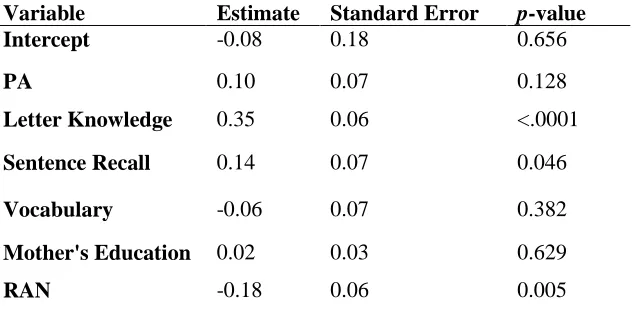
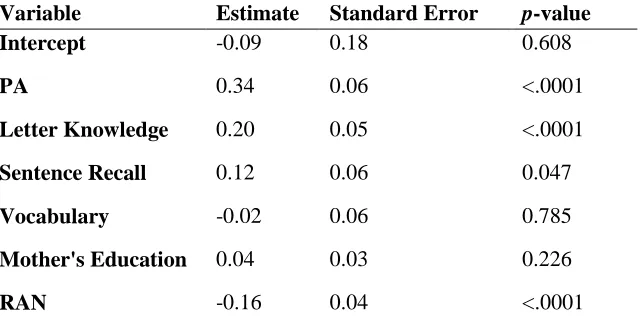
15 Ordinary Least Squares Regression. Tables 3 and 4 display the results of OLS multiple regression for preschool and kindergarten predictors, respectively. In the preschool multiple regression, letter knowledge, RAN, and sentence recall were the significant predictors of word reading. In the kindergarten multiple regression, letter knowledge, RAN, sentence recall, and PA were significant predictors of word reading.
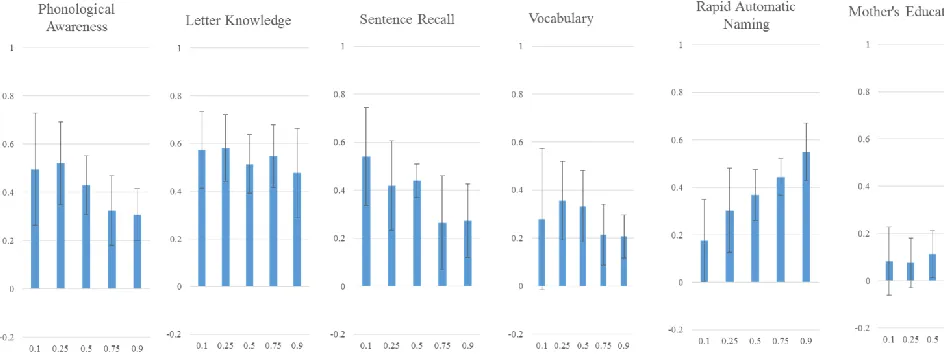
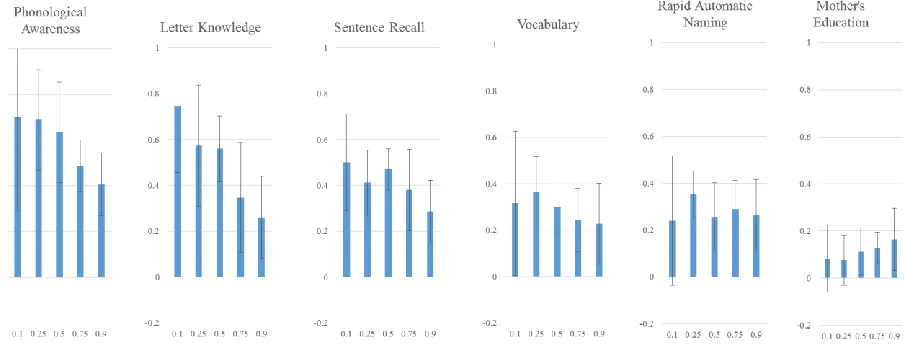
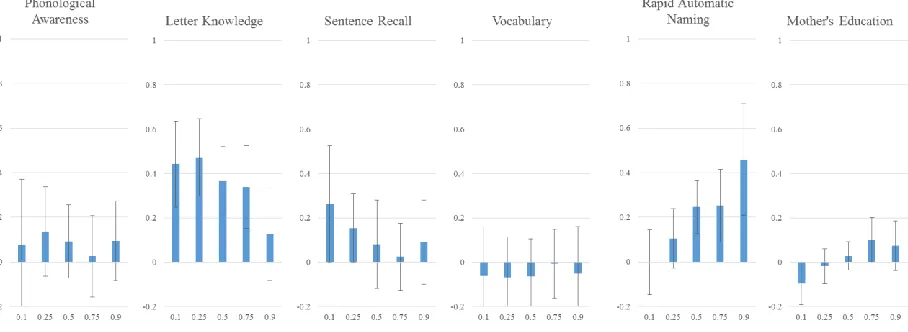
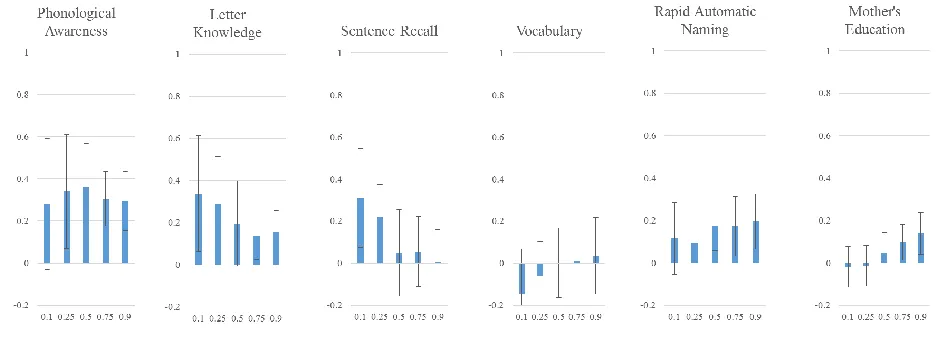
Quantile Regression. The above OLS predictions are estimates of the predictive nature of the specified variables for the child with the average level of word reading. A critical innovation of this study was the investigation of whether these relationships differ depending on children’s word reading ability. To do this, we used quantile regression analysis: this technique enabled us to examine how each predictor was related to word reading individually at different quantiles, and how predictors were uniquely related to word reading while controlling for the influences of each of the other predictors. We chose to estimate the relationships between variables at five points in the distribution of word reading (.1, .25, .5, .75, and .9). This number of points was selected to provide an overall representation of how the functional relationship changes along the distribution of word reading. It is important to note that the results of the reported quantiles would not vary if additional points were selected; these estimates are representative only of the point described, and not of a group of surrounding points (Petscher & Logan, 2013).
16 relationship between word reading and PA is .50. This means that two children at the .1 quantile in word reading who differ by 1 standard deviation in PA are predicted to differ by .50 standard deviations in word reading. At the higher end of word reading, the .9 quantile, the relationship is weaker: estimate equals .31. The results for sentence recall follow a similar pattern, where the relationship tends to be higher at lower quantiles. Letter knowledge and vocabulary show a flatter profile across quantiles, while RAN tends to increase at the higher quantiles. Mother’s education shows no significant effect at the lower quantiles (confidence interval includes zero) and a very small effect at the higher quantiles. Figure 2 displays the results for the kindergarten predictors. The coefficients for PA and letter knowledge tend to be higher at the lower quantiles than at the upper quantiles. Sentence recall, vocabulary, and RAN show flatter profiles with little change across quantiles. Mother’s education is once again not significant at the lower quantiles and has a very small effect at the higher quantiles.
17 predictor at the higher quantiles. Mother’s education was a significant unique predictor at the two highest quantiles.
Discussion
Previous research has documented many well-established relationships between pre-reading skills measured in preschool/kindergarten and word pre-reading ability in the early school grades. What is not as well understood is the extent to which these relationships apply to readers across the distribution, and in particular to poor readers. A cut-off score or series of cut-off scores is often used to create and compare subgroups of good and poor readers, but this approach does not account for the continuous nature of word reading ability, and can suffer from a loss of power. The current study introduced quantile regression to avoid the drawbacks of a cut-off-based approach. Using quantile regression, the significance of relationships between predictors in preschool/kindergarten and first grade word reading was examined at a number of different points along the distribution of word reading ability.
We began our analyses using OLS multiple regression, which has often been used to examine the predictors of reading performance. The results of this analysis were consistent with the findings of previous investigations in identifying a number of unique predictors of word reading ability. We found that letter knowledge, sentence recall, and RAN in preschool, and letter knowledge, PA, sentence recall, and RAN in kindergarten, were significant unique
predictors of word reading in first grade. We did not find, however, that vocabulary or mother’s education contributed uniquely to the prediction of first grade word reading.
18 predictors varied across grades and levels of word reading. Most noteworthy was the relationship between word reading and RAN, where RAN was not a significant unique predictor of word reading at the lower quantiles, but was significant at the middle and higher quantiles. A similar pattern was found in both preschool and kindergarten. Unlike what was found for RAN, letter knowledge was generally a better predictor for poor and average readers than for good readers, especially when measured in preschool. Sentence recall was somewhat similar to letter
knowledge in that it was significant at the lower quantiles, but only when measured in kindergarten. Finally, PA had a consistent relationship with word reading across quantiles in kindergarten but did not have a significant unique relationship with word reading when measured in preschool.
As noted above, letter knowledge was found to be a significant predictor especially for poor and average readers. Letter knowledge in preschool is typically considered to be a reflection of general print knowledge and/or early literacy experience (Kirby, Parilla, & Pfeiffer, 2003). Therefore, our results might be interpreted to indicate that early print knowledge and literacy experience may explain more of the subsequent individual differences among poor and average readers than among the best readers. The opposite pattern was found for RAN, such that RAN was a better unique predictor for good than for poor word readers. RAN can be considered a measure of the integration or automaticity of reading skill (Norton & Wolf, 2012). The
significance of RAN for better readers could reflect the importance of automaticity for readers with a higher level of reading proficiency. Poor and average readers, in contrast, may not benefit as much from a higher level of automaticity.
19 several possible reasons for this disagreement. First, the outcome measure used in our study was word reading accuracy, while de Groot et al. used word reading fluency. RAN may well have a more stable contribution to fluency across ability levels, while accuracy may owe less to RAN at lower ability levels. Second, the children in de Groot et al. were older than the children in our study. More experienced readers are likely to read in a more automatized way, while our subjects were younger and less experienced and thus perhaps less affected by variations in RAN.
Sentence recall was found to have a small but significant unique relationship with word reading at the low end of the distribution when measured in kindergarten. In other words, individual differences on this measure in kindergarten accounted for unique variation among poor readers in first grade. Sentence recall is a complex measure involving both phonological memory and grammatical ability. Thus it is difficult in this study to determine what aspect of this measure might allow it to differentiate among poor readers in first grade.
PA was a significant unique predictor across most quantiles when measured in kindergarten but was not a significant unique predictor in preschool. The lack of unique
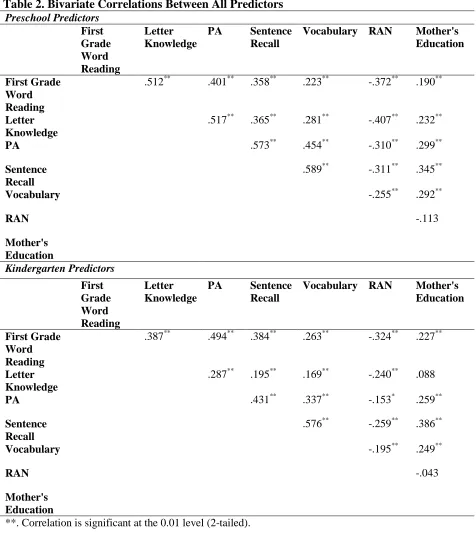
prediction for PA and sentence recall in preschool may be the result of greater collinearity in our preschool predictors than kindergarten predictors. Indeed there were larger bivariate correlations between measures in preschool than in kindergarten (see Table 2). Others have also found that early pre-reading skills may be more closely related to each other at the beginning of reading development, and show differentiation as reading skill progresses (Lervag, Braten, & Hulme, 2009).
20 reading achievement, especially in the study of poor readers. Our results further have
implications for early identification and intervention of reading disabilities. They reinforce the usefulness of measures such as letter knowledge, phonological awareness, and sentence
repetition in the early identification of children at risk for reading disabilities. Our results also suggest that measures of rapid naming may add little unique information in differentiating between children who subsequently read in the below average range. As such, these measures may not be helpful in identifying children whose performance falls on one side or the other of a cut-score for reading disability. Our findings also add to the large body of research indicating that early literacy experience and activities that highlight the sounds in words can promote reading ability in children who are at-risk for reading disabilities.
21 References
Catts, H. C., Petscher, Y., Schatschneider, C., Sittner Bridges, M., & Mendoza, K. (2009). Floor effects associated with universal screening and their impact on the early identification of reading disabilities. Journal of Learning Disabilities, 42, 2, 163-176.
de Groot, B. J. A., van den Bos, K. P., Minnaert, A. E. M, G., & van der Meulen, B. F. (2015). Phonological processing and word reading in typically developed and reading disabled children: Severity matters. Scientific Studies of Reading, 19, 2, 166-181.
Dunn, L. M., & Dunn, D. M. (2007). Peabody Picture Vocabulary Test-Fourth Edition. MN: Pearson Assessment.
Katzir, T., Kim, Y., Wolf, M., Kennedy, B, & Morris, R. (2006). The relationship of spelling recognition, RAN, and phonological awareness to reading skills in older poor readers and younger reading-matched controls. Reading and Writing, 19, 845-872.
Kirby, J. R., Desrochers, A., Roth, L., & Lai, S. S. V. (2008). Longitudinal predictors of word reading development. Canadian Psychology, 49, 2, 103-110.
22 Language and Reading Research Consortium. (in press). The dimensionality of language in
young children. Child Development.
Logan, J. A. R., Petrill, S. A., Hart, S. A., Schatschneider, C., Thompson, L. A., Deater-Deckard, K., DeThorne, L., S., Bartlett, C. (2012). Heritability across the distribution: An
application of quantile regression. Behavioral Genetics, 42, 2, 256-267.
Lonigan, C. J., Wagner, R. K., Torgesen, J. K., & Rashotte, C.A. (2007). Test of preschool early literacy. Austin, TX: ProEd.
Norton, E. S., & Wolf, M. (2012). Rapid automatized naming (RAN) and reading fluency: Implications for understanding and treatment of reading disabilities. Annual Review of Psychology, 63, 427-52.
Petscher, Y., & Logan, J. A. R. (2014). Quantile regression in the study of developmental sciences. Child Development, 85, 3, 861-881.
Petscher, Y. & Kim, Y.-S. (2011). The utility and accuracy of oral reading fluency score types in predicting reading comprehension. Journal of School Psychology, 49, 1, 107-129.
Scarborough, H. S. (1998). Predicting the future achievement of second graders with reading disabilities: Contributions of phonemic awareness, verbal memory, rapid naming and IQ. Annals of Dyslexia, 48, 115-136.
23 Semel, E., Wiig, E. H., & Secord, W. A. (2003). Clinical Evaluation of Language Fundamentals
– Fourth Edition; Examiner’s Manual and Stimulus Book 1. Bloomington, MN: Pearson, Inc.
Torgesen, J. K., Wagner, R. K., Rashotte, C. A., Burgess, S., & Hecht, S. (1997). Contributions of phonological awareness and rapid automatic naming ability to the growth of word-reading skills in second- to fifth-grade children. Scientific Studies of Reading, 1, 161-185. Woodcock, R. W. (1998). Woodcock Reading Mastery Tests – Revised/Normative Update.
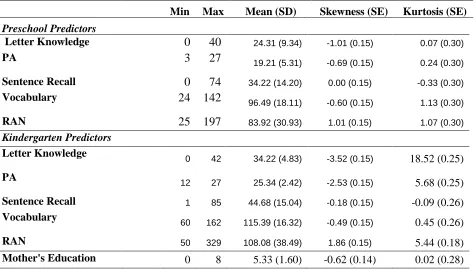
24 Table 1. Descriptive Statistics for Raw Variables
Min Max Mean (SD) Skewness (SE) Kurtosis (SE)
Preschool Predictors
Letter Knowledge 0 40 24.31 (9.34) -1.01 (0.15) 0.07 (0.30)
PA 3 27 19.21 (5.31) -0.69 (0.15) 0.24 (0.30)
Sentence Recall 0 74 34.22 (14.20) 0.00 (0.15) -0.33 (0.30)
Vocabulary 24 142 96.49 (18.11) -0.60 (0.15) 1.13 (0.30)
RAN 25 197 83.92 (30.93) 1.01 (0.15) 1.07 (0.30)
Kindergarten Predictors
Letter Knowledge 0 42 34.22 (4.83) -3.52 (0.15) 18.52 (0.25)
PA 12 27 25.34 (2.42) -2.53 (0.15) 5.68 (0.25)
Sentence Recall 1 85 44.68 (15.04) -0.18 (0.15) -0.09 (0.26)
Vocabulary 60 162 115.39 (16.32) -0.49 (0.15) 0.45 (0.26)
RAN 50 329 108.08 (38.49) 1.86 (0.15) 5.44 (0.18)
Mother's Education 0 8 5.33 (1.60) -0.62 (0.14) 0.02 (0.28)
25 Table 2. Bivariate Correlations Between All Predictors
Preschool Predictors First Grade Word Reading Letter Knowledge
PA Sentence
Recall
Vocabulary RAN Mother's
Education
First Grade Word Reading
.512** .401** .358** .223** -.372** .190**
Letter Knowledge
.517** .365** .281** -.407** .232**
PA .573** .454** -.310** .299**
Sentence Recall
.589** -.311** .345**
Vocabulary -.255** .292**
RAN -.113
Mother's Education Kindergarten Predictors First Grade Word Reading Letter Knowledge
PA Sentence
Recall
Vocabulary RAN Mother's
Education
First Grade Word Reading
.387** .494** .384** .263** -.324** .227**
Letter Knowledge
.287** .195** .169** -.240** .088
PA .431** .337** -.153* .259**
Sentence Recall
.576** -.259** .386**
Vocabulary -.195** .249**
RAN -.043
Mother's Education
**. Correlation is significant at the 0.01 level (2-tailed). *. Correlation is significant at the 0.05 level (2-tailed).
26 Table 3. Slope Values from Multiple Regression for Preschool Predictors
Variable Estimate Standard Error p-value
Intercept -0.08 0.18 0.656
PA 0.10 0.07 0.128
Letter Knowledge 0.35 0.06 <.0001
Sentence Recall 0.14 0.07 0.046
Vocabulary -0.06 0.07 0.382
Mother's Education 0.02 0.03 0.629
RAN -0.18 0.06 0.005
27 Table 4. Slope Values from Multiple Regression for Kindergarten Predictors
Variable Estimate Standard Error p-value
Intercept -0.09 0.18 0.608
PA 0.34 0.06 <.0001
Letter Knowledge 0.20 0.05 <.0001
Sentence Recall 0.12 0.06 0.047
Vocabulary -0.02 0.06 0.785
Mother's Education 0.04 0.03 0.226
RAN -0.16 0.04 <.0001