DRTRMRTIC
® AUGUST 15, 1988A CAHNERS PUBLICATION
SPECIAL REPORT: DBMS
FatalFlaws
InSQL
By E.F. (odd
Also In This Issue:
•
Why Management Must Confront the VDT Issue
•
Contract Programming Is Hotter Than Ever
T
hen you've got to
turn those numbers
into a presentation,
turn to the SAS® System. The
SAS System includes
easy-to-use procedures for charts,
plots, maps, and
three-dimen-sional displays. At a glance,
you can grasp detailed statistics,
spot relationships among items,
and trace emerging trends.
And when your manager wants
more, the SAS System lets you
customize your graphs and
present multiple displays on the
same page for easy comparison.
You can produce your graphs
on terminals, plotters,
trans-parencies, or slides.
Actual
r),r Phorte Sy.temll :eaaed " ... ,-J r - - . . / " 4/' ... .-...
~ Phone Syslems purchased
The SAS System runs on these minicomputers: Digital Equipment Corp. VAX'" 8xxx and 11/7xx series under VMS:" and MicroVAX II'" under MicroVMS""
You can even use the SAS
System to analyze your data
before you present them. We've
got tools for every kind of
analysis - from simple
descrip-tive statistics to advanced
regression, analysis of variance,
discriminant analysis,
cluster-ing, scorcluster-ing, and more.
And as your needs
grow, the SAS System
grows with you. All the
tools you need for
full
screen data entry,
model-ing, forecastmodel-ing, "what if"
analysis, project
man-agement,
optimiza-tion, and quality
control are
Prime Computer, Inc. Prime 50 series under PRIMOSqp; and Data General Corp'. ECLIPSEqp MV series under AOSNS. The SAS System also runs on IBM 370/30xx/43xx and compatible machines under OS, CMS, DOSNSE, SSX, and ICCF; IBM XT/370 and AT/370 under VM/PC; and IBM PC XT and PC AT under PC DOS. Not all products are available for all systems. SAS and SAS/GRAPH are registered trademarks of SAS Institute Inc., Cary, NC, USA.
Copyright 01987 by SAS Institute Inc. Printed in the USA.
utgrow.
available in the SAS
System. You choose
the products you
need, and enjoy the
same easy-to-use
lan-guage and syntax in
each. Whether you
license one product
or several, you'll enjoy
the same high-quality
software, training,
documentation, and
support we've offered for more
than ten years.
For details, send us your
name and address. Or call
a Software Sales
Representa-tive today.
SASj RAP
Software
Your
CINCOM Opens Doors For BestWestem.
PROBLEM:
How
tv
easily access and
update large volumes of corporate
infor-mation vitalfor strengthening image
and facilitating expansion
CINCOM SOLVED
m
With SUPRA
Advanced RelationaJ DBMS and MANTIS,
a
powerfulapplication development /vol
, Tracking and managing
Mr. Robert
C.Seate
information for 3,300 hotels in more than 30 countries around the world is enough to give any MIS manager some sleepless nights. But, thanks to the SUPRN'M Advanced Rela-tional DBMS from Cincom®, Best Western's Robert Seate (along with member hoteliers and guests) can rest assured things are running smoothly.
Manager, Management Information Systems Best ~stern Internatio1lal, Inc.
"With SUPRA, we really have the best of both worlds," explains Seate. "We get the advantages of a relational environment and, at the same time, get a system that performs very well in a large volume production environment."
SUPRA's superior performance lets the world's largest hotel chain access and update the marketing data as well as the property and travel publications essential to support and promote each hotel. SUPRA also works in concert with MANTIS®, a flexible application development tool in the CASE ENVIRONMENf1M, to drive multiple programs de-signed to monitor and upgrade quality standards throughout the Best Western organization. "When you increase the value of the chain, people want to become a part of it," Seate explained.
"SUPRA and all the Cincom products work together to help us meet our corporate expansion and quality goals," Seate points out. "It's a set of tools that is very flexible, very easy to use and learn, and very capable of developing and support-ing a wide variety of applications:'
As for SUPRA's reliability, Seate has no reser-vations. "Let's put it this way," he says, "we're run-ning our payroll on it. We'd be crazy to do that if we didn't have a high degree of confidence in the system."
Jfyou're looking for a relational data base with IBM and VAX compatibility, high perform-ance and reliability, plus the option of a flexible application development tool, it's time you checked into SUPRA and MANflS.
Call us today for more product and customer success information, or write our Marketing Service Department, Cincom World Headquarters, 2300 Montana Avenue, Cincinnati, OH 45211.
1-800-543-3010
In Ohio, 513-661-6000
In Canada, 1-800-387-5914
I~
NEWS
1 1
Look Ahead
Amdahl expects MVS/ESA support to cost more.
1 9
Supercomputing
In a new IEEE study made available exclusively to DATAMATION, grave con-cerns are expressed about the U.S. supercomputer in-dustry's ability to compete with Japan. Willie Schatz explores the reasons why.
21
Software
Gary McWilliams investi-gates the jumble of graphical user interfaces and operat-ing systems vyoperat-ing for devel-opers' favor. Behind the obvious cosmetic differences lie some substantial issues.
24
Microcomputers
The death of Boris Naumov, the man oversee-ing computerization in So-viet society, may hinder any East-West high-tech joint ventures. David Hebditch probes what's ahead. With:
24 The Structure of the Soviet
IS Industry
30
Networks
Brad Schultz illuminates a little-known research project into so-called MEMNETS. If
successful, the need for products to implement con-formance to network proto-cols may be over.
39
Behind the News
The recent Suffolk County, N.Y., mandate for VDT work-er "protection" has rekin-dled the debate over VDT safety. Willie Schatz exam-ines how the focus has shift-ed to ergonomics and what the work environment is like at several firms.
With:
4 1
Using Ergonomics To
Im-prove the Bottom Line
2 DATAMATION D AUGUST 15, 1988
L ·
U~
The first wave of DBMS us-age is ending. New tasks for IS are at hand, namely, achieving integration. This report examines the state of DBMS today.
45
Fatal Flaws in SQL
Part I
BY E.F. CODD
SQL is the de facto standard in DBMSS today. Here, "the father of relational technol-ogy" examines two of the three flaws he sees in SQL.
51
All TPls Are Not
Created Equal
BY STEVEN CANIANO
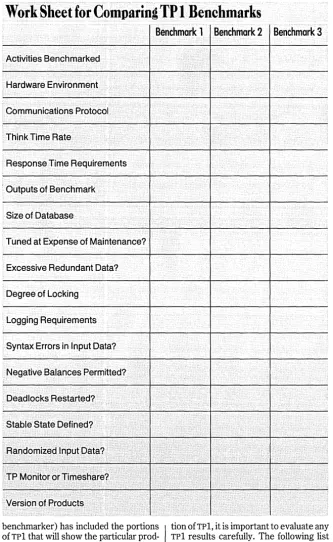
Different evaluations of OLTP DBMS products with TPI benchmarks don't always produce equivalent results. Herewith, a guide to mak-ing useful comparisons. With:
53 Clearing the Benchmark
Air
New TPI guidelines.
57
The New Era of DBMS
Integration
BY DAVID R. BROUSELL
Three of every four IS managers surveyed in an ex-clusive DATAMATION poll say they plan to integrate main-frame DBMSS with those on pcs and workstations.
63
The Traveling
Program-mer's Popular Show
BY MARY JO FOLEY
Packaged software and sys-tems integrators were ex-pected to crimp third-party programmers' style, but it ain't necessarily so. With:
65 A partial list of contract programmers.
74
The DATAMATION/Price
Vfaterhouse Survey
o
o
NEW PRODUCTS
68 HardwareNew Teleos Communications releases for ISDN switching be-tween basic rate interface and primary rate interface circuits. In Trends: page printers fuel nonimpact printer sales.
70 Software
Walker Interactive Systems makes its mainframe financial software available under IBM's DB2 RDBMS for the MVS operat-ing system. In Trends: a way for CICS users to use the COBOL sort verb on-line.
I
DEPARTMENTS
4 Letters
73 Calendar
OOPSLA '88, a conference on object-oriented programming, is coming up in San Diego.
76 Career Opportunities
88 Advertisers' Index
Cover Paper Sculpture by Ajin
Coming in the next issue: A Corporate Profile of
Unisys
Fatal Flaws in SQL, Part 2
How New Technologies Show the Maturation of the IS Industry
CALLING ALL USER GROUPS!
Please send information about your User Group so it can be included in DATAMATION's upcoming User Group Directory. If
possible, please include address, phone number, number of members, names of officers, date of next meeting, statement of purpose, and a list of services provided. The address is:
249 W. 17th St. New York, NY 10011 Attn.: Managing Editor
AUGUST 15, 1988 VOLUME 34 NUMBER 16 THIS ISSUE, 184,089 COPIES
1988 JESSE H. NEAL AWARD
1987 JESSE H. NEAL AWARD
Editorial
Time To Go On
The Offensive
It's neither the biggest nor the richest company in its field, yet that hasn't prevented Con Edison froD;1 assuming a leadership position in managing information age workers. Specifically, the 23rd-Iargest U.S. utility has gone on the offensive in protecting the health of employees who use video display terminals, the subject of Willie Schatz's Behind the News report (p. 39).
Not satisfied with steps it has already taken, such as eye exams and work breaks, Con Ed plans to embark soon on an ergonomic training program to teach employees how to avoid screen glare, among other things. Unfortunately, several other user organizations have taken a defensive posture on vDTs-investing sums in lawyers and lobbyists to thwart legislative moves to govern VDT use in the workplace.
We find little fault with organizations that oppose VDT -use laws on Constitutional grounds-they have every right to oppose government intrusion into their markets. But we can't help wondering whether the money wouldn't be better spent on research and retrofits. Although more states have rejected VDT -use legislation than have approved it-the score is 24 states to nine at this point, according to one association-the issue is unlikely to go away. Local governing bodies will step in where state legislatures or employers fail to act, just as Suffolk County, N.Y., has recently done. The sheer number of vnTs in use-30 million by one estimate-and the growing populations of pcs and workstations will require that greater attention be paid to health concerns surrounding such modern-day tools.
"It's an issue we can't afford to turn our back on," says Paul Berger, president of the influential Society of Information Management. "But we shouldn't do an overkill either." He points out that although no scientific studies have concretely linked VDT use to health problems, some U.S. companies are already improving the environments of VDT workers, playing catch-up to their counterparts in Europe and, he suspects,]apan. "Maybe we weren't as conscious of those environments when people were using typewriters," he says.
Being conscious of such matters early on certainly hasn't cost Con Ed anything. Its ROI ranks second among utilities. Maybe the best offense isn't a good defense after
all.
Maybe it's just a good offense-especially where the health of workers is at stake.TIM MEAD EDITOR-IN-CHIEF
CRTRMRTICN
Editor-in-Chief Tim Mead
Senior Editor Linda Runyan
Managing Editor/News & Features David R. Brousell
Senior Writer Ralph E. Carlyle
Deputy News Editor Theresa Barry
Deputy Features Editor Marsha J. Fisher
New Products Editor Mary Kathleen Flynn
Editorial Assistant KarenJ. Scher
Editorial Secretary Anne M. Mangieri
Managing Editor/Production & Special Proiects Parker Hodges
Copy Chief Steven Korn
Production Editor Hernalee Walker
Copy Editors Rene Matthews, John Quain
Production Assistant Suzanne P. Jones
International Editor Paul Tate
Editorial Assistant (London) Lauren Murphy Correspondents James Etheridge, Paris; David Hebditch, Eastern Europe; Janette Martin, Milan
U.S. Bureau Managers Boston Gary McWilliams
Dallas Robert Francis
Los Angeles Tom McCusker
San Francisco Jeff Moad
San Jose Susan Kerr
Washington Willie Schatz
Art Director Robert 1. Lascaro
Associate Art Director Anne Cooney
Assistant Art Director Carolee Young
Contributing Editors Joseph Kelly, Fred Lamond, HeshWiener
Advisory BoardJoseph Ferreira, John Imlay, Angeline Pantages, Russell Pipe, Carl Reynolds
Publishing Director Donald Fagan
Associate Publisher William Segallis
Promotion Manager Stacy Aaron
Production Manager Eric Jorgensen
Research Manager Laraine Donisi
Director of Production Robert Elder
Director of Art Department Barrie Stern
Circulation Manager Cheryl Barnett
EDITORIAL OFFICES
Headquarters: 249 W. 17 St., New York, NY 1O01l, (212) 645-0067; telex 127703; fax (212) 242-6987. New England: 199 Wells Ave., Newton, MA 02159, (617) 964-3730; Washington, D.C.:
4451 Albemarle St. NW, Washington, DC 20016, (202) 966-7100;
Central: 9330 LBJ Freeway, Suite 1060, Dallas, TX 75243, (214) 644-3683; Western: 12233 W. Olympic, Los Angeles, CA 90064, (213) 826-5818; 582 Market St., Suite 1007, San Francisco, CA 94104,(415) 981-2595; 3031 Tisch Way, Suite 100, San Jose, CA 95128-2593, (408) 243-8838. International: 27 Paul St., London EC2A 4JU, England, (44-1) 628-7030, telex 9149ll; CPO Box 665, Tokyo,Japan, (81-3) 201-2335, fax 2135053.
DATAMATION (lSSN 0011-6963) Magazine is issued twice monthly on the 1st and 15th of every month byThe Cahners Pub-lishing Company, A Division of Reed PubPub-lishing USA, 275 Wash-ington St., Newton, MA 02158-1630. William M. Flatt, Chief Executive Officer; Terrence M. McDermott, President; Frank]. Sibley, Group Vice President; Jerry D. Neth, Vice President/ Publishing Operations;J.J. Walsh, Financial Vice President/Mag-azine Division; Thomas]. Dellamaria, Vice President/Produc-tion and Manufacturing. Editorial and advertising offices, 249 W. 17th St., New York, NY 1001l. Published at Woodstock, IL. An-nual subscription rates: U.S. and possessions: $60; Canada: $85; Japan, Australia, New Zealand: $155 air freight; Europe: $135 air freight, $250 air mail. All other nations: $135 surface, $250 air mail. Reduced rate for U.S. public and school libraries: $40. Sin-gle copy: $3 in U.S. Sole agent for subscriptions in Japan is Maru-zen Co. Ltd., 3-10 Nihonbashi, 2-Chome, Chuo-ku, Tokyo 103, J; sole agent for all other foreign subscriptions is J.B. Tratsart Ltd., 154 A Greenford Rd., Harrow, Middlesex HA13QT, England, (01) 422-8295 or 422-2456. No subscription agency is authorized by us to solicit or take orders for subscriptions. Circulation records are maintained at 44 Cook Street, Denver, CO 80206. Phone (303) 388-4511. Second-class postage paid at Denver, CO 80206 and at additional mailing office. DATAMATION copyright 1988 by Reed Publishing USA; Saul Goldweitz, Chairman; Ronald G. Segel, President and Chief Executive Officer; Robert L. Kra-koff, Executive Vice President. All rights reserved. DATAMA-TION is a registered trademark of Cahners Publishing Co. Reprints of articles are available; contact Frank Pruzina (312) 635-8800. Microfilm copies of DATAMATION may be obtained from University Microfilms, A Xerox Company, 300 N. Zeeb Rd., Ann Arbor, MI 48106. Printed by Graftek Press Inc. All inquiries and requests for change of address should be accompanied by mailing label from latest issue of magazine. Allow two months for change to be made. POSTMASTER: send address changes to DATAMATION, 44 Cook St., Denver, CO 80206.
MP
WSPA
4 DATAMATION D AUGUST 15, 1988
Letters
Distortion
"The Supercomputer Breaks Through" (May 1, p. 50) distorts Boeing Computer Services' pricing and unfairly positions the company as being grossly overpriced for its services.
The article [quoting John Taylor, manager of Du Pont's scientific comput-er division] states that Boeing Computcomput-er Services charged a customer "$10,000 per cpu hour." To set the record straight, Boeing Computer Services did not offer pricing based on cpu hour to any customer.
In point of fact, there are no accept-able industrywide cpu pricing standards. Further, rate comparisons based on cpu hours alone can be misleading. The run times of specific jobs on a machine are heavily influenced by the system config-uration. For example, using a solid-state storage device, run times on our ma-chines have been lowered from 24 to four hours and cpu hours have also been re-duced considerably.
Boeing Computer Services has and will continue to provide its customers with rates that are competitive with uni-versity and in-house installations. We would welcome the opportunity to pro-vide an industry-competitive or bench-mark quote to any prospective customer.
SURESH SHUKLA National Product Manager Boeing Computer Services Bellevue, Wash.
Israeli Realities
I would like to comment on your article entitled "Israel: Where Necessity Moth-ers Innovation" (April 1, p. 54-11). The article states that Israel lacks "central-ized planning for high technology." This is incorrect at least in one respect. Com-puters and telecommunications in acade-mia are being coordinated by a central government-financed organization. We currently have a network spanning 47 mainframe systems located in over sev-en universities with connections to the European Academic Research Network (EARN), as well as to BITNET and CSNET.
This centralized planning has al-lowed us to coordinate our efforts and, sometimes, to learn from others' mis-takes. Currently, the U.S. research and academic networks are attempting to co-ordinate their efforts since they now re-alize that each is running a parallel net-work. The DOD (ARPANET), the DOE (HEP-NET), the NSF (NSF(HEP-NET), the list is endless. The problem now is to establish
a centralized coordinating unit that will remove the redundant links that current-ly crisscross the continental United States and to create a single high-speed backbone of 1-3Gbits per second. Israel is not at the stage to create networks of that speed, but at least we are able to co-ordinate our efforts.
Your article did not cover the major reason companies in Israel are not able to produce up to their potential. Tele-communications was touched upon but was covered as a side note to the overall problem. A 64Kb international link from the U.S. to Europe costs approximately $4,000. The cost of the European end is approximately $9,500 (based on a 10-country average). This represents a total monthly cost of $13,500 for a 64Kb link. On the other hand, Israel's sole PTT, Bezek, charges $21,000 for the same link, bringing the total monthly costs up to $25,000 (when including the American side of the link).
The situation for data communica-tions within Israel is no better. Typical 64Kb digital tariffs are between three-to-five times the European average. Small software houses cannot afford the exor-bitant prices that Bezek demands on be-half of the services they supply.
HANK NUSSBACHER Computer Consultant Israel
Health and Networks
Regarding the McDonnell Douglas Infor-mation Systems profile in the DATAMA-TION 100 aune 15, p. 99), your descrip-tion implies that the company is no long-er in the business of providing eithlong-er health information or network systems to customers. This couldn't be farther from the truth.
While McDonnell Douglas Informa-tion Systems Co. did sell a minor physi-cian systems operation, the company continues to be a major health care sys-tems provider. In fact, one in every four U.S. hospitals uses a McDonnell Douglas health system.
Further, our Tymnet network is one of the two leading public data com-munications networks in the U.S. It con-tinues to be a cornerstone in our ability to offer customers total systems integra-tion soluintegra-tions.
c:---~
/~')
-
(
. ~---~~
J
Closer to Genius
Introducing PowerHouse
pcn~
the most powerful 4GL for
serious application development
on a personal computer.
PowerHouse PC delivers more power than any other PC application development product. It gives you OS/2TM perlormance and integrated communications. And it gives you all of this - today.
PowerHouse now lets you prototype and build serious business applications on your PC in addition to HP, Digital and DG mid-range computers. The simplicity of one language across architectures gives you the flexibility of choosing the production environment that best suits your needs.
Use PowerHouse PC as a development workstation to develop applications for your mini, as a host extension to offload processing, or for stand-alone applications. Complete with a communications facility, PowerHouse PC makes the most of your resources by allowing you to share applications and data between architectures. What makes PowerHouse PC even smarter is that it runs under both DOS and OS/2.
When you're ready for serious application development on a personal computer, you're ready for PowerHouse
Pc.
Call Cognos Direct, 1 800-4-COGNOS
05/2 is a trademark of International Business Machines Corporation. The Cognos logo and PowerHouse are registered trademarks of Cognos Incorporated. PowerHouse PC is a Cognos trademark.
Cognos Corporation, 2 Corporate Place, 1-95, Peabody, MA, USA 01960, (800) 4-COGNOS. Cognos Incorporated, 3755 Riverside Drive, P.O. Box 9707, Ottawa, Ontario, Canada, KIG 3Z4, (613) 738-1440, Telex: 053-3836. Cognos Limited, Westerly Point, Market Street, BrackneIl, Berkshire RG12 lQB, United Kingdom, National (0344) 486668, International +44344486668, Telex: 846337 Cognos G.
Your company undoubtedly has tremendous data resources.
Metaphor's Data Interpretation System can help you turn them
into a tremendous competitive advantage.
Metaphor's system is far more than an
incrediblysophisti-cated, amazingly easy-to-use computer. It's a means of gaining a
real edge in the battle for more business, through gains in
pro-fessional productivity and enhanced business decision-making.
Metaphor is the only system that can give your key
decision-makers direct access to multiple data bases. They will be able
to readily transform raw data into meaningful information. And
share the results with management and peers, quickly, easily.
So decisions can be made in time to make a difference.
Metaphor's system makes a big difference for Information
Systems professionals, too. Metaphor lets users build their
own applications, so IS managers can turn their skills to more
effectively managing the corporate information resource,
rather than grinding out user reports and applications from
a seemingly endless backlog of requests. And given Metaphor's
proven understanding of end-user needs, IS gains a strong
"support arm;' too.
That's what customers at over 100 installations in the
world's largest and most successful companies tell us. They've
proved Metaphor's Data Interpretation System is a powerful
business tool, giving them an enormous
advantage over those who don't keep up
with the latest technologies.
Start the competitive advantage
flowing to your company now, with
metaphor
§§§§§~j j \.~§§§§ .... f \:
Metaphor. Write us at 1965 Charleston Road, Mountain View, CA
94043, or call us toll-free at 800-255-5803 today.
, I
cY~
Let's
tall~about
relational data bases.
But first, find the clown with
the red nose,
top
hat and no balloons.
IT you picked the first clown from the right on the top row, you didn't need the
help of a relational data base system.
Of course, real-life business problems are considerably more complicated. That's
'vhy IBM, the leader in relational data base technology, offers a wide range of
products to work with a full range of hardware, from workstations to midrange and
mainframe computers.
IBM's data base products can help users in any department retrieve information
about as easily as you solved the problem above. They also provide tools for
programmers to do their job more efficiently. And that means improved productivity
for everyone.
In fact, IBM's D B2 and SQ LIDS offer referential integrity, which allows you to
maintain data relationships without complex programming. And with application
enabling tools such as IBM's Cross Systems Product, you can develop new programs
with speed and simplicity. So even as your business needs change, your existing
applications and data bases will remain sound investments.
Call 1-800-IBM -2468, ext. 44, for literature or to arrange for an IBM marketing
representative-in the blue suit, yellow tie with a black briefcase-to contact you.
-§ :
:~~~®
The Bigger Picture
I '
\
'''.\ I. 1\
I. .•
""~"---FROl\n POSTSCRIPT
TO 80 P.lIlGES PER I\fjINUTE!
[\J BS Southern IS the cmnpany [flat blankets the non-impact pr'intlng spectrum. From the PostScript-compatible. I:) page-pel'-minute model 3815, to the blazing 80 ppm speed of the Mercurion 1/80, [\J BS has a solution to your computer printing needs.
Model 3815 - Maximum Office Versatility
/\vaii,lUle in PostSc(ipt, t--'C net-wor k. tVJlr I-axial. cO-Clxial ClrlCJ ASCII v(?rsions. tile ~:Je1:5 IS tar more durable HlcHl most desktop laser pr'inters and is the ideal solution
\
,
\
for cJlilv cycles of up to ~)E5.c)()0
pages per month.
~.nodel 30tlO - Complm~ Output
at 40 ppm
Tilis laser printer houses up to 150 resident bitmap fonts elt 300 dpi. c=3nrJ rrocesses complex forms and graphics at full rated speed. Its nominal duty cycle of 200,000
p~lgCS per rTlonth makes it a
per-fect fit for both host-attach and network printing applications.
Affordable H igh-spaed 'Norkhorsc
[\Jow you can match the output of
three high-speed impact printers
Circle 8 on Render Cnrd
at only a fraction of the per page cost. Using an ion deposition process, Ule Mercurion 1/80 pro-duces 80 letter-size pages per minute, with a rated monthly duty cycle of 500,000 pages. It accepts a variety of host interfaces and delivers high quality forms and text via 240 dot-per-inch resolution.
Decide which NBS non-impact printer is best for your needs; then contact us for detailed specs and prices. NBS Southern. Inc ..
-1'~ ,1C-1 C',.-,.,,+h O""I ... h " .... Dr."-1r~ 1 1'-+..) 1 0UULII UClvllC;1 I I V U U .
LClrgo. F'::lorida 34643_ Telephone 813/5 /l1- 2200.
outside Florida 800/327- 5602;
PClVIS NERVOUS ABOUT
lVIVS/ESA ...
... AS WELL AS
IBlVI'S DISK
DRIVE PLANS
HITACHI CHECKS OUT SINGAPORE
ISDN TO BE LAUNCHED BY WEST GERMANS
Look Ahead
SUNNYVALE, CALIF. -- It turns out that supporting
IBM's popular new MVS/ESA operating system extension
may not be quite as easy as plug-compatible mainframe
vendors and their customers assumed at first. Amdahl
Corp. says that in order to account for engineering
changes that will be necessitated by ESA, i t recently
increased the standard financial reserve i t usually
carries on its books. The company, which normally sets
aside a larger reserve to pay for engineering changes
than i t is likely to need, won't say by how much the
amount was increased. Amdahl cfo Ed Thompson does say
that it's likely to be more expensive for Amdahl to
support ESA because hardware changes will be
neces-sary on more boards than was initially expected.
SAN JOSE -- Meanwhile, pcm storage hardware makers are
nervous as they anticipate the next IBM disk move.
Word has i t that IBM's storage engineers in San Jose
are at work on two projects that could cause headaches
for pcms while solving some problems for users. Both
are projects to replace IBM's current 3380-class disk
storage devices with drives using smaller disks and
taking up less of users' valuable floor space. One
project is thought to be based on mul tiple 5!4-inch
drives, and the other on a drive using a 10. 7-inch
disk. The problem for pcms is that, while changing
disk size from the current 14-inch standard, IBM may
also alter track lengths and disk rotating speeds,
making i t harder to make devices that match.
SINGAPORE -- Japanese IS giant Hitachi is determined
to get its fair share of software development
exper-tise from one of the fastest growing software centers
in Asia--the city-state of Singapore. By early next
year , i t plans to establish a regional Software
Devel-opment Center here. NEC, HP, Cullinet, Sony, and
Nix-dorf already have similar software centers in place.
Sources say the Singapore center will likely focus on
three key areas: English versions of Hitachi's
Japa-nese-developed AI and expert systems products; new
manufacturing applications software; and a special
project to create protocols and communications
soft-ware for linking Hitachi systems with other vendors'
machines, particularly those from IBM and DEC.
BONN, WEST GERMANY -- Watch for the official launch of
ISDN services in West Germany this fall following
suc-cessful trials of the technology by the West German
Bundespost in Stuttgart and Mannheim involving some
800 business users over the last two years. The
EAST SEEKING WESTERN TARGETS
GOV'T EYES NEe SUPER
IS EVERYBODY HAPPY?
Look Ahead
cial ISDN system will begin with eight ISDN switching
centers coming into operation over the next few
months, and the Bundespost hopes to be able to meet
around 90% of the country's demand for ISDN ports by
the end of 1993. But, as many users point out, that
de-mand will depend on the pricing policy covering the
new services--an issue that is still being hotly
de-bated by users and the West German telecom authority.
TOKYO -- Kobe Steel is hunting for IS investment
tar-gets in the U. S. as part of a plan to expand revenues
from its data processing and electronics division. It
has already backed Los Angeles-based disk maker Racet
Computers and Boston-based laser company QC Optics.
Sources here say Kobe's plan is to hit revenues of $75
million from its IS and electronics businesses by 1990
and $750 million by 1995. Over that period, Kobe
ex-pects to hire an extra 1,000 people to run its IS
busi-ness. Plans are cheap though, and putting them into
practice in an environment where many other
tradi-tional industries are diversifying is really going to
test the steel company's mettle.
LOS ALAMOS, CALIF. -- The last few benchmarking teams
from the government lab here have returned from Japan
and spread the rumor that i t might not be such a bad
move to buy an NEC SX 3. That machine won't hit the
streets until next year, but when i t does , i t promises
to blow its competition away. "A lot of people at Los
Alamos are very interested in the SX 3," says a close
observer of the scene.
GENEVA -- Are the trade barriers that hinder free
trade in telecom and IS services in some countries
ac-tually receding? That's the implication in the lack of
response from major multinationals to a call from the
U. S. trade office for examples of the trade barriers
faced when marketing IS services in foreign
coun-tries. The request for examples is in preparation for
the Uruguay Round of negotiations of the General
Agreement on Tariffs and Trade (GATT) here later this
year. The lack of response has surprised U. S. trade
officials. A list of complaints compiled in 1984 cited
Australia" for protecting its domestic software
industry through excessive taxation of software l i
-censes," Brazil for its "market reserve policy
limit-ing the foreign telecom services that can be offered,"
Canada's banking laws, which "discriminate against
re-mote accessed foreign processing," and Norway's
priva-cy laws relating to intra corporate dataflows.
DEC WEIGHS U.S. EDI OFFER
JAPANESE HAVE A YEN FOR CONSORTIA
RUMORS AND
RAW
RA1IDOM
DATALook Ahead
MAYNARD, MASS. -- Digital Equipment Corp. is lining up
applications for an expected September launch of a
u.
S. value-added network service. The computer maker
already has agreements with vendors of financial,
purchase order, funds transfer, and other
applica-tions that could reside on a planned X12 electronic
data interchange (EDI) network. A spokesman would say
only that the company" is considering" aU. S. EDI
net-work offering. Having built a nationwide voice/data
fiber-optic network to link its U. S. facilities, the
company earlier began studying a value-added network
offering in a U.K. pilot program.
TOKYO -- Japan, now preparing for its next-generation
research scheme, may launch consortia next year to
conduct basic research in neural and optical
comput-ing. The Ministry of International Trade and Industry
(MITI) thinks neural computers would be more adept
than
convention~alcomputers at pattern and voice
rec-ogni tion and robotic control. The optical project
MITI is considering would develop materials that
could be used in optical computers, which use light
rather than electricity. MITI has until Sept. 1 to
make its requests to the finance ministry in time for
legislative bodies to consider funding for next
April. The Key Technology Center, a government
foun-dation, already has decided to form a consortium with
industry and academia to study fuzzy computing over a
six- to eight-year period beginning next March. Fuzzy
computing, based on multivariate rather than binary
logic, could be applied to machine translation,
ex-pert systems, and de fense .
Digi tal Equipment Corp. seeks to boost its
transac-tion processing contingent with some near-term
dis-tributed database support. The company is promising
an enhanced VAX Rdb relational database that will
al-low users to build physically distributed databases
over multiple nodes or design distributed access to an
Rdb database that makes a remote database appear as if
i t were local . . . . Wang Laboratories Inc .'s new VS 5000
line finally cracked the development logjam that has
made every computer released since January 1985 an
ex-ercise in repackaging. In its research and
develop-ment, Wang now can focus on putting together
replace-ments for its VS 7000 family. In the works are two new
families based on CMOS and ECL gate array
semiconduc-tor technologies, high-speed system buses, and mul
ti-processor support beyond the present limit of two
cen-tral processing units.
since Oracle Corporat\on. is twice as
software vendor in the DEC marketplace.
Why do VMS and ULTRIX users buy the ORACLE\!)
RDBMS more than twice
as
often
as
any other? Why is
ORACLE so far ahead of Cullinet, Software AG and ADR
on IBM Mainframes?
Because ORACLE offers the best set of
4th~generation
application development tools.
Because ORACLE fully supports
every~thing from loosely coupled VAXs to tightly
coupled IBM mainframes, and also allows you
to transparently share data among PCs,
work~stations and mainframes - even mainframes
running DB2.
Because ORACLE runs on virtually every
micro, mini and mainframe. Which means
your ORACLE applications run everywhere.
Because ORACLE was the first
imple~mentation of SQL, the data management
standard adopted by IBM, ANSI, ISO and
the federal government. But ORACLE isn't
. just SQL compatible. With such added
functionality as
outer jOins and
CONNECT BY,
ORACLE is the most powerful SQL
imple-mentation for micros, minis or mainframes.
Because ORACLE has been the best-performing
RDBMS on the VAX. And you haven't seen
anything yet!
Call today, to reserve a seat in the next ORACLE
seminar in your area. Learn why database competition
is no contest. Find out what ORACLE can do for you.
-:0
COMPATIBILITY· PORTABILITY' CONNECTABILITY
Call1-800-345-DBMS, ext.1D7 today.
• DIGITAL NEWS, 1/25/88. page 58. © 1988 by Oracle Corporation. ORACLE'" is a registered trademark of Oracle Corporation. The other companies mentioned ou'n numerous registered trademarks. TRRA
u.s.
SEMINARS AL Birmingham... . ... Oct 11AR Little Rock... . ... OCt 13 AZ Phoenix ... Sep 13, Oct 13, Nov 8 Thcson ... Oct 25 CA Costa Mesa ... Sep I, Oct 4, Nov 11
Los Angeles .... Sep 15, Oct 18, Nov 15 Oakland ... Oct 6 sacramento ... Sep 22, Nov 10 San Diego ... Sep 8, Oct 6, Nov 3 San Francisco .... Sep 14, Oct 11, Nov 9 San Jose ... Sep 20, Oct 26, Nov 17 CO Denver... ... Sep 22, Oct 27 Colorado Springs ... Oct 25 CT Farmington.. . ... Oct 4 New Haven... . ... Sep 8 Stamford... .. ... Nov 15 DC Washington (Federal) ... Sep 16, Oct 21, Nov 18 FL Ft. Lauderdale ... OCt 18 Jacksonville ... .. ... Oct 19 Orlando ... Sep 14 GA Atlanta ... Sep 7, Oct 5, Nov 9 HI Honolulu... .. ... Sep 13
IA Des Moines... . ... Sep 13, Nov 10
1D Boise... ... Oct 5 IL Chicago ... Sep 15, Oct 11, Nov 16 Springfield ... Sep 14, Nov 9 IN Indianapolis... . ... Oct 13, Nov 17
KS Wichita ... Sep 13 KY Lexington ... Sep 14 Louisville ... Oct 12 LA New Orleans. .. ... OCt 28 Shrevepon... . ... Oct 13 MA Boston ... .. ... Oct 12 Burlington ... . ... Nov 18 Springfield ... Oct 12 MD Bethesda (Commercial) . ... Sep 21 Baltimore ... Oct 19 ME Ponland ... Oct 5 MI Detroit.. ... Sep 13, Oct 4, Nov 8 Grand Rapids... . ... Oct 12 MN Minneapolis ... Sep 27, Oct 19, Nov 10 MO Kansas City ... Sep 14, Oct 18 St. Louis.. . ... Sep 6, Oct 6, Nov 7 NC Charlotte... . ... Oct 20, Nov 17 Raleigh ... Sep 15, Nov 2 Winston·Salem... . ... Oct 5 NE Omaha... . ... Oct 4 NH Concord ... Sep 20
NJ Iselin ... Sep 15, Oct 13, Nov 17 Princeton ... Sep 15. Oct 4, Nov 22 NM Albuquerque.... . ... Sep 29
NY Las \egas ... Sep 22, Nov 10
NY Albany... . .... Sep 20, Nov 9 Buffalo ... Oct 4 Long Island .... Sep 20, Oct 19, Nov 16 New York City ... Sep 14, Sep 28, Oct 12, Oct 26, Nov 9, Nov 16 Rochester ... . .... Sep 14, Nov 2 OH Akron... . ... Sep 20 Cincinnati... . ... Sep 15 Cleveland.. . ... Oct 19 Columbus ... Sep 22 OK Oklahoma City... . . . ... Sep 13 Thlsa... . . ... ... Oct 25
OR Ponland ... Sep 8, Nov 15 PA ~~~~rp~;~ ... S~P .. i9;.o~i'i·6J~~ ~~
Pittsburgh .. .. ... Oct 26 Valley Forge... .. Sep 8, Nov 10 RI Providence ... Sep 22 SC Charleston. ... Oct 5 Columbia... . ... Nov 16 Greenville. .. ... Oct 19 TN Memphis.. .. ... Sep 14 Nashville... .. ... Nov 9 TX Amarillo.... .. ... Sep 20 Austin... . ... Oct 20 Dallas ... Sep 7, Oct 4, Nov 2 Ft. Wlnh... .. ... Nov 9 Houston .... . . .. Sep 8, Oct 6, Nov 10 Midland... . ... Oct 19 San Antonio... .. . ... Oct 21 VT Salt Lake City ... Sep 20, Nov 9 VA Norfolk (Fedefal) ... Oct 4 Richmond... .. .... Oct 6, Nov I
VT Burlington Sep 28 WA Seattle ... Sep 14, Oct 20 Spokane ... .. ... Nov 3 WI Madison ... Oct 5 Milwaukee ... Oct 12, Nov 29
CANADIAN SEMINARS To register for Canadian seminars,
~:~:~afo1.~'t(~~6~~~~~~rw~·613.
~;!-;t~81i£59~~~nt:337.07SS. ~~~~~~ ... Se~ .. 15.'.N~:tl~ Halifax... .. .... Oct 13 Kingston... .. ... Sep 16 London ... Oct 20 Montreal ... Sep 28, Oct 26, Nov 23 Ottawa ... Sep I, Oct 6, Nov 3 Quebec ... Sep 7, Oct 5, Nov 2 Regina... . .. Sep 22 Sask3100n ... Nov 10 Toromo ... Sep 13, Oct 11, Nov 8 Vancouver .. Sep 8, Nov 10 Victoria ... . .. Nov 24 Winnipeg... .. ... Oct 20
Attn: National Seminar Coordinator Oracle Corporation' 20 Davis Drive Belmont, California 94002
o
~;~t~~;~~~~spl~~~eo~~~~lf~~ai~at:
the FREE ORACLE seminar to be held
on: ________________ _
•
is
e*lc
For more
If you're looking for the best
database, just look at this data.
It's the best-seller.
According to a recent
Dataquestsurvey, Informix
UNIX' DBMS products
out-sold their closest competitors
by almost 2 to
1.
More-Informix
$34M
are easier to build
applica-tions with.
You see, INFORJVIIX-4GL is
the only true
COBOL-replace-ment caliber tool.While those
other DBMS products
masquer-ade as 4GLs (providing mere
report writers and screen
gen-erators), INFORJVIIX-4GL gives
you a complete language.
over, INFORMIX-SQL and
INFORJVIIX-4GL recently won
UNIX WORLD
magazine's
UNIX DBMS SALES 1987
ing
So you can torget about cod-
in
C or COBOL. And count
coveted "Readers' Choice" awards in their
respective categories. Better yet, the same
readers named INFORJVIIX-SQL the best
UNIX software, period.
Hardly surprising, when you consider
everything Informix has going for it.
It's the easiest.
Because it's the only
true 4GL.
Why do we get such a big slice of the
UNIX DBMS market? Because our products
on beingatleast ten times more productive.
Plus you can use our exclusive Interactive
Debugger to view and debug your 4GL
source code while the program runs.
Delivering finished applications in
record time.
It's the fastest.
ltabasein
•
t1
one reason.
INFORJv1IX-TURBO database server they
fly. In fact, in a recent TPI (transaction
processing) benchmark study, Informix
ran a great deal faster than other leading
DBMS products.
It's the most portable.
With Inforrnix, you'll never have to
rewrite your source code. Our Rapid
Devel-opment System lets you compile your code
without a C compiler or linker So
port-ing to other operatport-ing systems is a snap.
And you can run your Inforrnix application
on over 200 machines from more than
85 companies. Twice as many machines as
our nearest competitor
Informix
TPIBENCHMARKSTUDY
Send for our free booklet,
"How To Choose
An
RDBMS:'
Call or write today for complete product
data, plus our free guide to selecting the
RDBMS that's right for you. Informix
Software, Inc., 4100 Bohannon Drive, Menlo
Park, CA 94025. (415) 322-4100.
And we'll make you our #1 priority.
rIJ
INFORMIX
#1 for good reason.
Inforrnix is a registered trademark of Inforrnix Software, Inc. Ul\IX, Oracle and are, registered trademarks of their respective manufacturers. © 1988 Inforrnix Software, Inc.
" . " .
UnlQck
The
'Mysteries ,
Of'DB2
/ .Performance. \
I . . . :'. \'-'.. t:.
Dynami~
SQlCaU Being'
.~x~cuted
..
INSERT
··Ii\\TO
·TDQ~A.TA.BLE82'~·
To manage DB2 performance, you need more than
information. You need solutions. OMEGAMON® for
DB2 gives you both.
Exception Analysis warns you when key thresholds
are exceeded. Before a stray thread turns your
system to stone. Then powerful zooming features
take you where no one else can. Deep into the
passageways of DB2. Right down to the SQL call. And
Recommendation Screens translate detailed data
into realtime solutions.
Yet what's sophisticated on the inside is made
simple on the outside with menus and help screens.
OMEGAMON identifies the problem thread so your
~rOT
;C\L} \,
ALU.ES (000, 1)
Proprietary software engineering keeps overhead as
low as 1% with minimal space requirements. And
OMEGAMON is always available-even when DB2 is
locked up.
Candle's always available, too. With round-the-clock
customer service, technical education, and a
commitment to stay current with IBM. So you won't
ever be lost in the passageways ofDB2.
To decipher the mystery ofDB2 performance, call
Terry Forbes today at (800) 541-8513.
tCandle®
troubleshooting is as effortless as pressing a PF key.
Copyright © 1988 Candle Corporation. All rights reserved.News in Persllective
SUPERCOMPUTING
IEEE
Warns of the Japanese
Supercomputer Threat
A new study finds that the
u.s.
must act now to stem the
perceived]apanese invasion and suggests a new civilian
agency focused on long-term national interests.
BY WILLIE SCHATZ The IEEE's Committee on Communications and Infor-mation Policy has made avail-able to DATAMATION a new re-port on how the Japanese are wiping out the U.S. super-computer industry. Entitled "U.S. Supercomputer Vul-nerability," it leads to the in-exorable conclusion that "we better do something," accord-ing to its principal author, Alan McAdams, an assistant professor of managerial eco-nomics at Cornell University. The Scientific Super-computer Subcommittee of IEEE contends that the U.S. supercomputer industry is in deep trouble thanks to a fo-cused market strategy by the Japanese. To overcome U.S. firms' vulnerability will re-quire coordination by govern-ment to a degree seldom achieved in peacetime-and time is of the essence.
What's new about this? "The IEEE has never taken a position like this before," Mc-Adams says. "This is the non-partisan IEEE taking a policy position. Things must be pretty bad for them to start screaming. "
Finding the Framework
The something Mc-Adams refers to is finding "an acceptable institutional framework in which govern-ment, industry, and academia can pursue these objectives to the long-run benefit of the nation as a whole." Were that to occur, the institutional framework would still be use-less without a guarantee that economic and technological
decisions be made according to economic and technologi-cal-not military and politi-cal-criteria.
"The answer may 'well require that the coordination and leadership functions be nested in a new, lean, expert civilian agency of government that is capable of focusing on the longer-term national in-terest," find McAdams and friends. "Only through a coor-dinated approach to all these
Hopefully, the new adminis-tration will have more of a commitment to understand-ing high tech. But it's still not worth creating another bureaucracy."
That opinion isn't con-fined to the government. "Any proposal to establish a new government agency isn't something I favor," says Sid Karin, director of the National Science Foundation's (NSF'S) San Diego Supercomputer
CORNELL'S McADAMS: The threat isn't limited to supercomputers.
issues will we able to ensure a strong U.S. base for innova-tion, productivity, and inter-national competitiveness."
Grass-Roots Commitment
"A new agency is fine if you've got a professional gov-ernment with a long-term in-terest," says a government official intimately involved in the supercomputer industry. "But if Congress thinks it can just create it with a few pieces of paper, then it will be anoth-er bureaucracy that won't work. What you really need is a grass-roots commitment.
Center (SDSC). "I've heard all this before. There's nothing earthshaking in here."
The IEEE begs to differ. "People aren't realizing the real crisis that exists," Mc-Adams contends. "The whole U.S. technological base is at risk, and it's getting worse.
To emphasize that this report is different from all the others that have reached the same conclusion, McAdams rests his case on economics and technology.
"To overcome [U.S. su-percomputers'] vulnerability will require a systems
solu-tion: an integrated coopera-tive effort among industry, universities, and
govern-ment," the report says. "It
ap-pears that such a solution will require coordination by gov-ernment to a degree seldom if ever achieved in this country in peacetime. But the threat is real, and it is not limited to supercomputers. Supercom-puters appear to represent only a next step in an ongoing process."
Banging the Drum Slowly
Thus, while Cray and ETA may say that Japanese components are not yet avail-able for export to those two companies, the devices are readily available to end users in the Japanese supercom-puter systems.
"This continues the fa-miliar, oft-repeated pattern," the report contends. "Japa-nese firms plan and act in ac-cord with long-range goals. When they achieve a techno-logical advantage in one area, they use that advantage to in-sure their advance into new areas. They have targeted su-percomputers as the next high-tech area in which to es-tablish a dominant position."
You couldn't tell it from looking at the Japanese super-computers in the U.S., though. The only one is an NEC SX 2 leased by the Hous-ton Area Research Consorti-um (HARC). There have been many other efforts to land a Japanese supercomputer, but none has succeeded (see "Su-percomputer Dumping Al-leged at U.S. Universities," Sept. 15, 1987, p. 17).
The SDSC would just as soon keep it that way, but it
sees the U.S. government ~
tripping all over itself. ~
"The supercomputer
agreement with Japan con-
t
tains seeds which can further 1
undermine the position of ~
U.S. manufacturers," the re- .,g
port contends. "It requires of .£
Japan a number of actions ~
which, if made reciprocal to
j
the U.S., could facilitate the entry of Japanese supercom-puters into the U.S. market."
Supercomputer Partnerships Now, the supercom-puter trade agreement re-quires the Japanese in gov-ernment or university super-computer procurements to give equal preference to U.S. manufactured supercom-puters. The Japanese essen-tially have agreed to avoid un-fair pricing by their
manufac-turers. According to
McAdams, however, what looks unfair to a trade admin-istrator looks to a manufactur-er like recognition of partnmanufactur-er- partner-ship with a government agen-cy or university.
"This sounds like a com-plete misunderstanding of the trade agreement," says Lauren Kelley, a supercom-puter analyst in the Depart-ment of Commerce (DOC) Office of Computer and Busi-ness Equipment. "The agree-ment is based on the interna-tional GATT [General Agree-ment on Tariffs and Trade] government procurement code. In fact, nothing in the agreement is different from the standard General Ser-vices Administration proce-dures. To say this is a one-sid-ed arrangement is completely untrue."
Nonetheless, the IEEE thinks a hard rain's gonna fall. Here's the U.S. telling the Japanese to open their mar-kets or else, while simulta-neously blocking the Massa-chusetts Institute of Technol-ogy (MIT) from purchasing an
sx 2 from NEC. Of course,
even a Freedom of Informa-tion Act search wouldn't un-cover a written policy on the subject, but you can bet the national debt that govern-ment agencies aren't about to open their doors to the Japanese.
(The Department of De-fense, which sees national se-curity in every byte, is legisla-tively prohibited from buying
Peak Supercomputer Performance Rates
SINGLE CPU PEAK ALLOWING MULTIPLE 64-81T MFLOP RATE CPUS
Cray-1 160 160
CrayX-MP 233 932 (4 cpus)
Cray-2 488 1,952 (4 cpus)
Cray-3 (1989) 1,000 16,000 (16 cpus) est.
Cyber20S 200 (2 pipe) 400 (4 pipe)
ETA 10 (1986) 350 1,400 (4 cpus)
ETA 10lE 415 1,660 (4 cpus)
ETA 10/G (1988) 643 5,142 (8 cpus)
Fujitsu VP 100 271 271
Fujitsu VP 200 533 533
Fujitsu VP 400 1,067 1,067
Hitachi 5-810/20 630 630
Hitachi 5-820/80 2,000 N/A
IBM3090NF 116 696 (6 cpus)
NEC SX 1 570 570
NECSX 2 1,300 1,300
NEC 5X 3 (1989) 5,000 20,000 (4 cpus) Source:
"u.s.
Supercomputer Vulnerability," IEEE's Scientific Supercomputer Subcommittee.any foreign-Congress
meant Japanese-supercom-puters in 1988.)
"How long can such a pattern last?" the paper asks. "Is it realistic to believe that the Japanese machines are foreclosed from U.S.
institu-tions? If the requirements we
now impose on the Japanese were made reciprocal for U.S. universities and government laboratories, Japanese super-computers would have to be acceptable to those agencies on nondiscriminatory terms." For some supercom-puter users, that day can't dawn soon enough.
"We Want the Best Product" "The economic leverage of supercomputers is irrele-vant and always will be," NSF's Karin says. "What mat-ters is the use of supercom-puters. We need the best su-percomputers, and we need to make the best use of them. Who makes a supercomputer is far less important than how
it's used."
"There's a genuine con-cern here about foreign com-petition," says a user at a ma-jor federal lab. "But when it comes to computers, we just want the best product. And by keeping out the Japanese, the government and the U.S. su-percomputer industry are pretending the situation is better than it really is."
However, by letting in the Japanese, the IEEE sees the industry living on desola-tionrow.
"The new requirements could greatly facilitate the en-try of the Japanese into the U.S. At the same time such re-quirements could disrupt the implicit partnership between U.S. manufacturers and U.S. government laboratories and/ or U.S. universities, and transfer the benefits of part-nership to Japanese firms. In response to a low bid, U.S. na-tional labs could be required to become partners to Japa-nese firms in perfecting their
20 DATAMATION D AUGUST 15,1988
systems for penetration of U.S. markets."
No U.S. lab would want to do that, at least on the rec-ord. But the Japanese clearly have the fast single-processor system and are expected to increase that lead with their next generation product ex-pected next year (see "Peak Supercomputer Performance Rates"). So how much longer can users be shut down at their expense? Not very. So it's only a matter of time be-fore HARC has company.
Japan's Software Is Lacking That could be very soon if the Japanese get their ware act together. Their soft-ware isn't quite up to their hardware, but therein lies the danger.
"Once general portabil-ity of applications is achieved, the avenue to continued mar-ket leadership by U.S. firms would be solely through tech-nical leadership," the report says. "But how can U.S. firms simultaneously rely on com-ponentry manufactured by their competitors, the Japa-nese, and assure their cus-tomers that they, the U.S. firms, can maintain techno-logical leadership?"
They can't.
"As soon as Japanese firms have software that U.S. companies need, they'll be selling heavily here," the gov-ernment official says. "NEC is working its butt off to develop software. When those devel-opments take place, we have no laws to restrict them." This is generally expected to be sooner rather than later.
So why not let them come and fight it out nanosec-ond-to-nanosecond in the tried-and-true capitalist tra-dition?
"Because our entire economy is at risk," Mc-Adams contends. "Super-computers are the key to
in-dustrial design. If you lose
su-percomputers, you're in real
News in Perspective
SOFTWARE
Developers Ponder Choices
Among Graphic Environments
ing HP's NewWave, says that differences among window systems and toolkits are not being explained to developers by the vendors of those sys-tems. Knoble says it is "my hope and understanding" that HP will be able to use one
envi-ronment "by and large. If we
have to do development and integration [across environ-ments] to any significant lev-el, I'll be unhappy."
The array of windowing options and other features in
various icon-based systems leads some to ask if a scroll
bar in one system is still a scroll bar in another.
BY GARY MeWI LLiAMS It's almost enough to make a programmer yearn for the simpler days. With nearly a dozen graphical user inter-faces and operating environ-ments soon to be available and contending for attention,
the obtuse C > and $ prompts
quickly may prove to be rel-ics. Color bands, scroll bars, menus, and buttons are taking their place.
Another change may be equally obvious. Those con-fused and puzzled looks that used to identify a new system user may turn up instead on the faces of veteran program-mers. "It's a difficult time to be a developer," says Cheryl C. Currid, departmental com-puting services manager for Coca-Cola Foods, Houston.
Significant Issues at Work Behind the merely cos-metic differences lie signifi-cant development issues. They can be as basic as a choice of windowing systems, or as substantial as the com-puting philosophy.
Many emerging graphi-cal environments impose a client-server approach that invokes a minicomputer or other server to execute parts of an application. Others allow the application to reside whol-lyon the workstation. The de-gree of differences within en-vironments can be as varied as the applications them-selves.
For instance, Hewlett-Packard's NewWave initially employs Microsoft Windows as its windowing system. Fu-ture versions will be available
for IBM's Presentation Man-ager and the XII window sys-tem, according to Robert J. Frankenberg, Hewlett-Pack-ard's Information Systems Group general manager. "We made a decision to use indus-try standard windowing capa-bilities and the associated toolkits as well," he says.
Intelligent Workstations To developers, the envi-ronments bear on issues as
di-not obscure the common fea-tures of various graphic envi-ronments (see "Graphical Interface Environments"). Both client-server and net-worked pc approaches posi-tion intelligent workstaposi-tions as the focal point for render-ing an application. Similarly, each graphical environment positions C as the common language for developers. With the exception of Apple Computer Inc., all profess a
Third-Party Features
Others already working within a graphical environ-ment say they expect third-party software developers to have the greatest say on which environments and fea-tures will remain. "To us," says Kevin M. Maloney, a technical consultant with Fi-delity Software Development
Graphical Interface Environments
WINDOWING
VENDOR INTERFACE AVAILABILITY ENVIRONMENTS TOOLKITS
AT&T/Sun Open Look QI '89 NeWS, X-II NDE,XT+
DEC DECwindows Fall '88 X-II/Windows DEcwindows
HP NewWave Nov./Dec. '88 Ms-Windows* NewWave
IBM Presentation Oct. '88 Presentation Presentation
Manager Manager Manager
Microsoft Windows 2.03 Current Ms-Windows MS-Windows
Apple Computer Inc. Macintosh Current Macintosh Mac Toolkit
(Macintosh only)
Apollo Computer Open Dialog Current X-ll Object Manager
* NewWave is being migrated fo run on Presentation Manager and X-ll windowing environments. Source: DATAMATION
verse as the computer type and the wayan application is approached. Richard Tread-way, Digital Equipment Corp.'s manager of DECwin-dows programs, says the cli-ent-server approach of Xll enables the lowliest of work-stations to display the results of an application running else-where on a network. How-ever, XlI's demands on com-puter performance rule out enabling the DECwindows graphical environment to run directly on the most widely used workstations.
Such differences should
readiness to license their en-vironments to hardware and software developers.
Some developers antici-pate a gradual reduction of dif-ferences to alleviate the di-lemma for programmers. Jaime Knoble, group leader for strategic technology at American Cyanamid Co., Wayne, N.J., says the Open Software Foundation, the XlI consortium, and pacts in-volving Microsoft, Hewlett-Packard, and IBM should de-crease the variations within each environment.
Knoble, currently
test-Co., Boston, "the issue is which environment will offer the greatest number of appli-cations that we will not devel-op ourselves."
Aaron Goldberg, vp of pc services at market research firm International Data Corp., Framingham, Mass., esti-mates that such graphical en-vironments largely will be the province of third-party soft-ware developers.
HP's Frankenberg says programmers will have to learn to view development from an "event-based" per-spective: "This programming