warwick.ac.uk/lib-publications
Original citation:Liu, Hong, Pikhurko, Oleg and Sharifzadeh, Maryam (2018) Edges not in any monochromatic copy of a fixed graph. Journal of Combinatorial Theory, Series B .
doi:10.1016/j.jctb.2018.07.007
Permanent WRAP URL:
http://wrap.warwick.ac.uk/105223
Copyright and reuse:
The Warwick Research Archive Portal (WRAP) makes this work by researchers of the University of Warwick available open access under the following conditions. Copyright © and all moral rights to the version of the paper presented here belong to the individual author(s) and/or other copyright owners. To the extent reasonable and practicable the material made available in WRAP has been checked for eligibility before being made available.
Copies of full items can be used for personal research or study, educational, or not-for-profit purposes without prior permission or charge. Provided that the authors, title and full bibliographic details are credited, a hyperlink and/or URL is given for the original metadata page and the content is not changed in any way.
Publisher’s statement:
© 2018, Elsevier. Licensed under the Creative Commons Attribution-NonCommercial-NoDerivatives 4.0 International http://creativecommons.org/licenses/by-nc-nd/4.0/
A note on versions:
The version presented here may differ from the published version or, version of record, if you wish to cite this item you are advised to consult the publisher’s version. Please see the ‘permanent WRAP url’ above for details on accessing the published version and note that access may require a subscription.
Edges not in any monochromatic copy of a fixed graph
Hong Liu1
Mathematics Institute and DIMAP, University of Warwick, Coventry CV4 7AL, UK.
Oleg Pikhurko2
Mathematics Institute and DIMAP, University of Warwick, Coventry CV4 7AL, UK.
Maryam Sharifzadeh3
Mathematics Institute and DIMAP, University of Warwick, Coventry CV4 7AL, UK.
Abstract
For a sequence (Hi)ki=1 of graphs, let nim(n;H1, . . . , Hk) denote the maximum number of edges not contained in any monochromatic copy of Hi in colouri, for any colour i, over all k -edge-colourings ofKn.
When each Hi is connected and non-bipartite, we introduce a variant of Ramsey number that determines the limit of nim(n;H1, . . . , Hk)/ n2
as n → ∞ and prove the corresponding stability result. Furthermore, if each Hi is what we callhomomorphism-critical (in particular if eachHi is a clique), then we determine nim(n;H1, . . . , Hk) exactly for all sufficiently large n. The special case nim(n;K3, K3, K3) of our result answers a question of Ma.
For bipartite graphs, we mainly concentrate on the two-colour symmetric case (i.e., when
k= 2 and H1 =H2). It is trivial to see that nim(n;H, H) is at least ex(n, H), the maximum
size of anH-free graph on nvertices. Keevash and Sudakov showed that equality holds ifH is the 4-cycle and n is large; recently Ma extended their result to an infinite family of bipartite graphs. We provide a larger family of bipartite graphs for which nim(n;H, H) = ex(n, H). For a general bipartite graph H, we show that nim(n;H, H) is always within a constant additive error from ex(n, H), i.e., nim(n;H, H) = ex(n, H) +OH(1).
1. Introduction
Many problems of extremal graph theory ask for (best possible) conditions that guarantee the existence of a given ‘forbidden’ graph. Two prominent examples of this kind are the Tur´an function and Ramsey numbers. Recall that, for a graphH and an integern, theTur´an function
ex(n, H) is the maximum size of an n-vertexH-free graph. Let Kt denote the complete graph on t vertices. The famous theorem of Tur´an [48] states that the unique maximum Kr+1-free
graph of order n is the Tur´an graph T(n, r), the complete balanced r-partite graph. Thus ex(n, Kk+1) = t(n, r), where we denote t(n, r) := e(T(n, r)). For a sequence a1, . . . , ak of integers, theRamsey number R(a1, . . . , ak) is the minimumRsuch that for every edge-colouring of KR with colours from [k] :={1, . . . , k}, there is a colour-icopy of Kai for some i∈[k]. The
fact that R exists (i.e., is finite) was first established by Ramsey [39] and then independently rediscovered by Erd˝os and Szekeres [16]. Both of these problems motivated a tremendous
1
Supported by the Leverhulme Trust Early Career Fellowship ECF-2016-523. 2Supported by ERC grant 306493 and EPSRC grant EP/K012045/1. 3
amount of research, see e.g. the recent surveys by Conlon, Fox and Sudakov [4], F¨uredi and Simonovits [20], Keevash [28], Radziszowski [38] and Sudakov [44].
A far-reaching generalisation is to ask for the number of guaranteed forbidden subgraphs. For the Tur´an function this gives the famous Erd˝os-Rademacher problem that goes back to Rademacher (1941; unpublished): what is the minimum number of copies of H in a graph of given order n and size m >ex(n, H)? This problem was revived by Erd˝os [8, 9] in the 1950– 60s. Since then it continues to be a very active area of research, for some recent results see e.g. [3, 5, 6, 26, 30, 32, 34, 35, 36, 40, 41, 45]. The analogous question for Ramsey numbers, known as the Ramsey multiplicity problem, was introduced by Erd˝os [10] in 1962 and is wide open, see e.g. [2, 7, 17, 21, 27, 43, 46, 47].
A less studied but still quite natural question is to maximise the number of edges that do not belong to any forbidden subgraph. Such problems in the Tur´an context (where we are given the order n and the size m > ex(n, H) of a graphG) were studied in [13, 19, 22, 23]. In the Ramsey context, a problem of this type seems to have been first posed by Erd˝os, Rousseau, and Schelp (see [12, Page 84]). Namely, they considered the maximum number of edges not contained in any monochromatic triangle in a 2-edge-colouring ofKn. Also, Erd˝os [12, Page 84] wrote that “many further related questions can be asked”. Such questions will be the focus of this paper.
Let us provide a rather general definition. Suppose that we have fixed a sequence of graphs
H1, . . . , Hk. For ak-edge-colouring φofKn, let NIM(φ) consist of all NIM-edges, that is, those edges of Kn that are not contained in any colour-icopy of Hi for any i∈[k]. In other words, NIM(φ) is the complement (with respect toE(Kn)) of the union overi∈[k] of the edge-sets of
Hi-subgraphs of colour-i. Define
nim(n;H1, . . . , Hk) := max φ:E(Kn)→[k]
|NIM(φ)|,
to be the maximum possible number of NIM-edges in a k-edge-colouring of Kn. If all Hi’s are the same graph H, we will write nimk(n;H) instead. Note that for k = 2 by taking one colour-class to be a maximumH-free graph, we have nim2(n;H)≥ex(n, H). In ([12, Page 84]),
Erd˝os mentioned that together with Rousseau and Schelp, they showed that in fact
nim2(n;H) = ex(n, H), for all n≥n0(H), (1.1)
when H =K3 is the triangle. As observed by Alon (see [29, Page 42]), this also follows from
an earlier paper of Pyber [37]. Keevash and Sudakov [29] showed that (1.1) holds when H is an arbitrary clique Kt (or, more generally, when H is edge-colour-critical, that is, the removal of some edge e∈E(H) decreases the chromatic number) as well as when H is the 4-cycle C4
(andn≥7). They [29, Problem 5.1] also posed the following problem.
Problem 1.1 (Keevash and Sudakov [29]). Does (1.1) hold for every graph H?
In a recent paper, Ma [33] answered Problem 1.1 in the affirmative for the infinite family of reducible bipartite graphs, where a bipartite graphH is calledreducible if it contains a vertex
v ∈ V(H) such that H−v is connected and ex(n, H −v) = o(ex(n, H)) asn → ∞. Ma [33] also studied the case of k≥3 colours and raised the following question.
Problem 1.2 (Ma [33]). Is it true that nim3(n;K3) =t(n,5)?
The lower bound in Problem 1.2 follows by taking a blow-up of a 2-edge-colouring of K5
1.1. Non-bipartite case
In order to state some of our results, we have to introduce the following variant of Ramsey number. Given a set X, denote by Xi
(resp. ≤Xi
), the set of all subsets of X of sizei (resp. at mosti). Given two graphsH and G, a (not necessarily injective) mapφ:V(H)→ V(G) is ahomomorphism if it preserves all adjacencies, i.e.φ(u)φ(v)∈E(G) for everyuv ∈E(H), and we say that Gis ahomomorphic copy ofH.
Definition 1.3. Given a sequence of graphs (H1, . . . , Hk), denote by r∗(H1, . . . , Hk) the
maxi-mum integer r∗ such that there exists a colouring ξ: [≤r∗2]→[k]such that
(P1) the restriction of ξ to [r2∗]
is (H1, . . . , Hk)-homomorphic-free (that is, for each i ∈ [k]
there is no edge-monochromatic homomorphic copy of Hi in the i-th colour);
(P2) for every distinct i, j∈[r∗]we haveξ({i, j})6=ξ({i}), that is, we forbid a pair having the same colour as one of its points.
For any r0 ≤r∗, we will call a colouring ξ : ≤[r02] → [k] feasible (with respect to (H1, . . . , Hk))
if it satisfies both (P1) and (P2). We say that (H1, . . . , Hk) is nice if every feasible colouring
ξ: [r∗(H1,...,Hk)]
≤2
→[k]assigns the same colour to all singletons.
Note that the colour assigned byξto the empty set∅ ∈ [≤r∗2]
does not matter. Note also that whenk= 2, due to (P2), a feasible colouring should use the same colour on all singletons. Thus,
r∗(H1, H2) = max{χ(H1), χ(H2)} −1. If we ignore (P2), then we obtain the following variant
of Ramsey number that was introduced by Burr, Erd˝os and Lov´asz [1]. Let rhom(H1, . . . , Hk) be thehomomorphic-Ramsey number, that is the maximum integer r such that there exists an (H1, . . . , Hk)-homomorphic-free colouringξ : [r2]
→[k]. We remark that for the homomorphic-Ramsey number, the colours of vertices do not play a role. When all Hi’s are cliques, this Ramsey variant reduces to the classical graph Ramsey problem:
rhom(Ka1, . . . , Kak) =R(a1, . . . , ak)−1. (1.2)
There are some further relations to r∗. For example, by assigning the same colouri to all singletons and using the remaining k−1 colours on pairs, one can see that
r∗(H1, . . . , Hk)≥max
i∈[k] rhom(H1, . . . , Hi−1, Hi+1, . . . , Hk). (1.3)
If someHi is bipartite, then the problem ofr∗reduces torhom. Indeed, asK2is a homomorphic
copy of any bipartite graph, when someHi is bipartite, no feasible colouringξ can use colouri on any pair. Consequently, we have equality in (1.3). This is one of the reasons why we restrict to non-bipartiteHi in this section.
It would be interesting to know if (1.3) can be strict. We conjecture that if all Hi’s are cliques then there is equality in (1.3) and, furthermore, every optimal colouring uses the same colour on all singletons:
Conjecture 1.4. For any integers 3 ≤ a1 ≤. . . ≤ ak, (Ka1, . . . , Kak) is nice. In particular,
r∗(Ka1, . . . , Kak) =R(Ka2, . . . , Kak)−1.
It is worth noting that not all k-tuples are nice. For example, it is easy to show that
r∗(C5, C5, C5) =rhom(C5, C5) = 4, whereCi denotes the cycle of lengthi, while Figure 1 shows a feasible colouring of ≤[4]2
assigning two different colours to singletons.
Figure 1: A feasible colouring ofK4 with respect to (C5, C5, C5), with two different colours on vertices.
Theorem 1.5. LetHi be a non-bipartite graph,i∈[k], and letr∗ :=r∗(H1, . . . , Hk). For every
ε >0, we have that, for all large n,
nim(n;H1, . . . , Hk)≤
1− 1 r∗
n2
2 +εn
2. (1.4)
Furthermore, if each Hi is connected or there exists a feasible colouring of [r
∗] ≤2
withk colours such that all singletons have the same colour, then we have nim(n;H1, . . . , Hk)≥t(n, r∗).
We also obtain the following stability result stating that if the number of NIM-edges is close to the bound in (1.4), then the NIM-graph is close to a Tur´an graph. Let the edit distance
between graphsGand H of the same order be
δedit(G, H) := min
σ |E(G)4σ(E(H))|, (1.5)
where the minimum is taken over all bijectionsσ :V(H)→V(G). In other words, δedit(G, H)
is the minimum number of adjacency edits needed to makeGand H isomorphic.
Theorem 1.6. For any non-bipartite graphs Hi, i∈[k], and any constant ε >0, there exists
δ >0such that the following holds for sufficiently large n. If the number of NIM-edges of some
φ: [n2]→[k] satisfies
nim(φ;H1, . . . , Hk)≥
1− 1 r∗
n2
2 −δn
2,
then δedit(Gnim, T(n, r∗))≤εn2, where r∗ :=r∗(H1, . . . , Hk) and Gnim is the NIM-graph of φ, i.e., the spanning subgraph with edge set NIM(φ).
Our next theorem shows that if Conjecture 1.4 is true, then this would determine the exact value of nim(·) for a rather large family of graphs, including cliques. We call a graph H
homomorphism-critical if it satisfies the following. IfF is a minimal homomorphic copy ofH, i.e. no proper subgraph ofF is a homomorphic copy of H, then for any edgeuv ∈E(F), there exists a homomorphismg:V(H)→V(F) such that|g−1(u)|=|g−1(v)|= 1, i.e. the pre-image sets of u and v are singletons. For example, all complete multipartite graphs with at least two parts of size 1 are homomorphism-critical. A simple consequence of this property is the following. As F is minimal, it does not have any isolated vertices. Therefore, for any vertex
v∈V(F), there exists a homomorphismg:V(H)→V(F) such that|g−1(v)|= 1.
Theorem 1.7. Let (H1, . . . , Hk) be a nice sequence of non-bipartite graphs such that each Hi
is homomorphism-critical. Then for sufficiently large n,
nim(n;H1, . . . , Hk) =t(n, r∗),
where r∗ :=r∗(H1, . . . , Hk); additionally, the NIM-graph of every extremal colouring is
In the following theorems, we prove Conjecture 1.4 for k = 3, and for a1 = . . . = a4 = 3
when k= 4.
Theorem 1.8. For all integers3≤a1 ≤a2≤a3, (Ka1, Ka2, Ka3) is nice. In particular,
r∗(Ka1, Ka2, Ka3) =R(a2, a3)−1.
Theorem 1.9. We have that(K3, K3, K3, K3) is nice. In particular,
r∗(K3, K3, K3, K3) =R(3,3,3)−1 = 16.
The following is an immediate corollary of Theorems 1.7, 1.8 and 1.9. In particular, the special case a1=a2 =a3= 3 answers Problem 1.2 affirmatively.
Corollary 1.10. Let 3≤a1 ≤a2≤a3 be integers. Then for sufficiently large n,
nim(n;Ka1, Ka2, Ka3) =t(n, R(a2, a3)−1),
nim4(n;K3) = t(n,16), and the NIM-graph of every extremal colouring is the corresponding Tur´an graph.
1.2. Bipartite graphs
For bipartite graphs, we will provide a new family for which Problem 1.1 has a positive answer. Let us call an h-vertex graph H weakly-reducible if there exist n0 ∈ N and a vertex
v∈V(H) such that ex(n, H−v) <ex(n, H)−22h2nfor all n≥n0. (The function 22h
2
comes from the proof and we make no attempt to optimise it.) Note that the family of weakly-reducible graphs includes all reducible graphs except the path of length 2 and this inclusion is strict. For example, for integerst > s≥2, the disjoint union of the complete bipartite graphsK2,tandK2,s is weakly-reducible but not reducible; this can be easily deduced from the result of F¨uredi [18] that ex(n, K2,k) = (
√
k/2 +o(1))n3/2 for any fixedk≥2 as n→ ∞.
Theorem 1.11. Let H be a weakly-reducible bipartite graph and n be sufficiently large. Then
nim2(n;H) = ex(n, H).
Furthermore, every extremal colouring has one of its colour classes isomorphic to a maximum
H-free graph of order n.
For a general bipartite graphH, we give in the following two theorems a weaker bound with an additive constant error term, namely,
nim2(n;H)≤ex(n, H) +OH(1).
This provides more evidence towards Problem 1.1.
Theorem 1.12. Let H be a bipartite graph on at mosth vertices containing at least one cycle. Then for sufficiently large n,
nim2(n;H)≤ex(n, H) +h2.
For more than 2 colours, we obtain an asymptotic result for trees. Fix a tree T, by taking random overlays of k−1 copies of extremal T-free graphs, we see that nimk(n;T) ≥ (k−
1)ex(n, T)−Ok,|T|(1) (this construction is from Ma [33]). We prove that this lower bound is
Theorem 1.13. Let T be a forest with h vertices. If k= 2 or if T is a tree, then there exists a constantC :=C(k, h) such that, for all sufficiently large n,
nimk(n;T)−(k−1) ex(n, T)
≤C(k, h).
Organisation of the paper. We first introduce some tools in Section 2. Then in Section 3, we will prove Theorems 1.11, 1.12, and 1.13. In Section 4, we will prove Theorems 1.5 and 1.6. We will present the proof for Theorem 1.7 in Section 5 and the proofs of Theorems 1.8 and 1.9 in Section 6. Finally, in Section 7 we give some concluding remarks.
2. Preliminaries
In this section, we recall and introduce some notation and tools. Recall that [m] :=
{1,2, . . . , m} and Xi (resp. ≤Xi) denotes the set of all subsets of a set X of size i (resp. at most i). We also use the term i-set for a set of size i. We may abbreviate a singleton {x}
(resp. a pair {x, y}) as x (resp. xy). If we claim, for example, that a result holds whenever 1a b >0, this means that there are a constanta0 ∈(0,1) and a non-decreasing function
f : (0,1)→(0,1) (that may depend on any previously defined constants or functions) such that the result holds for alla, b∈(0,1) witha≤a0 and b≤f(a). We may omit floors and ceilings
when they are not essential.
Let G = (V, E) be a graph. Its order is v(G) := |V| and its size is e(G) := |E|. The
complement of G is G:=
V, V2\E
. The chromatic number of G is denoted by χ(G). For
U ⊆ V, let G[U] := (U,{xy ∈ E :x, y ∈U}) denote the subgraph of G induced by U. Also, denote
NG(v, U) := {u∈U |uv∈E},
dG(v, U) := |NG(v, U)|,
and abbreviate NG(v) := NG(v, V) and dG(v) := dG(v, V). Let δ(G) := min{dG(v) : v ∈ V} denote the minimum degree of G.
Let U ={U1, U2, . . . , Uk} be a collection of disjoint subsets of V. We write G[U1, . . . , Uk]
or G[U] for the multipartite subgraph of G with vertex set U := ∪i∈[k]Ui where we keep the
cross-edges ofG(i.e. edges that connect two parts); equivalently, we remove all edges fromG[U] that lie inside a partUi∈ U. In these shorthands, we may omitGwhenever it is clear from the context, e.g. writing [U1, . . . , Uk] for G[U1, . . . , Uk]. We say that U is a max-cut k-partition of
Gife(G[U1, . . . , Uk]) is maximised over allk-partitions of V(G).
For disjoint sets V1, . . . , Vt witht≥2, letK[V1, . . . , Vt] denote the completet-partite graph
with partsV1, . . . , Vt. Its isomorphism class is denoted byK|V1|,...,|Vt|. For example, if part sizes
differ by at most 1, then we get the Tur´an graph T(|V1|+. . .+|Vt|, t). Let Mh denote the matching with h edges.
Definition 2.1. For an edge-colouring φ: [n2] →[k] of G:= Kn, define NIM(φ;H1, . . . , Hk) to be the set of all edges not contained in any monochromatic copy of Hi in colour i, and let nim(φ;H1, . . . , Hk) :=|NIM(φ;H1, . . . , Hk)|. Thus
nim(n;H1, . . . , Hk) = max φ:E(Kn)→[k]
nim(φ;H1, . . . , Hk).
If the Hi’s are all the same graphH, then we will use the shorthands NIMk(φ;H),nimk(φ;H)
andnimk(n;H)respectively. Also, we may dropkwhenk= 2and omit the graphsHiwhen these
are understood. Let Gnim be the spanning subgraph of G with E(Gnim) = NIM(φ;H1, . . . , Hk). For i∈ [k], denote by Gi and Gnimi the spanning subgraphs of G with edge-sets E(Gi) = {e∈
E(G) : φ(e) = i} and E(Gnimi ) = {e ∈ E(Gnim) : φ(e) = i}. We call an edge e ∈ E(Gnim)
Definition 2.2. Forξ: ≤[t]2
→[k]and disjoint setsV1, . . . , Vt, the blow-up colouringξ(V1, . . . , Vt) : V1∪···∪Vt
2
→[k]is defined by
ξ(V1, . . . , Vt)(xy) :=
(
ξ(ij), if xy∈E(K[Vi, Vj]),
ξ(i), if x, y∈Vi.
If |Vi|=N for every i∈[t], then we say thatξ(V1, . . . , Vt) is an N-blow-upof ξ.
We say that a colouring φ contains another colouring ψ and denote this by φ ⊇ψ ifψ is a restriction ofφ. In particular, φ⊇ξ(V1, . . . , Vt) means that φis defined on every pair inside
V1∪ · · · ∪Vtand coincides with ξ(V1, . . . , Vt) there.
We will make use of the multicolour version of the Szemer´edi Regularity Lemma (see, for example, [31, Theorem 1.18]). Let us recall first the relevant definitions. LetX, Y ⊆V(G) be disjoint non-empty sets of vertices in a graphG. Thedensity of (X, Y) is
d(X, Y) := e(G[X, Y])
|X| |Y| .
For ε > 0, the pair (X, Y) is ε-regular if for every pair of subsets X0 ⊆ X and Y0 ⊆Y with
|X0| ≥ε|X|and |Y0| ≥ ε|Y|, we have |d(X, Y)−d(X0, Y0)| ≤ε. Additionally, if d(X, Y) ≥γ, for some γ > 0, we say that (X, Y) is (ε, γ)-regular. A partition P ={V1, . . . , Vm} of V(G) is an ε-regular partition of a k-edge-coloured graphG if
1. for all ij ∈ [m2]
,|Vi| − |Vj|
≤1;
2. for all but at most ε m2
choices of ij ∈ [m2]
, the pair (Vi, Vj) isε-regular in each colour.
Lemma 2.3 (Multicolour Regularity Lemma). For every real ε > 0 and integers k ≥ 1 and
M, there exists M0 such that every k-edge-coloured graph G with n ≥ M vertices admits an
ε-regular partition V(G) =V1∪. . .∪Vr withM ≤r≤M0.
Givenε, γ >0, a graphG, a colouringφ:E(G)→[k] and a partition V(G) =V1∪ · · · ∪Vr,
define thereduced graph
R:=R(ε, γ, φ,(Vi)ri=1) (2.1) as follows: V(R) = {V1, . . . , Vr} and Vi and Vj are adjacent in R if (Vi, Vj) is ε-regular with respect to the colour-`subgraph ofGfor every`∈[k] and the colour-mdensity of (Vi, Vj) is at least γ for some m∈[k]. For brevity, we may omit φ or (Vi)ri=1 in (2.1) when these are clear.
The graph R comes with the majority edge-colouring which assigns to each edge ViVj ∈E(R) the colour that is the most common one among the edges in G[Vi, Vj] under the colouring φ. In particular, the majority colour has density at leastγ in G[Vi, Vj]. We will use the following consequence of the Embedding Lemma (see e.g. [31, Theorem 2.1]).
Lemma 2.4 (Emdedding Lemma). Let H and R be graphs and let 1 ≥ γ ε 1/m > 0. Let Gbe a graph obtained by replacing every vertex of R by m vertices, and replacing the edges of R with ε-regular pairs of density at least γ. If R contains a homomorphic copy of H, then
H⊆G.
We will also need the Slicing Lemma (see e.g. [31, Fact 1.5]).
Lemma 2.5 (Slicing Lemma). Let ε, α, γ ∈ (0,1) satisfy ε≤ min{γ, α,1/2}. If (A, B) is an
(ε, γ)-regular pair, then for any A0 ⊆A and B0 ⊆B with |A0| ≥α|A|and |B0| ≥α|B|, we have that(A0, B0) is an (ε0, γ−ε)-regular pair, where ε0:= max{ε/α,2ε}.
3. Proofs of Theorems 1.11, 1.12 and 1.13
By adding isolated vertices, we can assume that each graphHihas even order. The following proposition will be frequently used. It basically says that there are no monochromatic copies of
Kv(Hi),v(Hi)/2 in colourithat contains a NIM-i-edge. Its proof follows from the fact that every
edge of Kv(Hi),v(Hi)/2 is in anHi-subgraph.
Proposition 3.1. For every graphG, fixed bipartite graphsH1, . . . , Hk, and ak-edge-colouring
φ:E(G) → [k], we have the following for every vertex v ∈V(G) and i∈ [k]. Let Ui := {v0 ∈
V(G) :vv0 ∈Gnimi }.
(i) For every vertex u∈Ui, the graph Gi[NGi(v)\ {u}, NGi(u)\ {v}] isKv(Hi),v(Hi)/2-free.
(ii) The graph Gi[Ui, V \(Ui∪ {v})] is Kv(Hi),v(Hi)/2-free.
One of the key ingredients for the 2-colour case for bipartite graphs is the following lemma, which is proved by extending an averaging argument of Ma [33]. It states that any 2-edge-colouring of Kn has only linearly many NIM-edges, or there is neither a large NIM star nor matching in one of the colours.
Lemma 3.2. For anyh-vertex bipartiteH with heven and any 2-edge-colouringφ ofG:=Kn
with nim(φ;H)>22h2n, there existsi∈[2] such that Gnimi is {K1,h, Mh/2}-free.
Proof. We may assume, without loss of generality, that Gnim1 containsK1,h, since otherwise
nim(φ;H)≤2·ex(n, K1,h)≤(h−1)n,
contradicting nim(φ;H)>22h2n. Let Sv be an h-star inGnim1 centred at v. We will show that
if Gnim2 contains the star K1,h (Case 1) or the matching Mh/2 (Case 2), then it follows that
nim(φ;H)≤22h2n, which is a contradiction. In each case, we will define a setS ⊆V(G), with
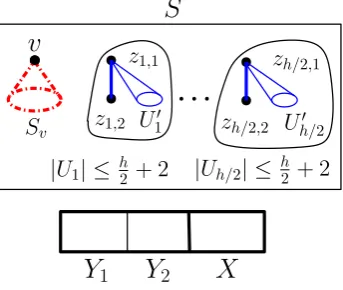
h+ 1≤ |S| ≤h2, containing Sv as follows. In Case 1, letSu be anh-star centred atu inGnim2
(u andv are not necessarily distinct). Define S=V(Sv)∪V(Su) withh+ 1≤ |S| ≤2h+ 2. In Case 2, let M ⊆Gnim2 be a matching with edge set{e1, . . . , eh/2}, where ei =zi,1zi,2 for every
1≤i≤h/2. Denote Z:=∪h/i=12{zi,1, zi,2}. For each edge ei ∈E(M), without loss of generality, assume thatdG2(zi,1)≥dG2(zi,2). Define iteratively for everyi= 1, . . . , h/2 a setU
0
i as follows,
(
Ui0⊆Wi, |Ui0|= h2, if|Wi| ≥h/2,
Ui0=Wi, otherwise,
where Wi := NG2(zi,1)\
Z∪∪ij−=11Uj0
; further define Ui := Ui0 ∪ {zi,1, zi,2}. Finally, set
S :=
∪h/i=12Ui
∪V(Sv). So h+ 1≤ |S| ≤h+ 1 + (h/2 + 2)·h/2≤h2.
We now define a partition ofV(G)\S that will be used in both Case 1 and Case 2. For each vertexw∈V(G)\S, denote byfw the functionS→[2] whose value ons∈S isfw(s) =φ(sw). In other words, fw encodes the colours of the edges from w toS. Define
Y1 := {v∈V(G)\S :|fv−1(2)|< h/2},
Y2 := {v∈V(G)\S :|fv−1(1)|< h/2},
X := V(G)\(S∪Y1∪Y2).
Claim 3.3. e(Gnim[X])≤h |S|
h/2
n.
Proof of Claim. Assume to the contrary that e(Gnimi [X]) ≥h h/|S2|
n/2, for some i∈[2]. Then there exists a vertex x∈ X withdGnim
i [X](x) ≥h
|S|
h/2
. By the definition of X, each vertex in
NGnim
i [X](x) has at least h/2 Gi-neighbours in S. By the Pigeonhole Principle, there exists a
copy of Kh,h/2 ⊆Gi[NGnim
i [X](x), S], which is a contradiction by Proposition 3.1(ii). Claim 3.4. |Y1|< h·2|S|.
Proof of Claim. Assume to the contrary that|Y1| ≥h·2|S|. Since the total number of functions
S → [2] is 2|S|, by averaging, there exists a function f and a subset Yf ⊆ Y1 with |Yf| ≥ h such that for all verticesy ∈Yf, the functionsf and fy are the same. By the definition of Y1,
there is a subsetI ⊆V(Sv)\ {v}with |I| ≥h/2 such that for alls∈I,f(s) = 1, i.e., all pairs betweenYf and I are of colour 1. Recall that Sv is theh-star consisting of NIM-i-edges, thus, there exists a copy ofKh/2,h ⊆G1[NGnim
1 (v), Yf], which contradicts Proposition 3.1(ii).
We now show thatY2has also to be small (given thatGnim2 contains a large star or matching),
otherwise nim(φ, H) is linear.
Case 1: Gnim2 has the starK1,h.
A similar argument as in Claim 3.4 (withSu playing the role ofSv) shows that|Y2|< h·2|S|.
Case 2: Gnim2 has the matching Mh/2.
By the definition of S, all the Ui’s are pairwise disjoint and h+ 1 ≤ |S| ≤ h2, see Figure 2. Suppose that |Y2| ≥h·2|S|. Again there exists a functionf :S →[2] with|f−1(1)|< h/2 and
X
Y
2Y
1 U0Uh=0 2 z
z 2
zh= 2
zh= 22
jUj h
2 2 jUh=2j
h
2 2
v
[image:10.595.212.384.421.566.2]v
Figure 2: Case 2 of Lemma 3.2
a subsetYf ⊆Y2 with |Yf| ≥h, such that for all vertices y∈Yf,fy is the same as f. We will use the following claim.
Claim 3.5. For every 1≤i≤h/2, there existsw∈Ui such thatf(w) = 1.
Proof of Claim. For a fixed 1 ≤ i≤ h/2, assume to the contrary that for all s ∈ Ui, we have
f(s) = 2, i.e., E(G[Ui, Yf]) ⊆ E(G2). Thus, |NG2(zi,1)\(∪
i−1
j=1Uj0 ∪Z)| ≥ |Yf|. Consequently,
By Claim 3.5 together with the fact that the Ui’s are pairwise disjoint, f assumes value 1 at leasth/2 times, which contradicts Yf ⊆Y2. Therefore, in both cases, |Y2|< h·2|S|.
Let Y :=Y1∪Y2. Since|S| ≤h2, by Claims 3.3 and 3.4, we get that
nim(φ;H) ≤ e(Gnim[S]) +e(Gnim[S, V \S]) +e(Gnim[Y]) +e(Gnim[Y, X]) +e(Gnim[X])
≤ |S| ·n+|Y| ·n+e(Gnim[X])
≤ (h2+ 2·h2h2)n+h
h2 h/2
n < 22h2n,
a contradiction.
This completes the proof of Lemma 3.2.
3.1. Weakly-reducible bipartite graphs
Proof of Theorem 1.11. Let H be a weakly-reducible bipartite graph. Let h =v(H) and w ∈ V(H) be a vertex such that ex(n, H−w)<ex(n, H)−22h2nforn≥n0. In particular, we have
that ex(n, H) > 22h2n for n ≥n0. Thus by Lemma 3.2, we may assume that there is i ∈ [2]
such that e(Gnimi ) ≤ex(n,{K1,h, Mh/2}) ≤h2. By the symmetry between the two colours, let
us assume thati = 1. Suppose that E(Gnim1 ) 6=∅ as otherwise we are trivially done. We now distinguish the following two cases.
Case 1: For every edge e=uv ∈E(Gnim1 ), dG1(u)≤10h and dG1(v)≤10h.
In this case, pick one such edge, e = uv, and define V1 = (NG1(u)∪NG1(v))\ {u, v}. So
|V1| ≤dG1(u) +dG1(v)≤20h. Let
V2 :=V(G)\(V1∪ {u, v}) =NG2(u)∩NG2(v).
Note that the subgraph of Gnim2 induced on vertex setV2 satisfiese(Gnim2 [V2])≤ex(n, H−w).
Otherwise, a copy of H−w inGnim2 [V2] together withu forms a copy of H in colour 2. Recall
that |V1| ≤ 20h,e(Gnim1 )≤h2 and V1∪V2∪ {u, v} is a partition of V(G). Therefore for large
n, we have
nim(ψ;H) ≤ e(Gnim2 ) +e(Gnim1 ) ≤ e(Gnim2 [V2]) + (|V1|+ 2)n+h2 (3.1)
≤ ex(n, H−w) + 30hn ≤ ex(n, H)−22h2n+ 30hn < ex(n, H).
Case 2: There exists an edgee=uv∈E(Gnim1 ) such thatdG1(u)≥10h.
Pick A⊆NG1(u) with |A|= 10h, and denote
X := {z∈V(G)\(A∪ {u, v}) :dG2(z, A)≥h},
Y := {z∈V(G)\(A∪ {u, v}) :dG1(z, A)≥h} \X.
Note thatX∪Y ∪A∪ {u, v} is a partition ofV(G). We will use the following claims.
Claim 3.6. For every vertexw∈X∪Y,dGnim
2 (w, X)< h
10h h
.
Proof of Claim. Assume to the contrary that there exists a vertexw∈X∪Y withdGnim
2 (w, X)≥
h 10hh, and define S := NGnim
2 (w, X). Since |A|= 10h and vertices inS all have G2-degree at
leasth in A, there exists a subset ofS of size at least h such that its vertices are connected in
G2 to the same hvertices inA, i.e., Kh,h⊆G2[S, A], which contradicts Proposition 3.1(ii).
Define Y0 = Y ∩NG1(v) to be the set of all vertices in Y that are adjacent to v with a
Claim 3.7. |Y0|< 10hh
h.
Proof of Claim. Assume to the contrary that |Y0| ≥ 10hh
h. Since all vertices in Y0 have at leasth G1-neighbours inA, there exists a copy of Kh,h⊆G1[Y0, A], which extends to a copy of
Kh+1,h+1 ⊇H containing the edgeuv ∈E(Gnim1 ), a contradiction.
By Claims 3.6, 3.7 and since |A|= 10h, the number of edges in Gnim2 with at least one end point in the set A∪Y0∪X∪ {u, v} is at most 3h 10hh
n. It remains to estimate e(Gnim2 [Y00]). We claim that e(Gnim2 [Y00])≤ex(n, H−w). Otherwise, since all the edges connecting v toY00
have colour 2, we can extend the copy of H−w⊆Gnim2 [Y00] to a copy of H by adding v. This contradicts the definition of Gnim2 . Hence,
nim(ψ;H) = e(G2nim) +e(Gnim1 )≤ 3h
10h
h
n+ ex(n, H−w) +h2
< ex(n, H)−22h2n+ 4h
10h
h
n < ex(n, H).
Thus, any colouring with NIM-edges of two different colours is not extremal.
3.2. General bipartite graphs
In this subsection, we will prove Theorems 1.12 and 1.13.
Proof of Theorem 1.12. AsHcontains a cycle, ex(n, H)/n→ ∞asn→ ∞. Then by Lemma 3.2, we may assume that, for example,Gnim1 is {K1,h, Mh/2}-free. SinceGnim2 is H-free, we
immedi-ately get that
nim2(n, H)≤ex(n, H) + ex(n,{K1,h, Mh/2})≤ex(n, H) +h2,
as desired.
Proof of Theorem 1.13. Let us first present the part of the proof which works for an arbitrary number of colours kand any forest T. Leth=v(T).
The stated lower bound on nimk(n;T) can be obtained by using the argument of Ma [33]. Fix some maximumT-free graphHon [n] and take uniform independent permutationsσ1, . . . , σk−1
of [n]. Iteratively, for i = 1, . . . , k − 1, let the colour-i graph Gi consists of those pairs
{σi(x), σi(y)}, xy ∈ E(H), that are still uncoloured. Finally, colour all remaining edges with colour k. Clearly, all edges of colours between 1 and k − 1 are NIM-edges. Since
e(H)≤hn=O(n), the expected size of Pki=1−1e(Gi) is at least
(k−1)e(H)−
k−1 2
e(H)2
n
2 −1
≥(k−1)ex(n, T)−k2h2.
By choosing the permutations for which Pki=1−1e(Gi) is at least its expectation, we obtain the required bound.
Let us turn to the upper bound. Fix an extremal G with colouring φ : [n2] → [k], so nimk(φ;T) = nimk(n;T). For every 1≤i≤k, denote
Ai :={v∈V(G) :∃u∈V(G), uv∈E(Gnimi )} and ai:=|Ai|.
In other words,Ai is the set of all vertices incident with at least onei-coloured NIM-edge. Note that
nimk(φ;T)≤
k X
i=1
Also, for every X⊆[k], define
BX :={v∈V(G) :v ∈Ai ⇔i∈X}=∩i∈XAi\(∪j /∈XAj) and bX :=|BX|.
In other words, BX is the set of vertices which are incident with edges in Gnimi if and only if
i∈X. By definition, for two distinct subsets X, Y ⊆[k],BX∩BY =∅.
Claim 3.8. For every two subsetsX, Y ⊆[k] withX∪Y = [k], min{bX, bY}<6kh.
Proof of Claim. Assume on the contrary that there exist two subsets X, Y ⊆ [k] such that
X∪Y = [k] and bX, bY ≥6kh. LetB0X ⊆BX and BY0 ⊆BY be such that |B0X|=|BY0 |= 6kh. By averaging, some colour, say colour 1, contains at least 1/kproportion of edges inG[BX0 , BY0 ]. SetF =G1[BX0 , BY0 ]. Then there exists F0 ⊆F on vertex set BX00 ∪BY00, where BX00 ⊆BX0 and
BY00 ⊆B0Y, such that the minimum degree ofF0 is at least half of the average degree ofF, that is,
δ(F0)≥ e(F) |V(F)|≥
|BX0 | · |BY0 | k·(|B0X|+|BY0 |) =
(6kh)2
k·12kh = 3h.
Let v ∈ V(T) be a leaf, u be its only neighbour, and T0 := T −v, where T −v is the forest obtained from deleting the leaf v from T. Since X∪Y = [k], without loss of generality, we can assume that 1∈X. Fix an arbitrary vertex x ∈B00X and let w be a Gnim1 -neighbour ofx. (Such a vertex exists as x ∈ B00X ⊆ BX and 1 ∈ X.) Then δ(F0−w) ≥δ(F0)−1 ≥ 2h. We can then greedily embed T0 in F0 −w with x playing the role of u. As this copy of T0 is in
F0−w ⊆ G1, together with xw ∈ Gnim1 , we get a monochromatic copy of T with an edge in
Gnim, a contradiction (see Figure 3).
n
w
g
T
Y
[image:13.595.240.356.420.523.2]x
w
Figure 3: Finding a copy ofT ∈G1.
We will divide the rest of the proof into two cases.
Case 1: There exists a subsetX ⊂[k] such that|X|=k−1 andbX ≥6kh.
Let {j} = [k]\X, and Y be the collection of all subsets of [k] containing j. By Claim 3.8,
bY <6kh, for every set Y ∈ Y, implying thataj = P
Y∈YbY <2k·6kh. Hence, by (3.2),
nimk(φ;T) ≤ X
i∈[k]
ex(ai, T) ≤ X
i∈[k]\{j}
ex(ai, T) + ex(2k·6kh, T)
≤ (k−1)ex(n, T) + 2k·6kh2.
Thus the theorem holds in this case.
By Claim 3.8, we haveb[k]≤2·6kh. Hence, all but at most (k+ 2)6khvertices are adjacent to
NIM-edges with at most k−2 different colours, which implies that they are in at most k−2 different sets Ai. Therefore,
a1+· · ·+ak≤(k−2)n+ 12(k+ 2)kh. (3.3)
Now our analysis splits further, depending on the cases of Theorem 1.13. If k= 2, then we are done by (3.2) and (3.3):
nim2(φ;T)≤h(a1+a2)≤96h2 ≤ex(n, T).
Thus it remains to consider the case when k ≥ 3 and T is a tree. By taking the disjoint union of two maximum T-free graphs, we see that the Tur´an function of T is superadditive, that is,
ex(`, T) + ex(m, T)≤ex(`+m, T), for any`, m∈N. (3.4)
The Fekete Lemma implies that ex(m, T)/mtends to a limitτ. Since, for example, ex(m, T)≤ hm, we have thatτ ≤h, in particular, τ is finite. Also, excluding the caseT =K2 when the
theorem trivially holds, we have τ > 0. In particular, |ex(m, T)/m−τ| < c for all large m, wherec:=τ /(3k−4)>0 satisfies (τ +c)(k−2) = (k−1)(τ−2c).
Thus (3.2), (3.3), (3.4) and the fact that nis sufficiently large give that
nimk(φ;T) ≤ ex(a1+· · ·+ak, T) ≤ ex((k−2)n+ 12(k+ 2)kh, T)
≤ (τ+c) (k−2)n+ 12(k+ 2)kh ≤ (k−1)(τ−2c)n+ 24(k+ 2)kh2 ≤ (k−1)(τ −c)n≤(k−1)ex(n, T).
This finishes the proof of Theorem 1.13.
4. Proofs of Theorems 1.5 and 1.6
We need the following lemma, which states that the reduced graph of the NIM-graph cannot have a large clique, linking the nim function to the new Ramsey variant r∗.
Lemma 4.1. Fori∈[k], letHi be a non-bipartite graph, and let1/k,1/r≥γ ε1/N >0,
where r :=R(a1−1, . . . , ak−1) and ai := χ(Hi). Let V1, . . . , Vm be disjoint sets, each of size
at least N. Take any φ: V2→ [k], whereV :=V1∪ · · · ∪Vm, and let Gnim be the NIM-graph
of φ. Then the graphR:=R(ε, γ, φ|E(Gnim),(Vi)im=1) isKr∗+1-free, where r∗ :=r∗(H1, . . . , Hk).
Proof. Given the graphsHi withai =χ(Hi), andr=R(a1, . . . , ak), choose additional constants so that the following hierarchy holds:
1
r γ ε1
1
M ε
1
N >0.
Let theVi’s andφbe as in the statement of the lemma. For eachi∈[m], apply the Multicolour Regularity Lemma (Lemma 2.3) with constants ε1 and 1/ε1 to the k-coloured complete graph
on Vi to obtain an ε1-regular partition Vi = Ui,1 ∪ · · · ∪Ui,mi with 1/ε1 ≤ mi ≤ M. Let
Ri :=R(ε1, γ, φ|(Vi 2)
,(Ui,j)mj=1i ) be the associated reduced graph.
Note that the fraction of the elements xy ∈ Vi
2
with x ∈ Ui,a and y ∈ Ui,b such that the pair (Ui,a, Ui,b) is not ε1-regular in some colour or satisfies a =b is at most ε1+ 1/mi. Since
γ ≤1/k, the remaining elements of Vi
2
come from edges ofRi. Recall that mi =v(Ri). Thus, we have that
e(Ri)≥
(1−ε1−1/mi) |V2i|
d |Vi|/mie2
≥(1−2ε1)
mi 2
Letξ :E(R)→[k] be the colouring ofR. We extend it to the vertices of Ras follows. Take
i ∈ [m]. Let ξi : E(Ri) → [k] be the colouring of Ri. By (4.1) and since v(Ri) ≥ 1/ε1 and
ε1 1/r, we have that e(Ri) > ex(mi, Kr). By Tur´an’s theorem [48], the graph Ri contains an r-clique. By the definition of r, the restriction of the k-edge-colouring ξi to this r-clique contains a colour-p copy ofKap−1 for somep∈[k]. Let ξ assign the colour ptoVi.
Suppose to the contrary that some (r∗ + 1)-set A spans a clique in R. The restriction of
ξ to ≤A2 violates either (P1) or (P2) from Definition 1.3. We will derive contradictions in both cases, thus finishing the proof. Ifξcontains an edge-monochromatic homomorphic copy of someHi in colour i∈[k], then by the Embedding Lemma (Lemma 2.4) the colour-isubgraph ofGnim contains a copy ofHi, a contradiction toGnimconsisting of the NIM-edges. So suppose that (P2) fails, say, some pair ViVj ∈ A2
satisfies ξ(ViVj) = ξ(Vi), call this colour p. By the definition of ξ(Vi), Ri contains an (ap −1)-clique of colour p under ξi, say with vertices
U1, . . . , Uap−1 ∈ V(Ri). Observe that ε1 ≥ max{2ε, εM} ≥ max{2ε, ε·v(Ri)} and p is the
majority colour on edges inGnim[Vi, Vj]. The Slicing Lemma (Lemma 2.5) with e.g. α:= 1/M gives that each pair (Vj, Uh) with h ∈ [ap −1] is (ε1, γ/2)-regular in Gnimp . The Embedding Lemma (Lemma 2.4) gives a copy of Hp in G containing at least one (in fact, at least δ(Hp)) edges ofGnim[Vi, Vj], a contradiction.
Proof of Theorem 1.5. For the upper bound, let 1εγ ε1>0. Letn be large and
sup-pose to the contrary that there exists some colouringφ:E(Kn)→[k] that violates (1.4). Apply the Multicolour Regularity Lemma (Lemma 2.3) to the NIM-graphGnim ofφwith parameters
ε1 and 1/ε1. A calculation similar to the one in (4.1) applies here, where additionally one has
to discard at most kγ n2
edges in NIM(φ) coming from pairs that have density less than γ in each colour. Byγ ε, we conclude that the reduced graphR=R(ε1, γ, φ|E(Gnim)) ofGnim has
at least (1−1/r∗+ε/2)v(R2)2 edges. By Tur´an’s theorem,Kr∗+1 ⊆R, contradicting Lemma 4.1.
For the lower bound, take a feasible k-colouring ξ of [≤r∗2]
, where r∗ := r∗(H1, . . . , Hk). If possible, among all such colourings take one such that all singletons have the same colour. Consider the blow-up colouring φ := ξ(X1, . . . , Xr∗) where the sets Xi form an equipartition
of [n].
Let us show that every edge ofK[X1, . . . , Xr∗] is a NIM-edge. Take any copyF ofHi which is i-monochromatic in φ. Since the restriction of ξ to [r2∗] has no homomorphic copy of Hi by (P1), the graph F must use at least one edge that is inside someVj. If ξ assigns the value
i only to singletons, then no edge of the colour-i graph F can be a cross-edge. Otherwise, if
F is connected, then E(F) ⊆ Vj
2
because no edge between Vj and its complement can have
φ-colouriby (P2). We conclude that every cross-edge is a NIM-edge, giving the required lower bound.
Proof of Theorem 1.6. Choose εε1 δ γ ε2 1/n >0. Letφ be as in the theorem.
Apply the Regularity Lemma (Lemma 2.3) to NIM-graph Gnim with parameters ε
2 and 1/ε2
to get an ε2-regular partition V(Gnim) = V1∪ · · · ∪Vm. Let R = R(ε2, γ, φ|E(Gnim),(Vi)mi=1)
be the reduced graph. A similar calculation as in (4.1) yields that e(R) ≥ 1−r1∗ −2δ
m2
2 .
On the other hand, by Lemma 4.1, R is Kr∗+1-free. Thus, the Erd˝os-Simonovits Stability
Theorem [11, 42] implies thatδedit(R, T(m, r∗))≤ε1m2/2. Let a partitionV(R) =U1∪· · ·∪Ur∗
minimise |E(R)4E(K[U1, . . . ,Ur∗])|. We know that the minimum is at most ε1m2/2. Let
V(Gnim) = W1 ∪ · · · ∪ Wr∗ be the partition induced by Ui’s, i.e., Wi := ∪V
j∈UiVj for i ∈
[r∗]. Let G0 be the graph obtained from Gnim by removing all edges that lie in any cluster
Vi; or between those parts Vi and Vj such that ViVj is not an ε2-regular pair or belongs to
E(R)4E(K[U1, . . . ,Ur∗]). We have
|E(Gnim)4E(G0)|=|E(Gnim)\E(G0)| ≤m·(n/m)
2
2 +ε2m
2·n2
m2+|E(R)4E(T(m, r ∗
))|·n
2
As e(Gnim) ≥ (1−1/r∗)n2/2−δn2, we have e(G0) ≥ (1−1/r∗)n2/2−2ε1n2. Since G0 is
r∗-partite (with parts W1, . . . , Wr∗), a direct calculation gives that δedit(G0, T(n, r∗))≤εn2/2.
Finally, we obtain
δedit(Gnim, T(n, r∗))≤ |E(Gnim)4E(G0)|+δedit(G0, T(n, r∗))≤ε1n2+
εn2
2 ≤εn
2,
as desired.
5. Proof of Theorem 1.7
The following lemma will be useful in the forthcoming proof of Theorem 1.7. It is proved by an easy modification of the standard proof of Ramsey’s theorem.
Lemma 5.1 (Partite Ramsey Lemma). For every triple of integers k, r, u ∈ N there is ρ =
ρ(k, r, u) such that if φ is a k-edge-colouring of the complete graph on Y1 ∪ · · · ∪Yr, where
Y1, . . . , Yr are disjointρ-sets, then there are u-sets Ui ⊆Yi,i∈[r], and ξ: ≤[r2]
→[k]such that
ξ(U1, . . . , Ur) ⊆φ. (In other words, we require that each U2i
and each bipartite graph [Ui, Uj]
is monochromatic.)
Proof. We use induction on r with the case r = 1 being the classical Ramsey theorem. Let
r ≥2 and set N := (u−1)kr+ 1. We claim that ρ:= (2k)Nρ(k, r−1, u) suffices here. Let ξ
be an arbitrary k-edge-colouring of the complete graph onY1∪ · · · ∪Yr where each|Yi|=ρ. Informally speaking, we iteratively pick vertices x1, . . . , xN in Yr shrinking the parts so that each new vertex xi is monochromatic to each part. Namely, we initially let Ui0 := Yi for
i ∈ [r]. Then for i = 1, . . . , N we repeat the following step. Given vertices x1, . . . , xi−1 and
setsUi−1
r ⊆Yr\ {x1, . . . , xi−1} and Uji−1 ⊆Yj for j ∈[r−1], we let xi be an arbitrary vertex of Uri−1 and, for j ∈ [r], let Uji be a maximum subset of Uji−1 such that all pairs between xi and Ui
j have the same colour, which we denote by cij ∈[k]. Clearly,|Uji| ≥(|Ui
−1
j | −1)/k (the
−1 term is needed for j =r), which is at least (2k)N−i by a simple induction on i. Thus we can carry out all N steps. Moreover, each of the the final sets U1N, . . . , UrN−1 has size at least
ρ/(2k)N =ρ(k, r−1, u). By the induction assumption, we can findu-setsUj ⊆UjN,j∈[r−1], and ξ: [r≤−21]→[k] withξ(U1, . . . , Ur−1)⊆φ.
Each selected vertex xi comes with a colour sequence (ci1, . . . , cir) ∈ [k]r. So we can find a set Ur ⊆ {x1, . . . , xN} of dN/kre=u vertices that have the same colour sequence (c1, . . . , cr).
Clearly, all pairs in Ur
2
(resp. [Ur, Uj] for j∈[r−1]) have the same colourcr (resp.cj). Thus if we extend the colouring ξ to ≤[r2] by lettingξ(i, r) :=ci fori∈[r−1] and ξ(r) := cr, then
ξ(U1, . . . , Ur)⊆φ, as required.
The main step in proving Theorem 1.7 is given by the following lemma.
Lemma 5.2. Under the assumptions of Theorem 1.7, there is n0 such that if φ is an arbitrary
k-edge-colouring of G:=Kn with n≥n0,e(Gnim)≥t(n, r∗) and
δ(Gnim)≥δ(T(n, r∗)), (5.1)
where δ denotes the minimum degree, then Gnim ∼=T(n, r∗) (in particular, e(Gnim) =t(n, r∗)).
Proof. Let Hi,i∈[k], and r∗ be as in Theorem 1.7. Sor∗ =r∗(H1, . . . , Hk). Let
N := max
i∈[k]v(Hi)
−1≥1 and 1εε1 1/n0 >0.
Let P ={V1, . . . , Vr∗} be a max-cutr∗-partition of Gnim. In particular, for every i, j∈[r∗]
and every v ∈ Vi, we have dGnim(v, Vj) ≥ dGnim(v, Vi). By applying Theorem 1.6 to Gnim, we
have
e(Gnim[P])≥t(n, r∗)−ε1n2. (5.2)
A simple calculation shows that |Vi|= rn∗ ± 3
√
ε1nfor all i∈[r∗].
Claim 5.3. For everyi∈[r∗] andv∈Vi,dGnim(v, Vi)≤εn.
Proof of Claim. Assume to the contrary that there existi∈[r∗] andv∈Visuch thatdGnim(v, Vi)>
εn. For eachj ∈[r∗], asP is a max-cut, there exists a colour `∈[k] such that
dGnim
` (v, Vj)≥dGnim(v, Vj)/k≥dGnim(v, Vi)/k≥εn/k=:m.
So, forj ∈[r∗], let Zj ⊆NGnim
` (v, Vj) be any subset of size m. We have
e(Gnim[Z
1, . . . , Zr∗])≤e(Gnim[V1, . . . , Vr∗]) (5.2)
≤ ε1n2. (5.3)
Let ρ := ρ(k, r∗, N), where ρ is the function from the Partite Ramsey Lemma (Lemma 5.1). Fori∈[r∗], let Yi be a randomρ-subset ofZi, chosen uniformly and independently at random. By (5.3), the expected number of missing cross-edges in Gnim[Y1, . . . , Yr∗] is at most
ε1n2
m−1
ρ−1
.
m ρ
2
=ε1
ρk ε
2
<1.
Thus there is a choice of theρ-sets Yi’s such thatGnim[Y1, . . . , Yr∗] has no missing cross-edges.
By the definition ofρ, there are N-sets U1 ⊆Y1, . . . , Ur∗ ⊆Yr∗ and a colouringξ : [r ∗] ≤2
→ [k] such thatξ(U1, . . . , Ur∗)⊆φ.
Note that ξ is feasible. Indeed, if we have, for example, ξ(ij) = ξ(i) =:c, then by taking one vertex of Uj and all N vertices of Ui we get a colour-c copy of KN+1. However, since
N + 1≥ v(Hc), every edge of this clique is in an Hc-subgraph, contradicting the fact that all pairs in the complete bipartite graphK[Ui, Uj] are NIM-edges.
Consequently, as (H1, . . . , Hk) is nice, ξ must assign the same colour to all singletons, say colour 1. By construction, the vertex v is monochromatic into each Zi ⊇Ui. So we can take
ξ0 : [r∗≤+1]2 → [k] such that ξ0(U1, . . . , Ur∗,{v}) ⊆φ, where we additionally letξ0(r∗+ 1) := 1.
As r∗ = r∗(H1, . . . , Hk), the colouring ξ0 violates (P1) or (P2). This violation has to include the vertex r∗+ 1 since the restriction of ξ0 to [≤r∗2]is the feasible colouring ξ. We cannot have
i∈[r∗] withξ0(i, r∗+ 1) = 1 because otherwise Ui∪ {v} is an (N+ 1)-clique coloured 1 under
φ, a contradiction to all pairs betweenZi⊇Ui and v being NIM-edges. Therefore, there exists an edge-monochromatic homomorphic copy of Hj of colour j, say F, with r∗+ 1∈V(F). By the definition of homomorphism-criticality, there exists a homomorphism g : V(Hj) → V(F) such that |g−1(r∗ + 1)| = 1. Therefore, we can find an edge-monochromatic copy of Hj in colourj, withg−1(r∗+ 1) mapped to v, and all the other vertices of Hj mapped to vertices in
U1∪. . .∪Ur∗, a contradiction to all pairs between this set and v being NIM-edges.
We next show that all pairs inside a part get the same colour under φ.
Claim 5.4. For anyp∈[r∗] and any u1u2, u3u4 ∈ V2p
, we have φ(u1u2) =φ(u3u4).
Proof of Claim. Suppose on the contrary that u1, . . . , u4 ∈ Vp violate the claim. Without loss of generality, let p = r∗. Let U := {u1, . . . , u4}. By (5.1), Claim 5.3 and the fact that
|Vr|=n/r± 3
√
ε1n, all but at most 2εn edges from anyu∈Vr∗ toV \Vr∗ are NIM-edges. For
with the same colour pattern to U, i.e., for allx, x0 ∈Zi and j∈[4] we have φ(ujx) =φ(ujx0). By the Pigeonhole Principle, we have for i∈[r∗−1] that
|Zi| ≥
| ∩4
j=1NGnim(uj, Vi)|
k4 ≥
|Vi| −4·2εn
k4 ≥
n
2r∗k4.
Also,|Zr∗| ≥(|Vr∗| −4)/k4 ≥n/(2r∗k4).
Similarly to the calculation after (5.3), there are N-subsets Ui ⊆ Zi, i∈ [r∗], such that φ contains the blow-up ξ(U1, . . . , Ur∗) of some ξ : [r
∗] ≤2
→[k]. As in the proof of Claim 5.3, ξ is feasible and assigns the same colour, say 1, to all singletons. Since φ(u1u2)6=φ(u3u4), assume
that e.g.φ(u1u2)6= 1.
We define the colouring ξ0 : [r∗≤+1]2
→ [k] so that ξ0(U1, . . . , Ur∗−1,{u1},{u2}) ⊆φ, where
additionally we let both ξ0(r∗) and ξ0(r∗+ 1) be 1. Note that ξ0(r∗, r∗+ 1) = φ(u1u2). Also,
observe that we do not directly use the part Ur∗ when defining ξ0: the role of this part was to
guarantee that ξ is monochromatic on all singletons. By the definition of r∗, the colouring ξ0
violates (P1) or (P2).
Suppose first thatξ0 violates (P2), that is there is a pairij ∈ [r∗2+1]
withξ0(ij) = 1. Since
ξ0(r∗, r∗+ 1) =φ(u1u2)6= 1, we have {i, j} 6={r∗, r∗+ 1}. Also, we cannot havei, j ∈[r∗−1],
because ξ0 coincides on [r∗≤−21]
with the feasible colouring ξ. So we can assume by symmetry that i∈[r∗−1] and j =r∗. However, then the vertexu1 is connected by NIM-1-edges to the
colour-1 clique on the N-setUi, a contradiction.
We may now assume that the colouring ξ0 violates (P1). Let this be witnessed by an edge-monochromatic homomorphic copy of Hj of colour j, say F. If F contains exactly one vertex from{r∗, r∗+ 1}, then by an argument similar to the last part of the proof of Claim 5.3 we get a contradiction. Otherwise, if {r∗, r∗+ 1} ⊆V(F), then, by the definition of homomorphism-critical, there exists a homomorphismg:V(Hj)→V(F) such that|g−1(r∗)|=|g−1(r∗+1)|= 1. Therefore, we can find an edge-monochromatic copy of Hj in colour j, with g−1(r∗) (resp.
g−1(r∗+ 1)) mapped to u1 (resp. u2), and all the other vertices of Hj mapped to vertices in
U1∪. . .∪Ur∗−1, a contradiction to all pairs between this set and{u1, u2}being NIM-edges.
Let i ∈ [r∗]. By Claim 5.4 we know that G[Vi] is a monochromatic clique. Since |Vi| ≥ maxj∈[k]v(Hj), no pair inside Vi is a NIM-edge. Thus Gnim is r∗-partite. Our assumption
e(Gnim)≥t(n, r∗) implies that Gnim is isomorphic to T(n, r∗), as desired.
We are now ready to prove the desired exact result.
Proof of Theorem 1.7. We know by Theorem 1.5 that nim(n;H1, . . . , Hk)≥t(n, r∗) for all n.
On the other hand, let n0 be the constant returned by Lemma 5.2. Let n≥ n20 and let ψ
be an extremal colouring ofG:= Kn. In order to finish the proof of the theorem it is enough to show that necessarily Gnim ∼=T(n, r∗).
Initially, let i= n, Gn := G and φn := ψ. Iteratively repeat the following step as long as possible: if the NIM-graph of φi has a vertexxi of degree smaller thanδ(T(i, r∗)), let φi−1 be
the restriction of φi to the edge-set of Gi−1 :=Gi−xi and decrease iby 1. Suppose that this procedure ends with Gm and φm.
Note that, for every i∈ {m+ 1, . . . , n}, we have that
t(i−1, r∗) = t(i, r∗)−δ(T(i, r∗)),
nim(φi−1) ≥ nim(φi)−δ(T(i, r∗)) + 1,
the latter inequality following from the fact that every NIM-edge of φi not incident to xi is necessarily a NIM-edge of φi−1. These two relations imply by induction that
In particular, it follows that m > n0 for otherwise NIM(φn0) is a graph of order n0 with at
least n−n0 > n20
edges, which is impossible. Thus Lemma 5.2 applies to φm and gives that NIM(φm)∼=T(m, r∗). By (5.4) we conclude thatm=n, finishing the proof of Theorem 1.7.
6. Proofs of Theorems 1.8 and 1.9
Next we will show that Conjecture 1.4 holds for the 3-colour case.
Proof of Theorem 1.8. Take an arbitrary feasible 3-colouringξ of ≤[r2]
, wherer=R(a2, a3)−1.
It suffices to show thatξassigns the same colour to all the singletons in [r]. Indeed, suppose that (Ka1, Ka2, Ka3) is not nice. Suppose first that there exists a feasible 3-colouringξ
∗ of [r∗] ≤2
that is not monochromatic on the singletons in [r∗], where r∗ := r∗(Ka1, Ka2, Ka3) ≥ r. Up
to relabeling, we may assume that [r] contains two singletons of different colours in ξ∗. We then arrive to a contradiction, as the restriction of ξ∗ on [r] is also feasible. Otherwise take an arbitrary feasible colouring ξ∗ of [≤r∗2]
such that ξ∗ is monochromatic on singletons, say in colour i. Then due to (P2), colour i cannot appear on [r2∗], and so r∗ ≤ R(aj, ak)−1 ≤ r, where{j, k}= [3]\ {i}. Thus r∗ =r and sinceξ∗ was arbitrary, the triple (Ka1, Ka2, Ka3) has
to be nice.
For i ∈ [3], let Vi be the set of vertices with colour i with respect to ξ. Thus we have a partition [r] =V1∪V2∪V3. Fori, j∈[3], letωj(Vi) be the size of the largest edge-monochromatic clique of colour j inVi.
Observe the following properties that hold for every triplei, j, `∈[3] of distinct indices, i.e., for{i, j, `}= [3]. By (P2), the colour of every edge insideVi is either j or`while all the edges going between Vj and V` have colour i. By the latter property and (P1), we have
ωi(V`) +ωi(Vj)≤ai−1 and Vj 6=∅ ⇒ ωi(V`)≤ai−2. (6.1)
For notational convenience, define r(n1, . . . , nk) := R(n1, . . . , nk)−1 to be one less than
the Ramsey number (i.e. it is the maximum order of a clique admitting a (Kn1, . . . , Knk)-free
edge-colouring). By the definition ofωj(Vi), we also have
|Vi| ≤r(ωj(Vi) + 1, ω`(Vi) + 1). (6.2)
Also, we will use the following trivial inequalities involving Ramsey numbers that hold for arbitrary integersa, b, c≥2: r(a, b) +r(a, c)≤r(a, b+c−1) andr(a, b)< r(a+ 1, b).
First, let us derive the contradiction from assuming that each colour i∈ [3] appears on at least one singleton, that is, each Vi is non-empty. In order to reduce the number of cases, we allow to swap colours 1 and 2 to ensure that ω1(V2) ≥ω2(V1). Thus we do not stipulate now
which ofa1 anda2 is larger. Observe that
|V1|+|V2| (6.2)
≤ r(ω2(V1) + 1, ω3(V1) + 1) +r(ω1(V2) + 1, ω3(V2) + 1)
≤ r(ω1(V2) + 1, ω3(V1) + 1) +r(ω1(V2) + 1, ω3(V2) + 1)
≤ r(ω1(V2) + 1, ω3(V1) +ω3(V2) + 1) (6.1)
≤ r(ω1(V2) + 1, a3). (6.3)
Hence, we get
r = |V1|+|V2|+|V3|
(6.2),(6.3)
≤ r(ω1(V2) + 1, a3) +r(ω1(V3) + 1, ω2(V3) + 1) (6.1)
≤ r(ω1(V2) + 1, a3) +r(ω1(V3) + 1, a2−1)
< r(ω1(V2) + 1, a3) +r(ω1(V3) + 1, a3)
≤ r(ω1(V2) +ω1(V3) + 1, a3) (6.1)
The above contradiction shows that, for some`∈[3], the partV`is empty. Let{i, j, `}= [3]; thus [r] =Vi∪Vj. It remains to derive a contradiction by assuming that each of Vi and Vj is non-empty. By the symmetry between iand j, we can assume thatωj(Vi) ≥ωi(Vj). Then we have
r=|Vi|+|Vj|
(6.2)
≤ r(ωj(Vi) + 1, ω`(Vi) + 1) +r(ωi(Vj) + 1, ω`(Vj) + 1)
≤ r(ωj(Vi) + 1, ω`(Vi) + 1) +r(ωj(Vi) + 1, ω`(Vj) + 1)
≤ r(ωj(Vi) + 1, ω`(Vi) +ω`(Vj) + 1)
(6.1)
≤ r(aj−1, a`) < r(aj, a`) ≤ r,
which is the desired contradiction that finishes the proof of Theorem 1.8.
Next, let us present the proof thatr∗(3,3,3,3) = 16, the only non-trivial 4-colour case that we can solve.
Proof of Theorem 1.9. Let ξ : [16]≤2 → [4] be an arbitrary feasible colouring. It is enough to show that all singletons in [16] get the same colour. For every i ∈ [4], let Vi denote the set of vertices of colour i. Suppose there are at least two different colours on the vertices, say V3, V4 6= ∅. As 5 does not divide 16, there exists at least one class, say V3, of size not
divisible by 5, i.e., |V3| 6≡0 (mod 5). Choose an arbitrary vertex v ∈V4. Sinceξ is a feasible
colouring, by (P2) the edges incident to v cannot have colour ξ(v) = 4. We can then partition [16]\ {v} =∪j∈[3]Wj, where Wj := {u : ξ(uv) =j}. Let j ∈ [3]. By (P1) and (P2), colourj is forbidden in Wj
≤2
. Then by Theorem 1.8, |Wj| ≤ r∗(K3, K3, K3) = R(3,3)−1 = 5. Since
P
j∈[3]|Wj|= 15, we have that|Wj|= 5 for everyj∈[3]. Again by Theorem 1.8, all vertices in
Wj should have the same colour. Recall that v ∈V4, so V3 ⊆ ∪j∈[3]Wj and consequentlyV3 is
the union of someWj’s. This contradicts |V3| 6≡0 (mod 5).
7. Concluding remarks
• As pointed out by a referee, the function nim(n;H1, . . . , Hk) is related to that of exr(n;H1, . . . , Hr), which is the maximum size of an n-vertex graph G that can be r-edge-coloured so that
thei-th colour isHi-free for all i∈[r]. Indeed, we have the following lower bound:
nim(n;H1, . . . , Hk)≥max i∈[k] ex
k−1(H
1, . . . , Hi−1, Hi+1, . . . , Hk).
It is not inconceivable that the equality holds above ifn≥n0(H1, . . . , Hk). Theorems 1.7 and 1.11 give classes of instances, when we have equality above. We refer the readers to Section 5.3 of [25] for more on the function exr.
• The Ramsey variant r∗ introduced here is related to the version of Ramsey numbers studied by Gy´arf´as, Lehel, Schelp and Tuza [24]. In particular, Proposition 5 in [24] states that r∗(K3, K3, K3, K3) = 16, which is the consequence of the fact that (K3, K3, K3, K3)
is nice from Theorem 1.9.
• We prove in Theorem 1.13 that for any treeT, nimk(n;T) = (k−1)ex(n, T)+OT(1). LetT be an (h+ 1)-vertex tree and suppose that the Erd˝os-S´os conjecture holds, i.e. ex(n, T)≤
fi : V(F) → [n], i ∈ [k−1], be k−1 arbitrary injective maps and let Fi be the graph obtained by mappingF on [n] via fi. It suffices to show that we can modifyfi’s to have
E(Fi)∩E(Fj) = ∅ for any ij ∈ [k−21]
. Indeed, then the lower bound is witnessed by colouring e ∈ E(Kn) with colour-i if e ∈ E(Fi), for each i ∈ [k−1], and with colour-k otherwise. Suppose that there is a “conflict” uv ∈ E(Fi)∩E(Fj). Let F∗ :=∪i∈[k−1]Fi. Note that ∆(F∗) ≤ (k−1)(h−1). As n > ∆(F∗)2 + 1, there exists a vertex w that is at distance at least 3 from v. We claim that switching v and w in fi will remove all conflicts atv and w. If true, one can then repeat this process till all conflits are removed to get the desired fi’s. Indeed, suppose that after switchingv and w, there is a conflict
wz ∈E(Fi)∩E(F`) for some z ∈NFi(v) and`∈[k−1]\ {i}. Then w, z, v form a path
of length 2 inF∗, contradicting the choice ofw.
It would be interesting to prove a matching upper bound, i.e. to show that
nimk(n;T) = (k−1)ex(n, T)
for every tree T and sufficiently large n. Note that equality above need not be true when T is a forest. Indeed, consider M2, the disjoint union of two edges. Recall that
ex(n, M2) = n−1. For any k ≥ 3 and n ≥ 4k, we have that nimk(n;M2) = (k−
1)ex(n, M2)−12(k−1)(k−2). Indeed, for anyk-edge-colouringφofKn, one colour class,
say colour-1, has size at least n2
/k ≥ 2(n−1). As every edge share endpoints with at most 2n−4 other edges, we see that every colour-1 edge is in a copy of M2. Thus,
nim(φ)≤exk−1(n, M2, . . . , M2) =Pki=0−2(n−1−i) = (k−1)ex(n, M2)−12(k−1)(k−2),
as desired.
Acknowledgement
We would like to thank the referees for pointing out a flaw in the original draft, and for their careful reading, which has greatly improved the presentation of this paper.
References
[1] S. A. Burr, P. Erd˝os, and L. Lov´asz,On graphs of Ramsey type, Ars Combinatoria1(1976), 167–190. [2] D. Conlon,On the Ramsey multiplicity of complete graphs, Combinatorica32(2012), 171–186.
[3] D. Conlon, J. Fox, and B. Sudakov,An approximate version of Sidorenko’s conjecture, Geom. Func. Analysis 20(2010), 1354–1366.
[4] D. Conlon, J. Fox, and B. Sudakov,Recent developments in graph Ramsey theory, Surveys in combinatorics 2015, London Math. Soc. Lecture Note Ser., vol. 424, Cambridge Univ. Press, Cambridge, 2015, pp. 49–118. [5] D. Conlon, J. H. Kim, C. Lee, and J. Lee,Some advances on Sidorenko’s conjecture, E-print arxiv:1510.06533,
2015.
[6] D. Conlon and J. Lee,Finite reflection groups and graph norms, Adv. Math.315(2017), 130–165.
[7] J. Cummings, D. Kr´al’, F. Pfender, K. Sperfeld, A. Treglown, and M. Young,Monochromatic triangles in three-coloured graphs, J. Combin. Theory (B)103(2013), 489–503.
[8] P. Erd˝os,Some theorems on graphs, Riveon Lematematika9(1955), 13–17. [9] ,On a theorem of Rademacher-Tur´an, Illinois J. Math.6(1962), 122–127.
[10] ,On the number of complete subgraphs contained in certain graphs, Magyar Tud. Akad. Mat. Kutat´o Int. K¨ozl.7(1962), 459–464.
[11] , Some recent results on extremal problems in graph theory. Results, Theory of Graphs (Internat. Sympos., Rome, 1966), Gordon and Breach, New York, 1967, pp. 117–123 (English); pp. 124–130 (French). [12] P. Erd˝os,Some recent problems and results in graph theory, Discrete Math.164(1997), 81–85.
[13] P. Erd˝os, R. J. Faudree, and C. C. Rousseau,Extremal problems involving vertices and edges on odd cycles, Discrete Math.101(1992), 23–31.
[17] F. Franek and V. R¨odl, Ramsey problem on multiplicities of complete subgraphs in nearly quasirandom graphs, Graphs Combin.8(1992), 299–308.
[18] Z. F¨uredi,New asymptotics for bipartite Tur´an numbers, J. Combin. Theory (A)75(1996), 141–144. [19] Z. F¨uredi and Z. Maleki,The minimum number of triangular edges and a symmetrization method for multiple
graphs, Combin. Probab. Comput.26(2017), 525–535.
[20] Z. F¨uredi and M. Simonovits,The history of degenerate (bipartite) extremal graph problems, Erd¨os centennial, Bolyai Soc. Math. Stud., vol. 25, J´anos Bolyai Math. Soc., Budapest, 2013, pp. 169–264.
[21] G. Giraud,Sur le probl`eme de Goodman pour les quadrangles et la majoration des nombres de Ramsey, J. Combin. Theory (B)27(1979), 237–253.
[22] V. Gruslys and S. Letzter,Minimising the number of triangular edges, E-print arxiv:1605.00528; accepted byCombin. Probab. Comput., 2018.
[23] A. Grzesik, P. Hu, and J. Volec,Minimum number of edges that occur in odd cycles, E-print arxiv:1605.09055, 2016.
[24] A. Gy´arf´as, J. Lehel, R. H. Schelp, and Zs. Tuza,Ramsey numbers for local colorings, Graphs Combin.3 (1987), 267–277.
[25] R. Hancock, K. Staden, and A. Treglown,Independent sets in hypergraphs and ramsey properties of graphs and the integers, E-print arXiv:1701.04754v2, 2017.
[26] H. Hatami,Graph norms and Sidorenko’s conjecture, Israel J. Math.175(2010), 125–150.
[27] C. N. Jagger, P. ˇSˇtov´ıˇcek, and A. Thomason,Multiplicities in subgraphs, Combinatorica16(1996), 123–141. [28] P. Keevash,Hypergraph Tur´an problem, Surveys in Combinatorics (R. Chapman, ed.), London Math. Soc.
Lecture Notes Ser., vol. 392, Cambridge Univ. Press, 2011, pp. 83–140.
[29] P. Keevash and B. Sudakov,On the number of edges not covered by monochromatic copies of a fixed graph, J. Combin. Theory (B)90(2004), 41–53.
[30] J. H. Kim, C. Lee, and J. Lee, Two approaches to Sidorenko’s conjecture, Trans. Amer. Math. Soc. 368 (2016), 5057–5074.
[31] J. Koml´os and M. Simonovits,Szemer´edi’s regularity lemma and its applications to graph theory, Combina-torics, Paul Erd˝os is Eighty (D. Mikl´os, V. T. S´os, and T. Sz˝onyi, eds.), vol. 2, Bolyai Math. Soc., 1996, pp. 295–352.
[32] J. L. X. Li and B. Szegedy,On the logarithmic calculus and Sidorenko’s conjecture, E-print arxiv:1107.1153; accepted byCombinatorica, 2018.
[33] J. Ma,On edges not in monochromatic copies of a fixed bipartite graph, J. Combin. Theory (B)123(2017), 240–248.
[34] D. Mubayi,Counting substructures I: Color critical graphs, Adv. Math.225(2010), 2731–2740.
[35] V. Nikiforov,The number of cliques in graphs of given order and size, Trans. Amer. Math. Soc.363(2011), 1599–1618.
[36] O. Pikhurko and Z. Yilma,Supersaturation problem for color-critical graphs, J. Combin. Theory (B)123 (2017), 148–185.
[37] L. Pyber,Clique covering of graphs, Combinatorica6(1986), 393–398.
[38] S. Radziszowski,Small Ramsey numbers, Electronic J. Combin.DS1(2017), 104pp. [39] F. P. Ramsey,On a problem of formal logic, Proc. London Math. Soc.30(1930), 264–286.
[40] A. Razborov,On the minimal density of triangles in graphs, Combin. Probab. Comput.17(2008), 603–618. [41] C. Reiher,The clique density theorem, Annals of Math.184(2016), 683–707.
[42] M. Simonovits,A method for solving extremal problems in graph theory, stability problems, Theory of Graphs (Proc. Colloq., Tihany, 1966), Academic Press, 1968, pp. 279–319.
[43] K. Sperfeld,On the minimal monochromaticK4-density, E-print arxiv:1106.1030, 2011.
[44] B. Sudakov,Recent developments in extremal combinatorics: Ramsey and Tur´an type problems, Proceedings of the International Congress of Mathematicians. Volume IV, Hindustan Book Agency, New Delhi, 2010, pp. 2579–2606.