warwick.ac.uk/lib-publications
A Thesis Submitted for the Degree of PhD at the University of Warwick
Permanent WRAP URL:
http://wrap.warwick.ac.uk/126470
Copyright and reuse:
This thesis is made available online and is protected by original copyright.
Please scroll down to view the document itself.
Please refer to the repository record for this item for information to help you to cite it.
Our policy information is available from the repository home page.
M A
E
G
NS I
T A T MOLEM
U N
IV ER
SITAS WARWICEN SIS
Performance-aware Task Scheduling in
Multi-core Computers
by
Shenyuan Ren
A thesis submitted to The University of Warwick
in partial fulfilment of the requirements
for admission to the degree of
PhD
Department of Computer Science
The University of Warwick
Abstract
Multi-core systems become more and more popular as they can satisfy the
increasing computation capacity requirements of complex applications. Task
scheduling strategy plays a key role in this vision and ensures that the task
processing is both Quality-of-Service (QoS, in this thesis, refers to deadline)
satisfied and energy-efficient. In this thesis, we develop task scheduling
strate-gies for multi-core computing systems. We start by looking at two objectives of a
multi-core computing system. The first objective aims at ensuring all tasks can
satisfy their time constraints (i.e. deadline), while the second strives to minimize
the overall energy consumption of the platform. We develop three power-aware
scheduling strategies in virtualized systems managed by Xen. Comparing with
the original scheduling strategy in Xen, these scheduling algorithms are able
to reduce energy consumption without reducing the performance for the jobs.
Then, we find that modelling the makespan of a task (before execution)
ac-curately is very important for making scheduling decisions. Our studies show
that the discrepancy between the assumption of (commonly used) sequential
execution and the reality of time sharing execution may lead to inaccurate
cal-culation of the task makespan. Thus, we investigate the impact of the time
sharing execution on the task makespan, and propose the method to model and
determine the makespan with the time-sharing execution. Thereafter, we
ex-tend our work to a more complex scenario: scheduling DAG applications for
time sharing systems. Based on our time-sharing makespan model, we further
develop the scheduling strategies for DAG jobs in time-sharing execution, which
achieves more effective at task execution. Finally, as the resource interference
also makes a big difference to the performance of co-running tasks in multi-core
computers (which may further influence the scheduling decision making), we
are co-running on a multicore computer and propose the machine learning-based
prediction frameworks to predict the performance of the co-running tasks. The
Acknowledgements
First, I would like to express my sincere gratitude to my supervisor Dr. Ligang
He, whose guidance, encouragement and support have been invaluable to me
during my time at the Department of Computer Science at the University of
Warwick. I benefited greatly from his insightful advices and comments in finding
and solving research problems. I look forward to maintaining our collaboration
in the future.
I would like to thank my husband Junyu whose patience, encouragement
and unwavering love has been the magical special ingredient in my life for the
past two years. I thank my parents for their continuous and unreserved support
in my pursuit of an academic career.
I thank Dr. Roger Packwood for his support in solving technical issues and
his positive attitude which influenced me greatly. I thank the staffs in our
de-partment (Ruth Cooper, Sharon Howard, Jackie Pinks, Jane Clarke, Mike
Crib-don, Maria Ferreiro, Lynn McLean, Gillian Reeves-Brown and Paul Williamson)
for their kind help and warm supports.
Last but not the least, I want to thank my fellow lab-mates, particularly
Bo Gao, Chao Chen, Huanzhou Zhu, Zhuoer Gu, David Purser, James Van
Hinsbergh, Peng Jiang, Chen Gu, Bo Wang, Qingzhi Ma, Yijun Quan, Haoyi
Wang, Hao Wu, Zhiyan Chen and Yujue Zhou for their stimulating discussions
in current trends in technology and for creating all the happy memories that we
Declarations
This thesis is submitted to the University of Warwick in support of the authors
application for the degree of Doctor of Philosophy. It has been composed by the
author and has not been submitted in any previous application for any degree.
The work presented was carried out by the author except where acknowledged.
Parts of this thesis have been previously published (or accepted) by the author
in the following:
1 S. Ren, L. He, H. Zhu, Z. Gu, W. Song and J. Shang. Developing
power-aware scheduling mechanisms for computing systems virtualized by Xen.
Concurrency and Computation: Practice and Experience, 29(3): e3888.
URL https://onlinelibrary.wiley.com/doi/abs/10.1002/cpe.3888.
2 S. Ren, L. He, J. Li, C. Chen, Z. Gu, and Z. Chen. Scheduling dag
applications for time sharing systems. 18th International Conference on
Algorithms and Architectures for Parallel Processing.
3 S. Ren, L. He, J. Li, Z. Chen, P. Jiang, and L. Chang-Tsun.
Contention-aware prediction for performance impact of task co-running in multicore
computers. Wireless Networks Journal.
4 P. Jiang, L. He, S. Ren, and Z. Chen. vchecker: a application-level
demand-based co-scheduler for improving the performance of parallel jobs
in xen. 9th EAI International Conference on Big Data Technologies and
Applications.
5 J. Li, L. He, and S. Ren. Data fine-pruning: A simple way to accelerate
neural network training. 15th IFIP International Conference on Network
and Parallel Computing.
for optimizing the performance of parallel jobs in xen. 18th International
Sponsorship and Grants
The research presented in this thesis was made possible by the support of the
following benefactors and sources:
Abbreviations
AWS Amazon Web Service
BFM Best Frequency Match
BFMM Best Frequency Match for Multi-core
BFMS Best Frequency Match for Single-core
BT Block Tri-diagonal solver
BVT Borrowed Virtual Time
BoT Bag-of-Tasks
CG Conjugate Gradient
CMPs Chip Multi-core Processors
CP Critical Path
CPU Central Processing Unit
DAG Directed Acyclic Graph
ddl Deadline
DER Desired Execution Requirement
DNA Deoxyribonucleic Acid
DVFS Dynamic Voltage Frequency Scaling
EDF Earliest Deadline First
EP Embarrassingly Parallel
GA Genetic Algorithm
IaaS Infrastructure as a Service
IBM International Business Machines
IoP Internet of People
IPAC Infrared Processing and Analysis Center
LLC Last Level Cache
LLS Least Performance Loss
LSVMs Latency-sensitive Virtual Machines
LTF Largest Task First
LU Lower-Upper Gauss-Seidel solver
NASA National Aeronautics and Space Administration
NLS No performance Loss Scheduling
NP Non-deterministic Polynomial-time
NPB NASA Advanced Supercomputing Parallel Benchmarks
OS Operating System
PE Performance Event
PM Physical Machine
P-states Power-states
PSO Particle Swarm Optimization
QoS Quality-of-Service
RL RunningList
RNA Ribonucleic Acid
RT-Xen Real Time Xen
SEDF Simple Earliest Deadline First
SPEC Standard Performance Evaluation Corporation
SVM Support Vector Machine
TAA Task Allocation Algorithm
TLB Translation Lookaside Buffer
TmpRT Temporary Remaining Time
TS Time-sharing
VCPU Virtual Central Processing Unit
VM Virtual Machine
VMM Virtual Machine Monitor
Contents
Abstract 2
Acknowledgements 4
Declarations 5
Sponsorship and Grants 7
Abbreviations 8
List of Figures 17
List of Tables 18
1 Introduction 1
1.1 Virtual Machine Scheduling in Cloud Computing Platforms . . . 1
1.2 Scheduling DAG Applications for Time Sharing Systems . . . 3
1.3 Performance Impact of Task Co-running in Multicore Computers 4
1.4 Thesis Organization . . . 6
2 Literature Review 8
2.1 Scheduling Strategies for Computing Systems Virtualized by Xen 8
2.1.1 Performance Model and Power Consumption Model . . . 10
2.1.2 Energy-aware Scheduling Strategy . . . 10
2.1.3 Performance-aware Scheduling Strategy . . . 12
2.2 Scheduling Strategies for Tasks in Native Environment . . . 13
2.2.1 Scheduling Strategies for Bag of Tasks (BoT) in
Multi-core Computers. . . 14
2.2.2 Scheduling Strategies for DAG Applications in Multi-core
2.3 Performance Prediction of Task Co-running in Multi-core
Com-puters . . . 16
2.3.1 Resource Contention Problem of Co-running Tasks . . . . 17
2.3.2 Performance Prediction Approaches . . . 18
3 Power-aware Scheduling Mechanisms for Virtualized Environ-ments 21 3.1 A Motivating Example . . . 22
3.2 Performance and Energy Model for the DVFS-enabled Xen . . . 24
3.2.1 Performance Model. . . 24
3.2.2 Power Consumption Model . . . 25
3.3 Scheduling Strategies . . . 26
3.3.1 The Scheduling Strategy with Least Performance Loss . . 26
3.3.2 The Scheduling Strategy with No Performance Loss . . . 28
3.4 BFM Scheduler . . . 30
3.4.1 BFM for Single-core Processors . . . 31
3.4.2 BFM for Multi-core Processors . . . 35
3.5 Evaluation. . . 38
3.5.1 Experimental Setup . . . 38
3.5.2 Experiments on Single-core Processors . . . 39
3.5.3 Experiments on Multi-core Processors . . . 42
3.6 Summary . . . 44
4 Scheduling DAG Applications for Time Sharing Systems 46 4.1 A Motivating Example . . . 46
4.2 Workload and Resource Model . . . 48
4.3 Makespan Model . . . 50
4.3.1 The Makespan with the Sequential Execution Model . . . 50
4.3.3 The Makespan Model for DAG Applications under the
Time-sharing Execution . . . 53
4.3.4 Case Study . . . 56
4.4 DAG Scheduling Adjustment . . . 58
4.4.1 Calculating Latest Finish Time . . . 59
4.4.2 Calculating the Migration Impact . . . 60
4.4.3 Task Migration Algorithm . . . 62
4.5 Multi-task Migration Algorithm. . . 66
4.6 Task Allocation Algorithm. . . 69
4.6.1 Resource Bounds . . . 70
4.7 Evaluation. . . 71
4.7.1 Performance with different number of tasks . . . 73
4.7.2 Performance with the different number ofP Ms . . . 75
4.7.3 Results for Randomly Generated DAGs . . . 75
4.8 Summary . . . 78
5 Contention-aware Prediction for Performance Impact of Task Co-running in Multi-core Computers 80 5.1 Motivation and Background . . . 81
5.1.1 Performance Impact of Multi-core . . . 81
5.1.2 Performance Impact of Scaling Frequency . . . 83
5.1.3 Performance Impact of Time-sharing Execution. . . 83
5.2 The Performance Prediction Framework for Co-running Tasks . . 85
5.2.1 Feature Selection . . . 87
5.2.2 The Performance Prediction Framework for Repetitive Tasks . . . 88
5.2.3 The Performance Prediction Framework for New Tasks . 89 5.3 Other Machine Learning Approaches . . . 96
5.3.1 Linear Regression. . . 96
5.3.3 Support Vector Machine . . . 98
5.3.4 Random Forest . . . 98
5.4 Evaluation. . . 98
5.4.1 Experiment Results for Co-running Tasks . . . 99
5.4.2 Experiments with Various CPU Frequencies . . . 104
5.4.3 Experiment Results for Time-sharing Tasks . . . 109
5.5 Summary . . . 111
6 Conclusions and Future Work 113 6.1 Power-aware Scheduling Mechanisms for Virtualized Environments113 6.2 Scheduling DAG Applications for Time Sharing Systems . . . 114
6.3 Contention-aware Prediction for Performance Impact of Task Co-running in Multi-core Computers . . . 115
6.4 Directions for Future Work . . . 115
List of Figures
2.1 An example of SEDF scheduling process . . . 9
3.1 Frequency sampling of Domain 0 for 60 times; each sampling
interval is 300 ms . . . 22
3.2 Energy waste and performance loss under DVFS in Xen . . . 24
3.3 ”Least Performance Loss” Scheduling Strategy (above);
Illustra-tion of changing the execuIllustra-tion posiIllustra-tion of a randomly selected
task (below). . . 26
3.4 ”No Performance Loss” Scheduling Strategy . . . 30
3.5 An example of the BFM scheduling strategy . . . 33
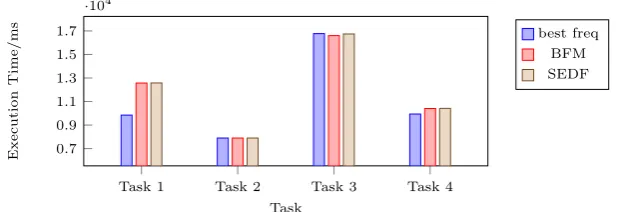
3.6 The execution times of different benchmark tasks running with
different frequencies . . . 39
3.7 The power consumption of benchmarks running with different
frequencies . . . 40
3.8 Execution times of tasks on a single core under SEDF and BFM 41
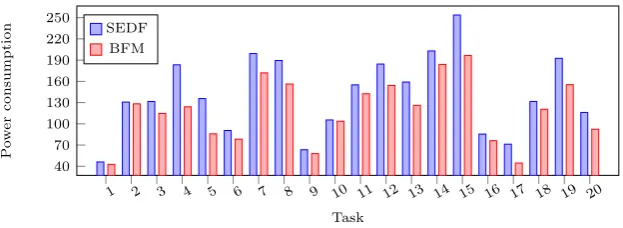
3.9 Power consumption of tasks on a single core under SEDF and BFM 42
3.10 Task consolidation on Quad-Core using SEDF scheduler . . . 43
3.11 Task consolidation on Quad-Core using BFM scheduler . . . 43
3.12 Execution times of tasks on a multi-core processor under SEDF
and BFMM . . . 43
3.13 Power consumption of tasks on a multi-core processor under SEDF
and BFMM . . . 44
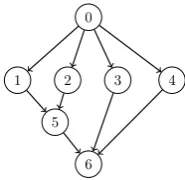
4.1 A Motivating Example DAG . . . 47
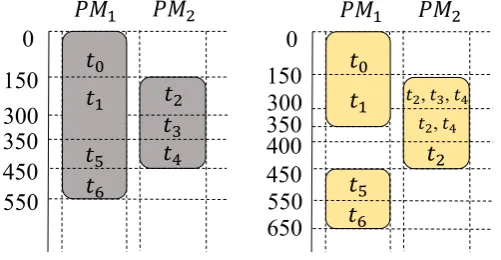
4.2 Sequential Execution Makespan (left) vs. Time-sharing Makespan
(right) . . . 48
4.4 Time-sharing executing process . . . 51
4.5 An example of four independent tasks executing on a single core 53 4.6 Case study: DAG. . . 56
4.7 Case study: Scheduling scheme using Time-sharing Makespan model . . . 57
4.8 Case study: Scheduling scheme using Traditional Makespan model 58 4.9 Migration effects on four kinds of tasks. . . 61
4.10 Original Mapping for topology level 1 . . . 69
4.11 Re-allocation for topology level 1 . . . 69
4.12 CyberShake . . . 72
4.13 Epigenomics. . . 72
4.14 Inspiral . . . 73
4.15 Sipht. . . 73
4.16 Montage . . . 73
4.17 Structures of the real-world workflows [21] . . . 73
4.18 Results for the real-world workflows runtime in different node numbers underM−T S,M−S and M−T AA . . . 76
4.19 Makespan-TAA with different number ofP Ms . . . 77
4.20 Makespan results for Randomly generated DAGs . . . 78
5.1 Motivation Experiments . . . 82
5.2 Comparison of performance events of SPEC 459 between solo execution and co-running . . . 83
5.3 Execution time for SPEC 403, 462 and 470 when executing under different frequencies . . . 84
5.4 Diagrams of two kinds of execution manners. . . 85
5.5 Non-time-sharing vs Time-sharing makespan (Under the same frequency, 3301 MHz) . . . 86
5.8 Residual analysis for co-running task prediction (static) . . . 100
5.9 Top 15 important features for predicting the execution time of
co-running tasks . . . 103
5.10 Execution time for SPEC benchmarks when executing under
dif-ferent frequencies . . . 106
5.11 Residual analysis for execution time prediction with various
fre-quencies (online) . . . 107
5.12 Residual analysis for execution time prediction with various fre-quencies (static) . . . 107
5.13 Top 15 important features for predicting the execution time under
various frequencies . . . 108
5.14 Residual analysis for execution time prediction time-sharing
ex-ecuting tasks (static) . . . 110
5.15 Top 20 important features for predicting the execution time of
List of Tables
4.1 Characteristics of the Real-World DAGs . . . 72
4.2 Results of the Real-World DAGs Makespan . . . 77
5.1 Experiment results for predicting the co-running time for repeti-tive tasks and new tasks, respecrepeti-tively. . . 101
5.2 Predicting the execution time under various frequencies for
repet-itive tasks and new tasks, respectively . . . 108
CHAPTER
1
Introduction
1.1
Virtual Machine Scheduling in Cloud
Com-puting Platforms
Cloud computing emerges as one of the most important technologies for
inter-connecting people and building the so-called “Internet of People (IoP).
Nowa-days, energy consumption in such a system is a critical metric to measure its
sus-tainability and eco-friendliness. Indeed, data centers used by the Cloud service
providers have become one of the fastest growing sources of power
consump-tion in industry. According to IDC (Internaconsump-tional Data Corporaconsump-tion), power
consumption of data centers worldwide accounts for about 8% of the global
electricity, which does not include the additional electricity consumed by the
cooling systems equipped in the data center. In such a Cloud-based IoP, the
virtualization technique, which allows multiple operating system instances (i.e.,
Virtual Machines) to run simultaneously in a physical machine, provides the
key supporting environments for running the IoP jobs such as performing data
analysis and mining personal information.
Xen [68] is a popular virtualization hypervisor used in the academic
com-munity. It has also been widely deployed in a number of industry-level Clouds,
such as AWS (Amazon Web Service), Rackspace, Verizon, etc. SEDF (Simple
Earliest Deadline First) is a scheduler in Xen. In SEDF, the CPU requirement
for each VM is specified by a tuple (s,p,x), in which s and p designate that
the VM has to run at least s in a period ofp. This CPU requirement can be
translated to the deadlines by which a VM has to start running (otherwise, the
1. Introduction
VM with the earliest deadline into execution [15].
Dynamic Voltage Frequency Scaling (DVFS) is a power management
tech-nique. DVFS can change the running frequency of CPU dynamically as required
and therefore reduce power consumption when the tasks do not need to be run
with the maximum CPU frequency. Xen currently has four power governors.
1) The Ondemand governor selects the CPU frequency which best fits the VM
(guest domain). 2) The Userspace governor selects the frequency specified by
user. 3) The Performance governor selects the highest frequency. 4) The
Pow-ersave governor selects the lowest frequency. There are twelve frequency states
in the Xen power management, in which the state P0 represents the highest
fre-quency while the state P12 represents the lowest frefre-quency. Here, we consider
the most complex scenario and assume that the guest domains are run under
the Ondemand governor, namely, the CPU frequency is dynamically adjusted
towards the best execution frequency of a guest domain.
In Xen, the CPU frequency can only be changed by one state in every interval
of 10ms. The interval of 10ms is called thefrequency scaling slice. For example,
it takes Xen 40ms to change the CPU frequency from P1 to P4. Our studies show
that this limitation in Xen in frequency changing may cause the energy waste
and performance loss (The problem is illustrated by an example the motivation
section of Chapter 3), which this work aims to reduce. In this work, we conduct
the theoretical ananlysis and construct the performance model and the energy
consumption model by taking into account the feature of Xen in frequency
changing. Based on the analysis and the models, we derive the condition under
which the best performance can be achieved, i.e., there is no performance loss
caused by the limitation of Xen in frequency changing. Further, we propose
a frequency-aware scheduling policy, called BFM (Best Frequency Match), by
adapting the SEDF scheduling policy in Xen. Compared with SEDF, BFM is
able to reduce the power consumption of running VMs without violating their
1. Introduction
1.2
Scheduling DAG Applications for Time
Shar-ing Systems
DAG is often used to model the precedence constraints of a group of related
tasks. Many DAG (Directed Acyclic Graph) scheduling algorithms have been
proposed in literature. The makespan of a DAG is an important metric to
measure the performance of a DAG scheduling solution. When computing the
makespan of a DAG, it is typically assumed that the tasks scheduled on the same
computing node run in sequence, i.e., being executed one by one in the
comput-ing node (which we call thesequential executionin this thesis) [48][50][93]. This
assumption is reasonable in the cluster platform, where there is only a central
queue in the head node and a new task is sent to a computing node only when
the node has completed the execution of the existing task. However, in some
situations, such as distributed systems and virtualized environments, there may
not be a central queue in the system. In a distributed system, there is no a
centralized management mechanism. The tasks in a DAG are often sent to the
computing machine as designated in the scheduling solution. After the
comput-ing machine receives these tasks, the tasks are run in the time sharcomput-ing manner
by the operating system. In virtualized environments, a VM is often created
to run a task. When multiple tasks are scheduled to the same machine, there
will be multiple VMs co-running in the physical machine. These VMs will not
be executed in sequence, but concurrently (i.e., time sharing) by the schedulers
(such as Credit or SEDF) deployed in the Virtual Machine Monitor.
Our studies, the details of which are presented in Chapter 4, show that the
discrepancy between the assumption of sequential execution and the reality of
time sharing execution may lead to inaccurate calculation for the finish times
of individual tasks and further for the execution performance, such as in terms
of makespan, of the whole DAG.
In this work, we first investigate the key difference between the time-sharing
1. Introduction
execution on the DAG makespan. Based on the analysis, we adapt the
conven-tional method of computing the DAG makespan in the sequential execution and
present our counterpart makespan model and method in the time-sharing
exe-cution. Usually, the makespan in the time sharing execution is worse (longer)
than that assumed in the sequential execution. Therefore, we propose the new
DAG scheduling strategies (a task migration algorithm and a task allocation
algorithm) for time-sharing systems.
1.3
Performance Impact of Task Co-running in
Multicore Computers
In the task scheduling, it is often assumed that the scheduler knows the
execu-tion time of the tasks. However, it is a non-trivial task to product the accurate
performance prediction for tasks, although a number of techniques are indeed
developed to predict the task performance [57]. These three situations make it
even more challenging to predict the task performance: 1) task co-running: the
tasks are running simultaneously (co-running) on multiple CPU cores in a
multi-core processor; 2) scaled CPU frequency: the CPU frequency may be scaled to
run tasks; 3) time-sharing execution: the tasks are running in a time-sharing
manner on the same core, due to the following reasons.
There are resource contention and interference among the co-running tasks,
since they need to share (contend) the resources in the computer such as internal
buses, cache, memory, hard disk, etc. The resource contention may lead to
the longer completion times of the tasks. The resource contention relation is
complicated because both the intensity level of contention and the type of the
contention (i.e., which type of the resource is contended by the tasks most
intensively) do not only relate to the hardware specification of the system (such
as cache size and memory bandwidth), but also vary from the characteristics
of the co-running tasks (such as memory access frequency, I/O requirement
1. Introduction
different contention levels of intensity. The complexity nature of the contention
among co-running tasks makes it difficult to develop the static formulas for
accurate performance prediction.
On one hand, executing with lower frequency can reduce the power
consump-tion. On the other hand, the execution time of the task will increase. Many
researches have been conducted based on the trade-off between the task
exe-cution time and the energy consumption. We conducted experiments to show
that the relationship between CPU frequency and execution time is non-linear.
Based on our investigation, we found that the performance impact of running
with different CPU frequencies depends on the characteristics of the task, as
well as the architecture of the hardware.
A time sharing scheduler aims to provide all processes with relatively equal
interval of time to access the CPU. It allows more efficient use of the computer
hardware; where a program is waiting for some events such as a user input or
I/O operation to complete, the central processor can still be used to run another
program [95]. Time-sharing execution often achieves higher CPU utilization
than sequential execution. However, due to the resource contention and other
resource requirements during processing, different combinations of time-sharing
executions may lead to different performance (This problem is illustrated by an
example in motivation section of Chapter 5).
We investigate the performance impact of tasks in the scenarios mentioned
above and present the method to identify the influential factors for the given
co-running tasks. Further, we propose a machine learning-based approach to
predicting the performance of the tasks. Two prediction frameworks are
devel-oped for two types of task that are often seen in production systems: repetitive
tasks (i.e., the tasks that arrive at the system repetitively) and new tasks (i.e.,
the task that are submitted to the system the first time), the difference between
which is that we have the historical running information of the repetitive tasks
while we do not have the prior knowledge about new tasks.
1. Introduction
framework is developed to predict the performance of the tasks by sampling the
performance events on the fly for a short period and then feeding the sampled
results to the prediction framework. We conducted the extensive experiments
with the SPEC2006 benchmark suite to compare the effectiveness of different
machine learning methods and present our observations and analyse. The results
show that our prediction model can achieve the high accuracy for both repetitive
tasks and new tasks in the three scenarios summarized above: tasks co-running,
varied CPU frequency and time-sharing execution.
1.4
Thesis Organization
The reminder of this thesis is organized as follows. This chapter provides a
brief overview of the work conducted in this thesis. In the next chapter, we
present the literature review of our research topics. Thereafter, each of the three
chapters (Chapter 3-5) of this thesis presents the task scheduling strategies from
a different scenario.
In Chapter 3, we formally construct the models for execution time and power
consumption. We identify the best performance scheduling situation where there
is no performance loss. Given the execution order of the tasks, we can determine
the start frequency that can guarantee that every task is able to run with the
best performance frequency. Thereafter, we propose a power consumption-aware
scheduling policy and design the task scheduling policies on a single core and
also on multiple cores. Our scheduling policies are able to reduce power waste,
which is supported by our intensive experiments.
In Chapter 4, firstly, we present a motivating case study to demonstrate the
difference of the time sharing execution from the sequential execution and its
impact on the makespan. Secondly, we present the workload and system model
and the notations used in our scenario. Then we present the makespan models
with both sequential and time-sharing executions, followed by the task adjusting
1. Introduction
Experimental results are presented in the last section of this chapter.
In Chapter 5, we investigate the influential factors of performance impact in
the three scenarios (i.e. task co-running, scaled CPU frequency and time-sharing
execution); a performance prediction framework is developed for repetitive tasks
and new tasks. Then we introduce the machine learning approaches applied in
our framework. The next section shows the experimental results of our work.
The experiments are conducted on benchmarks SPEC 2006 and NPB. Finally,
we conclude this chapter.
CHAPTER
2
Literature Review
This chapter presents the literature reviews. Section2.1and Section2.2discuss
the scheduling strategies for the virtualized environments and native
environ-ments, respectively. Then we reveal the problem of performance degradation
when scheduling co-running tasks and present the related research work in
Sec-tion2.3.
2.1
Scheduling Strategies for Computing
Sys-tems Virtualized by Xen
Xen is a hypervisor developed by the University of Cambridge. It is widely used
by many popular cloud service providers such as Amazon and IBM SoftLayer.
The Xen Hypervisor supports several different virtual CPU schedulers:
Bor-rowed Virtual Time (BVT) Scheduler, Simple Earliest Deadline First (SEDF)
Scheduler, Credit Scheduler, Credit2 Scheduler, etc. SEDF uses a real-time
scheduling algorithm called ”Earliest Deadline First (EDF)” to guarantee the
CPU requirements of the VM. EDF is an optimal scheduling algorithm in the
following sense: if a set of independent tasks (each task has its corresponding
arrival time, execution time and deadline) can be scheduled in a way that there
is no deadline miss, the EDF can schedule this set of tasks.
When scheduling periodic processes without violating their deadlines, EDF
has a utilization bound of 100%, which can be represented by the following
expression:
U =
n
X
i=1 Ci
Ti
2. Literature Review
A: (10,100,0) B: (50,100,0) C: (30,100,0)
ddl_A= 90 ddl_B= 50 ddl_C= 70
ddl_A= 90 ddl_B= 80 ddl_C= 70
ddl_A= 90 ddl_B= 80 ddl_C= 170
ddl_A= 90 ddl_B= 160 ddl_C= 170
B C B A
0 ms 30 ms 60 ms 90 ms
Figure 2.1: An example of SEDF scheduling process
whereU is the CPU utility,{Ci} are the worst case execution times of the
ntasks and theTi is their relative deadlines. That is, EDF can guarantee that
all deadline constraints are satisfied and the total CPU utilization is not more
than 100%.
In the SEDF scheduler, the CPU requirement for each VM is specified by
a tuple (s,p,x), in which s and p that the VM has to run at least s units in a
period ofp units. This CPU requirement can be translated to the deadlines by
which a VM has to start running (otherwise, the CPU requirement will not be
met). In each scheduling round, SEDF puts the VM with the earliest deadline
into execution [15]. Please note that the deadline in our first work (presented in
Chapter 3) refers to a relative deadline, which represents the CPU requirement
of the tasks.
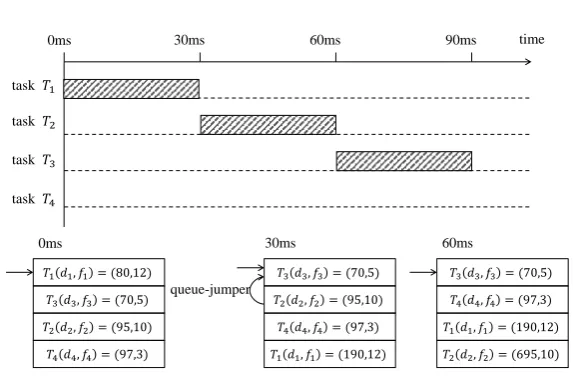
Figure2.1illustrates an example of the SEDF scheduling process. We assume
that task A, B, and C are scheduled by SEDF. The scheduling slice is 30 ms. The
CPU requirements of the tasks are A(10,100,0), B(50,100,0) and C(30,100,0),
respectively. Namely, task A, B and C need to run for at least 10, 50 and 30
ms in every 100 ms, respectively. At time point 0ms, the relative deadline of
the tasks (denoted by ddl x) are shown in the figure. At each scheduling point,
SEDF will select the task with the earliest relative deadline to execute (task B
in the figure). After running for 30ms, the relative deadline of task B changes to
2. Literature Review
to execute since task C has the earliest relative deadline. The same scheduling
policies are applied at other scheduling points.
Credit scheduler is a proportional fair share scheduler for virtual CPUs.
Each virtual machine is assigned a weight and a cap. The cap refers to the
amount (expressed as percentage) of CPU that a VM can use while the credit
is represented by the weight. The default time slice of the Credit scheduler is
30 ms. Once every 30 ms, the credits of all runnable VMs are recalculated,
the executing VM will be appended to the end of the runnable queue and the
scheduler will pick the first runnable VM to execute. Only the VMs with
non-zero credits are runnable. Further, to improve the performance of I/O intensive
tasks, Credit scheduler assigns them a priority boost. The VMs that are waken
up are likely to be scheduled immediately.
There have been many previous efforts to optimize the performance and
the power consumption of Xen-based systems. This section discusses several
performance models and power consumption models, the energy-aware
schedul-ing strategies, and some methods for optimizschedul-ing the resource consolidation on
multi-core processors.
2.1.1
Performance Model and Power Consumption Model
Reference [46] constructs an energy-aware stochastic task scheduling
architec-ture in heterogeneous computing environments, which incorporates HCS, BoT
applications, stochastic tasks, an energy model, and time and energy budget
constraints into consideration. Reference [92] [62] [6] and [104] also present
power consumption models in different virtualized environment.
2.1.2
Energy-aware Scheduling Strategy
RT-Xen [100], which is the first real-time hypervisor scheduling framework for
Xen. It bridges the gap between real-time scheduling and Xen. Basing on Xen’s
widespread adoption, RT-Xen constructs an attractive platform for integrating
2. Literature Review
Reference [43] attempts to meet the execution requirements of all the tasks
and to minimize the overall energy consumption of the processor. It
consid-ers the issue of scheduling a set of aperiodic tasks on DVFS-enabled multi-core
processors. Giving an ideal case to define the tasks’ Desired Execution
Re-quirement(DER), the algorithm will points out an evenly allocation method
to achieve saving processor energy, where it is especially suitable for real-time
systems.
Reference [51] presents a task scheduling strategy that solves the task
allo-cation problems on DVFS-enabled CPU cores, the tasks execution order and
the CPU processing frequency for each task. It formulates the task scheduling
model, the energy consumption model, a CPU processing frequency model and a
cost function. The formulas deduces the scheduling policy for both batch mode
and online mode of the tasks. The algorithm guarantees the minimal total cost
for every time interval.
In[41], a power consumption model is purposed for estimate the energy
con-sumption of the tasks in cloud systems. It divides the power concon-sumption into
leakage power and dynamic power and formulates the processor energy
consump-tion according to each in-processor event. The work presents an energy-credit
scheduler that schedules the tasks according to their energy budgets instead of
time credits. Also their scheduling algorithm lacks the careful consideration of
the tasks’ executing time requirements.
Reference [91] provides the performance model, the compute cluster model
and virtual machine model on DVFS-enabled cluster tasks. In addition, it
presents a power-aware cluster scheduling algorithm to minimize the power
con-sumption.
Reference [70] extends an existing formulation of the power-aware job
place-ment problem as to account for DVFS-enabled cluster nodes. Reference [70]
discusses two optimization problems: (i) optimizing performance by given a
constraint on energy consumption; (ii) optimizing the energy consumption by
2. Literature Review
several instantiations of the DVFS model, thereby quantifying the added benefit
of increased DVFS capabilities.
2.1.3
Performance-aware Scheduling Strategy
Reference [105] presents an optimization technique: periodically coalescing and
handling I/O events, which guarantees I/O performance as well as reduces the
preemption rate and scheduling latency. It also uses a Round-Robin manner
to handle I/O events periodically which improves I/O performance of
compu-tational tasks, though it leads to increasing number of migrations.
In [114], a layered graph is built to illustrate the co-scheduling problem.
As a result, the problem of finding the optimal co-scheduling strategy is then
modelled as looking up a shortest valid path in the built graph. Further, their
work presents the approaches of seeking the shortest path for both serial jobs
and parallel jobs. Besides, several optimization measures are also designed to
speed up the solving process.
Reference [2] emphasizes the virtual time discontinuity problem for lock and
interrupt handling in guest operating systems. It presents the downside of
sub-millisecond time slicing, and the architectural implication for future support of
VM consolidation and also proposes a context preservation technique based on
time sampling.
To mitigate I/O processing latency while retaining the benefit of CPU
shar-ing, reference [101] provides a new class of VMs named latency-sensitive VMs
(LSVMs). It provides a better performance for I/O-bound applications while
using the same resource share as other CPU-sharing VMs. LSVMs are
pow-ered by vSlicer, which is a hypervisor-level methodology scheduling each LSVM
more frequently but with a shorter micro time slice, without breaking the CPU
fairness among all sharing VMs.
Reference [27] presents a Flat Lightweight File System (iFlatLFS) to manage
small files basing on a simple metadata scheme and a flat storage architecture. It
2. Literature Review
holds as little as a fraction of the metadata size used on traditional file systems.
In [40], a task-aware virtual machine scheduling strategy is presented based
on inference methods applying the gray-box knowledge. It introduces partial
boosting that is a priority boosting mechanism with task-level granularity. By
applying such technique, any I/O-bound tasks can be selectively scheduled to
handle their incoming events straightway. As a result, the work using lightweight
mechanisms with full CPU fairness among VMs enhances I/O-bound tasks
per-formance within heterogeneous workloads.
vGreen [22] is a multi-tiered software system proposed for energy-efficient
computing in virtualized environments. It presents a number of novel
hierarchi-cal metrics measuring power and performance characteristics of both physihierarchi-cal
and virtual machines. In addition, several policies are introduced for energy
efficient virtual machine scheduling across the whole deployment.
Reference [35] addresses the challenges of dynamically scheduling parallel
jobs with QoS demands (soft-deadlines) in multi-clusters and grids system.
Three metrics (over-deadline, makespan and idle-time) are consolidated with
appropriate weights to evaluate scheduling performance. Moreover, two levels
of performance optimization methods are developed for the multicluster
envi-ronment.
2.2
Scheduling Strategies for Tasks in Native
Environment
In this section, we discuss the task scheduling strategies in native environments
(as opposed to virtualized environments). The tasks can be broadly divided into
two classes: Bag of Tasks, which refers to a set of independent tasks, and DAG,
which represents a set of tasks with precedence constraints. In this subsection,
we discuss scheduling strategies in native environments for these two classes of
2. Literature Review
2.2.1
Scheduling Strategies for Bag of Tasks (BoT) in
Multi-core Computers
Several works have been conducted to schedule BoT applications to multi-core
processors [60] [72] [79] [113] [80] and [16]. Reference [81] builds an energy-aware
cloud computing platform including its architecture, job and power
consump-tion model. Then, the authors develop a predicconsump-tion approach to forecast the
short-term workload that combines the linear regression and wavelet neural
network techniques. Reference [71] develops a comprehensive multi-objective
optimization model that takes four conflicting objectives, namely minimizing
task transfer time, task execution cost, power consumption, and task queue
length, into consideration. Reference [84] investigates BoT scheduling from an
energy efficiency perspective.
Survey [4] presents the power management strategies that minimize the
makespan under a power budget. Reference [107] addresses the energy
con-sumption problem by developing DVFS-based scheduling strategies for parallel
real-time tasks. Reference [52] develops task scheduling strategies that find a
balance point between two conflicting objectives (performance and energy
con-sumption). Reference [85] studies BoT load balance from an energy efficiency
perspective. In addition, two execution modes (batch mode and online mode)
are considered in the work. Reference [116] designs a dynamic voltage
scaling-based scheduling strategy called adaptive energy-efficient scheduling (AEES),
for BoT on heterogeneous clusters.
2.2.2
Scheduling Strategies for DAG Applications in
Multi-core Computers
It is typical to run a DAG application on clusters in order to exploit the inherent
parallelism in the DAG topology. Several popular scheduling frameworks have
been developed on clusters: YARN [87], Borg [89], Sparrow [65], Apollo [7],
2. Literature Review
Borg only have the global queues. In order to improve the scheduling
perfor-mance, it now becomes increasingly popular to employ the distributed
schedul-ing in large-scale data centres, where multiple schedulers make the schedulschedul-ing
decisions for different types of jobs simultaneously and independently. Such
distributed scheduling frameworks include Mercury [73], Apollo and our
previ-ous work presented. In distributed scheduling frameworks, a P M may receive
the tasks dispatched by different schedulers and these tasks are typically run
in a time sharing manner in the node. The experiments presented in [110] also
indicate that the vast majority of theP Ms in such clusters run multiple tasks
concurrently.
Scheduling a DAG and minimizing its makespan are proven to be a
NP-complete problem when there are more than twoP Ms [28]. Thus many heuristic
and meta-heuristic scheduling approaches are developed to minimize the DAG
makespan [13][47][31][9][37].
Although scientists began to study the scheduling long time ago, it is still a
hot topic nowadays to investigate the scheduling strategies for new platforms and
scenarios emerging over time, such as virtualized systems [99], multi-sites
work-flow scheduling [55], soft real-time scheduling in data centres [44], energy-aware
scheduling [66], and the scheduling with multiple objectives on IaaS Clouds [66].
Reference [106] proposes a scheduling algorithm, which combined the
cluster-based method and the interval insertion strategies to solve the problem that
most of the researches ignore the allocation of the non-critical predecessors.
Reference [76] addresses the problem of scheduling periodic parallel tasks with
implicit deadlines on multi-core processors. Reference [86] proposes an
aging-aware task scheduling framework for NoC-based multi-core systems. It
devel-ops a particle swarm optimization (PSO)-based heuristic to solve the scheduling
problem with an optimization objective of total task completion time, and
fi-nally obtain a scheduling result with higher efficiency compared with traditional
scheduling algorithms without considering of NBTI aging effect.
multi-2. Literature Review
objective optimization (i.e. energy consumption minimization and makespan
minimization) problem. Reference [63] solves the multi-objective problem by
developing a two-level schema: in the higher-level, the authors apply a heuristic
approach to map jobs between clusters; in the lower-level, specific scheduling
strategies are used for task scheduling locally within each cluster. Reference
[103] optimizes the makespan of DAG applications by setting up a priority
queue and duplicating specific tasks. In reference [49], a Minimum Energy
Under Probability Constraints (MEUPC) algorithm is designed to achieve
task-to-core mapping and a Trading Energy For Time (TEFT) strategy is developed
to achieve task parallelism. The main goal of reference [49] is to minimize the
energy consumption while satisfy the task deadline constraint.
However, in these algorithms, the tasks scheduled to the same node are
assumed to run in sequence. None of the above work assumes the time-sharing
execution when making the scheduling decisions. Our studies show that when
the tasks allocated to the same node are run in the time-sharing manner, the
finish times of individual tasks may be different from those in the sequential
execution and consequently affect the makespan. Therefore, if the existing DAG
scheduling algorithms are applied directly in the distributed scheduling, the
actual performance of the DAG execution, no matter in terms of makespan or
other objectives such as energy consumption, may not be as optimal as these
scheduling methods assume.
2.3
Performance Prediction of Task Co-running
in Multi-core Computers
The third work of this thesis is to perform contention-aware prediction for
per-formance impact of task co-running in multi-core computers. In this section, we
first investigate the influential factors that impact on the performance when the
tasks are co-running on multi-core computers. The related work is discussed
2. Literature Review
approaches in subsection2.3.2.
2.3.1
Resource Contention Problem of Co-running Tasks
Several works have explored the performance degradation problem of co-running
tasks. Survey [117] focuses on the approaches that address the shared resource
contention problem of task scheduling on Chip Multi-core Processors (CMPs).
Performance and energy model are built to analyze and predict the performance
impact [53] [82] [83] [102] [58] [12] [115] and [67]. Reference [11] studies the
im-pact of L2 cache sharing on the concurrent threads; Reference [115] proposes an
interference model, which considers the time-variant inter-dependency among
different levels of resource interference to predict the application QoS.
Refer-ence [112] decomposes parallel runtime into compute, synchronization and steal
time, and uses the runtime breakdown to measure program progress and identify
the execution inefficiency under interference (in virtual machine environment).
Reference [3] reveals that the cross-application interference problem is related
to the amount of simultaneous access to several shared resources. Based on
this discovery, it proposes a multivariate and quantitative model, which has an
ability of predicting cross-application interference level by considering a set of
features, for example, the amount of concurrent accesses to SLLC, DRAM and
virtual network, and the similarity between the amount of those accesses in
virtual environments. Reference [45] predicts the execution time of an
applica-tion workload for a hypothetical change of configuraapplica-tion on the number of CPU
cores of the hosting VM. Reference [26] gained the insight into the principle
of enriching the capability of the existing approaches to predicting the
perfor-mance of multi-core systems. Reference [25] develops an efficient ELM based
on the Spark framework (SELM), which includes three parallel subalgorithms,
is proposed for big data classification.
However, most of above studies only consider part of features that may
affect the co-running performance. Our experimental results reveal that there
2. Literature Review
We collect all these performance events during executing and use the feature
selection methods to reduce dimensionality.
Reference [111] observed that the performance degradation of an application
can be represented as a piecewise predictor function of the aggregate pressures on
shared resources from all cores. Based on this observation, the author proposes
to adopt the regression analysis to build a predictor function for an application.
The two features that the author considered are cache and bandwidth.
How-ever, to predict the execution time and the impact of time-sharing execution on
task performance, more performance events have to be considered to build the
prediction model.
2.3.2
Performance Prediction Approaches
Predicting the performance (such as execution time) of co-running tasks
accu-rately is necessary for task scheduling. When scheduling tasks with time
con-straints (i.e. deadlines), the worst-case execution time (WCET) is often used to
indicate the upper bound of the execution time. Several works have analyzed
and estimated the WCET of the tasks [34] [5] [64] [59] [29] [97]. Survey [97]
suggests that the WCETs problem is hard if the supporting architecture has the
components such as caches, pipelines, branch prediction, and other speculative
components. The paper discusses and compares different approaches to solve
the problem mentioned above.
Furthermore, estimating the execution time of co-running tasks in
multi-core situations is chanllenging as we need to take the resource contention into
consideration [33] [14] [56] [74]. Reference [88] builts Ernest, a performance
prediction framework for large scale analytics achieves a low prediction error
while having a training overhead of less than 5% for long-running jobs. Survey
[98] investigates the prediction approaches that can estimate the performance
of distributed tasks. Two scenarios are taken into consider in this survey: 1) a
single task executing on a single node; 2) a batch of tasks co-running on a set
2. Literature Review
practical prediction model for estimating performance degradation due to shared
cache. Reference [18] proposes an approach that can automatically characterize
workflow requirements such as I/O, runtime, memory usage, and CPU
utiliza-tion. The input data of this approach is the size of the input files. Reference
[77] makes a trade-off between prediction accuracy and measurement cost. It
adapts two widely used sampling strategies for performance prediction and
de-velops a new heuristic based on feature frequencies. Reference [10] proposes an
analytic modeling approach based on the use of Markovian Agents and Mean
Field Analysis that can accurately represent different concurrent Big Data
ap-plications. Reference [32] aims at a formal definition of timing compositionality.
It highlights challenges and suggests unsolved problems that arise in the context
of compositional analyses. Reference [42] divide the resource interference of
co-running VMs into two metrics, sensitivity and pressure. Sensitivity denotes how
an application’s performance is affected by its co-run applications, and pressure
measures how it impacts the performance of its co-run applications. Further, a
regression model is built to predict the two metrics with high accuracy.
Reference [45] proposes NICBLE to predict the execution time of an
appli-cation for a hypothetical change of configuration on the number of CPU cores
of the VM.
Reference [69] characterizes the task executions of workflow on the cloud by
using a set of parameters that reflect workflow input data, VM type on which
the task is executed, and hardware-dependent runtime information; then a novel
fully automatic two-stage approach is developed to predict task execution times
for varying input data across different cloud providers evaluated for various
real-world workflows applications.
Reference [75] proposes the ProcessorMemory (ProcMem) model, which
dy-namically predicts the distinct task execution times depending on the
imple-mented processor frequencies.
Reference [109] presents a framework for creating a lightweight thermal
2. Literature Review
feature selection algorithms to improve the performance of previously designed
machine learning methods. In addition, alternative methods are developed using
neural network and linear regression-based methods to perform a
comprehen-sive comparative study of prediction methods. Other papers such as [78] also
make contributions in either performance modeling or energy prediction using
CHAPTER
3
Power-aware Scheduling Mechanisms for Virtualized
Environments
The virtualization technique provides the key supporting environments for a
cloud system. Nowadays, energy consumption in such a system is a critical
metric to measure the sustainability and eco-friendliness of the system. This
chapter develops three power-aware scheduling strategies in virtualized systems
managed by Xen, which is a popular virtualization technique. These three
strategies are the Least performance Loss Scheduling strategy, the No
perfor-mance Loss Scheduling strategy, and the Best Frequency Match scheduling
strat-egy. These power-aware strategies are developed by identifying the limitation of
Xen in scaling the CPU frequency and aim to reduce the energy waste without
sacrificing the jobs running performance in the computing systems virtualized
by Xen. Least performance Loss Scheduling works by re-arranging the execution
order of the virtual machines (VMs). No performance Loss Scheduling works
by setting a proper initial CPU frequency for running the VMs. Best Frequency
Match reduces energy waste and performance loss by allowing the VMs to jump
the queue so that the VM that is put into execution best matches the current
CPU frequency. Scheduling on both single core and multi-core processors is
considered in this chapter. The evaluation experiments have been conducted,
and the results show that compared with the original scheduling strategy in
Xen, the developed power-aware scheduling algorithm is able to reduce energy
3. Power-aware Scheduling Mechanisms for Virtualized Environments
0 10 20 30 40 50 60
1,500 2,000
Samples
F
requencey/MHz
Figure 3.1: Frequency sampling of Domain 0 for 60 times; each sampling interval is 300 ms
3.1
A Motivating Example
As introduced in Chapter 1, under the OnDemand governor, DVFS is used to
adjust the CPU frequency on demand. We ran an experiment on a quad-core
machine to record the frequency of the CPU core, which Domain0 runs on.
We pinned two vcpus of Domain0 to core 3 and recorded the frequency of the
core once every 300 milliseconds (ms) for 60 times. The results are shown in
Fig. 3.1. It can be seen that Domain0 does not always run with the highest
frequency of 2301 MHz. Indeed, under the Ondemand governor, different tasks
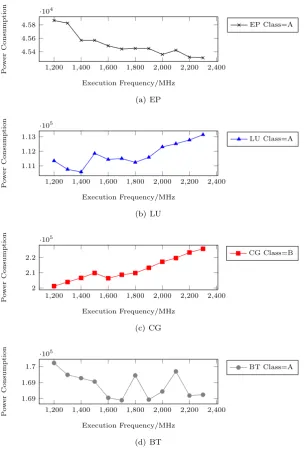
may run with different execution frequencies. For example, Fio, which is a I/O
benchmarking tool, ran at the lowest scaling frequency (1200 MHz), while the
computation-intensive benchmark BT (a benchmark application in the NAS
Parallel benchmark) ran at the highest frequency, 2301 MHz.
The following illustrates the problem of energy waste and performance loss
caused by the limitation of Xen in changing the CPU frequency. Fig. 3.2 shows the changes of Power-states (P-states) when four VMs (VM1-VM4) are
running on a single core. The x axis is the elapsed time, while the y axis is
the Power-state of the core at the corresponding time point.. The time slice of
a VM (namely the time duration for which a VM runs continuously before the
Xen hypervisor jumps in and schedule another VM into execution.) is 30 ms
3. Power-aware Scheduling Mechanisms for Virtualized Environments
in the figure. The power governor checks and changes, if necessary, the CPU
frequency every 10 ms by at most one level [54]. Assume that the P-states
demanded by VM1, VM2, VM3 and VM4 are P1, P9, P3 and P7, respectively.
In this example, the initial P-state is set to be P3. When the current frequency
deviates from (higher or lower than) the best frequency of a running VM, the
power governor adjusts the frequency towards the best frequency. However, it
can only adjust the frequency by one level every 10 ms due to the feature of
Xen in frequency changing. With this restriction, the actual CPU frequencies
over time are those highlighted by the bold black line. When a VM runs on a
frequency higher or lower than its best execution frequency, Energy waste or
performance loss occurs. The difference between the best frequency and the
actual frequency represents the amount of energy waste or performance loss.
In this figure, the red area and the shadowed grey area represent the amount
of energy waste and performance loss, respectively. For example, at time 0,
the VM (VM4) only requires P5 (the best P-state), while the current actual
frequency is P3 (initial P-state). Since the current P-state is higher than the
best P-states of the VM, the frequency is adjusted down by one level every 10
ms until it reaches the best frequency or the VM is scheduled out after its time
slice of 30 ms is used up. In the case of VM4, the VM is scheduled out before
the actual frequency reaches the best frequency. VM3 is scheduled in after
VM4. Since the best frequency of VM3 is P3, which is higher than the current
running frequency, the frequency is adjusted up. Since the frequency can only
be adjusted by one level every 10 ms, VM3 still runs at a frequency lower than
its best frequency in the first 10 ms of VM3’s time slice, which leads to the
performance loss (indicated by the shadowed grey area) and will consequently
increase the execution time of the application that is running in the VM. In the
remaining time slice, VM3 runs perfectly at its best frequency.
The above example suggests that the feature of Xen in adjusting the CPU
frequency may cause both energy waste and performance loss. The objective of
3. Power-aware Scheduling Mechanisms for Virtualized Environments
10 20 30 40 50 60 70 80 90100 110 120 130 140 150 160 170 180 190 200 210 220 230 240 P12
P11 P10 P9 P8 P7 P6 P5 P4 P3 P2 P1 P0
VM2 VM4 VM3 VM4 VM1 VM2 VM3 VM4
Time/ms
P-states
[image:43.595.137.454.127.266.2]best frequency power waste performance loss
Figure 3.2: Energy waste and performance loss under DVFS in Xen
policy so as to minimize the energy waste and performance loss under DVFS.
3.2
Performance and Energy Model for the
DVFS-enabled Xen
3.2.1
Performance Model
Assume a set of independent tasks T ={T1, T2, ..., Tn}. Task Ti runs inV Mi.
fi denotes the best frequency ofV Mi. ti denotes the execution time of taskTi
whenV Miruns at the frequency offi (Ti is executed inV Mi). Psdenotes the
scheduling time slice, which is 30 ms by default, whilePf denotes the frequency
scaling slice, which is 10 ms. Let c(fi0) denote the equivalent execution rate of
Ti when V Mi runs at the frequency fi0. c(fi0) can be calculated by Equation
3.1, where Ft(fi0) is the function of execution time over CPU frequency.
c(fi0) = ti
Ft(fi0)
(3.1)
fi0(j) denotes the frequency which taskTi runs at in the jth time interval.
c(fi0(j)) denotes the execution rate ofTiin thejth time interval. Inequality3.2
can be used to determine the number of intervals thatV Miuses to complete the
3. Power-aware Scheduling Mechanisms for Virtualized Environments
3.2.
m
X
j=0
c(fi0(j))Pf ≥ti (3.2)
Then the total execution time of task Ti when it is not always running at
its best frequencyfi (denoted byt0i) can be modelled as Equation3.3, wherem
is the minimal value that satisfies Inequality3.2.
t0i= m
X
j=0
Pf (3.3)
3.2.2
Power Consumption Model
When taskTiruns at the frequency offi0, Equation3.4is the classic equation to
calculate the power consumption rate of CPU for runningTi[61] (denoted byri),
whereCis the capacitance being switched per clock cycle,V is the voltage,Ais
the activity factor indicating the average number of switching events undergone
by the transistors in the chip andfi0 is the frequency.
ri(fi0) =A×C×V
2×f0
i (3.4)
Inequality3.2 is used to determine the number of intervals that V Mi uses
to complete the execution of taskTi. The total power consumption of taskTi,
denoted by ei, can be modelled by Equation 3.5, where fi0(j) is the frequency
which taskTi runs at in thejth time interval, same as in Equation 3.2.
ei= m
X
j=0
3. Power-aware Scheduling Mechanisms for Virtualized Environments
0 10 20 30 40 50 60 70 80 90 100 110 120 130 P12 P11 P10 P9 P8 P7 P6 P5 P4 P3 P2 ... fi ... fj ... fn ... fj ... fi ... fr Time/ms Best executing frequency best frequency
[image:45.595.170.425.123.367.2]0 10 20 30 40 50 60 70 80 90 100 110 120 130 P12 P11 P10 P9 P8 P7 P6 P5 P4 P3 P2 ... fi ... fj ... fn ... ... fj fi ... fr Time/ms Best executing frequency best frequency
Figure 3.3: ”Least Performance Loss” Scheduling Strategy (above); Illustration of changing the execution position of a randomly selected task (below)
3.3
Scheduling Strategies
3.3.1
The Scheduling Strategy with Least Performance
Loss
The power management in Xen can only adjust the power state by at most
one level every 10 ms. The frequency gap between the current CPU frequency
f and the task Ti’s best (desired) executing frequency fi will lead to either
performance loss or energy waste. When the current CPU frequencyf is lower
(or higher) than Ti’s best executing frequency,fi, and the power management
cannot increase (or reduce) f to fi immediately, performance loss (or energy
waste) occurs.
Given the current CPU frequency and a set of tasks, Theorem 1 gives the
“Least Performance Loss” Scheduling strategy (LLS), namely the execution
3. Power-aware Scheduling Mechanisms for Virtualized Environments
Theorem 1. Given a set of tasks,T ={T1,T2,...,Tn}, the best CPU frequency
of Ti is fi and the set of tasks are run in a time-sharing manner. Assume f1
≤ f2 ≤ ... ≤ fn. If the current CPU frequency is f, then given the current
CPU frequency, the LLS strategy (i.e., the execution order that leads to the least
performance loss for the set of tasks) is to run the tasks in the following order,
where Tr’s frequency fr is the highest frequency that is less than the current
frequencyf.
Tr,Tr+1,...,Tn−1,Tn,Tn−1,...,Tr+1,Tr,Tr−1,...,T2,T1, T2,..., Tn, Tn−1,..., T1
...
Namely, the execution order is to start fromTr, go up to Tn in the
increas-ing order of frequency and then come down to T1 in the decreasing order of
frequency, and that the upward and downward execution pattern in terms of
frequency repeat until all tasks have been completed.
Proof. The performance loss is related to the frequency gap of the tasks during
the execution. Performance loss increases with the increase in the frequency
gap. We prove this theorem by proving that any change in the execution order
from the LLS strategy will lead to the increase of the frequency gap, thus the
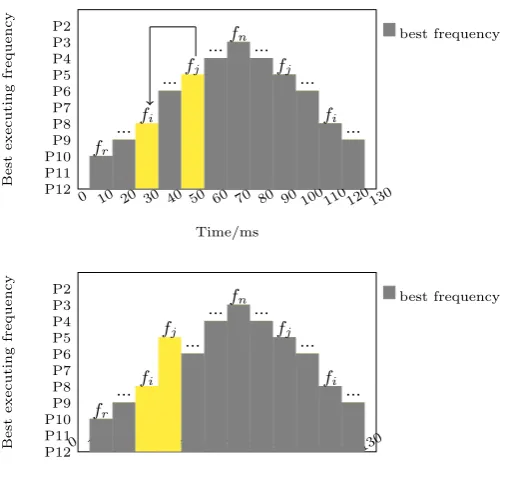
performance loss.
We randomly change the execution position (specified by the LLS strategy)
of a randomly selected task. Assume task Tj is moved to the position after
task Ti. Without the loss of generality, we assume j > i+ 1, (i.e., we move Tj
forwards as shown in Fig. 3.3.
Before the change, the frequency gap among the relevant tasks (i.e. taskTi,
Ti+1,Tj−1,Tj,Tj+1) is:
E= (fi+1 -fi) + (fj -fj−1) + (fj+1 -fj)
=fi+1 -fi -fj−1 +fj+1.
After the change, the frequency gap among the involved tasks is:
E0 = (fj -fi) + (fj+1 -fj−1).
Note that the gap offj−fi+1 is not counted in the expression above since it
3. Power-aware Scheduling Mechanisms for Virtualized Environments
the frequency timely fromfj tofi+1.
The difference betweenE0 andE is:
E0 -E = (fj -fi) + (fj+1 -fj−1) - (fi+1 -fi -fj−1 +fj+1)
=fj -fi+1.
Sincefj ≥fi+1, we getE0 ≥E.
In the similar way, we can prove the theorem also holds when i > j (i.e.,
moving the task backwards). Therefore, given the current CPU frequency, the
LLS strategy generates the least performance loss for a set of tasks.
3.3.2
The Scheduling Strategy with No Performance Loss
The previous section derives LLS, the scheduling strategy with the least
per-formance loss, given the current CPU frequency. LLS requires re-arranging
the execution order of the VMs. In this section, we will derive the scheduling
strategy under which there is no performance loss for a set of tasks. We call
this strategy the No performance Loss Scheduling (NLS) Strategy. NLS aims
to ensure all tasks run with the frequencies no less than their best frequencies.
NLS does not reorder the VMs’ execution. The VMs can be executed in the
order of their positions in the run-queue. Rather, NLS calculates the initial
CPU frequency that the CPU needs to be set with in order for all VMs to run
without performance loss.
According to the Xen power management policy, the execution frequency
can be modified once every 10 ms, which we call the frequency scaling slice.
The default time slice, which we call the scheduling slice, for running a VM in
Xen is 30 ms. After 30 ms, the Xen hypervisor jumps in and schedule another
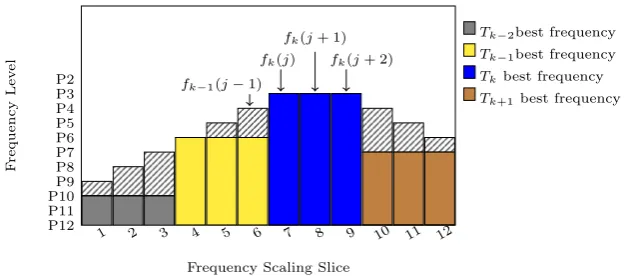
VM to run. Therefore, the frequency can be changed three times at most in
each scheduling slice. As shown in Fig. 3.4, fk(j),fk(j+ 1),fk(j+ 2) indicates
the three execution frequencies of task Tk in the three frequency scaling slices
(indexed as j, j+ 1 and j+ 2 in the example of Fig. 3.4) in Tk’s scheduling
3. Power-aware Scheduling Mechanisms for Virtualized Environments
frequency of the frequency scaling slice beforefk(j) (i.e., the (j−1)-th frequency
scaling slice) should be at leastfk(j)−∆f, where ∆f is the frequency that can
be changed at most each frequency scaling slice (which is 100 MHz, i.e., one
P-state, in Xen). (j−1)-th frequency scaling slices falls in the scheduling slice
of task Tk−1, which means that the execution frequency that Tk−1 has to run
with, denoted byfk−1(j−1), has to be (fk(j)−∆f) even ifTk−1does not need
such a high running frequency. The best frequency of task Tk−1, i.e., fk−1 is
shown by the yellow bar, which is lower thanfk−1(j−1). Similarly,fk−1(j−2)
has to befk−1(j−1)−∆f orfk−1(Tk−1’s best frequency), whichever is higher.
In general, assuming that Tk has the highest best frequency in the set of
tasks (i.e., fk is highest) and that j, j+ 1 and j+ 2 are the three frequency
scaling slices inTk’s first scheduling slice during the running of the set of tasks,
Equation 3.6 can be used recursively, starting from i = j, to calculate the
running frequency in each frequency scaling slice before j-th frequency scaling
slice (it is obvious thatfk(j),fk(j+ 1) andfk(j+ 2) should all befk), so that
all VMs can run without performance loss, i.e., with the frequencies no less than
their corresponding best frequencies.
The algorithm for performing the recursive calculation is outlined in
Algo-rithm 1. The output of Algorithm 1 is the value of f1(1), i.e., the starting
frequency that the CPU has to be set with in order for the set of tasks to run
without performance loss.
Note that although NLS guarantees no performance loss, it may cause energy
waste. The shadowed areas above the coloured bars in Fig. 3.4 represent the
energy waste.