warwick.ac.uk/lib-publications
Manuscript version: Author’s Accepted Manuscript
The version presented in WRAP is the author’s accepted manuscript and may differ from the
published version or Version of Record.
Persistent WRAP URL:
http://wrap.warwick.ac.uk/112525
How to cite:
Please refer to published version for the most recent bibliographic citation information.
If a published version is known of, the repository item page linked to above, will contain
details on accessing it.
Copyright and reuse:
The Warwick Research Archive Portal (WRAP) makes this work by researchers of the
University of Warwick available open access under the following conditions.
Copyright © and all moral rights to the version of the paper presented here belong to the
individual author(s) and/or other copyright owners. To the extent reasonable and
practicable the material made available in WRAP has been checked for eligibility before
being made available.
Copies of full items can be used for personal research or study, educational, or not-for-profit
purposes without prior permission or charge. Provided that the authors, title and full
bibliographic details are credited, a hyperlink and/or URL is given for the original metadata
page and the content is not changed in any way.
Publisher’s statement:
Please refer to the repository item page, publisher’s statement section, for further
information.
David Loeffler and Sarah Livia Zerbes
Abstract.
Euler systems are certain compatible families of cohomology classes, which play a key role in studying the arithmetic of Galois representations. We briefly survey the known Euler systems, and recall a standard conjecture of Perrin-Riou predicting what kind of Euler system one should expect for a general Galois representation. Surprisingly, several recent constructions of Euler systems do not seem to fit the predictions of this conjecture, and we formulate a more general conjecture which explains these extra objects. The novel aspect of our conjecture is that it predicts that there should often be Euler systems of several different ranks associated to a given Galois representation, and we describe how we expect these objects to be related.
Acknowledgements This survey is based on the notes of a lec-ture given by the second author at the 60th birthday conference for Michael Harris at MSRI, Berkeley, in 2014. It was expanded to a sur-vey article during the “Euler Systems and Special Cycles” semester at the Centre Bernoulli, Lausanne, in autumn 2017. We are grateful to MSRI and to the Centre Bernoulli for their hospitality. We would also like to thank the anonymous referee, and the editorial board of the Iwasawa centenary proceedings, for their valuable comments on earlier drafts of this paper.
2010Mathematics Subject Classification. 11R23, 11F80.
§1. Cohomology of Galois representations
The representations of Galois groups of number fields play a cen-tral role in number theory. For instance, ifK is a number field and
E/K is an elliptic curve, one can consider itsTate module
Tp(E) := lim←− n
E[pn],
for a prime p; this is a free rank 2 Zp-module, with a continuous action of the group GK := Gal(K/K). The representation Tp(E) contains much useful arithmetic data aboutE; for instance, E has good reduction at a prime` 6= pif and only if the inertia group I` acts trivially onTp(E) (the “Ner´on–Ogg–Shafarevich criterion”).
Deeper properties of E are encoded in the (continuous) Galois cohomology groups Hi(GK, Tp(E)), which we shall abbreviate as
Hi(K, Tp(E)) henceforth. There is a natural injective map, the Kum-mer map,
κ:E(K)⊗Zp→H1(K, Tp(E)),
and many of the deepest results we have concerning the Mordell– Weil groups of elliptic curves – notably Kolyvagin’s theorem that if E is an elliptic curve over Q and ords=1L(E, s) ≤ 1, then the Tate–Shafarevich group ofEis finite and the Birch–Swinnerton-Dyer conjecture holds for E – have been proved by studying the image of E(K) in H1(K, Tp(E)), using sophisticated techniques in Galois cohomology. So describing and controlling the cohomology of Galois representations is a deep and fundamental problem.
One of the few tools available for controlling global cohomology groups is the theory of Euler systems, and in this article we shall introduce the theory of Euler systems, and formulate a new conjecture predicting what sort of Euler systems one might expect for general Galois representations.
§2. Euler systems
Definition 2.1. For an integral ideal m of K, we write K(m)
for the maximal extension ofK of p-power degree contained the ray class field ofK modulo m.
LetT be a finite-rank freeO-module with a continuous action of
GK, unramified at almost all primes. We write T∗(1) for the Tate dual Hom(T,O(1)), and if q is a finite prime of K at which T is unramified, we define a local Euler factorPq∈ O[X] by
Pq(X) := detO 1−XFrob−q1:T∗(1)
.
We fix an idealN ofK, divisible bypand by all primes at which
Tis ramified; and an infinite abelian extensionKofKwhich contains
K(q), for every primeq-N, and the cyclotomicZp-extensionK∞⊂ K(p∞).
Definition 2.2([Rub00, Definition 2.1.1]). An Euler systemfor
(T,K,N)is a collection of cohomology classes
c={cF ∈H1(F, T) :K⊆fF ⊂ K},
(where the notationK⊆fF ⊂ Ksignifies thatF runs over the finite
extensions ofK contained in K), satisfying the following relation: if K⊆f F⊆fF0⊂ K, then
(?) coresFF0(cF0) =
Y
q∈Σ(F0/F)
Pq σ−q1
cF
whereΣ(F0/F)is the set of (finite) primes ofKnot dividingN which ramify inF0but not inF, andσqis the image ofFrobqinGal(F/K).
Note that only the local Euler factors at unramified primes ap-pear in the definition; the Euler factors at the bad primes play no direct role.
examples of anticyclotomic Euler systems, but we shall not discuss them further in this survey, for reasons of space.
The basic function of Euler systems is to boundSelmer groups, which are subgroups ofH1(K, T) defined by local conditions.
Definition 2.4.
(i) Ifv-pis a (finite) prime ofK, we define
Hf1(Kv, T) := ker H1(Kv, T)→H1(Kvnr, T ⊗Qp)
whereKnr
v is the maximal unramified extension of Kv. (ii) We define the relaxed Selmer group,H1
rel(K, T), as
x∈H1(K, T) : locv(x)∈Hf1(Kv, T)for all v-p .
(iii) We define the strict Selmer group,H1
str(K, T), as
x∈H1(K, T) : locv(x)∈H 1
f(Kv, T) for allv-p,
locv(x) = 0 for allv|p.
Theorem 2.5(Rubin, cf. [Rub00, Theorem 2.2.3]). Supposecis an Euler system for (T,K,N), and cK is non-torsion inH1(K, T);
and suppose that T satisfies a mild “large image” hypothesis. Then the groupHstr1 (K, T∗(1))is finite.
Remark 2.6. Rubin states his theorem in a somewhat different form, involving the finiteness of the strict Selmer group of the p -torsion representationT∗(1)⊗Qp/Zp, but this is equivalent to the above statement.
The Poitou–Tate global duality theorem for Galois cohomology, combined with Tate’s Euler characteristic formula, shows that the finiteness of the strict Selmer group of T∗(1) implies a bound for the cohomology of T. This bound involves the following important numerical invariant:
Definition 2.7. We define
d−(T) := X
v|∞
vreal
rankO Tσv=−1+ X
v|∞
vcomplex
rankO(T),
Let us writehi(−) for the rank of the cohomology groupHi(−) as anO-module.
Proposition 2.8. SupposeH0(K, T) =H0(K, T∗(1)) = 0, and H0(K
v, T∗(1)) = 0for all primes v|p. Then we have
h1rel(K, T)≥d−(T),
with equality if and only ifH1
str(K, T∗(1)) = 0.
So, by Rubin’s theorem, the existence of a non-trivial Euler sys-tem forcesH1
rel(K, T) to have the minimal possible rank.
Proof. Let V := T ⊗O L, let S be the set of primes dividing
N ∞, and let GK,S be the Galois group of the maximal extension of K unramified outside S. Then, for any T unramified outside S, Poitou–Tate duality gives an exact sequence of finite-dimensionalL -vector spaces
0→Hrel1 (K, V)→H1(GK,S, V)→
M
v∈S v-p
Hs1(Kv, V)→Hstr1 (K, V∗(1))∗
→H2(GK,S, V)→
M
v∈S
H2(Kv, V)→H0(K, V∗(1))∗→0.
HereH1
s(Kv, V) =H1(Kv, V)/Hf1(Kv, V) =Hf1(Kv, V∗(1))∗. We now count dimensions. We haveh2(K
v, V) =h1s(Kv, V) for
v - p, so the local terms for v - p cancel out; and h0(G
K,S, V)−
h1(G
K,S, V) +h2(GK,S, V) = −d−(T) by Tate’s global Euler
char-acteristic formula. Finally, local Tate duality gives h2(K
v, V) =
h0(K
v, V∗(1)). Collecting terms therefore gives
h1rel(K, T)−h0(K, T) =h1str(K, T∗(1))−h0(K, T∗(1))
+d−(T) + X
v|p
h0(Kv, T∗(1)).
Under our simplifying hypotheses, most of these terms are zero and the formula simplifies to
h1rel(K, T) =d−(T) +h1str(K, T∗(1)).
Soh1
rel(K, T)≥d−(T), with equality if and only ifh1str(K, T∗(1)) =
§3. The cased−(T) = 1
One can check that classes forming an Euler system always lie in
H1
rel. Hence, ifd−(T) = 1 andcis an Euler system forTwithcK non-torsion, then one has a rather precise picture of the cohomology ofT, at least after invertingp; the spaceHrel1 (K, T)⊗Lis one-dimensional, andcK is anL-basis vector of this space.
This situation, whered−(T) = 1, may seem rather special, but
it in fact covers several of the most familiar Euler systems:
• The Euler system of cyclotomic units: here K = Q and
T =Zp(1).
• The Euler system of elliptic units: here K is imaginary quadratic andT is againZp(1).
• The Euler system ofBeilinson–Kato elements: hereK=Q
andT =Tf∗(1) whereTf is the representation attached to a modular form of weight≥2, so thatT has rank 2 and σ∞
acts via a matrix conjugate to −1 0 0 1
.
However, there are not many more examples beyond these. The problem is that in practice “most” representationsT have approxi-mately the same number of +1 and−1 eigenvalues for complex con-jugation; so d− is usually about 12[K : Q] rankO(T), which will be much larger than 1 unlessKandT are both small.
In practice, one is usually interested in Selmer groups with more sophisticated local conditions at p, rather than the (rather crude) strict and relaxed local conditions. The “right” local condition was defined by Bloch and Kato, using p-adic Hodge theory. We impose the assumption that T is de Rham at the places abovep (which is automatically satisfied for all representations arising from geometry, by deep comparison theorems due to Faltings and Tsuji).
Definition 3.1 ([BK90, §3.7]). For v | p, define submodules H1
f(Kv, T)⊆Hg1(Kv, T)⊆H1(Kv, T) by
Hf1(Kv, T) = ker H1(Kv, T)→H1(Kv, T⊗Bcris)
Hg1(Kv, T) = ker H1(Kv, T)→H1(Kv, T⊗BdR)
where Bcris andBdR are Fontaine’s p-adic period rings. Define the
global Bloch–Kato Selmer group by
From the theorems above, we see that ifd−(T) = 1 and an Euler
systemcexists forT withcKnon-torsion, thenHf1(K, T) has dimen-sion either 1 or 0, depending on whether or not locv(cK)∈Hf1(Kv, T) for all primesv|p.
If V has all Hodge–Tate weights1≥1 at some primev|p, then
H1
g(Kv, T) = H1(Kv, T) [Ber03, Lemma 6.5]; if we suppose also that H0(K
v, T∗(1)) = 0, as in Proposition 2.8, then we even have
H1
f(Kv, T) = H1(Kv, T), so the condition locv(cK)∈ Hf1(Kv, T) is automatically satisfied. For instance, this applies to the Euler system of Beilinson–Kato elements if the modular formf has level coprime top.
On the other hand, if the Hodge–Tate weights are not all ≥ 1 atv, one expects that locv(cK) should only be inHf1(Kv, T) if some “unlikely coincidence” occurs. For instance, in the setting of the Beilinson–Flach elements one can use atwisting construction to pro-duce an Euler systemc0 forT =Tf∗ (without the twist 1). It follows from Kato’s explicit reciprocity law that this twisted Euler system has locp(c0Q)∈H1
f(Qp, Tf∗) if and only if L(f,1) = 0.
§4. Higher rank Euler systems
Ifd−(T)>1, what should one expect? Naively, one might guess
that it would beeasier to build Euler systems in this context, since
H1
rel is forced to be large by Proposition 2.8. However, this doesn’t seem to be the case: whend−is large it seems to be hard to construct
elements.
An intuitive explanation of this comes from the following obser-vation: systematic constructions of elements in global cohomology groups only seem to work well when those groups are 1-dimensional, because otherwise the class “doesn’t know where to go” within the space, and collapses to zero. (We shall call thisGross’ trap, since the observation was apparently first made by Dick Gross in the analogous setting of Heegner points on elliptic curves of analytic rank>1.)
1Our conventions are that the Hodge–Tate weight of the cyclotomic
character is +1. The Hodge–Tate weights of the representationTf attached to a weightkmodular form f are 0 and 1−k, so the representationT∗
One suggestion for resolving this problem, due to Perrin-Riou [PR98], is that the “correct” object to associate to a general T is not a collection of classes inH1(F, T), but rather classes in exterior powers of these modules. She defined a rank r Euler system, for
r≥1, to be a collection of classes
cF ∈ r
^
O[∆F]
H1(F, T) forK⊆fF ⊂ K,
where ∆F = Gal(F/K), satisfying the Euler system norm relations (?).
For simplicity, we shall state Perrin-Riou’s conjecture under an auxiliary assumption: that either d−(T) = d+(T), or every real place ofK remains real inK. (For example, we could takeK =Q
and K=S
mQ(µm)+, whereQ(µm)+ is the totally-real subfield of
Q(µm).) This avoids complications with ranks varying between dif-ferent complex-conjugation eigenspaces.
Conjecture 4.1(Perrin-Riou). For any global Galois represen-tation T arising in geometry, there exists an Euler system of rank d−(T) for T, satisfying a precise relation to the values of the L-function L(T∗(1), χ, s)for finite-order characters χof Gal(K/K).
Remark4.2. The exact relation toL-values is somewhat technical to state; see Perrin-Riou’s monograph [PR95], or the overview in [Rub00, Chapter 8].
This notion of higher-rank Euler systems has been extensively studied since, but it has proved to be rather thorny to work with, for two reasons.
Firstly, there are serious technical difficulties arising from the complicated algebra of wedge powers of modules over O[∆F]. This makes it difficult to prove an analogue of Theorem 2.5 for Euler sys-tems of rank >1. Recent work of Burns–Sano [BS16] strongly sug-gests that a better theory may be obtained by replacing the wedge powerVr
O[∆F]H
1(F, T) withTr O[∆F]H
1(F, T), whereTr
denotes the “exterior bi-dual” functor, defined for modulesM over a ringRby
r
\
R
M = HomR r
^
R
HomR(M, R), R !
However, another (possibly more serious) stumbling block is that there are very few interesting examples of rankrEuler systems known for r > 1 (in particular, none which are known to be related to values ofL-functions). In particular, it isnot expected that the Euler systems predicted by Perrin-Riou’s conjecture should be constructed by building r invidual elements in some canonical way, and then wedging them together (except in special cases, such as whenT is a direct sum of smaller representations); such an approach would fall into Gross’ trap.
Remark 4.3. One exception to this gloomy outlook is provided by ongoing work of Nekov´aˇr and Scholl (surveyed in [NS16]). Assum-ing a certain conjecture, the plectic conjecture, their method gives a construction of Euler systems of rank [F : Q] for certain Galois representations arising in the ´etale cohomology of Shimura varieties associated to reductive groups over totally real fields F. However, the plectic conjecture is currently wide open.
Another, unrelated approach is due to Urban, who has devised a method of constructing higher-rank Euler systems via Eisenstein congruences; but this approach (as presently formulated) requires one to assume bounds on congruence ideals as input to the method, and these congruence ideals are closely related to Selmer groups, so using these classes as input to a version of Theorem 2.5 would result in a circular argument.
§5. Euler systems with local conditions
In 2014, in joint work with Lei, we discovered a new example of an Euler system:
Theorem 5.1([LLZ14, Corollary 6.4.5]). Letf, gbe two modular forms of weight2and prime-to-plevel, and let
T = (Tf⊗Tg)∗,
where Tf and Tg are the Galois representations attached to f and
g. Then there exists a collection of classes cQ(µm) ∈H
1(Q(µm), T)
Remark 5.2. This theorem is, of course, vacuous as stated, since thecQ(µm)could all be 0; but we can also show in many cases that
cQ is non-torsion.
There are several curious features of the Euler system of Bei-linson–Flach elements. Firstly, it has the “wrong” rank: T is 4-dimensional and odd, so d−(T) = 2. Thus Conjecture 4.1 would
predict a rank 2 Euler system, not a rank 1 Euler system.
Secondly, the norm-compatibility relations satsified by the Bei-linson–Flach elements for`=pare not the expected ones. If we write
Qr=Q(µpr), then we obtain formulae of the form
coresQr+1
Qr (cQr+1) = (αfαg)·cQr,
whereαfandαgare some choices of roots of the Hecke polynomials of
f andgatp. Iff andgare ordinary, we may chooseαf andαgto be
p-adic units; then we can re-normalise by settingc0Q
r = (αfαg)
−rc
Qr to obtain the expected Euler system relation. However, ifαf andαg are notp-adic units, then there is no way to re-normalise the elements
cQr to be norm-compatible without introducing denominators. It turns out that these distorted norm-compatibility relations at
pareunavoidable. The Beilinson–Flach classes are automatically in
Hg1, since they are constructed geometrically; andT has Hodge–Tate weights {0,1,1,2}, which are not all ≥ 1. This means there is a local obstruction to having norm-compatible classes, because of the following theorem of Berger:
Theorem 5.3 ([Ber05, Theorem A]). Let T be an irreducible
O-linear de Rham representation ofGKv of dimension>1, forKv a p-adic field, and suppose we are given classes xn ∈Hg1(Kv(µpn), T) for alln≥1 which are compatible under corestriction.
Then eitherT has all Hodge–Tate weights≥1, orxn= 0 for all
n.
So ifT|GQpis irreducible (which can occur) then any collection of norm-compatible classes lying inH1
Fortunately, for the machinery of Kolyvagin derivatives, one is mainly interested in classes overQ(µm) wheremis a squarefree prod-uct of primes coprime top, so this “distortion” of thep-direction norm relations does not rule out applications to Selmer groups. One can use this to show (under the usual auxillary “big image” hypotheses) that whencQ is non-torsion, the group Hstr1 (Q, T∗(1)) is finite, and
H1
f(Q, T) is of rank 1 and is spanned bycQafter invertingp.
Remark 5.4. In the three classical examples of Euler systems listed in the previous section, the cohomology classes are also con-structed geometrically, so they likewise lie inHg1; but in these exam-ples the Hodge–Tate weights are all≥1, so H1
g is the whole of the local cohomology atpand Berger’s theorem is no obstruction. The novel feature of the Beilinson–Flach classes is that they are inH1
g at
pin a situation where this is a nontrivial condition.
§6. A conjecture
These properties of the Beilinson–Flach elements suggests that Perrin-Riou’s conjecture 4.1 is not the whole story. This motivates a more general Euler system conjecture, which we explain below.
For technical reasons, the conjecture is simplest to state if we abandon the assumption that the coefficient field L is a finite ex-tension of Qp, and instead assume that it is a finite extension of FracW(Fp), whereW(−) denotes Witt vectors. (This base-extension is not needed ifK=Q.) As before, we writeOfor the ring of integers ofL.
Let K, K andT be as in§2 above, and writeV =T ⊗OL. We
assumeV is unramified almost everywhere and de Rham at the places abovep. We also assume that V is irreducible and that H0(K, V) =
H0(K, V∗(1)) = 0.
Definition 6.1. We define
r0(T) :=d−(T)− X
v|p
dimLFil0DdR(Kv, V),
One checks easily2 that r
0(T∗(1)) = −r0(T), so for any T, at least one ofr(T) andr(T∗(1)) is zero. An application of Poitou–Tate duality gives the following relation:
Proposition 6.2. We have
h1f(K, T)−r(T) =h1f(K, T∗(1))−r(T∗(1)).
In particular, ifr(T∗(1)) = 0, then we have
h1f(K, T)≥r(T),
with equality if and only ifh1
f(K, T∗(1)) = 0. Q.E.D. The significance ofr(T) is as follows. The Bloch–Kato conjecture predicts that we should have
h1f(K, T) = ords=0L(T∗(1), s).
On the other hand, Deligne has defined an archimedean L-factor
L∞(T∗(1), s), which is a product of Γ-functions depending on the
Hodge–Tate weights ofT and the action of complex conjugation on it. Deligne’s conjectures predict that (under our hypotheses on T) the function
Λ(T∗(1), s) :=L(T∗(1), s)L∞(T∗(1), s)
should be meromorphic on C, and holomorphic at s = 0. The archimedean factor L∞(T∗(1), s) has no zeroes, but it does have
poles, and r(T) is exactly the order of the pole of L∞(T∗(1), s) at s = 0. Hence, if Λ(T∗(1), s) is to be holomorphic at s = 0, the function L(T∗(1), s) must vanish there to order at least r(T). In other words,r(T) is the “Archimedean contribution” to the order of vanishing ofL(T∗(1), s).
Remark 6.3. It is expected that for almost all values ofs (when-ever T does not have “motivic weight −1”) the functional equa-tion will force Λ(T∗(1), s) to be non-vanishing at s = 0; so this
2One hasd
Archimedean contribution should actually completely determine the order of vanishing.
Definition 6.4. For an integerr ≥0, we say T is r-critical if r(T) =r andr(T∗(1)) = 0.
The second condition is, of course, redundant if r > 0; it is included only in order to ensure that 0-critical agrees with the usual notion of critical, which is that neither L∞(T, s) nor L∞(T∗(1), s)
has a pole ats= 0.
We can now formulate our first conjecture on the existence of Euler systems. We first consider only fields unramified abovep, post-poning discussion of the “p-direction” until later.
Conjecture 6.5 (rough form). If T is r-critical, there exists a collection of cohomology classes
cF ∈ r
^
Hf1(F, T),
whereF varies over finite extensions ofK insideK that are unram-ified above p, satisfying the Euler system compatibility relation (?); and the bottom classcK is non-zero if and only ifL(r)(T∗(1),0)6= 0.
Remark 6.6. This conjecture is not precise, since we have not attempted to formulate a relation to L-functions. This should be roughly as follows: supposeT is the p-adic realisation of a motive. Then Beilinson’s conjecture predicts that L(r)(T∗(1),0) should be given by Beilinson’s regulator map applied to an element in the r -th wedge power of a motivic cohomology group, and it is natural to expect that cK should be the p-adic realisation of this motivic element.
It is also very possible that the conjecture may need some mod-ification to account for denominators, replacing VrH1
f(F, T) with some larger lattice inVrH1
f(F, V), such as the exterior bi-dual lattice
TrH1
f(F, T), as in the work of Burns–Sano cited above. However, we shall not pursue this here, since we want to focus primarily on cases where r(T) = 1; in this case the “naturally occurring” elements do indeed seem to lie inH1
For instance, iff, gare weight 2 modular forms, then we have
r((Tf⊗Tg)∗(m)) =
2 ifm≥1 1 ifm= 0
0 ifm≤ −1.
Thus our conjecture predicts that there should be Euler systems of
multiple ranks attached to different twists ofT = (Tf⊗Tg)∗. There should be Euler systems of rank 2 attached toT(m) for eachm≥1, which are the objects predicted by Perrin-Riou’s conjecture; but there should also be a rank 1 Euler system forT itself, which is the Euler system of Beilinson–Flach elements. We shall consider this example in more detail below.
It is important to note that this conjecture is not, in itself, par-ticularly novel; for instance, one can deduce it from Perrin-Riou’s Conjecture 4.1, by applying various linear functionals to the conjec-tural rank d− Euler system to move it down to rank 1, as we shall
describe in a later section. The reason why we feel that Conjecture 6.5 is interesting is that it may be more approachable than Conjec-ture 4.1. We optimistically hope that when our conjecConjec-ture predicts a
rank 1 Euler system (i.e. when we have a geometric Galois represen-tation with r(T) = 1) then one can reasonably expect to construct the necessary cohomology classes directly.
Moreover, the lower-rank Euler systems predicted by Conjecture 6.5 still have powerful arithmetic applications. Although they have lower ranks than those predicted by Perrin-Riou, this is “compen-sated for” by their additional local property atp– namely, they lie in
Hf1. As shown in [LLZ15, Appendix B], whenr(T) = 1 one can adapt the proof of Theorem 2.5 to make use of this additional information:
Proposition 6.7. Suppose r(T) = 1 and there exists a rank 1 Euler system for T such that cF ∈ Hf1(F, T) for all F and cK
is non-torsion. Under some auxilliary technical hypotheses, then H1
f(K, T
∗(1)) is finite, H1
f(K, T) has rank 1 and is spanned by cK,
andH1(K, T) has rankd
−(V).
to L-values simplifies greatly in this case, predicting that the im-age of the element cF ∈ O[∆F] under evaluation at a character χ of ∆F should give the critical L-value L(T∗(1), χ,0) divided by an appropriate period.
There are several naturally-occurring examples of such elements: for instance, one has the Stickelberger elements attached to T = O(χ), where χ is a Dirichlet character with χ(−1) = 1, and the Mazur–Tate elements forT =Tf(1) wheref is a weight 2 modular form.
§7. Ordinarity conditions at p
We now consider the question of norm relations in thep-direction. If r(T) < d−(T), so that our conjecture predicts Euler systems of
“non-optimal” rank, then there must be at least one prime above
pat which V has a Hodge–Tate weight ≤ 0. So Berger’s theorem shows that there is an obstruction to having norm-compatible systems of geometric classes over the p-cyclotomic tower. In other words, we should not expect to have such an interpolation unless the local representations are reducible.
In fact, it turns out that we need subrepresentations of a very specific kind:
Definition 7.1. Let v be a prime abovep. APanchishkin sub-representationofV atv is a subspaceV+
v ⊆V such that • Vv+ is stable underGKv,
• Vv+ has all Hodge–Tate weights ≥1, • V /Vv+ has all weights≤0.
Note thatVv+ is unique if it exists. If such aVv+ exists, then (up to minor grains of salt), one sees thatHf1(Kv, V) is simply the image of the natural mapH1(Kv, Vv+)→H1(Kv, V).
Definition 7.2. We say V satisfies the rank r Panchishkin conditionif r(V) =r, r(V∗(1)) = 0, and Panchishkin subrepresen-tationsV+
v exist for all v|p.
Note that if this holds, we must necessarily have P
v|p[Kv :
Qp] dimL(V+
This condition was introduced in the caser= 0 by Panchishkin, who suggested that the rank 0 Panchishkin condition was the “cor-rect” condition for a (bounded)p-adicL-function to exist – in other words, for rank 0 Euler systems to interpolate in the p-cyclotomic tower.
Remark 7.3. The Panchishkin condition is closely related to the notion ofordinarity. This has various formulations, but one flavour is to require thatV|GKv have a decreasing filtration by
subrepresen-tationsVv(i)such that each quotientVv(i)/Vv(i+1)has all Hodge–Tate weights equal to i. Thus V is ordinary at some prime v | pif and only if all its Tate twistsV(j) have Panchishkin subrepresentations. However, full ordinarity of this kind is a rather restrictive condition, and (as we shall see later) it is interesting and instructive to see how much of this condition is actually relevant in specific situations.
Conjecture 7.4. IfT isr-critical and satisfies the rankr Pan-chishkin condition, then there should be a collection of classes cF ∈
VrH1(F, T)as in Conjecture 6.5 for allK⊆
f F⊂ K (not just those
unramified abovep).
Notice that ifr=d−(V), then the rankrPanchishkin condition
is trivially satisfied (since we can take V+
v = V for every v | p). This is why ordinarity plays no role in the Euler system of Kato, for instance; but for Euler systems of non-optimal rank, the Panchishkin condition is a non-trivial restriction.
7.1. Example A: Rankin–Selberg convolutions
Consider the representations T = (Tf ⊗Tg)∗(m) introduced in Theorem 5.1, for f, g modular forms of weights k+ 2, `+ 2, with
k, ` ≥ 0. Note that d−(T) = 2. We assume k ≥` without loss of
generality.
• Whenm≥1, the representationT is 2-critical; so Conjec-ture 6.5 predicts a rank 2 Euler system, and the Panchishkin condition is automatic, so this Euler system should extend up thep-cyclotomic tower without further hypotheses. • When 0≥m≥ −`, the representation is 1-critical; in this
case, we need to take V+
1-dimensional subrepresentation of Vf ⊗Vg of Hodge–Tate weight 0.
If we assume f and g are both ordinary, thenVf and
Vg both have one-dimensional subrepresentations Vf+ and
V+
g (each of which is unramified, with Hodge–Tate weight 0) and we can take the 1-dimensional sub to beVf+⊗V+
g . • When −1−` ≥ m ≥ −k, the representation is 0-critical.
Hence, in order to find a rank 0 Euler system in the p -direction – that is, a p-adic L-function – we require the existence of a 2-dimensional subrepresentation ofVf⊗Vg ac-counting for the two highest Hodge–Tate weights{0,−1−`}. Such a subrepresentation exists when f has strictly larger weight, i.e.k > `, andf is ordinary: we can takeVf+⊗Vg. Note that we do not need to assume any ordinarity condi-tion on g here.
(We do not need to consider m≤ −1−k, since thenr(T∗(1)) is no longer zero and our conjecture does not apply.)
So we should expect a rank 1 Euler system in the p-direction when bothf andgare ordinary; but to form ap-adicL-function, we only need to assume ordinarity for whichever of the two forms has the highest weight. This matches exactly the behaviour one observes for Beilinson–Flach elements and the Panchishkin–Hidap-adic Rankin– SelbergL-function.
7.2. Example B: The spin representation for GSp(4)
We now consider a more sophisticated example. We take F a cuspidal Siegel modular eigenform of genus 2 and weight 3. By work of Taylor and Weissauer [Wei05], this gives rise to a Galois represen-tation
ρF:GQ→GSp4(Qp).
Composing this with the canonical inclusion of GSp4into GL4gives a 4-dimensional representation ofGQ, which we denote byVF.
the spin similitude group GSpin2g+1, which acts naturally on a 2g -dimensional space of “spinors”. However, forg= 2 there is an excep-tional isomorphism GSpin5 ∼= GSp4, and the spinor space is simply the 4-dimensional defining representation of GSp4.
The spin Galois representation should not be confused with the
standard representation, given by composing ρF with the
5-dimen-sional defining representation of SO5∼= PGSp4.
Ifpdoes not divide the level ofF, the local behaviour ofρF atp
is determined by the Hecke eigenvalues ofF atp. The Hecke algebra has two generators, corresponding to the double cosets
T(p) =
1 1
p p
and T1(p2) =
" 1
p p
p2
!# .
These correspond, respectively, to the two maximal proper par-abolic subgroups of GSp4: the Siegel and Klingen parabolics. We sayF isSiegel-ordinary ifT(p) acts as a p-adic unit, and Klingen-ordinary ifT1(p2) does so.
Theorem 7.6([Urb05, Corollary 1]).
(i) If F is Siegel-ordinary, then ρF(GQp) stabilises a line in VF.
(ii) If F is Klingen-ordinary, then ρF(GQp) stabilises a plane inVF.
Remark 7.7. Urban proves (ii) under an additional technical con-dition, that the automorphic representation Π generated by F be “stable at∞” (see Remark (i)loc.cit.). This hypothesis can now be removed, as a consequence of Arthur’s classification of cuspidal auto-morphic representations of GSp4, announced in [Art04] and proved in [GT18].
What does our conjecture say in this case? The representation
VFhasd−(V) = 2, and Hodge–Tate weights{0,−1,−2,−3}. Setting V =VF∗(−j), we expect that:
• when j = 1, V is 0-critical (i.e. critical in the sense of Deligne), so we expect a rank 0 Euler system; and the con-dition required to interpolate this into a p-adicL-function is that F should be Klingen-ordinary.
More generally, this analysis goes over to Siegel modular forms of any cohomological weight, and one again finds that Siegel-ordinarity is the condition for a rank 1 Euler system, and Klingen-ordinarity the right condition for ap-adicL-function. This is exactly what one sees in two recent papers: our work with Skinner on the construction of a (rank 1) Euler system for these representations [LSZ17]; and work of Dimitrov, Januszweski and Raghuram on the construction of ap-adic
L-function [DJR18].
§8. Iwasawa theory and Greenberg Selmer groups
Let F∞=Sn≥1Fn be a Z m
p-extension of K contained in K, for some m≥ 1. We assumeF∞ contains the cyclotomic Zp-extension
K∞/K. Let Γ = Gal(F∞/K), and let Λ(Γ) be the Iwasawa algebra
of Γ with coefficients inO.
8.1. The rank 0 case
For representations V satisfying the rank 0 Panchishkin condi-tion, we expect that there should be ap-adicL-function, which should be an element of Λ(Γ) interpolatingL-valuesL(V∗(1), χ,0)/(period) asχvaries over finite-order characters of Γ.
In a ground-breaking paper [Gre89] in Iwasawa’s 70th birthday proceedings, Greenberg showed how define a Selmer group associated toV overF∞, and thus formulate an Iwasawa main conjecture. He
introduced the following two objects, known as “Greenberg Selmer groups”:
• a subgroup HGr1 (F∞, T) of HIw1 (F∞, T) = lim←−nH 1(F
n, T) defined by local conditions, in which the local condition at
v | p is the image of the cohomology H1
Iw(F∞,v, T ∩Vv+) where V+
v is the Panchishkin subrepresentation; • a subgroupH1
Gr(F∞, T∨(1)) ofH1(F∞, T∨(1)), whereT∨=
Hom(T,Qp/Zp), defined similarly using the orthogonal com-plement ofT∩V+
The compact Greenberg Selmer group H1
Gr(F∞, T) is a finitely-generated Λ(Γ)-module, and the discrete versionH1
Gr(F∞, T
∨(1)) is a
co-finitely-generated one (i.e. its Pontryagin dualX(F∞, T) is finitely
generated). Moreover, the ranks of H1
Gr(F∞, T) and X(F∞, T) are
the same, by a Poitou–Tate duality computation. Greenberg’s main conjecture is that these modules are both torsion, and that the char-acteristic ideal ofX(F∞, T) is generated by thep-adicL-function.
8.2. Higher ranks
How should this look forr-critical representations, when r >0? If the rankrPanchishkin condition holds, the definitions of the two Greenberg Selmer groups still make sense; but one finds that their ranks differ by r. Moreover, if conjecture 7.4 holds, then the Euler system classescFnforn≥1 define an elementcF∞of
VrH1
Gr(F∞, T). The natural conjecture appears to be that the quotient
Vr
HGr1 (F∞, T)
Λ(Γ)·cF∞
should be torsion as a Λ-module, and that its characteristic ideal should coincide with that of X(F∞, T). When r = d−(T), so that
the local conditions in the Greenberg Selmer groups are the trivial ones, this conjecture has already been formulated by Perrin-Riou; see chapter 8 of [Rub00]. However, as explained above, we feel that settings withr= 1 may be more approachable.
§9. Rank-lowering operators and reciprocity laws
There exist “twisting” operators for Euler systems (of any rank): if χ is a continuous character of Gal(K/K) unramified outside N, then there is a canonical bijection between Euler systems forT and forT(χ). See e.g. [Rub00, §6.3]. In particular, if K contains the p -power cyclotomic extensionK(µp∞), then an Euler system for T is also an Euler system for all of its Tate twistsT(n).
for some integersr≥s; we would like to compare the conjectured Eu-ler systems forT and forT(χ). Let us writeT+
v for the Panchishkin subrepresentations forT, and T++
v for those3ofT(χ). Our assumptions imply that
X
v|p
[Kv :Qp] rank(Tv++)≤
X
v|p
[Kv:Qp] rank(Tv+),
and it seems reasonable to expect a relation wheneverT++
v ⊆Tv+for allv|p.
9.1. The equal-rank case
If r=s, then this condition will forceTv+ =Tv++ for allv; and one can reasonably expect that the rankr Euler systems associated to these two representations by 7.4 should coincide under twisting. This gives the following refinement of Conjecture 7.4:
Conjecture 9.1. Suppose we are given a collection P of local subrepresentationsT+
v ⊆T|GKv for allv|p, withr(P) =−d+(T) + P
v[Kv : Qp] rankT +
v ≥ 0. Let Σ(P) be the set of characters χ : Gal(K/K)→L×, unramified outside N and de Rham abovep, such thatT(χ)isr-critical andT+
v (χ)is a Panchishkin subrepresentation
ofT(χ)|GKv for allv|p.
IfΣ(P)is non-empty, there exists an Euler systemc(P)forT of rank r=r(P)such that for every χ ∈Σ(P) and every field F with
K ⊃F ⊇f K, the image of c(P) in V r
H1(F, T(χ)) is the classcF
predicted by Conjecture 7.4 applied toT(χ).
In other words, the Euler system depends not on the specific twistχ that we choose, but only on which local subrepresentations are the Panchishkin subrepresentations forχ.
Forr= 0, this is a familiar property ofp-adicL-functions – that a singlep-adicL-function will often interpolate critical values of twists with a range of infinity-types, as long as these twists are all critical “in the same way”, i.e. they all admit the same Panchishkin subrep-resentation. Forr= 1, the refined conjecture implies compatibilities under twisting between cohomology classes arising from very different
3
More precisely,T++
geometric constructions. In the case of the Beilinson–Flach elements, this compatibility does indeed hold [KLZ17, Theorem 6.3.4], but it is far from easy to show; it seems to be a rather deep result, requiring the full force of Kings’ theory of p-adic interpolation of Eisenstein classes.
9.2. Rank-lowering
We now suppose thatT++
v ⊆Tv+for allvand that we have strict inequalityr > s. Lett=r−s, and for eachvsetT]
v =Tv+/Tv++. We haveP
v[Kv:Qp] rank(Tv]) =t >0, so at least one of theT ] v is non-zero. Let F∞ be ap-adic Lie extension of K inside K, chosen such
that F∞ contains the cyclotomic Zp-extension K∞, and χ factors
through Gal(F∞/K). Write H+1(F∞, T) for the kernel of the map H1
Iw(F∞, T) → Lv|pH 1
Iw(F∞,v, T /Tv+), and similary H++1 (F∞, T).
Then there is an exact sequence
0→H++1 (F∞, T)→H+1(F∞, T)→ M
v|p
HIw1 (F∞,v, Tv]).
The final group in this sequence, however, is rather simpler than the previous ones, since it depends only on local information at p; in particular its rank over the Iwasawa algebra Λ is known – it is ex-actlyt. Moreover, thelocal epsilon-isomorphism conjectureof Fukaya and Kato [FK06, Conjecture 3.4.3] predicts that its top wedge power should be canonically identified with I⊗Vt
O( L
vT ]
v), where I is a certain explicit fractional ideal in Λ(Γ) (which is the unit ideal unless one of the local L-factors associated to the T]
v has an exceptional zero). Note that our assumption thatO containW(Fp) is essential here.
Sadly, for generalT]
v andF∞ this local conjecture appears to be
out of reach; but it is known in the important special case whenKvis unramified overQp, the local extensionF∞,vis abelian overQp, and
Tv] is crystalline (see [BB08] or [LVZ15]). In this case, the required trivialisation is given by the determinant of Perrin-Riou’s regulator map
LV :HIw1 (F∞,v, T])→ H(Γ)⊗Dcris(Kv, V),
In cases when we can establish the local ε-isomorphism conjec-ture, we obtain a supply of linear functionalsVt
H+1(F∞,v, T)→Λ. Recalling thatt=r−s, these functionals can be regarded as linear maps
r
^
H+1(F∞,v, T)→ s
^
H+1(F∞,v, T),
whose image is actually contained inVsH1
++(F∞,v, T).
Allowing the field F∞ to vary over p-adic Lie extensions of F
insideK, we obtain a map from Euler systems of rank rfor T with local conditions given by T+
v , to Euler systems of rank s for T(χ) with local conditions given byT++
v . We can now make the (rather optimistic) conjecture that the Euler systems predicted by Conjecture 7.4 should be compatible under these “rank-lowering operators”.
The cases= 0
Let us now home in on the case s= 0 for a moment. We have already noted that our rank 0 Euler systems forT(χ) should be fam-ilies of elements of group ringsO[∆F], interpolating the critical val-uesL(T∗(1)(χ−1), τ,0) asτvaries over finite-order characters of ∆F. Compatible systems of such objects, asF varies over subfields ofF∞,
can thus be regarded asp-adicL-functions. So our “rank-lowering” conjecture predicts that a map from rank r Euler systems to rank 0 Euler systems, given (essentially) by ther-th wedge power of the Perrin-Riou regulator map, should send the rank r Euler systems predicted by Conjecture 7.4 to p-adic L-functions interpolating the critical values of twists ofT.
Results of this kind – relating Euler systems to criticalL-values – are generally known as “explicit reciprocity laws”, such as Kato’s explicit reciprocity law for the Beilinson–Kato elements [Kat04, The-orem 16.6], and the explicit reciprocity law of [KLZ17, TheThe-orem B] for Beilinson–Flach elements. The conjectures of the preceding para-graphs suggest, at least to the present authors, that one should in-terpret any result comparing Euler systems of different ranks as an explicit reciprocity law.
§10. Modular forms over an imaginary quadratic field
the most interesting consequences only appear in situations whereK contains ap-adic Lie extension of dimension>1; this can only occur, of course, whenK6=Q(and, subject to Leopoldt’s conjecture, ifK
is not totally real).
We shall takeKto be an imaginary quadratic field withp=p1p2 split inK, and suppose thatKincludes the uniqueZ2
p-extensionF∞
ofK. We takeT = (Tf∗)|GK, whereTf is the representation of GQ associated to a weight 2 modular eigenformf.
Ifχis a character of Gal(F∞/K) which is de Rham abovep(and
hence corresponds to an algebraic Gr¨ossencharacter of K), then χ
has two Hodge–Tate weights (a, b). In Figure 1 on the facing page (adapted from Figure 1 of [LLZ15]), the shaded areas are the regions of the (a, b) plane for which T(χ−1) is r-critical for some r ≥ 0. Assumingf is ordinary atp, so there is a 1-dimensional subrepresen-tationT+ofT∗
f atp, we can describe Panchishkin subrepresentations for each of these regions as in the accompanying table.
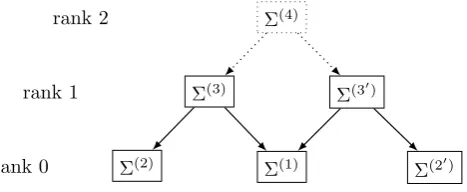
So Conjecture 9.1 predicts that we should have six Euler systems in this setting, one for each region in the diagram: one of rank 2, two of rank 1, and three of rank 0. Moreover, these should be con-nected by explicit reciprocity laws corresponding to the the arrows in Figure 2 on page 26.
At present, the bottom half of Figure 2 (the part drawn in solid ink) is firmly established. The three rank 0 Euler systems – or at least theirp-parts, which are measures on Gal(F∞/K) – are familiar
objects: they are the three p-adicL-functions described in [LLZ15, Theorem 6.1.3]. The two rank 1 Euler systems can be constructed using Beilinson–Flach elements associated to CM families of modu-lar forms; the construction of the CM family relies on a choice of prime above p, so one obtains two Euler systems corresponding to the regions Σ(3) and Σ(30). The four arrows linking these to the p -adic L-functions are all instances of the explicit reciprocity law of [KLZ17, Theorem B]. However, the top, dotted half of the diagram is more mysterious, since we know of no plausible geometric approach to constructing a rank 2 Euler system for the twists in Σ(4).
Remark 10.1.
Fig. 1. Panchishkin subrepresentations for twists ofT
a b
1 1
2 2
3 3
-1
-1 -2
-2
Σ(4)
Σ(2)
Σ(20)
Σ(3)
Σ(30)
Σ(1)
Region Critical? Tp+1 T
+
p2
Σ(1) 0-crit T+ T+
Σ(2) 0-crit T 0 Σ(20) 0-crit 0 T
Σ(3) 1-crit T+ T
Σ(30) 1-crit T T+
Σ(4) 2-crit T T
Fig. 2. Euler systems and explicit reciprocity laws forT
Σ(4)
Σ(3) Σ(30)
Σ(2) Σ(1) Σ(20)
rank 2
rank 1
rank 0
in order to define the rank 1 Euler systems for Σ(3) and Σ(30): the Beilinson–Flach elementsa priori take values in
Vf∗⊗Vg∗ where g is an auxiliary CM Hida family induced
fromK. To identify them with classes inVf∗alone, we need to find a basis ofVg∗ in whichGK acts diagonally. There is no canonical choice of such a basis overQp, but after base-extending toLwe can obtain a canonical basis from Ohta’s Λ-adic comparison isomorphism.
(2) We can obtain a Panchishkin subrepresentation for twists in Σ(1) without assuming that pis split, but the assump-tion that f be ordinary is essential. On the other hand, for Σ(2) and its mirror-image Σ(20), the ordinarity of f is not needed, but the splitting of p is essential; and both conditions are needed simultaneously for Σ(3) or for Σ(30). These are, of course, special cases of the remarks about Rankin–Selberg convolutions in section 7.1 above, since the
L-functionL(f /K, χ, s) can also be described as the Ran-kin–Selberg convolution off with a CM form induced from
χ.
(3) As sketched in§8.2 above, for each node in Figure 2 we can formulate an Iwasawa main conjecture of Greenberg type for T over F∞. These conjectures are not independent of
main conjectures for Σ(1) and Σ(2) are equivalent to each other. Although there is no direct link between the p-adic
L-functions concerned, they are tied together by the explicit reciprocity laws relating both of them to the rank 1 Euler system associated to Σ(3). This observation is due to Xin Wan, and its generalisations play a prominent role in recent work of Wan and his coauthors on the cyclotomic Iwasawa main conjecture and BSD leading term formula for super-singular elliptic curves over Q[Wan15, JSW17].
(4) The representation Tf|GK is the Galois representation at-tached to the base-change off toK, which is a cohomolog-ical automorphic form for the group GL2/K. The conjec-tural picture of Euler systems for T that we describe here would apply equally to the GK-representation attached to any cohomological eigenformF for GL2/K, whether or not it arises from base-change, as long asFis ordinary atp1and p2. However, in the non-base-change setting we can prove much less; for instance, we know of no way of p-adically interpolating the values L(F/K, χ,0) forχ∈Σ(2) ifF is a non-base-change form.
§11. The non-ordinary case
Greenberg’s formulation of Iwasawa theory relies on the exis-tence of Panchkishkin subrepresentations, but in many interesting cases these do not exist. A more flexible theory has been developed by Pottharst [Pot13], based on the observation that for eachv|pone can attach toV|GKv a semilinear algebra object known as a (ϕ,
Γ)-module, denotedD†rig(Kv, V); and there may be interesting
subob-jects ofD†rig(Kv, V) which do not come from subrepresentations of
V. For instance, iff is a modular form, one may attach a rank-1 submodule ofDrig† (Qp, Vf) to any non-zero rootαof the Hecke poly-nomialX2−a
p(f)X+pk−1εf(p), while this submodule only comes from a subrepresentation ifαis ap-adic unit.
locally analytic distributions on Γ, which is aQp-algebra having no natural Zp-lattice. So, in translating from the classical language to the new one, we lose control of theµ-invariants of Selmer groups.
Subject to this caveat, one can generalise the entire conjectural picture of Euler systems described above assuming only that one has a “Panchishkin submodule” ofD†rig(Kv, V) for eachv | p, i.e. a subobject which precisely accounts for all the positive Hodge–Tate weights. When this occurs, we should expect to be able to extend the cohomology classes of Conjecture 6.5 to elements of Pottharst’s ana-lytic cohomology modules in thep-direction, and these Euler systems should satisfy main conjectures, formulated in terms of equalities of characteristic ideals overH(Γ).
Remark 11.1. One new phenomenon that occurs when one re-casts the theory in Pottharst’s setting is that Panchishkin submod-ules are no longer unique. Hence one should formulate Conjecture 7.4 as associating a family of elements of ther-th powers of Pottharst’s analytic cohomology modules to anr-criticalGK-representation to-gether with achoice of Panchishkin submodule at each v|p(which should be understood as a “p-stabilisation”). For instance, the non-ordinary analogue of Figure 2 consists of 11 objects (one Euler system of rank 2, four of rank 1, and six of rank 0), with 16 potential explicit reciprocity laws connecting them. Many, but not all, of these can be constructed using the techniques of [LZ16].
References
[Art04] J. Arthur,Automorphic representations of GSp(4), Contributions to automorphic forms, geometry, and number theory, Johns Hop-kins Univ. Press, 2004, pp. 65–81. MR 2058604. ↑18
[BB08] D. Benois and L. Berger, Th´eorie d’Iwasawa des repr´esentations cristallines. II, Comment. Math. Helv. 83 (2008), no. 3, 603– 677. MR 2410782. ↑22
[Ber03] L. Berger,Bloch and Kato’s exponential map: three explicit formu-las, Kazuya Kato’s Fiftieth Birthday, Doc. Math. Extra Vol. 3
(2003), 99–129. MR 2046596. ↑7
[BK90] S. Bloch and K. Kato,L-functions and Tamagawa numbers of mo-tives, The Grothendieck Festschrift, Vol. I (Pierre Cartier et al., eds.), Progr. Math., vol. 86, Birkh¨auser, Boston, MA, 1990, pp. 333–400. MR 1086888. ↑6
[BS16] D. Burns and T. Sano, On the theory of higher rank Euler, Koly-vagin and Stark systems, preprint, 2016,arXiv:1612.06187.↑ 8
[DJR18] M. Dimitrov, F. Januszewski, and A. Raghuram, L-functions of
GL(2n): p-adic properties and non-vanishing of twists, preprint, 2018,arXiv:1802.10064.↑19
[FK06] T. Fukaya and K. Kato,A formulation of conjectures onp-adic zeta functions in noncommutative Iwasawa theory, Proceedings of the St. Petersburg Mathematical Society. Vol. XII, Amer. Math. Soc. Transl. Ser. 2, vol. 219, Amer. Math. Soc., 2006, pp. 1–85. MR 2276851. ↑22
[GT18] T. Gee and O. Ta¨ıbi, Arthur’s multiplicity formula forGSp4 and restriction toSp4, preprint, 2018,arXiv:1807.03988.↑18 [Gre89] R. Greenberg,Iwasawa theory forp-adic representations, Algebraic
number theory – in honor of K. Iwasawa (J. Coates et al., eds.), vol. 17, Math. Soc. Japan / Academic Press, 1989, pp. 97–137. MR 1097613. ↑19
[JSW17] D. Jetchev, C. Skinner, and X. Wan,The Birch and Swinnerton-Dyer formula for elliptic curves of analytic rank one, Cambridge J. Math.5(2017), no. 3, 369–434. MR 3684675. ↑27
[Kat04] K. Kato,P-adic Hodge theory and values of zeta functions of modu-lar forms, Cohomologiesp-adiques et applications arithm´etiques (III), Ast´erisque295(2004), 117–290MR 2104361. ↑23 [KLZ17] G. Kings, D. Loeffler, and S.L. Zerbes,Rankin–Eisenstein classes
and explicit reciprocity laws, Cambridge J. Math.5(2017), no. 1, 1–122. MR 3637653. ↑22, 23, 24
[LLZ14] A. Lei, D. Loeffler, and S.L. Zerbes, Euler systems for Rankin– Selberg convolutions of modular forms, Ann. of Math. (2) 180
(2014), no. 2, 653–771. MR 3224721. ↑9
[LLZ15] , Euler systems for modular forms over imaginary qua-dratic fields, Compos. Math.151(2015), no. 9, 1585–1625. MR 3406438. ↑14, 24
[LSZ17] D. Loeffler, C. Skinner, and S.L. Zerbes,Euler systems forGSp(4), preprint, 2017,arXiv:1706.00201.↑19
[LZ16] D. Loeffler and S.L. Zerbes,Rankin–Eisenstein classes in Coleman families, Res. Math. Sci.3(2016), no. 29, special collection in honour of Robert F. Coleman. MR 3552987. ↑28
[NS16] J. Nekov´aˇr and A.J. Scholl,Introduction to plectic cohomology, Ad-vances in the theory of automorphic forms and theirL-functions, Contemp. Math., vol. 664, Amer. Math. Soc., Providence, RI, 2016, pp. 321–337. MR 3502988. ↑9
[PR95] B. Perrin-Riou, Fonctions L p-adiques des repr´esentations p-adiques, Ast´erisque229(1995), 1–198. MR 1327803. ↑8 [PR98] , Syst`emes d’Euler p-adiques et th´eorie d’Iwasawa, Ann.
Inst. Fourier (Grenoble) 48 (1998), no. 5, 1231–1307. MR 1662231. ↑8
[Pot13] J. Pottharst,Analytic families of finite-slope Selmer groups, Alge-bra & Number Theory7(2013), no. 7, 1571–1612. MR 3117501. ↑27
[Rub00] K. Rubin,Euler systems, Annals of Mathematics Studies, vol. 147, Princeton Univ. Press, 2000. MR 1749177. ↑2, 3, 4, 8, 20 [Urb05] E. Urban, Sur les repr´esentations p-adiques associ´ees aux
repr´esentations cuspidales deGSp4/Q, Formes automorphes. II. Le cas du groupe GSp(4), Ast´erisque302(2005), 151–176. MR 2234861. ↑18
[Wan15] X. Wan,Iwasawa main conjecture for supersingular elliptic curves, preprint, 2015,arXiv:1411.6352v2.↑27
[Wei05] R. Weissauer,Four dimensional Galois representations, Formes au-tomorphes. II. Le cas du groupe GSp(4), Ast´erisque302(2005), 67–150. MR 2234860. ↑17
(Loeffler)Mathematics Institute
Zeeman Building, University of Warwick Coventry CV4 7AL, UK.
ORCID identifier: 0000-0001-9069-1877 E-mail address: [email protected]
(Zerbes)Department of Mathematics University College London