Proficient Recovery Over Records using Encryption in Cloud Computing
Mrs Maithili K
1, Assistant Professor in Kingston Engineering College ,Ranjith Kumar R
2, Umesh N
3,
Sunil Kumar J
4Abstract—Secure document storage and retrieval is one of the hottest research directions in cloud computing. Though many searchable encryption schemes have been proposed, few of them support efficient retrieval over the documents which are encrypted based on their attributes. In this paper, a hier- archical attribute-based encryption scheme is first designed for a document collection. A set of documents can be encrypted together if they share an integrated access structure. Compared with the ciphertext-policy attribute-based encryption (CP-ABE) schemes, both the ciphertext storage space and time costs of encryption/decryption are saved. Then, an index structure named attribute-based retrieval features (ARF) tree is constructed for the document collection based on the TF-IDF model and the documents’ attributes. A depth-first search algorithm for the ARF tree is designed to improve the search efficiency which can be further improved by parallel computing. Except for the document collections, our scheme can be also applied to other datasets by modifying the ARF tree slightly. A thorough analysis and a series of experiments are performed to illustrate the security and efficiency of the proposed scheme.
Index Terms—Cloud computing, document retrieval, file hier- archy, attribute-based encryption.
I. INTRODUCTION
ORE and more people and enterprises are motivated to outsource their local document management systems to the cloud which is a promising information technique (IT) to process the explosive expanding of data [1]. Cloud computing can collect and reorganize a huge amount of IT resources and apparently, the cloud servers can provide more secure, flexible, various, economic and personalized services compared with the local servers. Despite the advantages of cloud services, leaking the sensitive information, such as personal informa- tion, company financial data and government documents, to the public is a big threat to the data owners. In addition, to make full use of the data on the cloud, the data users need to access them flexibly and efficiently. Consequently, a huge challenge of outsourcing the data to the cloud is how to protect the confidentiality of the data properly while maintaining their searchability.
An intuitive approach is encrypting the documents first and then outsourcing the encrypted documents to the cloud. A large
This research is supported by National Natural Science Foundation of China (Grant No.11261060).
N. Wang and J.W. Zeng are with the School of Mathematical Science, Xi- amen University, Xiamen, 361005, China, e-mail: ([email protected], [email protected]).
J.S. Fu is with the School of Electronic and Information Engineering, Beijing Jiaotong University, Beijing, 100044, China, e-mail: (12120067@bj- tu.edu.cn).
B.K. Bhargava is with the Department of Computer Science, Purdue University, West Lafayette, IN 47906, USA, e-mail: ([email protected]).
number of searchable document encryption schemes have been proposed in the literatures, including single keyword Boolean search schemes [2]–[6], single keyword ranked search schemes [7]–[9] and multi-keyword Boolean search schemes [10]– [14]. However, all these schemes cannot support effective, flexible and efficient document search because of their sim- ple functionalities. Privacy-preserving multi-keyword ranked document search schemes [15]–[18] are more promising and practical. However, all the documents in these schemes are organized by a coarse-grained access control mechanism, i.e., each authorized data user can access all the encrypted documents. As an example, the whole IEEE Xplore Digital Library can be accessed by all the authorized organizations (e.g., the universities) at present and this cannot satisfy the data owners and users in the future.
In this paper, a new situation is considered. A data user may want to access part of the library (e.g., computers and data related papers) and intuitively she wants to pay less money compared with the data users who want to access the whole library. In other words, in the document collection, each document can be accessed only by a set of specific data users. In this case, we need to design a fine-grained access control mechanism for the documents and it is more reasonable compared with the present method.
to decrease the amount of secret keys for the data users is another challenge. Except for access control, document search efficiency is also a challenge for a large document collection. To our knowledge, most existing schemes cannot support time- efficient retrieval over the documents which are organized under attribute-based access control mechanism.
To support the previously discussed service, we first design an algorithm to generate hierarchical access trees for the document collection. The proposed algorithm employs the greedy strategy to build the access trees incrementally and each access tree grows by continuously splitting the nodes in the tree. Then we design a ciphertext-policy attribute-based hierarchical document collection encryption scheme called CP-ABHE. In the proposed scheme, a set of documents can share a same integrated access tree and be encrypted together rather than being encrypted individually. In this way, both the ciphertext storage space and time costs of the encryp- tion/decryption are saved. The security of the proposed scheme is proved theoretically and its effectiveness is also evaluated by simulation.
To support accurate and efficient document search over the encrypted documents, a complicated index structure is then constructed for the document collection. We first map the documents to document vectors based on the TF-IDF model and, in addition, the attributes of the documents are also taken into consideration. The similarity function between the document vectors is carefully designed and the vectors are organized based on their relative similarities in the ARF tree. Specifically, the similar vectors compose micro clusters which are then aggregated with each other to generate macro clusters until all the vectors belong to one cluster. The ARF vectors of the nodes in the tree are used to describe the inherent properties of the clusters represented by the nodes. At last, a depth-first search algorithm for the ARF tree is designed to guarantee both the search efficiency and accuracy.
The main contributions of this paper are summarized as follows:
A practical hierarchical attribute-based document collec- tion encryption scheme is proposed in which the documents are organized and controlled based on attributes. The proposed scheme can greatly decrease the storage and computing bur- dens.
We map the documents to vectors in which both the keywords and associated attributes are considered. The ARF tree is proposed to organize the document vectors and support time-efficient document retrieval. In addition, a depth-first search algorithm is designed.
A thorough simulation is performed to illustrate the securi- ty, efficiency and effectiveness of our scheme. Specifically, the proposed encryption scheme performs very well in both time and storage efficiency. In addition, our scheme also provides efficient and accurate document retrieval method.
The rest of this paper is organized as follows: The related work is provided in Section II. In Section III, we state the prob- lem and present some preliminary techniques. The hierarchical attribute-based document encryption scheme is designed in Section IV and we present the time efficient document retrieval approach based on the ARF tree in Section V. The security
and efficiency analysis of our scheme is provided in Section VI and we further evaluate the performance of the proposed approach by experiments in Section VII. At last, Section VIII concludes this paper.
II. RELATED WORK
Our approach is mainly related with two research fields of cloud computing, i.e., ciphertext-policy attribute-based docu- ment encryption and encrypted document retrieval. The related work in these two fields is provided in the following.
Since Sahai et al. proposed the identity-based encryption (IBE) scheme [19], many ABE schemes [20], [32]–[34] have been proposed in which CP-ABE schemes [21]–[26], [35] are very promising because of their flexibility and scalability. In these CP-ABE schemes, the documents with different access structures need to be encrypted individually. To improve the encryption/decryption efficiency and scalability hierarchical attribute-based encryption has been widely researched [28]– [31] in which a set of documents may share a common access structure and can be encrypted together. Wang et al. propose a hierarchical attribute-based encryption scheme named FH- CP-ABE [28] and have proved its security theoretically. An advantage of the scheme is that the data users can decrypt all the authorized documents by computing the secret key once. Therefore, both the time costs of encryption and decryption are saved. Wang et al. design a scheme named HABE [29] with the traits of high performance, fine-grained access control, scalability and full delegation. HABE is a combination of hierarchical identity-based encryption and CP-ABE. Wan et al. propose hierarchical attribute-set-based encryption scheme (HASBE) [30] by extending ciphertext-policy attribute-set- based encryption (ASBE) with a hierarchical structure of the data users. The HASBE scheme can be seamlessly in- corporated with a hierarchical structure of system users by applying a delegation algorithm to ASBE. Deng et al. extend ABE to CP-HABE [31] to support hierarchically distributing and delegating the secret keys which can be used in large organizations. Guo et al. [36] propose a resilient-leakage hier- archical attribute-based encryption scheme to defend against the auxiliary input leakage attack and the security of the scheme is detailedly analyzed.
C · · ·
dynamically with an acceptable communication burden. How- ever, the document vectors are chaotically organized in the tree and the search efficiency can be further improved. Chen et al. [15] take the relationships of documents into consideration and a hierarchical-clustering-based index structure is designed to improve the search efficiency. In addition, a verification scheme is also integrated into their scheme to guarantee the correctness of the results. Though the index structure can obtain sub-linear search efficiency, it cannot return the accurate search results. Fu et al. [16] present a personalized multi- keyword ranked search scheme in which an interest model of the data users is integrated into the document retrieval system to support personalized search and improve users’ search experience. Specifically, the interest model of a data user is built based on her search history with the help of WordNet [38] in order to depict her behaviors in fine grit level. However, this scheme cannot support dynamic update operations, because the document vectors are constructed based on the statistical information of all the documents in the collection. In addition, though a MDB-tree is employed to improve the search efficiency, the effectiveness of the tree is hard to predict. Li et al. [39] propose a new attribute- based encryption scheme (KSF-OABE) which can implement keyword search function. Though the design goal of KSF- OABE is some similar with our scheme, it cannot hierar- chically encrypt a document collection and support efficient multi-keyword document retrieval.
III. PROBLEM STATEMENT AND PRELIMINARIES In this section, we state the problem and provide the related preliminary techniques. For convenience, some notations are first defined as follows:
The plaintext document collection of N files, denoted as = F1, F2, , FN . Each document is treated as a sequence of keywords. Note that, each file Fi(1 i N ) has a unique identifier fi(1 i N ) in the whole document collection.
• A− The attribute dictionary, denoted as A =
[image:3.612.319.562.72.215.2]{A1, A2, · · · , An}. Each document and data user is associated
Fig. 1. System model
document’s attribute set is a subset of the data user’s attribute set and this will be discussed in Section IV.A.
The result of a search request, i.e., a set of encrypted documents which are the top-k relevant documents to the request under the constraint of a data user’s attributes.
A. System Model and Design Goals
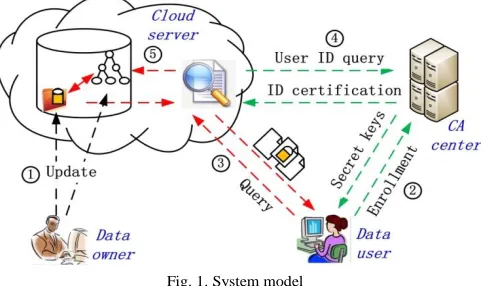
In this paper, we attempt to design a fine-grained access control mechanism for the encrypted documents which also support efficient document search. The search result of a query is defined as the top-k relevant encrypted documents with legal attributes. The process of executing a document query is presented in Fig. 1 and it is mainly composed of five stages:
1 The data owner is responsible for collecting and pre- processing the documents, and then obtains a set of high quality files . He sets the attributes for each document and then hierarchically encrypts the document collection based on attributes. In addition, an index vector is extracted from each document based on the document’s content and attributes. An index structure is constructed based on the index vectors of the documents. At last, both the encrypted documents and encrypted index structure are sent to the cloud server. The cloud server is responsible for storing the encrypted documents and executing document search based on the index structure. with a set of attributes in .
The ciphertext of . In this paper, is symmetrically encrypted by content secret keys ck = ck1, ck2, , ckN , i.e., i= Ecki (Fi), i = 1, 2, , N and all the ciphertexts of the files compose .
The index structure of . Each document is first mapped to a document vector and the vectors are organized in an ARF tree.
The keyword dictionary, denoted as = w1, w2, , wm , which is used to generated the document vectors and query vectors.
que
•
ry
W
.
Q− A subset of W, representing the keywords in a
The document query request of a data user. Each query contains multiple keywords Q which are employed to describe the interested documents. In addition, the attributes of the data user are also added into to check the legality of a document. We say that a document has legal attributes if the
2 When a data user wants to search a set of interested documents, she first needs to register herself as an authorized data user at the certificate authority (CA) center. Then, if possible, several attributes selected from are assigned to the data user by CA and a corresponding secret key associated with these attributes is sent to the data user. At last, the data user can send a query request to the cloud server.
· · ·
· · ·
cannot search the interested documents through the cloud server. However, the security of the system doesn’t greatly decrease without this functionality and it can be explained by the fact that the illegal data users cannot decrypt the documents returned by the cloud server because they don’t have the secret keys.
In this paper, we assume that the CA center and the cloud server are trustable. Specifically, the CA center can distribute proper attributes to the data users and the cloud server can execute all the instructions honestly. We further assume that the data users are greedy and attempt to obtain as many plaintext files as possible. The data users try to collude with other users to decrypt the encrypted documents. We mainly restrict our attention to the process of encryption, document search and decryption, and the design goals of our scheme are presented as follows:
Flexibility. The documents can be encrypted and decrypt- ed flexibly based on their attributes. In general, we hope that the proposed scheme can get logarithmic encryption and decryption time efficiency.
Compactability. For a data user with an attribute set, she needs to store only one secret key and the key can be used to decrypt all the documents that have legal attributes.
Accuracy. The search results are accurate according to the data users’ search request.
Efficiency. Our scheme aims to achieve logarithmic search efficiency over the encrypted files in general and at least sub- linear search efficiency in the worst case.
Vj′[i] = 0. The attribute vector of a data user VQ′ can be constructed based on the user’s attributes in the similar manner. At last, we adopt the widely used “TF-IDF” measurement to calculate the relevance score between a document Fj and a query Q as follows:
RScore(Fj, Q) = RScore(Vj, VQ) = Vj· VQ (2)
It can be observed that the attribute vectors are not employed when calculating the relevance scores between a document and a query. This is reasonable considering that we need to return the legal documents of the query rather than the documents that have similar attributes with the query.
C. Attribute-based Retrieval Feature and ARF Tree
To improve the search efficiency of multi-keywords search process, a height-balanced index tree named ARF tree is built based on the document vectors. Specifically, the document vectors are organized as clusters according to their similarities. Each node in the tree represents a cluster composed of a set of document vectors or sub-clusters. An ARF vector is a quintuple summarization about a cluster. Given P documents Fjwhere j = 1, 2, , P , we assume that a cluster C
comprises the document vectors of Fj, i.e., Vj, Vj′ where j = 1, 2, , P . Then, the ARF vector of the cluster is defined as follows: ARF = (P, LS, SS, Vmax, Amin), where P is the number of document content vectors in the cluster, LS is the linear sum of the P content vectors, i.e., LS = P Vj, SS is the square sum of the P content vectors, i.e., SS =
B. Document/Query Vector P j=
1 V 2
, Vmaxdenotes a vector consisting of m values which
In this paper, the vector of a document is composed of two parts including a normalized content vector and an attribute vector. To build the content vector, each document is treated as a stream of keywords and we use the normalized term frequency (TF) vector to quantize the documents [40]. For each keyword wi in keyword dictionary , we denote the number of times that this keyword appears in the document Fj by fj,wi and the TF value of keyword wiin Fj is defined as T Fj′,w = ln(1 + fj,wi ). We construct the content vector
are calculated as follows:
Vmax[i] = max(V1[i], V2[i], · · · , VP[i]), i = 1, 2, · · · , m (3)
where Vj[i] is the i-th dimensional value of Vj, Amin is the common attribute set vector of the documents in the cluster and it can be calculated as follows:
Amin[i] = V1′[i] ∧ V2′[i] ∧ · · · ∧ VP′ [i], i = 1, 2, · · · , n (4) i
of F as ′ , TF ′ , · · · ′ where V ′[i] is the i-th dimensional value of V ′. For each pair
1 2 m
this vector by of bits in V ′ and V ′, logic operation “ ∧ ” returns 1 if both
T Fj,wi = √
T Fj′,wi , i = 1, 2, · · · , m (1)
the two bits are 1; otherwise, “ ∧ ” returns 0. For each pair of bits in Vi′ and Vj′, logic operation “ ∨ ” returns 1 if either of
Σwk ∈W (T Fj′,w )2
At last, the normalized content vector for Fjis denoted as Vj = (TFj,w1 , TFj,w2 , , TFj,wm ). The inverse document frequency (IDF) value of the keyword wi is defined as
the two bits is 1; otherwise, “ ” returns 0. As an example, (1, 0, 0, 1) (1, 1, 0, 0) = (1, 0, 0, 0); (1, 0, 0, 1) (1, 1, 0, 0) = (1, 1, 0, 1).
In this paper, a search request of a data user contains both a set of keywords WQ and a set of attributes SU associated IDFwi = ln( N ) wi where N is the number of documents with the data user. Only the documents, whose attributes are in the whole collection and Nwi is the number of documents
that contain the keyword wi. Further, the query vector of a query Q is represented as VQ= (q1, q2, · · · , qm) where qiis 0, if wi∈/ WQ; and qiis IDFwi , if wi∈ WQ.
matched with SU and contents are relevant with Q, are returned to the data user. As a consequence, both the content vectors and the attribute vectors of the documents should be taken into consideration in document search process. The sim- The attribute vector of Fjis denoted as Vj′ = ilarity between a pair of documents Fi, Fjwith content vectors (Vj′[1], Vj′[2], · · · , Vj′[n]) which is constructed based on the Vi, Vjand attribute vectors Vi′, Vj′ is defined as follows: attribute dictionary A = {A1, A2, · · · , An} as follows: If
′ ′ Ai∈ att(Fj), Vj′[i] = 1, where the function att(Fj) returns Sim(F ,F )= γ·RScore(V ,V )+(1−γ)· Length(Vi ∧Vj ) (5)
i j Length(V ′∨V ′)
challenger outputs a random 5-tuple (g, A = ga, B = gb, C = gc, T = e(g, g)t). The adversary must then output a guess v′ of v.
An adversary, , has at least an ε advantage in solving the DBDH problem if
a b c abc a b c t
[image:5.612.111.237.64.163.2]|P r[B(g,g ,g ,g ,e(g,g) )=1]−P r[B(g,g ,g ,g ,e(g,g) )=1]|≥2ε
Fig. 2. Assumption of access control mechanism
where 0 γ 1 and RScore(Vi, Vj) is the relevance score between the content vectors of the two documents and it is calculated as:
where the probability is over the randomly chosen a, b, c, t and the random bits consumed by . For the convenience of ex- pression, we denote that BDH = (g, ga, gb, gc, e(g, g)abc)
and BDH = (g, ga, gb, gc, e(g, g)t) .
Definition 1: The DBDH assumption holds if no proba-
bilistic polynomial-time adversary has at least ε advantage in solving the above game.
RScore(Vi, Vj) = Vi· Vj (6)
γ is a preset parameter to adjust the importance degrees of document vectors and attribute vectors, Length(V ′) returns the number of non-zero elements in vector V ′. Based on an ARF vector, the centroid of a cluster C can be easily calculated as:
c = LS/P (7)
and the similarity between cluster C and a document Fjis defined as:
Length(Amin∧Vj′)
E. Selective-Set Security Game
In this paper, we employ the Selective-Set Security Game [21], [28], [41] to prove our scheme’s security. The game is composed of six phases and they are presented as follows.
Init. The adversary declares an access tree with a set of attributes S that he wants to be challenged upon.
Setup. The challenger runs the Setup algorithm presented in Section IV to generate the public parameters which are provided to the adversary.
Query Phase 1. The adversary is allowed to issue queries to obtain the secret keys of any access structure A∗ with attribute
Sim(C,Fj)= γ ·RScore(c,Vj)+(1−γ)·
Length(A ∨V ′) (8) set S
′, where S ¢ S′. The secret keys are generated by the
min j
where 0 ≤ γ ≤ 1 and RScore(c, Vj) is calculated as:
RScore(c, Vj) = c · Vj (9)
Further, the radius of cluster C is defined as follows:
R = ΣP (Vj− c)2/P (10)
and it also can be calculated by the ARF vector as follows:
R = (SS − LS2/P )/P (11)
Theorem 1 (ARF Additivity Theorem) : If we
merge two disjoint clusters with ARF vectors:
ARF1 = (P1, LS1, SS1, Vmax1, Amin1), ARF2 =
(P2, LS2, SS2, Vmax2, Amin2), the ARF vector of the combined cluster is:
ARF = ARF1 + ARF2
= (P + P , LS + LS , SS + SS , V , A )
challenger through the KeyGen(MSK, S′) algorithm. Challenge. The adversary provides two different messages
M0and M1with equal length to the challenger. The challenger randomly flips a coin µ 0, 1 and encrypts Mµ with attribute set S. At last the encrypted message is sent to the adversary.
Query phase 2. The query phase 1 is repeated.
Guess. Based on the obtained information, the adversary output a guess µ′of µ.
We say that our scheme is secure if all the polynomial time adversaries have at most a negligible advantage in the game, where the advantage of the adversary is defined as |Pr(µ′= µ) − |. Otherwise, we say that the adversary wins the game.
IV. HIERARCHICAL ATTRIBUTE-BASED DOCUMENT ENCRYPTION
A. Monotone Hierarchical Access Tree
Let A = {A1, A2, · · · , An} be a set of attributes. A 1 2 1 2 1 2 max min collection A ⊆ 2Ais monotone: Given ∀B, C, if B ∈ A
where Vmax[i]=max(Vmax1[i],Vmax2[i]),Amin=Amin1Amin2.
Proof : The proof consists of straightforward algebra.
D. DBDH Assumption
Let G0, G1 be two groups of prime order p and g is a generator of G0. The operator e is a bilinear map between G0 and G1 as specified in Section IV.B. The challenger chooses
a, b, c, t Zpat random. Then the challenger flips a fair binary
coin v and if v = 1, it generates a BDH 5-tuple (g, A = ga, B = gb, C = gc, T = e(g, g)abc); otherwise, if v = 0, the
and B C, then C A. A monotone access structure of a document is a monotone collection A comprised of non-empty subsets of , i.e., A 2A . The sets in A are called authorized sets and the sets not in A are called unauthorized sets. In this paper, we restrict our attention to monotone access structure which is practical considering the characteristics of the problem stated previously.
T
T T
T T
Algorithm 1 BuildingAccessStructure.
Input: Document collection F = {F1, F2,· · ·, FN} with attribute sets {att(F1), att(F2),· · ·, att(FN)}
Output: A set of access trees ST
1: Sort the files in F in descending order based on the number of their attributes and obtain F′ = {F ′ , F ′ , · · · , F ′ };
[image:6.612.66.287.58.161.2](a) (b)
Fig. 3. Examples of access trees.
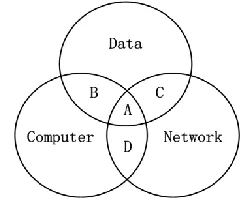
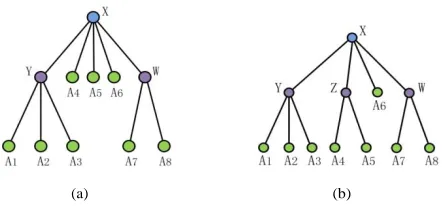
including computer, network and data related documents. Some documents may own two or three attributes such as the documents in region A, B, C and D. Under our assumption, the crossing region A can be accessed by the data users who own all the three roles of computer researcher, network researcher and data researcher; region B can be accessed by the data users who own the roles of data and computer researcher; region C can be accessed by the data users who own the roles of data and network researcher; region D can be accessed by the data users who own the roles of network and computer researcher. Apparently, under our assumption, the access structure of a document is monotone. Take region B as an example, a data user who owns the attribute of data and computer researcher can access B and then any other data users who have at least these two attributes can also access region B.
Let be a monotone hierarchical access tree representing an integrated access structure for a set of documents. The collection of all the access trees is called the access structure of the whole document collection. In this paper, each non- leaf node of the tree represents a threshold “AND” gate and associates with a set of attributes which are represented by the leaf nodes. For convenience, some functions are defined as follows. The number of the child nodes of a non-leaf node x is denoted as numx. The function att(x) denotes the associated attributes with the node x and in addition, att(Fi) also returns the attribute set associated with document Fi. Each node in the tree is assigned with a numerical identifier and the function index(x) returns the identifier of node x. In addition, index(Fi) returns the identifier of Fi. Note that, each non-leaf node has a unique numerical identifier and the leaf nodes that represent the same attribute in different access trees share a same numerical identifier. Each node in an access tree may contain some files identifiers and the corresponding files will be encrypted by this node. The function file(x) return the file identifiers contained in node x.
We say that node Y in the access tree matches a set of attributes S if and only if the attribute set of Y equals to S. As shown in Fig. 3(a), Y matches S if and only if S = A1, A2, A3 and we denotes it as Y (S) = 0. If there is no node in the tree can match S, we check whether a node in the tree can cover S. We say that node X covers S if X cannot match S and the leaf child nodes of X compose a superset of S. We denote TX(S) = 1 if node X covers S. As shown in Fig. 3(a), node Y covers S if S = {A1, A2} and
1 2 N
2: ST= null; 3: for i = 1 : N do 4: S = att(F ′ );
5: Scan the access trees in order; 6: for the scanned access tree in S do
7: if node Y in matches S, i.e., Y(S) = 0 then 8: Insert the identifier of Fi′into node Y ;
9: break;
10: else if node X in covers S, i.e., X (S) = 1 then 11: Build a new node Z and let the created node Z be the
child of X, and further the leaf nodes associated with S are inserted to Z; meanwhile, the leaf nodes are deleted from X;
12: Insert the identifier of Fi′into the new node Z;
13: break;
14: end if 15: end for
16: if the identifier of Fi′has not been inserted into an access tree then
17: Build a new access tree for Fi′based on its attributes and insert the identifier of Fi′to the root node;
18: Insert the tree to ST ; 19: end if
20: end for
node X covers S if S = {A4, A5, A6}.
· · ·
[image:7.612.53.297.73.182.2]· ∀ ∈ ·
Fig. 4. The flow chart of document encryption and decryption
The pseudo-code of incrementally generating the hierarchi- cal access trees for a document collection is presented in Algorithm 1. Based on Algorithm 1, a set of integrated access trees are constructed for the documents. Note that, all the nodes in an access tree compose a monotone access structure and each access tree contains several document identifiers. All the documents in a tree can be encrypted together, which will be discussed in Section IV.B. The identifier of the node x in an access tree is assigned as follows:
1. If x associated with attribute Ai is a leaf node, its numerical identifier is i.
2.If x is a non-leaf node and associated with a set of ordered attributes Ai, Aj, , Ak (i < j < < k), its numerical identifier is ij k.
In this way, each non-leaf node in the access structure has a unique identifier and apparently the leaf nodes associated with a same attribute share a same identifier.
B. Hierarchical Document Encryption
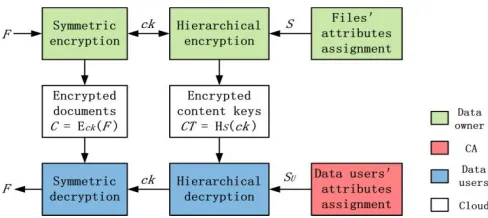
We first describe the system model of hierarchical attribute- based document encryption scheme as shown in Fig. 4. The data owner first selects a set of content keys ck =
ck1, ck2, , ckN which are used to encrypt the documents
in symmetrically. Then, the content keys are hierarchically encrypted by the attributes assigned by the data owner. The encrypted documents, access structure and encrypted content keys are outsourced to the cloud server. In addition, the index structure of the document collection is also stored in the cloud server to support document search and it will be discussed in Section V. Once the encrypted search results are sent to the data users, they decrypt the content keys by their secret keys and further decrypt the documents based on the decrypted content keys. In the following, we mainly discuss how to
In addition, G0 is a bilinear group if the group operations in G0 and the bilinear map e : G0 G0 G1 are both efficiently computable. The Lagrange Coefficient i,S for
i Zpand a set, S, of elements in Zpis defined as i,S(x) =
x−j
. In addition, a hash function H : 0, 1 ∗
is employed to map the string attributes to a random group element in G0.
The detailed process of encrypting the documents is pre- sented in the following:
Setup. Each document in is assigned with a set of attributes and the access structure of the document collection is constructed based on Algorithm 1. A set of content keys
ck = ck1, ck2, , ckN are randomly selected for the files
in which are used to encrypt the files symmetrically. Then the setup algorithm chooses a bilinear group G0 with g as a generator, a bilinear map e : G0 × G0 → G1 and two random numbers α, β ∈ Zp. The public key is published as:
PK = (G0, g, h = gβ, e(g, g)α)
and the master secret key MSK is (β, gα).
Encrypt(PK, ck, ST ). For each attribute Ai in , we first randomly select a unique secret number si Zp. si Zp. Then we choose a secret number skxfor each node x in the access trees. In each access tree, these secret numbers for the nodes are chosen in a bottom-up manner, starting from the leaf nodes to the root node. The number skxof the leaf node x associated with attribute Aiis set as si. Then for the non-leaf node x with a set of child nodes Sx, the secret number skxis computed as skx= z Sx skz i,Sx′ (index(x)) where i = index(z),
Sx′ = index(z), z Sx , index(x) is the numerical identifier of node x. By iterating the above process, each node in the access structure can be assigned with a secret number.
Then, the content keys are encrypted by the secret numbers of the nodes in the access trees. As presented in Algorithm 1, each node x contains a set of file identifiers fm, , fn which can be returned by file(x). We encrypt all the cor- responding content keys {ckm,· · ·, ckn} by the same secret number skx. Specifically, for each access tree in ST, let
Y be the set of leaf nodes in . All content keys related with are encrypted together and the ciphertext is constructed as follows:
CT = (T , ∀x ∈ T , fi ∈ f ile(x) : Cx∗ = gskx , Ci = cki· e(g, g)α·skx ,∀y ∈ Y : Cy= hsky , C
y′ = H(att(y))sky)
Note that, several leaf nodes y1, y2, · · · , ydof different access trees T1, T2, · · · , Tdmay share a same attribute Aiand in this case, Cy1 = Cy2 = · · · = Cyd = h , Cy = Cy2 = · · · =
encrypt the content keys in detail. Cy′
d = H(Ai)
si . Therefore, in the ciphertext of the whole
We first introduce the conceptions of bilinear map and Lagrange interpolation which are involved in our scheme. Let G0 and G1 be two multiplicative cyclic groups of prime order p. Let g be a generator of G0 and e be a bilinear map,
e : G0× G0→ G1with the following properties:
1. Bilinearity: For all u, v G0and a, b Zp, e(ua, vb) =
e(u, v)ab.
2. Non-degeneracy: e(g, g) = 1.
3. Distributivity: For u, v, w G0and a, b, c Zp,
e(ua, vbwc) = e(ua, vb)e(ua, wc).
document collection, only (i.e., the number of attributes) records of Cyand Cy′ need to be stored.
KeyGen(MSK, S). The key generation algorithm takes a set of attributes S as input and output a secret key that identifies the set. We first chose a random r Zp, and then random rj Zp for each attribute Aj S. Then the keys are computed as follows:
SK = (D = gα hr, Aj S : Dj= gr H(Aj)rj , D
j′ = hrj )
[image:8.612.62.288.67.143.2]
Fig. 5. Comparison of CP-ABE, FH-CP-ABE and our scheme
algorithm takes a ciphertext CT, a private key SK which is associated with a set of attributes S, and a node x from as input. If the node x is a leaf node, let Ai= att(x), and if Ai S, the algorithm is defined as follows:
[image:8.612.316.559.67.161.2]e(Di, Cx)
Fig. 6. An ARF tree
number s31, s32. In FH-CP-ABE, file F1, F2 share an access structure and they are encrypted together. File F3 is encrypted individually. In this case, attribute A1 is related with two secret number s11, s12. Attribute A2 is related with s2 and attribute
DecryptNode(CT, SK, x) = e(D′ , C′ ) A3is related with s31, s32. In our scheme, each attribute is
i x related with only one secret number.
e(gr · H(Ai)ri , hskx )
e(hri , H(Ai)skx )
e(gr, hskx )e(H(Ai)ri , hskx )
=
e(hri , H(Ai)skx )
= e(g, g)rβ·skx
If Ai / S, we define DecryptNode(CT, SK, x) = .
When x is a non-leaf node, the algorithm is operated recursively. Specifically, it processes as follows: we denote the set of x’s children nodes by Sx. For each node z Sx, it calls DecryptNode(CT, SK, z) and stores the output as Fz. If at least one Fz =⊥, the function DecryptNode(CT, SK, x)
returns ⊥. Otherwise, we denote i = index(z), Sx′ = {index(z), z ∈ Sx} and compute
V. EFFICIENT RETRIEVAL OVER ENCRYPTED DOCUMENT COLLECTION
In this section, an efficient retrieval scheme over encrypted document collection is designed and we first describe the process of constructing the ARF tree. Then a depth-first searching algorithm of the ARF tree is designed and in addition, it can be operated in a parallel manner flexibly. Given a collection of documents = F1, F2, , FN , each document needs to be scanned for one time and the number of each keyword is recorded. Then a normalized vector for the document is generated based on the keyword dictionary as discussed in Section III.B. The attribute vector of a document can be built based on attribute dictionary △i,Sx′ (index(x))
x z
z∈Sx
= (e(g, g)rβ·skz)△i,Sx′ (index(x))
z∈Sx
= (e(g, g)rβ·Σz∈Sx skz·△i,Sx′ (index(x))
= e(g, g)rβ·skx
If a data user with a set of attributes S that satisfies the sub- tree x, the data user can calculate A = Fx = e(g, g)rβ·skx
and then each content key cki encrypted by node x with
skx can be decrypted by computing Ci/(e(Cx∗, D)/A) =
Ci/(e(gskx , gα hr)/e(g, g)rβ·skx ) = cki. At last, all the
documents encrypted by ckican be decrypted. Otherwise, the data user cannot decrypt the documents.
Note that, in the encryption phase, the secret numbers of the nodes are chosen in a bottom-up manner which is totally different from existing schemes such as ABE and FH- CP-ABE. An advantage of this manner is that all the same attributes in different access trees share a same secret number and this can significantly improve the flexibility of encryption, decryption and secret keys distribution. As an example shown in Fig. 5, three files F1, F2, F3are associated with attribute sets
A1, A2 , A1, A2, A3 and A1, A3 , respectively. In CP- ABE, the three files are encrypted individually and attribute
A1 is related with three random secret number s11, s12, s13,
A2is related with s21, s22, A3is related with random secret
and the associated attributes assigned by the data owner. Organizing the document vectors properly can significantly improve the search efficiency. In some encrypted document retrieval schemes [17], [18], the document content vectors are organized randomly and the search complexity is O(N ), where
N is the number of documents. To improve search efficiency, in some other schemes [15], [16], the vectors are organized based on their relative similarities and they can obtain sub- linear search efficiency. However, the search accuracy cannot be guaranteed. In our scheme, the similarity between a pair of documents is calculated based on both the content vectors and attribute vectors. The proposed scheme can always obtain the accurate search results with at least a sub-linear search efficiency.
For convenience sake, we first describe the structure of an ARF tree briefly. An ARF tree is presented in Fig. 6 and it can be observed that the ARF tree is a height-balanced multi- way tree. An ARF tree has three main parameters including branching factors K1, K2and threshold T which are preset by the data owner. A leaf node Licontains at most K1 document vectors and it is defined as follows:
Li= (ARF, child1, · · · , childj), 1 ≤ j ≤ K1
vectors. Each non-leaf node NLicontains at most K2child nodes and it is defined as follows:
Algorithm 2 DepthFirstSearch.
Input: an ARF tree with root r, a query vector VQ, an attribute vector VQ′ of the data user
NLi=(ARF, ARF1, child1, · · · , ARFj, childj), 1 ≤ j ≤
K2
where ARF is the ARF vector of the whole cluster represented
by NLi, ARFj is the ARF vector of the j-th sub-cluster and
childj is a pointer to the child node representing the sub-
cluster. Therefore, a non-leaf node represents a cluster made up of all the sub-clusters represented by its child nodes. Further, the cluster of a leaf node must satisfy a threshold requirement: the radius of the cluster which can be calculated by (11) has to be less than T .
We construct the ARF tree in an incremental manner which
Output: The most k relevant legal document vectors
1: u r;
2: while u is not a leaf node do
3: for all the child nodes v of node u do
4: Calculate the relevance scores between v with VQby
RScore(v, VQ);
5: Check whether the attribute set Av,minis covered by VQ′ by comparing Length(Av,min VQ′) and Length(Av,min); 6: u the most relevant child node whose attributes are
covered by VQ′; 7: end for
8: end while
9: Select the most relevant k document vectors in the leaf node u
is similar to the construction process of the CF tree [42]. The process of inserting a document Fj with vector Vj, Vj′ into
the ARF tree is presented as follows:
• Identifying the appropriate leaf node: Starting from the
whose attributes are covered by VQ′ 10: Stack.push(r);
11: while Stack is not empty do
12: u ← Stack.pop();
and construct RList;
root, Fj recursively descents the ARF tree by choosing the most similar child node according to the similarity scores between Fj and the sub-clusters as defined in (8) until it reaches a leaf node.
Modifying the leaf node: When Fj reaches a leaf node
Li, it tests whether Lican “absorb” Vj, Vj′ without violating
the constraints of K1 and T . If so, Vj, Vj′ is inserted into
Liand the ARF vector of Liis updated based on Theorem 1 as discussed in Section III.C. If not, we must split Li to two leaf nodes. Node splitting is done by choosing the farthest pair of document vectors based on (5) as seeds, and then redistributing the remaining document vectors based on the closest criteria. The ARF vectors of the two new leaf nodes need to be recalculated.
• Modifying the path from the root node to the leaf node:
13: if the node u is not a leaf node then
14: if RScore(Vu,max, VQ) > kthScore and
Length(Au,min VQ′) = Length(Au,min) then
15: Sort the child nodes of u in ascent order based on the relevant scores with VQ whose attribute sets are covered by VQ′;
16: Push the children of u into Stack in order, i.e., the most relevant child is latest inserted into Stack;
17: end if 18: else
19: Calculate the relevance scores between the document vec- tors in the leaf node with VQ and compare their attributes with VQ′;
20: Update RList; 21: end if
22: end while 23: return RList
After inserting Vj, Vj′ into a leaf node, we need to update
the ARF vector for all the nodes on the path to the leaf node
Li. In the absence of a split, this simply involves updating ARF vectors based on Theorem 1. A leaf node split requires us to insert a new leaf node to the parent node. If the parent node has space for the new leaf node, we just need to insert the new leaf node into it and then update ARF vector for the parent node. In general, however, we may have to split the parent node as well, and so up to the root. If the root is split, the tree height increases by one.
Except for K1, K2, and T , the parameter γ can also affect the structure of the ARF tree. If γ is set to 1, the documents will be organized based on their content only and the associ- ated attributes are ignored. On the contrary, if we set γ as 0, the attributes of the documents decide the ARF tree and the content of the documents are not employed. In general, we can set γ as a number between 0 and 1 to balance the important degrees of documents’ contents and attributes.
Another challenge is searching the top-k relevant documents whose attributes are covered by the data users. We design a depth-first search algorithm for the ARF tree and the pseudo- code is presented in Algorithm 2. For convenience, some symbols and functions are first defined as follows:
kthScore - The smallest relevance score in current result
list RList which stores the most k relevant legal accessed
document vectors with VQ and the corresponding relevance scores in order.
RScore(u, VQ) - The relevance score between the cluster
represented by node u and a query vector VQis defined as
RScore(u, VQ) = c · VQwhere c is the center of the cluster.
Stack - We employ the variable Stack to store the nodes
which need to be searched in the future. In addition,
Stack.push(u) inserts node u into Stack and Stack.pop()
returns the latest inserted node.
Length(V ′) - This function returns the number of
non-zero elements in attribute vector V ′. For two attribute vectors V1′ and V2′, we can test whether V1′ is covered by
V2′ by checking whether Length(V1′ V2′) = Length(V1′). If Length(V1′ V2′) = Length(V1′), V1′ is covered by V2′; otherwise, V1′ is not covered by V2′.
As shown in line 1 to line 9 in Algorithm 2, we first need to initialize RList by finding the most similar leaf node. Then, as shown in line 10 to line 22, the paths in the tree needed to be searched are selected by criteria RScore(Vu,max, VQ) > kthScore and Length(Au,min VQ′ ) = Length(Au,min). This is reasonable considering that if RScore(Vu,max, VQ)
kthScore for a cluster, it is impossible that any document
T ∀ ∈
tive. In addition, if Length(Au,min VQ′ ) = Length(Au,min) for a cluster, all the attributes of the documents in the cluster cannot match that of the data user. As a consequence, this cluster is also unnecessary to be searched. However, if a leaf node is searched, the result list RList needs to be updated. In this way, quite many paths are pruned and hence the search efficiency greatly improves. Once the top-k relevant documents are located in the ARF tree, the corresponding encrypted documents are sent to the data user. Apparently, these legal documents can be decrypted by the data user and then the document query process is completed.
We can further improve the search efficiency by operating the searching process in parallel. In the search process, all the processors need to share the same result list RList. Assume that there is a set of processors = p1, p2, , pl and given a search request, an idle processor pi is used to find most relevant leaf node on the tree and initialize RList. Then, all the necessary search paths are selected based on criteria VQ Vmax > kthScore and Length(Amin VQ′ ) = Length(Amin). If the search process can be continued on q search paths and there are more than q idle processors, any q processors are selected and each processor is responsible for searching a child path. If there is q′(q′ < q) idle processors, they search the latest inserted q′ children paths in Stack. Once an idle processor appears, it continue to search the node generated by Stack.pop(). At last, the most relevant k encrypted files (i.e., the search result ) are sent to the data user and they are decrypted by the secret key of the data user. Though the document retrieval efficiency is greatly im- proved based on the ARF tree, a companying challenge is how to protect the privacy of the document vectors in the index structure and query vectors. Fortunately, this problem has been widely discussed and researched [15]–[17], [37]. In this paper, we strictly employ the method in [18] to protect
a simulator that can play the DBDH game with an advantage ε . The game is executed as follows:
First, the challenger chooses G0, G1, g, a, b, c, t and a bilin- ear map e as specified in Section IV.B. Then he randomly flips a fair binary coin v and if v = 1, T = e(g, g)abc, i.e.,(g, A = ga, B = gb, C = gc, T = e(g, g)abc) BDH ; otherwise, if v = 0, T = e(g, g)t, i.e., (g, A = ga, B = gb, C = gc, T = e(g, g)t) BDH . The challenger sends (g, A, B, C, T ) = (g, ga, gb, gc, T ) to the simulator . The simulator now plays the role of challenger in the security game. Then, the security game are executed as follows:
Init. The adversary dv submits the simulator a set of
attributes S that it wants to be challenged upon.
Setup. The simulator sets α = α′ + ab where α′
is randomly selected from Zp and it computes e(g, g)α = e(g, g)α′ · e(g, g)ab. It further sets h = gβ= gb = B. At last, the public key PK is sent to the adversary Adv.
Query Phase 1. The adversary dv queries the secret
keys SK of any access structure A∗ with a set of attributes S′and S ¢ S′. The simulator B randomly selects a number r′∈ Zpand set r = r′− a. Then it calculates D = gα· hr = gα′+ab · gb(r′−a) = gα′
· hr′ . For each attribute Aj ∈ S′,
B randomly chooses rj ∈ Zp and calculates Dj = g(r′−a) · H(A )rj = gr′ · H(A )rj and D′ = Brj . At last, the secret key SK is sent to the adversary Adv.
Challenge. For convenience sake, we assume that only
one file is encrypted and consequently the ciphertext can be simplified as CT = ( , Cx∗, Ci, y S′ : Cy = Bsky , C
y
′ =
H(att(y))sky ). The adversary dv submits two messages M0 and M1 with equal lengths to . The simulator randomly flips a coin µ 0, 1 and encrypts Mµwith attribute set S. Let Cx∗ = gskx = gc = C. Suppose that the simulator is given a BDH tuple, that is T = e(g, g)abc. Then we the security of the document vectors while maintaining the have C˜i = Mµ · e(g, g)αc = Mµ· e(g, g) abc · e(g, g) α′c =
searchability.
VI. SECURITY ANALYSIS
Mµ T e(g, g)α′c. We see that the ciphertext is a valid encryption of Mµ. Otherwise, we have that T = e(g, g)tis a random element of G1. In that case the ciphertext will give In the document retrieval system, the cloud server and
CA center are assumed to be trustable. In this section, we focus on the security of the proposed hierarchical document encryption scheme and its security mainly involves two aspects including document confidentiality and content keys confi- dentiality. The documents are encrypted based on symmetric encryption schemes (e.g., AES) with content keys and their security is out of the scope in this paper. In this section, we analyze the security of the content keys which are encrypted by the proposed hierarchical encryption scheme. We provide the Decisional Bilinear Diffie-Hellman [28], [41], [43] assumption (DBDH) in Section III.D and Selective-Set Security Game is given Section III.E. In this section, we reduce the security of the content keys to the hardness of the DBDH and prove the security of the proposed scheme under the Selective-Set Security Game.
Theorem 2: Under the DBDH assumption, no polynomial time adversary can win the Selective-Set Security Game.
Proof: Suppose there exists an polynomial adversary dv that can break our scheme with an advantage ε. We can design
no information about the simulator’s choice of µ. At last, the CT is sent to Adv.
Query phase 2. The query phase 1 is repeated.
Guess. The adversary dv makes a guess µ′of µ based on
the obtained information. At the same time, the simulator also makes the corresponding guess of v in playing the DBDH game based on the different results the adversary dv guessed. If µ′ = µ, outputs guess v′ = 1 in playing the DBDH game and points out that the challenger given 5-tuple to it which is selected from BDH . If µ′ = µ, outputs guess v′ = 0 in playing the DBDH game and points out that the challenger given 5-tuple to it which is selected from BDH.
The probability that the simulator successes in playing the DBDH game between simulator and challenger is calculated as follows.
If v = 1, the challenger generates a BDH tuple (g, ga, gb, gc, e(g, g)abc), i.e. (g, A, B, C, T ) BDH. Then we see that CT is a valid encryption of Mµand by definition, in this case the adversary dv has a non-negligible advantage ε to guess the correct µ′, whose probability of success can be
⊇ ⊇ · · · ⊇
TABLE I. Comparison of CP-ABE, FH-CP-ABE and our scheme
Component CP-ABE FH-CP-ABE Our Scheme
Encryption Time [2(|AC1|+· · ·+|ACN|)+N ]CG0+N CG1+N Ce
2[(|t1|+· · ·+|tN|)+N ]CG1+[2(|AC1 |+· · ·+|ACN
|)+N ]Ce
3LG0+LG1
LZp+LG0
[2(|AC1 |+· · ·+|ACN |)+N ]LG0
[2(|AC1 |+· · ·+|ACN |)+N ]LG0+N LG1
Null (2|A|+ρN
)CG0+NCG1+NCe
2N (ρ+1)CG1+(2|A|+N
)Ce
2LG0+LG1
LZp+LG0
(2|A|+1)LG0
(2|A|+ρN )LG0+NLG1
Decryption Time Null
The Size of PK 3LG0+LG1
The Size of MSK LZp+LG0
The Size of SK
The Size of CT
[2(|AC1 |+· · ·+|ACN |)+N
]LG0
Null
calculated as Pr[µ′ = µ (g, A, B, C, T ) BDH] = 1 + ε. If v = 0, the challenger builds a random 5-tuple
(g, ga, gb, gc, e(g, g)t), i.e. (g, A, B, C, T ) BDH. Then we have that T is a random element of G1. The adversary dv did not get any information about the message Mµ, so there is no advantage to guess the correct µ′. As a consequence, the adversary can make a correct choice with a probability 1
. Therefore, the probability of success for the simulator is
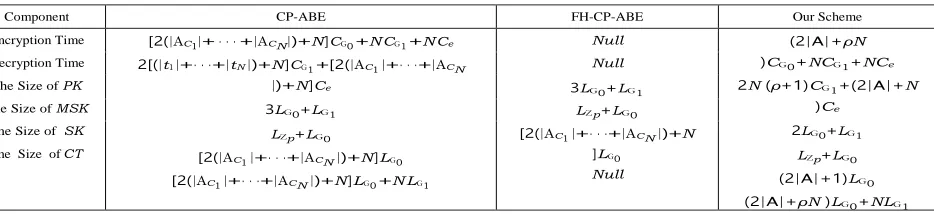
As a consequence, our scheme performs better then CP- ABE in time costs of encryption and decryption, and the sizes of PK, SK and CT . The two schemes have same performance in the size of MSK. In conclusion, our scheme can improve time and storage efficiency compared with CP- ABE. For a constant attribute set and parameter ρ, the encryption time, decryption time and size of CT all increase linearly with the number of documents in our scheme. The 2
Pr[µ′ = µ|(g, A, B, C, T ) ∈ RBDH] = 1
.
sizes of the keys are independent of the document collection.
At last, the overall advantage of B in playing the DBDH
game can be calculated as 1 Pr[µ′ = µ|(g, A, B, C, T ) ∈ In addition, our scheme outperforms FH-CP-ABE in terms of the size of PK and SK and they have similar performance
PBDH ] + 1Pr[µ′ = µ| (g, A, B, C, T 2 ) ∈ RBDH ] − 1 = ε . in terms of MSK. Considering that FH-CP-ABE is designed
Based on the definition of DBDH assumption, we can infer that our scheme is secure. The theorem is proved.
VII. PERFORMANCE EVALUATION
In this section, we evaluate the performance of the hierar- chical document encryption scheme and in addition the search efficiency of the ARF tree. We first analyze the efficiency the- oretically and then conduct experiments to verify the analysis result.
A. Theoretical Analysis
We compare our hierarchical encryption scheme with CP- ABE scheme in [21] and FH-CP-ABE scheme [28], and some definitions are defined first. We assume that CGi (i = 0, 1) is the time cost of an operation on the group such as exponenti- ation or multiplication. Let Zpbe the group 0, 1, , p 1
and Ce be the cost of an bilinear map operation e. Let N be the number of documents in the collection, ρ be a parameter that associated with Algorithm 1 and ρN is the number of the nodes in all the access trees. Considering that a set of file identifiers share a node in the access trees, ρ is naturally smaller then 1. Let , Au, ACi be the attribute dictionary,
the attributes associated with the data user and document Fi respectively. Let ti be the number of interior nodes in the access tree of file Fi. In addition, we define | ∗| as the number of elements in , L∗as the length of an element in .
In the analysis, we assume that the data owner has N document files and their content keys are encrypted by CP- ABE, FH-CP-ABE and our scheme. Note that, we focus on the encryption process of the content keys rather than that of the documents which are encrypted by the content keys symmetrically. We further assume that a data user is respon- sible for decrypting all the documents and the analysis result is presented in Table 1. For a large document set, we have
|A| ≪ (|AC1 |+· · ·+|ACN |) and ρN < N ≪ |t1|+· · ·+|tN|.
to encrypt a set of documents with incremental attribute sets, i.e., AC1 AC2 ACN , it is impossible to accurately
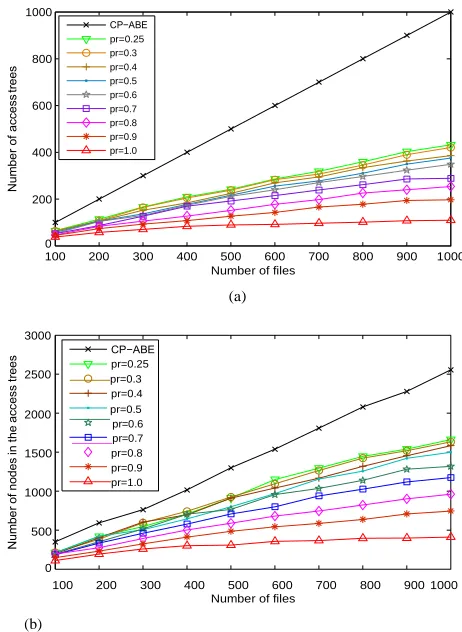
predict the time cost of encryption and decryption and the size of CT for a document collection with randomly assigned attribute sets. As a consequence, we will further compare our scheme with FH-CP-ABE by simulation in Section VII.B.
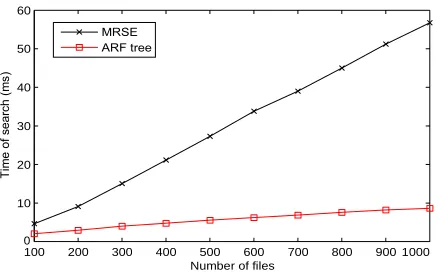
The organization structure of the document collection af- fects the search efficiency significantly. The keyword balanced binary (KBB) tree [18] can provide accurate search result. However, the document vectors are randomly inserted into the tree and they are organized chaotically. Some similar vectors may locate very far in the tree and some totally different vectors may be neighbors with each other. Consequently, the interior nodes in the tree can provide very limited information to lead a query vector to the area with a set of strongly relevant document vectors. On the contrary, the vectors in the ARF tree are organized strictly according their similarities and similar vector can always compose a cluster in spite of the vectors’ input order. The query vector can easily locate a cluster that contains relevant document vectors. The search proportion is defined as the proportion that the document vectors being searched in a search process and it is calculated by the number of the searched nodes to the number of all the nodes in the tree. A basic comparison between the two trees is presented in Fig. 7. All the document vectors are randomly generated in 2D and 3D space. To be fair, we ignore the attributes of data user and documents considering that the KBB tree does not support attribute constrained search. It can be observed that the ARF tree outperforms KBB tree significantly in both 2D and 3D spaces. Specifically, the search proportion of ARF tree is about 5% to 10% to that of KBB tree.
B. Experimental Simulation