warwick.ac.uk/lib-publications
Manuscript version: Author’s Accepted Manuscript
The version presented in WRAP is the author’s accepted manuscript and may differ from the published version or Version of Record.
Persistent WRAP URL:
http://wrap.warwick.ac.uk/115184
How to cite:
Please refer to published version for the most recent bibliographic citation information. If a published version is known of, the repository item page linked to above, will contain details on accessing it.
Copyright and reuse:
The Warwick Research Archive Portal (WRAP) makes this work by researchers of the University of Warwick available open access under the following conditions.
Copyright © and all moral rights to the version of the paper presented here belong to the individual author(s) and/or other copyright owners. To the extent reasonable and
practicable the material made available in WRAP has been checked for eligibility before being made available.
Copies of full items can be used for personal research or study, educational, or not-for-profit purposes without prior permission or charge. Provided that the authors, title and full
bibliographic details are credited, a hyperlink and/or URL is given for the original metadata page and the content is not changed in any way.
Publisher’s statement:
Please refer to the repository item page, publisher’s statement section, for further information.
EM sensor array system and performance evaluation for inline
measurement of phase transformation in steel
H. Yang1, F.D. van den Berg1, C. Bos1, A. Luinenburg1, J. Mosk1,
P. Hunt2, M. Dolby2, J. Hinton2, A. J. Peyton3, C. L. Davis4
1 Tata Steel, The Netherlands, [email protected] 2 Primetals Technologies, United Kingdom, [email protected] 3 University of Manchester, United Kingdom, [email protected]
4 University of Warwick, United Kingdom, [email protected]
Abstract
In a hot strip mill (HSM), the evolution of phase transformation in steel during the dynamic cooling process on a runout table has a significant effect on the microstructure and mechanical properties of hot-rolled materials and further processing in the subsequent processing steps. An electromagnetic (EM) sensor array system, EMSpec® (ElectroMagnetic Spectroscopy), has been developed for in-line measurement of steel phase transformation. The first industrialised system has been installed on the run-out table (ROT) of HSM #2 at Tata Steel in the Netherlands for industrial trials. The EMSpec system consists of multiple sensor nodes located at different positions on the run-out table. Each sensor node measures the impedance spectrum, from which the amount of transformed phase fraction is determined based on a measurement model. All of the sensor nodes are calibrated for the delivery of proper sensor signals, such that progressively increasing phase transformation of the steel strip travelling from one node to the next can be correctly measured. Besides the sensing principle and system calibration, this paper presents in-line measurement results, which are interpreted and compared with phase transformation predictions from a physical thermodynamic and kinetic phase transformation model.
1. Introduction
2
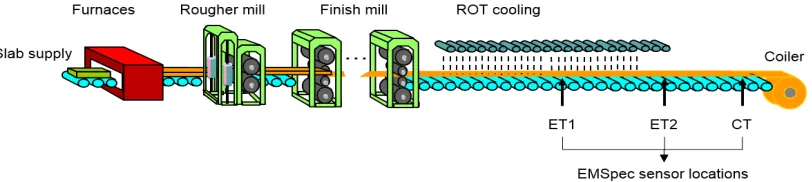
Figure 1. A simplified schematic diagram of hot strip mill rolling and ROT cooling process. Multiple EMSpec sensors are installed between rolls in the ROT cooling zone to
measure the evolution of the phase transformation during the cooling process.
For the current practice, strip temperature measurements by optical pyrometers are used as an indicator, together with thermodynamic and kinetic phase transformation models, for the cooling process control. It is quite often that the phase transformation behaviour is not well predicted by the models, especially for high-strength steels, either due to incomplete knowledge and models for the change in the microstructure, or due to insufficient or inaccurate information on the process and material conditions. This underlines the need for an inline system for the measurement of the amount of transformed phase evolving on the ROT.
An electromagnetic sensor array system, EMSpec® (ElectroMagnetic
Spectroscopy), has been developed for inline measurement of steel phase transformation. The principles of phase transformation measurement using EM sensors were developed by the Universities of Manchester and Warwick [2] and the EMSpec sensor was initially prototyped by the University of Manchester and Tata Steel, and later industrialized by Primetals Technology Limited (previously known as Siemens VAI) [3][4]. The first industrialised system was installed in 2015 on the run-out table of the hot strip mill (HSM) #2 at Tata Steel in IJmuiden in The Netherlands, as schematically shown in Figure 1. Three sensor nodes were installed at different locations where pyrometers are present: the first two sensors are at the intermediate positions ET1 and ET2, the third one at the CT location before coiling. The sensor array system is robustly designed and constructed to survive the harsh environment, whilst maintaining proper sensing functionality.
Although each sensor head has been replicated to be the same, surrounding environments, e.g. roller gaps, might not be exactly the same, depending on the locations where sensor heads are installed. For this reason, calibration all the sensor heads is necessary such that all the heads give the same measurement values for material with the same EM properties. This makes sure that the progressively increasing phase fractions can be accurately measured.
transformation model in Section 4. Finally, conclusions will be drawn in Section 5.
2. Sensor design and industrialisation
[image:4.595.108.490.434.607.2]For each sensor node, the core component is the “H” form yoke with excitation coil winding on the centre bar and with sensing coils on the four legs. In addition to the sensor yoke, auxiliary components are robustly designed and added in order to protect the yoke against the harsh production environment on the run-out table in a hot strip mill, where hot strips having a temperature in the range 500 – 800 °C pass at speeds up to 20 m/s, without hindering sensors functioning. The auxiliary components mainly consist of a steel container, a ceramic hatch and a water cooled steel housing.
Figure 2 illustrates the internal assembly of the sensor [4][5]. The sensor yoke is first encapsulated in the steel container and then mounted into the steel housing capped off with the hatch. The steel container and the housing provide magnetic shielding from the surrounding environment. The hatch is an integration of a steel frame and a ceramic window, which not only gives protection from mechanical impact but also provides a passage for the magnetic field that interacts with the hot steel above the hatch. The steel housing and the hatch have been designed to have regulated water flow inside the housing and a laminar flow around the sensor, which allows for optimal functioning of the sensor head at a relatively stable temperature.
Figure 2. Mechanical assembly and installation of each sensor head on the run-out table.
The sensor head is mounted on a slider bar together with a pyrometer, which allows for inline measurement of both strip temperature and phase transformation at the same time. Thanks to its compact design, the whole assembly can be installed in the narrow gap (74 mm in our case) between transportation rolls. The easy retraction of the slider bar allows convenient access for testing and maintenance of the system.
4
The core sensing component of each sensor node consists of a H-shaped ferrite yoke, one excitation coil, one active sensing coil and one dummy sensing coil, as depicted in Figure 3. The excitation coil runs simultaneously at multiple frequencies, which are typically in the range from hundreds Hz to tens of kHz. The serial connection between the active and dummy coils delivers a differential output, which is sensitive to the presence of the steel above the active side thanks to the cancellation of imperfections existing in the coil windings and electrical circuits. For each measurement, a complex mutual inductance spectrum is calculated using a digital signal processor (DSP) based on the fast Fourier transforms of the measured excitation current and induced voltage.
Figure 3. Each sensor node consists of ferrite yoke, excitation coil and sensing coils.
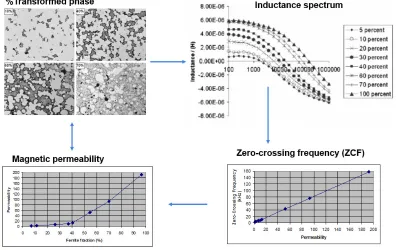
The basic principle of measuring the amount of transformation phase fraction is schematically shown in Figure 4. Each inductance spectrum gives a finger print of the microstructure corresponding to a certain amount of ferrite phase statistically mixed with austenite phase. A zero-crossing frequency (ZCF), which is the frequency at which the inductance goes to zero, is characterised by the effective electrical resistivity and low field magnetic permeability of the steel strip under measurement [2]. The low field magnetic permeability can be deduced from the ZCF and is used to determine the amount of phase fraction by using effective medium theory.
The advantage of using the ZCF to determine the low field magnetic permeability is that it is relatively insensitive to the variation of lift-off distance compared to the inductance itself [6]. Here the lift-off refers to the distance between the sensor head and the steel strip above the sensor. This is a particularly important feature for inline measurement on the ROT in a HSM, where a fast travelling strip has always this sort of lift-off variation.
In addition to the establishment of the links between sensor output and the amount of transformed phase fraction, the temperature dependencies of
electrical resistivity and low field magnetic permeability are also taken into account in the measurement models [7]. Currently the system has been developed for the measurement of steel’s austenite-ferrite phase transformation, which could be further extended for advanced high-strength steels (AHSS).
Figure 4. The amount of ferrite phase in a two phase austenite and ferrite microstructure is linked with steel’s low field magnetic permeability, which is deduced from the ZCF measured by the inductance sensors. Examples here are shown for room temperature
mixed austenite – ferrite model microstructures [8].
For distributed sensing of phase transformation on the ROT, multiple sensors are installed at different locations. All the sensor nodes have to be calibrated to deliver the same low field magnetic permeability values, which are determined from the ZCFs, for the same material with certain electrical and magnetic properties. This is required for correct measurement of the progressively increasing phase transformation of the steel strip travelling from one node to the next one over time.
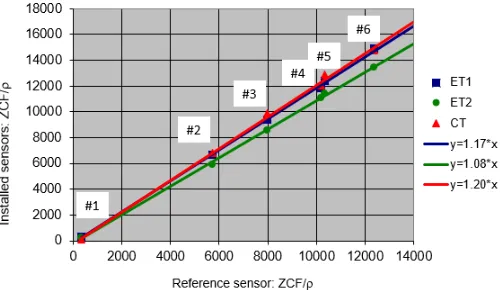
The calibration is carried out by measuring several materials, at room temperature, which have a large spread of electrical and magnetic properties. For the three nodes installed at the ET1, ET2 and CT locations on the run-out table in Figure 1, we have measured the ZCF values for six different steel strips. The ratio between the ZCF and the electrical resistivity (i.e. ZCF/ρ) represents a scaling of the intrinsic magnetic permeability and varies slightly from one sensor node to another. Figure 5 shows ZCF/ρ of the three inline sensors against a reference sensor in the laboratory.
6
[image:7.595.174.424.180.325.2]scaling factors of individual nodes determined and applied in the sensor model, low field magnetic permeability values can be properly delivered by all the sensor nodes and are subsequently translated into a quantitative measurement of the amount of transformed phase fraction, using the approach indicated in Figure 4.
Figure 5. For six steel strips #1 - #6, the ratios ZCF/ρ are measured by the three installed
EMSpec sensors and compared with a reference one.
4. Inline measurement results
With all the three EMSpec sensors calibrated, the amount of transformed phases from austenite to ferrite on the ROT can be measured and delivered in real time. The inline measured results are compared with calculated values by using thermodynamic and kinetic phase transformation models.
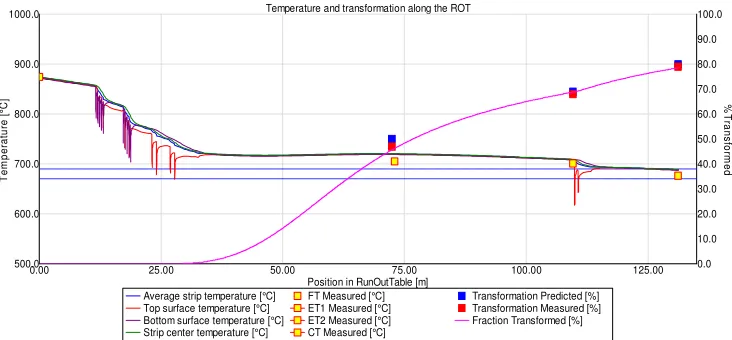
For the purpose of illustration, Figure 6 gives an example of a single steel strip. This figure shows measured temperatures by pyrometers (yellow square) and percentages of the transformed phase by the EMSpec sensors (red square) at the three locations on the ROT, which are compared to inline mill model
predicted phase transformation (blue square) and offline model calculated strip temperature (see labels in the plot) and phase transformation (purple line). The blue squares concern the inline calculated amounts of phase transformation at ET1, ET2 and CT. It is expected that the offline model gives relatively more accurate calculations of phase transformation than the inline feed forward
Figure 6. For a sample steel strip, calculated strip temperatures, including average, top/bottom surfaces and strip centre temperatures, and phase transformation (the purple
line: offline model; blue squares: inline model) on the ROT using mill models. They are compared with measured temperatures (yellow squares) and transformations (red
squares) by EMSpec sensors at 3 locations.
One can see from the figure that with water applied for cooling control, the strip temperature decreases and the amount of transformed phase is progressively increasing when the strip moves from the finishing mill exit to the coiler on the run-out table. It is evident from the comparison that the transformed phase fractions measured by the EMSpec sensors and calculated by the off-line mill model are in good agreement.
Since the off-line calculated and inline measured temperatures at ET1, ET2 and CT are also in good agreement, and the phase transformation generates heat which heats up the strip, it can be concluded that the EMSpec sensors accurately measure the phase transformation fractions at ET1, ET2 and CT for this sample steel strip.
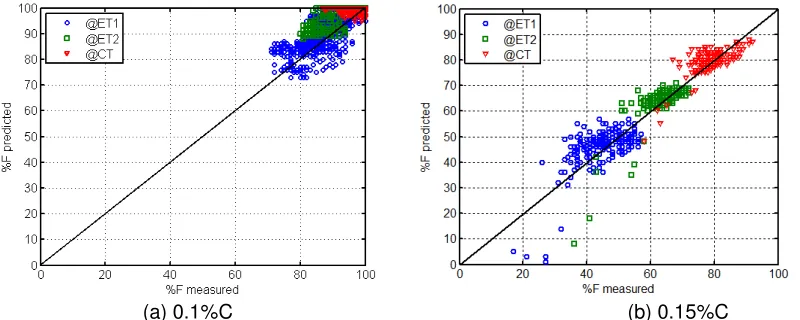
In addition to the validation using the offline model, we have collected both EMSpec data and inline mill data for multiple steel coils. Figure 7(a) and (b) give the EMSpec measurement versus the inline mill model predictions for coils with a carbon content 0.1%wt C and 0.15%wt C, respectively. One can see that the difference between EMSpec measurements and inline mill model predictions is generally within ±10%.
Temperature and transformation along the ROT
Position in RunOutTable [m]
T e m p e ra tu re [ °C ] % T ra n s fo rm e d 125.00 100.00 75.00 50.00 25.00 0.00 1000.0 900.0 800.0 700.0 600.0 500.0 0.0 10.0 20.0 30.0 40.0 50.0 60.0 70.0 80.0 90.0 100.0
Average strip temperature [°C] Top surface temperature [°C] Bottom surface temperature [°C] Strip center temperature [°C]
FT Measured [°C] ET1 Measured [°C] ET2 Measured [°C] CT Measured [°C]
8
[image:9.595.97.497.93.253.2](a) 0.1%C (b) 0.15%C
Figure 7. Inline measured phase transformation by the EMSpec sensors versus inline mill model predictions at the 3 sensor locations on the run-out table for sample steel coils
with carbon content 0.1%C (a) and 0.15%C (b).
The results in Figure 7 also indicate that for a relatively small amount of carbon content, the majority of the phase transformations in the strips occur in the early section of the run-out table and hence the strips are in general fully transformed before coiling. With the increase of carbon content, the majority of the phase transformations in the strips tend to occur at locations shifting towards the coiler and there is an increasing possibility of incomplete phase transformation on the run-out table before coiling. For AHSS steels with higher alloy content, the evolution of microstructure on the ROT will be more sensitive to the variations of processing parameters than conventional steels and it becomes more challenging for the real-time mill model to predict the phase transformation. Hence, inline measurement of phase transformation becomes even more valuable. The results from the real-time EMSpec system can be used for a better understanding on the variations of microstructures during the cooling process and for improvements on thermodynamic and kinetic phase transformation models, which can be used to refine the cooling strategies of these steels.
5. Conclusions
This paper has described an industrialised EMSpec sensing system, which is installed in the run-out table in a hot strip mill for the real time measurement of steels phase transformation during the controlled cooling process. The paper has explained the basic sensing principle and the measurement concept of linking the electromagnetic sensors’ output to the amount of transformed phase fraction. In addition, the paper has presented the procedure of calibrating multiple sensor nodes in order to measure accurately the progressively increasing phase transformation when steel strips travel from one node to the next before coiling.
With increasing alloy content and especially for advanced high strength steels, variations of microstructure will be more sensitive to the processing conditions and it becomes more challenging for accurate prediction of phase transformation on the run-out table using inline mill models. Hence, the EMSpec system will be more valuable for real-time monitoring of phase transformation. The results from the EMSpec sensor measurements can be used for a better understanding on the variations of steels microstructure on the run-out table and for the improvements of metallurgical models, which can be used to refine the tuning of cooling strategies.
References
[1] VB. Ginzburg, Metallurgical Design of Flat Rolled Steels (Manufacturing
Engineering and Material Processing), Springer Science & Business, 2005
[2] W. Yin, X.J. Hao, A.J. Peyton, M. Strangwood and C.L. Davis, “Measurement of
permeability and ferrite/austenite phase fraction using a multi-frequency electromagnetic sensor,” NDT&E Int., vol.42, pp.64-68, 2009
[3] W. Zhu, H. Yang, A. Luinenburg, F. vd Berg, S. Dickinson, W. Yin, AJ Peyton, “The
development and deployment of an on-line multi-frequency electromagnetic system to monitor steel hot transformation on the run-out table of a hot strip mill”,
Ironmaking and Steelmaking 2014 Vol41 No.9 pp685-693
[4] P. Hunt, P. Sherman, AJ. Peyton, F. vd Berg and H. Yang, “The Real Time
Transformation Control at Hot Strip Mill”, METEC 2015, 16 – 19 June 2015, Düsseldorf Germany.
[5] F. vd Berg, H. Yang, J. Mosk, A. Peyton and P. Hunt, “Inline monitoring of phase
transformation in hot strip mill”, the 52nd Rolling Seminar in the ABM Week, Rio de
Janeiro, Brasil, Aug 2015.
[6] W. Yin, R. Binns, SJ. Dickinson, CL. Davis, AJ. Peyton, “Analysis of the Liftoff
Effect of Phase Spectra for Eddy Current Sensors”, IEEE Trans Instrum Meas, 56, 2775-2781 (2007)
[7] H. Yang, F. vd Berg, A. Luinenburg, C. Bos, G. Kuiper, J. Mosk, P. Hunt, M. Dolby,
M. Flicos, A. Peyton, C. Davis, “In-Line Quantitative Measurement of Transformed
Phase Fraction by EM Sensors during Controlled Cooling on the Run-Out Table of a Hot Strip Mill”, 19th World Conference on Non-Destructive Testing 2016 (WCNDT-2016), paper Mo_1_G_4.
[8] X J Hao, W Yin, M Strangwood, A J Peyton, P F Morris, C L Davis, ‘Modelling the
![Figure 2 illustrates the internal assembly of the sensor [4][5]. The sensor yoke](https://thumb-us.123doks.com/thumbv2/123dok_us/9426695.447020/4.595.108.490.434.607/figure-illustrates-internal-assembly-sensor-sensor-yoke.webp)