warwick.ac.uk/lib-publications
Original citation:
Hartlieb, M., Williams, E. G., Kuroki, A., Perrier, Sébastien and Locock, K. E.. (2017)
Antimicrobial polymers : mimicking amino acid functionality, sequence control and
three-dimensional structure of host-defense peptides. Current Medicinal Chemistry, 24 .
Permanent WRAP URL:
http://wrap.warwick.ac.uk/88727
Copyright and reuse:
The Warwick Research Archive Portal (WRAP) makes this work by researchers of the
University of Warwick available open access under the following conditions. Copyright ©
and all moral rights to the version of the paper presented here belong to the individual
author(s) and/or other copyright owners. To the extent reasonable and practicable the
material made available in WRAP has been checked for eligibility before being made
available.
Copies of full items can be used for personal research or study, educational, or not-for-profit
purposes without prior permission or charge. Provided that the authors, title and full
bibliographic details are credited, a hyperlink and/or URL is given for the original metadata
page and the content is not changed in any way.
Publisher’s statement:
The published manuscript is available at EurekaSelect via
http://www.eurekaselect.com/149294/article
A note on versions:
The version presented here may differ from the published version or, version of record, if
you wish to cite this item you are advised to consult the publisher’s version. Please see the
‘permanent WRAP URL’ above for details on accessing the published version and note that
access may require a subscription.
XXX-XXX/14 $58.00+.00 © 2014 Bentham Science Publishers
Antimicrobial polymers: Mimicking amino acid functionality through to
three-dimensional structure of host-defense peptides
Matthias Hartlieb
a, Elizabeth G. L. Williams
b,
Agnès Kuroki
a,
Sébastien Perrier
a,cand
Katherine E. S.
Locock
a*aDepartment of Chemistry, The University of Warwick, Coventry CV4 7AL, UK; bCSIRO Manufacturing, Clayton, VIC 3168, Australia; cFaculty of Pharmacy and Pharmaceutical Sciences, Monash University, 381 Royal Parade, Parkville, Victoria 3052, Australia
Abstract: Peptides and proteins control and direct all aspects of cellular function and communication. Having been honed by nature for millions of years, they also typically display an unsurpassed specificity for their biological targets. This underlies the continued focus on peptides as promising drug candidates. However, the development of peptides into viable drugs is hampered by their lack of chemical and
pharmacokinetic stability and the cost of large scale production. One method to overcome such hindrances is to develop polymer systems that are able to retain the important structural features of these biologically active peptides, while being cheaper and easier to produce and manipulate chemically.
This review illustrates these principles using examples of polymers designed to mimic antimicrobial host-defence peptides. The host-defence peptides have been identified as some of the most important leads for the next generation of antibiotics as they typically exhibit broad spectrum antimicrobial ability, low toxicity toward human cells and little susceptibility to currently known mechanisms of bacterial resistance. Their movement from the bench to clinic is yet to be realised, however, due to the limitations of these peptides as drugs. The literature provides a number of examples of polymers that have been able to mimic these peptides through all levels of structure, starting from specific amino acid sidechains, through to more global features such as overall charge, molecular weight and three-dimensional structure (e.g.
α-helical). The resulting optimised polymers are able retain the activity profile of the peptides, but within a synthetic macromolecular construct that may be better suited to the development of a new generation of antimicrobial therapeutics. Such work has not only produced important new leads to combat the growing threat of antibiotic resistance, but may also open up new ways for polymers to mimic other important classes of biologically active peptides.
Keywords: antimicrobial peptides, polymers, bacteria, peptide mimic, host-defense peptides 1. INTRODUCTION
The discovery of penicillin and its use in treating bacterial infection is hailed as one of the greatest breakthroughs in modern medicine, responsible for saving millions of lives. We are, however, facing a time where infectious diseases that were easily treatable, are now once again life threatening. The increasing prevalence of bacterial resistance, compounded with the slowing rate of novel antibiotic discovery in recent times has created what the World Health Organization has dubbed as a post-antibiotic era 1. We have not experienced such low levels of effective infection control for more than 75 years 2. This has placed great pressure on medicinal chemists to identify novel classes of antibiotic, particularly those that have a lessened ability to elicit resistance in the microbes they combat.
A class of molecules that hold great promise are the antimicrobial peptides (AMPs). These are small peptides, usually 10-50 amino acids long, amphipathic in nature, with a high concentration of cationic residues. Many have also been shown to adopt facially amphiphilic structures, with hydrophobic residues aligned on one side of the molecule, cationic groups along the other. AMPs are produced by all forms of life, forming part of innate immune systems in higher organisms, as denoted by their alternative name, host
defence peptides 3. The key aspects of activity for these peptides is that they show broad spectrum antimicrobial effects, a high safety profile against mammalian cells and a reduced susceptibility to resistance. In fact, it is estimated that bacteria have been exposed to AMPs for over half a billion years4 yet show a low prevalence of resistance compared with conventional antibiotics 5. This has been in part explained by the unique mechanism of action underlying these peptides.
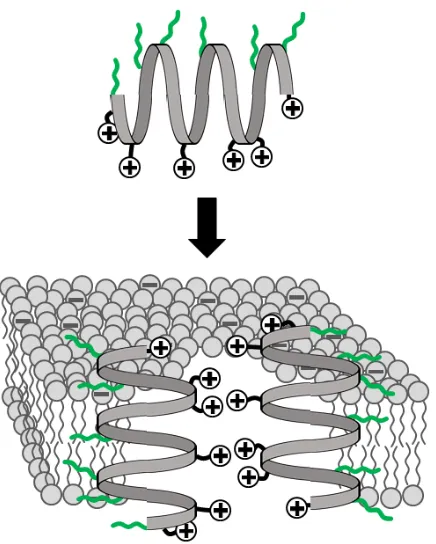
The cationic groups present on AMPs are thought to drive binding to bacterial membranes which are anionic at their surface (Fig. 1). From here, hydrophobic residues disrupt the integrity of the membrane to cause cell death. As mammalian cells have a net neutral charge at their surface, AMPs are less likely to bind to these cells, accounting for the selectivity observed for microbial membranes. This mechanism contrasts to that of conventional antibiotics such as penicillin, that involve binding to very defined moieties within bacterial proteins. The specificity of this binding, allows only very small genetic adaptions to invoke resistance, whereas resistance to AMPs would more likely require a global change to membrane architecture. It should also be noted there is growing body of evidence for
additional intracellular bacterial metabolic targets that mediate AMP effects.
Fig. (1). Schematic representation of the mode of action of AMPs
While the activity profile of AMPs warrants further examination, their transition from the bench to bedside has been slow 6. Peptides are not typically ideal drug candidates as they are expensive to produce on industrial scale and show limited pharmacokinetic stability. To overcome this, chemists are now examining synthetic mimics of AMPs. With the discovery that a facially amphipathic structure was not essential for AMP activity, came the ability to examine a wider array of synthetic architectures. Perhaps the most promising of these are the AMP mimicking polymers. This review illustrates the principles used to design such polymers, with a key focus on mimicry of different levels of peptide structure, stretching from specific amino acid functionality, mimicry of primary structure with polymer sequence control through to the tertiary level with the three-dimensional structure of polymer nano-particles.
2. STRUCTURE-ACTIVITY RELATIONSHIPS IN AMP MIMICKING POLYMERS
2.1 Amphiphilic Balance
In the context of polymer mimics of AMPs, on many accounts the balance of hydrophobic unit and cationic charge, the amphiphilic balance, is the most investigated parameter. This originates from the proposed mechanism of
action of killing bacterial cells and the selectivity between bacterial and mammalian cells.
The antimicrobial activity of AMPs and their mimics is based on the interaction and disruption of the cell membrane. In order to select bacterial membranes over others, the charge plays an important role. The share of negatively charged phospholipids on the outside of bacterial cell membranes (i.e. phosphatidylglycerol in gram negative or cardiolipin in gram positive bacteria) is significantly higher as compared to mammalian cells (where usually zwitterionic phosphatidylcholines are present) enabling a targeting of these membranes by charge-charge interaction.7 If the positive charge potential of a polymer at physiological conditions is high enough, it will preferentially bind to bacterial cell membranes by electrostatic interactions. The hydrophobicity of the material then enables it to to insert into the hydrophobic domain of the membrane, leading to its disruption, which ultimately leads to bacterial cell death. A further difference between mammalian and bacterial cell membranes is the increased presence of sterols, which regulate membrane fluidity and potentially prevent the disruption by AMPs and their mimics.8 Different mechanisms have been observed for the membrane disruption of AMPs, with the barrel stave model (i.e.
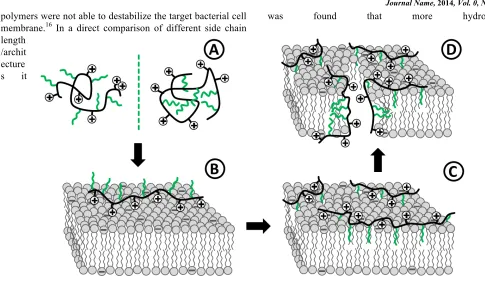
alamethicin9), the toroidal pore model (i.e. Magainin10 or Melittin11) and the carpet model (i.e. Dermaseptin12) being the most accepted mechanisms.13 Since polymeric mimics of AMPs usually do not possess a facially amphiphilic structure, but rather acquire this conformation when interacting with membranes, their mode of action is more likely to follow the carpet model (Fig. 2).14
In order for this process to operate efficiently and in a selective way, a subtle balance of hydrophobicity units and cationic charges has to be matched; such balance also affects solubility of the polymer. Unfortunately, both parameters are interconnected: an increase in positive charge will decrease the overall hydrophobicity of the polymer and vice versa. Many studies on different polymeric systems have been published on the systematic variation of this parameter.
2.1.1 Poly(methacrylate)s
[image:3.612.79.297.104.376.2]polymers were not able to destabilize the target bacterial cell membrane.16 In a direct comparison of different side chain length
/archit ecture s it
was found that more hydrophobic
Fig. (2). Schematic representation of the mode of action of AMP mimicking polymers. A) Polymer in solution as either random coil (left) or partially segregated (and possibly aggregated, right). B) Attachment to bacterial membrane by electrostatic interaction. C) Insertion into the hydrophobic domain of the membrane. D) Membrane disruption leading to cell death.
monomers require a higher amount of cationic comonomer in order to be effective/selective, and for methacrylate based polymers, the methyl side chain was identified to achieve the highest selectivity when the amphiphilic balance is matched,19 which also holds true when tertiary amines are used as a hydrophobic component (dimethylamine vs. diethylamine).20 It becomes obvious how fragile that balance is when small changes in the backbone architecture (met
hacy lami de inste ad of
[image:4.612.63.548.47.334.2]Fig. (3). Typical examples of polymeric mimics of AMPs: A) Poly(norbornene)s, B) Poly(methacylate)/poly(methacylamide), C) Nylon-3 copolymers, D) Poly(carbonate)s.
2.1.2 Poly(norbornene)s
The group of Tew focussed on poly(norbornene) backbone architectures obtained by ring-opening metathesis polymerization (ROMP) to identify the optimal combination of antimicrobial activity and haemocompatibility (Fig. 3). Amphiphilic balance was achieved by homopolymerization of monomers bearing both, hydrophobic and cationic groups with varying alkyl chains,22 as well as by side chain attached pyridine units, quarternized with various alkyl chains.23 Also, changes in charge density were addressed by comparing systems having one, two or three primary amine functions per monomer unit.24 An increase of hydrophilic amine groups diminished the hemolytic activity of the polymers, and introduced a selectivity between gram negative and positive bacteria (Staphylococcus aureus vs. Escheria Coli), which could be related to the diverse membrane architectures both types of bacteria possess.22d In general, a similar trend to that of methacrylic systems was found: hydrophobicity is needed but leads to undesired hemolytic effects when present in excess. A further study on this system revealed the necessity of a certain charge threshold for antimicrobial polymers25. Only above this threshold, polymers will bind effectively (and irreversibly) to bacterial membranes, after which the hydrophobic section will account for the membrane disruption, thus suggesting that additional charges after a specific point will not affect further antimicrobial activity.
2.1.3 Nylons
A third class of polymers, which has been utilized to conduct systematic variation, is the family of nylon-3 copolymers investigated by Gellman and coworkers, composed of a primary amine containing monomeric unit and a cyclohexyl containing monomer as hydrophobic component. In this case also small changes in composition resulted in a changing selectivity with an optimum at about 60% cationic monomer.26 The monomer architecture was also varied (i.e. variation in alkyl ring size27 or cyclic vs.
non-cyclic28) and it was concluded that an excess of hydrophobicity (i.e. by larger alkyl ring sizes) results in increased hemolytic activity and loss of antimicrobial activity (presumably by ineffective membrane attachment).27 However, the backbone flexibility seems to also play a role
as a non-cyclic monomer with the same number of carbon atoms showed improved biological activity.29
2.1.4 Beyond cationic and hydrophobic units
The global amphiphilicity of the polymer can also be influenced by the introduction of a third, non-cationic, hydrophilic component. This approach was used for nylon-3 copolymers,30 with best results obtained when the ratio of cationic to hydrophobic comonomer was kept constant (related to the best performing binary system) and small doses of hydroxyl functionalized monomer were added, which resulted in a minor increase in MIC while hemolytic activity was decreased drastically. Similar results were observed for poly(norbornene) copolymers when extended by either zwitterionic, sugar or PEG moieties.31 In the case of polyacrylics, a complete exchange of the hydrophobic component (HEMA32 or PEGMA33) still results in antimicrobial polymers. However, it is unclear whether these systems still target the bacterial membrane like other AMP mimics.
A further parameter that can be introduced into AMP mimics are hydrogen bond donors and acceptors. As recently demonstrated using quarternized amine containing polymers the presence of amide bonds in the side chain of the polymer strongly increases the antimicrobial activity as compared to a control polymer equipped with ester units instead.34 It was also shown that polymers with amide moieties require less hydrophobic units to be efficient antimicrobial agent in comparison to ester containing AMP mimics.35
As shown by Yang and coworkers it is also possible to control the antimicrobial activity of a polymer by a stimuli responsive change in amphiphilicity. In this example, the presence of methacrylic acid prevents membrane attachment at alkaline pH level, as the acid function is deprotonated and forms a complex with the cationic part of the polymer. Decreasing the pH value to an acidic level induces antimicrobial activity.36
2.2 Molecular Weight
One major parameter for antimicrobial polymers is the length of the macromolecule. Many studies have considered the structure-property relationship and have come to the conclusion that the DP of an AMP mimic should be low, preferably below 30 (it is noteworthy that AMPs are typically less than 45 amino acids long13a), independently of the nature of the polymer, being methacrylates,17a, 37 nylon-3 polymers, 27 and poly(norbornenes).22b For some examples, longer polymeric chains maintain their activity against bacteria, while the ability to destroy red blood cells increases, 27, 38 for other polymeric systems also antimicrobial activity scales with the molecular weight.22b, 27 This was investigated in detail for norbornene polymers with small variations in molar mass. Indeed, it was shown that while monomeric units did not show any activity, oligomers did kill bacteria. With increasing polymer length antibacterial activity increased, as did the hemolytic potential.22b Further studies showed that there is a possible link to a bacterial outer peptidoglycan layer, which is able to sieve large polymers and prevent them from interacting with the membrane.22d For systems, where a hydrophilic component instead of a hydrophobic comonomer is incorporated, an opposite trend is reported (increased antimicrobial activity at higher molar mass).32 For other polymers (poly(carbonates)) biological activity does not seem to scale with length.39
It is important in this context to keep in mind that all described systems are polydisperse synthetic polymers. In contrast to AMPs the presence of multiple sizes of polymers can influence the biological performance drastically. This is nicely demonstrated for nylon-3 copolymers where a small change in dispersity (at constant molar mass) shows tremendous increase in haemolysis (Ð = 1.06, HC50 = 800 µg mL-1; Ð = 1.15, HC50 = 12.5 µg mL-1).27 It was confirmed by dialysis experiments that the higher molecular weight fractions cause the toxicity. This demonstrates the importance of the molar mass in this context and the necessity for controlled polymerization techniques in order to draw structure property relationships.
2.3 Spacer Length
The length of the alkyl spacer between cationic group and backbone also influences antimicrobial activity. When interacting with cellular membranes, cationic moieties are responsible for the attachment of the polymer to the membrane surface. Length and flexibility of the connection to the polymer could, therefore, influence the efficiency with which the hydrophobic subunits of the polymer can enter the membrane.
This parameter was addressed using methacrylate copolymers synthesised with a primary amine containing
monomer containing a spacer of increasing length/flexibility (ethyl/butyl/hexyl/cyclohexyl) using butyl or ethyl methacrylate as a hydrophobic comonomer.40 It was found that the pKa values of the amine groups increased with increasing spacer length, which could be assigned to an increased mobility, able to compensate electrostatic repulsion. Also the antimicrobial activity increased for longer spacers. However, it is not clear if this effect originates from an increased mobility of the spacer or the increased hydrophobicity, which accompanies. A difference in MIC and HC50 between hexyl and cyclohexyl spacers (similar hydrophobicity but different mobility) suggests that a higher mobility of the cationic charge results in increased antimicrobial but also massively enhanced hemolytic activity. This is further supported by simulations, where an increased spacer enables a better penetration of the hydrophic domain of the membrane by the polymer.40
A similar trend was found by Hedrick et al. for poly(carbonate)s where an increased spacer length led to lower MIC and HC50 values.39 They also found improved properties when combining long and short spacer arm length resulting in polymers with slightly decreased antimicrobial activity (in comparison to a polymer with only long spacers) but a drastically increased HC50 values. This concept was further investigated by Yang and coworkers, combining a C6 spacer, primary amine monomer with a C2 spacer, secondary amine monomer in different ratios to obtain optimal selectivity.33
2.4 Nature of the Charged Unit
The charged unit is an essential part of an AMP mimic, as it generates affinity to bacterial cell membranes and, consequently, selectivity. In natural AMPs, lysin is the most common source of cationic charge, however also arginine is incorporated frequently. Many studies investigated the influence of the nature the cationic charge on the biological performance of polymeric AMP mimics.
polymers containing both primary and tertiary amines showed a significant decrease in MIC with increased primary amine fraction.20 A reason for the superior membrane interaction of primary amines could be the reversibility of the charge, enabling local adjustments in terms of amphiphilicity, which is not possible for quarternary amines.
Additional variation is possible by replacing amine groups with guanidine units as an equivalent to arginine. This approach was investigated for methacrylates,42 and poly(norbornene)s43 and in both cases a biological activity was found superior to comparable polymers bearing primary amines.
In a different study, guanidine containing monomers (acrylamide-based) were copolymerized with primary amine bearing acrylamides to investigate the influence on antibacterial performance.44 In this case a decrease of antimicrobial activity and compatibility with mammalian cells with an increasing guanidine content was found, contradicting the previous studies. However, no hydrophobic comonomer was used in these polymers, highlighting the importance of hydrophobicity in the context of arginine mimics.
The ion pairs of guanidine units are kinetically labile enabling a fast exchange of counter ions (hydrophilic vs. hydrophobic) resulting in efficient membrane crossing.45 However, investigations of artificial membranes (SUVs) revealed no dye leakage, and also live/dead staining of polymer treated bacteria showed no indication of a compromised membrane. These results suggest a different antimicrobial mechanism of these guanidine based polymers, for instance their possible complexation to DNA/RNA, or interaction with other components of the cytosol. It should be noted here that one major advantage of membrane active polymers as antibiotics is the difficulty for bacteria to form resistances against such macromolecules, which was proven experimentally for different polymer types.37, 46 For guanidine-based antimicrobial polymers, the development of bacterial resistance after repeated treatment was not investigated so far.
2.5 Counter Ion
Only a few studies have evaluated the presence of salt or the variation of the counterion of the cationic charge in the activity of AMP mimics. Investigation of poly(norbornene)s revealed a dramatic decrease in antimicrobial activity when organic counter ions were used, such as tosylate or dodecanoate.25 Experiments using LUV indicated a decreased membrane destabilization, which was assigned to the tight nature of the ion pair, interfering with membrane attachment of the polymers. The influence of the solvent and the presence of salts was also investigated. It was found for antimicrobial peptides that a high ion strength has a negative influence on the antimicrobial activity,47 which was ascribed to a masking of cationic and anionic charges by small ions.48
A similar effect was observed for methacrylate based AMP mimics.46a Furthermore, bivalent cations such as Ca2+ or Mg2+ were found to have a higher inhibiting potential, which was ascribed to the bridging of membrane components, increasing the membrane stability. Also the interaction of anionic peptides from growth media with cationic nylon-3 copolymers was described resulting in a diminished activity.49
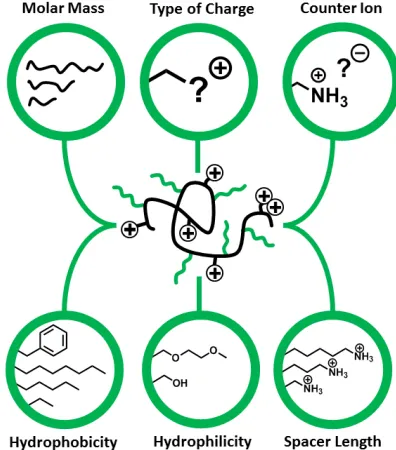
In conclusion, the various parameters influencing the efficiency of AMP mimics are very complex. While as a main specification, the amphiphilic balance has to be matched, other structural variations lead to changes is either bacterial interaction or blood compatibility (Fig. 4). As many of these parameters are interconnected, it is difficult to define an optimal design standard. However, as seen in this
section, a multitude of studies have dealt with single design parameter, and their influence on the overall activity of the resulting polymer, thus giving an excellent basis for the design of new polymeric systems.
Fig. (4). Parameters reported to influencee the efficiency of polymeric AMP mimics.
3. POLYMER BACKBONE
Several classes of synthetic mimics of antimicrobial peptides (SMAMPs) have been reported, including the
poly(norbornene)s, the poly(carbonate)s,
[image:7.612.347.545.258.483.2]3.1. Poly(norbornene)s
Poly(norbornene)s represent one of the most studied classes of SMAMPs. Coughlin and Tew employed ring-opening metathesis polymerization (ROMP) for the facile synthesis of poly(norbornene) derivatives to provide an extensive library of amphiphilic polymers. The norbornene monomer enables incorporation of both cationic and hydrophobic functionality within a single monomer, thereby providing dual pendant amphiphilic homopolymers. These poly(norbornene) polymers can be split into two classes – same-faced poly(oxanorbornene)s (Fig 5A and B), and opposite face poly(norbornene)s (Fig 5C).
Fig. (5). Same-faced, separate centre (A); same-faced, same centre (B) and opposite-faced (C) poly(norbornene)s
Tew and co-workers reported two classes of same-faced poly(oxanonorbornene)s; the first where cationic and hydrophobic units were contained within separate repeat units (Fig. 5A),50 and the second where these units were incorporated into a single monomer (Fig. 5B).51 The polymers comprised of separate repeat unit functionality were synthesised as 50:50 random copolymers in two molecular weight ranges; low molecular weight (2.1-4.2 kDa) and high molecular weight (12.2-15.9 kDa), with the high molecular weight polymer class proving to have no antimicrobial activity with MIC values typically ≥ 400 µg mL-1. The low molecular weight polymers showed more promising activity with MIC values as low as 50 µg mL-1 for the C4 and C5 linear and branched alkyl chains. When the ratio of cationic to hydrophobic monomers deviated from
50:50 (for the low molecular weight polymers) no improvement in antimicrobial activity was seen. These polymers displayed lower antimicrobial activity in general, compared to their regularly spaced same-face and opposite-faced counterparts. This is attributed to the random unit sequence of the polymer, leading to pockets of cationic or hydrophobic blocks at the local monomer level, thereby highlighting the importance of the spatial organisation of amphiphilic groups for the poly(norbornene)s.
The polymer class comprising cationic and hydrophobic units in a single oxanonorbornene monomer (Fig. 5B) were prepared as polymers with molecular weights of either 3 kDa or 10 kDa. The lower molecular weight (3 kDa) polymers exhibited much greater antimicrobial activity than their 10 kDa counterparts, in agreement with the segregated poly(oxanonorborene)s (Fig 5A). An optimum alkyl chain length (hydrophobic unit) was identified, with the propyl containing 3 kDa polymer being the most active with MIC90 values of 6.25 and 15 µg mL-1 for E. coli and S. aureus respectively.
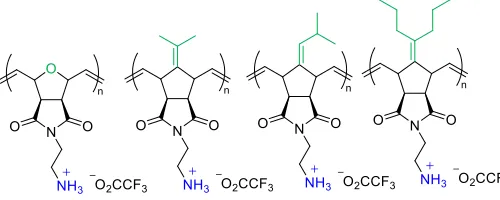
In 2004 Coughlin reported a series of modular norbornene derivatives for the generation of homopolymers with opposite face amphiphilicity.52 Figure 5C shows the designed homopolymers with regular spacing of hydrophobic and hydrophilic groups across the facially amphiphilic structure. Coughlin and co-workers generated a library of polymers with a large range of molecular weights from 4.5 kDa to 64 kDa. Their studies found that a minimum molecular weight of 4.5 kDa was required to obtain phospholipid membrane lysis activity, however, no molecular weight dependency on membrane lysis was observed between 4.5 kDa and 64 kDa. Further studies from Coughlin and Tew examined these hompolymers and random copolymers of the following four norbornene repeat units for their antibacterial activity (Fig 6) .22c
The polymers displayed narrow dispersities of <1.3, and a large range in molecular weight from oligomers to 137.5 kDa. These polymers were evaluated for their antibacterial activity (MIC value) against E. Coli and B. Subtilis, and assessed for their hemolytic activity against red blood cells. For the
[image:8.612.58.293.218.500.2] [image:8.612.331.581.559.659.2]homopolymers, only the isobutenyl-containing polymer was able to display good antibacterial activity with MIC values of 25 µg mL-1 for both E. coli and B. subtilis at molecular weights of either 1.6 or 10 kDa. Above this molecular weight MIC values rose to 40 µg mL-1 and higher. Whilst the antimicrobial activity of the isobutenyl-containing polymers was high, this polymer series also displayed high hemoylsis. Both hemolytic and antimicrobial activity falls for the isopropylidene and oxanorbornene homopolymers. In general, the homopolymer series of these 4 monomeric units failed to provide any clinical antimicrobial candidates. Random copolymers of these monomers failed to improve antimicrobial activity.
Despite their synthetic versatility, these polymers have limited applicability in antimicrobial treatments such as topical films since they are not biodegradable. One method of ensuring biodegradability is to generate α-peptide linked polymers which can undergo enzymatic degradation.
3.2. Poly(carbonate)s
Initial studies into the poly(carbonate) backbone for synthetic mimics of AMPs were based on maintaining the peptide linkage of naturally occurring AMPs through transition metal catalysed ring-opening polymerization of α -aminoacid-N-carboxyanhydrides (NCAs). This method gives rise to α-peptide linked polymers as seen in Figure 7 in one step, compared to traditional solid-phase peptide synthesis. Zhou and co-workers used this method to prepare a series of random copolymers containing primary amines for lysine mimics and alkyl or aryl hydrophobic side chains as alanine, leucine or phenylalanine mimics.53 The series investigated the optimum hydrophobic content for five different bacterial species (see previous section). The polymers synthesised by this method had narrow dispersities (1.11-1.28) and a range of molecular weights from 5kDa to 35kDa. These polymers displayed broad spectrum antimicrobial activity and represent a promising class of therapeutics due to their low cost of production (<10 $/g).
Fig. (7). Poly(carbonate) backbone studied by Zhou and co-workers
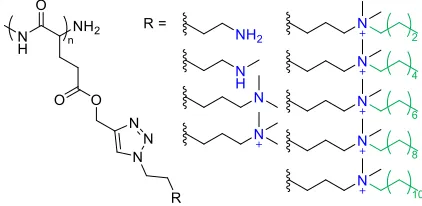
Engler and co-workers adopted a similar approach to generate α-peptide backbones bearing pendant azide groups for click reaction to produce primary amine or N-alkyl
functionalised homopolymers (Fig. 8). 54 Polymer lengths ranged from 30 to 140 repeat units with varying side group functionality with hydrophobic alkyl groups ranging from 1 to
Fig. (8). Poly(carbonate) backbone studied by Engler and co-workers
12 carbons. Molecular weight was dependent on activity for the gram positive S. aureus, with an optimal degree of polymerization at 140. No such dependency was observed when tested against E. coli. These polymers displayed minimal antimicrobial activity overall, however, this synthetic approach does enable rapid evaluation of hydrophobic and cationic functional groups.
3.3. Nylon Polymers
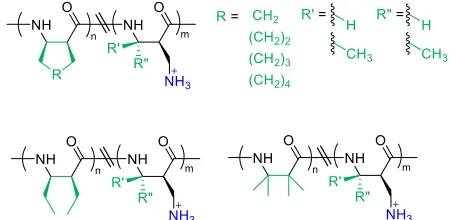
Despite their ease of synthesis, α-peptides are readily degraded by enzymes, thus a β-peptide approach was adopted by Gellman and co-workers.27 Gellman reported the ring-opening polymerization (ROP) of β-lactams to afford random β-peptide, Nylon-3 polymers (Fig. 9) in one step. Several structures were investigated, all with a random backbone structure. Hydrophobic groups were chosen from cyclic, acyclic and geminal dimethyl, whilst a primary amine served as the cationic group. Further hydrophobicity was added with the inclusion of geminal dimethyl groups adjacent to the primary amine group. A detailed analysis of the various side chain groups will be discussed in Section 4.
Fig. (9). Nylon-3 backbone studied by Gellman and co-workers
3.4. Poly(carbodiimide)s
Poly(carbodiimide)s have stable polymeric backbones that are resistant to degradation by enzymes. Novak and co-workers generated a series of helical poly(carbodiimide)s through the coordination-insertion polymerization of carbodiimide monomers with a titanium-BINOL catalyst.55 Adopting CuAAC click chemistry, Novak and co-workers functionalised poly(carbodiimide) polymers with guanidine groups. Two guanidine functionalised series were prepared.
Figure 10 depicts the mono-functionalised
[image:9.612.339.564.421.531.2] [image:9.612.88.287.534.601.2]from an alkylated carbodiimide monomer (A), and the bis-functionalised poly(carbodiimide)s with two guanidine groups per repeat unit (B), generated from a carbodiimide monomer containing two alkyne functional handles.
Fig. (10). Poly(carbodiimide)s with alkyl and guanidine side chains (A), or bis-guanidine functionality (B)
Novak and co-workers studied the helical chirality of these polymers and their associated antimicrobial activity and found no influence on antimicrobial activity. These polymers exhibited moderate antimicrobial activities with MIC values >64 µg mL-1 and activity was independent of molecular weight, with polymers having a wide molecular weight range from 15 kDa to 35 kDa (note that these molecular weights are for the non-functionalised poly(carbodiimide) backbone - after click reaction the resulting polymers are insoluble in the THF/diethanolamine SEC systems).
3.5. Poly(aniline)s
Ambrose and co-workers studied functionalised poly(aniline)s (fPANI), following reports that PANI-containing PVA/PE films56, and PANI-coated cotton57 had antimicrobial properties (Fig. 11). Ambrose reported several different fPANI polymers, incorporating acidic, halogen and hydrophobic groups in the backbone.58 Unfunctionalised PANI gave MIC values >10 mg/mL when tested against E. coli, P. aeruginosa, S. aureus and their associated multi-drug resistant cell lines. Copolymerization of aniline and 2-aminobenzoic acid or 3-2-aminobenzoic acid (2-ABAPANI and 3-ABAPANI, respectively) had much improved antimicrobial activity when in the emeraldine salt (ES) form with MIC values between 1.25 to 2.5 mg/mL. When crystallised in the emeraldine base (EB) form, antimicrobial activity was reduced to 5 mg/mL. Functionalized poly(aniline) copolymers containing SO3H, Cl, OMe or CH3 groups failed to improve antimicrobial activity, with MIC values between 5 to 10 mg/mL.
Fig. (11). Poly(aniline) backbone studied by Ambrose
3.6. Poly(vinylpyridine)s
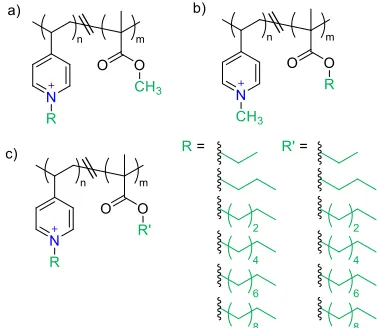
Free radical polymerization is a versatile method to generate random, block and homopolymers with a wide range of functional groups. Sen and co-workers adopted this approach to generate a series of random copolymers of 4-vinylpyridine and methacrylates (Figure 12).21 Sen prepared three different series via N-alkylation of the pyridinyl group: a) alkyl functionalised pyridinium-methyl methacrylate (same centre); b) methyl functionalised pyridinium-alkyl functionalised methacrylate (different centre); and c) alkyl functionalised pyridinium and methacrylate (same centre). This enabled Sen to compare amphiphilic polymers whose hydrophobic and cationic components were either spatially separated (single pendant; Fig. 12a and b) or directly connected to each other (dual pendant; Fig. 12c).
Fig. (12). 4-Vinylpyridine, methacrylate copolymers studied by Sen and co-workers
Sen concluded that while both displayed antimicrobial activities, the incorporation of hydrophobicity within the same centre (Fig. 12a and c) were non-hemolytic, as opposed to their different centre (Fig. 12b) counterparts which were hemolytic. These contrasting trends prove that spatial arrangement of cationic and hydrophobic groups is another factor to be considered in the design of antimicrobials.
3.7. Poly(methacrylate)s
[image:10.612.93.258.110.266.2] [image:10.612.359.548.326.490.2]cationic ratios using mercaptan chain transfer agents (Fig 13).59 Polymers containing 47% of the hydrophobic methyl methacrylate unit were found to have antimicrobial activity at low micromolar MIC values, and little hemolytic activity.18 Increasing the hydrophobic balance of the copolymers with longer alkyl chains, such as butyl methacrylate served to increase toxicity, relative to methyl methacrylate-containing copolymers which display the lowest toxicity. Modifying the cationic content from primary to tertiary and quaternary ammonium groups reduced antimicrobial activity significantly, with the quaternary ammonium cationic groups displaying no antimicrobial activity.18 Antimicrobial activity was independent of molecular weight, however, higher molecular weight polymers displayed much increased hemolytic activities.17a
Fig. (13). Kuroda’s poly(methacrylate) SMAMPs, employing quaternary ammonium groups as cationic components, and aliphatic and aromatic groups for hydrophobicity.
Kuroda and co-workers further explored the poly(methacrylate) class by incorporation of self-degradable 3-butenyl 2-chloroproprionate into the backbone. This was accomplished using a metal-catalysed simultaneous chain- and step-growth radical polymerisation to provide cationic side chains and main-chain ester linkages. These polymers comprised a random polymer chain, with a post-polymerisation modification of the t-butyl acrylate groups to required amine functionality. Various monomer feed ratios of 1/1, 3/1 and 1/3 were prepared to investigate amphiphilic effects. Amine functionality was present as an acrylic lysine mimic, an acrylamide lysine mimic, or a quaternized acrylic lysine mimic with short alkyl chains (Fig. 14A, B and C, respectively). When these polymers were assessed for their activities against E. coli, the acrylic lysine mimicking degradable copolymers provided the lowest MIC values at 16-104 µg/mL, compared to the peptide mgainin-2, which gave an MIC of 125 µg/mL. Lower molecular weight polymers within this discrete class also proved to be more potent, however, they displayed low HC50 values, indicating that their hemolytic activity would prevent their development as clinical candidates. Interestingly, a change to the acrylamide back bone resulted in a significant loss of
activity, with MIC’s observed at > 500 µg/mL, which was attributed to the hydrophilic nature of the acrylamide, preventing the proposed mechanism of insertion of hydrophobic polymer regions into the bacterial cell membrane. Further polymer design must be undertaken to incorporate desired degradability whilst maintaining low MIC values and high bacterial selectivity.60
Fig. (14). Kuroda’s self-degradable antibacterial polymers made by simultaneous chain- and step-growth radical polymerisation
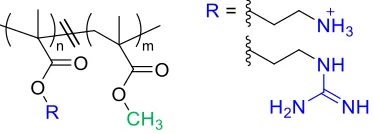
Locock and co-workers explored the poly(methacrylate) polymer class using Reversible Addition-Fragmentation chain Transfer (RAFT) polymerization for access to controlled molecular weight random copolymers (Fig 15). 42, 61 Polymers were comprised of methyl methacrylate as the
hydrophobic unit, and an amine containing methacrylate as the cationic group. Post-polymerization conversion of the amine into a guanidine unit provided a direct comparison of amine and guanidine cation sources for antimicrobial activity and toxicity. The hydrophobic/cationic balance was investigated to identify a lipophilic composition of <40% was required to provide high activity and low toxicity. Molecular weight was dependent on antimicrobial activity, with low molecular weight polymers (3.3 – 4.5 kDa) having significantly lower MIC values than their high molecular weight counterparts (10 -23 kDa).
Fig. (15). Lysine and arginine mimicking cationic side groups investigated by Locock in the poly(methacrylate) SMAMPs
[image:11.612.333.576.164.314.2] [image:11.612.100.264.255.366.2] [image:11.612.357.544.569.636.2]Building upon their established research into SMAMPS using a poly(methacrylate) back bone, Kuroda and colleagues prepared vinyl ethers containing an hydrophilic amino-ethyl vinyl ether (AEVE) and a hydrophobic isobutyl vinyl ether (IBVE) monomer (Fig. 16). These copolymers were prepared by base-assisting living cationic polymerization, with varied molecular weights from 5 kDa to 25 kDa. Polymers were assessed against E. coli for their antibacterial properties in both a random and block copolymer sequence – this will be elaborated upon in Section 5.62
Fig. (16). Poly(vinyl ether)s containing amine and isobutyl functionality in either block or random sequence
Evaluation of antibacterial activity was undertaken using bactericidal concentration (BC99.9), characterized as the lowest polymer concentration to cause at least a 3-log reduction (99.9% killing) in the number of viable E. coli cells after incubation with the polymers for 4 h at 37 °C. The random and block copolymers gave B99.9 values of 1-63 µg/mL, with monomer composition being the influencing factor on bactericidal activity, rather than sequence, when IBVE content was less than 50 mol%.
When comparing hemolytic activity, block copolymers displayed significantly higher HC50 values (>1000 µg/mL) compared to random sequences. However, these block copolymers induced hemagglutination, while their random counterparts did not.
This study has focussed on aggregation of hydrophobic vinyl ether polymers to explain trends in decreasing activity with increasing hydrophobic content, yet increased selectivity towards bacterial cells. A relationship between the critical aggregation concentration (CAC) and BC99.9 was discovered, whereby block copolymers form intramolecular aggregates to provide a hydrophobic core and outer cationic surface, leading to the increased hemagglutination of RBCs due to electrostatic interaction with surface-bound biopolymers, but reduced hemolysis due to hidden hydrophobicity. The random copolymers, on the other hand, remain in a random-coil structure in the absence of concentrated regions of hydrophobicity. This enables their charged content to interact with bacterial cells walls, but their
hydrophobic content is able to interact with both bacterial cells and RBCs, resulting in both bactericidal activity and hemolysis.
3.9. (Maleimide-alt-isobutylene) copolymers
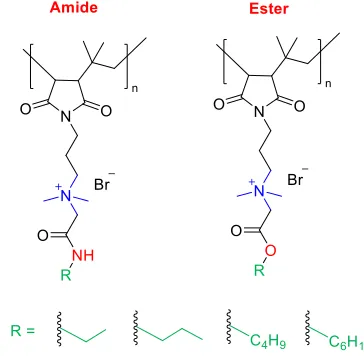
The Haldar group investigated maleimide and isobutylene alternating copolymers to understand the effect of hydrogen bonding and hydrophobicity in concert with a constant cationic charge on the selectivity of antibacterial polymers. This is the first study to include hydrogen bonding as a strategy for improved bacterial selectivity. By creating polymers containing ester- and amide- groups, they aimed to provide a degradable polymer with tunable side chain hydrophobicity (Fig. 17).63
Fig (17). Poly(maleimide-alt-isobutylene) SMAMPs
The series probed a molecular weight range between 15-18 kDa, with different length side chains from ethyl to hexyl to study effects of hydrophobicity whilst keeping cationic charge density constant. The amide series (Fig 17, Amide) proved to be effective antibacterial agents, with MIC values as low as 16 µg/mL and 8 µg/mL for E. coli and S.
aureus, respectively when a C6 hexyl group was
incorporated. Reduction in hydrophobic content from C6 to C2 resulted in a steady drop off in antibacterial activity, with MIC values of 62 g/mL for both E. coli and S. aureus for the C2 amide series. Interestingly, the amide polymers are more potent towards S. aureus than E. coli, particularly for the C4 functionalised amides, however, a hydrophobic group of C3 or less provides low hemolytic activity, and appears to be optimum for activity/selectivity balance.
[image:12.612.57.299.220.341.2] [image:12.612.358.540.246.424.2]counterparts, but did display lower toxicity at greater hydrophobic content (C4-C6) than the corresponding amides.
The authors believe that the hydrogen bonding backbone, and, in particular, its alternating sequence, provides a structural strategy and ordered backbone, enabling optimal selectivity towards bacteria over RBCs.
3.10. Alternating ROMP Polymers
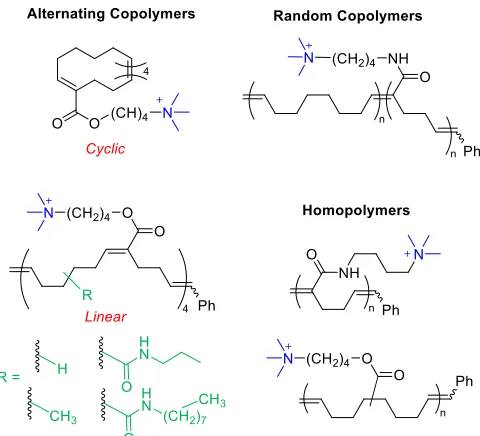
Fig. (18). AROMP copolymers and homopolymers of selected cyclobutene and cyclohexene monomers
The Sampson group have also reported a study on backbone sequence and antibacterial activity. The effects of sequence will be discussed in greater detail in Section 5. Whilst Tew and co-workers employed ROMP to the norbornene monomer to provide rapid access to a wide variety of poly(norbornenes), Sampson has made use of the technology to copolymerise cyclobutenes and cyclohexenes in alternating sequence (AROMP), to provide a carbon backbone bearing cationic and lipophilic groups at regularly spaced intervals or 4, 8, and 10 carbons. Hydrophilicity was tuned by careful choice of substituents on the cyclobutene and/or cyclohexene monomers. A series of random copolymers and homopolymers were also prepared for comparison, to assess the importance of spacing of functionality and the cation source itself.64
The optimum AROMP SMAMP was found to be one in which there were no pendant hydrophobic groups on the already sufficiently hydrophobic backbone (Fig. 18; R=H). Of the alternating series, it was found that polymers with higher hydrophobic content were less effective antibacterial agents, and showed a decrease in erythrocyte lysis – contrary to the effects seen in other AMP mimics. Based on the alternating copolymer series, Sampson discovered that polymers with a regular 8-10Å spacing of cationic residues proved to be more potent antibacterials,
when screened against a range of positive and Gram-negative bacteria. An additional requisite is that the spacer must be hydrophobic – addition of a cationic group as a spacer resulted in significant reduction in activity. This finding is consistent with the 5Å cationic spacing found in naturally occurring AMPs. Another feature of the AROMP SMAMPs, which is common to other SMAMP polymer classes is the need for conformational flexibility to afford antimicrobial activity. This was evidenced by Sampson’s evaluation of cyclic alternating polymer constructs, which displayed significantly lower antibacterial activities than their acyclic counterparts.
4. MIMICKING AMINO ACIDS
Antimicrobial peptides contain a range of lipophilic and cationic amino acid residues. Commonly found lipophilic groups are short alkyl chains (alanine, valine, leucine and isoleucine) or aromatics (phenylalanine, tyrosine, tryptophan). Lysine (primary amine) and arginine (guanidine) are the two cationic amino acids that are common to most AMPs. Synthetic peptide-mimetic polymers have focussed on mimicking these amino acid pendant groups in order to provide structures that may mimic the facial amphilicity and/or tertiary structure to gain similar activity profiles.
4.1. Hydrophobic Amino Acids
Hydrophobic pendant groups have been more widely studied than their cationic counterparts, with a strong focus on aliphatic chains of varying length and branching. In the poly(norbornene) polymer class, Coughlin and Tew investigated isopropylidene and isobutenyl groups as lipophilic mimics (Fig 19).22c
Fig. (19). Hydrophilic side chains studied by Tew and Coughlin
[image:13.612.67.307.164.382.2] [image:13.612.327.574.485.579.2]range of modified structures, but whilst they have been outperformed in antibacterial activity, they still represent the most non-hemolytic polymers reported in the literature.
In subsequent studies, Tew and co-workers moved towards the oxanorbornenes with same face amphiphilicity. They reported the study of short (C1 – C6) and long (C6 – C12) linear and branched alkyl chains (Fig 20a and b) as lipophilic amino acid side chain mimics.
Fig. (20). Same faced, different centre polyoxanorbornes (A), and same faced, same centre polyoxanorbornenes (B) and the hydrophobic pendant groups studied
The same-faced, different centre polyoxanorbornenes (low molecular weight: 2.5-4.5 kDa) displayed the most promising activity for the C3, C4 and C5 linear and branched alkyl chains with MIC values as low as 50 µg/mL. Other alkyl chain lengths showed substantially lower antimicrobial efficacy at MIC values of >100 µg/mL. Hemolytic concentrations of the C3-C5 linear and branched alkyl chains, however, were low, indicating an increased ability to lyse red blood cells. These observations were supported by the same-faced, same centre polyoxanorbornenes with the propyl linear chain having the lowest MIC values (6.25 µg/mL), however at this chain length and above, polymers become increasingly hemolytic, with decreasing antimicrobial activity beyond a C4 alkyl chain length. The ethyl alkyl chain provides moderate activity with MIC values of 50 µg/mL, but shows high selectivity for bacterial cells over mammalian cells.
Zhou and co-workers chose to mimic alanine, leucine and phenylalanine with their choice of methyl, isobutyl and phenyl hydrophobic pendant groups for the poly(carbonate) SMAMPs (Fig. 21). The cationic group was maintained as a lysine mimic for all three hydrophobic series.53
Fig. (21). Alanine, leucine and phenylalanine mimicking hydrophobic groups investigated by Zhou and co-workers
The phenyl series proved to be the most active against all five pathogens (E. coli, S. aureus, S. marcescens, C. abicans and P. aeruginosa), maintaining activity across a wide range of hydrophobic content (20-80% phenyl content). All three hydrophobic series had an optimal hydrophobic content of 60%, but the alanine and leucine mimics displayed no activity against S. marcescens and C. albicans. The phenylalanine mimic at 60% phenyl content displayed higher hemolytic activities than natural AMPs (e.g. Indolicidin) HC50 = 16 µg/ mL). Combination of phenyl and isobutyl groups provided a similarly active SMAMP, again with poor selectivity for bacterial cells.
Within the poly(carbonate) class, Engler’s click chemistry approach enabled the study of a range of aliphatic primary, secondary, tertiary and quaternary amines with varying alkyl chain lengths from C4-C12 (Fig 22).54
Fig. (22). Primary, secondary, tertiary and quaternary amines employed in Engler’s poly(carbonate) SMAMP class
These polymers were evaluated for their activity against
S. aureus and E. coli. The primary amine polypeptides displayed activity against both gram positive and gram negative bacteria, albeit at high MIC values (70-140 µg/mL and 562-1125 µg/mL respectively). Secondary and tertiary amines are inactive against both bacterial classes. Quaternization of the amine proves to be ineffective in improving activity until incorporation of an alkyl chain of >6 carbons.39 At a carbon chain length of 8, MIC values for S. aureus and E. coli fall to 78-156 µg/mL and 156-312 µg/mL, respectively. Additional hydrophobicity is detrimental for E. coli activity, but enhances activity against S. aureus at a C12 chain length (MIC = 39-78 µg/mL). These polymers do exhibit low hemolytic behaviour across the series, but their relatively high MIC values (compared to other SMAMPs) and their ineffectiveness as broad spectrum antimicrobials limits their therapeutic development.
[image:14.612.67.304.158.328.2] [image:14.612.338.549.306.409.2]centre – whereby the positive charge was located on the pyridine (methyl pyridinium ion) and the alkyl group incorporated on the acrylate centre.21 For both series, MIC
values decreased to an optimum alkyl tail length of C4 for E.
[image:15.612.91.552.116.214.2]coli and C6 for B.
Table 1: Comparison of antibacterial and hemolytic activities for cyclic and acyclic nylon-3 subunits
Polymer
MIC (µg/mL)
C. difficile
B. subtilis
E. coli VREF MRSA S.
enterica P.
aeruginosa B. cereus
HC10
DM:CH 12.5 <1.6 6.3 6.3 6.3 50 25 100 19
DM:TM 12.5 <1.6 13 3.1 3.1 - - - 400
DM:βDE - 6.3 25 25 25 - - - <3.1
DM:HE - - - 50 50 100 -
DM: βCP - 3.1 6.3 6.3 6.3 - - - <3.1
subtilis. The MIC values then increased with increasing alkyl tail length, as previously observed in other SMAMP polymers, suggesting alkyl lengths from C3-C8 provide sufficient membrane disruption. As expected, hemolytic activity increased with increasing tail length, however, this effect was far more pronounced for the separate centred polymers.
The nylon-3 SMAMPs have been the most widely studied synthetic polymer class, with a focus on comparison of ring size and cyclic versus acyclic groups. Figure 23 summaries the different lactam monomers used in these studies.29
Fig. (23). β-lactam monomers used in study
Initial studies focussed on incorporation of the MM
subunit with the CH cyclic subunit.27 This random copolymer displayed the most effective MIC against E. coli,
B. subtilis, S. aureus and E. faecium when the cationic content (MM) was ≤50%. Above this level, polymers became highly hemolytic. When the cationic units were compared for their activity against C. albicans and other fungal strains (MM vs. NM vs. DM), it was found that the
NM subunit was intrinsically antifungal46b. Homopolymers of NM maintained low MIC values against drug-resistant strains of C. albicans (3.1 µg/mL for K1 and Gu5 strains). Applying these NM subunit homopolymers to biofilms of C. albicans proved their ability to inhibit fungal biofilm growth down to SMIC80 (concentration to inhibit 80% of biofilm formation) values of 9.4 µg/mL, whilst displaying very little RBC lysis, even at 2000 µg/mL.65 When NM subunits were
supplemented with hydrophobic groups (CP, CH and CO), antifungal activity was diminished, although the more hydrophobic subunits displayed less dramatic decreases in activity relative to CP, attributed to their antifungal effects. Interestingly the DM subunit has some intrinsic antifungal behaviour, but also intrinsic hemolytic effects, whereby upon replacement of the DM unit with hydrophobic groups, HC10 values increase.
Comparison of increasingly hydrophobic cyclic substituents CP and CH groups generally show lower hemolytic activity and low antifungal activity (for the NM
and MM series). CHp and CO have similar antifungal activities, but increasing hydrophobicity to CD results in high hemolytic activity. The CH group has therefore been selected as the most commonly studied cyclic subunit.
Within the DM series, comparison of CH cyclic subunit with acylic subunits TM, βDEHE and βCP that TM was not only comparably active to CH, the subunit also provides a hemolytic effect, with HC10 values of >400 µg/mL.28-29 Table 1 compares the four acyclic groups with CH at a 1:1 ratio with DM.
[image:15.612.69.299.365.498.2]containing C2 (ethyl) and C4 (butyl) had lower or no selectivity and therefore would be appropriate as biocides. The phenylalanine mimic (benzyl group) proved to be less effective as an antimicrobial entity, with MIC values ranging between 20-100 µM compared to <10 µM for its methyl-containing counterpart.
Further exploration of the role of hydrophobic groups in the poly(methacrylate) class was performed by Locock and co-workers, who studied alanine and tryptophan mimicking groups. Tryptophan-rich AMPs such as indolicidin and tritrpticin have been shown to insert into membranes, and partition near the membrane-water interface, enabling the peptide to anchor to the bilayer surface, however this motif has been little investigated in SMAMPs.66,67 A tryptophan-like indole monomer, 2-(1H-indol-3-yl)ethyl methacrylate (IEMA), was incorporated into two tryptophan mimicking series – one with a lysine mimic cation source (aminoethyl methacrylate – AEMA; poly(AEMA-IEMA), and the other with an arginine mimic cation source (2-guanidinoethyl methacrylate – GEMA; poly(GEMA-IEMA.)68 These polymers were evaluated against S. epidermidis and the methicillin-resistant strain of S. aureus for their antimicrobial activity. The tryptophan series exhibited lower antimicrobial activity, compared to hompolymers of GEMA, and were found to be more hemolytic. A 5% IEMA content gave the lowest hemolytic activity at 5.6% and 14.0% for poly(AEMA-IEMA) and poly(GEMA-IEMA), respectively. This highlights the importance of hydrophobic/cationic balance, since the alanine mimicking methyl methacrylate (MMA)-containing poly(AEMA-MMA) and poly(GEMA-MMA) copolymers require a hydrophobic content of 30-40% MMA for optimum antimicrobial/toxicity balance. Poly(GEMA-IEMA) at 5% IEMA content was found to be the most potent of the tryptophan mimics, with an MIC of 12 µg/mL and 47 µg/mL for S. epidermidis and the methicillin-resistant strain of S. aureus, respectively.
When comparing the IEMA hydrophobic source to that of MMA, at a 30% hydrophobic content, the poly(AEMA-IEMA) copolymers provide an MIC of ca. 50 µg/mL compared to 500 µg/mL for its poly(AEMA-MMA) counterpart when tested against S. epidermidis. The poly(GEMA-IEMA) copolymers, however, perform at MIC value of ca. 40 µg/mL compared to 10 µg/mL for the poly(GEMA-MMA) copolymers, highlighting the impact of the cation source, which will be discussed in the next section.
4.2. Cationic Amino Acids
Tew and co-workers completed several studies to sequentially investigate different cationic amino acid mimicking side chains. One approach was to generate monomers with multiple primary amines in the single unit (Fig 24a). This multiple amine approach was initially studied using the isobutenyl poly(norbornene)s. Tew had previously
reported that the added hydrophobicity of isobutenyl containing poly(norbornene) backbones leads to greater toxicity,24 however by increasing the hydrophilicity through the doubling and tripling of primary amine groups, the resultant polymers were less hemolytic. Increasing the number of primary amines per unit, however, gave no improvement in antimicrobial activity for E. coli or S. aureus. A move to the more hydrophilic oxanorbornene systems (Fig 24b) were non-toxic, as expected, due to their hydrophilicity and therefore non interaction with RBCs. These systems also provided no antibacterial activity against
E. coli bacterial strains, even when the cationic amine content was doubled or tripled. However, when tested against S. aureus doubling or tripling the amine content provided improved antimicrobial activity with MIC90 values falling from >200 µg mL-1 for the single amine polymers to 25 and 15 µg/mL for the double and triple amine polymers, respectively.
Fig. (24) Investigation of increasing cationic amine content per unit of the isobutenyl poly(norbornene)s (a) and the poly(oxanorbornene)s (b).
[image:16.612.345.550.282.363.2]Fig. (25). Lysine and arginine mimicking cationic groups of the poly(oxanorbornene) SMAMP class
Despite the high prevalence of the arginine motif in AMPs, the guanidine group has been little studied compared to primary amine, lysine mimics. Sampson and colleagues investigated the guanidine group for their AROMP SMAMPS, comparing this multidentate group to a trimethylammonium cation. Despite a slight improvement in antibacterial activity in the presence of the guanidine group, the synthetic effort to include this group was deemed an over-riding factor when selecting optimum SMAMP candidates. This could provide a rationale as to why this important cation source is often overlooked.64
Locock and co-workers have further built upon the findings of superior antimicrobial activity of guanidine containing SMAMPs by incorporating the functionality into poly(methacrylate)s.42 Their studies compared the incorporation of aminoethyl methacrylate (AEMA) or 2-guanidinoethyl methacrylate (GEMA) into methyl methacrylate (MMA) copolymers. In both copolymer series, a 30-40% MMA content and a low molecular weight (ca. 3.3-4.5 kDa) provided optimum antimicrobial activities. Molecular weight was strongly dependent on antimicrobial activity for the poly(MMA-GEMA) series, but independent for the poly(MMA-AEMA) series. The arginine mimicking poly(MMA-GEMA) copolymers also exhibited much lower MIC values than their lysine mimicking AEMA counterparts. When evaluated against S. epidemidis, S.
aureus, and C. albicans the GEMA series gave MIC values
of 10, 94 and 8 µg/mL respectively, compared to the AEMA values of 625, >1500 (inactive) and >128, respectively.
Another feature of the guanidine-containing
poly(methacrylate)s is their low toxicity when compared to their primary amine counterparts. When comparing hemolytic extent (as a percentage value) via lysis or red blood cells, the guanidine polymers again outperformed the amine functionalised polymers, with low hemolytic activity at their MIC for S. epidermidis. Even at a high MMA content, the guanidine polymers exhibited very low hemolytic activity, in contrast to the lysine mimicking polymers, which gave an increase in hemolysis with increased MMA content.
Kuroda also investigated the cationic source in the poly(methacrylate) class, focussing on lysine mimics. The group prepared primary, secondary, tertiary and quaternary ammonium salt cationic groups, and found that the primary group provided the highest antimicrobial activities, whilst
quaternary ammonium salts were inactive for the poly(methacrylate) series.18, 69
5. SEQUENCE CONTROL IN POLYMERIC AMP MIMICS
As the key requirements for efficient polymeric mimics of AMP are being elucidated, recent work has shown that the distribution of functionalities along the polymer backbone can also affect their activity. As seen earlier, the alpha-helical secondary structure of AMPs is not necessary to exhibit an antimicrobial activity. However, the overall structure of an AMP seems to have a direct impact on the interaction with bacterial membranes, thus, on the antimicrobial activity. In this section, the impact on aggregation and biological activity of the distribution of functionalities along the polymer backbone and in respect to each other is reviewed.
5.1 Structural Control via Monomer Architecture
The usual approach of synthesizing polymeric AMP mimics is the statistical copolymerization of a hydrophobic and a cationic monomer, having both components in undefined proximity in the resulting polymer chain. To investigate the impact on the distance of both functionalities relative to each other, different approaches have been taken.
In order to establish the impact of the relative position of the alkyl chain towards the cationic centre, Sambhy et al.