J. exp. Biol. 136, 483-488 (1988) 4 8 3 Printed in Great Britain © The Company of Biologists Limited 1988
SHORT COMMUNICATION
CONTROL OF CERCAL POSITION DURING FLIGHT IN THE
COCKROACH: A MECHANISM FOR REGULATING SENSORY
FEEDBACK
BY FREDERIC LIBERSAT AND JEFFREY M. CAMHI
Department of Zoology, Hebrew University of Jerusalem, Jerusalem, Israel Accepted 9 December 1987
In a flying cockroach, the response of cereal wind receptors to standard wind stimuli was reduced by 40 % compared with when the animal was at rest. While flying, rhythmic bursts of action potentials, phase-locked to the wingbeat rhythm, descended the nerve cord. These bursts appeared responsible for a phase-locked rhythmic discharge of cereal motor neurones. This, in turn, evoked a cereal displacement, maintained throughout flight. It is suggested that this displacement causes a pressure block of the sensory nerve, since it has recently been shown that experimental displacement of the cercus in a non-flying cockroach causes a similar degree of sensory reduction (40%) by means of such a mechanism (Libersat, Goldstein & Camhi, 1987). The functional significance of this means of sensory reduction is discussed.
Rhythmic behaviours such as locomotion are known to be produced in part by pattern generators within the central nervous system (Delcomyn, 1980; Selverston & Moulins, 1985). As a result of an animal's locomotion, it receives considerable sensory feedback, much of which is also used to help control the movements (Burrows, 1976; Libersat, Clarac & Zill, 1987; Pearson & Wolf, 1987). However, some of this feedback is not useful and could even perturb the behaviour if not filtered out (Kennedy, Calabrese & Wine, 1974).
When a cockroach flies, its forward progression plus the beating of its wings produce strong wind stimuli to the cerci, paired wind-sensitive appendages located posteriorly on the abdomen. Each cercus bears about 220 filiform hairs that detect air displacement (Nicklaus, 1965). They are stimulated by minute air currents, such as those produced by the approach of a predator (Camhi, 1980). Currents of l e m s "1 are sufficient to evoke an evasive run. The wind generated by flying is roughly 300 times this velocity and could thus activate an inappropriate escape movement during flying, and could habituate the escape circuit. We demonstrate here that the cockroach partly circumvents this problem by means of a novel mechanism involving cereal movements made during flight (Fig. 1A).
Adult male Periplaneta americana were anaesthetized with CO2 and the legs,
B
Meta thorax
IWWM
60 ms
Sensory feedback in flying cockroaches 485
the wind receptor axons), the lateral cereal nerve [containing motor axons to the cereal muscles (Bernard, Gobin & Callec, 1983)] and the nerve cord were exposed for recording (Fig. IB) and the preparation was perfused with saline (Callec & Satelle, 1973).
To record electromyograms from elevator muscles of the metathoracic wings, pairs of 50 /m\ diameter copper wires, insulated to their tips, were inserted through small holes made in the cuticle of the anterior tergal process of the third thoracic segment (Carbonell, 1947). Pairs of hooks were used to record from or stimulate the nerve cord, and to record from the medial and lateral cereal nerves (Fig. IB). Sequences of flight activity were triggered either by puffing air onto the head or by electrical stimulation of the nerve cord (pulses of 200/is duration, at 200 s"1 for 700 ms) (Ritzmann, Tobias & Fourtner, 1980). These stimuli caused the wing stumps to open and beat rhythmically, and caused the flight muscles to fire rhythmically at 20-30 s"1, within the natural range of wingbeat frequency for this species (Roeder, 1951). Once flight had begun, a sensory response was evoked in the cereal nerve by a controlled wind puff delivered from a tube (Westin, Langberg & Camhi, 1977). All recordings were stored on tape for further analysis. Sensory nerve recordings were passed through a window discriminator to select action potentials which exceeded a preset level (generally chosen as the baseline noise level during rest) and all the selected signals were counted for an interval of 200 ms using a digital counter. By this means, sensory responses to a wind puff during flight were compared with those during rest.
Recordings were made during flight from a single connective of the cord at two different anterior-posterior locations, and showed bursts of small-amplitude spikes descending the nerve cord, phase-locked to the EMG of the flight muscle (Fig. 1C). This descending rhythm was seen in all 60 bouts of flight recorded in seven animals. Descending bursts were often followed by one or two ascending action potentials of larger amplitude (Fig. 1C), an analysis of whose activity will be reported elsewhere (F. Libersat & J. M. Camhi, in preparation).
Immediately upon receiving a wind puff or electrical stimulation to trigger flight, the animal displaced both cerci medially and vibrated them slightly, by contracting its cereal muscles. These muscles receive innervation from a group of
motor neurones in the last abdominal ganglion that send their axons through the lateral sensory-motor cereal nerve (Bernard et al. 1983). When the lateral cereal nerves were cut distally, only the motor action potentials to these muscles were recorded (Fig. ID). At the onset of flight, the initial cereal displacement was characterized by an intense burst of spike activity in the motor neurones. As soon
t
t
50 msSensory feedback in flying cockroaches 487
as flight started (indicated by rhythmic EMG activity in the bottom trace), the motor activity was organized into regular bursts. These bursts in both lateral cereal nerves were phase-locked with the EMG from the wing muscle (Fig. ID). Such bursts were seen in each of 50 bouts of activity studied in five animals.
Each motor burst began on average 5 ms after the end of the previous descending burst in the cord. This timing is consistent with the possibility that each descending burst in the cord evokes the subsequent motor burst.
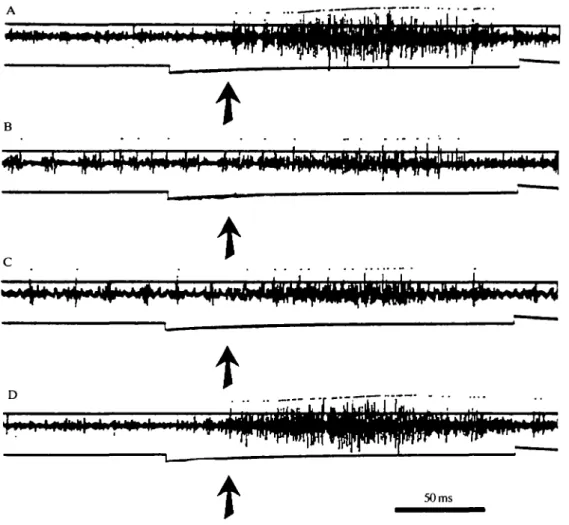
Previous experiments have shown that either continuous stimulation of the cereal motor neurones, which evokes a similar cereal displacement when the animal is at rest, or manual cereal displacement induces a reduction of sensory activity in response to controlled wind puffs (Libersat et al. 1987). We wished to determine whether the cereal movements which occur naturally during flight are also accompanied by a decrease in the wind-sensitive input. Recordings made from the medial cereal nerve with the cockroach at rest showed a vigorous train of action potentials in response to a controlled wind puff (Fig. 2A). During flight, controlled wind puffs elicited a response reduced by a mean of 39 ± 6 % (S.E.M., N-70 stimuli flying and 70 at rest, in seven animals) (Fig. 2B,C) relative to rest. This reduction was highly significant (P< 0-001, paired Mest, N-15 bouts). After the sequence of flight, the cerci returned to their original position, and the wind response returned to normal (Fig. 2D).
We conclude that during flight, the response of the cereal nerve to wind is substantially reduced, concomitant with a maintained cereal displacement. In a resting animal, the sensory reduction upon displacing the cercus does not result from the altered cereal angle relative to the wind stimulus. Instead, the displacement appears to impose a pressure block on the sensory nerve, reducing the number of sensory action potentials by roughly 40 % (35 % for manual displacement and 45 % for displacement by electrical stimulation of the lateral cereal nerve) (Libersat et al. 1987). The close correspondence between the sensory reduction in non-flying and flying animals suggests that the same mechanism accounts for both.
The results presented here indicate that a copy of the flight rhythm, descending the nerve cord from the thorax, is responsible for the sensory reduction, and that it will be effective for just the duration of flight. A sensory reduction of the amount we report here has been shown to lead to a substantial reduction of wind-evoked activity in the giant interneurones that mediate the escape response (Goldstein & Camhi, 1987). Therefore, this sensory reduction could help to prevent inappro-priate activation of escape movements during flight and/or help protect the escape circuit from habituation.
References
BERNARD, J., GOBIN, B. & CALLEC, J. J. (1983). A chordotonal organ inhibits giant interneurons in the sixth abdominal ganglion of the cockroach. J. comp. Physiol. 153, 377-383.
BURROWS, M. (1976). Neural control of flight in the locust. In Neural Control of Locomotion (ed. R. M. Herman, S. Grillner, P. S. Stein & D. G. Stuart), pp. 419-438. New York: Plenum Press.
CALLEC, J. J. & SATTELLE, D. B. (1973). A simple technique for monitoring the synaptic action of pharmacological agents. /. exp. Biol. 59, 711-723.
CAMHI, J. M. (1980). The escape system of the cockroach. Scient. Am. 243, 158-172.
CARBONELL, C. S. (1947). The thoracic muscles of the cockroach Periplaneta americana. Smithson. misc. Collns 107, 1-23.
DELCOMYN, F. (1980). Neural basis of rhythmic behavior in animals. Science 210, 231-239. GOLDSTEIN, R. S. & CAMHI, J. (1987). Non-synaptic regulation of sensory activity during
movement reduces wind-sensitive interneuron activity in the cockroach. Brain Res. 440, 366-369.
KENNEDY, D., CALABRESE, R. L. & WINE, J. J. (1974). Presynaptic inhibition: Primary afferent depolarization in crayfish neurons. Science 186, 451-453.
LIBERSAT, F., CLARAC, F. & ZILL, S. (1987). Force sensitive mechanoreceptors of the crab. Single-unit responses during walking and evaluation of function. J. Neurophysiol. 57, 1618-1637.
LIBERSAT, F., GOLDSTEIN, R. S. & CAMHI, J. M. (1987). Non synaptic regulation of sensory activity during movement. Proc. natn. Acad. Sci. U.S.A. 84, 8150-8154.
NICKLAUS, R. (1965). Die Erregung einzelner Fadenhaare von Periplaneta americana in Abhaegigkeit von der Groesse und Richtung der Auslenkung. Z. vergl. Physiol. 50, 331-362. PEARSON, K. G. & WOLF, H. (1987). Comparison of motor patterns in the intact and
deafferented flight system of the locust. I. Electromyographic analysis. J. comp. Physiol. 160, 259-268.
RITZMANN, R. E., TOBIAS, M. L. & FOURTNER, C. R. (1980). Flight activity initiated via giant interneurons of the cockroach. Evidence for bifunctional trigger interneurons. Science 210, 443-445.
ROEDER, K. D. (1951). Orthopteran flight. Biol. Bull. mar. biol. Lab., Woods Hole 100,95-105. SELVERSTON, A. I. & MOULINS, M. (1985). Oscillatory neural networks. A. Rev. Physiol. 47,
29-48.