HEAD-BOBBING DURING WALKING, RUNNING AND
FLYING: RELATIVE MOTION PERCEPTION IN THE PIGEON
By MARK N. O. DA VIES AND PATRICK R. GREEN Department of Psychology,' University of Nottingham,
Nottingham NG7 2RD, UK Accepted 9 March 1988
Summary
Measurements of head and body velocity were made by single-frame analysis of films showing pigeons walking, running, flying towards a perch and taking off from the ground. A rhythm of head velocity was always observed in the first three situations, but never in the last. During walking, this head-bobbing rhythm resulted in stabilization of the head relative to the surroundings for a part of each cycle. During running or flying towards a perch, this stabilization did not occur, and the head continued to move forwards throughout the cycle. The velocity of head movement at the minimum of the cycle increased smoothly with body speed in the range of body speeds from 75cms"1 upwards, with no indication of any discontinuity between running and flight. The results provide evidence that head-bobbing is not a mechanical consequence of cursorial or flight activity, and that its visual functions must include others besides stabilization of the retinal image. It is suggested that head-bobbing has the dual function of amplifying relative motion in the retinal image during the thrust phase, making the detection of food objects more likely, while allowing detection of object motion during the hold phase.
Introduction
Pigeons, chickens and other bird species demonstrate the behaviour of head-bobbing during running and walking. These birds give the impression of alternately thrusting forwards and then retracting the head as they move, but, since the first cin6 film analysis of the behaviour (Dunlap & Mowrer, 1930) it has been known that the apparent retraction of the head is illusory. Instead, the head-bobbing cycle consists of a forward thrust of the head, followed by stabilization of the head relative to the animal's surroundings; a form of saltatory head movement (Friedman, 1975). Throughout the cycle, the body moves forward continuously, giving an illusory effect of backwards motion of the head. Despite this clear illustration of the true nature of head-bobbing as a thrust-/ioId cycle, confirmed by Friedman (1975) and Frost (1978a), it has still been incorrectly described by some authors as a thrust-retract cycle (Dagg, 1977a; Fremlin, 1972; Kare, 1965; Walls,
967).
i
Head-bobbing occurs widely among bird species; at least 8 out of 27 orders of birds have head-bobbing representatives (Frost, 1978a), and Dagg (19776) lists 28 species which head-bob during cursorial locomotion. Furthermore, Daanje (1951) and Friedman (1975) argue that head movements during hopping are closely related to those in head-bobbing, and Dagg (1977ft) has observed both the swamp hen (Porphyrio porphyrio) and the crested grebe (Podiceps cristatus) head-bobbing while swimming.
Any consideration of the functions of head-bobbing must take into account its relationship with vision, as the behaviour will constrain the information available to the bird for the visual guidance of behaviour. The relationship could take either of two forms. First, head-bobbing may have a specific visual function, making information about the surroundings available to the bird which would not be available if the head moved smoothly through space. Second, even if the function of head-bobbing is not visual, the behaviour would still impose constraints upon the processing of visual information. For this reason, psychophysical evidence from pigeons on visual acuity (e.g. Blough, 1973; Uhlrich et al. 1982) and motion detection (e.g. Hodos et al. 1975; Martinoya et al. 1983) must be put in the context of head movement patterns if visual functions during normal behaviour are to be understood.
One hypothesis for a non-visual function for head-bobbing is that it assists balance during cursorial locomotion (Daanje, 1951; Dagg, 1977a,ft) in the same way as do arm movements in man and head movements in the giraffe (Dagg, 1962, 1911 a). The head saltares are regular, in the pigeon at least, and therefore could be controlled by a vestibular reflex. It has long been known that the head-bobbing cycle is synchronized with the stepping cycle (Cracraft, 1971; Daanje, 1951; Dagg, 1911 a,b; Dunlap & Mowrer, 1930), the hold phase occurring as the travelling leg is placed upon the ground. An interesting contrast, however, is Dagg's (1977ft) observation that the swamp hen does not necessarily synchronize its head-foot rhythm while swimming.
One piece of evidence against the hypothesis that head-bobbing has a function in maintaining balance is that many birds do not head-bob during cursorial locomotion, and yet show no handicap in balance. Further contrary evidence is that head-bobbing is under visual rather than vestibular control. In both the pigeon (Frost, 1978a) and the Barbary dove (Streptopelia risoria) (Friedman, 1975) head-bobbing does not necessarily occur when the bird moves through inertial space; it is also necessary for there to be relative movement between the bird and its surroundings. Indeed, such relative movement is sufficient to cause head-bobbing whether the bird moves through inertial space or not. Frost (1978a) also demonstrated that the head of a pigeon is not exactly stabilized during the hold phase of head-bobbing, but moves relative to the surroundings at a low velocity and so provides a velocity error signal to stabilize the head.
stabilizes the retinal image and so allows object recognition. Two versions of this hypothesis are possible, depending upon whether it is assumed that stabilization of the image on the retina is sufficient for object recognition, or whether it is also necessary that the image of the object be stabilized on the fovea. This second version gives the hold phase the more specific function of fixating a particular part of the image, as occurs during human eye movements. We will use the term stabilization to mean only that the image is made stationary on the retina, without any implication that fixation of a particular image on a particular part of the retina necessarily takes place.
The other hypothesis is that the thrust phase makes motion parallax information available, which can specify relative distances of objects in the surroundings, in the same way as peering can make parallax information available in birds (Grinnell, 1921; Dunlap & Mowrer, 1930), the gerbil (Ellard et al. 1984), insects (Collett, 1978; Horridge, 1986,1987) and man (Johansson, 1973). A third possibility is that head-bobbing serves both these functions and that distinct mechanisms of processing of visual information operate during its two phases (Frost, 1978a). Neurophysiological findings from single units in the pigeon tectum have also been brought to bear on this question (e.g. Frost, 1985), and these will be discussed later.
Although no means have been devised for testing these hypotheses directly, further information about the occurrence of head-bobbing during different forms of locomotion would help to decide between them. First, how does the head-bob cycle change as a bird's speed of walking increases? Second, does head-bobbing occur during slow flight? Some evidence on the first question comes from the work of Dunlap & Mowrer (1930), who recorded the head-bobbing behaviour of birds carried passively by an experimenter. When birds were carried at low speeds either forwards or backwards, they showed the same head-bobbing behaviour as in active walking, but, when carried at a higher speed, they thrust the head forwards and held it in a fixed position, with 'virtually all head movements abandoned' (Dunlap & Mowrer, 1930).
Turning to the question of head-bobbing in flight, Frost (1978a) reported that saltation of the head could be seen in his film of pigeons alighting from flight onto a horizontal surface, when run at normal or slow speeds, but argued that the movement was illusory. A frame-by-frame plot of head position showed no hold phase as in walking, although it did suggest a rhythm in the forward speed of the head. Evidence that head movements in flight are not driven mechanically or reflexively by the wingbeat cycle has been obtained by Bilo et al. (1985) in their work on course control in the pigeon. During slow flight manoeuvres involving angular changes in the horizontal plane, turns of the head led turns of the body with a latency of 55 ms. Bilo et al. concluded that the neck-flight muscle linkage is not 'compulsory' but 'optional', possibly switched on when the bird visually fixates an object.
that the behaviour is under visual and not vestibular control. Why, therefore, should it stop simply because the bird is in flight and not walking? Whatever visual function is served by head-bobbing on the ground would presumably also be useful during flight. Second, if head-bobbing does stop during flight, what factors control it? Is it the form of locomotion, the forward speed of the body or a combination of these?
The experiments described in this paper give preliminary answers to these questions by extending the work of Dunlap & Mowrer (1930) and Frost (1978a), first analysing the changes in head-bobbing as speed of active walking increases, and then recording head movements during slow flight, both in take-off and in landing.
Subjects and methods General
The subject population of homing pigeons used for the study consisted of birds of both sexes, varying in age from 1 year upwards. The birds were a confined population, and their walking and flight behaviour was filmed in a flight tunnel 5-47m long, 0-87m wide and 2-04m high. 16mm Kodak Tri-X reversal cin6 film was used in a Beaulieu R16 automatic camera. The filming speed was 52-5 frames s"1, measured by calibration against a digital clock. Filming was carried out under natural daylight.
Films were analysed by plotting the position of the eye and the breast of the bird using a Vanguard motion analyser with a frame counter. This information was then used to calculate the distance travelled by eye and breast between successive frames, the distance on the analyser screen being converted to actual distance in the flight tunnel. These distances were used as estimates of head and body velocity in each inter-frame interval of approximately 19 ms.
Cursorial locomotion
Recordings were made of pigeons walking at a variety of speeds along the flat tarmac floor of the flight tunnel. The birds' paths were approximately linear and were perpendicular to the optical axis of the camera.
Flight: landing
Recordings were made of single birds flying from a starting perch at one end of the flight tunnel to a perch 3-28m distant. The gap between the perches was not obstructed by any other objects. Films were used only if the bird flew directly to the goal perch and landed on it, although there was some variation between films in the birds' angles of approach.
Flight: take-off
tunnel in response to a mild startle stimulus - a looming object from behind the bird or a sudden sound. Take-offs were vertical or near-vertical and were not obstructed by any overhead objects.
Results Cursorial locomotion
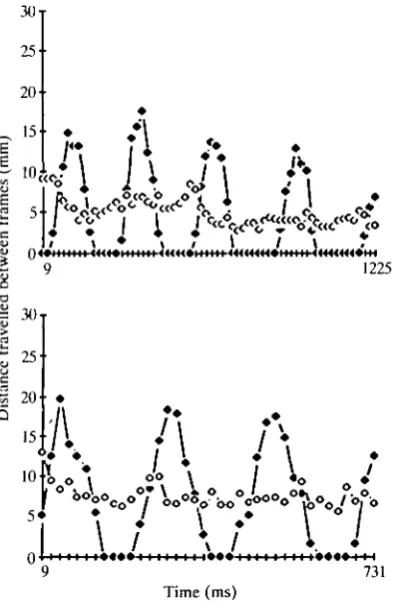
Forty-three recordings were made of pigeons walking and running at various speeds. Fig. 1 shows two typical examples for birds walking slowly. The pattern of results is clearly in agreement with earlier findings that there is no backwards motion of the head relative to the bird's surroundings during the head-bobbing cycle. Instead, the cycle consists of a hold and a thrust phase.
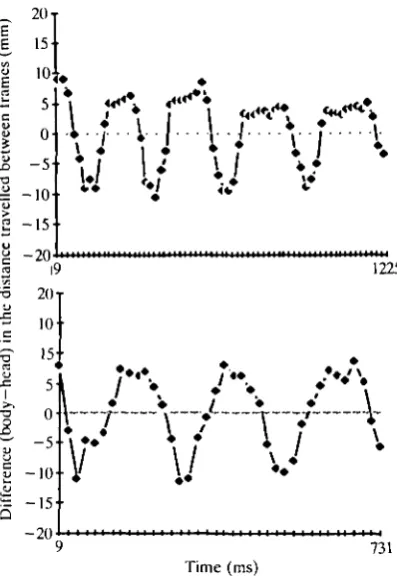
The rhythm of head velocity during walking can be seen more clearly if the data are replotted as the difference between the distances travelled by head and body in inter-frame intervals. Fig. 2 demonstrates a regular rhythm of extension and passive retraction of the head relative to the body.
30T
30
25
20 \
15
10
A
• •
Oa I
!•«•> I I I I I I I ! • • •
'
l
A
[image:5.451.129.327.290.594.2]731 Time (ms)
_ 20'
-E
15I 10
i 5,
c
8 0
S -5
•a
= -10
u
S -15
- 2 0
1225
- 2 0
[image:6.451.125.324.75.366.2]731 Time (ms)
Fig. 2. Differences in the distances travelled by head and body in inter-frame intervals (1 interval = 19 ms) as a function of time during cursorial locomotion for bird B2 (above) and bird C3 (below). Negative values indicate that the head is moving forwards more quickly than the body.
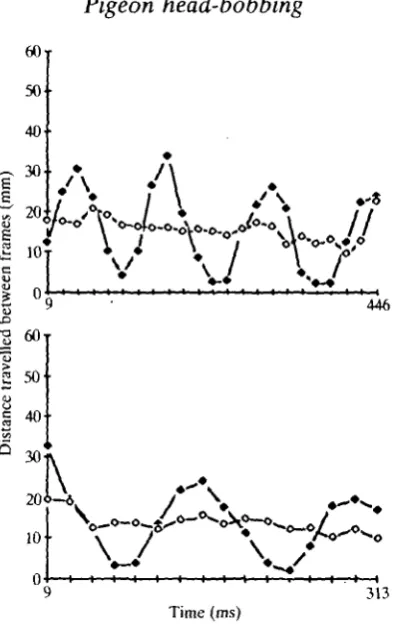
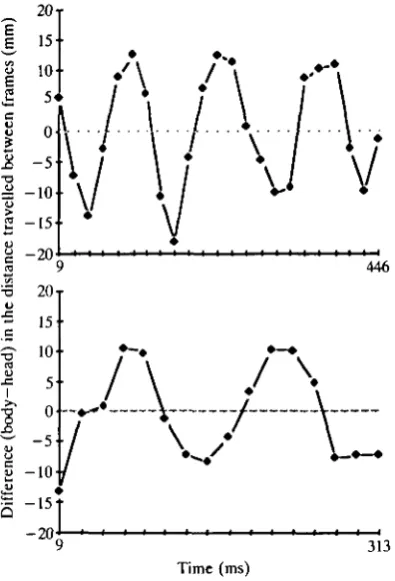
As the cursorial speed of the bird increases to a run, the pattern of the head-bobbing cycle with hold and thrust phases persists, although the peak velocity relative to the surroundings reached by the head in each cycle obviously increases. Once a certain speed is reached, however, the hold phase no longer occurs and is replaced by what we term a flexion phase, in which the head continues to move forwards (Fig. 3). There is still a regular rhythm of head velocity, but it no longer reaches zero at the minima. Fig. 4 demonstrates the same pattern of extension and passive retraction as in slow walking, even though the head is never stabilized relative to the surroundings.
446
60
50' 40
30
10
4 «
V
V J
V , *
'«
I I—I I I
[image:7.451.129.328.53.368.2]313 Time (ms)
Fig. 3. Distances travelled by head ( • ) and body « » in inter-frame intervals (1 interval = 19 ms) as a function of time during fast cursorial locomotion for bird B6 (above) and bird C3 (below). Average body velocities were 82-3 and 71-7cms~', respectively.
phase taking up a smaller part of the cycle as speed increases, and disappearing at speeds above 81 cms"1.
The smoothness of this relationship can be further illustrated by calculating the correlation between the proportion of the head-bobbing cycle occupied by the hold phase and the overall velocity of the bird. To do this, statistically independent data from different birds must be taken from each interval represented in the histogram in Fig. 5. This gives a sample of 10 data points (Fig. 6). The correlation between overall velocity and proportion of the cycle occupied by the hold phase is highly significant (Pearson r = — 0-97, df = 8, P < 0-01). The x on y regression line For these data (x = 75-29—l-13y) predicts that the overall body speed at which the hold phase will disappear is 75cms"1.
Landing flight
446
- 15 + £ 10 * 5
-5
-10
-15t
- 2 0 0 • - - •
,1
10/A
-•—-V-/ \
313
[image:8.451.127.325.76.367.2]Time (ms)
Fig. 4. Differences in the distances travelled by head and body in inter-frame intervals (1 interval = 19 ms) as a function of time during fast cursorial locomotion for bird B6 (above) and bird C3 (below). Negative values indicate that the head is moving forwards more quickly than the body.
there were occasionally frames in which the position of either eye or breast was occluded by the wing. Whenever this happened, an interpolated position midway between the frame before and the frame after was recorded. Note that this is a conservative procedure which will tend to smooth any fluctuations in velocity of either head or body.
11-20 21-30 31-40 41-50 51-60 61-70 71-80 8J-Overall body velocity (cms"1)
Fig. 5. The proportions of the head-bobbing cycle occupied by the mutually exclusive hold and thrust phases during cursorial locomotion at different overall body velocities. Total sample size was 43.
O
<D
00
cent
s
70
60
50
40
30
20
10
0
0 10 20 30 40 50 60 70 80 90 Overall body velocity (cms"1)
Fig. 6. Regression line (y on x) for the proportion of the head-bobbing cycle occupied by the hold phase and overall body velocity during cursorial locomotion. The sample consisted of 10 independent data points from different birds. (Pearson, r=— 0-97, d f = 8 ,
Take-off flight
[image:9.451.112.321.320.479.2]579 9 Time prior to alighting from flight (ms)
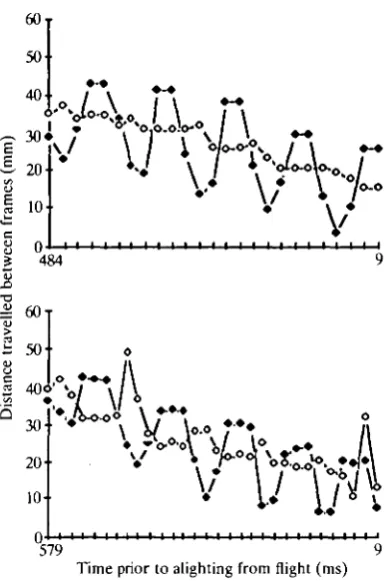
Fig. 7. Distances travelled by head ( • ) and body (O) in inter-frame intervals (1 interval = 19 ms) as a function of time during landing flight for bird G (above) and bird F (below).
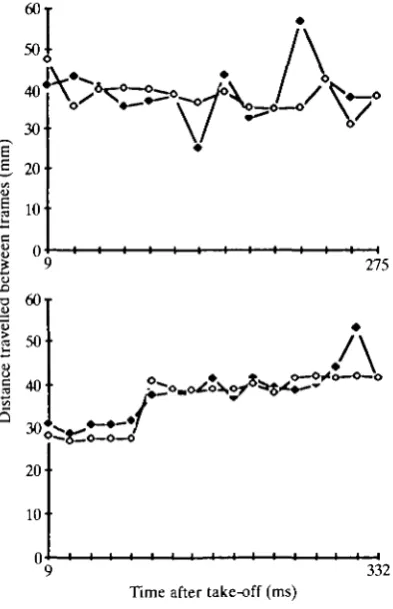
plotted as differences between distances travelled by head and body in inter-frame intervals. The rhythm shown in the comparable graphs for walking (Fig. 2), running (Fig. 4) and landing flight (Fig. 8) is absent in Fig. 10.
The contrast in patterns of head movement between the selected examples of landing and take-off flight in Figs 7 and 9 appeared in all recordings made of both types of flight. To express this consistency quantitatively, an autocorrelation analysis (Broom, 1979) was performed on each record of successive head velocities. This analysis calculates a correlation coefficient for each head velocity value and the value n intervals ahead (the lag interval). For each record, correlation coefficients were calculated for lags from 1 up to half the number of velocity values in the record. Table 1 shows, for all landing and take-off records, the highest positive correlation coefficient obtained, its significance and the lag at which it occurred.
-o - i n
u - 1 5
25
20H
15 10 5' 0 - 5 10 15 20 25
v 1/ y v
484
• a o
XI
a
-Time prior to alighting from flight (ms)
Fig. 8. Differences in the distances travelled by head and body in inter-frame intervals (1 interval = 19 ms) as a function of time during landing flight for bird G (above) and bird F (below). Negative values indicate that the head is moving forwards more quickly than the body.
intervals (about 95-115ms). The take-off records present a clear contrast. The peak correlation coefficients are lower than in the landing records and fewer are significant (those which are significant occur at lags of 1 or 2, and indicate only that velocity changes smoothly). Most important, peak coefficients occur equally frequently over the whole range of lags, and there is therefore no consistent periodicity in head velocity values in the take-off records.
General
Time after take-off (ms)
Fig. 9. Distances travelled by head (^) and body (O) in inter-frame intervals (1 interval = 19 ms) as a function of time during near vertical take-off flight for bird A3 (above) and bird Br (below).
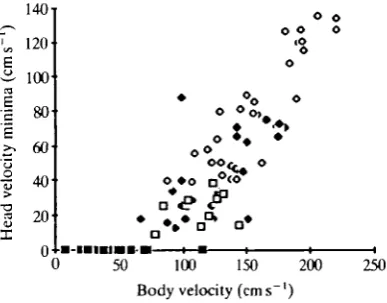
velocity at the last minimum of head velocity before landing and at the penultimate minimum before landing. Selection of data from cursorial records depended upon whether they showed a hold phase. If so, body velocity at the middle hold-phase in the record was taken, head velocity obviously being zero. If not, the minimum with the highest corresponding body velocity was chosen, to give a spread of data points, and head and body velocity were taken at that point.
Time after take-off (ms)
Fig. 10. Differences in the distances travelled by head and body in inter-frame intervals (1 interval = 19 ms) as a function of time during near vertical take-off flight for bird A3 (above) and bird Br (below). Negative values indicate that the head is moving forwards more quickly than the body.
Discussion Cursorial locomotion
the behaviour does not stabilize the retinal image. It should be noted, however, that even at slow walking speeds stabilization is not exact; Frost (1978a) demonstrated that the head slips at between 2-5 and 3-6 mm s"1 during the hold phase, but velocities this low cannot be measured from our records.
[image:14.451.39.421.188.347.2]The evidence obtained here appears to conflict with Dunlap & Mowrer's (1930) finding that pigeons carried passively at high speed show no rhythmic head
Table 1. Maximum positive autocorrelation coefficients (r) for each record of landing flight and take-off flight, with their corresponding lags
r 0-913* 0-914* 0-858* 0-882* 0-931* 0-912* 0-776* 0-737* 0-861* 0-903* Lag 5 5 5 5 5 5 4 6 11 6 Landing r 0-753* 0-826* 0-940* 0-504 0-850* 0-882* 0-815* 0-641* 0-724* 0-936* flight Lag 6 6 6 12 6 5 6 6 6 5 r 0-923* 0-8O7* 0-779* 0-746* 0-9O0* 0-781* 0-728* 0-895* 0-713* Lag 5 5 5 5 10 5 6 6 6 r 0-425 0-434 0-533 0-659* 0-525 0-119 0-612* 0-347 0-499 0-511* Take-off Lag 4 6 7 1 6 1 1 6 7 1 flight r 0-886* 0-709* 0-735 0199 0-751* 0-252 0-570 Lag 4 1 8 3 2 1 8
Values significant at the P = 0-05 level are marked with an asterisk.
In each record, autocorrelation coefficients were calculated for lags from 1 to half the total number of data points (between 9 and 16 for landing flights, between 7 and 10 for take-off flights). W3 E CO £ ty m i > r3 CJ 140-120 100 80 60 40 20 0 o » + a ) 50 Body • °o o o<» oo<
«« °
• O D°«>
• * Q*
100 150 velocity (cms
o o o o o
'%
o
o
200 25
[image:14.451.129.323.418.569.2]movements but instead hold the head in a fixed extended position. It is unlikely that head movements are different during active running and passive movement, as visual flow alone can induce head-bobbing (Friedman, 1975). A more likely explanation of the conflict is that Dunlap & Mowrer's birds reached higher speeds than the running birds in this experiment, but unfortunately the earlier study gives no figures for speeds used.
Flight
The recordings of pigeons' landing approaches to a perch show that the head-bob rhythm occurring during cursorial locomotion also occurs during landing flight (see Fig. 7). Just as when running at speeds above 75 cm s"1, there is no hold phase during landing flight, but the cycle of extension and retraction of the head relative to the body is still present (see Fig. 8). We conclude that head-bobbing occurs in slow landing flight, as it does in fast running, even though it does not stabilize the retinal image.
Our conclusion differs from that of Frost (1978a), who argued that single-frame analysis of a film of a landing pigeon showed no head-bobbing. The discrepancy arises from different definitions of the behaviour. Frost takes the presence of a hold phase with stabilization of the head relative to the surroundings to be the essential feature of head-bobbing, but we prefer to define head-bobbing as a rhythm of head movement relative to the body, which may or may not involve a hold phase. The advantage of our definition is that it brings out more clearly the continuities between patterns of head movement during different types of locomotion. Since the figures provided by Frost (1978a) do show the same rhythmic pattern of head movement as our data, the discrepancy in our conclusions arises only from this difference in definitions.
The continuity in head-bobbing between walking and flight is brought out clearly in the relationship between body velocity and minimum head velocity during the head-bob cycle (see Fig. 11). Once body velocity exceeds 75cms"1, minimum head velocity increases smoothly regardless of the form of locomotion, with data from running and landing flight overlapping considerably. This evidence supports the hypothesis that head-bobbing is controlled by the speed and visuomotor requirements of the bird, but not by the form of locomotion.
expected from the fact that turns of pigeons' heads lead turns of the body during flight manoeuvres (Bilo et al. 1985).
The results of this experiment therefore weaken the argument that head-bobbing during landing is a mechanical consequence of clap-fling wingbeat during slow flight. They suggest instead that head-bobbing occurs during flight when the bird needs information about its surroundings, and particularly about the distances of surfaces and objects. A pigeon approaching a perch needs more accurate distance information than one taking off in surroundings free of obstacles. The occurrence of head-bobbing in the first but not in the second context suggests a visual function for the behaviour.
General
What implications do the findings reported here have for the possible visual functions of head-bobbing? They provide strong evidence that its function cannot be only to achieve stabilization of the image relative to the retina during the hold phase. If this were so, birds would not be expected to head-bob during running or slow flight when the behaviour does not achieve stabilization, unless compensatory eye movements were made at the point of lowest velocity. There is no evidence available on the occurrence of eye movements in freely moving pigeons, although Pratt (1982) recorded saccadic eye movements in walking chickens during the thrust phase of the head-bob cycle. While it is theoretically possible that stabilization could be achieved in this way during fast running or slow flight, there is no evidence at present to indicate that it is.
An explanation of head-bobbing more consistent with the present findings is that given by Frost (1978a), who argues that the behaviour has the dual functions of stabilizing the retinal image during the hold phase, so that object motion can be detected, and of generating motion parallax during the thrust phase to provide depth information. We would suggest, however, a number of refinements to Frost's hypothesis, based both on our results and on a closer consideration of how information about a bird's surroundings is specified in the fluctuating retinal image. We will consider the functions of the thrust and hold phases in turn, before concluding with comparative and physiological predictions.
What visual information is available during the thrust phase of the head-bob cycle which would not be available to a bird walking at the same average speed but moving its head smoothly? As a bird's head moves forwards through space, surrounding objects move backwards through its visual field and their images flow over the retina away from the centre of expansion of the retinal image (Gibson, 1966).
The angular velocity # of any part of the retinal image is given by:
parallax - the motion of an image over the retina as an observer moves - can therefore provide depth information if the velocity of movement is known. It is possible that this is available to a walking pigeon from reafferent or vestibular information, or from the velocity of the ground, which is at a known distance. Provided one of these mechanisms is available, image motion during the thrust phase could provide depth information.
A second kind of information provided by image flow during locomotion needs to be considered, however. Discontinuities in retinal velocity specify the edges of objects lying in front of more distant surfaces. Relative motion between regions of the retinal image can therefore identify objects against backgrounds, a problem which is more difficult if only a static retinal image is available. Behavioural evidence that such relative motion information is used by animals has been obtained from insects. For example, Reichardt & Poggio (1979) have shown that a tethered fly turns to fixate a stripe of random-dot texture in front of an identically textured background when both are moving, provided that they move with different velocities.
In vertebrates, neurones responding to relative motion between an object and background have been identified in the pigeon tectum (Frost, 19786; Frost & Nakayama, 1983), the cat superior colliculus (Mandl, 1985) and striate cortex (Hammond et al. 1986) and the owl monkey prestriate cortex (Allman et al. 1985). The widespread occurrence of responses to relative motion has led Horridge (1987) to argue for its general importance as a source of information about the structure of a moving animal's surroundings, proposing that mechanisms of form perception involving memory have evolved relatively recently alongside more primitive systems computing relative motion.
A class of objects which pigeons need to detect are small, possibly camouflaged food objects lying on the ground. As a bird walks, the image of such an object will move more quickly over the retina than the image of the ground surface. The velocity of relative motion A# (velocity of image of upper surface of object minus velocity of image of the ground) is given by:
i) (2)
the thrust phase, and so the relative motion of object against background in this case would reach a velocity of about 6 ° s- 1.
If a function of the thrust phase is to amplify relative motion in the retinal image and make detection of objects on the ground more likely, then head-bobbing would be expected to occur in all situations where a bird needs information about nearby objects below it, whether the image could be stabilized or not. A running bird would be expected to head-bob to increase the chance of detecting food objects on the ground, and one in slow flight towards a landing surface would head-bob to obtain more information about the texture of the surface it is approaching. A bird taking off from the ground does not need information about the surface below it, and head-bobbing would not be expected.
Frost (1978a) argues that stabilization of the retinal image during the hold phase allows a walking bird to detect moving objects in its surroundings. This would be a problem for a bird which moved its head smoothly because relative motion in the image caused by object movement and the bird's own movement could not always be discriminated. If an object moves in the same direction as the bird, and at a greater speed, it will move across the visual field in the opposite direction to surrounding stationary objects, and it could therefore be detected relatively easily. If it moves in the opposite direction to the bird, or in the same direction but more slowly, then it will move across the visual field in the same direction as surrounding stationary objects. In this case, it would not be sufficient simply to detect the sign of retinal velocity, and more complex processing would be necessary to detect the anomalous motion. The brief stabilization of the retinal image during the hold phase solves this problem and ensures that any retinal motion is caused by object motion in the surroundings, which could therefore be detected unambiguously whatever its direction.
How can this explanation of the hold phase account for the occurrence of head-bobbing during running and flight, when the retinal image is not stabilized? One possibility is that the flexion phase has no direct visual function, but is simply necessary to allow the thrust phase to occur. Alternatively, it is possible that the flexion phase could increase the efficiency of detection of object motion during running or slow flight, by reducing the retinal velocity of images of stationary objects and so increasing the relative retinal velocity of a moving object. The efficiency with which object movement could be discriminated from self-induced motion by this means would fall with increasing head velocity in the flexion phase, but this would be a graded decline in efficiency, rather than a drop to zero as soon as stabilization became impossible.
One problem in testing such predictions is the likelihood that head-bobbing is one of a number of behaviour patterns which all achieve alternating rapid and slow or zero retinal motion. One example is hopping behaviour, which differs in form from head-bobbing but could serve the same visual functions. Another is the head movements of herons stalking prey, which alternate between fixing the head in space and small swaying movements. It is likely that these all have similar functions but are suited to birds with different body sizes and structures.
Turning to neurophysiology, the arguments above lead to predictions about the properties of the neurones in the pigeon tectum which respond to relative motion (Frost, 19786; Frost etal. 1981; Frost & Nakayama, 1983). Frost (1985) argues that these cells make up a system detecting object motion, in contrast to the detection of self motion in the accessory optic system. We agree with the division between analysis of local motion and global motion in these two systems, but do not agree that the tectal system analyses only local motion in the retinal image caused by object motion. Specifically, we differ from Frost (1985) on two points.
First, we propose that the tectal system also analyses local relative motion caused by self movement, and so contributes to figure-ground segregation. Since an important aspect of figure-ground segregation is the detection of food objects on the ground, we predict that there will be cells in the tectum sensitive to small patches of texture moving backwards through the visual field about 5-10° s"1 more quickly than a background moving in the same direction. Cells of this kind, responsive to differences in speed of motion alone, have not yet been reported in the pigeon, but are known in cat superior colliculus (Mandl, 1985) and striate cortex (Hammond et al. 1986). Since pecking targets will normally be located on the ground below the eye, it is probable that cells with these characteristics will have fields in the lower part of both the frontal and lateral visual fields.
Second, we do not agree that cells responsive to a spot and background moving in opposite directions (Frost & Nakayama, 1983) are sufficient to explain detection of object motion. They would fail to detect objects moving backwards through the visual field at velocities similar to that of the bird, as their responses could not be discriminated from those caused by self-induced motion. 'Backward notch' neurones (Frost & DiFranco, 1976), with rapid adaptation to backwards motion, do not solve this problem, but cells responsive to movement in any direction against a stationary background would solve it, since their activity during a hold phase would signal object motion unambiguously. We therefore predict that cells with these properties will also be found in the tectum. Moving objects which pigeons need to detect are most likely to occur at a distance from the bird, in the upper part of the visual field, and it is possible that these cells will have fields in this region. Our hypothesis for the function of head-bobbing therefore predicts a segregation of physiological processes between upper and lower parts of the visual field, and the relationship of this division to that between frontal and lateral fields ^s an interesting question for the future.
valuable comments on the manuscript. We are indebted to Lynne Easom and Teresa Sharp for their expert care of the pigeons and for assistance with experiments; to Sam Grainger, David Matthews and Steve Sharp for photographic advice; and to Dennis Vardy for technical assistance. MNOD was supported by a Medical Research Council Studentship.
References
ALLMAN, J., MIEZIN, F. & MCGUINNESS, E. (1985). Direction- and velocity-specific responses from beyond the classical receptive field in the middle temporal visual area (MT). Perception
14, 105-126.
AULIE, A. (1983). The fore-limb muscular system and flight. In Physiology and Behaviour of the Pigeon (ed. M. Abs), pp. 117-129. London: Academic Press.
BILO, D., BILO, A., MULLER, M., THEIS, B. & WEDEKIND, F. (1985). Neurophysiological-cybernetic analysis of course control in the pigeon. Biona Report 3, 445-477.
BLOUGH, P. M. (1973). Visual acuity of the pigeon. II. Effects of target distance and retinal lesions./, exp. anal. Behav. 20, 333-343.
BROOM, D. M. (1979). Methods of detecting and analysing activity rhythms. Biol. Behav. 1, 3-18.
COLLETT, T. S. (1978). Peering - a locust behaviour pattern for obtaining motion parallax information. /. exp. Biol. 76, 237-241.
CRACRAFT, J. (1971). The functional morphology of the hind limb of the domestic pigeon, Columbia livia. Bull. Am. Mus. nat. Hist. 144, 173-268.
DAANJE, A. (1951). On locomotory movements in birds and the intention movements derived from them. Behaviour 3, 48-%.
DAGG, A. I. (1962). The role of the neck in the movements of the giraffe. /. Mammal. 43, 88-97. DAGG, A. I. (1977a). Running, Walking and Jumping: The Science of Locomotion. London:
Wykeham.
DAGG, A. I. (1977/>). The walk of the silver gull (Larus novaehollandiae) and other birds. J. Zool., Lond. 19, 529-540.
DUNLAP, K. & MOWRER, O. H. (1930). Head movements and eye functions of birds. J. comp. Psychol. 11, 99-113.
ELLARD, C. G., GOODALE, M. A. & TIMNEY, B. (1984). Distance estimation in the Mongolian gerbil: the role of dynamic depth cues. Behav. Brain Res. 14, 29-39.
FREMLIN, J. (1972). How stereoscopic vision evolved. New Scient. 56, 26-28.
FRIEDMAN, M. B. (1975). How birds use their eyes. In Neural and Endocrine Aspects of Behaviour in Birds (ed. P. Wright, P. G. Caryl & D. M. Vowles), pp. 181-204. Oxford: Elsevier.
FROST, B. J. (1978a). The optokinetic basis of head-bobbing in the pigeon. J. exp. Biol. 74, 187-195.
FROST, B. J. (1978£>). Moving background patterns alter directionally specific responses of pigeon tectal neurons. Brain Res. 151, 599-603.
FROST, B. J. (1985). Neural mechanisms for detecting object motion and figure-ground boundaries contrasted with self-motion detecting systems. In Brain Mechanisms of Spatial Vision (ed. D. Ingle, M. Jeannerod & D. Lee), pp. 415-449. The Hague: Nijhoff.
FROST, B. J. & DIFRANCO, D. E. (1976). Motion characteristics of single units in the pigeon optic tectum. Vision Res. 16, 1229-1234.
FROST, B. J. & NAKAYAMA, K. (1983). Single visual neurons code opposing motion independent of direction. Science 220, 744-745.
FROST, B. J., SCILLEY, P. L. & WONG, S. C. P. (1981). Moving background patterns reveal double opponency of directionally specific pigeon tectal neurons. Expl Brain Res. 43, 173-185. | GIBSON, J. J. (1966). The Senses Considered as Perceptual Systems. London: George Allen of
URJNNELL, J. (1921). The principle of rapid peering in birds. Univ. Calif. Chron. 23, 392-396. HAMMOND, P., AHMED, B. & SMITH, A. T. (1986). Relative motion sensitivity in cat striate
cortex as function of stimulus direction. Brain Res. 386, 93-104.
HEPPNER, F. & ANDERSON, J. G. T. (1985). Leg thrust important in flight take-off in the pigeon. /. exp. Biol. 114, 285-288.
HODOS, W., SMITH, L. & BONBRIGHT, J. C. (1975). Detection of the velocity of movement of visual stimuli by pigeons. /. exp. anal. Behav. 25, 143-156.
HORRIDGE, G. A. (1986). A theory of insect vision: velocity parallax. Proc. R. Soc. Ser. B 229, 13-27.
HORRIDGE, G. A. (1987). The evolution of visual processing and the construction of seeing systems. Proc. R. Soc. Ser. B 230, 279-292.
JOHANSSON, G. (1973). Monocular movement parallax and near-space perception. Perception 2, 135-146.
KARE, M. R. (1965). The special senses. In Avian Physiology (ed. P. D. Sturkie), pp. 406-418. Cornell University Press.
MANDL, G. (1985). Responses of visual cells in cat superior colliculus to relative pattern movement. Vision Res. 25, 267-281.
MARTTNOYA, C , RIVAUD, S. & BLOCH, S. (1983). Comparing frontal and lateral viewing in the pigeon. II. Velocity thresholds for movement discrimination. Behav. Brain Res. 8, 375—385. PRATT, D. W. (1982). Saccadic eye movements are co-ordinated with head movements in
walking chickens. /. exp. Biol. 97, 217-223.
REICHARDT, W. & POGGIO, T. (1979). Figure-ground discrimination by relative movement in the visual system of the fly. Biol. Cybernectics 35, 81-100.
ULRICH, D. J., BLOUGH, P. M. & BLOUGH, D. S. (1982). The pigeon's distant visual acuity as a function of viewing angle. Vision Res. 22, 429—431.