Introduction
The vertebrate O2 transport and delivery system can be considered to be composed of four steps in series: ventilatory convection, alveolar–capillary diffusion, blood convection, and tissue capillary-to-cell diffusion of O2(Taylor and Weibel, 1981; Wagner, 1996). How whole-animal maximum aerobic capacity (VO2max) should respond to changes in ambient partial pressure of O2(PO2) depends on which of these steps is limiting and on mitochondrial oxidative capacity in peripheral tissues. For instance, hypoxia should cause a reduction in VO2maxunless both O2delivery and mitochondrial oxidative capacity were in excess. In this context, Lindstedt et al. (1988) have shown that when O2 delivery is reduced by anemia or hypoxia, VO2max declines in direct proportion to O2 delivery, whereas O2 extraction from the blood remains relatively constant (~90%).
Effects of hyperoxia on VO2max are not as straightforward, because limitations at different levels in the O2cascade may lead to different experimental outcomes (Richardson et al., 1999; Lindstedt and Conley, 2001; Noakes et al., 2001). Increased VO2maxin hyperoxia may suggest that O2uptake and delivery systems are more relevant for VO2maxin normoxia than mitochondrial oxidative capacity (i.e. central limitation), whereas potential constraints at the mitochondrial level in the muscles might be the case if VO2max remains unchanged at higher PO2 (i.e. peripheral limitation). [However, limits in cardiac output or blood O2 saturation in the latter example could not be ruled out, as convective steps in the O2 cascade (e.g. O2movement into the lungs, blood O2transport, muscle blood flow) might impose a ceiling in VO2maxregardless of the higher diffusion consequent of the increase O2gradient.] We compared maximum aerobic capacity during forced
exercise (VO22max) in hypoxia (PO22=14% O2), normoxia (21%) and hyperoxia (30%) of lines of house mice selectively bred for high voluntary wheel running (S lines) with their four unselected control (C) lines. We also tested for pleiotropic effects of the ‘mighty mini-muscle’ allele, a Mendelian recessive that causes a 50% reduction in hind limb muscle but a doubling of mass-specific aerobic enzyme activity, among other pleiotropic effects. VO22maxof female mice was measured during forced exercise on a motorized treadmill enclosed in a metabolic chamber that allowed altered PO22. Individual variation in VO22max was highly repeatable within each PO22, and values were also significantly correlated across PO22. Analysis of covariance showed that S mice had higher body-mass-adjusted VO22max than C at all PO22, ranging from +10.7% in hypoxia to +20.8% in hyperoxia. VO22max of S lines increased practically linearly with PO22, whereas that of C lines plateaued from normoxia to hyperoxia, and respiratory exchange ratio (=CO2production/VO22max) was lower for S lines. These results suggest that the physiological
underpinnings of VO22maxdiffer between the S and C lines. Apparently, at least in S lines, peripheral tissues may sustain higher rates of oxidative metabolism if central organs provide more O2. Although the existence of central limitations in S lines cannot be excluded based solely on the present data, we have previously reported that both S and C lines can attain considerably higher VO22max during cold exposure in a He–O2 atmosphere, suggesting that limitations on VO22maxdepend on interactions between the central and peripheral organs involved. In addition, mini-muscle individuals had higher VO22maxthan did those with normal muscles, suggesting that the former might have higher hypoxia tolerance. This would imply that the mini-muscle phenotype could be a good model to test how exercise performance and hypoxia tolerance could evolve in a correlated fashion, as previous researchers have suggested.
Key words: artificial selection, central limitation, exercise, hypoxia, hyperoxia, maximum metabolic rate, oxygen availability, peripheral limitation, respiratory exchange ratio, symmorphosis.
Summary The Journal of Experimental Biology 209, 115-127
Published by The Company of Biologists 2006 doi:10.1242/jeb.01883
Maximum aerobic performance in lines of Mus selected for high wheel-running
activity: effects of selection, oxygen availability and the mini-muscle phenotype
Enrico L. Rezende*, Theodore Garland, Jr, Mark A. Chappell, Jessica L. Malisch and
Fernando R. Gomes
Department of Biology, University of California, Riverside, CA 92521, USA
*Author for correspondence at present address: Integrative Ecology Group, Estación Biológica de Doñana, CSIC, Apdo. 1056, E-41080 Seville, Spain (e-mail: [email protected])
Alternatively, it could be the case that all steps in the O2 cascade are virtually identical in capacity, such that none, by itself, would set the limit for maximum organismal performance. Indeed, symmorphosis (Taylor and Weibel, 1981) has been proposed as a response at many levels of biological organization to the ‘powerful optimizing process’ (Alexander, 1989, p. 1200) attributed to natural selection. Whether animals are symmorphotic presently remains a matter of debate among physiologists (Hammond and Diamond, 1997; Bacigalupe and Bozinovic, 2002), and several authors have argued against its biological relevance in the light of evolutionary theory and various empirical results (Garland and Huey, 1987; Garland, 1998; Gordon, 1998; brief review in Suarez and Darveau, 2005). Almost all existing studies aimed at testing symmorphosis have been interspecific comparisons, so experimental evolution can offer a novel approach to the study of such hypotheses about the correlated evolution of complex phenotypes (Garland, 2001, 2003; Swallow and Garland, 2005; Garland and Carter, 1994).
Artificial selection for high voluntary wheel running in four replicate lines of house mice (Swallow et al., 1998a) provides an opportunity to examine interactions between aerobic limits and locomotor activity. Existing evidence indicates that normoxic VO2max has increased, especially in males, coincident with the evolution of higher activity levels in the selected (S) lines as compared with their random bred control (C) lines (Swallow et al., 1998b; Rezende et al., 2005, 2006). Therefore, selection might have affected hypoxia tolerance at the muscle level because these lines run voluntarily at speeds approaching their maximum aerobic speeds for at least some minutes per night (Girard et al., 2001; Rezende et al., 2005, 2006).
An unexpected part of the response to selection has been the evolution of the ‘mighty mini-muscle’ phenotype, which represents homozygotes for a Mendelian recessive allele that halves gastrocnemius muscle mass (Garland et al., 2002; Belter et al., 2004) while doubling per gram aerobic capacity (Houle-Leroy et al., 2003). This phenotype occurs in only two of the four selected lines and has now gone to fixation in one of them. Apparently, the other two selected lines lost the allele, which was initially rare, by random genetic drift during the early generations of the experiment (Garland et al., 2002). In any case, the increase in frequency of this gene of major phenotypic effect represents an important component of the overall response to selective breeding. Moreover, because it has significant effects on a variety of other traits in addition to gastrocnemius muscle mass (Garland et al., 2002; Houle-Leroy et al., 2003; Swallow et al., 2005; Syme et al., 2005; Kelly et al., in press), it should be accounted for in statistical analyses. For example, the soleus muscle of mini-muscle individuals is actually larger than in normal individuals (Syme et al., 2005). And, considering that mini-muscle individuals often run both more and faster on wheels as compared with normal-muscled individuals within the same line (Syme et al., 2005; Kelly et al., in press), one might expect that the phenotype could also affect VO2max.
The purpose of this study was to determine the effects of different atmospheric PO2on VO2maxduring forced exercise in the S and C lines of mice and to test for pleiotropic effects of the mini-muscle phenotype. Results can be important for several reasons. First, they may provide insight about the physiology underlying VO2maxand the relative importance of O2uptake and delivery systems at the whole-individual level. Second, given that S lines have elevated VO2maxas compared with C lines (Swallow et al., 1998b; Rezende et al., 2005, 2006), hypoxia and hyperoxia may affect S and C lines differently, which would suggest differences at lower physiological levels in the O2cascade, as has been found in lines of rats selected for high vs low treadmill performance (e.g. Henderson et al., 2002; Howlett et al., 2003). Such results would be relevant for symmorphosis. Specifically, if S lines have evolved in a symmorphotic fashion, one would expect effects of PO2on VO2maxto be independent of selection history, and differences between S and C would remain constant across different PO2. Conversely, if S and C lines respond differently to changes in PO2, this would suggest that traits subordinate to VO2maxhave evolved in a ‘non-symmorphotic’ fashion in response to selection. Third, effects of hyperoxia on VO2max and running performance could reveal whether aerobic constraints may be limiting to the evolution of even higher levels of wheel running in the S lines. An increased performance by S mice in a hyperoxic atmosphere would suggest that they might run even more (faster) on wheels if O2availability at the tissue level were higher. Finally, results may help elucidate why the mini-muscle phenotype has been favored by the selection regimen (Garland et al., 2002; Houle-Leroy et al., 2003; Swallow et al., 2005; Syme et al., 2005; Kelly et al., in press).
Materials and methods Animals and experimental protocol
was 2.37-fold (averaged over all eight lines and both sexes; T. Garland, Jr., unpublished results; Pselection<0.001).
After breeders for the next generation were selected, we obtained our individual females from different families from within each line. We used six females per line, except for line 6, which is polymorphic for the mini-muscle allele mentioned above (sibs were sometimes used in this line; see Statistics), where we used 17 females. Note that line 3 is now apparently fixed for the mini-muscle allele (i.e. all individuals have the phenotype; Syme et al., 2005; T. Garland, Jr., unpublished results). Prior to choosing these individuals for study, we excluded the lowest runner within each family to compensate for the bias caused by having chosen the highest runners to become breeders during the selection protocol (see previous paragraph). Mice were housed four per cage from weaning to selection, with food and water ad libitum, then measured for 6·days on wheels, beginning at around 62·days of age (range 54–70·days), and subsequently were maintained in individual cages.
At approximately 95·days of age (79–110·days), individuals were randomly assigned to five measurement batches of 12 mice each (although within each line, older individuals were assigned to initial batches to minimize differences in age). Each batch was used for treadmill measurements at three different PO2 (see below) for six consecutive days – measurements were performed twice on consecutive days at each PO2. To control for training or ‘acclimating’ effects, batches were measured in each atmosphere in different sequences, and individuals were measured in random order within each batch. All trials were performed between 09.00 and 12.00·h. On day 7, mice were sacrificed and dissected, and individuals with the mini-muscle phenotype were identified by inspection of graphs of muscle mass versus body mass (see Garland et al., 2002; Houle-Leroy et al., 2003; Belter et al., 2004; Syme et al., 2005).
Treadmill measurements in hypoxia, normoxia and hyperoxia
Maximum aerobic capacity during forced exercise (VO2max) was estimated with open-flow respirometry by running mice in an enclosed motorized treadmill, as described previously (Hayes and Chappell, 1990; Chappell et al., 2003; Rezende et al., 2005). The treadmill had an inclination of 25°, which maximizes the VO2max values obtained in mice (Kemi et al., 2002) and resulted in significantly higher VO2maxin males from generation 33 when compared with males tested without slopes (E.L.R., T.G., F.R.G. and M.A.C., unpublished data). Treadmill tests were performed at room temperature (22–25°C). We used positive-pressure, flow-through respirometry to determine rates of oxygen consumption (VO2) and carbon dioxide production (VCO2). Airflow was regulated with upstream mass flow controllers (Applied Materials, Tylan, Billerica, MA, USA), with a flow rate of 2100·ml·min–1, that maintained excurrent O2 concentrations within 0.5% of incurrent gas. Approximately 100·ml·min–1 of excurrent air was subsampled and analyzed for CO2 (which was then scrubbed) and O2. Oxygen concentration was measured with
an Ametek/Applied Electrochemistry S-3A analyzer (Pittsburgh, PA, USA), and CO2 was measured with LiCor 6251. Data from gas analyzers and other instruments were recorded on Macintosh computers equipped with National Instruments A-D converters and ‘Labhelper’ software (Warthog Systems, www.warthog.ucr.edu).
To maintain different atmospheric O2 concentrations, flow controllers were supplied with room air or connected to cylinders with different mixtures of oxygen and nitrogen creating hypoxia (14% O2) and hyperoxia (30% O2). Reference readings of incurrent gas were obtained at the start and end of measurements. References from cylinders were always checked against room air before measurements and remained precise (±0.1%) throughout the experiment. Mice were placed inside the treadmill’s working section (6·cm wide, 7·cm high, 13.5·cm long), which was flushed for ~1·min to attain stable O2 concentration during hypoxia and hyperoxia (for consistency, this was also applied in normoxic trials). Mice were allowed a 1–2·min adjustment period and were then run at increasing speeds starting at 0.15–0.2·m·s–1and raised in step increments of ~0.15·m·s–1 every 45·s. A trial was terminated when mice could no longer keep pace with the treadmill and VO2did not increase with increasing tread speed. All animals failed to maintain position at the highest tread speeds implemented. Trial quality was also assessed using a subjective scale (five categories, from ‘poor’ to ‘excellent’; following Swallow et al., 1998b; Rezende et al., 2005). In this sample of mice, no individual was scored as ‘poor’ and hence none were excluded from analyses. Preliminary analyses using trial quality as an additional covariate indicated that it was never statistically significant, so it was not included in final models.
We applied the ‘instantaneous’ transformation (Bartholomew et al., 1981) to resolve rapid changes in metabolism. Effective volume of the treadmill was 903·ml (Chappell et al., 2004). We calculated VO2 (ml·min–1) as in Eqn·1, after scrubbing subsampled air of water vapor and CO2 (Drierite and soda lime, respectively):
VO2 = V(FIO2– FEO2)/(1 – FEO2), (1)
where Vis flow rate (ml·min–1STP; standard temperature and pressure), and FIO2 and FEO2 are the fractional O2 concentrations in incurrent and excurrent air, respectively (FIO2 was 0.3002, 0.2095 and 0.1405 for hyperoxia, normoxia and hypoxia; FEO2 was always within 0.5% of FIO2). VCO2 (ml·min–1) was calculated as:
VCO2 = {V[(FECO2 – FICO2)–FECO2]VO2} / (1 – FECO2), (2)
where FICO2and FECO2are the fractional CO2 concentrations of incurrent and excurrent gas, respectively (FICO2was ~0.0004 in normoxia and 0 in hypoxia and hyperoxia). We determined
calculations and corrections on VO2 files were performed using LabAnalyst software (Warthog Systems).
Statistics
Analyses were performed with SPSS for Windows and SAS PROC MIXED (version 8, SAS Institute, Cary, NC, USA, 1996). Repeatability between traits, measured on two consecutive days, was estimated with Pearson product-moment correlations (Hayes and Jenkins, 1997) on residuals from nested analysis of covariance (ANCOVA), correcting for selection history (line type and line), mass, batch and age (see below). To check for day-to-day ‘training’ effects, we used paired t-tests comparing trials 1 and 2.
As shown below, individual performance in the first and second trials within a given PO2 was highly repeatable, consistent with maximal effort. Because we were interested in maximum performance, we selected the higher of the two
VO2maxrecorded at each PO2 for most analyses, consistent with previous studies (e.g. Swallow et al., 1998b; Rezende et al., 2005). Differences between line types (S versus C) were assessed with type III sums of squares, using linear mixed models. Line type was the grouping variable, replicate lines (N=8) were nested within line type as a random factor, mass and age were covariates, and batch was a cofactor. Line effects were determined by comparing maximum-likelihood (ML) estimates with and without lines in the model (the difference between ML values follows a 2distribution with 1 d.f.). Least-squares means adjusted to a common age and body mass were calculated to estimate the difference between S and C lines. Regular ANCOVAs were also performed for S and C separately, including line as a random factor (four lines) and using the same covariates of the nested ANCOVA. Discriminating effects of the mini-muscle allele from other effects is not straightforward (see Discussion); hence, we employed two different approaches. First, nested ANCOVAs were performed with an additional dummy variable equal to 0 for normal phenotypes and 1 for mini-muscles (N=48 and 11, respectively). Second, we compared individuals with and without the mini-muscle phenotype within line 6, employing regular ANCOVA with mass and age as covariates.
We assessed how VO2 changed as a function of O2 concentration and whether these changes differed due to selection history, employing general linear models (GLM) for repeated measures (SPSS for Windows). Individuals were experimental units, partial pressure (hypoxia, normoxia and hyperoxia) was the within-subjects factor, and selection history and lines were included as between-subjects factors (the latter, in this case, was treated as a fixed factor). Significance of selection history (S versusC) was estimated by dividing mean square error (MSE) of the model including only line type as the fixed factor by MSE from the model with line ⫻ line type (i.e. same d.f. obtained in the nested ANOVA). To determine how variables differed between trials, contrasts (differences between successive values for each individual) were compared employing multivariate ANOVAs (test of within-subject contrasts). We also tested for
individual effects acrossdifferent PO2with an Fratio between the MSEs between- and within-individuals (=MSEbetween/ MSEwithin), obtained from a repeated-measures ANOVA with individuals as the grouping factors. When there are only two repeated measures, this test is analogous to Pearson’s correlations and can also be used to test for ‘consistency’ between measurements, i.e. ‘repeatability’ (Hayes and Jenkins, 1997; Zar, 1999; Rezende et al., 2005).
All Pvalues shown correspond to two-tailed tests, although in many cases one-tailed tests would be appropriate. For example, in all measures of repeatability of individual differences, the alternative hypothesis is for a positive correlation, not just a correlation different from zero (unless fatigue effects were large and carried over for 24·h). Similarly, for VO2max, the expectation from both first principles and previous studies (Swallow et al., 1998b; Rezende et al., 2005) is that mice from S lines will have higher values than those from C lines. On the other hand, multiple tests are performed that compare the same set of animals for various traits, which would suggest some sort of correction for multiple comparisons (e.g. see Rice, 1989; Curran-Everett, 2000). Thus, we report test statistics, d.f. and P values for all statistical tests; independent conclusions may be drawn from these as desired.
Results
Maximum rates of O2 consumption (VO2max) and CO2 production (VCO2max) were highly repeatable in hypoxia, normoxia and hyperoxia, regardless of selection history (Table·1). Respiratory exchange ratios obtained at VO2max (RERVO2max) were repeatable only in hypoxia and normoxia (P<0.02 in all cases), whereas RERVCO2maxwere not repeatable in most analyses. Maximum running speeds (treadmill with 25° slope) in S and C lines were always significantly repeatable between days (Table·1). Accordingly, effects of individual variation across PO2 remained statistically significant for
VO2max, VCO2max and maximum running speeds but not for either of the RER indexes (see below).
Training effects were negligible for VO2max, which was 2.2% lower in the first trial in hypoxia (two-tailed P=0.023), and the same was true for VCO2max(P=0.003). No differences between trials 1 and 2 were observed in maximum running speeds at any PO2(P>0.05 in all cases).
Selection, body mass and mini-muscle effects
Table 1.Repeatability analyses estimating individual consistency of VO2max, VCO2max, respiratory exchange ratios at VO2maxand at
VCO2max, and maximum running speed on the treadmill between days 1 and 2 at each partial pressure of O2
Hypoxia (14% O2) Normoxia (21% O2) Hyperoxia (30% O2)
r P r P r P
Pooled (N=59)
VO2max 0.607 <0.0001 0.711 <0.001 0.587 <0.0001
VCO2max 0.733 <0.0001 0.810 <0.0001 0.797 <0.0001
RERVO2max 0.496 <0.0001 0.346 0.004 0.041 0.379
RERVCO2max 0.280 0.016 0.057 0.333 0.117 0.188
Maximum speed 0.758 <0.0001 0.728a <0.0001 0.862b <0.0001
Selected (N=35)
VO2max 0.633 <0.0001 0.634 <0.0001 0.719 <0.0001
VCO2max 0.733 <0.0001 0.824 <0.0001 0.840 <0.0001
RERVO2max 0.443 0.004 0.356 0.018 0.064 0.356
RERVCO2max 0.232 0.090 0.354 0.018 0.172 0.162
Maximum speed 0.749 <0.0001 0.780a <0.0001 0.800b <0.0001
Control (N=24)
VO2max 0.627 <0.001 0.720 <0.0001 0.476 0.009
VCO2max 0.750 <0.0001 0.759 <0.0001 0.763 <0.0001
RERVO2max 0.497 0.007 0.476 0.009 0.139 0.259
RERVCO2max 0.217 0.154 –0.300 n.a. 0.190 0.186
Maximum speed 0.723 <0.0001 0.679 <0.0001 0.683 <0.0001
aTwo individuals excluded from analyses because maximum speed unavailable. bOne individual excluded from analyses because maximum speed unavailable.
Pearson product-moment correlations were computed for residuals from nested ANCOVAs accounting for selection history (line types and/or lines), mass, age and batch effects. P-values are for one-tailed hypotheses, and values in bold indicate statistically significant values at P<0.05. n.a., direction of correlation opposite to directional hypothesis, so Pvalue not reported.
3 5 7 9
Body mass (g)
20 24 28 32 36 20 24 28 32 36 40
3 5 7
3 5 7 X Data
3 5 7 9 Hypoxia
3 5 7
3 5 7 Normoxia
Hyperoxia
Selected Control
Normal Mini-muscle
Maximum O
2
consumption (ml min
–1)
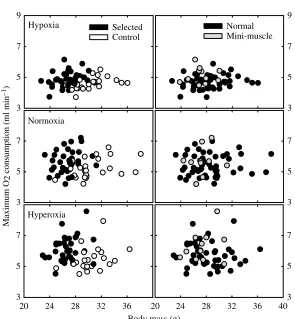
Fig.·1. Maximum aerobic capacity (VO2max) measured
during forced exercise in a hypoxic (14% O2), normoxic
(21% O2) and hyperoxic atmosphere (30% O2) for 59
mice from lines selected for high voluntary wheel running (S) and their non-selected control lines (C). Each point represents the highest 60-s average obtained in two measurements on the treadmill performed on consecutive days (see Materials and methods). (Left panels) Aerobic capacity in relation to selection history – i.e. S (closed circles) versusC (open circles). Adjusted means for S and C in each PO2 are listed in Table·2.
[image:5.612.46.341.419.738.2]According to the nested ANCOVA, mice from S lines were significantly smaller in body mass than C mice (adjusted means of 27.6±1.5·g and 31.5±1.5·g, respectively, Pselection=0.0038; Fig.·1), but there were no differences between normal and mini-muscle phenotypes (full model nested ANCOVA, Pmini=0.720). In addition, according to regular ANCOVA within line 6 with age as covariate, body mass did not differ between mini-muscle and normal mice (F1,14=0.088,
P=0.771).
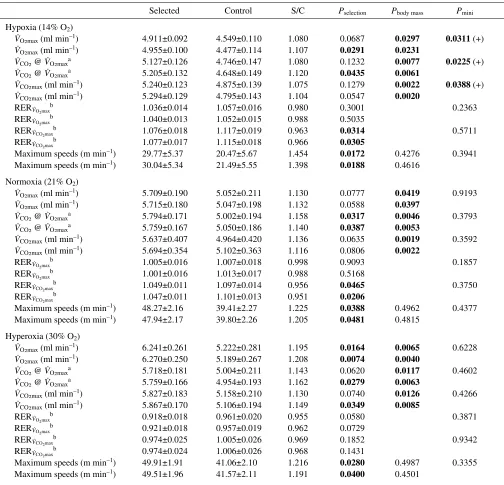
After accounting for variation in body mass, S lines achieved higher VO2max and VCO2max than C mice (Fig.·2), with the greatest difference in hyperoxia (Table·2). In the full nested model, individuals with mini-muscles had statistically higher VO2max and
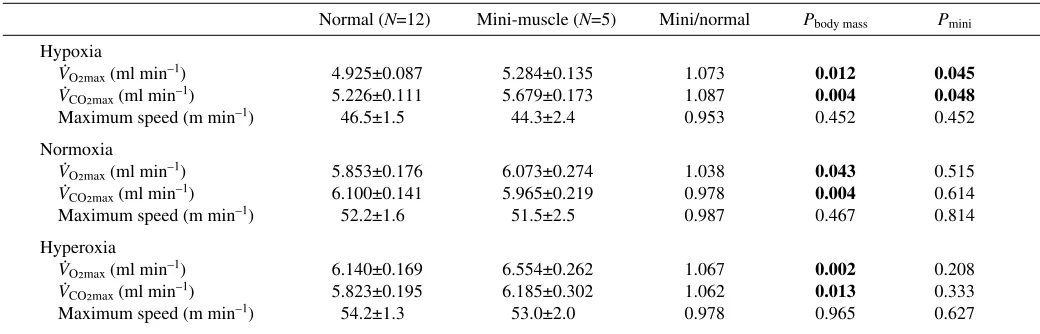
VCO2max only in hypoxic conditions (Table·2; Fig.·1). Considering only individuals within selection line 6, those with the mini-muscle phenotype achieved statistically higher VO2max and VCO2max in hypoxia (Table·3) but not in normoxia or hyperoxia (P>0.21 in all cases; Table·3).
Maximum running speeds were significantly higher in S mice at all O2 concentrations (Table·2; Fig.·2). Regardless of atmospheric PO2, VO2max and VCO2max increased significantly with body mass, whereas maximum running speeds did not (Table·2). Speeds were not affected by mini-muscle status in the full data set (Table·2) or within line 6 (Table·3).
Aerobic performance at different PO2
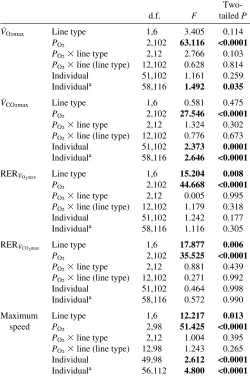
Repeated-measures analyses show that increased PO2 led to increased VO2max and VCO2max in all lines,
Hypoxia Normoxia Hyperoxia Hypoxia Normoxi a
Hyperox ia
0.8 0.9 1.0 1.1
Maximum O
2
consumption (ml min
–1)
3 4 5 6 7
3 4 5 6 7
Selected Control
Maximum CO
2
production (ml min
–1
)
RER at
VO
2
max
Maximum speed (m min
–1
)
0 20 40 60
A
B
C
D
a
b
c b c
a
b a
c
c b
a Fig.·2. (A) Maximum aerobic capacity (VO2max),
(B) carbon dioxide production, (C) respiratory exchange ratio at VO2max (RER=VCO2/VO2max) and
(D) maximum running speeds, measured in S and C mice (N=35 and 24, respectively) during forced exercise on a treadmill with a hypoxic (14% O2),
normoxic (21% O2) or hyperoxic atmosphere (30%
O2). Values are shown as adjusted means ± s.e.m.
Statistical differences between hypoxic, normoxic and hyperoxic trials are shown in lowercase letters; effects of selection history for each trait at a given PO2 are shown in Table·2; overall effects of
selection on the entire dataset (i.e. across PO2) are
listed in Table·4.
r=0.631, P<0.001 r=0.585, P<0.001
3 5 7 9
VO
2
max
normoxia
3 5 7
Selected Control r=0.543, P<0.001
VO2max hypoxia (ml min–1)
3 5 7 9
VO
2
max
hyperoxia (ml min
–1
)
3 5 7
VO2max normoxia (ml min–1)
Fig.·3. Individual consistency of maximum aerobic performance (VO2max)
measured across different PO2. Points represent the highest 60-s averages
for each individual obtained from either of two treadmill trials each in hypoxia (14% O2), normoxia (21% O2) and hyperoxia (30% O2). The
broken line represents equality (x=y) in each plot. Pearson product-moment correlations are also reported for residuals calculated from nested ANCOVAs performed separately for each PO2, including mass and age as
regardless of selection history (Fig.·2; Table·4). Similarly, within-subject contrasts – i.e. testing whether the mean at a given PO2is significantly different from the mean obtained at the previous level – show that VO2maxmean values were always significantly higher at higher PO2, regardless of selection history
(F1,51=74.24, P<0.0001 for hypoxia versus normoxia, and
[image:7.612.58.562.84.569.2]F1,51=57.35, P<0.0001 for hyperoxia versus normoxia; Fig.·2A). The same was true for VCO2max(P<0.008 in both cases; Fig.·2B). Selection history had a marginal effect on VO2max (one-tailed P=0.057; Table·4), supporting the conclusion that S mice Table 2.Adjusted means ± s.e.m. for S and C female mice, with line types tested over replicate lines nested within line types
Selected Control S/C Pselection Pbody mass Pmini
Hypoxia (14% O2)
VO2max(ml·min–1) 4.911±0.092 4.549±0.110 1.080 0.0687 0.0297 0.0311 (+)
VO2max(ml·min–1) 4.955±0.100 4.477±0.114 1.107 0.0291 0.0231
VCO2@ VO2maxa 5.127±0.126 4.746±0.147 1.080 0.1232 0.0077 0.0225 (+)
VCO2@ VO2maxa 5.205±0.132 4.648±0.149 1.120 0.0435 0.0061
VCO2max(ml·min–1) 5.240±0.123 4.875±0.139 1.075 0.1279 0.0022 0.0388 (+)
VCO2max(ml·min–1) 5.294±0.129 4.795±0.143 1.104 0.0547 0.0020
RERVO2max
b 1.036±0.014 1.057±0.016 0.980 0.3001 0.2363
RERVO2max
b 1.040±0.013 1.052±0.015 0.988 0.5035
RERVCO2maxb 1.076±0.018 1.117±0.019 0.963 0.0314 0.5711
RERVCO2maxb 1.077±0.017 1.115±0.018 0.966 0.0305
Maximum speeds (m·min–1) 29.77±5.37 20.47±5.67 1.454 0.0172 0.4276 0.3941
Maximum speeds (m·min–1) 30.04±5.34 21.49±5.55 1.398 0.0188 0.4616
Normoxia (21% O2)
VO2max(ml·min–1) 5.709±0.190 5.052±0.211 1.130 0.0777 0.0419 0.9193
VO2max(ml·min–1) 5.715±0.180 5.047±0.198 1.132 0.0588 0.0397
VCO2@ VO2maxa 5.794±0.171 5.002±0.194 1.158 0.0317 0.0046 0.3793
VCO2@ VO2maxa 5.759±0.167 5.050±0.186 1.140 0.0387 0.0053
VCO2max(ml·min–1) 5.637±0.407 4.964±0.420 1.136 0.0635 0.0019 0.3592
VCO2max(ml·min–1) 5.694±0.354 5.102±0.363 1.116 0.0806 0.0022
RERVO2maxb 1.005±0.016 1.007±0.018 0.998 0.9093 0.1857
RERVO2max
b 1.001±0.016 1.013±0.017 0.988 0.5168
RERVCO2max
b 1.049±0.011 1.097±0.014 0.956 0.0465 0.3750
RERVCO2maxb 1.047±0.011 1.101±0.013 0.951 0.0206
Maximum speeds (m·min–1) 48.27±2.16 39.41±2.27 1.225 0.0388 0.4962 0.4377
Maximum speeds (m·min–1) 47.94±2.17 39.80±2.26 1.205 0.0481 0.4815
Hyperoxia (30% O2)
VO2max(ml·min–1) 6.241±0.261 5.222±0.281 1.195 0.0164 0.0065 0.6228
VO2max(ml·min–1) 6.270±0.250 5.189±0.267 1.208 0.0074 0.0040
VCO2@ VO2maxa 5.718±0.181 5.004±0.211 1.143 0.0620 0.0117 0.4602
VCO2@ VO2maxa 5.759±0.166 4.954±0.193 1.162 0.0279 0.0063
VCO2max(ml·min–1) 5.827±0.183 5.158±0.210 1.130 0.0740 0.0126 0.4266
VCO2max(ml·min–1) 5.867±0.170 5.106±0.194 1.149 0.0349 0.0085
RERVO2maxb 0.918±0.018 0.961±0.020 0.955 0.0580 0.3871
RERVO2maxb 0.921±0.018 0.957±0.019 0.962 0.0729
RERVCO2max
b 0.974±0.025 1.005±0.026 0.969 0.1852 0.9342
RERVCO2max
b 0.974±0.024 1.006±0.026 0.968 0.1431
Maximum speeds (m·min–1) 49.91±1.91 41.06±2.10 1.216 0.0280 0.4987 0.3355
Maximum speeds (m·min–1) 49.51±1.96 41.57±2.11 1.191 0.0400 0.4501
aWhen we ran the models with V
O2maxas an additional covariate, selection and mass effects were never significant (P>0.05). bBody mass was not included in the model.
attain higher VO2max at any given PO2(Fig.·2A). This was not the case with VCO2max(one-tailed P=0.237).
Changes in PO2had a less dramatic effect on VCO2maxthan on VO2max (Fig.·2). Accordingly, RER at VO2max and VCO2max changed significantly between ambient PO2. In addition, both RER indexes were significantly lower for S mice when mass effects were not controlled (Tables·2,·4). Contrast analyses from repeated-measures ANCOVA found significant differences in RER between hypoxia versus normoxia, and normoxia versus hyperoxia (P<0.0001 in both cases). In addition, maximum running speeds on the treadmill also changed significantly with PO2, being 13% higher in normoxia than in hypoxia (F1,57=54.78, P<0.001) and 4.2% higher in hyperoxia than in normoxia (F1,57=48.73, P<0.001; Fig.·2D). Line type (S versusC) was statistically significant as between-subject effects (F1,6=76.43, P<0.001), indicating that S mice achieved higher speeds. Comparisons among contrasts were not performed separately for S and C because the line type ⫻ trial interaction was never statistically significant (i.e. responses across trials did not differ between S and C).
Values of VO2max at different PO2 were significantly correlated at the level of individual variation after accounting for selection history, mass, age and batch (Fig.·3). Correlations performed separately for S and C, employing residuals from regular ANCOVA with lines as grouping factors, provide identical results: individual consistency in VO2max across PO2 was statistically significant regardless of selection history (r>0.352, P<0.046 in all cases; Fig.·3).
Discussion
Previous studies of these same lines at generations 10, 32 and 34 also indicated that S mice have higher average aerobic capacities than C mice in normoxia (respectively, +6% for males in Swallow et al., 1998b; +18% for males in Rezende et al., 2006; +7% for females in Rezende et al., 2005). Although our a prioriexpectation was that mice from the S lines would
evolve higher VO2max, a small response, especially at earlier generations, is consistent with a study of the base population, which found limited evidence for narrow-sense heritability in this trait (Dohm et al., 2001). In the present study of females from generation 36, controlling statistically for body mass but not for the mini-muscle phenotype, S lines attained VO2max averaging 13.2% higher than C in normoxia (one-tailed
P=0.0294; Table·2; Fig.·2A), although the values are within the range of those previously reported (Swallow et al., 1998b; Rezende et al., 2005,2006). Accordingly, we also detected a marginal effect of line type on VO2maxin the repeated-measures ANOVA (one-tailed P=0.057; Table·4), supporting the conclusion that S females attained higher VO2maxat all PO2as compared with C mice (Fig.·3).
In hypoxia, S lines attained VO2max averaging 10.7% (P=0.0291) higher than C, whereas in hyperoxia the difference was 20.8% (P=0.0074; Table·2; Fig.·2A). The repeated-measures analysis was unable to detect a significant line type ⫻ PO2 interaction (two-tailed P=0.103; Table·4), although Table·2 and Fig.·2 suggest that S and C lines actually do respond differently when exposed to variation in PO2, particularly between normoxia and hyperoxia. Moreover, quadratic effects in the repeated-measure analysis bordered significance in C lines (F1,20=4.08, two-tailed P=0.057) but not in S lines (F1,31=1.16, P=0.289), in spite of the higher sample size in the latter group. That is, within the range of PO2studied,
VO2max seems to increase essentially linearly in S mice but plateaus at normoxic levels in C mice (Fig.·2A).
With respect to maximal CO2 production, Astorino and Robergs (2003, p. 13) stated that ‘an enhanced VCO2 may
represent greater oxidative ATP production, yet few studies have demonstrated significant increases in VCO2in hyperoxia’. Contrasts analyses show that S mice attained significantly higher VCO2max in hyperoxia versus normoxia (F1,31=7.45,
[image:8.612.44.564.84.251.2]P=0.010), but C mice did not (F1,20=1.58, P=0.223; Fig.·2B), suggesting that oxidative metabolism increased significantly in S lines during trials in hyperoxia. Although VCO2max could Table 3.Regular ANCOVA (no nested factors) performed for line 6 individuals to check mini-muscle effects
Normal (N=12) Mini-muscle (N=5) Mini/normal Pbody mass Pmini
Hypoxia
VO2max(ml·min–1) 4.925±0.087 5.284±0.135 1.073 0.012 0.045
VCO2max(ml·min–1) 5.226±0.111 5.679±0.173 1.087 0.004 0.048
Maximum speed (m·min–1) 46.5±1.5 44.3±2.4 0.953 0.452 0.452
Normoxia
VO2max(ml·min–1) 5.853±0.176 6.073±0.274 1.038 0.043 0.515
VCO2max(ml·min–1) 6.100±0.141 5.965±0.219 0.978 0.004 0.614
Maximum speed (m·min–1) 52.2±1.6 51.5±2.5 0.987 0.467 0.814
Hyperoxia
VO2max(ml·min–1) 6.140±0.169 6.554±0.262 1.067 0.002 0.208
VCO2max(ml·min–1) 5.823±0.195 6.185±0.302 1.062 0.013 0.333
Maximum speed (m·min–1) 54.2±1.3 53.0±2.0 0.978 0.965 0.627
increase because of higher muscle fiber recruitment in hyperoxia, or increased oxidative metabolism, the significant reductions observed in RER in hyperoxia (Fig.·2C) support the latter alternative (see below). Consistent with this possibility, Houle-Leroy et al. (2000) studied both sexes at generation 14 and found that S mice housed without wheel access exhibited a trend for higher mixed hind limb muscle aerobic capacities, as indicated by higher levels of mitochondrial (cytochrome c
oxidase, carnitine palmitoyltransferase, citrate synthase,
pyruvate dehydrogenase) and glycolytic (hexokinase, phosphofructokinase) enzymes, with lower anaerobic capacities, as indicated by lactate dehydrogenase (especially in males). [In males from generation 10, when the S versus C differential in wheel running was substantially less, Zhan et al. (1999) found no evidence of elevated succinate dehydrogenase activity in the medial gastrocnemius muscles of S mice.] Interestingly, VCO2max is related to some types of locomotor endurance at the level of individual variation in lizards (Garland, 1984).
Aerobic capacity and the mini-muscle phenotype
The mini-muscle allele is still segregating within line 6 but is now apparently fixed in line 3 (see also Syme et al., 2005). We therefore increased sample size within line 6 (see Materials and methods) to allow within-line comparisons. Whether any effects within line 6 would be the same as in line 3 are unknown and difficult to study because these lines probably differ in allele frequencies at many other loci, leading to possible effects of different genetic backgrounds and/or epistatic interactions. Nevertheless, analyses of the entire data set (all eight lines) and just within the polymorphic S line 6 were consistent: individuals with the mini-muscle phenotype had significantly higher VO2max and VCO2max under hypoxic conditions but not in normoxia or hyperoxia (Tables·2,·3; Fig.·1). Although previous studies have described a twofold increase in mass-specific oxidative capacity in hind limb muscles of individuals with the mini-muscle phenotype (Houle-Leroy et al., 2003), and higher wheel-running distances and speeds in some samples (Syme et al., 2005; Kelly et al., in press), this is the first report of significant effects of the mini-muscle phenotype on aerobic capacity at the whole-organism level.
Although the most straightforward explanation for elevated
VO2maxwould be increased mass-specific aerobic capacity (in
[image:9.612.45.295.113.493.2]vitrocatalytic rates of oxidative enzymes; Houle-Leroy et al., 2003), several lines of evidence suggest that additional factors may be involved. First, individuals with the mini-muscle phenotype have gastrocnemius almost 50% lighter than normal, compensating for the twofold increase in mass-specific oxidative capacity (Garland et al., 2002; Houle-Leroy et al., 2003; Syme et al., 2005). Second, one might expect that any favorable effect of the mini-muscle allele would be more pronounced under those conditions in which it was selected (normoxia). By contrast, differences between mini-muscle and normal individuals were somewhat inconsistent across different PO2 (i.e. genotype-by-environment interaction; Tables·2,·3). Although this does not exclude the possibility that higher cellular oxidative capacities could increase O2 gradient from capillaries to muscles, increasing overall O2 extraction from the air and ultimately VO2maxunder hypoxic conditions, that scenario assumes that effects of hypoxia on additional steps of the O2cascade are negligible, which might not be the case (see below). Third, pleiotropic effects of the mini-muscle allele on other steps in the O2 cascade are possible (see also Belter et al., 2004; Swallow et al., 2005). Table 4. F-values obtained from tests of between- and
within-subjects effects from repeated-measures ANOVA on VO2max
attained during hypoxia, normoxia and hyperoxia
Two-d.f. F tailed P
VO2max Line type 1,6 3.405 0.114
PO2 2,102 63.116 <0.0001
PO2⫻line type 2,12 2.766 0.103
PO2⫻line (line type) 12,102 0.628 0.814
Individual 51,102 1.161 0.259
Individuala 58,116 1.492 0.035
VCO2max Line type 1,6 0.581 0.475
PO2 2,102 27.546 <0.0001
PO2⫻line type 2,12 1.324 0.302
PO2⫻line (line type) 12,102 0.776 0.673
Individual 51,102 2.373 0.0001
Individuala 58,116 2.646 <0.0001
RERVO2max Line type 1,6 15.204 0.008
PO2 2,102 44.668 <0.0001
PO2⫻line type 2,12 0.005 0.995
PO2⫻line (line type) 12,102 1.179 0.318
Individual 51,102 1.242 0.177
Individuala 58,116 1.116 0.305
RERVCO2max Line type 1,6 17.877 0.006
PO2 2,102 35.525 <0.0001
PO2⫻line type 2,12 0.881 0.439
PO2⫻line (line type) 12,102 0.271 0.992
Individual 51,102 0.464 0.998
Individuala 58,116 0.572 0.990
Maximum Line type 1,6 12.217 0.013
speed PO2 2,98 51.425 <0.0001
PO2⫻line type 2,12 1.004 0.395
PO2⫻line (line type) 12,98 1.243 0.265
Individual 49,98 2.612 <0.0001
Individuala 56,112 4.800 <0.0001
Analyses were performed including line type and line as factors, and line type effects were tested over the model with line ⫻line type interaction as the grouping factor. Effects of individual variation were also estimated employing a different model with individuals as the grouping factor and PO2 as the within-subject effect (a), being
analogous to testing for repeatability across different PO2 (see
Individuals with the mini-muscle must provide the same amount of O2 to their muscles as normal mice but are constrained by smaller overall muscle cross-sections, and potentially fewer capillaries, to transport blood into these muscles. Mice with the mini-muscle phenotype have significantly larger ventricle mass than normal (Garland et al., 2002; Swallow et al., 2005; unpublished result in Gomes et al., 2004), which might be indicative of compensations at other levels, such as higher cardiac outputs. Another possibility is that the capillary/fiber ratio has increased in the mini-muscle, as has been described in muscles with high oxidative capacity (Hepple and Vogell, 2004; and references therein), which could facilitate the O2 flux to muscles and decrease the necessity of increased blood pressures.
Factors limiting VO2max
Factors limiting maximum O2uptake may be broadly broken into four categories: (1) pulmonary diffusing capacity, (2) maximum cardiac output, (3) oxygen transport in the blood and (4) skeletal muscle characteristics (Wagner, 1996; Richardson et al., 1999; Bassett and Howley, 2000; see Hochachka, 2003, for details of O2transport within cells). According to Fick’s law of diffusion and the Fick principle, the relative importance of each of these factors in determining VO2max may vary at different atmospheric PO2. Hence, the interaction between environmental PO2, selection history and the presence or absence of the mini-muscle phenotype and their effects on
VO2maxmust be considered in a holistic manner.
Our results show that neither S nor C lines can compensate for the lower PO2gradient during hypoxic trials (Fig.·2). Assuming a mixed venous PO2of 21 and 34·Torr (1·Torr=133.3·Pa) during
VO2max in hypoxia and normoxia (based on measurements performed in rats by Henderson et al., 2002; their inspired PO2in hypoxia was ~30·Torr lower than ours, however) and everything else being equal, one would predict a decrease of 32% in VO2max in hypoxia compared with normoxia, contrasting with 12.9±1.6% and 10.9±1.9% for S and C, respectively (Table·2; Fig.·2). Although lower diffusion rates are probably the main causal factor, several physiological processes, such as reduced cardiac output, might be contributing to lower VO2maxin hypoxia (e.g. Gonzalez et al., 1998; Calbet et al., 2003).
The mean increase of 7.2% in VO2maxin hyperoxia versus normoxia is considerably lower than the 55.1% increase predicted if venous PO2was assumed to be identical to values obtained in normoxia (above), supporting the hypothesis that muscle aerobic capacity might constrain higher VO2max in hyperoxia. Accordingly, previous studies have reported relatively minor increases in VO2maxwith increased O2delivery (Spriet et al., 1986; Lindstedt et al., 1988; Richardson et al., 1999; Lindstedt and Conley, 2001), which suggests that O2 delivery was enhanced beyond the capacity of mitochondria to metabolize the O2 available. Although it is possible that mitochondrial capacity might be reaching its limit in 30% O2 (e.g. Richardson et al., 1999 in humans at 100% PO2), two lines of evidence suggest that VO2maxin S and C lines under normal conditions (i.e. normoxia) is constrained by pulmonary and
cardiovascular systems. First, RER decreased significantly as
PO2 increased (Fig.·2C), which might be due to a higher O2 transport, facilitated by higher O2concentration at the alveolar level. Second, both S and C mice had significantly higher
VO2max in hyperoxia compared with normoxia (see Results), emphasizing that peripheral muscles can increase aerobic metabolism when more intracellular O2is available.
The differential response of VO2maxbetween S and C mice during hyperoxia suggests that selection for high wheel running affected differentially some of the components involved in the O2cascade. Polynomial analyses suggest that C animals could not increase VO2maxin hyperoxia to the extent that S mice did (Fig.·2A), although the PO2 ⫻ line type interaction was not statistically significant according to a two-tailed hypothesis (Table·4). Nevertheless, ANOVAs and ANCOVAs have relatively low power to detect interactions (e.g. Wahlsten, 1990; Houle-Leroy et al., 2000), and it is reasonable to suggest that VO2maxresponses to hyperoxia differ between S and C lines (Table·4; PO2⫻ line type F2,12=2.77, one-tailed P=0.051).
If so, then two non-exclusive hypotheses are possible, assuming that O2transport within the cell and mitochondrial oxidative capacity do not limit cellular metabolism (see above) or differ between line types (e.g. Houle-Leroy et al., 2000). First, O2 extraction in lungs and/or muscles might have increased in S lines. Henderson et al. (2002) showed that rats selected for high treadmill endurance during forced exercise evolved higher VO2max despite minimal changes in convective O2 transport (cardiac output was significantly different between lines, however; Hussain et al., 2001). A higher O2 extraction was attributed to greater muscle fiber capillarization (smaller muscle fibers, same number of capillaries) in the high endurance performers (see also Howlett et al., 2003). If the same pattern is true in our lines, this could explain why S lines have consistently higher VO2max than C mice regardless of PO2.
If differences between S and C were simply caused by unequal O2extraction, then one would expect the relationship between PO2and VO2maxto be linear for both S and C, but with different slopes. The presence of a significant quadratic component in C lines (Fig.·2A) suggests that other factors might be involved. Therefore, a second alternative is that O2 convection (either due to ventilatory convection or cardiac output) limits higher VO2maxin C lines – but not in S lines – in normoxia and hyperoxia. One possibility is that hyperoxia might be preventing hemoglobin desaturation at high exercise levels in S lines, as reported for humans (Nummela et al., 2002). Breathing frequency was significantly higher in S lines during VO2maxin a He–O2atmosphere (Rezende et al., 2005), although it is not clear if that would be the case during forced exercise.
effects (Gomes et al., 2004; differential training effects between S and C may be a factor because mice were measured after 6·days of wheel access). Although severe hyperoxia (100% O2) causes reduction of microvascular flow due to vasoconstriction in resting hamsters (Tsai et al., 2003), we do not know if any such effects might occur at 30% O2 during strenuous exercise in mice, or if increased cardiac outputs and presumably higher blood pressures could prevent such maldistribution of perfusion in the microcirculation. Nevertheless, significantly lower RER in S lines (Table·4) suggests that selection for high activity has led to more efficient O2transport to muscles.
Inspection of the values in Table·3 shows that mice with mini-muscles always tended to have higher VO2maxthan those with the normal phenotype (see also Fig.·1). Although larger hearts and higher mass-specific muscle aerobic capacity suggest that increases in cardiac output, blood pressure and PO2 gradient at the capillary level might potentially explain (at least partially) the differences in aerobic capacity between phenotypes, further studies are required to address this question. Indeed, many of the factors that could explain S
versus C differences could also explain differences between mini versus normal phenotypes (e.g. greater muscle fiber capillarization; as in Howlett et al., 2003).
Finally, some studies have proposed that central nervous system limitations might constrain VO2max in hyperoxia (see Astorino and Robergs, 2003). Neurobiological differences between S and C lines have been described, especially regarding dopaminergic function (review in Rhodes et al., 2005), and dopaminergic function is known to be involved in respiratory control in mice (e.g. Huey et al., 2003). The higher variability in VCO2maxestimates in normoxia in both S and C lines (Fig.·2B) might be related to changes in ventilatory regulation in this treatment, associated with the presence of atmospheric CO2in the incurrent gas – i.e. CO2 was not removed in normoxia, and baseline measurements were used to obtain corrected values of VCO2(see Materials and methods). This possibility seems very unlikely, however, given the very small fraction of CO2 inspired compared to lung PCO2. It is also unclear whether ventilatory differences between S and C lines (above), possibly associated with changes in dopamine function per se, could explain the ‘plateau’ in VO2max observed in C lines in hyperoxia (Fig.·2A).
Concluding remarks
Our results support previous indications that selection for high voluntary wheel running has caused increased aerobic capacity (Swallow et al., 1998b; Rezende et al., 2005, in press). Although we have previously reported correlated responses at the level of peripheral tissues (e.g. increased frequency of the mini-muscle allele leading to more oxidative gastrocnemius), the main difference between S and C lines across different PO2seems to be associated with central factors in the O2 cascade. Our results also show that individual variation in aerobic performance can be independent of PO2;
that is, individuals with high aerobic performances in normoxia consistently achieve higher VO2max in hypoxia and hyperoxia (Table·4). In addition, selection history seems to be the major factor determining how individuals will perform at different PO2.
Because mice attained higher VO2maxin hyperoxia regardless of selection history, our study shows that VO2maxin normoxia seems to be centrally limited in these lines. However, in a previous study (Rezende et al., 2005), we used cold exposure in combination with a He–O2 atmosphere to demonstrate conclusively that lungs and heart can provide more O2 than necessary to attain VO2max on the treadmill, a result that indicates that central limitations do not seem to be applicable for VO2maxduring forced exercise. Taken together, these results suggest that whole-organism VO2maxis probably dependent on the interaction of several factors at many different levels in the O2 cascade, as has been suggested in recent studies of metabolic regulation (e.g. Lindstedt and Conley, 2001; Darveau et al., 2002; Suarez and Darveau, 2005). Nevertheless, the differential response to O2 availability between S and C lines suggests that subordinate traits have evolved somewhat independently and thus that S lines have not evolved in a strictly symmorphotic fashion.
We have also observed that mice with the mini-muscle phenotype achieved significantly higher VO2max than normal only under hypoxic conditions, which indicates a genotype-by-environment interaction. This interesting result seems consistent with the idea that phenotypes favorable for locomotor endurance might also evolve as a correlated response to selection for hypoxia tolerance (Hochachka et al., 1998). Further, it would seem that a selection experiment designed to increase hypoxia tolerance could be a novel way to explore such hypotheses about correlated evolution of complex phenotypes (see Swallow and Garland, 2005 and references therein). Finally, the mini-muscle phenotype may prove an interesting model to elucidate genetic components underlying increased hypoxia tolerance and its evolution (Powell, 2002). Although the reasons why the mini-muscle phenotype achieves higher VO2max only in hypoxia are yet unknown, we hypothesize that higher cardiac outputs and muscle vascularization, as well as increased PO2gradients due to enhanced muscle O2extraction, are involved.
List of abbreviations VO2 oxygen consumption (ml·O2·min–1)
VO2max maximum oxygen consumption observed during forced exercise (highest 1-min average)
VCO2 CO2 production (ml·CO2·min–1)
VCO2max maximum CO2production during forced exercise (highest 1-min average)
RERVO2max respiratory exchange ratio (=VCO2/VO2) during
VO2max
RERVCO2max respiratory exchange ratio during VCO2max
We thank L. Karpinski, J. Sinclair and several undergraduates for their help with the mouse colony, and J. Urrutia for constructing the treadmill. All animal procedures are in compliance with the UCR Institutional Animal Care and Use Committee and US laws. This study was supported by NSF IBN-0111604 (to K. A. Hammond and M.A.C.) and NSF IBN-0212567 (T.G.).
References
Alexander, R. McN.(1989). Optimization and gaits in the locomotion of
vertebrates. Physiol. Rev. 69, 1199-1227.
Astorino, T. A. and Robergs, R. A.(2003). Effect of hyperoxia on maximal
oxygen uptake, blood acid-base balance, and limitations to exercise
tolerance. J. Exerc. Physiol. 6, 8-20.
Bacigalupe, L. D. and Bozinovic, F.(2002). Design, limitations and sustained
metabolic rate: lessons from small mammals. J. Exp. Biol.205, 2963-2970.
Bartholomew, G. A., Vleck, D. and Vleck, C. M.(1981). Instantaneous
measurements of oxygen consumption during preflight warm-up and
postflight cooling in sphinged and saturnid moths. J. Exp. Biol.90, 17-32.
Bassett, D. R., Jr and Howley, E. T.(2000). Limiting factors of maximum
oxygen uptake and determinants of endurance performance. Med. Sci. Sports Exer. 32, 70-84.
Belter, J. G., Carey, H. V. and Garland, T., Jr(2004). Effects of voluntary
exercise and genetic selection for high activity levels on HSP72 expression
in house mice. J. Appl. Physiol.96, 1270-1276.
Calbet, J. A. L., Boushel, R., Rådegran, G., Søndergaard, H., Wagner, P.
D. and Saltin, B.(2003). Determinants of maximal oxygen uptake in severe
acute hypoxia. Am. J. Physiol. 284, R291-R303.
Chappell, M. A., Rezende, E. L. and Hammond, K. A.(2003). Age and
aerobic performance in deer mice. J. Exp. Biol.206, 1221-1231.
Chappell, M. A., Garland, T., Rezende, E. L. and Gomes, F. R.(2004).
Voluntary running in deer mice: speed, distance, energy costs and
temperature effects. J. Exp. Biol. 207, 3839-3854.
Curran-Everett, D. (2000). Multiple comparisons: philosophies and
illustrations. Am. J. Physiol.279, R1-R8.
Darveau, C.-A., Suarez, R. K., Andrews, R. D. and Hochachka, P. W.
(2002). Allometric cascade as a unifying principle of body mass effects on
metabolism.Nature 417, 166-170.
Dohm, M. R., Hayes, J. P. and Garland, T., Jr(2001). The quantitative
genetics of maximal and basal metabolic rates of oxygen consumption in
mice. Genetics 159, 267-277.
Garland, T., Jr(1984). Physiological correlates of locomotory performance
in a lizard: an allometric approach. Am. J. Physiol. 247, R806-R815.
Garland, T., Jr(1998). Conceptual and methodological issues in testing the
predictions of symmorphosis. In Principles of Animal Design. The Optimization and Symmorphosis Debate (ed. E. R. Weibel, C. R. Taylor and L. Bolis), pp. 40-47. Cambridge: Cambridge University Press.
Garland, T., Jr(2001). Phylogenetic comparison and artificial selection: two
approaches in evolutionary physiology. In Hypoxia: From Genes to the Bedside. Advances in Experimental Biology and Medicine, vol. 502 (ed. R. C. Roach, P. D. Wagner, and P. H. Hackett), pp. 107-132. New York: Kluwer Academic/Plenum Publishers.
Garland, T., Jr (2003). Selection experiments: an under-utilized tool in
biomechanics and organismal biology. In Vertebrate Biomechanics and Evolution(ed. V. L. Bels, J.-P. Gasc and A. Casinos), pp. 23-56. Oxford: UK BIOS Scientific Publishers.
Garland, T., Jr and Carter, P. A.(1994). Evolutionary physiology. Annu.
Rev. Physiol.56, 579-621.
Garland, T., Jr and Huey, R. H. (1987). Testing symmorphosis: does
structure match functional requirements? Evolution 41, 1404-1409.
Garland, T., Jr, Morgan, M. T., Swallow, J. G., Rhodes, J. S., Girard, I.,
Belter, J. G. and Carter, P. A. (2002). Evolution of a small-muscle
polymorphism in lines of house mice selected for high activity levels. Evolution 56, 1267-1275.
Girard, I., McAleer, M. C., Rhodes, J. S. and Garland, T., Jr(2001).
Selection for high voluntary wheel-running increases speed and
intermittency in house mice (Mus domesticus). J. Exp. Biol.204,
4311-4320.
Gomes, F. R., Rezende, E. L., Bunkers, J. L. and Garland, T., Jr(2004).
Organ masses and carbohydrate metabolism of mice artificially selected for
high voluntary wheel running. Integr. Comp. Biol. 43, 912.
Gonzalez, N. C., Clancy, R. L., Moue, Y. and Richalet, J.-P. (1998).
Increasing maximal heart size increases maximal O2 uptake in rats
acclimatized to simulated altitude. J. Appl. Physiol. 84, 164-168.
Gordon, M. S.(1998). Evolution of optimal systems. In Principles of Animal
Design. The Optimization and Symmorphosis Debate (ed. E. R. Weibel, C. R. Taylor and L. Bolis), pp. 37-39. Cambridge: Cambridge University Press.
Hammond, K. A. and Diamond, J. (1997). Maximal sustained energy
budgets in humans and animals. Nature 386, 457-462.
Hayes, J. P. and Chappell, M. A.(1990). Individual consistency of maximal
oxygen consumption in deer mice. Funct. Ecol. 4, 495-503.
Hayes, J. P. and Jenkins, S. H.(1997). Individual variation in mammals. J.
Mamm. 78, 274-293.
Henderson, K. K., Wagner, H., Favret, F., Britton, S. L., Koch, L. G.,
Wagner, P. D. and Gonzalez, N. C.(2002). Determinants of maximal O2
uptake in rats selectively bred for endurance running capacity. J. Appl. Physiol. 93, 1265-1274.
Hepple, R. S. and Vogell, J. E.(2004). Anatomic capillarization is maintained
in relative excess of fiber oxidative capacity in some skeletal muscles of late
middle-aged rats.J. Appl. Physiol.96, 2257-2264.
Hochachka, P. W. (2003). Intracellular convection, homeostasis and
metabolic regulation. J. Exp. Biol. 206, 2001-2009.
Hochachka, P. W., Gunga, H. C. and Kirsch, K.(1998). Our ancestral
physiological phenotype: an adaptation for hypoxia tolerance and for
endurance performance? Proc. Natl. Acad. Sci. USA 95, 1915-1920.
Houle-Leroy, P., Garland, T., Swallow, J. G. and Guderley, H.(2000).
Effects of voluntary activity and genetic selection on muscle metabolic
capacitites in house mice Mus domesticus. J. Appl. Physiol.89,
1608-1616.
Houle-Leroy, P., Guderley, H., Swallow, J. G. and Garland, T., Jr(2003).
Artificial selection for high activity favors mighty mini-muscles in house
mice. Am. J. Physiol.284, R433-R443.
Howlett, R. A., Gonzalez, N. C., Wagner, H. E., Fu, Z., Britton, S. L.,
Koch, L. G. and Wagner, P. D.(2003). Skeletal muscle capillarity and
enzyme activity in rats selectively bred for running endurance. J. Appl. Physiol. 94, 1682-1688.
Huey, K. A., Szewczak, J. M. and Powell, F. L.(2003). Dopaminergic
mechanisms of neural plasticity in respiratory control: transgenic
approaches. Respir. Physiol. Neurobiol. 135, 133-144.
Hussain, S. O., Barbato, J. C., Koch, L. G., Metting, P. J. and Britton, S.
L.(2001). Cardiac function in rats selectively bred for low- and
high-capacity running. Am. J. Physiol. 281, R1787-R1791.
Jones, J. H. and Lindstedt, S. L.(1993). Limits to maximal performance.
Annu. Rev. Physiol. 55, 547-569.
Kelly, S. A., Czech, P. P., Wight, J. T., Blank, K. M. and Garland, T., Jr
(in press). Experimental evolution and phenotypic plasticity of hindlimb
bones in high-activity house mice. J. Morph.in press.
Kemi, O. J., Loennechen, J. P., Wisløff, U. and Ellingsen, Ø.(2002).
Intensity-controlled treadmill running in mice: cardiac and skeletal muscle
hypertrophy. J. Appl. Physiol. 93, 1301-1309.
Koch, L. G. and Britton, S. L.(2001). Artificial selection for intrinsic aerobic
endurance running capacity in rats. Physiol. Genomics 5, 45-52.
Lindstedt, S. L. and Conley, K. E.(2001). Human aerobic performance: too
much ado about limits to VO2. J. Exp. Biol. 204, 3195-3199.
Lindstedt, S. L., Wells, D. J., Jones, J. H., Hoppeler, H. and Thronson, H.
A., Jr(1988). Limitations to aerobic performance in mammals: interaction
of structure and demand. Int. J. Sports Med.9, 210-217.
Noakes, T. D., Peltonen, J. E. and Rusko, H. K.(2001). Evidence that a
central governor regulates exercise performance during acute hypoxia and
hyperoxia. J. Exp. Biol. 204, 3225-3234.
Nummela, A., Hämäläine, I. and Rusko, H.(2002). Effect of hyperoxia on
metabolic responses and recovery in intermittent exercise. Scand. J. Med. Sci. Sports 12, 309-315.
Powell, F. L.(2002). Functional genomics and the comparative physiology of
hypoxia. Annu. Rev. Physiol. 65, 203-230.
Rezende, E. L., Chappell, M. A., Gomes, F. R., Malisch, J. L. and Garland,
T., Jr(2005). Maximal metabolic rates during voluntary exercise, forced
exercise, and cold exposure in house mice selectively bred for high wheel
running. J. Exp. Biol.208, 2447-2458.
Rezende, E. L., Kelly, S. A., Gomes, F. R., Chappell, M. A. and Garland,
T., Jr(2006). Effects of size, sex, and voluntary running speeds on costs of
locomotion in lines of laboratory mice selectively bred for high
wheel-running activity. Physiol. Biochem. Zool. 79, in press.
mice selected for high voluntary wheel-running activity. Integr. Comp. Biol.
45, 438-455.
Rice, W. R.(1989). Analyzing tables of statistical tests. Evolution 43,
223-225.
Richardson, R. S., Leigh, J. S., Wagner, P. D. and Noyszewski, E. A.
(1999). Cellular PO2 as a determinant of maximal mitochondrial O2
consumption in trained human skeletal muscle. J. Appl. Physiol. 87,
325-331.
Saltin, B. and Strange, S. (1992). Maximal O2 uptake: ‘old’ and ‘new’
arguments for a cardiovascular limitation. Med. Sci. Sports Exerc. 24,
30-37.
Spriet, L. L., Gledhill, N., Froese, A. B. and Wilkes, D. L.(1986). Effect
of graded erythrocythemia on cardiovascular and metabolic responses to
exercise. J. Appl. Physiol.61, 1942-1948.
Suarez, R. K. and Darveau, C. A. (2005). Multi-level regulation and
metabolic scaling. J. Exp. Biol.208, 1627-1634.
Swallow, J. G. and Garland, T., Jr (2005). Selection experiments as
a tool in evolutionary and comparative physiology: insights into
complex traits–An introduction to the symposium. Integr. Comp. Biol.45,
387-390.
Swallow, J. G., Carter, P. A. and Garland, T., Jr (1998a). Artificial
selection for increased wheel-running behavior in house mice. Behav. Genet. 28, 227-237.
Swallow, J. G., Garland, T., Carter, P. A., Zhan, W. Z. and Sieck, G. C.
(1998b). Effects of voluntary activity and genetic selection on aerobic
capacity in house mice (Mus domesticus). J. Appl. Physiol. 84, 69-76.
Swallow, J. G., Rhodes, J. S. and Garland, T., Jr(2005). Phenotypic and
evolutionary plasticity of organ masses in response to voluntary exercise in
house mice. Integr. Comp. Biol.45, 426-437.
Syme, D. A., Evashuk, K., Grintuch, B., Rezende, E. L. and Garland, T.,
Jr(2005). Contractile abilities of normal and “mini” triceps surae muscles
from mice (Mus domesticus) selectively bred for high voluntary wheel
running. J. Appl. Physiol.99, 1308-1316.
Taylor, C. R. and Weibel, E. R.(1981). Design of the mammalian respiratory
system I: problem and strategy.Respir. Physiol.44, 1-10.
Tsai, A. G., Cabrales, P., Winslow, R. M. and Intaglietta, M.(2003).
Microvascular oxygen distributionin awake hamster window chamber
model during hyperoxia. Am. J. Physiol. 285, H1537-H1545.
Wagner, P. D. (1996). Determinant of maximum oxygen transport and
utilization. Annu. Rev. Physiol. 58, 21-50.
Wahlsten, D.(1990). Insensitivity of the analysis of variance to
heredity-environment interaction. Behav. Brain Sci.13, 109-161.
Zar, J. H. (1999). Biostatistical Analysis, 4th edn. London: Prentice-Hall
International, Inc.
Zhan, W.-Z, Swallow, J. G., Garland, T., Proctor, D. N., Carter, P. A. and
Sieck, G. C.(1999). Effects of genetic selection and voluntary activity on
the medial gastrocnemius muscle in house mice. J. Appl. Physiol.87,