Development and evaluation of a questionnaire for daily
measurements with chronic pain patients:
A pilot study based on Acceptance and Commitment
Therapy
Author:
Luisa Oevermann, University of Twente, Enschede (NL)
Tutor:
Hester Trompetter, MSc.
Roessingh Research & Development and University of Twente, The Netherlands (Department of Psychology, Health & Technology)
Dr. Karlein Schreurs
Table of Contents
1. Abstracts
1.1. English ……….………..….…... 4
1.2. Dutch ………..……….….…………...….… 5
2. Introduction 2.1. Origins of Acceptance and Commitment Therapy ………..……...…. 6
2.2. Acceptance and Commitment Therapy ……….……... 7
2.2.1. Effectiveness of ACT in chronic pain …….……… 10
3. Methods 3.1. Part 1 ……….…...………….. 12
3.1.1. Participants ………..……… 12
3.1.2. Procedure ……….…..………..…… 12
3.1.3. Three-Step Test Interview ………..……….………… 13
3.2. Part 2 ……….………...………….. 13
3.2.1. Participants ……….……….… 13
3.2.2. Procedure ………...……..…… 14
4. Results 4.1. Part 1 ………..………..……….. 15
4.1.1. Outcomes ………..………...……… 15
4.1.2. Process of item selection ……….……… 17
4.1.3. General findings ………..……… 18
4.2. Part 2 ………..……….……... 18
4.2.1. Outcomes ………. 19
4.2.2. General findings ………..……….………... 31
4.2.3. Feedback of participants ……….. 32
5. Discussion 5.1. Conclusion ………... 33
5.2. Critical remarks ……….. 34
5.3. Further research ……… 35
6. References ………....…. 37
7. Attachment 7.1. Appendix A – Part 1 I) Questionnaire ……..……….……….. 39
II) Evaluation of participants ………..………...……. 42
III) Comments to items 9-18 ……… 48
IV) Table of all items and participants ………. 49
7.2. Appendix B – Part 2 I) Questionnaire ……….……… 50
II) Answers of participants ………. 52
4
1.
Abstracts
1.1.English
In the context of this paper, Acceptance and Commitment Therapy (ACT) was introduced.
ACT is a new therapy that seeks to increase the psychological flexibility through processes
like acceptance of negative experiences and the determination of personal values. A couple of
studies show ACT to be effective for patients suffering from chronic pain. No studies are
available about the suitability of ACT for daily measurements, so the paper at hand aims at
the development and evaluation of a questionnaire for daily measurements with chronic pain
patients. Items for the questionnaire were newly formulated and taken from existing
questionnaires.
This paper contains two parts of research: In the first part, ten participants responded to a
questionnaire by Three-Step Test Interview. The purpose was to find the most suitable items,
especially for a new concept: „values-based living‟. In the second part, three participants
responded daily, for two weeks, to the chosen items from the first part. This part aimed at
examining how the items function during daily measurements.
The researcher was successful in developing a questionnaire for daily measurements and
was able to evaluate the quality of items for daily measurements. Recommendations were
5 1.2.Dutch
In de context van deze studie werd Acceptance and Commitment Therapy (ACT)
geïntroduceerd. ACT is een nieuwe therapie en heeft het doel de psychologische flexibiliteit
te verhogen door het accepteren van negative ervaringen en door onder andere het vastleggen
van eigen waarden. Een aantal studies laten zien dat ACT geschikt is voor patiënten met
chronische pain. Er zijn geen studies beschikbaar die onderzoek doen naar ACT en dagelijkse
meetingen, dus de doelstelling van dit article is het ontwikkelen en evalueren van een
vragenlijst voor dagelijkse meetingen bij patienten met chronische pijn. Items voor de
vragenlijst werden nieuw geformuleerd en gebruikt uit al bestaande vragenlijsten.
Het artikel bestaat uit twee delen: In het eerste gedeelte gaven tien deelnemers antwoord
op de vragenlijst met behulp van de Three-Step Test Interview. Het doel was het vinden van
de meest geschikte items voor dagelijkse meetingen, met name voor een nieuw concept:
„values-based living‟. In het tweede deel van deze studie gaven drie deelnemers gedurende
twee weken antwoord op de geselecteerde items, uit studie 1. Hier was het doel om te
examineren hoe de items functioneerden tijdens de dagelijkse metingen.
De onderzoeker was succesvol in het ontwikkelen van een vragenlijst voor dagelijkse
metingen. De kwaliteit van de items, gemeten gedurende twee weken, werd geanalyseerd.
6
2.
Introduction
Pain is one of the oldest symptoms people search treatment for. In the context of this paper
an important difference must be made between acute and chronic pain. Acute pain can be
diagnosed directly, treated causally and decreases after a restricted period. If this period is
exceeded, the pain is called chronic pain. Chronic pain can, but does not necessarily need to,
be elicited by an injury. Generally it lasts more than six month and becomes worse due to
factors beyond the original cause. People living with chronic pain can experience constraints
in the somatic, psychic, and social domain (Thorn, 2005). According to Bekkering et al.
(2003), the annual incidence of the Dutch population experiencing low back pain, a type of
chronic pain, is five percent. In Germany approximately five million people, which is eight
percent of the population, suffer from chronic pain (Zimmermann, 2004). These high numbers
show that the search for an effective treatment is highly relevant.
The aim of this study is to develop and evaluate a questionnaire for daily measurements
with patients suffering from chronic pain. In this paper the author concentrates on the
treatment of pain through psychotherapy, especially on „Acceptance and Commitment
Therapy‟ (ACT; spoken as „act‟).
In the following, the origins of ACT are presented. Then the main concepts of ACT and its
relation with chronic pain will be discussed. Subsequently the research questions are posed.
2.1.Origins of Acceptance and Commitment Therapy
When looking at the history of therapies with a behavioural approach there are two
ancestors to this third and modern version of behaviour therapy.
The first wave is the traditional behaviour therapy, prevailing in the 1950th and 1960th
(Harris, 2009). This traditional therapy focused primarily on behaviour change by two
approaches. Within the classical conditioning, with its founder I.P. Pavlov, behaviour change
was applied purely by stimulus and response. Within the operant conditioning, with its
founder J.B. Watson, a basic human ability to learn was taken into account and thus behaviour
change was realised by means of reinforcement and punishment. Within this wave of
traditional behaviour, only direct observed behaviour was seen as crucial. Authors and
clinicians of that time found the classical and operant learning principles not adequate enough
7
Thus the ignorance of complex cognitive processes led to the second wave of behaviour
therapy in the 1970th, with „Cognitive Behaviour therapy‟ (CBT) as the most dominant one
(Harris, 2006). The major emphasis of CBT is the challenge of dysfunctional and negative
thoughts and their replacement with positive and realistic ones. This „cognitive intervention‟
is the key strategy of CBT and is still applied in practice. However, according to Bach &
Moran (2008), no “basic theoretical principles that are supposed to underlie the therapy”
could be found and the effect sizes of CBT are rated modest (Hayes, 2006).
The third wave of cognitive and behavioural therapies became more popular, trying to take
a more evidence- based approach. „Acceptance and Commitment Therapy‟ (ACT) is a modern
version of behaviour therapy and is the most representative one of this wave. As the term
implies it has two interrelated intentions. On the one hand ACT tends to reach the acceptance
that there might be things which are out of a persons‟ own control. On the other hand it tends
to reach the commitment to take action to enrich a persons‟ life. These actions can be taken by
means of helping to clarifying personal values and act according to them, and by learning
„mindfulness skills‟ (= psychological skills to handle painful thoughts and feelings
effectively).
2.2.Acceptance and Commitment Therapy
Acceptance and Commitment Therapy is based upon „Relational Frame Theory‟ (RFT).
RFT is a quite technical theory and a detailed description is beyond the scope of this article.
According to RFT human beings learn by interacting verbally with their environment (A-Tjak,
De Groot, 2008). All private experiences, whether thoughts, memories, smell, touch or taste
can be defined as events (Harris, 2006). People suffering from chronic pain generally try to
avoid certain events and experiences that could cause pain in the future or did so in the past
(Wicksell, Melin, Lekander & Olsson, 2008a). This phenomenon is generally called
„experiential avoidance‟, „emotional avoidance‟ or „cognitive avoidance‟ (Hayes et al.,
1994). Hayes (1994) defines it as
a “putative pathological process [...] that occurs when a person is unwilling to remain in
contact with particular private experiences (e.g., bodily sensations, emotions, thoughts,
memories, behavioural predispositions) and takes steps to alter the form and frequency of
8
Every day people are confronted with thoughts and situations they want to avoid.
According to Harris (2006) the approach of avoidance works well in the material world, for
instance building a shelter to avoid rain. But the more time and energy we spend on trying to
get rid of unwanted experiences (thoughts, emotions, etc.) the more we could suffer
psychologically in the long term. To clarify this argument an example of anxiety by Harris
(2006) is presented: “The more importance we place on avoiding anxiety, the more we
develop anxiety about our anxiety- thereby exacerbating it.” In his book (2009) he gives an
example of a man, who has unwanted thoughts and drinks a lot of beer whenever he wanted to
get rid of these thoughts. Consequently, often applying such problem solving strategies makes
people psychological inflexible in altering these strategies, mainly in relation to thoughts.
According to Ruiz (2010), „experiential avoidance‟ is not problematic if the „psychological
flexibility‟ is maintained. It only becomes problematic if valued actions cannot be
accomplished. To prevent situations of avoidance, a therapy has to operate against the
inflexibility in thoughts. Thus the main goal of ACT is to develop „psychological flexibility‟.
Wicksell (2010) defines „psychological flexibility‟ as “the ability to act effectively in
accordance with personal values in the presence of interfering thoughts, emotions, and bodily
sensations”.
Although ACT has several similarities with CBT, it differs crucial in its aim and
underlying focus. The reduction of pain, the change of frequency or the content of thoughts is
not relevant in the first place. Instead, the aim of ACT is the promotion of greater acceptance
of negative private experiences in order to increase psychological flexibility. Psychological
flexibility is increased through the implementation of six processes. A short description of
these processes is given:
1. Acceptance
2. Cognitive Defusion
3. Contact with the Present Moment
4. Self as Context
5. Values
6. Committed Action
Through the „Acceptance‟ of uncontrollable events a person opens up and makes room for
painful feelings, urges, etc. As Harris (2006) writes, Acceptance means “making room for
unpleasant feelings [...] and allowing them to come and go without struggling with them”. It
9
beholds the opposite of „Experiential Avoidance‟. Much research has been performed on
acceptance in terms of chronic pain (see paragraph 2.2.1. „The Effectiveness of ACT‟, page 9).
When thoughts are experienced as literally true and not just as words, this is called
„cognitive fusion‟. A fusion can lead to the experience of pain if only reading the word „pain‟
literally. This can lead to experiential avoidance described above, which could be a threat to
the psychological flexibility. Thus the goal of the process „Cognitive Defusion‟ is to defuse
one‟s thoughts so they have less impact and influence. It means to watch one‟s thinking and
to change the interaction and relationship one has with own thoughts. A distance is created to
decrease the attachment to private events, and to see the thoughts as what they are – words
and (mental) pictures. Two examples of strategies to increase cognitive defusion are given to
make this process more clear: A person learns to speak in terms like „I think that I am
suffering from pain‟ instead of „I have pain‟, or speaking out loud a thought again and again
until it is only a sound, instead of an emotional loaded thought.
People tend to shift their thoughts and daydream or operate on „automatic pilot‟. The
process of „Contact with the present moment‟ or „Being present‟ implies being conscious of
one‟s own physical and psychological reality. By mindfulness exercises one learns to be
present in the actual moment and pay attention to the here- and- now experience. This
awareness of the world around oneself makes behaviour more flexible, thereby making
actions more consistent with personal values.
„Self as Context‟ is a process in which a person learns to discriminate between the
„thinking self‟ and the „observing self‟. The process of „thinking‟ contains the self- perception
of a person, containing all thoughts that arise. During the process of „observing‟, experiences
are made through the awareness of the presence of these thoughts. Thus thoughts are seen in a
broader context and not as essential of the self. Harris (2006) writes that the body, thoughts,
and feelings change, but the „I‟, which observes everything, never changes.
„Values‟ are chosen by a person to qualify his or her directions in life. They are essential
in creating a meaningful life.
„Committed action‟ implies both the determination of personal goals, based on personal
values, and an effective achievement of activities to reach these goals.
The processes described above can be represented in the „ACT Hexaflex‟(Hayes, 2006, p.8,
Fig. 2). The author chose for an adapted illustration of the Hexaflex (Figure 1, by S. Bufink).
10
Mindfulness - Consciously bringing awareness to the „here-and-now experience‟ with
openness, interest and receptiveness - is a key aspect of psychological flexibility because it
empowers valuing and committed action. „Self as Context‟, „Committed Action‟, „Values‟
and „Contact with the Present Moment‟ can be assigned to the concept of „Commitment and Behaviour Change‟. All processes are interrelated. Combined they increase psychological
flexibility. Figure 1 shows that „Contact with the Present Moment‟ and „Self as Context‟ are
overlapping. This is due to the fact that all psychological activity, of conscious human beings,
[image:10.595.79.507.259.566.2]involves the here-and-now as known (Hayes, 2006).
Figure 1: A model of the positive psychological processes ACT seeks to strengthen. (Hayes, 2006)
2.2.1.Effectiveness of ACT
Various studies with patients suffering from chronic pain have shown ACT to be effective.
Here three studies will be presented.
In the study of Dahl, Wilson, & Nilsson (2004) the participants were workers, who present
a certain amount of risk to develop disabilities due to pain and stress. The researchers showed
that ACT can decrease the number of sick days and the use of medical treatment resources of
11
McCracken and Eccleston (2005) analyzed the acceptance of pain and patients‟ overall
functioning (emotional, social, and physical functioning, medication consumption, and work
status) at two different points of measurement. They found a relationship between the
acceptance of pain at the first point of measurement and the functioning of the patient at the
second point of measurement. According to McCracken, accepting pain, and thus engaging in
activities regardless of pain, can lead to healthy functioning for patients with chronic pain.
Wicksell et al. (2008a) compared the effectiveness of ACT to a multidisciplinary treatment
approach (MDT) on the functioning ability in relation to pediatric longstanding pain. They
evaluated ACT to be more effective, performing better on the perceived functional ability in
relation to this pain.
Although the studies mentioned above have shown the effectiveness of ACT in chronic
pain, no research has been done on ACT using daily measurements so far. Thus especially for
daily measurements more research is needed.
In a new study, the effectiveness and working mechanisms of ACT in patients with chronic
pain will be analyzed. To assess the effectiveness and working mechanisms a single case
design will be used. A Single-case study is a repeated measure design in which a single
participant is observed over time. A number of observations are made at different times over
the course of the treatment, for example daily (Hadert & Quinn, 2008). The items included in
this new study have never been used before in daily measurements.
Therefore, a pilot-study of the (daily) items has to be performed. The pilot- study has to 1)
give more information about the suitability of items (approached in part 1 of this study) and
their functioning when assessed on a daily basis (approached in part 2). Further it has to 2)
give general information about daily measurements (also approached in part 2). The ultimate
goal of the pilot- study is to give specific recommendations for the larger study. For one of the
concepts measured (in the large study), no suitable items were available, so the first part of
this research focused on the selection of suitable items.
The following research questions can be conducted:
1) What items are most suitable for daily measurement of the concept „values-based
living‟?
2) When performing daily measurements in pilot: How do the chosen items function
when applied daily (for two weeks)?
12
3.
Methods
Both research parts of this study are separated from one another in this and the next
chapter, containing the results.
The first part of this study is based on the item selection process by means of „Three-Step
Test-Interview‟. The second part is based on the analysis of the items‟ functioning during
daily measurements.
Below relevant information about the participants and the applied procedure of each part
are presented.
3.1.Part 1
3.1.1.Participants
In the first part of the research ten participants suffering from chronic pain participated. All
participants were women, with huge age differences. They suffer from various forms of
chronic pain. The participants of this study went through an eight- week pain rehabilitation
program at the Roessingh Rehabilitation Centre (RRC). At the time of this research all
participants were in their last week of treatment.
3.1.2.Procedure
The participants were contacted by the group leaders of the Roessingh Rehabilitation
Centre to see whether anyone was interested to take part in this study. Participation was
voluntary and did not have any financial or other reward. Interview appointments were made
personally by the researcher at the Centre.
Each participant was interviewed separately in a quiet room. A voice recorder was used
during all the interviews. Furthermore, notes were taken to ease the analysis of all statements
afterwards. Before the interview started, the participants were instructed. The opportunity to
read the instructions by themselves was given. After they agreed verbally, the paper
questionnaire (Appendix A, I) was handed out to them. By means of an example (“Ik vermijd
het doen van dingen wanneer er het risico bestaat dat het pijn zou doen of de dingen erger
maken”) the researcher wanted to assure that the participants got the intention of this part
correctly. The applied technique will be presented in the following paragraph.
The length of the interviews varied between 5 and 23 minutes among the participants.
Subsequent to the interviews, the participants were asked whether they were interested to
13
3.1.3.Three-Step Test-Interview
The author used the „Three-Step Test-Interview‟ (TSTI) to collect the data. The TSTI
comprises two main techniques, „think aloud‟ and „probing‟ (Hak et al. (2004)). „Probing‟,
where reports about thinking are elicited outside of the context of the questions, will not be
used in this study. This technique is inconvenient in the context of this research.
In this paper the author applied the „think aloud‟ technique which aims at making the
cognitive process of thinking visible. It contains three steps: The main step is „concurrent
think aloud‟, with the purpose to collect information about the participant‟s response behavior.
The aim is a quiet observer and a participant who speaks out loud everything that comes into
his/ her mind while reading an item. In general the process of thinking is hidden, but by
verbalizing their thoughts and acts, like skipping items, the cognitions of participants become
observable and therefore an analysis is feasible. Two additional steps are „focused interview‟,
which serves to complete the observational data from the first step, and „semi-structured
interview‟, which aims at eliciting experiences and opinions.
The questionnaire, containing 18 items, was discussed in two steps with each participant.
In the first step the process of „concurrent think aloud‟ (described above) was applied. In the
second step, so called „problem-items‟ were given more attention and were discussed in
greater detail. If a participant verbalized problems with items, skipped items or took a longer
break in the „concurrent think aloud‟ process, these items were discussed again. This
discussion was realised by the steps of „focused interview‟ and „semi-structured interview‟.
The author chose a conjunction of these two steps because both illustrate and explore the
observed data from the previous step („concurrent think aloud‟) and because this research is a
pilot and such an explicit distinction between them is not necessary.
3.2.Part 2
3.2.1.Participants
Five participants from the first part of the study had agreed to participate in the second part
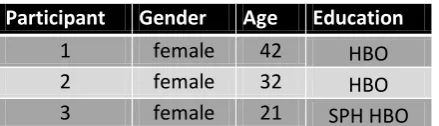
as well, but only three participants completed this study (see Table 1, page 13). They all have
had an eight-week treatment at the RRC and already spend a couple of weeks at home, in their
14
Participant Gender Age Education
1 female 42 HBO
2 female 32 HBO
[image:14.595.71.291.69.132.2]3 female 21 SPH HBO
Table 1: Descriptive information about participants, part 2
3.2.2.Procedure
The item analysis of the first part had to be finished before the start of the second part and
hence it took a couple of weeks before the daily measurements began.
Firstly, again contact was made with the participants as their daily therapy at the RRC had
ended. The researcher received the mail address or phone number of the participants and
contacted them to ask whether they were still interested to participate in the study. Of the five
participants, four liked to be assessed via email and one via regular mail.
Secondly, a postal- package was sent to one participant. This package contained a letter of
instruction, 14 questionnaires for daily completion and two retour-envelops to send the
completed questionnaires (Appendix B, I) back to the researcher after two weeks. In the end
the participant got a feedback paper (Appendix C, I) via mail, to evaluate the daily
measurement. The participant had the opportunity to give her opinion about the suitability of
the items for daily measurement and her personal impression and feelings while responding to
the items. The other four participants received the instructions per email, including a link,
which connects them with the online questionnaire tool „Survey Monkey‟. It is suitable for
market survey, scheduling of events, feed-back from clients, planning of products, or
education and training. This page is public for everyone who opens an account. On „Survey
Monkey‟ the same questionnaire like the postal one was created. Every participant received
an anonymous code to ensure their privacy was protected. The participants were asked to fill
in the questionnaire in the evening, between 6 pm and 9 pm. After they responded to the items,
the results were immediately saved and could be analyzed by the researcher. This was
advantageous because the researcher could take a daily look at whether the participants
responded or not. A few days after the daily measurements, the participants received a new
link per email, which presented them a feedback questionnaire on Survey Monkey. Like the
feedback via mail, the participants had the opportunity to give their opinions about the
suitability of the items for daily measurement and their personal impression and feelings
during the two weeks of measurement.
In the following, results of the „think aloud‟ interviews are presented (part 1). The second
15
4.
Results
This section, like the section where the methods were presented, contains two parts. In the
first part, the participants evaluated the given questionnaire one-time. In the second part, the
experiences of daily measurements were tested with a couple of the participants.
4.1. Part 1
The presented questionnaire consists of three different concepts. The most important
concept in the context of this study is the one of „values-based living‟. The first research
question “What items are most suitable for daily measurement of the concept „values-based living‟?” was approached by the analysis of the items 1 to 8, because they contain this
concept. No questionnaire measuring this concept was available, thus items 1, 2 and 3 were
chosen from the „Life regard index‟ (Ballista & Almond, 1973) and items 4 and 5 were chosen from Hayes‟ Daily Diary Measure. Items 6, 7 and 8 are newly formulated items for
this study.
The two remaining concepts of „Psychological Inflexibility‟ and „Pain‟ are important
outcomes variables in the research context about the effectiveness of ACT in chronic pain
patients. Items 9 to 13, chosen randomly from the PIPS (Psychological Inflexibility in Pain
Scale) (Wicksell, 2008b), measure the concept of „Psychological Inflexibility‟. Items 14 to 18
were chosen randomly from the MPI-DLV (Multidimensional Pain Inventory, Dutch
language version) (Lousberg et.al, 1999), measuring the concept of „Pain‟. The items of these
two concepts (items 9 to 18) will be presented and discussed in less detail than the first eight
items because they were not in the main focus of this study. The PIPS and the MPI-DLV were
added to the questionnaire because this study provided the opportunity to gather responses to
these concepts. The items of these scales already exist and the questionnaires are already
validated, so they could be used without any further item analysis.
4.1.1. Outcomes
The main focus of attention is given to the concept „values-based living‟. The
comments given by the participants concerning this concept, containing items 1 to 8, are
presented below. Detailed evaluations of these items can be found in Appendix A, II.
Item 1 (Als ik terugkijk op deze dag, vind ik dat ik volledig leefde; English: Looking back
on this dayI feel that I am living fully) was considered difficult by five out of ten participants.
16
vague. One participant wished to have more response alternatives or an open item instead.
The participants asked themselves what a fully life is. A participant noted that this item does
not fit very well in the situation of the Rehabilitation Centre, because she does not have the
feeling of a fully life there, but the feeling of „being lived‟.
Item 2 (Als ik terugkijk op deze dag, vind ik dat ik me door niets heb laten tegen gehouden
om te doen wat ik echt wilde doen) implied a typing error in the word „gehouden‟ (English:
hold up). It had to be „houden‟. The remaining of this item was unobtrusive.
Item 3 (Als ik terugkijk op deze dag, vind ik dat het lijkt of ik de dingen die echt
belangrijk voor me zijn ook echt voor elkaar kon krijgen) was commented by two participants.
Both find „het lijkt‟ problematic. One of them said either you handle something or not. „Het
lijkt‟ was seen as incorrect in this context. Further some participants got confused by the word
„echt‟ which was presented twice within this item.
Item 4 (Als ik terugkijk op deze dag, vind ik dat ik succesvol was in het uitvoeren van
acties die waardevol voor me zijn) was considered difficult by two participants. For one
participant the word „succesvol‟ in combination with the word „waardevol‟ was irritading. For
the other participant the emphasis lies too much on „succesvol‟ en „acties‟.
Item 5 (Als ik terugkijk op deze dag, vind ik dat de dag van vandag onderdeel was van
een vitaal leven) can be compared with item 1 because the participants saw this item as
difficult as the first item. „Vitaal leven‟ was seen as a vague expression. According to one
participant it is almost impossible to measure a concept like „vitaal leven‟ based on a
measurement of one day.
Item 6 (Als ik terugkijk op deze dag, vind ik dat ik dingen heb kunnen doen die het
leven de moeite waard maken) was considerd a good item by the most participants. Only two
found „de moeite waard‟ too ample.
Item 7 (Als ik terugkijk op deze dag, vind ik dat ik aan dingen toegekomen ben die
belangrijk voor me zijn) was considered a good item in general. One participant commended
that „dingen die belangrijk zijn‟ is a process and do not refer to one day.
Item 8 (Als ik terugkijk op deze dag, vind ik dat ik heb geleefd, zoals ik altijd zou
willen leven) was evaluated very different by the participants. One half had no problems or
comments on this item, whereas five participants got irritated by „zou willen leven‟.
17
A discussion of items 9 to 18, containing the concepts of „Psychological Inflexibility‟ and
„Pain‟, will not be presented here, because these items lay beyond the main focus of this study.
Evaluations and comments of them can be found in Appendix A, III.
Based on the outcomes of this first part of the study, items for the second part were
selected.
4.1.2. Process of item selection
The aim of the item selection procedure was the creation of a questionnaire, suitable for
daily measurement in the second part of this research. Taking all concepts into account items
3, 4, 6, 7, 9, 10, 11, 12, 13, 14, 16, 17 and 18 got the most positive responses and were rated
as „good‟1
. An overview is presented in Appendix A, IV.
As mentioned before, items 1 to 8 contain the main concept of „values-based living‟.
Based on the participants responses, obtained by the think-aloud technique, items 1, 2, 5 and 8
were rated worst and thus were not taken into account any further in the selection process.
The remaining items of this concept 3, 4, 6 and 7 were evaluated individually and
independently by three researchers. According to the researchers, the phrasing „het lijkt‟ of
item 3 (Als ik terugkijk op deze dag, vind ik dat het lijkt of ik de dingen die echt belangrijk
voor me zijn ook echt voor elkaar kon krijgen) was a too vague statement; item 4 (Als ik
terugkijk op deze dag, vind ik dat ik succesvol was in het uitvoeren van acties die waardevol
voor me zijn) contains the judgement „succesvol‟ which was too objective in this context; item
6 (Als ik terugkijk op deze dag, vind ik dat ik dingen heb kunnen doen die het leven de moeite
waard maken) presents the participant the opportuniy to decide what makes life worth living
for him- or herself and item 7 (Als ik terugkijk op deze dag, vind ik dat ik aan dingen
toegekomen ben die belangrijk voor me zijn) is easily and as subjectively formulated as
neccesary. Based on these evaluations, items 6 and 7 were chosen to be most suitable for daily
measurements of the concept „values-based living‟. The items can be found in the
questionnaire of part 2 below.
The item selection of the remaining items (items 9 to 18) was made simple. All items from
the second concept „Psychological Inflexibility‟ were rated as „good‟1
by the participants. So
the researcher chose one item out of items 9 to 13 and three additional items from the original
PIPS. From the third concept „Pain‟ four items were selected out of items 14 to 18 and one
additional item was chosen from the original DLV. Because the original PIPS and
1
18
DLV are valid tested scales and the items for these concepts were chosen at random in the
first part, the author expected no problems when selecting other items from the original scales
to use in the second part of this study.
4.1.3. General findings
To some participants the situation at the Rehabilitation Centre and the situation at home
seemed to be very different. Especially the first participants commended that a lot of items
would better fit into a situation at home. This is due to the fact that the participants can better
respond to items containing values of life when they live in their familiar environment,
engaging in habitual activities which are valuable for them, than following to the program of
the RRC.
According to the participants, further difference should be made between pain and fatigue.
Some of them got a little confused and could not response to the items as it was intended
because the concept „pain‟ did not perfectly fit to them. A few gave the suggestion of an extra
questionnaire with items about fatigue or a combination of both, pain and fatigue. So the
questionnaire should be adjusted in the second part of this study, however two different
questionnaires are not necessary in this context.
Furthermore, several participants disliked the response alternatives „wel-geen verandering‟
of the items because no change could be detected. This problem had been solved when the
questionnaire was presented daily and not only once.
4.2. Part 2
This part corresponds to the second research question. The aim was to analyze how the
selected items from part 1 function when applied in daily measurements, for two weeks.
Item 1 and 2 of the new questionnaire belonged to general information about the
participants‟ personal code and the time of starting and finishing with each daily session and
thus are not relevant in this context. As described above in the items selection process above
(paragraph 4.1.2.), some items used in this second part were selected from the first part of the
study (items 5, 7, 8, 9, 10, 11, 13) and others are chosen from the original scales of the
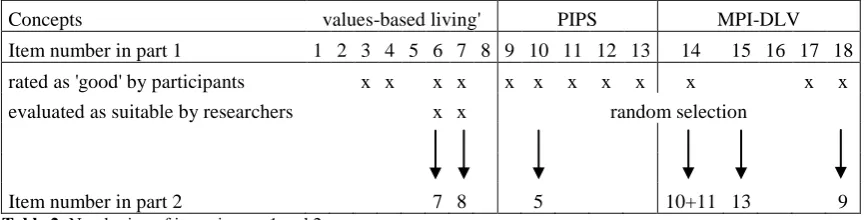
concepts. Table 2 (page 19) clarifies the different numbering of the items in part 1 and part 2.
An overview of the items is given in Appendix B, I. For more detail see also paragraph
4.1.2 „Process of item selection‟. The responses of three participants were analyzed. A
19
Concepts values-based living' PIPS MPI-DLV
Item number in part 1 1 2 3 4 5 6 7 8 9 10 11 12 13 14 15 16 17 18
rated as 'good' by participants x x x x x x x x x x x x
evaluated as suitable by researchers x x random selection
Item number in part 2 7 8 5 10+11 13 9
Table 2: Numbering of items in part 1 and 2.
In the following paragraph the responses to each item will be presented separately.
Subsequently the responses will be compared within each concept. Here the same like
mentioned above is true for the items: Item 7 and 8 of the concept „values-based living‟ are
the most interesting. To keep track of the different concepts they are marked in different
colours.
4.2.1. Outcomes
Items 3 to 6 are taken from the PIPS (coloured in red), representing the concept of
„Psychological Inflexibility‟. Higher scores on the items represent more psychological
inflexibility and lower scores represent less psychological inflexibility, thus more flexibility.
Item 3
Participant 1 responded during the 14 days measurement to item 3 (Als ik terugkjik op deze
dag zou ik er bijna alles aan doen om van mijn pijn af te komen.) with a mean score of 6.64
on the 10-point scale, ranging from 5 to 9 and a variance of 1.94. Participant 2 responded with
a mean score of 5.21, a range from 3 to 7 and a variance of 1.57. Participant 3 responded with
a mean score of 2.43, a range from 1 to 5 and a variance of 1.96. The participants responded
[image:19.595.70.504.71.181.2]20 Figure 2: Responses of three participants to item 3 of the concept „Psychological Inflexibility‟.
Item 4
Participant 1 responded to item 4 (Als ik terugkijk op deze dag is het belangrijk dat ik leer
mijn pijn te controleren.) with a mean score of 6.57, a range between 5 and 9 and a variance
of 1.65. Participant 2 responded with a mean score of 4.14, a range between 3 and 6 and a
variance of 1.06. Participant 3 responded with a mean score of 1.64, a range between 1 and 4
and a variance of 1.02. The overall mean of the measurements was 4.12. The variances within
the range were 4.0, 3.0, and 3.0 respectively.
Figure 3: Responses of three participants to item 4 of the concept „Psychological Inflexibility‟.
Item 5
The overall mean of item 5 (Als ik terugkijk op deze dag heb ik dingen uitgesteld vanwege
mijn pijn.) was 4.81. Participant 1 scored with a mean of 6.0, a range between 4 and 9 and a
variance of 3.54. The mean score of participant 2 was 4.93. The range lay between 2 and 7,
0 2 4 6 8 10
1 2 3 4 5 6 7 8 9 10 11 12 13 14
R e sp o n se cate go ry
Day of measurement
3) … zou ik er bijna alles aan doen om van
mijn pijn af te komen
Participant 1 Participant 2 Participant 3 0 2 4 6 8 10
1 2 3 4 5 6 7 8 9 10 11 12 13 14
R e sp o n se cate go ry
Day of measurement
4) …is het belangrijk dat ik leer mijn pijn te
controleren
[image:20.595.76.515.444.650.2]21
and the variance was 2.53. Participant 3 responded with a mean score of 3.5, a range between
[image:21.595.71.513.108.314.2]1 and 6 and a variance of 3.35. The variance within the range was 5.0 for all participants.
Figure 4: Responses of three participants to item 5 of the concept „Psychological Inflexibility‟.
Item 6
Item 6 (Als ik terugkijk op deze dag heb ik het vermeden dingen te doen wanneer er het
risico bestond dat het pijn zou doen of de dingen erger zou maken.) was responded to by the
participants with an overall mean of 4.64. Participant 1 responded to this item with a mean
score of 6.79, a range between 4 and 9 and a variance of 2.03. Participant 2‟s mean score was
3.86, it ranged between 1 and 6 and had a variance of 2.59. Participant 3 responded with a
mean score of 3.29, a range between 1 and 6 as well, and a variance of 2.84. The variance
within the range was 5.0 for all participants.
Figure 5: Responses of three participants to item 6 of the concept „Psychological Inflexibility‟.
0 2 4 6 8 10
1 2 3 4 5 6 7 8 9 10 11 12 13 14
R e sp o n se cate go ry
Day of measurement
5) …heb ik dingen uitgesteld vanwege mijn
pijn
Participant 1 Participant 2 Participant 3 0 2 4 6 8 101 2 3 4 5 6 7 8 9 10 11 12 13 14
R e sp o n se cate go ry
Day of measurement
6) ...heb ik het vermeden dingen te doen
wanneer er het risico bestond dat het pijn zou
doen of de dingen erger zou maken
[image:21.595.73.514.522.722.2]22
Items 7 and 8 contain the concept of „values-based living‟ (coloured in green). Scoring
higher on these items means living more according to one‟s own values. Lower scores imply
living less according to one‟s own values.
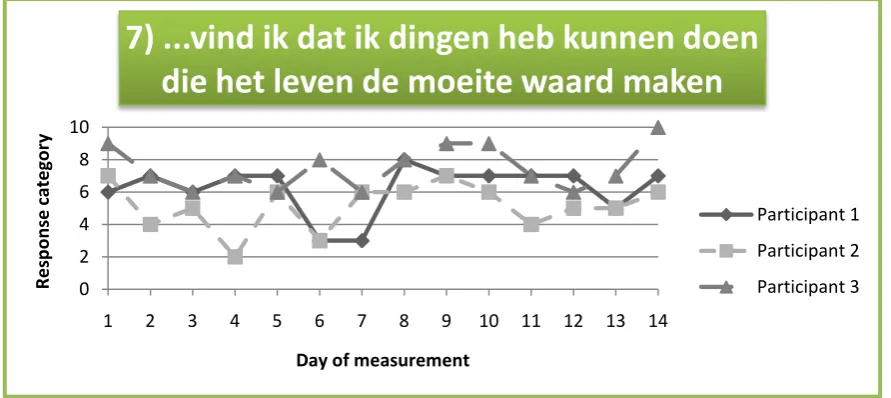
Item 7
Participant 1 responed to item 7 (Als ik terugkijk op deze dag vind ik dat ik dingen heb
kunnen doen die het leven de moeite waard maken.) with a mean score of 6.21. Its range lay
between 3 and 8 and the variance was 2.34. Participant 2 scored the mean 5.14 with a range
between 2 and 7 and a variance of 2.13. Participant 3 responded with a mean score of 7.5, a
range between 6 and 10 and a variance of 1.81. This item got an overall mean of 6.29. 5, 4,
[image:22.595.70.516.299.498.2]and 4 points were the variances within the range.
Figure 6: Responses of three participants to item 7 of the concept „values-based living‟.
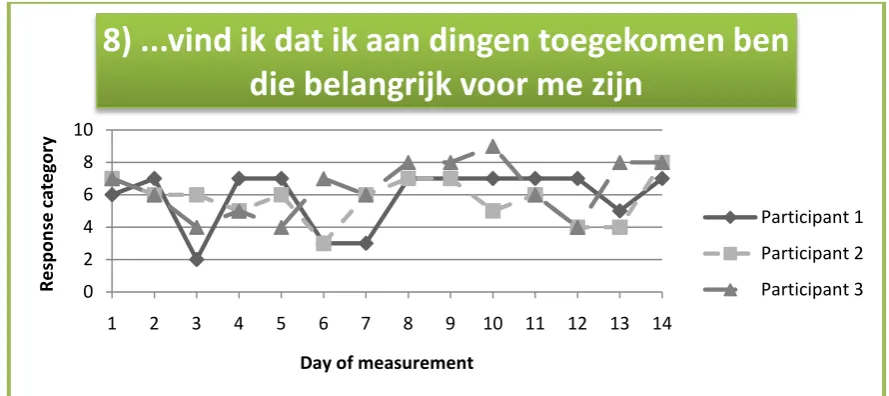
Item 8
The overall mean of item 8 (Als ik terugkijk op deze dag vind ik dat ik aan dingen
toegekomen ben die belangrijk voor me zijn.) was 6.0. The mean of participant 1 was 5.86 and
a range between 2 and 7, participant 2 responded with a mean of 5.71 ranging between 3 and
8, and participant 3 with a mean of 6.43 and a range between 4 and 9. The variances were
3.36, 1.91, and 2.88, respectively. For all participants the variance within the range was 5
points.
0 2 4 6 8 10
1 2 3 4 5 6 7 8 9 10 11 12 13 14
R
e
sp
o
n
se
cate
go
ry
Day of measurement
7) ...vind ik dat ik dingen heb kunnen doen
die het leven de moeite waard maken
23 Figure 7: Responses of three participants to item 8 of the concept „values-based living‟.
Items 9 to 13 were chosen from the MPI-DLV (coloured in blue), representing the concept
of „Pain‟. Higher scores on these items imply more reduction of daily activity caused by pain.
Lower scores imply less impact of pain in daily life.
Item 9
To item 9 (Als ik terugkijk op deze dag heeft de pijn mijn mogelijkheden tot het uitvoeren
van huishoudelijke werkzaamheden beinvloed.) was responded with an overall mean of 5.48.
Participant 1 scored a mean of 6.64, ranging between 4 and 9 and a variance of 2.56.
Participant 2 scored a mean of 5.93, ranging between 2 and 8 and a variance of 2.53.
Participant 3 scored a mean of 3.86, ranging between 1 and 6 and a variance of 2.9. The
variances within the range were 5, 6 and 5 points respectively.
Figure 8: Responses of three participants to item 9 of the concept „Pain‟.
0 2 4 6 8 10
1 2 3 4 5 6 7 8 9 10 11 12 13 14
R e sp o n se cate go ry
Day of measurement
8) ...vind ik dat ik aan dingen toegekomen ben
die belangrijk voor me zijn
Participant 1 Participant 2 Participant 3 0 2 4 6 8 10
1 2 3 4 5 6 7 8 9 10 11 12 13 14
R e sp o n se cate go ry
Day of measurement
9) ...heeft de pijn mijn mogelijkheden tot het
uitvoeren van huishoudelijke werkzaamheden
beïnvloed
[image:23.595.69.512.544.756.2]24
Item 10
The answers to item 10 (Als ik terugkijk op deze dag ben ik door de pijn belemmerd bij
deelname aan ontspanning.) of both participant 1 and 2 ranged between 4 and 9, with a mean
of 6.79 and 6.36 respectively. Participant 3 responded with a mean score of 3.86 and a range
between 1 and 7. The variances were 2.03, 1.48, and 3.98, respectively. 5.67 was the overall
mean of this item. The variances within the ranges were 5.0, 5.0, and 6.0 for participant 1, 2,
[image:24.595.70.519.217.422.2]and 3.
Figure 9: Responses of three participants to item 10 of the concept „Pain‟.
Item 11
6.43, 5.0, and 3.79 were the mean scores of participant 1, 2 and 3 to item 11 (Als ik
terugkijk op deze dag ben ik door de pijn belemmerd bij het uitvoeren van sociale
activiteiten.). The scores of participant 1 ranged between 4 and 9. The scores of participant 2
ranged between 2 and 7, and the scores of participant 3 ranged between 1 and 7. The
variances were 3.03, 3.08, and 4.95, respectively. The mean of all measurements of all
participants during the 14 days was 5.07. On this item the participants responded with a
variance of 5, 5, and 6 points within their response range.
0 2 4 6 8 10
1 2 3 4 5 6 7 8 9 10 11 12 13 14
R
e
sp
o
n
se
cate
go
ry
Day of measurement
10) ...ben ik door de pijn belemmerd bij
deelname aan ontspanning
25 Figure 10: Responses of three participants to item 11 of the concept „Pain‟.
Item 12
Participant 1 responded with a mean score of 5.93 to item 12 (Als ik terugkijk op deze dag
heeft de pijn mijn vermogen om te werken (betaalde of onbetaalde werkzaamheden)
beinvloed.). The scores ranged between 3 and 9 with a variance of 3.92. Participant 2
responded with a mean score of 4.57, ranging between 0 and 8. The variance was 5.03.
Participant 3 responded with a mean score of 3.9, a range between 1 and 7 and a variance of
6.38. The overall mean was 4.81. The variances within the ranges were 6.0, 8.0, and 6.0
respectively.
Figure 11: Responses of three participants to item 12 of the concept „Pain‟.
0 2 4 6 8 10
1 2 3 4 5 6 7 8 9 10 11 12 13 14
R e sp o n se cate go ry
Day of measurement
11) ...ben ik door de pijn belemmerd bij het
uitvoeren van sociale activiteiten
Participant 1 Participant 2 Participant 3 0 2 4 6 8 10
1 2 3 4 5 6 7 8 9 10 11 12 13 14
R e sp o n se cate go ry
Day of measurement
12) ...heeft de pijn mijn vermogen om te
werken (betaalde of onbetaalde
werkzaamheden) beïnvloed
[image:25.595.70.510.492.697.2]26
Item 13
Item 13 (Als ik terugkijk op deze dag heeft de pijn het plezier dat ik ondervind van
deelname aan gezin(sbezigheden) beinvloed.) got an overall mean score of 4.45. Participant 1
responded to this item with a mean score of 6.5, participant 2 responded with a mean score of
4.86 and participant 3 responded with a mean score of 2.0. The ranges lay between 3 and 9, 2
and 8, and 1 and 6, and the variances were 2.73, 2.44, and 2.15, respectively. The variances
[image:26.595.74.515.215.423.2]within the ranges were 6, 6, and 5 points.
Figure 12: Responses of three participants to item 13 of the concept „Pain‟.
Below the items were clustered by the concepts „Psychological Inflexibility‟,
„values-based living‟ and „Pain‟. Within each concept the items were compared separately between
the participants.
The clustering intended to detect how the items function within one concept. Especially
the concept „values-based living‟ containing items 7 and 8 was important.
Concept of „Psychological Inflexibility‟ (PIPS)
As mentioned before, higher scores on these items imply more psychological inflexibility.
Lower scores on these items imply more psychological flexibility.
Participant 1 responded to the items of the concept containing Psychological Inflexibility
with a mean of 6.5. The range was between 4 and 9. Participant 2 responded with a mean of
4.54. The range was between 1 and 7. Participant 3 responded with a mean of 2.71 and a
range between 1 and 6. Thus the variances between the ranges was 5, 6, and 5 points.
0 2 4 6 8 10
1 2 3 4 5 6 7 8 9 10 11 12 13 14
R
e
sp
o
n
se
cate
go
ry
Day of measurement
13) ...heeft de pijn het plezier dat ik
ondervind van deelname aan
gezin(sbezigheden) beïnvloed
27 Figure 13: Responses of participant 1 to items of concept „Psychological Inflexibility‟.
Figure 14: Responses of participant 2 to items of concept „Psychological Inflexibility‟.
Figure 15: Responses of participant 3 to items of concept „Psychological Inflexibility‟.
0 2 4 6 8 10
1 2 3 4 5 6 7 8 9 10 11 12 13 14
R e sp o n se cate go ry
Day of measurement
PIPS - participant 1
item 3 item 4 item 5 item 6 0 2 4 6 8 10
1 2 3 4 5 6 7 8 9 10 11 12 13 14
R e sp o n se cate go ry
Day of measurement
PIPS - participant 2
item 3 item 4 item 5 item 6 0 2 4 6 8 10
1 2 3 4 5 6 7 8 9 10 11 12 13 14
R e sp o n se cate go ry
Day of measurement
PIPS - participant 3
[image:27.595.70.460.499.699.2]28
Concept of „values-based living‟
As mentioned before, higher scores on these items imply more „values-based living‟.
Lower scores imply living less according to one‟s own values.
To items 7 and 8 of the „values-based living‟ concepts was responded with a mean of 6.04
by participant 1, with a mean of 5.43 by participant 2 and 6.96 by participant 3. The ranges
lay between 2 and 8 for participant 1 and 2 and between 4 and 10 for participant 3. The
[image:28.595.73.456.218.408.2]variance between the ranges was 6 points for all participants.
Figure 16: Responses of participant 1 to items of concept „values-based living‟.
Figure 17: Responses of participant 2 to items of concept „values-based living‟.
0 2 4 6 8 10
1 2 3 4 5 6 7 8 9 10 11 12 13 14
R e sp o n se cate go ry
Day of measurement
'Values-based living' - participant 1
item 7 item 8 0 2 4 6 8 10
1 2 3 4 5 6 7 8 9 10 11 12 13 14
R e sp o n se cate go ry
Day of measurement
'Values-based living' - participant 2
[image:28.595.71.458.436.623.2]29 Figure 18: Responses of participant 3 to items of concept „values-based living‟.
Concept of „Pain‟ (MPI-DLV)
As mentioned above, higher scores on this item imply more limitations of daily activity
caused by pain. Lower scores imply less impact of pain in daily life.
Participant 1 responded to the concept of the Multidimensional Pain Inventory with a mean
of 6.46, participant 2 with a mean of 5.34 and participant 3 with a mean of 3.49. The ranges
varied between 3 and 9, 0 and 9, and 1 and 7, respectively. The variances between the ranges
were 6 points for participants 1 and 3, and 9 points for participant 2.
Figure 19: Responses of participant 1 to items of concept „Pain‟.
0 2 4 6 8 10
1 2 3 4 5 6 7 8 9 10 11 12 13 14
R e sp o n se cate go ry
Day of measurement
'Values-based living' - participant 3
item 7 item 8 0 2 4 6 8 10
1 2 3 4 5 6 7 8 9 10 11 12 13 14
R e sp o n se cate go ry
Day of measurement
MPI-DLV - participant 1
[image:29.595.71.461.455.645.2]30 Figure 20: Responses of participant 2 to items of concept „Pain‟.
Figure 21: Responses of participant 3 to items of concept „Pain‟.
4.2.2. General findings
When looking at the individual items, the complete response range from 0 to 10 was used
by the participants. Most of the responses lay between the categories 2 and 8. Furthermore,
the range was almost the same for all items. For example a range of 4 points in item 3 and 5
points in items 5 and 6. A difference in the range was found only in item 12; on this item two
participants responded with a range of 6 points and one participant responded with an 8-point
range. Despite the overall comparable range, a variance between the responses of the
participants could be found. Noticeable were the scores of participant 3 on items 3, 4 and 13.
Here she responded with a very low score (category 1) on at least five days in a row.
Concerning the other items, she responded with a greater variation than the other two
participants and switched on some items (for example item 12) more extreme between the
response categories from one day to another.
0 2 4 6 8 10
1 2 3 4 5 6 7 8 9 10 11 12 13 14
R e sp o n se cate go ry
Day of measurement
MPI-DLV - participant 2
item 9 item 10 item 11 item 12 item 13 0 2 4 6 8 10
1 2 3 4 5 6 7 8 9 10 11 12 13 14
R e sp o n se cate go ry
Day of measurement
MPI-DLV - participant 3
31
When the items were clustered into concepts of „Psychological Inflexibility‟, „values based
living‟ and „Pain‟ the range was almost always 6 points on a scale from 0 to 10, for all three
participants. To the concept of „values-based living‟ was responded with a range of 6 points
by all participants. Within the concept of „Psychological Inflexibility‟ the range of one
participant was exactly 6 points. The range of the other two participants was 5 points. The
concept „Pain‟ presented a greater difference in the ranges. Here the range of two participants
was exactly 6 points, but one participant responded with a range of 9 points.
Noticeable in the clustering was the inverted picture of the concepts. Representative for
this picture were the responses of participant 3 on day 6 (Figures 15, 18, 21). She gave
extreme low answers to the items measuring „Psychological Inflexibility‟ (PIPS) and the items measuring „Pain‟ (MPI-DLV), but high answers on the „values-based living‟ scale,
compared to the other two participants. This opposition in concepts can be explained by the
fact that the responses between the three concepts are correlated: High scores on the PIPS and
the MPI-DLV on one day go along with a low score on the „values based living‟ scale on the
same day and vice versa, low scores on the PIPS and MPI-DLV go along with a high score on
the „values-based living'.
When comparing the mean values of the 14 days of measurement, a tendency among the
responses could be found. Participant 1 scored almost always higher than participant 2 and 3
on the items. Participant 3 always scored lower than participant 1 and 2, with the exception of
one day (day 12), where she scored higher than participant 1. The means of all items for all
participants converge from day 9 on, and evened out at an average score.
4.2.3. Feedback of participants
After the daily measurements were finished and every participant had answered 14 times, a
questionnaire, containing 8 items, was sent to them by e-mail. The participants were asked to
give a feedback about their experiences with the daily measurements. In questions 1 and 2 the
participants were asked if they managed to respond to the items daily and during the
suggested time. All three of them answered this question negatively. Their reasons were that
they had not enough time in the evening because of work, school, etc; they had no computer
available a couple of days; or simply lost sight of it. One of the participants made the
suggestion to respond to the items the next morning and thus think about the last day with a
greater distance. The amount of time to answer the questions, about 5 minutes each day, was
rated as acceptable. According to one participant, items 8 and 9 were comparable to item 11
32
another participant, items 3 and 4 were comparable and should be combined. She argued that
if one wants to get rid of the pain (item 3), one wants to control the pain (item 4) as well, thus
they were linked to each other.
All other items were not commented by the participants and thus can be seen as suitable for
daily measurements.
33
5.
Discussion
5.1. Conclusion
The aim of this study was to answer the three research questions presented in the
beginning.
The first research question „What items are most suitable for daily measurement of the
concept „values-based living‟?‟ was approached in the first part of this study. With regard to
this concept, item 6 (Als ik terugkijk op deze dag, vind ik dat ik dingen heb kunnen doen die
het leven de moeite waard maken) and item 7 (Als ik terugkijk op deze dag, vind ik dat ik aan
dingen toegekomen ben die belangrijk voor me zijn) were chosen for the daily measurement
by the ten participants and the three researchers. When including the other two concepts,
totally seven out of 18 items (items 6, 7, 10, 14 split, 15, 18) were selected for daily
measurement. These items were used in the second part of the study and can be used in the
later, larger study as well. According to the participants, especially dealing with concepts like
„volledig leven‟ (item 1) and „vitaal leven‟ (item 5) was challenging for them.
Generally, the researcher got the impression that the participants liked the possibility to
influence the creation of a questionnaire, especially to give their opinions about the items.
The second research question: „How do the chosen items function when applied daily (for
two weeks)?‟ was approached in the second part of this study. The collected data was
analysed in two different ways: Each item was (a) analysed separately to see how the
participants responded daily, then (b) the items were clustered and compared based on the
concepts of „Psychological Inflexibility‟ (PIPS), „values-based living‟, and „Pain‟ (MPI-DLV).
Concerning the analysis of the individual items, an overall range of 6 points was found.
This range provides the opportunity for improvements concerning the responses to the items.
The variance of the response range within the items was small, with exception of item 12,
although almost all response categories were used. This leads to the assumption that the items
will work the same way with other participants or a different time period.
Concerning the analysis of the clustered items, an overall range of 6 points was found as
well. Likewise, this range offers the opportunity for improvements. The variance of the range
within the clusters was also small, with exception of the response of participant 2 on the
concept „Pain. Discrepancies between the items of the concept „Pain‟ were not rated as
34
„values-based living‟ were meant to measure the same. The discrepancy between the items
roused the question whether they can be combined in one concept.
The third research question „What are the general outcomes of the pilot-study that can
improve the large study?‟ could be answered based on the general findings of the first and
second part of the study and especially based on the feedback given by the participants after
the daily measurements. Based on the outcomes of the first part, a distinction should be made
whether a participant responded to the items at home or at the Rehabilitation Centre. The
participants mentioned that some of the items, like item 9 (Als ik terugkijk op deze dag, heb ik
het vermeden activiteiten in te plannen vanwege mijn pijn), do not fit in the context of living
at the Rehabilitation Centre. This is important for the large study because therein, more
measurements on a single participant will take place during a longer period. This implies that
a participant will be in different treatment stages and will respond to the items at home and at
the Rehabilitation Centre.
A couple of participants noted that all items contained the concept of „pain‟ and ignored
the concept of „fatigue‟ which is important in the context of chronic pain as well. Because fatigue comes along with chronic pain, the author decided to state that the concept of „fatigue‟ was combined to the concept of „pain‟ at the beginning of the second part. Nevertheless, one
participant criticized it as a missing concept. Thus the adjusted questionnaire began with the
statement that fatigue is included in the items containing the concept of pain and not
mentioned separately. This awareness is useful for the large study.
The online application for the daily measurements (questionnaire tool Survey Monkey)
turned out to be beneficial for both sites. In case of a participant not responding, the
researcher could easily contact her. The other way around, the participants could contact the
researcher easily too, and it could be discussed how to continue. Furthermore, one participant
did not send back the postal questionnaire. Keep in touch with this participant turned out be
difficult. Thus it is recommended to use computers in the large study and possible later
studies as well.
An important note should be made about the time of the day when a participant responds
to the items. This time should be about the same each day, therefore it is important to discuss
together with the participant when it suits the best.
5.2. Critical remarks
In general it turned out that the participants got the intention of the research in totally
35
opinion about the quality of the items. Others had the tendency to not only respond to the
items but tried to arguing more and more about their answers. Justification of the answers was
not the aim of the research, so the researcher had to intervene and stimulate the participants to
talk about the quality or to go further with the items and not to go into a detailed explanation
before the second step (discussion of „problem items‟). Thus the technique could not be
applied in all cases.
The assumption arose that several participants had talked about the items among each
other. This was disadvantageous in case a participant gave a comparable answer like a
participant who was interviewed just before.
With regard to the second part of the research it was difficult to do more than descriptions
of the results. Only a limited conclusion could be drawn about the suitability because no
standardized group with „healthy‟ persons (without chronic pain) was available.
5.3. Further research
With regard to the problem concerning the different situations at home and at the
Rehabilitation Centre: Further research could concentrate on the question whether a
foundation of an item pool could be created and be added by some variable items, depending
on the particular measurement situation. It could be analyzed whether this approach is
necessary and useful.
A couple of participants noted in the first part that a distinction between the concepts of
„pain‟ and „fatigue‟ is important. Thus further research could work on the question whether a
distinction between pain and fatigue is useful and necessary or should make the combination
of the concepts more clearly.
Especially for the concept of „values-based living‟ further items could be tested. This
could be done by combining different questionnaire that have been tested already. The
creation of new items for this concept is possible as well. If items are tested valid by statistical
analysis, the concept of „values-based living‟ could be used in other contexts than „chronic pain‟. However the author advises caution with the use of terms like „vitaal leven‟ and „volledig leven‟.
With regard to the concept „Pain‟ further research should concentrate on the question
whether the items used in this study could be clustered into one concept.
Further research on ACT could examine whether other concepts, in addition to the one
presented here („Psychological Inflexibility‟, „values-based living‟, „Pain‟), play a role in the
36
Further research could concentrate on the establishing and testing of a standardized group,
composing people that do not suffer from any kind of chronic pain. The comparison with a
standardized group could help to give a better evaluation about the scores obtained in this
37
6.
References
1. A-Tjak, J. & de Groot, F. (2008). Acceptance & commitment therapy. Houten.Bohn Stafleu van Loghum
2. Bach, P.A. & Moran, D.J. (2008). ACT in practice. Case conceptualisation in acceptance & commitment therapy. Oakland. New Harbinger Publications, Inc.
3. Ba