With 6 text-figures Printed in Great Britain
THE ROLES OF
SODIUM TRANSPORT AND ANION PERMEABILITY IN
GENERATING TRANSEPITHELIAL POTENTIAL
DIFFERENCES IN LARVAL SALAMANDERS*
BY THOMAS H. DIETZ, LEONARD B. KIRSCHNER, AND DAVID PORTER
Department of Zoology, Washington State University
(Received 25 August 1966)
Recent investigation has shown that the fully aquatic, larval form of the salamander
Ambystoma tigrinum handles osmotic and ionic regulatory problems as do other fresh
water and semiterrestrial animals. Faced with osmotic water entry from a hypotonic environment, it excretes a dilute urine to remain in water balance. Uptake of NaCl from artificial-pond water occurs at the rate of about i/i-equiv. (10 g.J^hr.-1. This maintains an ionic steady state by compensating for losses in the urine and by diffusion across the skin and gills (Alvarado, 1962; Alvarado & Kirschner, 1963). Animals in a steady state in pond water ([NaCl] = 1-2 mM/1.) have a potential difference across the body surface of 10-20 mV., body fluids positive to the external solution. Nothing is known about the mechanism generating electrical asymmetry in these animals.
Transepithelial potential differences (TEPs) have been studied for many years, and our understanding of the ionic mechanisms underlying them is derived largely from studies on isolated frog skins and toad urinary bladders bathed on both sides by Ringer's solution. Little attention has been paid to the origin of TEPs in intact animals bathed by dilute solutions. Barker-Jorgensen, Levi & Zerahm (1954) showed that when frogs were immersed in 3-5 mM NaCl the TEP was 50-100 mV. body fluids positive to bathing solution. Lower potentials, the polarities of which were variable, were found when the animals were immersed in KC1. Brown (1962) found that the TEP in intact frogs depended on environmental NaCl concentration and that its concentration dependence resembled that of isolated skins. These observations are consistent with a role for active salt transport in generating the TEP, and suggest that the model developed for the in vitro preparation (Koefoed-Johnsen & Ussing, 1958; Ussing, i960) may be applicable to the intact animal in its normal environment. However, some flux data obtained on animals in dilute solutions are hard to reconcile with this model. For example, Krogh (1937) showed that salt-depleted frogs would take up chloride from solutions with a non-penetrating cation (K+), while the model provides no EMF for anion transfer in the absence of sodium transport. Krogh's animals also absorbed sodium from solutions with non-penetrating anions. Under these conditions the model requires that the TEP approach the EMF of the transport mechanism but that no net ion uptake occur. The observations were confirmed by Barker-Jergensen et al. (1954), who showed that even when NaCl was absorbed the
86 THOMAS H. DIETZ, LEONARD B. KIRSCHNER, AND DAVID PORTER
movement of neither ion satisfied the flux ratio criterion for diffusion. Hence, chloride appears to be actively transported into the animal from dilute solutions. These data suggest that the ionic basis for electrogenesis in dilute solutions needs further investigation.
Many of these observations have also been made in larval salamanders. The present investigation explores the relationship between ion uptake and electrogenesis in salamanders in dilute solutions. Special attention has been paid to establishing whether active sodium transport is part of the electrogenic mechanism and to the role played by anion absorption.
METHODS
The experimental animals were larval salamanders, Ambystoma tigrinum captured in local streams. A few experiments were conducted on A. gracilus. and no inter-specific differences were noted. Most of the animals weighed between 10 and 50 g. They were stored in porcelain tubs in a lighted room at 15 ± 1° C. The storage medium was local tap-water.
Experimental animals were removed from the holding tanks and equilibrated with an appropriate experimental solution for a week before measurements were made. Most of the animals were equilibrated with artificial' pond water' containing 1-2 mivt/1. NaCl (Alvarado & Kirschner, 1963). One group was salt-depleted by immersing them in deionized water which was changed daily. This treatment augments active salt transport, and on being returned to pond water these animals absorb NaCl 2-3 times as rapidly as normal (i.e. pond-water-adapted) animals (Alvarado & Kirschner, 1961). Another group of animals was adapted to 40 mM/1. NaCl before being used. This depresses the transport mechanism (unpublished experiments). The animals were used to study changes in TEP under condition of normal, augmented and depressed ion transport. The salt-depleted animals were also used to demonstrate independence of Na+ and Cl~ transport systems.
Each salamander was anaesthetized with tricaine methane sulphonate (o-i %). The skin and body wall were punctured with a dissecting needle, and a fine polyethylene tube filled with agar-3 M - K C I was inserted into the body cavity. The animal was then transferred to the experimental solution which contained 0-03 % tricaine methane sulphonate. A second agar-KCl-filled bridge dipped into the bathing solution. Both bridges were connected through calomel electrodes to a recording potentiometer with an input resistance of 100 kD at balance. Potentiometric precision was about + 1 mV. At the end of each experiment electrode asymmetry was measured by connecting the body fluids of the animal through a saturated KC1 bridge to the bathing solution. All potentials reported below have been corrected for the small asymmetries noted.
Many experiments were run in which animals were initially placed in distilled water, and the potential differences across the skins were recorded when NaCl was added to the bath. Although these experiments were adequate to demonstrate depen-dence of the TEP on external salt concentration, they had the disadvantage that both anion and cation concentration varied simultaneously. Since one of the goals of this investigation was to assess the role of each ion in electrogenesis, an alternative pro-cedure was used in all later work. This involved using 5 mM/1. K2SO4, rather than
K+ and SO42~ have a low mobility in the skin. Theassumption underlying its use is that
a non-penetrating salt should have no electrical effect on the animal. This is borne out by the fact that the transepithelial potentials in distilled water and in 5 min/l. KjSO4
fell into the same range, 5-20 mV., body fluids negative to the external solution. By using NajSC^ it was possible to vary the sodium concentration through the range o-i-iomM/1. without changing the anion composition or the ionic strength of the medium. The effects of (NH^SCV LijjSO^ CejjSC^ and MgSO4 were also tested.
Chloride concentration was varied through the same range by using KC1. In all experiments the animal was placed in the initial bathing solution and allowed to remain until the TEP was stable. Studies on the dependence of potential on ion concentration began by replacing a measured volume of bathing solution with an equal volume of 5 mM/1. NaaSO4 or KC1. When the new TEP was stable it was recorded. This
procedure was repeated to give a series of readings through the range O-I-IO mM/1.
with each step increasing the test ion concentration about threefold. Concentrations were measured rather than calculated, because intermittent urination provided an uncontrolled source of ions. Sodium, potassium, and calcium were determined with a direct-ieading flame-photometer. Precision of these measurements was about + 1 %. Chloride was determined by silver titration with a Cotlove 'chloridimeter'.
Net fluxes of Na+, K+ and Cl~ were measured on animals previously salt-depleted for 1 week. Each animal was placed in a plastic container with a known volume of solution, initially o-6 mM/1. NajSO4 for one group and 1-2 mM/1. KC1 for another.
Samples were removed periodically for analysis. After about 24 hr. each animal was transferred to pond water (1-2 mM/1. NaCl) and aliquots were taken for another 24 hr. Changes in concentrations in the bath were estimated by flame-photometry (Na+, K+) or silver titration (Cl~). Net uptake or excretion was calculated from these changes. Chloride determinations were not made on N^SC^ solutions because of sulphate interference.
Sulphate permeability was measured by placing animals in media made from Na2MSO4 and measuring disappearance of isotope from the bathing solution. Aliquots
were plated on aluminum planchets with a drop of detergent. After drying they were counted with an ultrathin-window GM tube.
The ammonia-excretion experiments were carried out in cylindrical Lucite chambers stirred and aerated by a stream of compressed air. The pH of the bathing solution was adjusted to 6-8 to minimize distillation of ammonia in the air stream. Such losses were shown to be negligible by leading the air through a trap containing boric acid. No ammonia appeared in trap even after 6 hr. of aeration. Ammonia was determined by direct Nesslerization of aliquots removed from the bathing solution. Optical density was measured at 430 ra/i.
All experiments were carried out at a temperature of 15 + 1° C.
RESULTS Dissociation of sodium and chloride transport
negative, would be necessary to sustain a sodium steady state by diffusion. For chloride a TEP of 137 mV., body fluids positive, would be required. In several hundred measurements on animals in pond water the body fluids have always been positive, but values never exceeded 35 mV., and most were in the range 10-20 mV. Therefore, both ions must be actively transported into the animal under these conditions.
However, these data provide no information on whether the ion movements are coupled through a single mechanism or are independent. To answer this question the following experiment was performed. Four animals were salt-depleted for a week. Two were transferred to i-znni/L KC1 and net movements of Na+, K+ and Cl~ were measured for 23 hr. The other pair were placed in o-6 mM/1. Na2SO4 and net transfers
of Na+ and K+ were measured. At the end of this period all four animals were trans-ferred to pond water and ion movements were followed for another 20-5 hr.
Table. 1. Net movement of ions in salt-depleted salamanders
(Experimental protocol described in the text. Each value is the mean for two animals. Net absorption is denoted + ; net loss —.)
In initial medium (23 hr.): /i-equiv. After transfer to pond water (20-5 hr): taken up per 10 g. body weight /i-equiv. taken up per 10 g. body weight Initial
medium KC1
NajSOi
N a+
- 7 9
+ 20 0
K+ + 9-5 - 7 - 3
ci-+ 23-6
N a+
+ 37 5 + 17-5
K+
- 5 - i
+ 1 6
c i -+ 20-5 + 37 5
Table 1 shows the total quantity of each ion transferred in each experimental period. It is clear that Cl~ uptake from K.C1 occurred. A net loss of sodium occurred during this period. Although unidirectional ion fluxes were not measured here,* the data show that chloride uptake can occur without simultaneous sodium transport. Uptake of K+ occurs in some animals but is absent in many. Even when it can be demonstrated (as in Table 1) it is never equal to Cl~ uptake. When these animals were transferred to normal pond water, influx of Na+ markedly exceeded that of CI". There was a net loss of K+.
Animals placed in NajjSO4 showed a net uptake of Na+ while losing some K+.
Chloride was not measured, but none was present initially and a net loss must have occurred. When this pair was transferred to pond water, Cl~ uptake was much greater than Na+ uptake.
Since Na+ and Cl~ appear to move independently it is necessary to account for the preservation of electrostatic neutrality. In the case of Na+ uptake an alternative to anion absorption is exchange with another cation. Fig. 1 shows that animals adapted to pond water excrete ammonia continually in that medium. During the first 2 hr. the untreated animals excreted more ammonia than those with cloacas sutured to prevent urination, but in the period 2-5~7'25 hr. average ammonia efflux was comparable in both groups: o-52/imole (10 g."1 hr."1 for untreated animals; o-6o/imole (10 g.)"1 hr."1 for animals with stitched cloacas. Since the high initial output was seen only in the control animals it probably is due to urinary ammonia.
But the sustained efflux in both groups must represent movement across the body surface, and hence may be part of a cation exchange system.
No flux experiments relating to electrostatic neutrality during chloride uptake were conducted.
Sodium transport and electrogenesis
When animals were transferred from pond water to a sodium-free solution the normal TEP was replaced by a small one of opposite polarity, usually in the range
15
"8
i
1
o 1 0
0 1 2 3 4 5 6 7 8
Hours
Fig 1. Ammonia excretion by larval salamanders. Five control animals (O—O) and five animals with stitched cloacas (•—•) were immersed in 5 mM/l.K,SO4 containing 1 mM/l.Na, SOf At the times shown samples of the bathing solutions were removed and analysed for
ammonia nitrogen. Each point is the mean of the five determinations. Standard deviations are indicated by the vertical lines.
2-15 mV. body fluids negative. These 'reversed' TEPs have been measured with animals in deionized water, in K2SO4 (5 mM/1.), and in KCl (10 mM/1.). This suggests
that the normal TEP is dependent on the presence of sodium in the bathing solution. Fig. 2 shows that when [NaCl] was increased through 4 orders of magnitude the TEP increased non-linearly with concentration to about 20 mM/1., then decreased at higher concentrations. The same phenomenon is seen in isolated frog skins (Steinbach, 1933; Linderholm, 1951), and in the frog in vivo (Brown, 1962). Fig. 2 also shows that in the range O-I-IO mM/1. the data can be expressed approximately as in equation (1):
TEP = Oo + i log [NaCl]. (1)
Abolition of the TEP in sodium-free solution, and its concentration dependence, both could be explained if the potential were generated by sodium transport. Such a working hypothesis suggests that animals with augmented ion transport should generate high TEPs while those with inactive transport systems should show low TEPs. Three groups of animals were prepared as described under Methods: (i) one group was salt-depleted to stimulate transport; (2) a 'normal' group was adapted to
60
45
30
B 15 2
0
- 1 5
0 05 01 05 1 0
[NaCl] mM/1
5 0 10 50 100
Fig. 2. TEP as a function of [NaCl]. A single larval salamander was anaesthetized and im-mersed in 50 ml. deionized H,O containing 0-02 % MS-222. At the beginning of the experi-ment the animal had lost enough Na+ to make the initial bath concentration o 056 miu/L The concentration was increased in steps by adding NaCl from a stock solution (IM/1.). After each determination of TEP an aliquot of the solution was removed for Na+ analysis. The sign of the potential is that of the internal electrode.
Table 2. TEP and [NagSOJ in animals preadapted to different salinities
Adaptation Medium (mM/1. [Na+J)
o-o 1-2 40
b
mV.
N* n\ a (mV.) \log [mM]/
8
12 10
40 61
So
21-9 129
37
17-4 165
87-1 618 28-5
0-742 0-512 0-562
313-3
2OI-2 6 2 1
* Number of animals used.
t Number of potential measurements made.
X Variance of the estimate.
§ Sample variance for concentrations. || Sample variance for TEPs.
pond water; (3) transport was depressed in the third group by pre-adaptation to 40 mM/1. NaCl. The relationship expressed in equation (1) was examined, beginning with the animals in KjjSO4 (5 mM/1.) as described under Methods. Thus, the anion
concentration and total ionic strength of the medium remained constant; only [Na+] varied. Measurements on all animals in each group were pooled, and a0 and b were
uptake generated larger potentials than animals adapted to pond water. The difference between a0 values is highly significant (P < o-ooi), although no significance can be
ascribed to the apparent differences in slopes (P > o-i). Conversely, animals
pre-raits Milli ' 4O 30 20 10 0
- 1 0
-(0 050)
I I I I Ca1 +
I i
(0067)
1 1 1 1 1 1
/ / c3-o-— (0 070) i i / / / "(0088)
i i i
Q
•^0*123)
i i i i i i i
0 05 0-10 0 5 1 0 50 10 50
[image:7.451.88.364.123.301.2]Concentration (mM/1.)
Fig. 3. TEP and [Ca+], A single animal was immersed in 50 ml. 5 mM/l.K,SO4. The TEP was
measured at different Ca1+ concentrations (O—O), and after each determination an aliquot of the solution was removed for Cat+ and Na+ analyses. At the end of this series fresh K,SO4
re-placed the last test solution, and the TEP was measured at a series of [Na4^ (•—D). The
num-bers is parentheses give the [Na+] of the bathing solution for each point in the Ca1+ series.
30
-(P
M 20
-1
10
5
4X10⁻⁵M/I
-1 -1 -1 1 \ 0 \ o o 1 x10" I t / \ 1 4
M / I .
Wash o o o 1 1 o
1 1 1
20 40 60 80 100 120 140 160 180 200 Minutes
Fig. 4. The effect of dinitrophenol on the TEP. The salamander was immersed in 5 mM/1. K,SO4 containing I mM/l.NaaSO4 about 5 hr. before time zero. The potential had been stable
for several hours. At the first arrow dinitrophenol was added to give the concentration shown, and at the second the concentration was increased. The inhibitor was washed out and replaced by fresh bathing solution at the third arrow.
adapted to high salinities show much smaller TEPs over the same concentration range. In this case both OQ and b are different (P < 0001) from their values in animals adapted to pond water.
was similar to that described by equation (i). A small TEP also appeared in the presence of low concentrations (o-1-0-3 HIM/I.) of Ca2"1" even in Na+-free solutions, but this potential was little changed by further increasing [Ca^]. Fig. 3 shows the TEPs generated by Ca2"1" and Na+ in the same animal, and the differences in magnitude and concentration dependence are apparent. The small increase in TEP at higher [Ca^] was probably due to a gradual rise in [Na+] through the experiment (shown by the figures in parentheses near each experimental point on the calcium curve). K+, Rb+, Cs+, Mg2"1" and NH4+ were also tested; none of them generated a TEP over this
concentration range.
Table 3. TEP and [NaCl] in animals preadapted to different salinities
Adaption * medium / m V- \
Na+]) N n a
o(mV.) \log [HIM]/ & Si «J o-o 8 35 22-7 19 8 98-9 0744 391-1 i-2 12 56 14-2 177 n8-o 0501 2737 40 10 50 38 114 279 0520 95-2
Table 4. Sulphate uptake by larval Ambystoma tigrinum
(The animals were placed in 200 ml. of 05 mM/1. Na,SO«. About 1 fie. of MSO4 was added to each
container, i-ornl. aliquots were removed at the times specified and counted, after drying, with an ultrathin-window GM tube.)
Counts per min./ml. bathing solution)
Hours Pond-adapted* Salt-depletedf o 2137 1864
4 2059 1901 9 2142 1986 16 2160 2001 22 2175 1994
• Mean value for six animals. •)• Mean value for three animals.
The metabolic inhibitors azide and dinitrophenol abolished the TEP. Fig. 4 shows the time-course of the dinitrophenol effect in one animal, as well as the fact that it acts reversibly. Azide inhibition was irreversible. Strophanthin had no effect on the TEP when added to the bath in concentrations to 10 /ig./ml. or when injected into the animal.
The effect of onions on the TEP
NaCl had the same effect on the TEP as NajSO^ This was shown in an experiment similar to that described in Table 2, except that aliquots of the initial K2SO4 solution
These data suggest that there may be little difference between the diffusion mobili-ties of chloride and sulphate ions in the salamander skin. Sulphate permeability was measured by placing animals in artificial pond water made from Na^SO^ and measur-ing the disappearance of isotope from the bath. Table 4 shows that no measurable uptake occurred; in another experiment a very small uptake (0-01-0-02/i-equiv. (10 g.)"1 hr."1) was noted. Net sodium uptake by animals under these conditions is in the range 0-5-1-0 /j-equiv. (10 g.)"1 hr.-1. Thus, skin permeability to sulphate is low, and this implies that leak permeability to chloride is also small.
30
25
n 20
1
I
1 5
10
I
, D D -• -a_ L
100 200 300 400 500 600 Minutes
[image:9.451.103.358.202.387.2]700 800 900
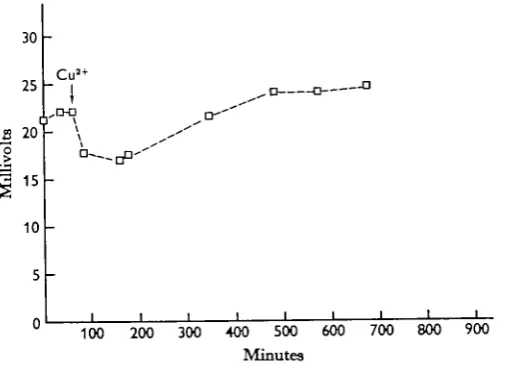
Fig. 5. The effect of copper on the TEP. Two animals were immersed in 5 min/1, KtSOj con-taining 1 min/l. NaCl. After 2 hours the TEP was stable and the experiment was begun (time zero). The TEP of the untreated nnima1n was measured for 60 minutes more, then CuSO« was added (arrow) to a final concentration of 1-25 x io~* M/L Measurements were made as shown. Each point is the mean of the two TEPs. TEPs during the control period were nearly the same for both animals. (200 and 22-5 mV).
Ussing (1949) has shown that dilute Cu2+ added to Ringer's solution bathing the outside of the isolated frog skin augments the TEP by decreasing chloride permeability. Fig. 5 shows that low concentrations of cupric ions have little effect on the TEP generated by salamanders in pond water. A transient period of depression occurred as described by Ussing, but even after 15 hr. of exposure the potential difference was within a few millivolts of its initial value. Higher concentrations of the metal only depressed the potential. Lack of copper effect is also consistent with low chloride permeability in the untreated animal under these conditions.
Fig. 6 shows the results of an experiment in which the KgSO4 solution was replaced
(0 09)H (0
18)-S ~o —10
>
- 2 0
I
10 20 30 4 0 50 60 70 80 90 10 0 [C1-] mM/1.
Fig. 6. TEP as a function of [Cl~]. Protocol as in Figure 3 except that replacement of K,SOi was made with KC1. After each measurement an aliquot of the solution was removed for Cl~ and Na+ analyses. The numbers in parentheses give [Na+] over the range included between two vertical lines. The abrupt rise from 009 to o-18 mM/1. probably resulted from urination and is a likely cause of the small increase in TEP shown. The internal electrode remained negative throughout.
DISCUSSION
It is clear that when salamanders are in an ionic steady state in pond water both Na+ and Cl~ are actively transported inward. In addition, the data in Table 1 show that the transport systems can operate independently of each other. The fact that up-take of each ion in this experiment was not balanced by absorption of a counter ion can only mean that electrostatic neutrality must be maintained by a pair of ion-exchange systems. Fig. 1 shows that these animals excrete ammonia across the body surface. In 3 experiments involving 13 salamanders ammonia excretion was measured for periods of 5-7 hr. The mean efflux was 071 ±0-27 (s.D.) /imole (10 g.)-1 hr.-1. Sodium uptake was not measured in these animals but a mean value of 1-3 /imole (10 g.)- 1 hr.- 1 was reported by Alvarado & Kirschner (1963). Thus, ammonia excre-tion is somewhat lower than sodium uptake, but would provide electrostatic balance for much of it. Na+/NH4+ exchanges have been reported in the frog (Krogh, 1937),
in the goldfish (Maetz & Garcia-Rameau, 1964), and in the crayfish (Shaw, 19606), and ammonia is also excreted by Necturus maculosus (Fanelli & Goldstein, 1964). All of these animals have the same ionic regulatory problems as the larval salamanders used in our work, and it appears possible that such an exchange system operates to maintain electrical neutrality during Na+ uptake in all fresh-water animals. An alterna-tive possibility in Na+/H+ exchange, with NH3 diffusing out of the epithelial cells to
maintain a constant cytoplasmic pH.
involved in generating the TEP (Kirschner, 1955; Ussing & Zerahn, 1951). The correlation between transport rate and TEP, suggested by the concentration depen-dence, was confirmed by comparing TEPs in salt-depleted (augmented transport), normal, and salt-loaded (depressed transport) animals.
Depression of the potential by metabolic inhibitors may also be a concomitant of transport inhibition. However, these compounds also effect the diffusion permeability of some preparations, for example the isolated frog skin (Nakajima & Hashimoto, i960; confirmed by unpublished experiments in our laboratory). Such an increase in passive ionic conductance would also tend to depress the potential, and this makes interpreta-tion of inhibitor studies equivocal. However, the results reported here are compatible with participation of sodium transport in electrogenesis.
Lack of effect of strophanthin in the TEP was the only observation apparently inconsistent with a direct role for the sodium pump. Addition of the inhibitor to the external bathing solution may have prevented it from reaching the transport locus, but injection of the compound in quantities sufficient to give blood concentrations of 1-10 /ig./ml. were also ineffective. These observations are in contrast with similar studies showing that strophanthin inhibits sodium transport across many epithelia (Nakajima, i960).
Our experiments also show that salamander skins have a low leak conductance for chloride in dilute solutions. Cl~ uptake is thermodynamically active, and can occur independently of simultaneous cation absorption. Fig. 6 shows that Cl~ uptake is not electrogenic. These observations suggest that a tightly coupled exchange against another anion must be involved. We have no evidence concerning the identity of the exchangeable anion. A C1~/HCO3~ exchange across the body surface has been described
in frogs (Krogh, 1937), crayfish (Shaw, 1960a) and fresh-water teleosts (Maetz & Garcia-Rameau, 1964). Such exchanges are also well known in other epithelia, and the ready availability of CO2 makes bicarbonate a probable member of such an
ex-change system in the salamander.
Thus, the TEP in larval salamanders in dilute saline appears to be generated by active Na+ transport with electrostatic neutrality maintained by cation exchange. External anions play no role in electrogenesis. The experiments of Barker-Jorgensen
et al. (1954) and Krogh (1937) show that this may also be the case in frogs. Yet there is
little doubt that isolated frog skins bathed by Ringer's solution have an appreciable diffusion permeability to Cl~ and that influx of this ion maintains electrostatic neutra-lity during Na+ transport. Either isolation of the skin or the use of Ringer's solution outside seems to cause a change in leak permeability to chloride. This change is being investigated.
SUMMARY
1. Larval salamanders in pond water actively transport both Na+ and Cl~ inwards. The two fluxes can occur independently, indicating that they are not linked obligatorily through a single mechanism. Ammonia is excreted extrarenally at rates comparable with active Na+ influx.
such a TEP, while K+, Rb+, Ca2+, Mg2+, and NH4+ salts have little effect. Azide and
dinitrophenol abolish the TEP, while strophanthin has no effect. When active Na+ uptake is enhanced by salt-depletion, higher TEPs are generated. Conversely, animals with Na+ transport depressed by salt-loading show significantly smaller TEPs. 3. The magnitude of the TEP is uneffected by replacing NaCl with Na2SO4.
Permeability of the body surface to SO42~ is very low, and the similarity in electrical
behaviour of the two anions suggests that Cl~ penetration by diffusion is also small. This surmise is supported by two observations: (1) KC1 generates no TEP over a wide range of concentrations; and (2) cupric ion has no effect on the TEP developed in dilute NaCl solution.
4. It is suggested that the TEP in salamanders is generated by active inward transport of Na+, but that in dilute solutions electrostatic neutrality is maintained by a cation-exchange system involving ammonium ion. Uptake of Cl~ under these condi-tions appears to occur by an independent mechanism and is non-electrogenic.
REFERENCES
ALVARADO, R. H. (1962). Osmotic and Ionic Regulation in Ambyttoma ttgrtnwn Ph.D. Thesis, Washing-ton State University. 123 pp.
ALVARADO, R. H. & KIRSCHKER, L. B. (1961). Factors influencing sodium balance in the tiger salamander,
Ambyttoma tigrinum. Am. Zool. 1,338.
ALVARADO, R. H. & KIRSCHNER, L. B. (1963). Osmotic and ionic regulation in Ambyttoma tignnum.
Comp. Biochem. Phyttol. 10, 55—67.
BARKER-J0RGENSEN, C., LEVI, H. & ZERAHN, K. (1954). On active uptake of sodium and chloride ions in Anurans. Acta Pkytiol. Scand. 30, 178-90.
BROWN, A. C. (1962). Current and potential of frog skin m vivo and in vitro. J. Cell. Comp. Phyttol. 60, 263-70.
FANELLI, G. M. & GOLDSTEIN, L. (1964). Ammonia excretion in the neotenous newt, Necturut maculosus.
Comp. Biochem. Physwl. 13, 193-205.
KIRSCHNER, L. B. (1955). On the mechanism of active sodium transport across the frog skin. J. Cell.
Comp. Phyttol. 45, 61-89.
KOHFOED-JOHNSEN, V. & USSING, H. H. (1958). The nature of the frog skin potential. Acta Pltyttol.
Scand. 43, 298-308.
KROGH, A. (1937). Osmotic regulation in the frog by active absorption of chloride ions. Scand. Arch.
Phyttol. 76, 60-74.
LINDERHOLM, H. (1952). Active transport of ions through frog skin with special reference to the action of certain diuretics. Acta Phyttol. Scand. vj (Suppl. 97), 1-144.
MAETZ, J. & GARCIA-RAMEAU, F. (1964). The mechanisms of sodium and chloride uptake by the gills of a freshwater fish, Carattiut auratut. 11. Evidence for NH+4/Na+ and HCO~3/C1~ exchanges. .7. Gen. Phyttol. 47, 1209-27.
NAKAJIMA, S. (i960). The effects of ouabain on active sodium transport through frog skin. Proc. Japan
Acad. 36, 226-8.
NAKAJIMA, S. & HASHIMOTO, T. (i960). The effects of metabolic inhibitors on active Na transport through frog skin. Proc. Japan Acad. 36, 223—5.
SHAW, J. (1960a). The absorption of chloride ions by the crayfish Attacut Palhpet Lereboullet. Exp.
Biol. 37,
557-72-SHAW, J. (19606). The absorption of sodium ions by the crayfish Attacut Palhpet Lereboullet. Exp. Biol. 37,
534-47-STEINBACH, H. B. (1933). The electrical potential difference across living frog skin. J. Cell Comp.
Phyttol. 3, 1-27.
USSING, H. H. (1949). The distinction by means of tracers between active transport and diffusion.
Acta Pkyttol. Scand. 19, 43-56.
USSING, H. H. (i960). The frog skin potential. J. Gen. Phytiol. 43, 135-47.
![Fig. 3. TEP and [Cameasured at different Caplaced the last test solution, and the TEP was measured at a series of [Naof the solution was removed for Cabers is parentheses give the [Na+], A single animal was immersed in 50 ml](https://thumb-us.123doks.com/thumbv2/123dok_us/1213238.645015/7.451.88.364.123.301/cameasured-different-caplaced-solution-measured-solution-parentheses-immersed.webp)