The development of physiological traits is a critical aspect of evolutionary and ecological physiology (Burggren, 1991). Most natural selection probably occurs during the juvenile stages, because young animals generally have much higher rates of mortality than fully developed, adult organisms (insects – Estevez and Gonzalez, 1991; reptiles – Iverson, 1991; arachnids – Tanaka, 1992; birds – Currie and Matthysen, 1998; fish – Molles, 1999; mammals – Durant, 2000). Therefore, knowledge of the physiology of juveniles and developmental patterns of physiological traits is important in understanding ecological success and evolution.
Adult and pupal insects tolerate low levels of oxygen (<5·kPa O2), at which most mammals would die (Wegener,
1993), and generally have resting critical oxygen partial pressures [Pc; the oxygen partial pressure (PO∑) below which
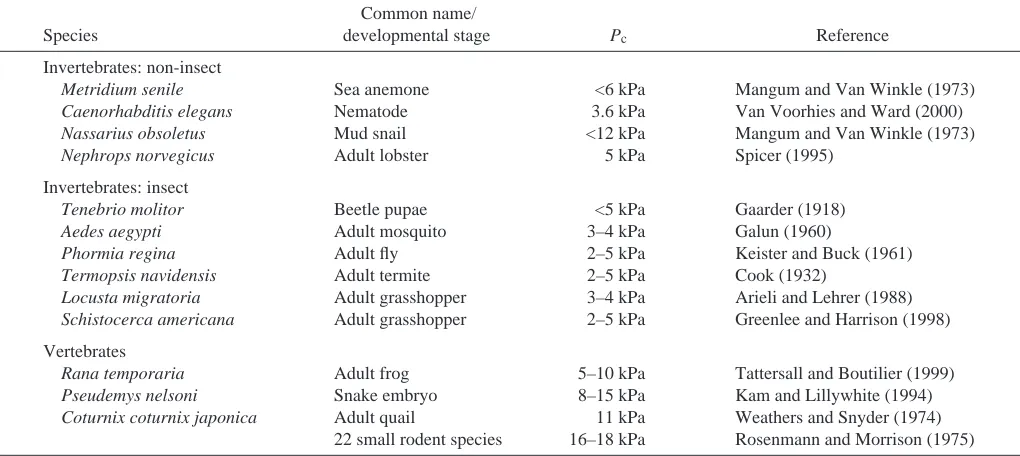
metabolism can no longer be maintained] well below those of vertebrates and perhaps below those of non-tracheate invertebrates (Table·1; Hoback and Stanley, 2001). Pcis the
point at which an animal switches from being an oxy-regulator to an oxy-conformer (Yeager and Ultsch, 1989; Portner and Grieshaber, 1993), and thus it defines the safety margin for O2
delivery (the range of PO∑s across which metabolism is
constant; Kam and Lillywhite, 1994). For this reason, organisms with low Pcs tend to tolerate hypoxia better than
animals with higher Pcs (Ultsch, 1973, 1974). To our
knowledge, Pc has not yet been compared across the
developmental stages of an insect.
One prominent hypothesis suggests that as insects become larger, gas exchange becomes more difficult due to increases in tracheal system lengths (Graham et al., 1995; Dudley, 1998). This logic is the basis for the hypothesis that increases in atmospheric O2 during the Paleozoic era facilitated insect
gigantism (Graham et al., 1995; Dudley, 1998). Alternatively, larger insects could have greater tracheal diameters or could increase the use of ventilation to compensate for increased tracheal lengths. We tested this hypothesis using developing grasshoppers. If older, larger grasshoppers have smaller safety margins (higher Pcs) for oxygen delivery than younger, smaller
grasshoppers, this would support the hypothesis of Graham et al. (1995).
Development of the respiratory system is particularly interesting, because all organisms grow in size and increase total oxygen demand with age. Pc changes during ontogeny
will depend on whether the ratio of maximal tracheal
doi:10.1242/jeb.00767
We tested the hypothesis that oxygen delivery from the atmosphere to the tissues becomes more difficult as grasshoppers increase in body size throughout development due to increases in tracheal length. If this is true, then older, larger grasshoppers should have smaller safety margins [higher critical oxygen partial pressures (PO∑s)] for oxygen delivery than younger, smaller
grasshoppers. We exposed grasshoppers of first, third and fifth instars and adults to decreasing levels of atmospheric O2and measured their ventilatory responses. Contrary to
our prediction, we found that larger grasshoppers had critical PO∑s eight times lower than juveniles due in part to
their threefold lower mass-specific metabolic rates and
their ability to quadruple convective gas exchange. Adults more than doubled abdominal pumping frequency and increased tidal volume by 25% as PO∑decreased fourfold,
whereas the youngest juveniles showed no such responses. This study indicates that juveniles may be more susceptible to hypoxia in natural situations, such as exposure to high altitude or restricted burrows. Also, larger size is not necessarily correlated with a smaller safety margin for oxygen delivery in insects.
Key words: ontogeny, insect, grasshopper, Schistocerca americana, ventilation, gas exchange, hypoxia.
Summary
Introduction
Development of respiratory function in the American locust
Schistocerca americana
I. Across-instar effects
Kendra J. Greenlee* and Jon F. Harrison
Section of Organismal, Integrative, and Systems Biology, School of Life Sciences, Arizona State University, PO Box 874601, Tempe, AZ 85287-4601, USA
*Author for correspondence (e-mail: [email protected])
conductance to metabolic rate changes with age. Maximal tracheal system conductance (Gmax; µmol·g–1·h–1·kPa–1) will
depend on tracheal system structure (e.g. spiracle size and dimensions and density of tracheae and tracheoles) and function (e.g. the magnitude of convective gas exchange). The scaling exponents for metabolic rates during insect development vary widely and may exceed 1.0 (Casey and Knapp, 1987; Vogt and Appel, 1999).
In the present study, we quantify developmental changes in metabolic rate, maximal tracheal system conductance and several aspects of tracheal system function (ventilation frequency and abdominal pumping height, an index of tidal volume) for the American locust Schistocerca americana. We also compare the Pc for oxygen consumption and carbon
dioxide emission to verify that our Pcfor CO2emission truly
reflected the Pcfor oxygen delivery. In addition, we examine
the effect of hypoxia exposure time on the Pc for CO2
emission, since we wanted to be sure that our calculated Pc
values were not strongly affected by the duration of hypoxia exposure in our major experiment.
Materials and methods Animals
Schistocerca americana Drury were reared from eggs in
culture at Arizona State University as previously described (Harrison and Kennedy, 1994). For these experiments, it was important to have grasshoppers of known age and body size. We took 200 grasshoppers that hatched on the same day and marked them with paint (Testors, Rockford, IL, USA). We monitored the colony each day, and, when an animal molted, we applied a new color of paint. All animals that molted on a given day had the same paint color, so we knew the age in days of each individual. Experimental animals were
randomly selected from the animal care facility in the morning and kept in a lit, 35°C incubator with access to green leaf lettuce for 0.5–6·h before measurements were made. We recorded body mass (Mb) of all animals, weighing them to
the nearest 0.001 g using an analytical balance (Mettler Instruments, Hightstown, NJ, USA). For measurements of adult insects, we used only males, but for measures of juveniles, sex was not determined.
Comparison of Pcvalues for O2consumption and CO2 emission
Adult animals were placed in a 26·ml Plexiglas cylinder sealed with rubber stoppers. Inside the chamber, we placed cotton anterior and posterior to the grasshopper to prevent movement and around the animal’s head to prevent visual stimulation. Test animals sat in the chamber for 20·min before measurements were made, a procedure that kept ventilatory frequencies similar to those of unrestrained grasshoppers behind one-way mirrors (Gulinson and Harrison, 1996). Each grasshopper was exposed to 11 different levels of PO∑(21, 16,
13, 9, 7, 5, 3, 2, 1, 0.5 and 0·kPa O2) for at least 15·min in
descending order to prevent increases in metabolic rate associated with prior hypoxic exposure (Greenlee and Harrison, 1998).
Gas mixtures were made by diluting dry, CO2-free air with
N2(Balston purge-gas generator; Havervill, MA, USA). The
ratio of air to N2was controlled by a Brooks 5878 mass flow
controller and mass flow meters (Brooks Instruments, Hatfield, PA, USA). Gas mixtures were pushed through three identical chambers at 223–326·ml·min–1. Flow from one of
[image:2.612.46.556.87.315.2]these chambers was directed to the reference cells of the gas analyzers. The sample cells of the gas analyzers received output either from the animal chamber or an empty baseline chamber. All three chambers emptied into 60·ml syringes Table 1. Summary of critical oxygen partial pressures (Pc) for metabolic rates of vertebrates and invertebrates
Common name/
Species developmental stage Pc Reference
Invertebrates: non-insect
Metridium senile Sea anemone <6·kPa Mangum and Van Winkle (1973)
Caenorhabditis elegans Nematode 3.6·kPa Van Voorhies and Ward (2000)
Nassarius obsoletus Mud snail <12·kPa Mangum and Van Winkle (1973)
Nephrops norvegicus Adult lobster 5·kPa Spicer (1995)
Invertebrates: insect
Tenebrio molitor Beetle pupae <5·kPa Gaarder (1918)
Aedes aegypti Adult mosquito 3–4·kPa Galun (1960)
Phormia regina Adult fly 2–5·kPa Keister and Buck (1961)
Termopsis navidensis Adult termite 2–5·kPa Cook (1932)
Locusta migratoria Adult grasshopper 3–4·kPa Arieli and Lehrer (1988)
Schistocerca americana Adult grasshopper 2–5·kPa Greenlee and Harrison (1998) Vertebrates
Rana temporaria Adult frog 5–10·kPa Tattersall and Boutilier (1999)
Pseudemys nelsoni Snake embryo 8–15·kPa Kam and Lillywhite (1994)
from which excurrent gases were subsampled. The reference stream and the sample stream were pulled through the CO2
analyzer (LI-6252; Li-Cor, Lincoln, NE, USA) and then the O2 analyzer (Sable Systems Oxzilla, Las Vegas, NV,
USA) by an AMETEK R-1 flow controller (Pittsburgh, PA, USA). Water and CO2 were removed between the two
analyzers using columns of drierite and ascarite. The output of both gas analyzers was digitized and recorded (Sable Systems).
We calculated the rates of CO2 emission and O2
consumption (M˙CO2and M˙O2, respectively; µmol·g–1·h–1) using
the following equations:
where V.inis the flow rate measured upstream of the animal
chamber (ml·min–1 STP; Omega mass flow meter, Stamford,
CT, USA), V.O∑is the rate of O2consumption, FICO∑and FIO∑
are the incurrent CO2 and O2 fractions, respectively, and FECO∑ and FEO∑ are the excurrent CO2 and O2 fractions, respectively. Additionally, 2678.57 is the conversion factor used to convert ml g–1min–1 to µmol g–1h–1 (1000µl ml–1,
60 min h–1 and 22.4µlµmol–1). Although flow rate was
measured upstream from the chamber, the added volume flow due to water production by the animal was negligible, introducing an error of less than 0.08% (Greenlee and Harrison, 1998).
Effect of duration of hypoxic exposure on M˙CO∑
We wanted to be sure that our calculated Pcvalues were not
strongly affected by the short-duration hypoxia exposure in our major experiment. Therefore, we exposed first-instar juvenile and adult grasshoppers for 1·h to each of seven levels of PO∑
(adults – 21, 5, 3, 2, 1, 0.5 and 0·kPa O2; juveniles – 21, 16,
13, 9, 7, 3, 1 and 0·kPa O2) and measured CO2emission rates.
Animals were treated as described above, except that small animals were placed in glass cylinders and larger animals were in Plexiglas cylinders. In all cases, the inner diameter of the chamber was just large enough to insert the animal but small enough to inhibit movement. Gas mixtures were made as described above and were sub-sampled from a 60·ml syringe using an AMETEK R-1 flow controller, which pushed the mixture through the respirometry chamber and then through the CO2analyzer only. Flow rates ranged from 30·ml·min–1to
300·ml·min–1, increasing with the size of the animal. The
weakest signal-to-noise ratio (average p.p.m. CO2in excurrent
air relative to peak-to-peak system noise) was 13:1 during anoxia for first-instar grasshoppers. The signal-to-noise ratio improved as oxygen level and animal body sizes increased (e.g. signal-to-noise ratio was 84:1 in normoxia for first-instar grasshoppers and 127:1 for adults in anoxia). M˙CO2 was
calculated at various time periods ranging from 3·min to
60·min after exposure to a new gas mix using the following equation:
For these calculations, we assumed that the respiratory exchange ratio (RER) was 1; the misestimation of flow due to possible variations in RER was negligible, as variation between 1.0 and 0.7 would have produced a variation in calculated M˙CO2of less than 0.026%.
Ontogenetic change in the responses of M˙CO∑and ventilation frequency to progressive hypoxia
Respirometry chambers, as described above, were placed in a 35°C water bath, the preferred field body temperature for most grasshoppers (Uvarov, 1966). First-, third- and fifth-instar and adult grasshoppers were each exposed to 12 different levels of PO∑(21, 16.2, 13.2, 9.1, 7.5, 6.2, 5.1, 3.8, 2.4, 1.3,
0.7 and 0·kPa O2) for 3–4·min at each PO∑. We counted
ventilatory frequency at each PO∑while viewing the animals
through a dissecting microscope. We calculated CO2emission
rate using equation·3 above.
Determination of Pcfor gas exchange and abdominal pumping
We determined individual Pc values for gas exchange by
statistically identifying the PO∑at which CO2emission or O2
consumption dropped (Fig.·1, box A). We compared 95% confidence intervals (CI) created using the mean ± (t×S.E.M.)
where t=1.96 (Zar, 1999). There were three criteria for designating a PO∑as critical: the 95% CI at the Pccould not
overlap and had to be (1) less than the CI of the previous PO∑
(Fig.·1, box B), (2) less than the CI of all the previous PO∑s
combined (Fig.·1, box C) and (3) greater than or equal to the CI of all subsequent PO∑s. The mean PO∑between the PO∑at
which CO2emission dropped significantly and the next higher PO∑was designated as the Pc(Fig.·1, box B; 1.3% O2). The Pc for abdominal pumping frequency was determined for each individual as the first PO∑ at which abdominal pumping
frequency dropped below that in normoxia and continued to decrease.
Magnitude of abdominal pumping
We obtained indices of tidal volume for first-instar juvenile and adult grasshoppers by measuring their abdominal height changes in response to hypoxia using videography. Each grasshopper was exposed to six levels of PO∑(adults – 21, 13,
5, 2, 1 and 0.5·kPa O2; juveniles – 21, 16, 13, 9, 5 and 1·kPa
O2) at flow rates of 500·ml·min–1. The grasshopper’s abdomen
was magnified with a dissecting microscope and the image was digitized with a Hitachi 3CCD camera (Tokyo, Japan) and displayed on a television monitor. We adjusted the magnification so that the abdomen nearly filled the monitor. Abdominal pumping was then video-recorded with a Panasonic SVHS (Desktop Editor Pro-Line, Secaucus, NJ, USA). Afterwards, the recording was analyzed frame by frame, (3)
V˙in(FECO∑– FICO∑) ×2678.57
Mb
M˙CO2= .
(2)
V˙in(FECO∑– FICO∑) – (V˙O∑×FECO∑) ×2678.57
(1 – FECO∑) ×Mb
M˙CO2= ,
(1)
V˙in×(FIO∑– FEO∑) ×2678.57
(1 – FEO∑) ×Mb
and the height of the abdomen was measured at the fourth abdominal segment using a digital micrometer (Mitutoyo Corporation, Kawasaki, Japan). We recorded maximal height (inspiration) and minimal height (expiration) and calculated the percent difference using the following equation:
This measure provided an index of tidal volume, where larger percentage differences indicated higher tidal volumes. We calculated a mean value at each PO∑for each animal from three
breaths and used this mean as a data point. Since we measured this index of tidal volume at relatively few PO∑s, we did not
calculate Pcvalues for this parameter.
Calculation of maximal tracheal system conductance
We calculated mass-specific tracheal system conductance for oxygen delivery (Gmax; µmol·g–1·h–1·kPa–1; from air to
mitochondria, incorporating both diffusive and convective conductances) as:
We assumed that at the Pc, tracheal system conductance would
be maximized, since animals should have their spiracles opened wide (Case, 1956; Miller, 1960), ventilation
maximized (Greenlee and Harrison, 1998) and tracheolar fluid removed (Wigglesworth, 1983). This calculation also assumes that mitochondrial PO∑is near zero at the
Pc(Richmond et al., 1999) and that RER is 1 (see Results). Since Pcwas
calculated as an average of two PO∑s,
we used the value of M˙CO2at the PO∑
just above the Pc. Statistics
Mean values ± S.E.M. are presented for parametric data, and median values are shown for nonparametric data. Statistical analyses were performed using SYSTAT 10.2, with our within-experiment type I error less than or equal to 5%. For our analyses, the adult instar was designated as instar 7. We used repeated-measures analysis of variance (ANOVA) to compare the hypoxia responses of each instar, since individuals were measured at multiple levels of PO∑; N=8 for all treatment groups. All Pc
values were statistically analyzed as nonparametric data, since these are discrete variables. We used the Kruskal–Wallis test, a single-factor analysis of variance in SYSTAT 10.2 and also calculated nonparametric multiple comparisons as described in Zar (1999). To determine whether there was a linear effect of instar on Pc,we also compared those
values using nonparametric regression, Kendall’s robust line-fit method and rank correlation coefficient (Sokal and Rohlf, 1995).
Results
Developmental effects on mass and normoxic CO2emission
Body mass (Mb) increased over 50-fold from hatching to
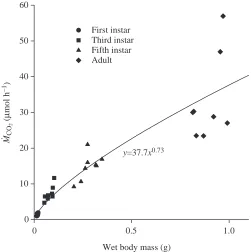
early adulthood (Fig.·2). Metabolic rates increased with body mass (metabolic rate=0.005×Mb0.77; r2=0.95). Third instar CO
2
emission rate was higher than predicted by the general scaling relationship for M˙CO2and Mb(Fig.·3).
Comparison of the Pcfor M˙CO∑and M˙O∑
In adult grasshoppers, the Pcfor M˙O2and the Pcfor M˙CO2
did not differ significantly (Table·2; Fig.·4; Mann–Whitney U test, U=32, P=1.0). Respiratory exchange ratios remained near one until the Pc was reached, below which they increased
dramatically (Fig.·4 inset; repeated-measures ANOVA,
F7,49=6.1, P<0.001).
Effect of the duration of hypoxia exposure on the Pcfor M˙CO∑
Duration of exposure (3·min or 1·h) had no significant effect (5)
Gmax= .
M˙CO2 PO2
(4) % Change in abdominal height =
.
100 × (Heightmax– Heightmin)
Heightmin
Time (min)
0 10 20 30
CO
2
(
p.p.
m
.)
O2
(
%
)
0 20 40 60 80 100
0 5 10 15 20
A B C
Fig.·1. Determination of critical oxygen partial pressure (Pc). This is the raw data file from an
individual grasshopper, showing CO2emission (solid line) and atmospheric O2(broken line). As
oxygen partial pressure (PO∑) drops incrementally, CO2 transiently increases. Briefly, we
compared 95% confidence intervals constructed around the mean CO2p.p.m. in each box. Box A
is the PO∑where CO2was significantly less than at the next higher PO∑(box B) and less than the
on the Pcof first-instar grasshoppers (Table·2; Fig.·5). Adults
exposed for 1·h at each PO∑had lower CO2emission rates than
those animals exposed for 3·min, and longer exposures slightly (but significantly) increased the Pcfor M˙CO2(Table·2; Fig.·5;
Mann–Whitney U test, U=4.5, P=0.002).
Across-instar developmental effects on the Pcfor M˙CO∑
There was a significant interaction between PO∑and instar
in the repeated-measures ANOVA, indicating that the decrease in M˙CO2 in response to hypoxia differed in different instars
(F27,252=10.5, P<0.001). As has been previously shown
(Greenlee and Harrison, 1998), adult grasshoppers exposed to
hypoxia were able to maintain constant CO2 emission down
to a median PO∑ of 1.8·kPa (Fig.·6). However, first-instar
grasshoppers appeared to be oxygen limited across PO∑levels
lower than the median Pcof 14·kPa, as metabolic rate dropped
virtually continuously with PO∑ below 14·kPa (18·kPa for
1·h measures). Third and fifth instars showed intermediate responses, with median Pc values of 9.7·kPa and 4.5·kPa,
respectively (Figs·6,·7). Overall, Pc decreased linearly over
sevenfold from hatchling to adult grasshopper (Fig.·7; Kendall’s rank correlation coefficient, τ=–0.58, P<0.01).
Across-instar developmental effects on the response of ventilatory frequency to hypoxia
For all instars, breathing frequency plummeted at some low level of ambient oxygen (Fig.·8). In contrast to the Pcfor M˙CO2,
the Pcfor abdominal pumping was very low across all instars
(Table·2; Fig.·7). However, there was still a significant effect of instar on the Pcfor abdominal pumping (Kruskal–Wallis test
statistic=14.3, P<0.01). Nonparametric multiple comparisons revealed that only third instars and adults differed in their Pc
for abdominal pumping, with the third-instar Pc threefold
higher than that of adults (q=4.7, P<0.05).
In response to hypoxia, adults more than doubled their ventilatory frequencies, while the first instars showed no change (Fig.·8). The response of abdominal pumping frequency to hypoxia varied significantly with instar, as indicated by a significant interaction between PO∑and instar
(repeated-measures ANOVA, F27,252=10.5, P<0.001). We
used analysis of covariance (ANCOVA) to determine which instars had different responses to hypoxia based on the slope of the line created when abdominal pumping was regressed on
PO∑at all PO∑s above the Pcfor abdominal pumping (21·kPa to 3·kPa). We limited our test to these PO∑s because, below the Pc, abdominal pumping decreased dramatically. This analysis revealed that the first-instar grasshoppers had no response to hypoxia above the Pc(slope=–0.114, P=0.9; Fig.·8). Pair-wise
comparisons of the slopes of the other instars indicated that all were different from the first-instar slope but not different from each other (first instar versus other instars: all P≤0.011; comparisons between third, fifth and adults: all P>0.6). Thus,
Instar
1 3 5 Adult
We
t bo
d
y m
ass
(g)
0 0.2 0.4 0.6 0.8 1.0
y=0.0046x3–0.0199x2+0.0415x
r2=0.99
Fig.·2. Wet body mass increased with instar for Schistocerca
americana.
Fig.·3. Absolute CO2emission (M˙CO2) in normoxia as a function of
wet body mass. M˙CO2 scaled with body mass to the 0.73 power; r2=0.77, P<0.001.
Wet body mass (g)
0 0.5 1.0
MCO
2
(
µ
mo
l
h
–
1)
0 10 20 30 40 50 60
.
First instar Third instar Fifth instar Adult
[image:5.612.51.295.78.226.2]y=37.7x0.73
Table 2. Summary of the median Pc values found in our
experiments
Variable Abdominal
Exposure M˙CO∑ M˙O∑ pumping
duration 3·min 15·min 60·min 15·min 3·min
Instar
1 14.1 18.5 2.3
3 9.7 3.0
5 4.5 1.3
Adult 1.8 3.25 4.0 3.25 0.95
M˙O∑, mass-specific rate of oxygen consumption; M˙CO∑,
[image:5.612.316.569.97.208.2] [image:5.612.50.301.449.701.2]only the first-instar grasshoppers did not increase breathing frequency in response to hypoxia, and the responsiveness of abdominal pumping frequency to hypoxia was similar from the third instar to the adult stage [abdominal pumping frequency=2.2(PO∑)+42.2; r2=0.12;
Fig.·8].
Across-instar effects on the responsiveness of tidal volume to hypoxia
Our index of tidal volume, percent change in abdominal height, was 35 times higher in normoxia for adults compared with first instars (Fig.·9). Juveniles compressed their abdomens less than 1% of maximal height, compared with a 20% abdominal compression in adults (Fig.·9). Because we measured tidal volume at different PO∑s for each instar, we were
able to statistically compare only the responses at common PO∑s (21, 5 and
1·kPa). There was a significant interaction effect of instar and PO∑ on tidal volume
(repeated-measures ANOVA, PO∑ ×
instar, F2,28=64.8, P<0.001). Adults
increased tidal volume almost 50% in response to hypoxia, while juveniles showed no significant change in tidal volume (repeated-measures ANOVA, adults – F4,28=21.8, P<0.0001; first instar
– F5,35=1.4, P=0.24).
Discussion
Throughout development, the grasshopper respiratory system improved in its ability to respond to hypoxia, as indicated by the increased responsiveness of ventilation frequency (Fig.·8) and tidal volume (Fig.·9) to hypoxia; together, these lead to a fourfold increase in the mass-specific capacity of the tracheal system to conduct oxygen (Gmax; Fig.·10). Older grasshoppers were also
much more able to tolerate hypoxia, as the Pc for
metabolic rate decreased sevenfold during ontogeny (Fig.·7). The increased tracheal system conductance with age may have been in preparation for a switch in the principal mode of locomotion from hopping to flight. In addition, the increased responsiveness to hypoxia of the tracheal system of older grasshoppers may be related to a general increased use of convective gas exchange in larger insects. Furthermore, our finding that development strongly affected the ability of grasshoppers to respond to ventilatory system challenges may mean that juveniles would be more sensitive to hypoxic environments encountered within restricted burrows, at high altitudes or during discontinuous gas exchange (Lighton, 1996).
Atmospheric PO2 (kPa)
0 5 10 15 20
0 10 20 30 40 50
0 5 10 15 20
RER
1 5
MCO2
MO2
MC O2
or
MO
2
(
µ
mo
l
g
–
1 h
–
1)
. .
. .
Fig.·4. Effect of decreasing atmospheric oxygen partial pressure (PO∑) on mass-specific
CO2 emission (M˙CO2) and mass-specific O2 consumption (M˙O2) for adult grasshoppers.
Critical oxygen pressures (Pc) were similar for both indices of metabolic rate. The inset
depicts the respiratory exchange ratio (RER) for these animals as atmospheric PO∑
decreases to the Pc. RERs at 0 and 0.6·kPa O2are off scale and are not shown; N=8 for
each treatment group.
0 5 10 15 20
0 20 40 60 80 100
Adults – 3 min exposure
Adults – 1 h exposure
First instar – 3 min exposure First instar – 1 h exposure
MCO
2
(
µ
mol
g
–
1 h
–
1)
.
Atmospheric PO2 (kPa)
Fig.·5. Effect of exposure time on mass-specific CO2 emission (M˙CO2)
responses to decreasing levels of atmospheric PO∑in adult (diamonds) and
first-instar (circles) grasshoppers. One hour exposures (open symbols) are compared with 3·min exposures (solid symbols). Values are means ±S.E.M.;
Validation of methods
CO2emission as an index of aerobic metabolic rate
We used CO2emission as our index of metabolic rate
in the across-instar comparisons because we could measure fractional CO2 content of the excurrent air
stream quickly and more accurately than if we measured O2, especially for the smallest grasshoppers. This
approach raises the concern that CO2emission might not
reflect the Pcfor aerobic metabolism. For example, the Pcfor M˙CO2might be lower than the Pcfor M˙O2if M˙CO2
was elevated at low PO∑s due to anaerobiosis or CO2
washout from body tissues due to hyperventilation. In our study, despite persistent elevation of M˙CO2at very
low PO∑s, adult grasshoppers had identical Pcvalues for M˙CO2 and M˙O2 (Table·2; Fig.·4). The Pc for M˙CO2 is
probably also close to the Pc for M˙O2 in juveniles,
because juveniles exhibited much lower ratios of CO2
emission in anoxia to CO2 emission in normoxia
(Fig.·11; ANOVA F3,28=15.2, P<0.001). Therefore, we
conclude that the Pc for M˙CO2 provided a reasonable
approximation of the Pcfor aerobic metabolism.
Interestingly, the RERs that we measured (Fig. 4 inset) were higher than those measured for resting
Schistocerca gregaria (0.82; Krogh and Weis-Fogh,
1951). One possible explanation for the discrepancy is that fuel use was different. Our grasshoppers were fed on green leaf lettuce, kale and dried wheat germ, whereas the grasshoppers in the prior study were fed green cabbage and dried grass. Alternatively, our grasshoppers could have been in a stressed state. However, the normoxic, acute metabolic rates we measured (after 20·min chamber acclimation time) were similar to those measured over 1·h, indicating that grasshoppers either were still stressed after 1·h or were settled within 20·min. Typically, grasshopper ventilation frequencies return to normal 20·min after a disturbance (Gulinson and Harrison, 1996). Perhaps the difference was due to inherent differences between the two species.
Acute exposure to hypoxia
We were also concerned that the use of short-term exposures to hypoxia would not reflect steady-state conditions. However, calculated Pcvalues for M˙CO2did not differ between first instar
animals exposed for three minutes or one hour to the test PO∑s
(Table·2; Fig.·5). Adult grasshoppers exposed to hypoxia for 1·h did have much lower CO2 emission rates and a slightly
higher Pc compared with acutely exposed animals (Fig.·5;
Table·2). We attribute the elevated M˙CO2 for the 3·min
exposures in adults to transient increases in CO2emission that
occurred in response to each drop in atmospheric PO∑(Fig.·1).
The increased CO2emission may be attributed to two events.
First, it has been noted that grasshoppers may physically struggle to escape when exposed to lower oxygen (Hochachka et al., 1993; Wegener, 1993). Secondly, exposure to hypoxia causes an increase in ventilation (enhancing CO2loss) relative
to metabolic rate (CO2production), which secondarily causes
a drop in hemolymph PCO∑ and total CO2 content (Greenlee
and Harrison, 1998). An alternative explanation for the transient increase in CO2 emission is that acid metabolites,
0 5 10 15 20
0 20 40 60 80 100
First instar Third instar Fifth instar Adults
MCO
2
(
µ
mo
l
g
–
1 h
–
1)
.
Atmospheric PO2 (kPa)
Fig.·6. Effect of decreasing atmospheric oxygen partial pressure (PO∑) on
mass-specific CO2 emission (M˙CO2) for first-instar (circle), third-instar
(square), fifth-instar (triangle) and adult animals (diamond). Values are means ±S.E.M.; N=8 for each treatment group.
Instar
1 3 5 Adult
Pc
(kP
a)
0 5 10 15 20
E D C A
B F
Fig.·7. Critical oxygen partial pressure (Pc) values for mass-specific
CO2 emission (M˙CO2) determined in multiple ways and for
abdominal pumping versus instar. Each symbol indicates the median; error bars mark the 25th and 75th percentiles. (A) Pc for M˙CO2
determined using 95% confidence intervals (N=8 for each treatment group), (B) Pcfor abdominal pumping (N=8 for each group), (C–E)
Pc determined as the oxygen partial pressure (PO∑) when M˙CO2
decreases below 75%, 50% or 25% of normoxic M˙CO2(N=8 for each
group) and (F) Pcdetermined using paired t-tests to identify the first
PO∑ at which mean M˙CO2from Fig.·6 was significantly lower than
such as lactate, accumulated in the tissues as PO∑ decreased
(Hochachka et al., 1993). Acid metabolite accumulation would decrease hemolymph pH and hence increase internal PCO∑,
enhancing CO2elimination. However, it is unlikely that acid
metabolites accumulated in the hemolymph because we have direct evidence that hemolymph pH increases during hypoxia and bicarbonate concentration is higher than expected at lower
PO∑s (Greenlee and Harrison, 1998). Thus, the washout of CO2 from the hemolymph and tissues as the animal moved towards
a new, lower, steady-state internal PCO∑is likely to be
the major cause of the transient increase in M˙CO2upon
exposure to hypoxia. It is worth noting that juveniles showed no transient increase in M˙CO2upon exposure to
hypoxia (Fig.·5), again consistent with our conclusion that they lack a ventilatory response to hypoxia.
Interestingly, a transient rise in CO2emission upon
exposure to a lower PO∑is observable even at relatively
high PO∑s where ventilation rates were unaffected by
hypoxia (Fig.·1). One possibility is that ventilation increased transiently in response to hypoxia and then lowered in response to reduced internal PCO∑levels by
the time we measured it. Alternatively, the transient rise in M˙CO2 could be due to transient changes in
non-ventilatory mechanisms for increasing tracheal conductance (e.g. increasing spiracular opening or decreasing tracheolar fluid levels).
Method for determination of Pc
Critical points are commonly determined in physiological research, and a variety of methods have been proposed for statistical analysis of critical point data (Nickerson et al., 1989; Yeager and Ultsch, 1989). However, in our study, and many others, critical points were determined by exposing individuals to a range of environmental conditions, an experimental design that should be analyzed using repeated-measures approaches (Potvin et al., 1990). Unfortunately, published methods for determining Pcs
have ignored the statistical problems with a repeated-measures design (Yeager and Ultsch, 1989). In the present study, we developed a method that allowed us to assign a Pcvalue to each
animal and then use this as a data point for further statistical analysis. This method may be generally useful for investigators who wish to compare critical points across groups of animals
0 5 10 15 20
Breathing frequency (abdominal pumps min
–
1)
0 20 40 60 80 100 120
First instar Third instar Fifth instar Adults
Atmospheric PO2 (kPa)
Fig.·8. Effect of decreasing atmospheric oxygen partial pressure (PO∑) on
abdominal pumping frequency for first-instar (circles), third-instar (squares), fifth-instar (triangles) and adult animals (diamonds). Values are means ±
S.E.M.; N=8 for each treatment group.
Fig.·9. Percent change in abdominal height during abdominal pumping at various oxygen partial pressures (PO∑s) for adults
(diamonds) and first instars (circles). Values are means ±S.E.M.; N=8 for each treatment group.
0 5 10 15 20
% Change in abdominal height
0 5 10 15 20 25
First instar Adults
Atmospheric PO2 (kPa)
Fig.·10. Maximal tracheal system conductance (Gmax) versus instar.
Circles are from short-term exposures; diamonds represent long-term exposures. Values are means ±S.E.M.; N=8 for each treatment group.
Instar
1 3 5 Adult
Gm
ax
(
µ
m
o
l
O2
g
–
1 h
–
1 kP
a
–
1)
in studies where the parameters are repeatedly measured for each animal.
Our technique could be criticized because the animal’s resting M˙CO2 value has a strong effect on the Pc, and visual
inspection of Fig.·6 shows a very large drop in M˙CO2 for
all instars at ~2–3·kPa. To address this issue and compare several methods of determining Pc, we first analyzed the
individual data files and identified the PO∑ at which M˙CO2
dropped below the 75th, 50th or 25th percentile of normoxic
M˙CO2(Fig.·7, lines C, D and E, respectively). Of these lines,
the 75th and 50th percentiles result in a significant decrease of
Pc with instar (Kendall’s rank correlation coefficient, 75th – τ32=–0.65, P<0.01; 50th – τ31=–0.32, P<0.01). Only 14
animals had M˙CO2 that dropped below 25% of normoxic
metabolic rate and, of these, eight were first-instar juveniles. There was no effect of instar on these Pc values
(median=0·kPa). We also used paired t-tests to determine the first PO∑at which mean M˙CO2decreased significantly below the
mean M˙CO2in normoxia (Fig.·7, line F). Pcdetermined in this
way decreased approximately sixfold with instar. The fact that most of these methods yield linear decreases of Pcwith age
supports our conclusion that Pc falls with age/size in S. americana. However, the fact that there is no age effect on the PO∑at which M˙CO2drops to 25% of its normoxic rate suggests
that even the youngest grasshoppers may be able to sustain some aerobic metabolism at very low atmospheric PO∑.
Alternatively, the very low M˙CO2measured at low air PO∑may
represent anaerobic metabolism.
Ontogenetic variation in the ventilatory response to hypoxia
In general, as grasshoppers grew, their hypoxia tolerance increased, as shown by the decreased Pcfor M˙CO2 with age.
This pattern is similar to that seen in the lobster Nephrops
norvegicus, where adults have a lower Pcfor O2consumption
compared with larvae (Spicer, 1995). Adult and older juvenile crayfish, Procambarus clarkii, respond to hypoxia by
increasing ventilation frequency, whereas larval ventilation frequency decreases in hypoxia (Reiber, 1997). To our knowledge, Pchas not been compared throughout ontogeny for any other insect species, so it is unclear whether this pattern will prove to be widespread throughout the arthropods.
Adult grasshoppers exposed to hypoxia were able to maintain constant CO2 emission down to a PO∑ of 1.8·kPa
(Figs·6,·7). Adult grasshoppers had such a low Pcbecause they
increased both breathing frequency and abdominal pumping height in response to hypoxia (Figs·6–9). Together, the increases in abdominal pumping frequency and tidal volume resulted in a fourfold increase in Gmaxfrom first-instar to adult
grasshoppers (Fig.·10; ANOVA effect of instar, F1,30=31.6, P<0.001). Interestingly, while Gmax increased strongly with age when using M˙CO2measures and Pcvalues from the 3·min
exposures to hypoxia, Gmax was similar for first instars and
adults when analyzed using 1·h exposures (Fig.·10). This pattern occurred because the 1·h exposure to hypoxia substantially decreased M˙CO2 in adults but not first instars
(Fig.·5) and Pcincreased more dramatically in adults (Table·2).
The physiological bases to the disparity between the 1·h and 3·min patterns for Gmax are unknown without information on
internal gas level variation during ontogeny. Based on our present data, the most likely explanation seems to be that M˙CO2
in adults exposed to short-term hypoxia was elevated by changes in internal PCO∑that did not occur in juveniles (Figs·5 and 11
suggest greater CO2washout occurs during hypoxia for adults).
When CO2emission occurs at rates equivalent to metabolic CO2
production (as presumably happens when M˙CO2 is measured
over 1·h), Gmaxis size invariant. This suggests that first instars
were able to achieve similar gas exchange rates despite lower tidal volumes and ventilatory frequencies, presumably because their smaller size enhances diffusive gas exchange.
The increased percent change in abdominal height (Fig.·8) is in contrast to our previous work (Greenlee and Harrison, 1998), which showed that tidal volume did not change in response to hypoxia in S. americana. The difference between the two studies may be due to population differences or the fact that we previously measured three dimensions of the abdomen; in the present study, we measured only the dorso-ventral dimension for a quicker index of tidal volume. However, prior research on Locusta migratoria, a closely related species, did show increases in both breathing frequency and tidal volume with decreased PO∑ (Arieli and Lehrer, 1988). To further
address this discrepancy, we calculated tidal volumes for adults at 2, 5, 10 and 21·kPa O2using the equation:
where M˙CO2 is the whole animal CO2 emission rate in
µmol min–1, 22.4 (µl µmol–1) is the ratio for converting M˙ CO2
to a volume, and FCO∑is the fraction of CO2in the tracheal air
for adult S. americana from Greenlee and Harrison (1998). According to this calculation, tidal volume did not vary with PO∑ (mean=29±1.9·µl·breath–1), supporting our prior (6)
Tidal volume = M ,
˙CO2×22.4
Breathing frequency ×FCO∑
Instar
1 3 5 Adult
0 0.1 0.2 0.3 0.4
MCO
2
i
n
an
oxi
a/
M
CO
2
i
n
n
o
rm
oxi
a
. .
Fig.·11. Mass-specific CO2 emission (M˙CO2) in anoxia divided by
M.CO∑ in normoxia as a function of instar. M˙CO2 in anoxia was
measured over 3·min after exposure to progressively more hypoxic gases (Fig.·6). Values are means ± S.E.M.; N=8 for each treatment
conclusion that tidal volume does not change during hypoxia exposure (Greenlee and Harrison, 1998). However, these calculated values were lower than those we measured optically (mean=44±3.7·µl·breath–1), possibly due to approximately
40% lower ventilation frequencies measured in that study (Greenlee and Harrison, 1998).
In contrast to the pattern seen in older grasshoppers, first-instar animals had no apparent ventilatory response to hypoxia. They showed no change in ventilation frequency (Fig.·8) or tidal volume (Fig.·9), and M˙CO2 dropped, though
not always significantly, with every decrease in atmospheric
PO∑(Fig.·6). Conceivably, first instars could have responded to hypoxia by increasing diffusive gas exchange (e.g. opening spiracles or removing tracheolar fluid). To test this idea, we calculated the ratio of M˙CO2 (µmol·min–1) to abdominal
pumping frequency. If younger grasshoppers were using more diffusive gas exchange, then the µmol·CO2·g–1·breath–1
should be higher in first instars and should increase during hypoxia. Indeed, in first-instar grasshoppers, this index of gas exchange per breath was higher than that in older instars (Fig.·12), supporting the hypothesis that first instars were more reliant on diffusion than older grasshoppers. Alternatively, first instars could simply have had higher internal and expired PCO∑ levels. However, there is no
evidence that first instars responded to hypoxia by opening spiracles or removing tracheolar fluid, as the µmol·CO2·g–1·breath–1was constant as air PO∑decreased until PO∑s dropped below the Pcfor abdominal pumping (Fig.·12).
Why do first-instar grasshoppers lack a ventilatory response? One hypothesis is that younger grasshoppers have not developed the complete neural circuitry for responding to
hypoxia. This idea is supported by the findings of Miller and Mills (1976), who noted that first- and second-instar S.
gregaria also lack synchronization between spiracular
valve activity and abdominal pumping. The adult pattern of synchronization between abdominal pumping and spiracular valve activity appears sporadically in the third instars (Miller and Mills, 1976). In our study, third-instar animals demonstrated an adult-like ventilatory response to hypoxia (Fig.·8). Alternatively, first-instar grasshoppers may have not yet developed the capacity to sense oxygen. This hypothesis could be tested by looking for members of the HIF-1α oxygen-sensing cascade (Lavista-Llanos et al., 2002) and comparing the expression patterns between instars. Interestingly, expression of HIF-1α and HIF-1β has been found to decrease with juvenile development in mice, the opposite of what we would predict for grasshoppers (Madan et al., 2002). Finally, first-instar grasshoppers may lack the large air sacs found in older animals, reducing the capacity for convective gas exchange.
What causes Pcto decline throughout development?
Rearranging equation·2 to solve the Pcfor M˙CO2, we can
see that the Pcdepends positively on M˙CO2and negatively
on conductance:
From first instar to adult, the Pcfor M˙CO2decreased eightfold
(Fig.·7). Much of the decrease was accounted for by the approximately fourfold increase in Gmax (Fig.·10). However,
the approximately threefold decrease in mass-specific M˙CO2at
the Pcwith age also contributed strongly to the trend towards
decreasing Pcwith age (Fig.·13).
The decrease in mass-specific metabolic rate with size is well known among animals (Schmidt-Nielsen, 1984; West et al., 1997). However, the increase in mass-specific gas-exchange capacity with age was less expected (Fig.·10). One possibility is that the increased tracheal system conductance with age in these grasshoppers facilitates flight, an adult activity that requires a 40–50-fold increase in O2consumption
above basal rates (Krogh and Weis-Fogh, 1951). Additionally, larger insects may generally be more able to cope with hypoxia because they have evolved mechanisms, such as abdominal pumping, to facilitate convective gas exchange, as may be necessary for adequate oxygen delivery in large insects (Weis-Fogh, 1964).
Pcfor abdominal pumping
In contrast to the decrease in Pc for M˙CO2 throughout
ontogeny, the Pcfor abdominal pumping was very low across
all instars. At each instar, abdominal pumping continued even after M˙CO2began to drop. The large disparity between the Pc
for M˙CO2and the Pcfor ventilation frequency strongly suggests
that insects are able to preferentially shut down certain body systems in response to hypoxia. Additionally, O2delivery to (7)
Pc= .
M˙CO2 Gmax
0 5 10 15 20
Index of gas exchange (
µ
m
o
l
CO
2
g
–
1 br
ea
th
–
1)
0 0.02 0.04 0.06 0.08 0.10 0.12 0.14
First instar Third instar Fifth instar Adult
Atmospheric PO2 (kPa)
Fig.·12. Index of gas exchange per breath (M˙CO2 in µmol·g–1·min–1
divided by abdominal pumps·min–1) as a function of oxygen partial
pressure (PO∑) for first-instar (circle), third-instar (square), fifth-instar
all parts of the respiratory system may be better than to other parts of the body, since the tracheal supply to the pacemaker neuron is substantial.
Interestingly, when we calculated Pc as the PO∑ at which M˙CO2 was lower than 50% of the normoxic rate, this line
overlapped the Pcfor abdominal pumping (Fig.·7). Does this
correlation mean that the Pcfor abdominal pumping represents
the ‘true’ critical point for oxygen delivery? This strongly depends on what is meant by ‘true’ critical point. Any significant drop in M˙CO2could be due to either a direct oxygen
limitation of chemical reactions or to an oxygen-sensing mechanism that reduces oxygen-consuming behavioral or physiological functions (for example, hypoxia induces fatigue in humans under conditions in which oxygen is not believed to be limiting to muscle mitochondrial function). It is likely that animals have several Pcvalues that vary with the function
being observed; an exciting test would be to determine the PO∑
at which other functions, such as feeding, protein synthesis or locomotion, are affected.
Insect gigantism during the Paleozoic era
In this study, we partially tested the idea that larger insects have more difficulty with gas exchange. A negative scaling of the safety margin for oxygen delivery is one possible prediction derived from the hypothesis that atmospheric hyperoxia in the late Paleozoic facilitated insect gigantism (Graham et al., 1995; Dudley, 1998). Clearly, the results from this study provide no support for this prediction. In fact, our
finding that smaller grasshoppers had a much higher Pcfor
gas exchange (Figs·6,·7) was exactly the opposite of what would be predicted if larger insects had decreased safety margins for gas exchange. However, our experiments did not distinguish between the effects of body size and development; to do so, the safety margin for oxygen delivery must be compared across individuals of different species at the same developmental stage. Additionally, a better test of whether gas exchange becomes more challenging for larger insects may be to examine the scaling of Pcfor gas exchange for insects at their maximal
M.O∑. Indeed, Erythemis simplicicollis dragonflies are
oxygen limited during flight in normoxia, evidence that safety margins for oxygen delivery are small during activity (Harrison and Lighton, 1998).
It is generally thought that larger insects must use convective gas exchange to achieve adequate oxygen delivery (Weis-Fogh, 1964), and our data strongly suggest that this is true within the developmental stages of S.
americana (Figs·8,·9,·13). Therefore, an alternative prediction derived from the hypothesis that larger insects have more difficulty with gas exchange is that larger insects may use compensatory mechanisms to overcome diffusion limitations. If so, we might expect the largest extant insects to exhibit maximal use of convective gas exchange. Increased use of convection might allow larger insects to have more responsive respiratory systems and control over diffusive water loss (Kestler, 1985). Examining the scaling of air sac volumes and use of convection across insects of various sizes would allow testing of this hypothesis.
Support for this project was provided by NSF IBN-9985857 to J.F.H., NSF IBN-0206678 to K.J.G. and J.F.H., and a Sigma Xi GIAR to K.J.G. We would also like to thank three anonymous reviewers, Michelle Fay, Jeffrey Hazel, Joanna Henry, Paul Kestler, Michael Quinlan, Brenda Rascón, Ron Rutowski, Glenn Walsberg, Art Woods and especially Scott Kirkton for helpful comments on this manuscript.
References
Arieli, R. and Lehrer, C. (1988). Recording of locust breathing frequency by barometric method exemplified by hypoxic exposure. J. Insect Physiol. 34, 325-328.
Burggren, W. W. (1991). Does comparative respiratory physiology have a role in evolutionary biology (and vice versa)? In Physiological Strategies for Gas Exchange and Metabolism, vol. 41 (ed. A. J. Woakes, M. K. Grieshaber and C. R. Bridges), pp. 1-13. Cambridge: Cambridge University Press.
Case, J. F. (1956). Carbon dioxide and oxygen effects on the spiracles of flies. Physiol. Zool. 29, 163-171.
Casey, T. M. and Knapp, R. (1987). Caterpillar thermal adaptation: behavioral differences reflect metabolic thermal sensitivities. Comp. Biochem. Physiol. A 86, 679-682.
Cook, S. F. (1932). The respiratory gas exchange in Termopsis nevadensis. Biol. Bull. 63, 246-257.
Currie, D. and Matthysen, E. (1998). Nuthatches Sitta europaea do not delay postfledging dispersal in isolated forest fragments. Belg. J. Ecol. 128, 49-54.
30 40 50 60 70 80 90 100
0 4 8 12 16
First instar
Third instar
Fifth instar
Adults
MCO2 in normoxia (µmol g
–1 h–1)
Pc
f
o
r
MCO
2
(
kP
a)
.
.
y=0.26x–8.32 r2=0.99
y=0.19x–4.93 r2=0.81
Fig.·13. Critical pressure (Pc) versus normoxic mass-specific CO2
emission (M˙CO2). The broken line shows the relationship when third
Dudley, R. (1998). Atmospheric oxygen, giant Paleozoic insects and the evolution of aerial locomotor performance. J. Exp. Biol. 201, 1043-1050. Durant, S. M. (2000). Predatory avoidance, breeding experience and
reproductive success in endangered cheetahs, Acinonyx jubatus. Anim. Behav. 60, 121-130.
Estevez, A. and Gonzalez, A. (1991). Vital-statistics of Steatoda retorta (Gonzalez), 1987, and comparative-analysis with those of Latrodectus mirabilis (Holmberg), Latrodectus antheratus (Badcock), Latrodectus corallinus (Abalos), Latrodectus diaguita (Carcavallo) and Tidarren sisyphoides (Walckenaer) (Araneae, Theridiidae). Stud. Neotrop. Fauna Environ. 26, 75-81.
Gaarder, T. (1918). Ueber den einfluss des sauerstoffdruckes auf den stoffwechsel. 1. Nach versuchen an mehlwurmpuppen. Biochem. Z 89, 48-93.
Galun, R. (1960). Respiration of decapitated mosquitoes. Nature 185, 391. Graham, J. B., Dudley, R., Aguilar, N. M. and Gans, C. (1995).
Implications of the late Palaeozoic oxygen pulse for physiology and evolution. Nature 375, 117-120.
Greenlee, K. J. and Harrison, J. F. (1998). Acid–base and respiratory responses to hypoxia in the grasshopper, Schistocerca americana. J. Exp. Biol. 201, 2843-2855.
Gulinson, S. L. and Harrison, J. F. (1996). Control of resting ventilation rate in grasshoppers. J. Exp. Biol. 199, 379-389.
Harrison, J. F. and Kennedy, M. J. (1994). In vivo studies of the acid-base physiology of grasshoppers: the effect of feeding state on acid-base and nitrogen excretion. Physiol. Zool. 67, 120-141.
Harrison, J. F. and Lighton, J. R. B. (1998). Oxygen-sensitive flight metabolism in the dragonfly Erythemis simplicicollis. J. Exp. Biol. 201, 1739-1744.
Hoback, W. W. and Stanley, D. W. (2001). Insects in hypoxia. J. Insect Physiol. 47, 533-542.
Hochachka, P. W., Nener, J. C., Hoar, J., Suarez, R. K. and Hand, S. C. (1993). Disconnecting metabolism from adenylate control during extreme oxygen limitation. Can. J. Zool. 71, 1267-1270.
Iverson, J. B. (1991). Life-history and demography of the yellow mud turtle, Kinosternon flavescens. Herpetologica 47, 373-395.
Kam, Y.-C. and Lillywhite, H. B. (1994). Effects of temperature and water on critical oxygen tension of turtle embryos. J. Exp. Zool. 268, 1-8. Keister, M. L. and Buck, J. (1961). Respiration of Phormia regina in relation
to temperatures and oxygen. J. Insect Physiol. 7, 51-72.
Kestler, P. (1985). Respiration and respiratory water loss. In Environmental Physiology and Biochemistry of Insects (ed. K. H. Hoffmann), pp. 137-183. Berlin: Springer-Verlag.
Krogh, A. and Weis-Fogh, T. (1951). The respiratory exchange of the desert locust (Schistocerca gregaria) before, during and after flight. J. Exp. Biol. 28, 344-357.
Lavista-Llanos, S., Centanin, L., Irisarri, M., Russo, D. M., Gleadle, J. M., Bocca, S. N., Muzzoopappa, M., Ratcliffe, P. J. and Wappner, P. (2002). Control of the hypoxic response in Drosophila melanogaster by the basic helix-loop-helix PAS protein similar. Mol. Cell. Biol. 22, 6842-6853.
Lighton, J. R. B. (1996). Discontinuous gas exchange in insects. Annu. Rev. Entomol. 41, 309-324.
Madan, A., Varma, S. and Cohen, H. J. (2002). Developmental stage-specific expression of the alpha and beta subunits of the HIF-1 protein in the mouse and human fetus. Mol. Genet. Metab. 75, 244-249.
Mangum, C. P. and Van Winkle, W. (1973). Responses of aquatic invertebrates to declining oxygen conditions. Am. Zool. 13, 529-541. Miller, P. L. (1960). Respiration in the desert locust II. The control of the
spiracles. J. Exp. Biol. 37, 237-263.
Miller, P. L. and Mills, P. S. (1976). Some aspects of the development of breathing in the locust. In Perspectives in Experimental Biology, vol. 1 (ed. P. S. Davis), pp. 199-208. Oxford: Pergamon Press.
Molles, M. C., Jr (1999). Ecology: Concepts and Applications. Boston: WCB/McGraw-Hill.
Nickerson, D. M., Facey, D. E. and Grossman, G. D. (1989). Estimating physiological thresholds with continuous two-phase regression. Physiol. Zool. 62, 866-887.
Portner, H.-O. and Grieshaber, M. K. (1993). Critical PO∑s in oxyconforming and oxyregulating animals: gas exchange, metabolic rate and the mode of energy production. In The Vertebrate Gas Transport Cascade: Adaptations to Environment and Mode of Life (ed. J. E. P. W. Bicudo), pp. 330-357. Boca Raton, FL: CRC Press, Inc.
Potvin, C., Lechowica, M. J. and Tardif, S. (1990). The statistical analysis of ecophysiological response curves obtained from experiments involving repeated measures. Ecology 71, 1389-1400.
Reiber, C. L. (1997). Ontogeny of cardiac and ventilatory function in the crayfish. Am. Zool. 37, 82-91.
Richmond, K. N., Shonat, R. D., Lynch, R. M. and Johnson, P. C. (1999). Critical PO∑of skeletal muscle in vivo. Am. J. Physiol. 277, H1831-H1840. Rosenmann, M. and Morrison, P. R. (1975). Metabolic response of highland and lowland rodents to simulated high altitudes and cold. Comp. Biochem. Physiol. A 51, 523-530.
Schmidt-Nielsen, K. (1984). Scaling: Why is Animal Size so Important? Cambridge: Cambridge University Press.
Sokal, R. R. and Rohlf, F. J. (1995). Biometry. New York: W. H. Freeman and Co.
Spicer, J. I. (1995). Ontogeny of respiratory function in crustaceans exhibiting either direct or indirect development. J. Exp. Zool. 272, 413-418. Tanaka, K. (1992). Size-dependent survivorship in the web-building spider
Agelena limbata. Oecologia 90, 597-602.
Tattersall, G. J. and Boutilier, R. G. (1999). Behavioural oxy-regulation by cold-submerged frogs in heterogeneous oxygen environments. Can. J. Zool. 77, 843-850.
Ultsch, G. R. (1973). A theoretical and experimental investigation of the relationships between metabolic rate, body size and oxygen exchange capacity. Respir. Physiol. 18, 143-160.
Ultsch, G. R. (1974). Gas exchange and metabolism in the Sirenidae (Amphibia: caudata) I. Oxygen consumption of submerged sirenids as a function of body size and respiratory surface area. Comp. Biochem. Physiol. A 47, 485-498.
Uvarov, B. (1966). Grasshoppers and Locusts: A Handbook of General Acridology. Cambridge: Cambridge University Press.
Van Voorhies, W. A. and Ward, S. (2000). Broad oxygen tolerance in the nematode Caenorhabditis elegans. J. Exp. Biol. 203, 2467-2478. Vogt, J. and Appel, A. (1999). Standard metabolic rate of the fire ant,
Solenopsis invicta Buren: effects of temperature, mass and caste. J. Insect Physiol. 45, 655-666.
Weathers, W. W. and Snyder, G. K. (1974). Functional acclimation of Japanese quail to simulated high-altitude. J. Comp. Physiol. 93, 127-137. Wegener, G. (1993). Hypoxia and posthypoxic recovery in insects:
physiological and metabolic aspects. In Surviving Hypoxia: Mechanisms of Control and Adaptation (ed. P. W. Hochachka), pp. 417-434. Boca Raton, FL: CRC Press.
Weis-Fogh, T. (1964). Diffusion in insect wing muscle, the most active tissue known. J. Exp. Biol. 41, 229-256.
West, G. B., Brown, J. H. and Enquist, B. J. (1997). A general model for the origin of allometric scaling laws in biology. Science 276, 122-125. Wigglesworth, V. B. (1983). The physiology of insect tracheoles. Advances
in Insect Physiology, vol. 17 (ed. M. J. Berridge, J. E. Treherne and V. B. Wigglesworth), pp. 86-148. New York: Academic Press.
Yeager, D. P. and Ultsch, G. R. (1989). Physiological regulation and conformation: a BASIC program for the determination of critical points. Physiol. Zool. 62, 888-907.