Reordering Model for Forest-to-String Machine Translation
Martin ˇCmejrek
IBM Watson Group Prague, Czech Republic
Abstract
In this paper, we present a novel exten-sion of a forest-to-string machine transla-tion system with a reordering model. We predict reordering probabilities for every pair of source words with a model using features observed from the input parse for-est. Our approach naturally deals with the ambiguity present in the input parse forest, but, at the same time, takes into account only the parts of the input forest used by the current translation hypothesis. The method provides improvement from 0.6 up to 1.0 point measured by (Ter−Bleu)/2 metric.
1 Introduction
Various commonly adopted statistical machine translation (SMT) approaches differ in the amount of linguistic knowledge present in the rules they employ.
Phrase-based (Koehn et al., 2003) models are strong in lexical coverage in local contexts, and use external models to score reordering op-tions (Tillman, 2004; Koehn et al., 2005).
Hierarchical models (Chiang, 2005) use lexi-calized synchronous context-free grammar rules to produce local reorderings. The grammatical-ity of their output can be improved by addi-tional reordering models scoring permutations of the source words. Reordering model can be either used for source pre-ordering (Tromble and Eisner, ), integrated into decoding via translation rules ex-tension (Hayashi et al., 2010), additional lexical features (He et al., ), or using external sources of information, such as source syntactic features ob-served from a parse tree (Huang et al., 2013).
Tree-to-string (T2S) models (Liu et al., 2006; Galley et al., 2006) use rules with syntactic struc-tures, aiming at even more grammatically appro-priate reorderings.
Forest-to-string (F2S) systems (Mi et al., 2008; Mi and Huang, 2008) use source syntactic forest as the input to overcome parsing errors, and to al-leviate sparseness of translation rules.
The parse forest may often represent several meanings for an ambiguous input that may need to be transtated differently using different word or-derings. The following example of an ambiguous Chinese sentence with ambiguous part-of-speech labeling motivates our interest in the reordering model for the F2S translation.
S.tˇaol`un (0)SSS.h`ui (1)SSSzˇenmey`ang (2)
discussion/NNSSmeeting/NN how/VV
discuss/VVSSSSSwill/VV
There are several possible meanings based on the different POS tagging sequences. We present translations for two of them, together with the in-dices to their original source words:
(a) NN NN VV:
How2was2the0discussion0meeting1?
(b) VV VV VV:
Discuss0what2will1happen1.
A T2S system starts from a single parse corre-sponding to one of the possible POS sequences, the same tree can be used to predict word reorder-ings. On the other hand, a F2S system deals with the ambiguity through exploring translation hy-potheses for all competing parses representing the different meanings. As our example suggests, dif-ferent meanings also tend to reorder differently
id rule
r1 NP(tˇaol`un/NN)→discussion
r2 NP(h`ui/NN)→meeting
r3 NP(x1:NPx2:NP)→thex1x2
r4 IP(x1:NP zˇenmey`ang/VV)→how wasx1
r5 IP(h`ui/VV zˇenmey`ang/VV)→what will happen
[image:2.595.337.490.64.151.2]r6 IP(tˇaol`un/VVx1:IP)→discussx1
Table 1: Tree-to-string translation rules (without internal structures).
during translation. First, the reordering model suit-able for F2S translation should allow for trans-lation of all meanings present in the input. Sec-ond, as the process of deriving a partial transla-tion hypothesis rules out some of the meanings, the reordering model should restrict itself to fea-tures originating in the relevant parts of the input forest. Our work presents a novel technique satis-fying both these requirements, while leaving the disambuiguation decision up to the model using global features.
The paper is organized as follows: We briefly overview the F2S and Hiero translation models in Section 2, present the proposed forest reordering model in Section 3, describe our experiment and present results in Section 4.
2 Translation Models
Forest-to-string translation (Mi et al., 2008) is an extension of the tree-to-string model (Liu et al., 2006; Huang et al., 2006) allowing it to use a packed parse forest as the input instead of a sin-gle parse tree.
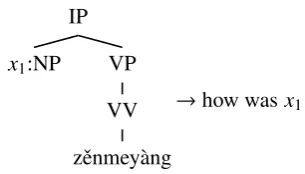
Figure 1 shows a tree-to-string translation
rule (Huang et al., 2006), which is a tuple
hlhs(r),rhs(r), ψ(r)i, where lhs(r) is the
source-side tree fragment, whose internal nodes are la-beled by nonterminal symbols (like NP), and whose frontier nodes are labeled by source-language words (like “zˇenmey`ang”) or variables from a finite set X = {x1,x2, . . .}; rhs(r) is
the target-side string expressed in target-language words (like “how was”) and variables; andψ(r) is a mapping fromXto nonterminals. Each variable xi ∈ X occurs exactly oncein lhs(r) and exactly
onceinrhs(r).
The Table 1 lists all rules necessary to derive translations (a) and (b), with their internal struc-ture removed for simplicity.
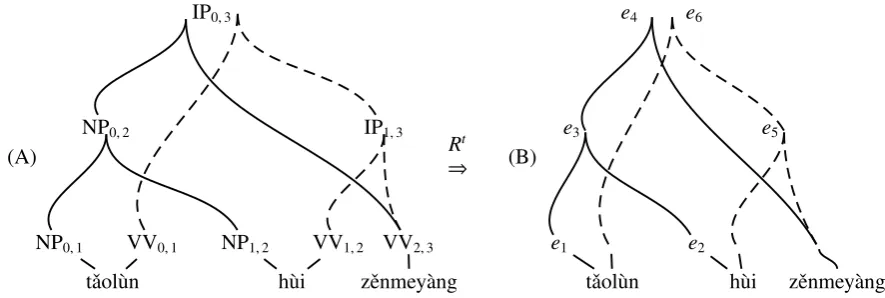
Typically, an F2S system translates in two steps (shown in Figure 2): parsing and decoding. In the
IP
x1:NP VP
VV
zˇenmey`ang
[image:2.595.72.296.64.152.2]→how wasx1
Figure 1: Tree-to-string ruler4.
parsing step, the source language input is con-verted into aparse forest(A). In the decoding step, we first convert the parse forest into atranslation
forest Ft in (B) by using the fast pattern-matching
technique (Zhang et al., 2009). Then the decoder uses dynamic programing with beam search and cube pruning to find the approximation to the best scoring derivation in the translation forest, and outputs the target string.
3 Forest Reordering Model
In this section, we describe the process of ap-plying the reordering model scores. We score pairwise translation reorderings for every pair of source words similarly as described by Huang et al. (2013). In their approach, an external model of ordering distributions of siblingconstituent pairs predicts the reordering of word pairs. Our ap-proach deals with parse forests rather than with single trees, thus we have to model the scores dif-ferently. We model ordering distributions for ev-ery pair ofclose relatives–nodes in the parse forest that may occur together as frontier nodes of a sin-gle matching rule. We further condition the distri-bution on a third node–a common ancestor of the node pair that corresponds to the root node of the matching rule. This way our external model takes into acount the syntactic context of the hypothe-sis. For example, nodes NP0,1and NP1,2are close
relatives, NP0,2and IP0,3are their common
ances-tors; NP0,1 and VV2,3are close relatives, IP0,3 is
their common ancestor; NP0,1 and VV1,2 are not
close relatives.
More formally, let us have an input sentence (w0, ...,wn) and its translation hypothesis h. For
every i and j such that 0 ≤ i < j ≤ n we as-sume that the translations ofwi andwj are in the hypothesisheither in the same or inverted
order-ing oi j ∈ {Inorder,Reorder}, with a probability
hy-(A)
IP0,3
NP0,2
NP0,1 tˇaol`un
VV0,1 NP1,2
h`ui VV1,2
IP1,3
zˇenmey`ang VV2,3
Rt
⇒ (B)
e4 e6
e3
e1
tˇaol`un e2
h`ui e5
[image:3.595.81.524.45.194.2]zˇenmey`ang
Figure 2: Parse and translation hypergraphs. (A) The parse forest of the example sentence. Solid hy-peredges denote the best parse, dashed hyhy-peredges denote the second best parse. Unary edges were col-lapsed. (B) The corresponding translation forestFtafter applying the tree-to-string translation rule setRt. Each translation hyperedge (e.g.e4) has the same index as the corresponding rule (r4). The
forest-to-string system can produce the example translation (a) (solid derivation:r1,r2,r3, andr4) and (b) (dashed
derivation:r5,r6).
pothesis forder(h) is then computed as
forder =
X
0≤i<j≤n
−logPorder(oi j =ohi j |h), (1)
whereoh
i j denotes the actual ordering used inh. The scorefordercan be computed recursively by dynamic programing during the decoding. As an example, we show in Table 2 reordering probabil-ities retrieved in decoding of our sample sentence. (a) Ifhis a hypothesis formed by a single trans-lation rule r with no frontier nonterminals, we
evaluate all word pairs wi and wj covered by h
such that i < j. For each such pair we find the
frontier nodes x and y matched by r such that
x spans exactly wi and y spans exactly wj. (In this case, x andy match preterminal nodes, each spanning one position). We also find the node z matching the root of r. Then we directly use the Equation 1 to compute the score using an exter-nal model Porder(oi j|xyz) to estimate the probabil-ity of reordering the relative nodes. For example, when applying rule r5, we use the ordering
dis-tribution Porder(o1,2|VV1,2,VV2,3,IP1,3) to score
reorderings of h`ui and zˇenmey`ang.
(b) If h is a hypothesis formed by a T2S rule with one or more frontier nonterminals, we eval-uate all word pairs as follows: If both wi andwj are spanned by the same frontier nonterminal (e.g., tˇaol`un and h`ui when applying the rule r4), the
score forderhad been already computed for the un-derlying subhypothesis, and therefore was already included in the total score. Otherwise, we compute
the word pair ordering cost. We find the close rel-atives x andy representing eachwi andwj. If wi is matched by a terminal in r, we selectx as the node matchingr and spanning exactlywi. Ifwi is spanned by a frontier nonterminal in r (meaning that it was translated in a subhypothesis), we select xas the node matching that nonterminal. We pro-ceed identically forwj andy. For example, when applying the ruler4, the word zˇenmey`ang will be
represented by the node VV2,3, while tˇaol`un and
h`ui will be represented by the node NP0,2.
Note that the orderingoh
i jcannot be determined in some cases, sometimes a source word does not produce any translation, or the translation of one word is entirely surrounded by the translations of another word. A weight corresponding to the bi-nary discount feature founknownis added to the score
for each such case.
The external model Porder(oi j|xyz) is imple-mented as a maximum entropy model. Features of the model are observed from paths connecting node z with nodes x and y as follows: First, we pick pathsz→xandz→y. Letz′be the last node
shared by both paths (the closest common ances-tor ofxandy). Then we distinguish three types of path: (1) Thecommon prefix z →z′ (it may have
zero length), theleft path z→x, and theright path
z →y. We observe the following features on each
rule word pair order probability a) how2was2the discussion0meeting1
r3 (tˇaol`un,h`ui) Inorder Porder o0,1|NP0,1,NP1,2,NP0,2
r4 (tˇaol`un,zˇenmey`ang) Reorder Porder o0,2|NP0,2,VV2,3,IP0,3
(h`ui,zˇenmey`ang) Reorder Porder o1,2|NP0,2,VV2,3,IP0,3
b) discuss0what2will1happen1
r5 (h`ui, zˇenmey`ang) Reorder Porder o1,2|VV1,2,VV2,3,IP1,3
r6 (tˇaol`un, h`ui) Inorder Porder o0,1|VV0,1,IP1,3,IP0,3
(tˇaol`un, zˇenmey`ang Inorder Porder o0,2|VV0,1,IP1,3,IP0,3
Table 2: Example of reordering scores computed for derivations (a) and (b).
ignores the internal structure of each rule1, relying
on frontier node annotation. On the other hand it is still feasible to precompute the reordering prob-abilities for all combinations of xyz.
4 Experiment
In this section we describe the setup of the exper-iment, and present results. Finally, we propose fu-ture directions of research.
4.1 Setup
Our baseline is a strong F2S system ( ˇCmejrek et al., 2013) built on large data with the full set of model features including rule translation prob-abilities, general lexical and provenance transla-tion probabilities, language model, and a vari-ety of sparse features. We build it as follows. The training corpus consists of 16 million sen-tence pairs available within the DARPA BOLT Chinese-English task. The corpus includes a mix of newswire, broadcast news, webblog data com-ing from various sources such as LDC, HK Law, HK Hansard and UN data. The Chinese text is seg-mented with a segmenter trained on CTB data us-ing conditional random fields (CRF).
Bilingual word alignments are trained and com-bined from two sources: GIZA (Och, 2003) and maximum entropy word aligner (Ittycheriah and Roukos, 2005).
Language models are trained on the English side of the parallel corpus, and on monolingual corpora, such as Gigaword (LDC2011T07) and Google News, altogether comprising around 10 billion words.
We parse the Chinese part of the training data with a modified version of the Berkeley parser
1Only to some extent, the rule still has to match the input forest, but the reordering model decides based on the sum of paths observed between the root and frontier nodes.
(Petrov and Klein, 2007), then prune the ob-tained parse forests for each training sentence with the marginal probability-based inside-outside al-gorithm to contain only 3nCFG nodes, wherenis the sentence length.
We extract tree-to-string translation rules from forest-string sentence pairs using the forest-based GHKM algorithm (Mi and Huang, 2008; Galley et al., 2004).
In the decoding step, we use larger input parse forests than in training, we prune them to
contain 10n nodes. Then we use fast
pattern-matching (Zhang et al., 2009) to convert the parse forest into the translation forest.
The proposed reordering model is trained on 100,000 automatically aligned forest-string sen-tence pairs from the parallel training data. These sentences provide 110M reordering events that are used bymegam(Daum´e III, 2004) to train the max-imum entropy model.
The current implementation of the reordering model requires offline preprocessing of the input hypergraphs to precompute reordering probabili-ties for applicable triples of nodes (x,y,z). Since the number of levels in the syntactic trees in T2S rules is limited to 4, we only need to consider such triples, wherezis up to 4 levels abovexory.
We tune on 1275 sentences, each with 4 refer-ences, from the LDC2010E30 corpus, initially re-leased under the DARPA GALE program.
We combine two evaluation metrics for tun-ing and testtun-ing: Bleu (Papineni et al., 2002) and Ter (Snover et al., 2006). Both the baseline and the reordering experiments are optimized with MIRA (Crammer et al., 2006) to maximize (Ter -Bleu)/2.
We test on three different test sets: GALE
System GALE Web MT08 Newswire MT08 Web
Ter−Bleu
2 Bleu Ter Ter−2Bleu Bleu Ter Ter−2Bleu Bleu Ter
F2S 8.8 36.1 53.7 5.6 40.6 51.8 12.0 31.3 55.3
+Reordering 8.2 36.4 52.7 4.8 41.7 50.5 11.0 31.7 53.7
[image:5.595.96.506.63.148.2]∆ -0.6 +0.3 -1.0 -0.8 +1.1 -1.3 -1.0 +0.4 -1.6
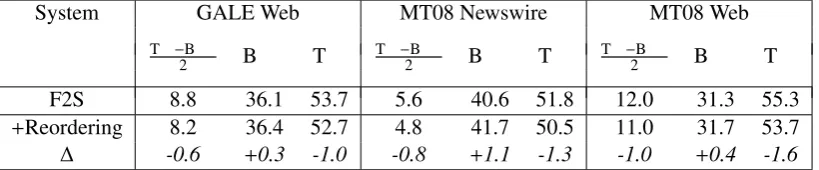
Table 3: Results.
portion (691 sentences, 4 references), and NIST MT08 Web portion (666 sentences, 4 references).
4.2 Results
Table 3 shows all results of the baseline and the system extended with the forest reordering model. The (Ter−Bleu)/2 score of the baseline system is 12.0 on MT08 Newswire, showing that it is a strong baseline. The system with the proposed re-ordering model significantly improves the base-line by 0.6, 0.8, and 1.0 (Ter−Bleu)/2 points on GALE Web, MT08 Newswire, and MT08 Web.
The current approach relies on frontier node annotations, ignoring to some extent the internal structure of the T2S rules. As part of future re-search, we would like to compare this approach with the one that takes into accout the internal structure as well.
5 Conclusion
We have presented a novel reordering model for the forest-to-string MT system. The model deals with the ambiguity of the input forests, but also predicts specifically to the current parse followed by the translation hypothesis. The reordering prob-abilities can be precomputed by an offline pro-cess, allowing for efficient scoring in runtime. The method provides improvement from 0.6 up to 1.0 point measured by (Ter−Bleu)/2 metrics.
Acknowledgments
We thank Jiˇr´ı Havelka for proofreading and help-ful suggestions. We would like to acknowledge the support of DARPA under Grant HR0011-12-C-0015 for funding part of this work. The views, opinions, and/or findings contained in this article are those of the author and should not be inter-preted as representing the official views or poli-cies, either expressed or implied, of the DARPA.
References
David Chiang. 2005. A hierarchical phrase-based model for statistical machine translation. In Pro-ceedings of the ACL.
Koby Crammer, Ofer Dekel, Joseph Keshet, Shai Shalev-Shwartz, and Yoram Singer. 2006. Online passive-aggressive algorithms. Journal of Machine Learning Research, 7.
Hal Daum´e III. 2004. Notes on CG and LM-BFGS op-timization of logistic regression. Paper available at
http://pub.hal3.name#daume04cg-bfgs, im-plementation available at http://hal3.name/ megam/.
Michel Galley, Mark Hopkins, Kevin Knight, and Daniel Marcu. 2004. What’s in a translation rule? InProceedings of the HLT-NAACL.
Michel Galley, Jonathan Graehl, Kevin Knight, Daniel Marcu, Steve DeNeefe, Wei Wang, and Ignacio Thayer. 2006. Scalable inference and training of context-rich syntactic translation models. In Pro-ceedings of the COLING-ACL.
Katsuhiko Hayashi, Hajime Tsukada, Katsuhito Sudoh, Kevin Duh, and Seiichi Yamamoto. 2010. Hi-erarchical Phrase-based Machine Translation with Word-based Reordering Model. In Proceedings of the COLING.
Zhongjun He, Yao Meng, and Hao Yu. Maximum entropy based phrase reordering for hierarchical phrase-based translation. In Proceedings of the EMNLP.
Liang Huang, Kevin Knight, and Aravind Joshi. 2006. Statistical syntax-directed translation with extended domain of locality. InProceedings of the AMTA. Zhongqiang Huang, Jacob Devlin, and Rabih Zbib.
2013. Factored soft source syntactic constraints for hierarchical machine translation. InProceeedings of the EMNLP.
Abraham Ittycheriah and Salim Roukos. 2005. A max-imum entropy word aligner for arabic-english ma-chine translation. In Proceedings of the HLT and EMNLP.
Philipp Koehn, Amittai Axelrod, Alexandra Birch Mayne, Chris Callison-Burch, Miles Osborne, and David Talbot. 2005. Edinburgh system description for the 2005 iwslt speech translation evaluation. In Proceedings of the IWSLT.
Yang Liu, Qun Liu, and Shouxun Lin. 2006. Tree-to-string alignment template for statistical machine translation. InProceedings of COLING-ACL. Haitao Mi and Liang Huang. 2008. Forest-based
trans-lation rule extraction. InProceedings of EMNLP. Haitao Mi, Liang Huang, and Qun Liu. 2008.
Forest-based translation. InProceedings of ACL: HLT. Franz Joseph Och. 2003. Minimum error rate training
in statistical machine translation. InProceedings of ACL.
Kishore Papineni, Salim Roukos, Todd Ward, and Wei-Jing Zhu. 2002. Bleu: a method for automatic eval-uation of machine translation. In Proceedings of ACL.
Slav Petrov and Dan Klein. 2007. Improved inference for unlexicalized parsing. InProceedings of HLT-NAACL.
Matthew Snover, Bonnie Dorr, Richard Schwartz, Lin-nea Micciulla, and John Makhoul. 2006. A study of translation edit rate with targeted human annotation. InProceedings of the AMTA.
Christoph Tillman. 2004. A unigram orientation model for statistical machine translation. Proceed-ings of the HLT-NAACL.
Roy Tromble and Jason Eisner. Learning linear order-ing problems for better translation. InProceedings of the EMNLP.
Martin ˇCmejrek, Haitao Mi, and Bowen Zhou. 2013. Flexible and efficient hypergraph interactions for joint hierarchical and forest-to-string decoding. In Proceedings of the EMNLP.