Combining Linguistic and Machine Learning Techniques for Email
Summarization
Smaranda Muresan Dept. of Computer Science
Columbia University 500 West 120 Street New York, NY, 10027 [email protected]
Evelyne Tzoukermann Bell Laboratories Lucent Technologies 700 Mountain Avenue Murray Hill, NJ, 07974 [email protected]
Judith L. Klavans Columbia University Center for Research on
Information Access 535 West 114th Street New York, NY 10027 [email protected]
Abstract
This paper shows that linguistic tech-niques along with machine learning can extract high quality noun phrases for the purpose of providing the gist or summary of email messages. We describe a set of comparative experi-ments using several machine learning algorithms for the task of salient noun phrase extraction. Three main conclu-sions can be drawn from this study: (i) the modifiers of a noun phrase can be semantically as important as the head, for the task of gisting, (ii) linguistic fil-tering improves the performance of ma-chine learning algorithms, (iii) a combi-nation of classifiers improves accuracy.
1 Introduction
In this paper we present a comparative study of symbolic machine learning models applied to nat-ural language task of summarizing email mes-sages through topic phrase extraction.
Email messages are domain-general text, they are unstructured and not always syntactically well formed. These characteristics raise challenges for automatic text processing, especially for the sum-marization task. Our approach to email summa-rization, implemented in the GIST-IT system, is to identify topic phrases, by first extracting noun phrases as candidate units for representing doc-ument meaning and then using machine learning algorithms to select the most salient ones.
The comparative evaluation of several machine learning models in the settings of our experiments indicates that : (i) for the task of gisting the mod-ifiers of the noun phrase are equally as important as the head, (ii) noun phrases are better than n-grams for the phrase-level representation of the document, (iii) linguistic filtering enhances ma-chine learning techniques, (iv) a combination of classifiers improves accuracy.
Section 2 of the paper outlines the machine learning aspect of extracting salient noun phrases, emphasizing the features used for classifica-tion and the symbolic machine learning models used in the comparative experiments. Section 3 presents the linguistic filtering steps that im-prove the accuracy of the machine learning algo-rithms. Section 4 discusses in detail our conclu-sions stated above.
2 Machine Learning for Content Extraction
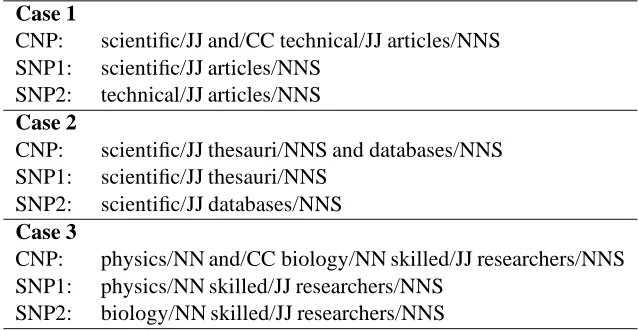
Case 1
CNP: scientific/JJ and/CC technical/JJ articles/NNS SNP1: scientific/JJ articles/NNS
SNP2: technical/JJ articles/NNS
Case 2
CNP: scientific/JJ thesauri/NNS and databases/NNS SNP1: scientific/JJ thesauri/NNS
SNP2: scientific/JJ databases/NNS
Case 3
CNP: physics/NN and/CC biology/NN skilled/JJ researchers/NNS SNP1: physics/NN skilled/JJ researchers/NNS
[image:2.595.138.457.64.229.2]SNP2: biology/NN skilled/JJ researchers/NNS
Table 1: Resolving Coordination of NPs
2.1 Candidate Phrases
Of the major syntactic constituents of a sentence, e.g. noun phrases, verb phrases, and prepositional phrases, we assume that noun phrases (NPs) carry the most contentful information about the doc-ument, a well-supported hypothesis (Smeaton, 1999; Wacholder, 1998).
As considered by Wacholder (1998), the sim-ple NPs are the maximal NPs that contain pre-modifiers but not post-nominal constituents such as prepositions or clauses. We chose simple NPs for content representation because they are se-mantically and syntactically coherent and they are less ambiguous than complex NPs. For extracting simple noun phrases we first used Ramshaw and Marcus’s base NP chunker (Ramshaw and Mar-cus, 1995). The base NP is either a simple NP or a coordination of simple NPs. We used heuristics based on POS tags to automatically split the co-ordinate NPs into simple ones, properly assigning the premodifiers. Table 1 presents some coordi-nate NPs (CNP) encountered in our data collec-tion and the results of our algorithm which split them into simple NPs (SNP1 and SNP2).
2.2 Features used for Classification
The choice of features used to represent the can-didate phrases has a strong impact on the accu-racy of the classifiers (e.g. the number of exam-ples needed to obtain a given accuracy on the test data, the cost of classification). For our classifica-tion task of determining if a noun phrase is salient or not to the document meaning, we chose a set of
nine features.
Several studies rely on the linguistic intuition that the head of the noun phrase makes a greater contribution to the semantics of the nominal group than the modifiers. However, for some specific tasks in NLP , the head is not necessar-ily the most semantically important part of the noun phrase. In analyzing email messages from the perspective of finding salient NPs, we claim that the modifier(s) of the noun phrase - usually nominal modifiers(s), often have as much seman-tic content as the head. This opinion is also sup-ported in the work of Strzalkowski et al. (1999), where syntactic NPs are captured for the goal of extracting their semantic content but are pro-cessed as an “ordered” string of words rather than a syntactic unit. Thus we introduce as a sepa-rate feature in the feature vector, a new TF*IDF measure which consider the NP as a sequence of equally weighted elements, counting individually the modifier(s) and the head.
Consider the following list of simple NPs se-lected as candidates:
1. conference workshop announcement 2. international conference
3. workshop description
4. conference deadline
new feature will be: TF ID F
confer ence
+TF
ID F
w or k shop
+TF ID F
announcement. Giving
these linguistic observations we divided the set of features into three groups, as we mentioned also in (Tzoukermann et al., 2001): 1) one associated with the head of the noun phrase; 2) one associ-ated with the whole NP and 3) one that represents the new TF*IDF measure discussed above.
2.2.1 Features associated with the Head
We choose two features to characterize the head of the noun phrases:
head tfidf: the TF*IDF measure of the
head of the candidate NP. For the NP in example (1) this feature will be TF
ID F
announcement.
head focc: The position of the first
occur-rence of the head in text (the number of words that precede the first occurrence of the head divided by the total number of words in the document).
2.2.2 Features associated with the whole NP
We select six features that we consider relevant in determining the relative importance of the noun phrase:
np tfidf: the TF*IDF measure of
the whole NP. For the NP in the example (1) this feature will be
TF ID F
confer encew or k shopannouncement.
np focc: The position of the first occurrence
of the noun phrase in the document.
np length words: Noun phrase length
mea-sured in number of words, normalized by di-viding it with the total number of words in the candidate NP list.
np length chars: Noun phrase length
mea-sured in number of characters, normalized by dividing it with the total number of char-acters in the candidate NPs list.
sent pos: Position of the noun phrase in the
sentence: the number of words that precede the noun phrase, divided by sentence length. For noun phrases in the subject line (which are usually short and will be affected by this
measure), we consider the maximum length of sentence in document as the normalization factor.
par pos: Position of noun phrase in
para-graph, same as sent pos, but at the paragraph level.
2.2.3 Feature that considers all constituents of the NP equally weighted
One of the important hypotheses we tested in this work is that both the modifiers and the head of NP contribute equally to its salience. Thus we consider mh tfidf as an additional feature in the feature vector.
mh tfidf: the new TF*IDF measure that
takes also into consideration the importance of the modifiers. In our example the value of this feature will be :TF ID F
confer ence + TFID F
w or k shop
+TFID F
announcement
In computing the TF*IDF measures (head tfidf,
np tfidf, mh tfidf), specific weights,w
i, were
as-signed to account for the presence in the email subject line and/or headlines in the email body.
w
i1: presence in the subject line and
head-line
w
i2: presence in the subject line
w
i3: presence in headlines where w
i1 >w
i2 >w
i3.
These weights were manually chosen after a set of experiments, but we plan to use a regression method to automatically learn them.
2.3 Symbolic Machine Learning Models
We compared three symbolic machine learning paradigms (decision trees, rule induction and de-cision forests) applied to the task of salient NP extraction, evaluating five classifiers.
2.3.1 Decision Tree Classifiers
parallel and oblique. The axis-parallel decision trees check at each node the value of a single at-tribute. If the attributes are numeric, the test has the formx
i
> t, wherex
i is one of the attribute
of an instance and t is the threshold. Oblique de-cision trees test a linear combination of attributes at each internal node:
n X
i=1 a
i x
i +a
n+1 >0
where a i
;:::;a
n+1 are real-valued coefficients.
We compared the performance of C4.5, an axis-parallel decision tree classifier (Quinlan, 1993) and OC1, an oblique decision tree classifier (Murthy et al., 1993).
2.3.2 Rule Induction Classifiers
In rule induction, the goal is to learn the small-est set of rules that capture all the generalisable knowledge within the data. Rule induction clas-sification is based on firing rules on a new in-stance, triggered by the matching feature values to the left-hand side of the rules. Rules can be of various normal forms and can be ordered. How-ever, the appropriate ordering can be hard to find and the key point of many rule induction algo-rithms is to minimize the search strategy through the space of possible rule sets and orderings. For our task, we test the effectiveness of two rule induction algorithms : C4.5rules that form pro-duction rules from unpruned decision tree, and a fast top-down propositional rule learning sys-tem, RIPPER (Cohen, 1995). Both algorithms first construct an initial model and then iteratively improve it. C4.5rules improvement strategy is a greedy search, thus potentially missing the best rule set. Furthermore, as discussed in (Cohen, 1995), for large noisy datasets RIPPER starts with an initial model of small size, while C4.5rules starts with an over-large initial model. This means that RIPPER’s search is more efficient for noisy datasets and thus is more appropriate for our data collection. It also allows the user to specify the loss ratio, which indicates the ratio of the cost of false positives to the cost of false negatives, thus allowing a trade off between precision and recall. This is crucial for our analysis since we deal with sparse data due to the fact that in a document the number of salient NPs is much smaller than the number of irrelevant NPs.
2.3.3 Decision Forest Classifier
Decision forests are a collection of decision trees together with a combination function. We test the performance of DFC (Ho, 1998), a deci-sion forest classifier that systematically constructs decision trees by pseudo-randomly selecting sub-sets of components of feature vectors. The advan-tage of this classifier is that it combines a set of different classifiers in order to improve accuracy. It implements different splitting functions. In the setting of our evaluation we tested the informa-tion gain ratio (similar to the one used by Quinlan in C4.5). An augmented feature vector (pairwise sums, differences, and products of features) was used for this classifier.
3 Linguistic Knowledge Enhances Machine Learning
Not all simple noun phrases are equally important to reflect document meaning. Boguraev and Kennedy (1999) discuss the issue that for the task of document gisting, topical noun phrases are usually noun-noun compounds. In our work, we rely on ML techniques to decide which are the salient NPs, but we claim that a shallow linguistic filtering applied before the learning process improves the accuracy of the classifiers. We performed four filtering steps:
1. Inflectional morphological processing:
Grouping inflectional variants together can help especially in case of short documents (which is sometimes the case for email messages). English nouns have only two kinds of regular inflection: a suffix for the plural mark and another suffix for the possessive one.
2. Removing unimportant modifiers: In this second step we remove the determiners that accompany the nouns and also the auxil-iary words most and more that form the pe-riphrastic forms of comparative and superla-tive adjecsuperla-tives modifying the nouns (e.g. “the most complex morphology” will be fil-tered to “complex morphology”).
in order to further filter the list of candi-date NPs. Thus, words like even, following,
every, are eliminated from the noun phrase
structure.
4. Removing empty nouns: Words like lot,
group, set, bunch are considered empty
heads. For example the primary concept of the noun phrases like “group of students”, “lots of students” or “bunch of students” is given by the noun “students”. We ex-tracted all the nouns that appear in front of the preposition “of” and then sorted them by frequency of appearance. A threshold was then used to select the final list (Klavans et al., 1990). Three different data collections were used: the Brown corpus, the Wall Street Journal, and a set of 4000 email messages (most of them related to a conference orga-nization). We generated a set of 141 empty nouns that we used in this forth step of the filtering process.
4 Results and Discussion
One important step in summarization is the dis-covery of the relevant information from the source text. Our approach was to extract the salient NPs using linguistic knowledge and machine learning techniques. Our evaluation corpus consists of a collection of email messages which is heteroge-neous in genre, length, and topic. We used 2,500 NPs extracted from 51 email messages as a train-ing set and 324 NPs from 8 messages for testtrain-ing. Each NP was manually tagged for saliency by one human judge. We are planning to add more judges in the future and measure the interuser agreement. This section outlines a comparative evaluation of five classifiers using two feature settings on the task of extracting salient NPs from email mes-sages. The evaluation shows the following im-portant results:
Result 1. In the context of gisting, the head-modifier relationship is an ordered relation be-tween semantically equal elements.
We evaluate the impact of adding mh tfidf (see section 2.2), as an additional feature in the feature vector. This is shown in Table 2 in the different feature vectors fv1 and fv2. The first feature vec-tor, fv1, contains the features in sections 2.2.1 and
2.2.2, while fv2 includes as an additional feature
mh tfidf.
As can be seen from Table 3, the results of eval-uating these two feature settings using five differ-ent classifiers, show that fv2 performed better than
fv1. For example, the DFC classifier shows an
in-crease both in precision and recall. This allows us to claim that in the context of gisting, the syntactic head of the noun phrase is not always the seman-tic head, and modifiers can have also an important role.
One advantage of the rule-induction algorithms is that their output is easily interpretable by hu-mans. Analyzing C4.5rules output, we gain an insight on the features that contribute most in the classification process. In case of fv1, the most im-portant features are: the first appearance of the NP and its head (np focc, head focc), the length of NP in number of words (np length words) and the tf*idf measure of the whole NP and its head (np tfidf, head tfidf ). For example:
IF head focc <= 0.0262172 AND np tfidf >0.0435465 THEN Relevant
IF np focc <= 0.912409 AND
np length words > 0.0242424 THEN
Relevant
IF head tfidf <= 0.0243452 AND np tfidf <= 0.0435465 AND np length words <=
0.0242424 then Not relevant
In case of fv2, the new feature m tfidf impacts the rules for both Relevant and Not relevant cat-egories. It supercedes the need for np tfidf and
head tfidf, as can be seen also from the rules
be-low:
IF mh tfidf>0.0502262 AND np focc<=
0.892585 THEN Relevant
IF mh tfidf > 0.0180134 AND
np length words > 0.0260708 THEN
Relevant
IF mh tfidf <= 0.0223546 AND
np length words <= 0.0260708 THEN
Not relevant
IF mh tfidf<= 0.191205 AND np focc >
Feature vector 1 (fv1)
head focc head tfidf np focc np tfidf np length chars np length words par pos sent pos
Feature vector 2 (fv2)
head focc head tfidf mh tfidf np focc np tfidf np length chars np length words par pos sent pos
Table 2: Two feature settings to evaluate the impact of mh tfidf
C4.5 OC1 C4.5 rules Ripper DFC
p r p r p r p r p r
fv1 73.3% 78.6% 73.7% 93% 73.7% 88.5% 83.6% 71.4% 80.3% 83.5%
fv2 70% 88.9% 82.3% 88% 73.7% 95% 85.7% 78.8% 85.7% 87.9%
Table 3: Evaluation of two feature vectors using five classifiers
Result 2. Classifiers’ performance depends on the characteristics of the corpus, and com-bining classifiers improves accuracy
This result was postulated by evaluating the performance of five different classifiers in the task of extracting salient noun phrases. As measures of performance we use precision and recall . The evaluation was performed according to what de-gree the output of the classifiers corresponds to the user judgments and the results are presented in Table 3.
We first compare two decision tree classifiers: one which uses as the splitting function only a sin-gle feature (C4.5) and the other, the oblique tree classifier (OC1) which at each internal node tests a linear combination of features. Table 3 shows that OC1 outperforms C4.5.
Columns 4 and 5 from Table 3 show the rela-tive performance of RIPPER and C4.5rules. As discussed in (Cohen, 1995), RIPPER is more ap-propriate for noisy and sparse data collection than C4.5rules. Table 3 shows that RIPPER performs better than C4.5rules in terms of precision.
Finally, we investigate whether a combination of classifiers will improve performance. Thus we choose the Decision Forest Classifier, DFC, to perform our test. DFC obtains the best results, as can be seen from column 6 of Table 3.
Result 3. Linguistic filtering is an important step in extracting salient NPs
As seen from Result 2, the DFC performed best in our task, so we chose only this classifier to present the impact of linguistic filtering. Table 4 shows that linguistic filtering improves
preci-sion and recall, having an important role espe-cially on fv2, where the new feature, mh tfidf was used (from 69.2% precision and 56.25% recall to 85.7% precision and 87.9% recall).
without filtering with filtering
precision recall precision recall
fv1 75% 75% 80.3% 83.5%
fv2 69.2% 56.25% 85.7% 87.9%
Table 4: Evaluation of linguistic filtering
This is explained by the fact that the filter-ing presented in section 3 removed the noise in-troduced by unimportant modifiers, common and empty nouns.
Result 4. Noun phrases are better candi-dates than n-grams
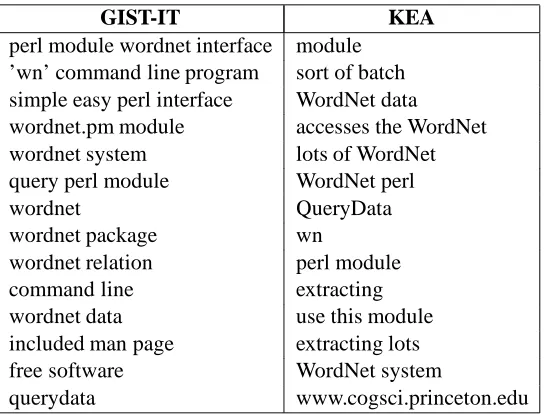
GIST-IT KEA
perl module wordnet interface module ’wn’ command line program sort of batch simple easy perl interface WordNet data
wordnet.pm module accesses the WordNet wordnet system lots of WordNet query perl module WordNet perl
wordnet QueryData
wordnet package wn
wordnet relation perl module
command line extracting
wordnet data use this module
included man page extracting lots
free software WordNet system
[image:7.595.164.436.62.269.2]querydata www.cogsci.princeton.edu
Table 5: Salient phrase extraction with GIST-IT vs. KEA on one email message
approaches, to test usability.
5 Related Work
Machine learning has been successfully applied to different natural language tasks, including text summarization. A document summary is seen as a succinct and coherent prose that captures the meaning of the text. Prior work in docu-ment summarization has been mostly based on sentence extraction. Kupiec et al. (1995) use ma-chine learning for extracting the most impor-tant sentences of the document. But extrac-tive summarization relies on the properties of source text that emails typically do not have: coherence, grammaticality, well defined struc-ture. Berger and Mittal (2000) present a summa-rization system, named OCELOT that provides the gist of the web documents based on proba-bilistic models. Their approach is closed related with statistical machine translation.
As discussed in (Boguraev and Kennedy, 1999), the meaning of “summary” should be ad-justed depending on the information management task for which it is used. Key phrases, for ex-ample, can be seen as semantic metadata that summarize and characterize documents (Witten et al., 1999; Turney, 2000). These approaches select a set of candidate phrases (bigrams or tri-grams) and then apply Na¨ive Bayes learning to classify them as key phrases or not. But
deal-ing only with n-grams does not always provide good output in terms of a summary. In (Bogu-raev and Kennedy, 1999) the “gist” of a document is seen as a sequence of salient objects, usually topical noun phrases, presented in a highlighted context. Their approach is similar to extracting technical terms (Justeson and Katz, 1995). Noun phrases are used also in IR task (Strzalkowski et al., 1999; Smeaton, 1999; Sparck Jones, 1999). The work of Strzalkowski et al. (1999) supports our hypothesis that for some NLP tasks (gisting, IR) the head+modifier relation of a noun phrase is in fact an ordered relation between semantically equally important elements.
6 Conclusions and Future Work
In this paper we presented a novel technique for document gisting suitable for domain and genre independent collections such as email messages. The method extracts simple noun phrases using linguistic techniques and then uses machine learn-ing to classify them as salient for the document content. The contributions of this work are:
1. From a linguistic standpoint, we demon-strated that the modifiers of a noun phrase can be as semantically important as the head for the task of gisting.
sev-eral classifiers: decision trees, rule induc-tion, and decision forests classifiers.
3. We proved that linguistic knowledge can en-hance machine learning by evaluating the impact of linguistic filtering before applying the learning scheme.
The study, the evaluation, and the results pro-vide experimental grounds for research not only in summarization, but also in information extrac-tion and topic detecextrac-tion.
References
A.L. Berger and V.O. Mittal. 2000. OCELOT:A sys-tem for summarizing web pages. In Proceedings of
the 23rd Anual International ACM SIGIR Confer-ence on Research and Development in Information Retrieval, pages 144–151, Athens, Greece.
B. Boguraev and C. Kennedy. 1999. Salience-based content characterisation of text documents. In In-terjit Mani and T. Maybury, Mark, editors,
Ad-vances in Automatic Text Summarization, pages 99–
111. The MIT Press.
W. Cohen. 1995. Fast effective rule induction. In
Machine-Learning: Proceedings of the Twelfth In-ternational Conference.
T.K. Ho. 1998. The random subspace method for constructing decision forests. IEEE
Transac-tions on Pattern Analysis and Machine Intelligence,
20(8):832–844.
J. Justeson and S. Katz. 1995. Technical terminol-ogy: Some linguistic properties and an algorithm for identification in text. Natural Language
Engi-neering, (1):9–27.
J.L. Klavans, M.S. Chodorow, and N. Wacholder. 1990. From dictionary to knowledge base via taxonomy. In Proceedings of the Sixth
Confer-ence of the University of Waterloo Centre for the New Oxford English Dictionary and Text Research: Electronic Text Research, University of Waterloo,
Canada.
J. Kupiec, J. Pedersen, and F. Chen. 1995. A train-able document summarizer. In Proceedings on the
18th Annual International ACM SIGIR Conference on Research and Development in Information Re-trieval, pages 68–73, Seattle,WA.
R.J Mooney and C. Cardie. 1999. Symbolic ma-chine learning for natural language processing. In
ACL’99 Tutorial.
S.K. Murthy, S. Kasif, S. Salzberg, and R. Beigel. 1993. OC1: Randomized induction of oblique de-cision trees. In Proceedings of the Eleventh
Na-tional Conference on Artificial Intelligence, pages
322–327, Washington, D.C.
J.R Quinlan. 1993. C4.5: Program for Machine Learning. Morgan Kaufmann Publisher, San
Ma-teo, California.
L.A. Ramshaw and M.P. Marcus. 1995. Text chunk-ing uschunk-ing transformation-based learnchunk-ing. In
Pro-ceedings of Third ACL Workshop on Very Large Corpora.
A. Smeaton. 1999. Using NLP or NLP resources for information retrieval tasks. In Tomek Strza-lkowski, editor, Natural Language Information
Re-trieval. Kluwer, Boston, MA.
K. Sparck Jones. 1999. What is the role for NLP in text retrieval. In Tomek Strzalkowski, editor,
Nat-ural Language Information Retrieval, pages 1–12.
Kluwer, Boston, MA.
T. Strzalkowski, F. Lin, J. Wang, and J. Perez-Carballo. 1999. Evaluating natural language pro-cessing techniques in information retrieval. In Tomek Strzalkowski, editor, Natural Language
In-formation Retrieval. Kluwer, Boston, MA.
P.D. Turney. 2000. Learning algorithms for keyphrase extraction. Information Retrieval, 2(4):303–336,
May.
E Tzoukermann, S Muresan, and J.L. Klavans. 2001. GIST-IT: Summarizing email using linguis-tic knowledge and machine learning. In Proceeding
of the HLT and KM Workshop, EACL/ACL 2001.
N. Wacholder. 1998. Simplex NPS sorted by head: A method for identifying significant topics within a document. In Proceedings of the COLING-ACL
Workshop on the Computational Treatment of Nom-inals, Montreal, Canada.
I.H. Witten, G.W. Paynter, E. Frank, C. Gutwin, and C.G. Nevill-Manning. 1999. KEA: Practical au-tomatic keyphrase extraction. In Proceedings of