Addressing the Data Sparsity Issue in Neural AMR Parsing
Xiaochang Peng∗1, Chuan Wang∗2, Daniel Gildea1 and Nianwen Xue2 1University of Rochester
{xpeng, gildea}@cs.rochester.edu 2Brandeis University
{cwang24, xuen}@brandeis.edu
Abstract
Neural attention models have achieved great success in different NLP tasks. How-ever, they have not fulfilled their promise on the AMR parsing task due to the data sparsity issue. In this paper, we de-scribe a sequence-to-sequence model for AMR parsing and present different ways to tackle the data sparsity problem. We show that our methods achieve significant improvement over a baseline neural atten-tion model and our results are also compet-itive against state-of-the-art systems that do not use extra linguistic resources.
1 Introduction
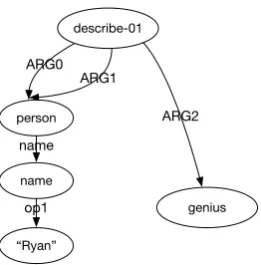
Abstract Meaning Representation (AMR) (Ba-narescu et al., 2013) is a semantic formalism where the meaning of a sentence is encoded as a rooted, directed graph. Figure 1 shows an exam-ple of an AMR in which the nodes represent the AMR concepts and the edges represent the rela-tions between the concepts they connect. AMR concepts consist of predicate senses, named entity annotations, and in some cases, simply lemmas of English words. AMR relations consist of core se-mantic roles drawn from the Propbank (Palmer et al., 2005) as well as very fine-grained semantic re-lations defined specifically for AMR. These prop-erties render the AMR representation useful in ap-plications like question answering and semantics-based machine translation.
The task of AMR graph parsing is to map nat-ural language strings to AMR semantic graphs. Recently, a sizable new corpus of English/AMR pairs (LDC2015E86) has been released. Different parsers have been developed to tackle this prob-lem (Flanigan et al., 2014; Wang et al., 2015b;
*Both authors contribute equally.
describe-01
person
genius ARG0
ARG1
ARG2
name
“Ryan” name
[image:1.595.352.483.224.357.2]op1
Figure 1: An example of AMR graph representing the meaning of: “Ryan’s description of himself: a genius.”
Artzi et al., 2015; Pust et al., 2015; Peng et al., 2015). Most of these parsers have used external re-sources such as dependency parses, semantic lexi-cons, etc., to tackle the sparsity issue.
Recently, Sutskever et al. (2014) introduced a neural network model for solving the general sequence-to-sequence problem, and Bahdanau et al. (2014) proposed a related model with an atten-tion mechanism that is capable of handling long sequences. Both models achieve state-of-the-art results on large scale machine translation tasks.
However, sequence-to-sequence models mostly work well for large scale parallel data, usually in-volving millions of sentence pairs. Vinyals et al. (2015) present a method which linearizes parse trees into a sequence structure and therefore a sequence-to-sequence model can be applied to the constituent parsing task. Competitive results have been achieved with an attention model on the Penn Treebank dataset, with only 40K annotated sen-tences.
AMR parsing is a much harder task in that the target vocabulary size is much larger, while the size of the dataset is much smaller. While for constituent parsing we only need to predict
terminal labels and the output vocabulary is lim-ited to 128 symbols, AMR parsing has both con-cepts and relation labels, and the target vocabu-lary size consists of tens of thousands of sym-bols. Barzdins and Gosko (2016) applied a sim-ilar approach where AMR graphs are linearized using depth-first search and both concepts and re-lations are treated as tokens (see Figure 3). Due to the data sparsity issue, their AMR parsing results are significantly lower than state-of-the-art models when using the neural attention model.
In this paper, we present a method which lin-earizes AMR graphs in a way that captures the interaction of concepts and relations. To over-come the data sparsity issue for the target vocab-ulary, we propose a categorization strategy which first maps low frequency concepts and entity sub-graphs to a reduced set of category types. In or-der to map each type to its corresponding target side concepts, we use heuristic alignments to con-nect source side spans and target side concepts or subgraphs. During decoding, we use the mapping dictionary learned from the training data or heuris-tic rules for certain types to map the target types to their corresponding translation as a postprocessing procedure.
Experiments show that our linearization strat-egy and categorization method are effective for the AMR parsing task. Our model improves signifi-cantly in comparison with the previously reported sequence-to-sequence results and provides a com-petitive benchmark in comparison with state-of-the-art results without using dependency parses or other external semantic resources.
2 Sequence-to-sequence Parsing Model
Our model is based on an existing sequence-to-sequence parsing model (Vinyals et al., 2015), which is similar to models used in neural machine translation.
2.1 Encoder-Decoder
Encoder. The encoder learns a context-aware representation for each position of the input se-quence by mapping the inputs w1, . . . , wm into a sequence of hidden layersh1, . . . , hm. To model the left and right contexts of each input position, we use a bidirectional LSTM (Bahdanau et al., 2014). First, each input’s word embedding repre-sentationx1, . . . , xm is obtained though a lookup table. Then these embeddings serve as the input to
two RNNs: a forward RNN and a backward RNN. The forward RNN can be seen as a recurrent func-tion defined as follows:
hfwi =f(xi, hfwi−1) (1)
Here the recurrent function f we use is Long-Short-Term-Memory (LSTM) (Hochreiter and Schmidhuber, 1997). The backward RNN works similarly by repeating the process in reverse order. The outputs of forward RNN and backward RNN are then depth-concatenated to get the final repre-sentation of the input sequence.
hi = [hfwi , hbwm−i+1] (2)
Decoder. The decoder is also an LSTM model which generates the hidden layers recurrently. Ad-ditionally, it utilizes an attention mechanism to put a “focus” on the input sequence. At each output time step j, the attention vector d0j is defined as a weighted sum of the input hidden layers, where the masking weightαji is calculated using a feed-forward neural network. Formally, the attention vector is defined as follows:
uji =vT tanh(W
1hi+W2dj) (3)
αji = softmax(uji) (4)
d0j =
m
X
i=1
αjihi (5)
where dj is the output hidden layer at time step
j, and v, W1, and W2 are parameters for the model. Here the weight vector αj1, . . . , αjm is also interpreted as a soft alignment in the neural machine translation model, which similarly could also be treated as a soft alignment between token sequences and AMR relation/concept sequences in the AMR parsing task. Finally, we concatenate the hidden layerdj and attention vectord0j to get the new hidden layer, which is used to predict the out-put sequence label.
P(yj|w, y1:j−1) = softmax(W3[dj, d0j]) (6)
2.2 Parse Tree as Target Sequence
John has a dog .
S
NP VP .
NNP VBZ NP
NP NP
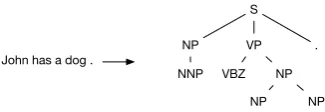
John has a dog . (S (NP NNP )NP (VP VBZ (NP DT NN )NP )VP . )S
Figure 2: Example parsing task and its lineariza-tion.
In practice, they found that using the attention model is more data efficient and works well on the parsing task. They also reversed the input sen-tence and normalized the part-of-speech tags. Af-ter decoding, the output parse tree is recovered from the output sequence of the decoder in a post-processing procedure. Overall, the sequence-to-sequence model is able to match the performance of the Berkeley Parser (Petrov et al., 2006).
3 AMR Linearization
Barzdins and Gosko (2016) present a similar lin-earization procedure where the depth-first traver-sal result of an AMR graph is used as the AMR sequence (see Figure 3). The bracketing structure of AMR is hard to maintain because the predic-tion of relapredic-tion (with left parenthesis) and the pre-diction of an isolated right parenthesis are not cor-related. As a result, the output AMR sequences usually have parentheses that do not match.
We present a linearization strategy which cap-tures the bracketing structure of AMR and the con-nection between relations and concepts. Figure 3 shows the linearization result of the AMR graph shown in Figure 1. Each relation connects the head concept to a subgraph structure rooted at the tail concept, which shows one branch below the head concept. We use the relation label and left parenthesis to show the beginning of the branch (subgraph) and use right parenthesis paired with the relation label to show the end of the branch. We additionally add “-TOP-(” at the beginning to show the start of the traversal of the AMR graph and add “)-TOP-” at the end to show the end of traversal. When a symbol is revisited, we replace the symbol with “-RET-”. We additionally add the revisited symbol before “-RET-” to decide where the reentrancy is introduced to.1 We also get rid of
1This is an approximation because one concept can appear
multiple times, and we simply attach the reentrancy to the most recent appearance of the concept. An additional index would be needed to identify the accurate place of reentrancy.
(describe-01 :ARG0 (person :name (name :op1 “Ryan”) ) :ARG1 (person ) :ARG2 genius)
-TOP-( describe-01 ARG0( person name( name op1( “Ryan” )op1 )name )ARG0 ARG1( person -RET- )ARG1 ARG2( genius )ARG2
)-TOP-Barzdins and Gosko (2016)
[image:3.595.79.242.69.125.2]Our linearization
Figure 3: Comparison of AMR linearization
variables and only keep the full concept label. For example, “g / genius” to “genius”.
We can easily recover the original AMR graph from its linearized sequence. The sequence also captures the branching information of each rela-tion explicitly by representing it with a start sym-bol and an end symsym-bol specific to that relation. During our experiments, most of the output se-quences have a matching bracketing structure us-ing this linearization strategy. The idea of lin-earization is basically a depth-first traversal of the AMR where the original graph structure can be reconstructed with the linearization result. Even though we call it a sequence, its core idea is actu-ally generating a graph structure from top-down.
4 Dealing with the Data Sparsity Issue
While sequence-to-sequence models can be suc-cessfully applied to constituent parsing, they do not work well on the AMR parsing task as shown by Barzdins and Gosko (2016). The main bottle-neck is that the size of target vocabulary for AMR parsing is much larger than constituent parsing, tens of thousands in comparison with 128, and the size of training data is less than half of that avail-able for parsing.
In this section, we present a categorization method which significantly reduces the target vo-cabulary size, as the alignment from the attention model does not work well on the relatively small dataset. To adjust for the alignment errors made by the attention model, we propose to add super-vision from an alignment produced by an external aligner which can use lexical information to over-come the limit of data size.
4.1 AMR Categorization
We define several types of categories and map low frequency words into these categories.
Before linearization:
chinese seismology be gallop down the wrong road .
(g / gallop-01
:ARG0 (s / seismology
:mod (c / country :wiki "China" :name (n / name :op1 "China")))
:ARG1 (r / road
:mod (w / wrong)) :direction (d / down))
Sentence side (lemmatized,
lower cased) AMR side
After linearization:
NE_country-0 -SURF--0 be -VERB--0 down the wrong -SURF—1 .
-TOP-( -VERB--0 ARG0( -SURF--0 mod( NE_country-0 )mod )ARG0 ARG1(
-SURF—1 mod( wrong )mod )ARG1 direction( down )direction
)-TOP-Figure 4: An example of categorized sentence-AMR pair.
2. NE{ent}: we reduce all named entity sub-graphs to this category, whereentis the root label of each subgraph, such as country or
person.
3. -VERB-: we map predicate variables with low frequency (n <50) to this category 4. -SURF-: we map non-predicate variables
with low frequency (n <50) to this category 5. -CONST-: we map constants other than num-bers, “-”, “interrogative”, “expressive”, “im-perative” to this category.
6. -RET-: we map all revisited concepts to this category.
7. -VERBAL-: we additionally use the verbal-ization list2from the AMR website and map
matched subgraphs to this category.
After the re-categorization, the vocabulary size is substantially reduced to around 2000, though this vocabulary size is still very large for the relatively small dataset. These categories and the frequent concepts amount to more than 90% of all the target words, and each of these are learned with a larger number of occurrences.
4.2 Categorize Source Sequence
The source side tokens also have sparsity issues. For example, even if we have mapped the number
1997to “DATE”, we can not easily generalize it
2
http://amr.isi.edu/download/lists/verbalization-list-v1.06.txt
to the token1993if it does not appear in the train-ing data. Also, some special 6-digit date formats such as “YYMMDD” are hard to learn using co-occurrence statistics.
from the specific date mention “June 6, 2007”. During decoding, we are only given the sen-tence. We first use the date templates learned from the training data to recognize dates in each sen-tence. We also use a named entity tagger to rec-ognize named entity mentions in the sentence. We use the entity name and wiki information fromQ
if there is a match of the entity mention, otherwise for convenience we simply use “person” as the en-tity name and use wiki “-”. For each of the other tokens, we first look it up inQand replace it with the most likely mapping. If there is no match, we further look it up in the verbalization list. In case there is still no match, we use the part of speech in-formation to assign its category. We replace verbs with category “-VERB-” and nouns with category “-SURF-”. In accordance with the categorized to-ken sequence, we also index each category in the resulting sequence from left to right.
4.3 Recovering AMR graph
During decoding, our output sequences usually have categories and we need to map each category to AMR concepts or subgraphs. When we cate-gorize the tokens in each sentence before decod-ing, we save the mapping from each category to its original token as tableD. As we use the same set of categories on both source and target sides, we heuristically align target side category label to its source side counterpart from left to right. Given tableD, we know which source side token it comes from and use the most frequent concept or subgraph of the token to replace the category. 4.4 Supervised Attention Model
In this section, we propose to learn the attention vector in a supervised manner. There are two main motivations behind this. First, the neural atten-tion model usually utilizes millions of data points to train the model, which learns a quite reason-able attention vector that at each output time step constrains the decoder to put a focus on the in-put sequences (Bahdanau et al., 2014; Vinyals et al., 2015). However, we only have 16k sentences in the AMR training data and our output vocab-ulary size is quite large, which makes it hard for the model to learn a useful alignment between the input sequence and AMR concepts/relations. Sec-ond, as argued by Liu et al. (2016), the sequence-to-sequence model tries to calculate the attention vector and predict the current output label simulta-neously. This makes it impossible for the learned
soft alignment to combine information from the whole output sentence context. However, tradi-tional word alignment can easily use the whole output sequence, which will produce a more in-formed alignment.
Similar to the method used by Liu et al. (2016), we add an additional loss to the original objec-tive function to model the disagreement between the reference alignment and the soft alignment produced by the attention mechanism. Formally, for each input/output sequence pair(w,y)in the training set, the objective function is defined as:
−1
n
n
X
j=1
logp(yj|w, y1:j−1) +λΘ(¯αj, αj) (7)
whereα¯j is the reference alignment for output po-sitionj, which is provided by the existing aligner,
αjis the soft alignment,Θ()is cross-entropy func-tion,n is the length of output sequence andλis the hyperparameter which serves as a trade-off be-tween sequence prediction and alignment super-vision. Note that the supervised attention part doesn’t affect the decoder which will predict the output label given learned weights.
One issue with this method is how we represent
¯
α. As the output of conventional aligner is a hard decision, alignment is either one or zero for each input position. In addition, multiple input words could be aligned to one single concept. Finally, in the AMR sequences, there are many output la-bels (mostly relations) which don’t align to any word in the input sentence. We utilize a heuristic method to process the reference alignment. We as-sign an equal probability among the words that are aligned to one AMR concept. Then if the output label doesn’t align to any input word, we assign an even probability for every input word.
5 Experiments
We evaluate our system on the released dataset (LDC2015E86) for SemEval 2016 task 8 on mean-ing representation parsmean-ing (May, 2016). The dataset contains 16,833 training, 1,368 develop-ment and 1,371 test sentences which mainly cover domains like newswire, discussion forum, etc. All parsing results are measured by Smatch (version 2.0.2) (Cai and Knight, 2013).
5.1 Experiment Settings
the named entities using the Illinois Named Entity Tagger (Ratinov and Roth, 2009).
For training all the neural AMR parsing sys-tems, we use 256 for both hidden layer size and word embedding size. Stochastic gradient descent is used to optimize the cross-entropy loss function and we set the drop out rate to be 0.5. We train our model for 150 epochs with initial learning rate of 0.5 and learning rate decay factor 0.95 if the model doesn’t improve for the 3 last epochs.
5.2 Baseline Model
Our baseline model is a plain sequence-to-sequence model which has been used in the con-stituent parsing task (Vinyals et al., 2015). While they use a 3-layer deep LSTM, we only use a single-layer LSTM for both encoder and decoder since our data is relatively small and empiri-cal comparison shows that stacking more layers doesn’t help in our case. AMR linearization fol-lows Section 3 without categorization. Since we don’t restrict the input/output vocabulary in this case, our vocabulary size is quite large: 10,886 for output vocabulary and 2,2892 for input vo-cabulary. We set them to 10,000 and 20,000 re-spectively and replace the out of vocabulary words with UNK .
5.3 Impact of Re-Categorization
We first inspect the influence of utilizing catego-rization on the input and output sequence. Table 1 shows the Smatch evaluation score on develop-ment set.
System P R F
Baseline 0.42 0.34 0.37
Re-Categorization (n= 50) 0.55 0.46 0.50
Table 1: Re-Categorization impact on develop-ment set
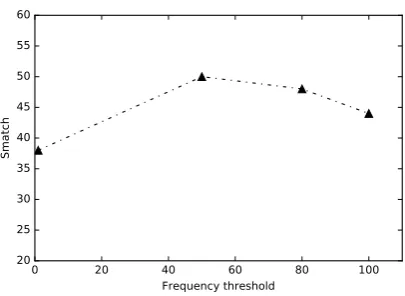
We see from the table that re-categorization improves the F-score by 13 points on the de-velopment set. As mentioned in section 4.1, by setting the low frequency threshold n to 50 and re-categorizing them into a reduced set of types, we now reduce the input/output vocabu-lary size to (2,000, 6,000). This greatly reduces the label sparsity and enables the neural attention model to learn a better representation on this small scale data. Another advantage of this method
0 20 40 60 80 100
Frequency threshold 20
25 30 35 40 45 50 55 60
Sm
atc
h
Figure 5: AMR parsing performance on develop-ment set given different categorization frequency.
is that although AMR tries to abstract away sur-face forms and retain the semantic meaning struc-ture of the sentence, a large portion of the con-cepts are coming from the surface form and have exactly same string form both in input sentence and AMR graph. For example, nation in sen-tence is mapped to concept (n / nation) in the AMR. For the frequent concepts in the out-put sequence, since the model can observe many training instances, we assume that it can be pre-dicted by the attention model. For the infrequent concepts, because of the categorization step, we only require the model to predict the concept type and its relative position in the graph. By applying the post-processing step mentioned in Section 4.3, we can easily recover the categorized concepts to their original form.
[image:6.595.321.524.72.220.2]5.4 Impact of Supervised Alignment
Choice of External Aligner. There are two ex-isting AMR aligners: one is a rule-based aligner coming with JAMR (Flanigan et al., 2014), which defines regular expression patterns to greedily match between AMR graph fragment and in-put token spans; another one is an unsupervised aligner (Pourdamghani et al., 2014) which adopts the traditional word alignment method in machine translation. Although evaluated on different set of manual alignment test sentences, both aligners achieved∼90% F1 score. Here we choose to use the second aligner, as it covers broader domains.
Different alignment configurations To balance between the sequence learning and alignment agreement, We empirically tune the hyperparam-eterλand set it to 0.3. For the external alignment we use for reference, we convert it to a vector with equal probability as discussed in Section 4.4. We then train a sequence-to-sequence model with re-categorized input/output and report the result on development set.
System P R F
Baseline 0.42 0.34 0.37
Categorization (n= 50) 0.55 0.46 0.50
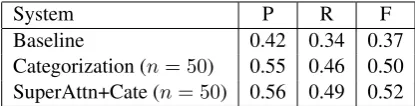
[image:7.595.78.286.388.441.2]SuperAttn+Cate (n= 50) 0.56 0.49 0.52
Table 2: Supervised attention impact on develop-ment set
As shown in Table 2, the supervised attention model is able to further improve the Smatch score by another 2 points, which are mainly contributed by 3 points increase in recall. Since the refer-ence/external alignment is mostly between the in-put tokens and AMR graph concepts, we believe that the supervised attention model is able to con-strain the decoder so that it will output concepts which can be aligned to some tokens in the input sentence.
System P R F
SuperAttn+Cate (n= 50) 0.56 0.49 0.52
NO-RELATION-ALIGN 0.46 0.40 0.43
Table 3: Supervised attention impact on develop-ment set
Because we have relations in the AMR graph, the alignment problem here is different from the
word alignment in machine translation. To verify the effectiveness of our setup, we also compare our configuration to the condition NO-RELATION
-ALIGN where we only ignore the alignment
be-tween sentence and AMR relations by putting an all zero vector as the reference attention for each output relation label. From Table 3 we see that simply ignoring the reference attention for rela-tions would greatly affect the model performance, and how we effectively represent the reference alignment for relations is crucial for the supervised attention model.
5.5 Results
In this section we report our final result on the test set of SemEval 2016 Task 8 and compare our model with other parsers. We train our model uti-lizing re-categorization and supervised attention with hyperparameters tuned on the development set. Then we apply our trained model on the test set.
Firstly, we compare our model to the exist-ing sequence-to-sequence AMR parsexist-ing model of Barzdins and Gosko (2016). As shown in ta-ble 4, the word-level model in Barzdins and Gosko (2016) is basically our baseline model. The sec-ond model they use is a character-based sequence-to-sequence model. Our model can also be re-garded as a word-level model; however, by uti-lizing carefully designed categorization and super-vised attention, our system outperforms both their results by a large margin.
System P R F
Our system 0.55 0.50 0.52
[image:7.595.315.521.511.561.2]Barzdins and Gosko (2016)† - - 0.37 Barzdins and Gosko (2016)? - - 0.43
Table 4: Compare to other sequence-to-sequence AMR parser. Barzdins and Gosko (2016)† is the word-level neural AMR parser, Barzdins and Gosko (2016)? is the character-level neural AMR parser.
state-of-the-art system. However, the best perform-ing system CAMR uses a dependency structure as a starting point, where dependency parsing has achieved high accuracy recently and can be trained on larger corpora. Also, it utilizes semantic role labeling and complex features, which makes the training process a long pipeline. Our system only needs minimal preprocessing, and doesn’t need the dependency parsing step. Our approach is competitive with the SHRG (Synchronous Hyper-edge Replacement Grammar) method of Peng et al. (2015), which does not require a dependency parser and uses SHRG to formalize the string-to-graph problem as a chart parsing task. However, they still need a concept identification stage, while our model can learn the concepts and relations jointly.
System P R F
Our system 0.55 0.50 0.52
Peng and Gildea (2016) 0.56 0.55 0.55
CAMR 0.70 0.63 0.66
Table 5: Comparison to other AMR parsers.
6 Discussion
In this paper, we have proposed several methods to make the sequence-to-sequence model work com-petitively against conventional AMR parsing sys-tems. Although we haven’t outperformed state-of-the-art system using the conventional meth-ods, our results show the effectiveness of our approaches to reduce the sparsity problem when training sequence-to-sequence model on a rela-tively small dataset. Our work could be aligned with the effort to handle low-resource data prob-lems when building the end-to-end neural network model.
In neural machine translation, the attention model is traditionally trained on millions of sen-tence pairs, while facing low-resource language pairs, the neural MT system performance tends to downgrade (Zoph et al., 2016). There has been growing interest in tackling sparsity/low-resource problem in neural MT. Zoph et al. (2016) use a transfer learning method to first pre-train the neu-ral model on rich-resource language pairs and then import the learned parameters to continue training on low-resource language pairs so that the model can alleviate the sparsity problem through shared
parameters. Firat et al. (2016) builds a multilin-gual neural system where the attention mechanism can be shared between different language pairs. Our work could be seen as parallel efforts to han-dle the sparsity problem since we focus on the in-put/output categorization and external alignment, which are both handy for low-resource languages. In this paper, we haven’t used any syntac-tic parser. However, as shown in previous works (Flanigan et al., 2014; Wang et al., 2015b; Artzi et al., 2015; Pust et al., 2015), using de-pendency features helps improve the parsing per-formance significantly because of the linguistic similarity between the dependency tree and AMR structure. An interesting extension would be to use a linearized dependency tree as the source se-quence and apply sese-quence-to-sese-quence to gener-ate the AMR graph. Our parser could also benefit from the modeling techniques in Wu et al. (2016).
7 Conclusion
Neural attention models have achieved great suc-cess in different NLP tasks. However, they have not been as successful on AMR parsing due to the data sparsity issue. In this paper, we described a sequence-to-sequence model for AMR parsing and present different ways to tackle the data spar-sity problems. We show that our methods have led to significant improvement over a baseline neural attention model, and our model is also competi-tive against models that do not use extra linguistic resources.
Acknowledgments Funded in part by a Google Faculty Award.
References
Yoav Artzi, Kenton Lee, and Luke Zettlemoyer. 2015. Broad-coverage CCG semantic parsing with AMR. In Proceedings of the 2015 Conference on Empiri-cal Methods in Natural Language Processing, pages 1699–1710, Lisbon, Portugal, September. Associa-tion for ComputaAssocia-tional Linguistics.
Dzmitry Bahdanau, Kyunghyun Cho, and Yoshua Ben-gio. 2014. Neural machine translation by jointly learning to align and translate. arXiv preprint arXiv:1409.0473.
for sembanking. InProceedings of the 7th Linguis-tic Annotation Workshop and Interoperability with Discourse.
Guntis Barzdins and Didzis Gosko. 2016. Riga at semeval-2016 task 8: Impact of smatch extensions and character-level neural translation on AMR pars-ing accuracy. arXiv preprint arXiv:1604.01278. Shu Cai and Kevin Knight. 2013. Smatch: an
evalua-tion metric for semantic feature structures. In Pro-ceedings of the 51st Annual Meeting of the Associa-tion for ComputaAssocia-tional Linguistics (Volume 2: Short Papers), pages 748–752, Sofia, Bulgaria, August. Association for Computational Linguistics.
Orhan Firat, Kyunghyun Cho, and Yoshua Bengio. 2016. Multi-way, multilingual neural machine translation with a shared attention mechanism. In Proceedings of the 2016 Conference of the North American Chapter of the Association for Computa-tional Linguistics: Human Language Technologies, pages 866–875, San Diego, California, June. Asso-ciation for Computational Linguistics.
Jeffrey Flanigan, Sam Thomson, Jaime Carbonell, Chris Dyer, and Noah A. Smith. 2014. A discrim-inative graph-based parser for the abstract mean-ing representation. InProceedings of the 52nd An-nual Meeting of the Association for Computational Linguistics (Volume 1: Long Papers), pages 1426– 1436, Baltimore, Maryland, June. Association for Computational Linguistics.
Sepp Hochreiter and J¨urgen Schmidhuber. 1997. Long short-term memory. Neural Computation, 9(8):1735–1780.
L. Liu, M. Utiyama, A. Finch, and E. Sumita. 2016. Neural Machine Translation with Supervised Atten-tion. ArXiv e-prints, September.
Jonathan May. 2016. Semeval-2016 task 8: Mean-ing representation parsMean-ing. In Proceedings of the 10th International Workshop on Semantic Evalua-tion (SemEval-2016), pages 1063–1073, San Diego, California, June. Association for Computational Linguistics.
Martha Palmer, Daniel Gildea, and Paul Kingsbury. 2005. The proposition bank: An annotated cor-pus of semantic roles. Computational Linguistics, 31(1):71–106.
Xiaochang Peng and Daniel Gildea. 2016. UofR at semeval-2016 task 8: Learning synchronous hyper-edge replacement grammar for AMR parsing. In Proceedings of the 10th International Workshop on Semantic Evaluation (SemEval-2016), pages 1185– 1189, San Diego, California, June. Association for Computational Linguistics.
Xiaochang Peng, Linfeng Song, and Daniel Gildea. 2015. A synchronous hyperedge replacement gram-mar based approach for AMR parsing. In Proceed-ings of the Nineteenth Conference on Computational
Natural Language Learning, pages 32–41, Beijing, China, July. Association for Computational Linguis-tics.
Slav Petrov, Leon Barrett, Romain Thibaux, and Dan Klein. 2006. Learning accurate, compact, and interpretable tree annotation. In Proceedings of the 21st International Conference on Computational Linguistics and 44th Annual Meeting of the Associa-tion for ComputaAssocia-tional Linguistics, pages 433–440, Sydney, Australia, July. Association for Computa-tional Linguistics.
Nima Pourdamghani, Yang Gao, Ulf Hermjakob, and Kevin Knight. 2014. Aligning English strings with abstract meaning representation graphs. In Proceed-ings of the 2014 Conference on Empirical Methods in Natural Language Processing (EMNLP), pages 425–429, Doha, Qatar, October. Association for Computational Linguistics.
Michael Pust, Ulf Hermjakob, Kevin Knight, Daniel Marcu, and Jonathan May. 2015. Parsing English into abstract meaning representation using syntax-based machine translation. In Proceedings of the 2015 Conference on Empirical Methods in Natu-ral Language Processing, pages 1143–1154, Lisbon, Portugal, September. Association for Computational Linguistics.
Lev Ratinov and Dan Roth. 2009. Design chal-lenges and misconceptions in named entity recog-nition. In Proceedings of the Thirteenth Confer-ence on Computational Natural Language Learning (CoNLL-2009), pages 147–155, Boulder, Colorado, June. Association for Computational Linguistics.
Ilya Sutskever, Oriol Vinyals, and Quoc V. Le. 2014. Sequence to sequence learning with neural net-works. InAdvances in Neural Information Process-ing Systems, pages 3104–3112.
Oriol Vinyals, Łukasz Kaiser, Terry Koo, Slav Petrov, Ilya Sutskever, and Geoffrey Hinton. 2015. Gram-mar as a foreign language. InAdvances in Neural Information Processing Systems, pages 2773–2781.
Chuan Wang, Nianwen Xue, and Sameer Pradhan. 2015a. Boosting transition-based AMR parsing with refined actions and auxiliary analyzers. In Pro-ceedings of the 53rd Annual Meeting of the Associ-ation for ComputAssoci-ational Linguistics and the 7th In-ternational Joint Conference on Natural Language Processing (Volume 2: Short Papers), pages 857– 862, Beijing, China, July. Association for Computa-tional Linguistics.
Chuan Wang, Sameer Pradhan, Xiaoman Pan, Heng Ji, and Nianwen Xue. 2016. CAMR at semeval-2016 task 8: An extended transition-based AMR parser. In Proceedings of the 10th International Workshop on Semantic Evaluation (SemEval-2016), pages 1173–1178, San Diego, California, June. As-sociation for Computational Linguistics.
Yonghui Wu, Mike Schuster, Zhifeng Chen, Quoc V. Le, Mohammad Norouzi, Wolfgang Macherey, Maxim Krikun, Yuan Cao, Qin Gao, Klaus Macherey, Jeff Klingner, Apurva Shah, Melvin Johnson, Xiaobing Liu, Lukasz Kaiser, Stephan Gouws, Yoshikiyo Kato, Taku Kudo, Hideto Kazawa, Keith Stevens, George Kurian, Nishant Patil, Wei Wang, Cliff Young, Jason Smith, Jason Riesa, Alex Rudnick, Oriol Vinyals, Greg Corrado, Macduff Hughes, and Jeffrey Dean. 2016. Google’s neural machine translation system: Bridging the gap between human and machine translation. CoRR, abs/1609.08144.