Computational Argumentation Quality Assessment in Natural Language
Henning Wachsmuth
Bauhaus-Universität Weimar Weimar, Germany
Nona Naderi
University of Toronto Toronto, Canada
Yufang Hou
IBM Research Dublin, Ireland
Yonatan Bilu
IBM Research Haifa, Israel
Vinodkumar Prabhakaran
Stanford University Stanford, CA, USA
Tim Alberdingk Thijm, Graeme Hirst
University of Toronto Toronto, Canada
{thijm,gh}@cs.toronto.edu
Benno Stein
Bauhaus-Universität Weimar Weimar, Germany
Abstract
Research on computational argumentation faces the problem of how to automatically assess the quality of an argument or argu-mentation. While different quality dimen-sions have been approached in natural lan-guage processing, a common understand-ing of argumentation quality is still missunderstand-ing. This paper presents the first holistic work on computational argumentation quality in natural language. We comprehensively sur-vey the diverse existing theories and ap-proaches to assess logical, rhetorical, and dialectical quality dimensions, and we de-rive a systematic taxonomy from these. In addition, we provide a corpus with 320 ar-guments, annotated for all 15 dimensions in the taxonomy. Our results establish a com-mon ground for research on computational argumentation quality assessment.
1 Introduction
What is a good argument? What premises should it be based on? When is argumentation persuasive? When is it reasonable? We subsume such ques-tions under the termargumentation quality; they have driven logicians, rhetoricians, linguists, and argumentation theorists since the Ancient Greeks (Aristotle, 2007). Now that the area of computa-tional argumentation is seeing an influx of research activity, the automatic assessment of argumentation quality is coming into the focus, due to its impor-tance for envisioned applications such as writing support (Stab and Gurevych, 2014) and argument search (Wachsmuth et al., 2017), among others.
Existing research covers the mining of argument units (Al-Khatib et al., 2016), specific types of evi-dence (Rinott et al., 2015), and argumentative rela-tions (Peldszus and Stede, 2015). Other works
clas-sify argumentation schemes (Feng et al., 2014) and frames (Naderi and Hirst, 2015), analyze overall argumentation structures (Wachsmuth et al., 2015), or generate claims (Bilu and Slonim, 2016). Also, theories of argumentation quality exist, and some quality dimensions have been assessed computa-tionally (see Section 2 for details). Until now, how-ever, the assertion of O’Keefe and Jackson (1995) that there is neither a general idea of what consti-tutes argumentation quality in natural language nor a clear definition of its dimensions still holds.
The reasons for this deficit originate in the vary-ing goals of argumentation: persuadvary-ing audiences, resolving disputes, achieving agreement, complet-ing inquiries, and recommendcomplet-ing actions (Tindale, 2007). As a result, diverse quality dimensions play a role, which relate to the logic of arguments, to the style and rhetorical effect of argumentation, or to its contribution to a discussion. Consider the fol-lowing argument against the death penalty:1
Everyone has an inalienable human right to life, even those who commit murder; sentencing a per-son to death and executing them violates that right.
Although implicit, the conclusion about the death penalty seems sound in terms of (informal) logic, and the argument is clear from a linguistic view-point. Some people might not accept the first stated premise, though, especially if emotionally affected by some legal case at hand. Or, they might not be persuaded that the stated argument is the most relevant in the debate on death penalty.
This example reveals three central challenges: (1) Argumentation quality is assessed on different levels of granularity; (2) many quality dimensions are subjective, depending on preconceived opin-ions; and (3) overall argumentation quality seems hard to measure, as the impact and interaction of the different dimensions remain unclear.
1Taken from www.bbc.co.uk/ethics/capitalpunishment.
This paper doesnotpropose a specific approach to assess quality; rather it defines a common ground by providing a so-far-missing holistic view on argu-mentation quality assessment in natural language. In particular, we first briefly but comprehensively survey all major theories and computational approa-ches for argumentation quality. Following Blair (2012), we distinguish three main quality aspects, each associated with several quality dimensions:
• Logical quality in terms of the cogency or
strength of an argument.
• Rhetorical qualityin terms of the persuasive
effect of an argument or argumentation.
• Dialectical qualityin terms of the
reasonable-ness of argumentation for resolving issues. We organize the survey along these aspects, dis-cussing quality at four levels of granularity: (1)
ar-gument unit, i.e., a segment of text that takes the
role of a premise or conclusion; (2)argument, i.e., a composition of premises and a conclusion, some of which may be implicit; (3)(monological)
argumen-tation, i.e., a composition of arguments on a given
issue; and (4)(dialogical) debate, i.e., a series of interacting argumentation on the same issue.
To unify and to consolidate existing research, we then derive a generally applicable taxonomy of argumentation quality from the survey. The taxon-omy systematically decomposes quality assessment based on the interactions of 15 widely accepted quality dimensions (including the overall quality). Moreover, we provide a new annotated corpus with 320 arguments for which three experts assessed all 15 dimensions, resulting in over 14,000 annotations. Our analysis indicates how the dimensions interact and which of them are subjective, making the cor-pus an adequate benchmark for future research.
In summary, the contributions of this paper are:
1. A comprehensive surveyof research on
argu-mentation quality assessment (Section 2).
2. A taxonomyof all major quality dimensions of
natural language argumentation, which clari-fies their roles and dependencies (Section 3).
3. An annotated corpusfor computational
argu-mentation quality assessment (Section 4).2 2 Survey of Argumentation Quality This section briefly surveys all major existing the-ories and the assessment of natural language argu-2The corpus is freely available at: http://www.arguana.com
mentation quality. While we order the discussions along the three main quality aspects, we point out overlaps and interrelations where relevant.
2.1 Theories of Argumentation Quality
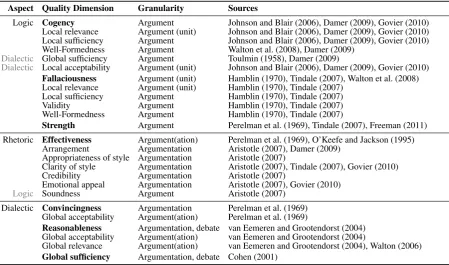
We focus on the major fields dealing with argumen-tation quality in natural language: argumenargumen-tation theory and rhetoric. Table 1 gives an overview of the quality dimensions that we detail below.
LogicFormal argumentation studies thesoundness
of arguments, requiring the truth of an argument’s premises and the deductive validity of inferring its conclusion. In case of inductive strength, the conclusion becomes probable given the premises. While sound arguments exist in natural language, most are defeasible in nature (Walton, 2006). The desired property of such arguments iscogency.
A cogent (or logically good) argument has in-dividually acceptable premises that are relevant to the argument’s conclusion and, together, sufficient to draw the conclusion (Johnson and Blair, 2006). Here,(local) acceptabilitymeans that a premise is rationally worthy of being believed by the target au-dience of the argument. It replaces truth, which is often unclear (Hamblin, 1970). A premise’s(local)
relevancerefers to the level of support it provides
for the conclusion, and(local) sufficiencycaptures whether the premises give enough reason to accept the conclusion. In the end, sufficiency thus presup-poses relevance (Blair, 2012). While acceptability is more dialectical, overall the three dimensions of cogency are, with slight variations, acknowledged to cover the logical quality of arguments.
Damer (2009) adds that a good argument also depends on the rebuttal it gives to anticipated coun-terarguments (a dialectical property) as well as on its structuralwell-formedness, i.e., whether it is in-trinsically consistent, avoids begging the question, and uses a valid inference rule. These dimensions adopt ideas from the argument model of Toulmin (1958), including rebuttals and warrants, and from the argumentation schemes of Walton et al. (2008), whose critical questions are meant to evaluate infer-ence rules. While not focusing on quality, critical questions particularly help identify fallacies.
Aspect Quality Dimension Granularity Sources
Logic Cogency Argument Johnson and Blair (2006), Damer (2009), Govier (2010) Local relevance Argument (unit) Johnson and Blair (2006), Damer (2009), Govier (2010) Local sufficiency Argument Johnson and Blair (2006), Damer (2009), Govier (2010) Well-Formedness Argument Walton et al. (2008), Damer (2009)
Dialectic Global sufficiency Argument Toulmin (1958), Damer (2009)
Dialectic Local acceptability Argument (unit) Johnson and Blair (2006), Damer (2009), Govier (2010)
Fallaciousness Argument (unit) Hamblin (1970), Tindale (2007), Walton et al. (2008) Local relevance Argument (unit) Hamblin (1970), Tindale (2007)
Local sufficiency Argument Hamblin (1970), Tindale (2007) Validity Argument Hamblin (1970), Tindale (2007) Well-Formedness Argument Hamblin (1970), Tindale (2007)
Strength Argument Perelman et al. (1969), Tindale (2007), Freeman (2011)
Rhetoric Effectiveness Argument(ation) Perelman et al. (1969), O’Keefe and Jackson (1995) Arrangement Argumentation Aristotle (2007), Damer (2009)
Appropriateness of style Argumentation Aristotle (2007)
Clarity of style Argumentation Aristotle (2007), Tindale (2007), Govier (2010) Credibility Argumentation Aristotle (2007)
Emotional appeal Argumentation Aristotle (2007), Govier (2010)
Logic Soundness Argument Aristotle (2007)
Dialectic Convincingness Argumentation Perelman et al. (1969) Global acceptability Argument(ation) Perelman et al. (1969)
Reasonableness Argumentation, debate van Eemeren and Grootendorst (2004) Global acceptability Argument(ation) van Eemeren and Grootendorst (2004)
Global relevance Argument(ation) van Eemeren and Grootendorst (2004), Walton (2006)
[image:3.595.75.525.62.327.2]Global sufficiency Argumentation, debate Cohen (2001)
Table 1: Theoretical treatment of quality dimensions in the referenced sources for the given granularities of natural language argumentation, grouped by the aspect the bold-faced high-level dimensions refer to.
as unjustified appeals to emotion. They represent an alternative assessment of logical quality. Fol-lowing Damer (2009), a fallacy can always be seen as a violation of one or more dimensions of good arguments. Fallaciousness negatively affects an argument’sstrength(Tindale, 2007).
Argument strength is often referred to, but its meaning remains unclear: “Is a strong argument an effective argument which gains the adherence of the audience, or is it a valid argument, which ought to gain it?” (Perelman et al., 1969). Tindale (2007) sees validity as a possible but not mandatory part of reasoning strength. Freeman (2011) speaks of the strength of support, matching the idea of induc-tive strength. Blair (2012) roughly equates strength with cogency, and Hoeken (2001) observes correla-tions between evidence strength and rhetorical per-suasiveness. Such dependencies are expected, as the use of true and valid arguments represents one means of persuasion: logos (Aristotle, 2007).
RhetoricAristotle’s work on rhetoric is one of the most systematic to this day. He defines rhetoric as the ability to know how to persuade (Aristotle, 2007). Besides logos, the three means of persua-sion he sees include ethos, referring to the arguer’s
credibility, and pathos, the successfulemotional ap-pealto the target audience. Govier (2010) outlines how emotions interfere with logic in arguments.
Pathos is not necessarily reprehensible; it just aims for an emotional state adequate for persuasion.
In overall terms, rhetorical quality is reflected by the persuasiveeffectiveness, i.e., the success in persuading a target audience of a conclusion (Blair, 2012). It has been suggested that what arguments are considered as effective is subjective (O’Keefe and Jackson, 1995). Unlike persuasiveness, which relates to the actual arguments, effectiveness covers all aspects of an argumentation, including the use of language (van Eemeren, 2015). In particular, the three means of persuasion are meant to be realized by what is said and how (Aristotle, 2007). Several linguistic quality dimensions are connected to argu-mentation (examples follow in Section 2.2). While many of them are distinguished by Aristotle, he groups them as theclarityand theappropriateness
audience (Aristotle, 2007). Arrangement, finally, addresses the structure of argumentation regarding the presentation of the issue, pros, cons, and conclu-sions. Damer (2009) outlines that a proper arrange-ment is governed by the dimensions of a good argu-ment. To be effective, well-arranged argumentation matches the expectations of the target audience and is, thus, related to dialectic (Blair, 2012).
DialecticThe dialectical view of argumentation tar-gets the resolution of differences of opinions on the merit (van Eemeren and Grootendorst, 2004). Qual-ity is assessed for well-arranged discussions that seek agreement. In contrast to the subjective nature of effectiveness, people are good in such an assess-ment (Mercier and Sperber, 2011). In their pragma-dialectical theory, van Eemeren and Grootendorst (2004) develop rules for obtainingreasonableness
in critical discussions. Reasonableness emerges from two complementary dimensions,
intersubjec-tive(global) acceptabilityand problem-solving
va-lidity, but effectiveness still remains the underly-ing goal (van Eemeren, 2015). For argumentation, global acceptability is given when the stated argu-ments and the way they are stated are acceptable to the whole target audience. Problem-solving valid-ity matches the(global) relevanceof argumentation that contributes to resolution, helping arrive at an ultimate conclusion (Walton, 2006).
Global relevance implicitly excludes fallacious moves, so reasonable arguments are cogent (van Eemeren, 2015). Van Eemeren sees reasonableness as a precondition forconvincingness, the rational version of persuasiveness. Following Perelman et al. (1969), persuasive argumentation aims at a parti-cular audience, whereas convincing argumentation aims at the universal audience, i.e., all reasonable beings. This fits the notion that dialectic examines general rather than specific issues (Aristotle, 2007).
Convincingness needs(global) sufficiency, i.e., all objections to an argumentation are countered. The dilemma here is that the number of objections could be infinite, but without global sufficiency the required support seems arbitrary (Blair, 2012). A solution is the relaxed view of Damer (2009) that only those counter-arguments that can be antici-pated are to be rebutted. For debates, Cohen (2001) speaks of dialectical satisfactoriness, i.e., whether all questions and objections have been sufficiently answered. In case a reasonable debate ends up in either form of global sufficiency, this implies that the discussed difference of opinion is resolved.
OtherAlthough closely related, critical thinking (Freeley and Steinberg, 2009) and persuasion re-search (Zhao et al., 2011) are covered only implic-itly here; their views on quality largely match with argumentation theory. We have not discussed de-liberation, as it is not concerned with the quality of argumentation primarily but rather with commu-nicative dimensions of group decision-making, e.g., participation and respect (Steenbergen et al., 2003). Also, we have restricted our view to the logic found in natural language. For formal and probabilistic logic, dimensions such as degree of justification (Pollock, 2001), argument strength (Pfeifer, 2013), and premise relevance (Ransom et al., 2015) have been analyzed. As we see below, such logic influ-enced some practical assessment approaches.
2.2 Approaches to Quality Assessment
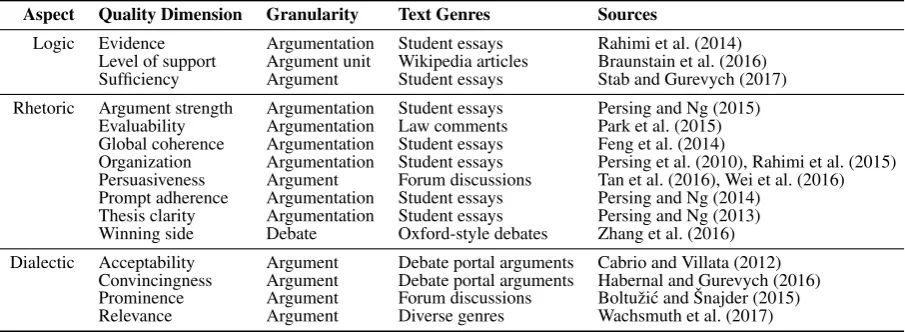
As for the theories, we survey the automatic quality assessment for natural language argumentation. All discussed approaches are listed in Table 2.
LogicBraunstain et al. (2016) deal with logical ar-gument quality in community question answering: Combining relevance-oriented retrieval models and argument-oriented features, they rank sentence-level argument units according to thelevel of sup-portthey provide for an answer. Unlike classical essay scoring, Rahimi et al. (2014) score an essay’s
evidence, a quality dimension of argumentation: it
captures how sufficiently the given details support the essay’s thesis. On the dataset of Correnti et al. (2013) with 1569 student essays and scores from 1 to 4, they find that the concentration and specificity of words related to the essay prompt (i.e., the state-ment defining the discussed issue) impacts scoring accuracy. Similarly, Stab and Gurevych (2017) in-troduce an essay corpus with 1029 argument-level annotations ofsufficiency, following the definition of Johnson and Blair (2006). Their experiments suggest that convolutional neural networks outper-form feature-based sufficiency classification.
Rhetoric Persing et al. (2010) tackle the proper arrangement of an essay, namely, itsorganization
Aspect Quality Dimension Granularity Text Genres Sources
Logic Evidence Argumentation Student essays Rahimi et al. (2014) Level of support Argument unit Wikipedia articles Braunstain et al. (2016) Sufficiency Argument Student essays Stab and Gurevych (2017) Rhetoric Argument strength Argumentation Student essays Persing and Ng (2015)
Evaluability Argumentation Law comments Park et al. (2015) Global coherence Argumentation Student essays Feng et al. (2014)
Organization Argumentation Student essays Persing et al. (2010), Rahimi et al. (2015) Persuasiveness Argument Forum discussions Tan et al. (2016), Wei et al. (2016) Prompt adherence Argumentation Student essays Persing and Ng (2014)
Thesis clarity Argumentation Student essays Persing and Ng (2013) Winning side Debate Oxford-style debates Zhang et al. (2016) Dialectic Acceptability Argument Debate portal arguments Cabrio and Villata (2012)
[image:5.595.73.526.63.229.2]Convincingness Argument Debate portal arguments Habernal and Gurevych (2016) Prominence Argument Forum discussions Boltuži´c and Šnajder (2015) Relevance Argument Diverse genres Wachsmuth et al. (2017)
Table 2: Practical assessment of quality dimensions in the referenced sources for the given granularities and text genres of natural language argumentation, grouped by the aspect the quality dimensions refer to.
approach above. Their results indicate a correlation between organization and local coherence. Feng et al. (2014) parse discourse structure to assess
global coherence, i.e., the continuity of meaning in a text. Lacking ground-truth coherence labels, they evaluate their approach on sentence ordering and organization scoring instead. Coherence affects the clarity of style, as do thethesis clarityandprompt
adherenceof essays. Persing and Ng (2013) find
the former to suffer from misspellings, while Pers-ing and Ng (2014) use prompt-related keywords and topic models to capture the latter (both for 830 ICLE essays like those mentioned above). For com-ments in lawmaking, Park et al. (2015) develop an argumentation model that prescribes what informa-tion users should give to achieveevaluability(e.g., testimony evidence or references to resources).
Not only linguistic quality, but also effectiveness is assessed in recent work: Persing and Ng (2015) score theargument strengthof essays, which they define rhetorically in terms of how many readers would be persuaded. Although potentially sub-jective, their manual 7-point score annotations of 1000 ICLE essays differ by at most 1 in 67% of the studied cases. Their best features are heuristic argument unit labels and part-of-speech n-grams. Recently, Wachsmuth et al. (2016) demonstrated that the output of argument mining helps in such argumentation-related essay scoring, obtaining bet-ter results for argument strength and organization. Tan et al. (2016) analyze which arguments achieve
persuasivenessin “change my view” forum
discus-sions, showing that multiple interactions with the view-holder are beneficial as well as an appropriate style and a high number of participants. On similar
data, Wei et al. (2016) find that also an author’s rep-utation impacts persuasiveness. Zhang et al. (2016) discover for Oxford-style debates that attacking the opponents’ arguments tends to be more effective than relying on one’s own arguments. These results indicate the relation of rhetoric and dialectic.
DialecticDialectical quality has been addressed by Cabrio and Villata (2012). The authors use textual entailment to find ground-truth debate portal argu-ments that attack others. Based on the formal ar-gumentation framework of Dung (1995), they then assess global argumentacceptability. Habernal and Gurevych (2016) compare arguments in terms of
convincingness. However, the subjective nature of
their crowdsourced labels actually reflects rhetor-ical effectiveness. Boltuži´c and Šnajder (2015) present first steps towards argumentprominence. Prominence may be a product of popularity, though, making its quality nature questionable, as popular-ity is often not correlated with merit (Govier, 2010). In contrast, Wachsmuth et al. (2017) adapt the fa-mous PageRank algorithm to objectively derive the
relevanceof an argument at web scale from what
other arguments refer to the argument’s premises. On a large ground-truth argument graph, their ap-proach beats several baselines for the benchmark argument rankings that they provide.
Log i c
R h e t o r i c D
i a l e
c ti c Cogency
Credibility Emotionalappeal
Clarity
Appropriateness
Arrangement
Local acceptability
Local relevance
Local sufficiency
Effectiveness
Reasonableness
Argumentation quality
Global relevance Global
acceptability
Global sufficiency Level of support
Braunstain et al. (2016)
Evidence Rahimi et al. (2014) Sufficiency Stab and Gurevych (2017)
Thesis clarity Persing and Ng (2013) Prompt adherence Persing and Ng (2014) Global coherence Feng et al. (2014) Evaluability Park et al. (2015)
Acceptability Cabrio and Villata (2012)
Organization Persing et al. (2010), Rahimi et al. (2015)
Argument strength Persing et al. (2015) Persuasiveness
Tan et al. (2016), Wei et al. (2016) Winning side
Zhang et al. (2016) Convincingness Habernal et al. (2016) Prominence
Boltužic and Šnajder (2015) Relevance
[image:6.595.77.524.63.292.2]Wachsmuth et al. (2017) ´
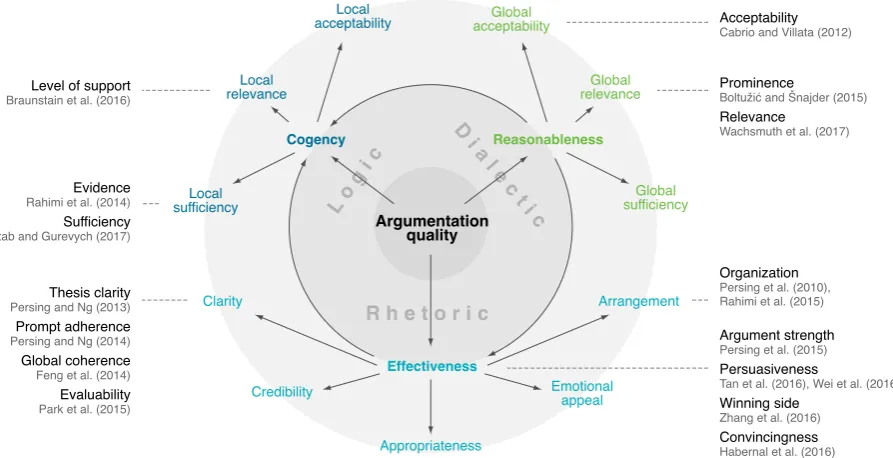
Figure 1: The proposed taxonomy of argumentation quality as well as the mapping of existing assessment approaches to the covered quality dimensions. Arrows show main dependencies between the dimensions.
even if said to aim for argument quality (Swanson et al., 2015). Much work exists for general text quality, most notably in the context of readability (Pitler and Nenkova, 2008) and classical essay scor-ing. Some scoring approaches derive features from discourse (Burstein et al., 1998), arguments (Ong et al., 2014; Beigman Klebanov et al., 2016; Ghosh et al., 2016), or schemes (Song et al., 2014)—all this may be indicative of quality. However, our focus is approaches that target argumentation qual-ity at heart. Similarly, review helpfulness (Liu et al., 2008) and deception (Ott et al., 2011) are not treated, as arguments only partly play a role there. Also, only few Wikipedia quality flaws relate to ar-guments, e.g., verifiability (Anderka et al., 2012).
3 A Taxonomy of Argumentation Quality Given all surveyed quality dimensions, we now pro-pose a unifying taxonomy of argumentation quality. The taxonomy decomposes quality assessment sys-tematically, thus organizing and clarifying the roles of practical approaches. It does not require a partic-ular argumentation model, but it rests on the notion of the granularity levels from Section 1.
3.1 Overview of the Theory-based Taxonomy
Our objective is not to come up with a new theory, but to provide a unified view of existing theories that is suitable for quality assessment. We aim for a common understanding of the dimensions that
af-fect quality, what interdependencies they have, and how they interact. Figure 1 illustrates the taxonomy that we propose for this purpose. The rationale be-hind its structure and its layout is as follows.
While Section 2 has outlined overlaps and rela-tions between the three aspects of argumentation, we have identified one dominant high-level quality dimension ofargumentation qualityin theory for each aspect: logicalcogency, rhetorical effective-ness, and dialecticalreasonableness. The latter two benefit from cogency, and reasonableness depends on effectiveness, as discussed. Often, only one of them will be in the focus of attention in practice, or even only a sub-dimension. In particular, each high-level dimension has a set of sub-dimensions agreed upon. The sub-dimensions are shown on the outer ring in Figure 1, roughly positioned according to the aspects they refer to, e.g.,local acceptability
lies next to the other dialectical dimensions. We ordered the sub-dimensions by their interrelations (left implicit for conciseness), e.g.,appropriateness
supportscredibilityandemotional appeal.
as it is close to effectiveness and as both the feasi-bility and the need of persuading the universal audi-ence has been questioned (van Eemeren, 2015). In-stead, we addglobal sufficiencyas part of reason-ableness. While global sufficiency may be infeasi-ble, too (Blair, 2012), it forces agreement in critical discussions and, thereby, reasonableness.
3.2 Definitions of the Quality Dimensions
Cogency is seen as an argument property, whereas effectiveness and reasonableness are assessed on the argumentation level usually. For generality, we give informal literature-based definitions of these dimensions and all sub-dimensions here for an au-thor who argues about an issue to a target audience:
Cogency An argument is cogent if it has accept-able premises that are relevant to its conclusion and that are sufficient to draw the conclusion.
• Local acceptability: A premise of an
argu-ment is acceptable if it is rationally worthy of being believed to be true.
• Local relevance:A premise of an argument is
relevant if it contributes to the acceptance or rejection of the argument’s conclusion.
• Local sufficiency:An argument’s premises are
sufficient if, together, they give enough sup-port to make it rational to draw its conclusion.
Effectiveness Argumentation is effective if it per-suades the target audience of (or corroborates agree-ment with) the author’s stance on the issue.
• Credibility:Argumentation creates credibility
if it conveys arguments and similar in a way that makes the author worthy of credence.
• Emotional Appeal:Argumentation makes a
successful emotional appeal if it creates emo-tions in a way that makes the target audience more open to the author’s arguments.
• Clarity: Argumentation has a clear style if
it uses correct and widely unambiguous lan-guage as well as if it avoids unnecessary com-plexity and deviation from the issue.
• Appropriateness:Argumentation has an
ap-propriate style if the used language supports the creation of credibility and emotions as well as if it is proportional to the issue.
• Arrangement: Argumentation is arranged
properly if it presents the issue, the arguments, and its conclusion in the right order.
Reasonableness Argumentation is reasonable if it contributes to the issue’s resolution in a sufficient way that is acceptable to the target audience.
• Global acceptability: Argumentation is
ac-ceptable if the target audience accepts both the consideration of the stated arguments for the issue and the way they are stated.
• Global relevance:Argumentation is relevant
if it contributes to the issue’s resolution, i.e., if it states arguments or other information that help to arrive at an ultimate conclusion.
• Global sufficiency: Argumentation is
suffi-cient if it adequately rebuts those counter-arguments to it that can be anticipated.
3.3 Organization of Assessment Approaches
The taxonomy is meant to define a common ground for assessing argumentation quality, including the organization of practical approaches. The left and right side of Figure 1 show where the approaches surveyed in Section 2.2 are positioned in the taxon-omy. Some dimensions have been tackled multiple times (e.g.,clarity), others not at all (e.g., credibil-ity). The taxonomy indicates what sub-dimensions will affect the same high-level dimension.
4 The Dagstuhl-15512 ArgQuality Corpus Finally, we present our new annotated
Dagstuhl-15512 ArgQuality Corpusfor studying
argumenta-tion quality based on the developed taxonomy, and we report on a first corpus analysis.3
4.1 Data and Annotation Process
Our corpus is based on theUKPConvArgRank data-set (Habernal and Gurevych, 2016), which contains rankings of 25 to 35 textual debate portal arguments for two stances on 16 issues, such asevolution vs.
creationandban plastic water bottles. All ranks
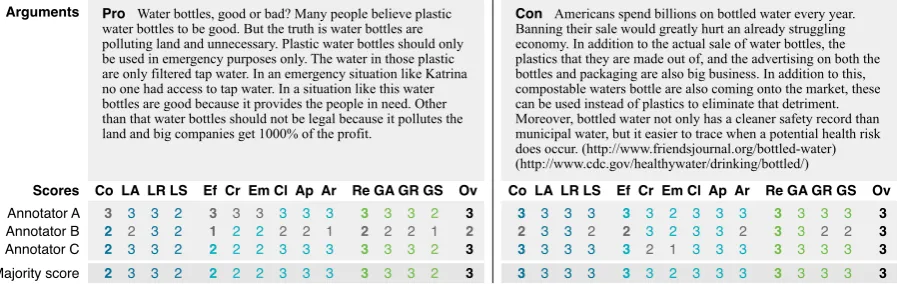
were derived from crowdsourced convincingness labels. For every issue/stance pair, we took the five top-ranked texts and chose five further via stratified sampling. Thereby, we covered both high-quality arguments and different levels of lower quality. Two example texts follow below in Figure 2.
Before annotating the 320 chosen texts, we car-ried out a full annotation study with seven authors of this paper on 20 argumentative comments from 3The corpus and annotation guidelines are available at
(a) Maj. Scores (b) Agreement (c) Pearson Correlation Coefficients
Quality Dimension 1 2 3 α full maj. Co LA LR LS Ef Cr Em Cl Ap Ar Re GA GR GS
Co Cogency 150 131 23 .44 40.1% 91.8% .64 .61 .84 .81 .46 .27 .41 .32 .55 .78 .64 .71 .70
LA Local acceptability 84 169 51 .46 27.0% 90.8% .64 .51 .53 .60 .54 .30 .40 .54 .46 .68 .75 .46 .45
LR Local relevance 25 155 124 .47 32.6% 92.4% .61 .51 .56 .56 .39 .27 .46 .35 .50 .62 .58 .68 .45
LS Local sufficiency 172 119 13 .44 37.2% 92.8% .84 .53 .56 .73 .39 .25 .37 .23 .51 .67 .51 .68 .74
Ef Effectiveness 184 111 9 .45 42.1% 94.4% .81 .60 .56 .73 .48 .31 .35 .34 .54 .75 .58 .66 .71
Cr Credibility 99 199 6 .37 37.8% 95.7% .46 .54 .39 .39 .48 .37 .32 .49 .37 .52 .52 .36 .40
Em Emotional appeal 48 235 21 .26 42.8% 94.4% .27 .30 .27 .25 .31 .37 .14 .30 .20 .30 .26 .26 .22
Cl Clarity 42 191 71 .35 29.3% 89.8% .41 .40 .46 .37 .35 .32 .14 .45 .56 .44 .45 .38 .27
Ap Appropriateness 43 196 65 .36 17.4% 87.5% .32 .54 .35 .23 .34 .49 .30 .45 .48 .47 .59 .20 .20
Ar Arrangement 91 189 24 .39 26.6% 93.4% .55 .46 .50 .51 .54 .37 .20 .56 .48 .55 .51 .49 .48
Re Reasonableness 126 159 19 .50 41.4% 95.7% .78 .68 .62 .67 .75 .52 .30 .44 .47 .55 .78 .65 .61
GA Global acceptability 88 161 55 .44 31.6% 95.4% .64 .75 .58 .51 .58 .52 .26 .45 .59.51 .78 .46 .43
GR Global relevance 69 167 68 .42 21.7% 90.1% .71 .46 .68 .68 .66 .36 .26 .38 .20 .49 .65 .46 .61
GS Global sufficiency 231 72 1 .27 44.7% 98.0% .70 .45 .45 .74 .71 .40 .22 .27 .20 .48 .61 .43 .61
[image:8.595.72.530.63.243.2]Ov Overall quality 152 128 24 .51 44.1% 94.4% .84 .66 .61 .74 .81 .52 .30 .45 .42.59 .86 .71 .70 .68 Table 3: Results for the 304 corpus texts classified as argumentative by all annotators: (a) Distribution of majority scores for each dimension (2 used in case of full disagreement). (b) Krippendorff’sαof the most agreeing annotator pair and full/majority agreement of all annotators. (c) Correlation for each dimension pair, averaged over the correlations of all annotators. The highest value in each column is marked bold.
the unshared task dataset of the 3rd Workshop on Argument Mining.4 The annotators assessed all 15 quality dimensions in the taxonomy for each com-ment (including its overall quality). Due to sim-ple initial guidelines based on the definitions from Section 3 and the subjectiveness of the task, the agreement of all seven annotators was low for all di-mensions, namely, at most .22 in terms of Krippen-dorff’sα. The three most agreeing annotators for each dimension achieved much higherα-values be-tween .23 (clarity) and .60 (credibility), though.5
The study results were discussed by all annota-tors, leading to a considerably refined version of the guidelines. We then selected three annotators for the corpus annotation based on their availability. They work at two universities and one company in three countries (two females, one male; two PhDs, one PhD student). For each text in the corpus, all annotators first classified whether it was actually argumentative. If so, they assessed all dimensions using ordinal scores from 1 (low) to 3 (high).6 Ad-ditionally, “cannot judge” could be chosen.
4.2 Corpus Distribution and Agreement
Table 3(a) lists the majority scores of each dimen-sion for the 304 corpus texts (95%) that are classi-fied as argumentative by all annotators, all covering
4Unshared task data found at: http://github.com/UKPLab 5We use Krippendorff’sαas is suitable for small samples,
multiple ratings, and ordinal scales (Krippendorff, 2007).
6We chose a 3-point scale to foster clear decisions on the
quality; in the annotation study, we used a 4-point scale but observed that the annotators only rarely chose score 1 and 4.
the whole score range. Five dimensions have the median at score 1, the others at 2. Some seem easier to master, such aslocal relevance, which received the highest majority score 124 times. Others rarely got score 3, above allglobal sufficiency. The latter is explained by the fact that only few texts include any rebuttal of counter-arguments.
Only one of the over 14,000 assessments made by the three annotators was “cannot judge” (for
glo-bal relevance), suggesting that our guidelines were
comprehensive. Regarding agreement, we see in Table 3(b) that the α-values of all logical and di-alectical quality dimensions except forglobal
suffi-ciencylie above 0.4 for the most agreeing annotator
pair. As expected, the rhetorical dimensions seem to be more subjective. The lowestαis observed
foremotional appeal(0.26). The annotators most
agreed on theoverall quality(α= 0.51), possibly meaning that the taxonomy adequately guides the assessment. In accordance with the moderateα -values, full agreement ranges between 17.4% and 44.7% only. On the contrary, we observe high ma-jority agreement between 87.5% and 98% for all di-mensions, even where scores are rather evenly dis-tributed, such as forglobal acceptability(95.4%). In case of full disagreement, it makes sense to use score 2. We hence argue that the corpus is suitable for evaluating argumentation quality assessment.
Pro Water bottles, good or bad? Many people believe plastic water bottles to be good. But the truth is water bottles are polluting land and unnecessary. Plastic water bottles should only be used in emergency purposes only. The water in those plastic are only filtered tap water. In an emergency situation like Katrina no one had access to tap water. In a situation like this water bottles are good because it provides the people in need. Other than that water bottles should not be legal because it pollutes the land and big companies get 1000% of the profit.
Annotator A Annotator B Annotator C Majority score
3 3 3 2 3 3 3 3 3 3 3 3 3 2 3
2 2 3 2 1 2 2 2 2 1 2 2 2 1 2
2 3 3 2 2 2 2 3 3 3 3 3 3 2 3
2 3 3 2 2 2 2 3 3 3 3 3 3 2 3 Co LA LR LS Ef Cr Em Cl Ap Ar Re GA GR GS Ov
3 3 3 3 3 3 2 3 3 3 3 3 3 3 3 2 3 3 2 2 3 2 3 3 2 3 3 2 2 3
3 3 3 3 3 2 1 3 3 3 3 3 3 3 3
3 3 3 3 3 3 2 3 3 3 3 3 3 3 3 Co LA LR LS Ef Cr Em Cl Ap Ar Re GA GR GS Ov Arguments
Scores
[image:9.595.76.525.63.205.2]Con Americans spend billions on bottled water every year. Banning their sale would greatly hurt an already struggling economy. In addition to the actual sale of water bottles, the plastics that they are made out of, and the advertising on both the bottles and packaging are also big business. In addition to this, compostable waters bottle are also coming onto the market, these can be used instead of plastics to eliminate that detriment. Moreover, bottled water not only has a cleaner safety record than municipal water, but it easier to trace when a potential health risk does occur. (http://www.friendsjournal.org/bottled-water) (http://www.cdc.gov/healthywater/drinking/bottled/)
Figure 2: The scores of each annotator and the majority score for all considered quality dimensions of one pro and one con argument from our corpus. The arguments refer to the issueban plastic water bottles.
but the pro argument shows more controversy with full disagreement in case ofeffectiveness (Ef). Es-pecially,annotator Bseems to be critical, giving one point less for several dimensions. In contrast, the con argument yields majority agreement for all 15 dimensions and full agreement for seven of them. It meets main quality criteria surveyed in Section 2, such as a rebuttal or references to resources. In fact, it constitutes the only corpus text with major-ity score 3 forglobal sufficiency (GS).
4.3 Correlations between Quality Dimensions
Table 3(c) compares the correlations of all dimen-sion pairs.Cogency(.84),effectiveness(.81), and
reasonableness(.86) correlate strongly withoverall
quality, and also much with each other.
Cogency andlocal sufficiency(.84) go hand in hand, whereaslocal acceptabilityandlocal
rele-vanceshow the highest correlation with their global
counterparts (.75 and .68 respectively). Quite in-tuitively,credibilityandappropriatenesscorrelate most with the acceptability dimensions. The coef-ficients ofemotional appealseem lower than ex-pected, in particular for effectiveness (.31), indi-cating the limitation of a correlation analysis: As reflected by the 235 texts with majority score 2 for emotional appeal, many arguments make no use of emotions, thus obliterating effects of those which do. On the other hand,claritywas scored 2 in most cases, too, so the very low value there (.14) is more meaningful. Clarity rather correlates with arrange-ment(.56), which in turn shows coefficients above .50 for all high-level dimensions.
Altogether, the correlations largely match the surveyed theory. While an analysis of cause and effect should follow in future work, they provide first evidence for the adequacy of our taxonomy.
5 Conclusion
Argumentation quality is of high importance for argument mining, debating technologies, and simi-lar. In computational linguistics, it has been treated only rudimentarily so far. This paper defines a com-mon ground for the automatic assessment of argu-mentation quality in natural language. Based on a survey of existing theories and approaches, we have developed a taxonomy that unifies all major di-mensions of logical, and dialectical argumentation quality. In addition, we freely provide an annotated corpus for studying these dimensions.
The taxonomy is meant to capture allaspects of argumentation quality, irrespective of how they can be operationalized. The varying inter-annotator agreement we obtained suggests that some quality dimensions are particularly subjective, raising the need to model the target audience of an argumen-tation. Still, the observed correlations between the dimensions support the general adequacy of our tax-onomy. Moreover, most dimensions have already been approached on a certain abstraction level in previous work, as outlined. While some refinement may be suitable to meet all requirements of the munity, we thus propose the taxonomy as the com-mon ground for future research on computational argumentation quality assessment and the corpus as a first benchmark dataset for this purpose.
Acknowledgments
References
Khalid Al-Khatib, Henning Wachsmuth, Matthias Ha-gen, Jonas Köhler, and Benno Stein. 2016. Cross-domain mining of argumentative text through
dis-tant supervision. In Proceedings of the 2016
Con-ference of the North American Chapter of the Asso-ciation for Computational Linguistics: Human Lan-guage Technologies, pages 1395–1404. Association for Computational Linguistics.
Maik Anderka, Benno Stein, and Nedim Lipka. 2012. Predicting quality flaws in user-generated content:
The case of Wikipedia. InProceedings of the 35th
International ACM Conference on Research and De-velopment in Information Retrieval, pages 981–990.
Aristotle. 2007. On Rhetoric: A Theory of Civic
Dis-course(George A. Kennedy, Translator). Clarendon Aristotle series. Oxford University Press.
Beata Beigman Klebanov, Christian Stab, Jill Burstein, Yi Song, Binod Gyawali, and Iryna Gurevych. 2016. Argumentation: Content, structure, and relationship
with essay quality. InProceedings of the Third
Work-shop on Argument Mining (ArgMining2016), pages 70–75. Association for Computational Linguistics. Yonatan Bilu and Noam Slonim. 2016. Claim
synthe-sis via predicate recycling. In Proceedings of the
54th Annual Meeting of the Association for Compu-tational Linguistics (Volume 2: Short Papers), pages 525–530. Association for Computational Linguis-tics.
J. Anthony Blair. 2012. Groundwork in the Theory of
Argumentation. Springer Netherlands.
Filip Boltuži´c and Jan Šnajder. 2015. Identifying prominent arguments in online debates using
seman-tic textual similarity. In Proceedings of the 2nd
Workshop on Argumentation Mining, pages 110–115. Association for Computational Linguistics.
Liora Braunstain, Oren Kurland, David Carmel, Idan Szpektor, and Anna Shtok. 2016. Supporting hu-man answers for advice-seeking questions in CQA
sites. InProceedings of the 38th European
Confer-ence on IR Research, pages 129–141.
Jill Burstein, Karen Kukich, Susanne Wolff, Chi Lu, and Martin Chodorow. 1998. Enriching automated
essay scoring using discourse marking. In
Dis-course Relations and DisDis-course Markers.
Elena Cabrio and Serena Villata. 2012. Combin-ing textual entailment and argumentation theory for
supporting online debates interactions. In
Proceed-ings of the 50th Annual Meeting of the Associa-tion for ComputaAssocia-tional Linguistics (Volume 2: Short Papers), pages 208–212. Association for Computa-tional Linguistics.
Daniel H. Cohen. 2001. Evaluating arguments and
making meta-arguments. Informal Logic, 21(2):73–
84.
Richard Correnti, Lindsay Clare Matsumura, Laura Hamilton, and Elaine Wang. 2013. Assessing stu-dents’ skills at writing analytically in response to
texts. The Elementary School Journal, 114(2):142–
177.
T. Edward Damer. 2009. Attacking Faulty
Reason-ing: A Practical Guide to Fallacy-Free Arguments. Wadsworth, Cengage Learning, Belmont, CA, 6th edition.
Phan Minh Dung. 1995. On the acceptability of ar-guments and its fundamental role in nonmonotonic reasoning, logic programming and n-person games.
Artificial Intelligence, 77(2):321–357.
Rory Duthie, Katarzyna Budynska, and Chris Reed.
2016. Mining ethos in political debate. In
Proceed-ings of the Sixth International Conference on Com-putational Models of Argument, pages 299–310.
Vanessa Wei Feng and Graeme Hirst. 2011.
Classi-fying arguments by scheme. InProceedings of the
49th Annual Meeting of the Association for Com-putational Linguistics: Human Language
Technolo-gies, pages 987–996. Association for Computational
Linguistics.
Vanessa Wei Feng, Ziheng Lin, and Graeme Hirst. 2014. The impact of deep hierarchical discourse
structures in the evaluation of text coherence. In
Pro-ceedings of COLING 2014, the 25th International Conference on Computational Linguistics: Techni-cal Papers, pages 940–949. Dublin City University and Association for Computational Linguistics.
Austin J. Freeley and David L. Steinberg. 2009.
Argu-mentation and Debate. Cengage Learning, Boston, MA, 12th edition.
James B. Freeman. 2011. Argument Structure:
Repre-sentation and Theory. Springer.
Debanjan Ghosh, Aquila Khanam, Yubo Han, and Smaranda Muresan. 2016. Coarse-grained argu-mentation features for scoring persuasive essays. In
Proceedings of the 54th Annual Meeting of the As-sociation for Computational Linguistics (Volume 2: Short Papers), pages 549–554. Association for Com-putational Linguistics.
Valentin Gold, Mennatallah El-Assady, Tina Bögel, Christian Rohrdantz, Miriam Butt, Katharina Holzinger, and Daniel Keim. 2015. Visual linguistic analysis of political discussions: Measuring
deliber-ative quality. Digital Scholarship in the Humanities.
Trudy Govier. 2010. A Practical Study of Argument.
Wadsworth, Cengage Learning, Belmont, CA, 7th edition.
Ivan Habernal and Iryna Gurevych. 2016. Which ar-gument is more convincing? Analyzing and predict-ing convincpredict-ingness of web arguments uspredict-ing
bidirec-tional lstm. InProceedings of the 54th Annual
Meet-ing of the Association for Computational LMeet-inguistics (Volume 1: Long Papers), pages 1589–1599. Associ-ation for ComputAssoci-ational Linguistics.
Charles L. Hamblin. 1970. Fallacies. Methuen,
Lon-don, UK.
Hans Hoeken. 2001. Anecdotal, statistical, and causal evidence: Their perceived and actual persuasiveness.
Argumentation, 15(4):425–437.
Ralph H. Johnson and J. Anthony Blair. 2006. Logical
Self-defense. International Debate Education Asso-ciation.
Klaus Krippendorff. 2007. Computing Krippendorff’s alpha reliability. Technical report, Univ. of Pennsyl-vania, Annenberg School for Communication. Yang Liu, Xiangji Huang, Aijun An, and Xiaohui
Yu. 2008. Modeling and predicting the
helpful-ness of online reviews. InProceedings of the 2008
Eighth IEEE International Conference on Data
Min-ing, pages 443–452.
Hugo Mercier and Dan Sperber. 2011. Why do hu-mans reason? Arguments for an argumentative the-ory.Behavioral and Brain Sciences, 34:57–111. Nona Naderi and Graeme Hirst. 2015.
Argumenta-tion mining in parliamentary discourse. In
Princi-ples and Practice of Multi-Agent Systems - Interna-tional Workshops: IWEC 2014, Gold Coast, QLD, Australia, December 1-5, 2014, and CMNA XV and IWEC 2015, Bertinoro, Italy, October 26, 2015, Re-vised Selected Papers, pages 16–25.
Daniel J. O’Keefe and Sally Jackson. 1995. Argument quality and persuasive effects: A review of current
approaches. InArgumentation and Values:
Proceed-ings of the Ninth Alta Conference on Argumentation, pages 88–92.
Nathan Ong, Diane Litman, and Alexandra
Brusilovsky. 2014. Ontology-based argument
min-ing and automatic essay scormin-ing. InProceedings of
the First Workshop on Argumentation Mining, pages 24–28. Association for Computational Linguistics. Myle Ott, Yejin Choi, Claire Cardie, and T. Jeffrey
Han-cock. 2011. Finding deceptive opinion spam by
any stretch of the imagination. In Proceedings of
the 49th Annual Meeting of the Association for Com-putational Linguistics: Human Language
Technolo-gies, pages 309–319. Association for Computational
Linguistics.
Joonsuk Park, Cheryl Blake, and Claire Cardie. 2015. Toward machine-assisted participation in
eRulemak-ing: An argumentation model of evaluability. In
Pro-ceedings of the 15th International Conference on Ar-tificial Intelligence and Law, pages 206–210.
Andreas Peldszus and Manfred Stede. 2015. Joint prediction in MST-style discourse parsing for
argu-mentation mining. InProceedings of the 2015
Con-ference on Empirical Methods in Natural Language Processing, pages 938–948. Association for Compu-tational Linguistics.
Chaïm Perelman, Lucie Olbrechts-Tyteca, John
Wilkin-son, and Purcell Weaver. 1969. The New Rhetoric:
A Treatise on Argumentation. University of Notre Dame Press, Notre Dame, IN.
Isaac Persing and Vincent Ng. 2013. Modeling
the-sis clarity in student essays. InProceedings of the
51st Annual Meeting of the Association for Compu-tational Linguistics (Volume 1: Long Papers), pages 260–269. Association for Computational Linguis-tics.
Isaac Persing and Vincent Ng. 2014. Modeling prompt
adherence in student essays. InProceedings of the
52nd Annual Meeting of the Association for Compu-tational Linguistics (Volume 1: Long Papers), pages 1534–1543. Association for Computational Linguis-tics.
Isaac Persing and Vincent Ng. 2015. Modeling
ar-gument strength in student essays. InProceedings
of the 53rd Annual Meeting of the Association for Computational Linguistics and the 7th International Joint Conference on Natural Language Processing (Volume 1: Long Papers), pages 543–552. Associa-tion for ComputaAssocia-tional Linguistics.
Isaac Persing, Alan Davis, and Vincent Ng. 2010.
Modeling organization in student essays. In
Pro-ceedings of the 2010 Conference on Empirical Meth-ods in Natural Language Processing, pages 229– 239. Association for Computational Linguistics.
Niki Pfeifer, 2013. Bayesian Argumentation: The
Practical Side of Probability, chapter On Argument Strength, pages 185–193. Springer Netherlands, Dordrecht.
Emily Pitler and Ani Nenkova. 2008. Revisiting read-ability: A unified framework for predicting text
qual-ity. InProceedings of the 2008 Conference on
Em-pirical Methods in Natural Language Processing, pages 186–195. Association for Computational Lin-guistics.
John L. Pollock. 2001. Defeasible reasoning with
vari-able degrees of justification. Artificial Intelligence,
133(1–2):233–282.
Zahra Rahimi, Diane J. Litman, Richard Correnti, Lind-say Clare Matsumura, Elaine Wang, and Zahid Kisa. 2014. Automatic scoring of an analytical
response-to-text assessment. InProceedings of the 12th
Inter-national Conference on Intelligent Tutoring Systems, pages 601–610.
assessment of the organization of writing. In Pro-ceedings of the Tenth Workshop on Innovative Use of NLP for Building Educational Applications, pages 20–30. Association for Computational Linguistics. Keith J. Ransom, Amy Perfors, and Daniel J. Navarro.
2015. Leaping to conclusions: Why premise
rele-vance affects argument strength. Cognitive Science,
pages 1–22.
Ruty Rinott, Lena Dankin, Carlos Alzate Perez, M. Mitesh Khapra, Ehud Aharoni, and Noam Slonim. 2015. Show me your evidence — an au-tomatic method for context dependent evidence
de-tection. In Proceedings of the 2015 Conference on
Empirical Methods in Natural Language Processing, pages 440–450. Association for Computational Lin-guistics.
Yi Song, Michael Heilman, Beata Beigman Klebanov, and Paul Deane. 2014. Applying argumentation
schemes for essay scoring. In Proceedings of the
First Workshop on Argumentation Mining, pages 69– 78. Association for Computational Linguistics. Christian Stab and Iryna Gurevych. 2014.
Identify-ing argumentative discourse structures in persuasive
essays. InProceedings of the 2014 Conference on
Empirical Methods in Natural Language Processing (EMNLP), pages 46–56. Association for Computa-tional Linguistics.
Christian Stab and Iryna Gurevych. 2016. Recogniz-ing the absence of opposRecogniz-ing arguments in persuasive
essays. In Proceedings of the Third Workshop on
Argument Mining (ArgMining2016), pages 113–118. Association for Computational Linguistics.
Christian Stab and Iryna Gurevych. 2017. Recogniz-ing insufficiently supported arguments in
argumen-tative essays. InProceedings of the 15th Conference
of the European Chapter of the Association for Com-putational Linguistics.
Marco R. Steenbergen, Andre Bachtiger, Markus Sporndli, and Jürg Steiner. 2003. Measuring
po-litical deliberation: A discourse quality index.
Com-parative European Politics, 1:21–48.
Reid Swanson, Brian Ecker, and Marilyn Walker. 2015. Argument mining: Extracting arguments from
on-line dialogue. In Proceedings of the 16th Annual
Meeting of the Special Interest Group on Discourse and Dialogue, pages 217–226. Association for Com-putational Linguistics.
Chenhao Tan, Vlad Niculae, Cristian Danescu-Niculescu-Mizil, and Lillian Lee. 2016. Win-ning arguments: Interaction dynamics and persua-sion strategies in good-faith online discuspersua-sions. In
Proceedings of the 25th International World Wide Web Conference, pages 613–624.
Christopher W. Tindale. 2007. Fallacies and
Argu-ment Appraisal. Critical Reasoning and ArguArgu-menta-
Argumenta-tion. Cambridge University Press.
Stephen E. Toulmin. 1958. The Uses of Argument.
Cambridge University Press.
Frans H. van Eemeren and Rob Grootendorst. 2004. A
Systematic Theory of Argumentation: The Pragma-Dialectical Approach. Cambridge University Press, Cambridge, UK.
Frans H. van Eemeren. 2015. Reasonableness and
Ef-fectiveness in Argumentative Discourse: Fifty Con-tributions to the Development of Pragma-Dialectics. Argumentation Library. Springer International Pub-lishing.
Henning Wachsmuth, Johannes Kiesel, and Benno Stein. 2015. Sentiment flow — A general model
of web review argumentation. InProceedings of the
2015 Conference on Empirical Methods in Natural Language Processing, pages 601–611. Association for Computational Linguistics.
Henning Wachsmuth, Khalid Al Khatib, and Benno Stein. 2016. Using argument mining to assess
the argumentation quality of essays. In
Proceed-ings of COLING 2016, the 26th International Con-ference on Computational Linguistics: Technical
Pa-pers, pages 1680–1691. The COLING 2016
Orga-nizing Committee.
Henning Wachsmuth, Benno Stein, and Yamen Ajjour.
2017. “PageRank” for argument relevance. In
Pro-ceedings of the 15th Conference of the European Chapter of the Association for Computational Lin-guistics.
Douglas Walton, Christopher Reed, and Fabrizio
Macagno. 2008. Argumentation Schemes.
Cam-bridge University Press.
Douglas Walton. 2006. Fundamentals of Critical
Ar-gumentation. Cambridge University Press.
Zhongyu Wei, Yang Liu, and Yi Li. 2016. Is this post persuasive? Ranking argumentative comments in
on-line forum. InProceedings of the 54th Annual
Meet-ing of the Association for Computational LMeet-inguistics (Volume 2: Short Papers), pages 195–200. Associa-tion for ComputaAssocia-tional Linguistics.
Justine Zhang, Ravi Kumar, Sujith Ravi, and Cristian Danescu-Niculescu-Mizil. 2016. Conversational
flow in oxford-style debates. InProceedings of the
2016 Conference of the North American Chapter of the Association for Computational Linguistics: Hu-man Language Technologies, pages 136–141. Asso-ciation for Computational Linguistics.
Xiaoquan Zhao, Andrew Strasser, Joseph N. Cappella, Caryn Lerman, and Martin Fishbein. 2011. A mea-sure of perceived argument strength: Reliability and
validity. Communication Methods and Measures,