Proceedings of the 2019 Conference on Empirical Methods in Natural Language Processing and the 9th International Joint Conference on Natural Language Processing, pages 728–737,
728
Supervising Unsupervised Open Information Extraction Models
Arpita Roy1, Youngja Park2, Taesung Lee2and Shimei Pan1 1University of Maryland, Baltimore County
Baltimore, MD 21250, USA
{arpita2, shimei}@umbc.edu 2 IBM T. J. Watson Research Center
Yorktown Heights, New York, USA
{young park, taesung.lee}@ibm.com
Abstract
We propose a novel supervised open infor-mation extraction (Open IE) framework that leverages an ensemble of unsupervised Open IE systems and a small amount of labeled data to improve system performance. It uses the outputs of multiple unsupervised Open IE sys-tems plus a diverse set of lexical and syntactic information such as word embedding, part-of-speech embedding, syntactic role embedding and dependency structure as its input features and produces a sequence of word labels indi-cating whether the word belongs to a relation, the arguments of the relation or irrelevant.
Comparing with existing supervised Open IE systems, our approach leverages the knowl-edge in existing unsupervised Open IE sys-tems to overcome the problem of insufficient training data. By employing multiple unsu-pervised Open IE systems, our system learns to combine the strength and avoid the weak-ness in each individual Open IE system. We have conducted experiments on multiple la-beled benchmark data sets. Our evaluation re-sults have demonstrated the superiority of the proposed method over existing supervised and unsupervised models by a significant margin.
1 Introduction
Open Information Extraction (Open IE) extracts textual tuples consisting of a relation phrase and argument phrases from a sentence (Banko et al.,
2007). Open IE was introduced as an alternative to traditional supervised information extraction (IE) method to address two major limitations of super-vised approaches. First, supersuper-vised IE relies heav-ily on labeled training data. Since manual relation annotation is very expensive, this method does not scale to a large number of relations and is very dif-ficult to adapt to new domains. Second, supervised IE systems require the target relations to be prede-termined and learn to extract only the predefined
relations. Therefore, they miss new and poten-tially meaningful domain relations that are promi-nent in a given dataset.
In contrast, Open IE operates in a completely domain-independent manner and is suitable when the target relations are not known in advance. Re-cently, Open IE has gained much attention, and various Open IE tools have been developed (Fader et al., 2011; Mausam et al., 2012; Akbik and L¨oser, 2012; Corro and Gemulla, 2013; Pal and Mausam,2016;Yu et al.,2017;Kadry and Dietz,
2017;Roth et al., 2018; Stanovsky et al., 2018). Many Open IE systems demonstrated that they can scale to massive open-domain corpora such as the Web and Wikipedia (Banko et al., 2007), and the extracted tuples can be used as interme-diate representation for various downstream NLP tasks such as knowledge base population ( Soder-land et al.,2010), question answering (Fader et al.,
2014;Khot et al.,2017) and event schema induc-tion (Mausam,2016a).
Typically, these systems read in one sentence at a time and extract tuples with a relation phrase and one or more arguments. Most Open IE systems extract binary relations using domain-independent syntactic and lexical constraints. However, sys-tems specialized in other syntactic constructions were also developed, such as noun-mediated re-lations (Pal and Mausam, 2016), n-ary rela-tions (Akbik and L¨oser, 2012), nested proposi-tions (Bhutani et al., 2016) and numerical Open IE (Saha et al.,2017a). Further, in recent years, there have been efforts to create a supervised Open IE system. (Stanovsky and Dagan, 2016) con-structed an annotated corpus for Open IE, and (Stanovsky et al.,2018) and (Cui et al.,2018) used the annotated data to build a supervised Open IE system by formulating Open IE as sequence tag-ging and generation problems respectively.
extract verbal relations, each of the systems fo-cuses on different relational structures and extrac-tion rules, resulting in heterogeneous results. Ta-ble 1 shows the different extraction results from the same sentence by three different Open IE sys-tems. These variations makes it hard to compare different Open IE systems and select one for a new task, given their different strengths and weak-nesses. This observation motivates us to explore an ensemble model which can learn from multiple existing Open IE systems which performs better than the underlying systems. This is especially at-tractive as no retraining or customization is needed to apply multiple existing Open IE systems.
In this paper, we propose a new Open IE method employing an ensemble of multiple unsupervised Open IE methods and a manually annotated data set. Similarly to (Stanovsky et al.,2018), we de-fine Open IE as a sequence tagging problem and classify each word if it is a part of a relation, ar-guments or none. We first run several existing IE systems on the labeled data and use their ex-traction results as input features along with other rich features including word embedding, part-of-speech embedding, syntactic role embedding and syntactic dependency information. The model is then trained using the labeled data.
In this paradigm, our model can enjoy the ad-vantages of both unsupervised Open IE approach and labeled data, since our model can learn the combined knowledge of the Open IE systems as well as optimized according to the labeled data. Evaluations with several benchmark datasets and Open IE systems show that our method outper-forms the baseline systems by a large margin vali-dating our hypothesis.
2 Supervised Ensemble of Open IE
In this work, we propose a new Open IE paradigm, a supervised ensemble of Open IE (SenseOIE). While there are many existing Open IE systems, each of the systems provides unique extraction rules and supports different relation constructs. This results in no single clear winner of the ex-isting methods, when one tries to apply Open IE to a new data set. Rather, it would be more bene-ficial to apply multiple OpenIE systems and com-bine the wisdoms of all the systems. In this work we propose supervised ensemble of three differ-ent IE systems. These systems are Stanford Open
IE(Angeli et al., 2015), OpenIE 51 and UKG (a private Open IE tool). Stanford Open IE is a dependency parser based system that uses hand-crafted patterns to extract a predicate-argument triple from a sentence. On the other hand Ope-nIE 5 can extract verbal relation, nominal rela-tion, relation with numeric argument and relation from consecutive sentences. UKG extracts verbal binary relations based on noun phrase detection, named entity recognition and dependency parsing. All three of these Open IE systems have differ-ent extraction rules and patterns focusing on ex-tracting different relation tuples. Stanford Open IE, OpenIE 5 and UKG can complement each other when combined together. As a result, by ensembling these IE systems, our proposed sys-tem SenseOIE achieves better and larger coverage of all possible relation extractions. We utilize a small amount of labeled data to further optimize the model that can produce higher quality tuples.
2.1 System Overview
In this work, we consider extraction of binary re-lations from sentences. Let us consider an in-put sentence S. The goal of our system is to extract a set of relation tuples T from S, where T = {T1, T2, . . . , Tn} and thei-th tuple Ti con-sists of < ei1, ri, ei2 >, where ri is the relation phrase ofTiandei1andei2are the first and second
arguments ofri. We frame this task as a sequence tagging, and the model annotates each word in the sentence toE1,E2,RorO (EORtags).E1and E2 denote the first and the second arguments,R is the relation, and O represents all other words. Figure1shows a system overview ofSenseOIE.
Human-labeled Data
Sentence
Features Labels Open IE ExtractorsOpen IE ExtractorsUnsupervised
Open IE Extractors
Other Feature Extractors
Labels
Open IE Model
Figure 1: System Overview ofSenseOIE
[image:2.595.307.504.553.707.2]Input Evil Corp has released a new improved variant of the Dridex trojan that was spread through Andromeda botnet.
OpenIE5 1. (the Dridex trojan; was spread; )
2. (Evil Corp ; has released; new variant of the Dridex trojan)
Stanford 1. (Evil Corp; has released; variant) 2. (Evil Corp; has released; variant of Dridex trojan) OpenIE 3. (Evil Corp; has released; new variant) 4. (Evil Corp; has released; new variant of Dridex trojan)
UKG 1. (Evil Corp; has released; a new improved variant of the Dridex trojan)
[image:3.595.73.524.69.158.2]2. (new improved variant of the Dridex trojan; was spread through; Andromeda botnet)
Table 1: Extracted tuples by different OpenIE systems for an input sentence
2.2 Features
For an input to our system, we extract features for each word in the corpus. We first collect the Open IE system outputs by 1) running the existing Open IE systems as a black-box on the labeled corpus, 2) mapping the extracted tuples back to the original input sentence, and 3) assigning theEORtags to each word based on the outputs of each Open IE system. This gives usk EORtags for each word fromkOpen IE tools (e.g., ‘E, E, O’ by three Open IE systems). In addition to the Open IE results, we extract part-of-speech (pos) tags, syntactic role and dependency parse tree.
In particular, we consider dependency parse tree based on the one-hop neighbors (i.e., parent and children) of a word in the dependency tree. We use parent(wi), the parent of word wi, and left-child(wi)andright-child(wi), the closest left and right children ofwi.
Formally, given an input sentenceS, we extract a feature vectorF(wi)for each wordwi ∈ S de-fined as follows:
F(wi) =emb(wi)⊕ FB(wi)
⊕FB(parent(wi))
⊕FB(left-child(wi))
⊕FB(right-child(wi))
where ⊕ denotes concatenation, FB(wi) = emb(pos(wi))⊕emb(role(wi))⊕EOR1,...,k(wi); pos(wi) is the part-of-speech of wi; role(wi) is the syntactic role of wi; emb(·) is the respective embedding for the categorical input that can be trained as part of the model, or pre-trained; and EOR1,...,k(wi) represent the k EORtags for wi assigned by thekOpen IE tools.
2.3 Model Architecture
Our system uses bidirectional long short term memory (Bi-LSTM) (Schuster and Paliwal,1997) to aggregate features and classify the labels of a
sequence of words. The advantage of using Bi-LSTM is that we can leverage the information from neighboring words from both sides. The out-puts are used in softmax for each word, producing independent probability distributions over possi-bleEORtags
2.4 Implementation Details
We implement SenseOIEusing the Keras frame-work (Chollet et al.,2015) with TensorFlow back-end 2. We use 2 layers of stacked bidirectional LSTM, each with 100 neurons with tanh acti-vation. We use the RMSprop optimizer which is often recommended for recurrent neural net-work. The model is trained using early stop-ping to prevent over fitting. We use the batch size of 32 samples, with 10% word-level dropout. The word embeddings are initialized using the word2vec (Mikolov et al., 2013) Google News 300-dimensions pre-trained embeddings. The part of speech and syntactic role embeddings are 25 dimensional and randomly initialized and updated during training.
3 Experiments
We validate SenseOIE with several benchmark data sets and compare it with the state-of-the-art Open IE systems including (1) a supervised Open IE system by (Stanovsky et al., 2018); (2) three unsupervised Open IE systems, OpenIE53, Stand-ford OpenIE 4 (Angeli et al., 2015) and UKG which is a proprietary Open IE tool.
3.1 Baseline Systems
RnnOIE is the first supervised model built for
Open IE (Stanovsky et al.,2018). The model is based on a Bi-LSTM transducer and is trained us-ing the annotated corpus built by the same research
2https://www.tensorflow.org/
3
http://openie.allenai.org 4https://stanfordnlp.github.io/
Figure 2: Model Architecture ofSenseOIE
team (Stanovsky and Dagan,2016). It takes a sen-tence and the word index of the predicate’s syn-tactic head as input, and generates a feature vec-tor for each word in the sentence by concatenating the word embeddings and POS tag embeddings of the word and the predicate head. Given these in-put features, the model learns whether the current word is part of argument of the particular predi-cate. At inference time, they first identify verbs and verb nominalization as candidate predicates and generate an input instance with each candidate predicate head.
Stanford Open IEis heavily based on depen-dency parsers. A classifier is learned for splitting a sentence into a set of logically entailed shorter clauses by recursively traversing its dependency tree and predicts whether an edge should yield an independent clause or not. In order to increase the usefulness of the extracted propositions, each self-contained clause is then maximally shortened by running natural logic inference over it. In the end, a set of 14 handcrafted patterns are used to extract a predicate-argument triple from each utterance.
OpenIE 5is a combination of four Open IE sys-tems CALMIE (Saha et al.,2018), BONIE (Saha et al.,2017b), RelNoun (Pal et al.,2016) and SR-LIE (Christensen et al.,2011). SRLIE converts the output of a SRL system into an Open IE extrac-tion by treating the verb as the relaextrac-tional phrase, and taking its role-labeled arguments as the argu-ments of the relation. On the other hand, RelNoun is a nominal Open IE system that extracts relations from compound noun phrases. BONIE focuses on extracting tuples where one of the arguments is a number or a quantity-unit phrase. CALMIE ex-tracts information from conjunctive sentences by using language model based scoring and several linguistic constraints to search over hierarchical
conjunct boundaries.
UKG was developed by some of this paper’s authors as a tool to construct a knowledge graph for the cybersecurity domain, which contains in-formation about cyber-incidents involving mal-ware, campaign, and IoCs (Indicators of Compro-mise). It extracts verbal binary relations based on noun phrase detection, named entity recogni-tion, dependency parsing. UKG currently extracts verbal binary relations from three dependency structures, ‘NP-VP-NP’, ‘NP-VP-PP’ and ‘VP-NP-PP’. Named entity extraction is performed to detect cybersecurity-specific entities (e.g., mal-ware names) and constrain the extractions to only cybersecurity-related relations (those with at least one argument being a cybersecurity entity). Fur-ther, UKG employs a coreference resolution, and coordination and apposition analysis to increase the recall of the extraction. To make UKG similar to other OpenIE systems for the evaluation, we did not run the cybersecurity named entity extraction but used all noun phrases as candidate arguments. Also, we did not apply the coreference resolution as other systems produce pronouns, not the refer-ring nouns, as arguments.
Majority Votesis another baseline system that we compared with SenseOIE. In this system we simply take majority votes from three different IE systems that we used to generate input feature for
SenseOIE.
3.2 Experiment Data
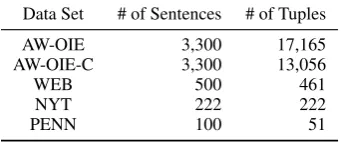
We use four different benchmark datasets to train and test the models. The datasets are AW-OIE (Stanovsky et al., 2018), WEB and NYT (de S´a Mesquita et al.,2013) and PENN (Xu et al.,
Data Set # of Sentences # of Tuples
AW-OIE 3,300 17,165 AW-OIE-C 3,300 13,056
WEB 500 461
NYT 222 222
[image:5.595.95.266.64.135.2]PENN 100 51
Table 2: Data sets used in this work
AW-OIE corpus was created by extending the OIE2016 corpus released by (Stanovsky and Da-gan, 2016). OIE2016 (Stanovsky and Dagan,
2016) was created by an automatic translation from question-answering driven semantic role la-beling annotations (He et al., 2015). (Stanovsky et al., 2018) extended these techniques and ap-ply them to the QAMR corpus (Michael et al.,
2018) to create AW-OIE. This dataset is the largest dataset available for supervised open information extraction.
However, when we observe the information ex-tracted from this dataset, we notice that the dataset is not accurate enough to be considered as a bench-mark dataset. We often find missing relations and noise introduced during the automatic generation process. To solve this problem, we manually in-spect the dataset and find several patterns causing this noise in the dataset. We use these patterns to filter out noisy and missing relations from the dataset and call the cleaned data set ‘AW-OIE-C’.
The WEB dataset represents the challenges of dealing with web text. This contains many incom-plete and grammatically unsound sentences. NYT contains formal, well written news stories from the New York Times Corpus. The PENN dataset was created from PENN Tree Bank. We use AW-OIE-C for training and testing purpose and other three datasets only for testing. We use 8,000 instances from AW-OIE-C to trainSenseOIEand 1,456 in-stances to test all the models. We set aside 3,600 instances for a new experiment described in Sec-tion3.4.
3.3 Performance Evaluation
In this section, we report the utility of our model by comparing its performance with the baseline systems on the four datasets (AW-OIE-C, WEB, NYT and PENN).
Evaluation Metric and Matching Function
We compare the systems using precision, recall and F1-score. In order to compute the measures, we need to match the automated extractions by the
systems and the ground truth extractions. In this work, we compute the measures based on tuple-level matching and word-tuple-level matching. Word-level matching has been used for the evaluation metric for many NER systems. For each word, we match the tag generated by the system with the word’s label.
Tuple-level matching is used in other Open IE systems (Stanovsky et al.,2018;Cui et al.,2018). It is done by mapping extracted tuples with their corresponding benchmark tuples. One strategy for tuple matching would be to enforce an exact match by matching the boundaries of the extracted and benchmark tuples in text. However, as noted in earlier works (Stanovsky et al., 2018; Schneider et al., 2017), this method penalizes different but equally valid arguments, which are resulted from different annotation styles employed by different Open IE systems. Therefore, dealing with multi-ple OIE systems requires a less restrictive match-ing strategy. (Schneider et al., 2017) introduced
relaxed containment strategy. With this strategy, extractions are counted correct as long as they contain all gold standard arguments. (Stanovsky et al., 2018) used a partial matching strategy al-lowing some variability (e.g., omissions of prepo-sitions or auxiliaries) in the predicted tuples.
Following these works, we also use a partial matching strategy that allows all these kind of vari-abilities. We consider each argument or predicate correct, if it partially matches with the benchmark data over a certain threshold. This threshold can control the leniency or strictness of the matching function. This metric allows a more balanced and fair comparison between systems which can ex-tract potentially correct arguments beyond bench-mark extraction.
Comparison with the Baseline Systems Ta-ble3shows the tuple-level F1-score ofSenseOIE
and the benchmark systems. As we can see,
SenseOIE outperforms all baseline systems with a large difference. On the AE-OIE-C dataset,
SenseOIE achieves the highest F1-score of 0.79. In comparison with the unsupervised Open IE methods, the performance gain of SenseOIE
AW-OIE-C Web NYT PENN AW-OIE
SenseOIE 0.79 0.66 0.41 0.52 0.72
RnnOIE - 0.67 0.35 0.44 0.62
OpenIE5 0.58 0.46 0.29 0.34 -Stanford OpenIE 0.19 0.24 0.21 0.31 -UKG 0.41 0.23 0.15 0.21 -Majority Votes 0.40 0.42 0.24 0.27
-Table 3: Performance (F1-score) comparison ofSenseOIEand the baseline systems
datasets. As the test data from AW-OIE-C follows the same annotation style as the training data, the performance ofSenseOIEis much higher on this dataset compared to other datasets.
Figure 3 shows the comparison results based on the word level F1-scores. The results also demonstrate thatSenseOIE works better than the other systems. Especially,SenseOIEshows much higher accuracy in detecting words belonging to the arguments and the relation, but a slightly lower accuracy for other words.
(a) (b)
(c) (d)
Figure 3: Word level F1-score comparison
Feature Ablation Study To investigate the con-tribution of each feature type on SenseOIE, we conducted a feature ablation study. Table4shows the F1-scores of several variations built with a dif-ferent subset of our features. We note that the performance of SenseOIE is, on aevrage, 92% higher than the model using only the ‘Embedding Features’, which is similar to the features used in other supervised Open IE systems (Stanovsky et al., 2018; Cui et al., 2018). Overall the per-formance gain ranges from 13% to 156%. This performance boost proves that using an ensemble
of multiple unsupervised OpenIE systems is very effective. The results also show that the ensem-ble of unsupervised Open IE results is more ef-fective than the embedding features, and the com-bined features of the embeddings and Open IE re-sults produce the best rere-sults. Surprisingly model without features from dependency parse tree out-performs SenseOIE in 2 out of 4 datasets. This might be indicator that simple concatenation is not the best way to include features from dependency tree.
3.4 SenseOIEas Annotator
SinceSenseOIEoutperforms the baseline systems by a large margin, we investigate if SenseOIE
can be used to bootstrap a supervised Open IE model for new domains by automatically produc-ing annotated data. Previously, (Cui et al.,2018) used OpenIE4 (Mausam, 2016b), an earlier ver-sion of OpenIE5, to automatically create a train-ing dataset. The limitation of their approach is that using only one OpenIE system’s extraction as ground truth will result in biased and low coverage of extracted relations. As each of the unsupervised OpenIE systems has it’s own rules to extract differ-ent relations, applying only one system might miss other potential relations that can be extracted by other Open IE systems. However, sinceSenseOIE
learns from multiple existing Open IE systems, it can extract many different relation types.
For this purpose, we runSenseOIEon the 3,600 instances from AW-OIE-C and use its extraction results as the ground truth to train a supervised model. We name this new modelSupervisedOIE
[image:6.595.77.278.372.564.2]pre-AW-OIE-C Web NYT PENN
[image:7.595.149.448.73.134.2]Embedding Features 0.42 0.58 0.16 0.27 Open IE Result Features 0.70 0.54 0.38 0.47 Embedding + Open IE Result Features 0.78 0.69 0.45 0.51 All Features 0.79 0.66 0.41 0.52
Table 4: Performance (F1-score) comparison of different feature sets. ‘Embedding Features’ denotes the concate-nated set of word embedding, POS embedding and syntactic role embedding. ‘Open IE Result Features’ include only theEORtags generated by the three unsupervised Open IE systems. ‘All Features’ consists of all the features as described in Section2.2.
vious word comes from ground truth and during testing this value is predicted by the model. This feature is useful to generate multiple sequences of extractions from a single sentence. However, note that this model does not use the results of unsu-pervised systems as features. Figure4 shows the architecture and features ofSupervisedOIE.
During the inference time, to extract multiple relations from a single sentence, we use beam search to find multiple possible labels for each word. Instead of greedily choosing the most likely next step as the sequence is constructed, the beam search expands all possible next steps and keeps thekmost likely results, wherekis a user-specified parameter and controls the number of beams or parallel searches through the sequence of probabilities. Figure5shows an example of beam search predicting multiple relation extraction se-quences from one sentence.
To validate the effectiveness of SenseOIE as an annotator model, we compareSupervisedOIE’s performance when trained with the human la-beled data and SenseOIE’s extractions. As with
SenseOIE, both models are initialized with the pre-trained word embedding and randomly initial-ize the part-of-speech and syntactic role embed-dings. In this experiments, we set the beam size to 3 which gives an overall best performance. Ta-ble 5 shows the results from these two models. We can see that both models achieve similar F1-scores on the four test dataset. These results sup-portsSenseOIE’s role as a digital annotator for un-labeled dataset.
4 Related Work
Early Open IE systems apply handcrafted rules or self-supervised learning paradigm, where the extraction results which satisfy a set of syntac-tic constraints are considered as positive exam-ples and the results which do not satisfy the
con-AW-OIE-C Web NYT PENN
Human Labels 0.55 0.51 0.23 0.27
SenseOIELabels 0.54 0.50 0.23 0.23
Table 5: Performance (F1-score) of SupervisedOIE
trained with the human-labeled data vs. labeled data generated bySenseOIE
strains are considered as negative examples. Tex-tRunner (Banko et al., 2007) is the first domain-independent Open IE system.ReVerb(Fader et al.,
2011) extracts verbal propositions from part of speech tags using a logistic regression classifier. OLLIE (Mausam et al., 2012) is built on Re-Verband extracts relations from syntactic and lex-ical dependency patterns. ClausIE (Corro and Gemulla,2013) first classifies clauses into clause types and extract tuples based on the clause type using predefined rules. Followed by these sys-tems, Stanford OpenIE (Angeli et al., 2015) and OpenIE5 are developed by combining several dif-ferent approaches as described in details in Sec-tion 3.1. Further, several systems focusing on a specialized constructs were developed, including noun-mediated relations (Pal and Mausam,2016), n-ary relations (Akbik and L¨oser, 2012), nested propositions (Bhutani et al.,2016) and numerical Open IE (Saha et al.,2017a).
Figure 4: Model Architecture of a newSupervisedOIE
Figure 5: Example of beam search predicting multiple relation extraction sequences from one sentence
they train the model using the results of Ope-nIE4 (Mausam, 2016a) as labeled training data and evaluate the model using the human-labeled data from (Stanovsky and Dagan, 2016) as Rn-nOIE (Stanovsky et al., 2018). (Sun et al.,
2018) present a supervised neural Open IE model for Chinese information extraction. They apply an attention-based sequence-to-sequence learning similarly to (Cui et al.,2018). However, they use the gated dependency attention mechanism based on the shortest path between a pair of words in the sentence’s dependency tree. We do not compare our model with this system because it supports dif-ferent target types and languages.
5 Conclusion
We propose a new Open IE paradigm which com-bines supervised learning and unsupervised Open IE systems. Our model uses the results of existing Open IE systems as features in addition to other linguistic features and then optimize the model ing a small amount of labeled data. Validation us-ing several benchmark data sets generated for the Open IE task shows that our method is very ef-fective outperforming both other supervised and unsupervised Open IE systems.
Further, we investigate if our model can be
applied to automatically generate annotated data to train a new supervised model for a new task. The experiment shows that a supervised model trained with the model-generated data performes similarly as the model trained with human labeled data. This result shows that our approach can over-come the cold-start problem in machine learning by leveraging existing unsupervised systems.
6 Acknowledgment
We gratefully acknowledge IBM for supporting this work.
References
Alan Akbik and Alexander L¨oser. 2012. Kraken: N-ary facts in open information extraction. InProceedings of the Joint Workshop on Automatic Knowledge Base Construction and Web-scale Knowledge Extraction, AKBC-WEKEX@NAACL-HLT 2012, pages 52–56.
[image:8.595.117.487.203.344.2]Michele Banko, Michael J. Cafarella, Stephen Soder-land, Matthew Broadhead, and Oren Etzioni. 2007. Open information extraction from the web. In Pro-ceedings of the 20th International Joint Conference on Artificial Intelligence (IJCAI), pages 2670–2676.
Nikita Bhutani, H. V. Jagadish, and Dragomir R. Radev. 2016. Nested propositions in open infor-mation extraction. In Proceedings of the 2016 Conference on Empirical Methods in Natural Lan-guage Processing, EMNLP 2016, Austin, Texas, USA, November 1-4, 2016, pages 55–64.
Franc¸ois Chollet et al. 2015. Keras. https:// keras.io.
Janara Christensen, Stephen Soderland, Oren Etzioni, et al. 2011. An analysis of open information extrac-tion based on semantic role labeling. InProceedings of the sixth international conference on Knowledge capture, pages 113–120. ACM.
Luciano Del Corro and Rainer Gemulla. 2013. ClausIE: clause-based open information extraction. In 22nd International World Wide Web Conference (WWW), pages 355–366.
Lei Cui, Furu Wei, and Ming Zhou. 2018. Neural open information extraction. InProceedings of the 56th Annual Meeting of the Association for Compu-tational Linguistics (ACL), pages 407–413.
Anthony Fader, Stephen Soderland, and Oren Etzioni. 2011. Identifying relations for open information ex-traction. InProceedings of the 2011 Conference on Empirical Methods in Natural Language Processing (EMNLP), pages 1535–1545.
Anthony Fader, Luke Zettlemoyer, and Oren Etzioni. 2014. Open question answering over curated and extracted knowledge bases. In The 20th ACM SIGKDD International Conference on Knowledge Discovery and Data Mining (KDD), pages 1156– 1165.
Luheng He, Mike Lewis, and Luke Zettlemoyer. 2015. Question-answer driven semantic role labeling: Us-ing natural language to annotate natural language. In Proceedings of the 2015 Conference on Em-pirical Methods in Natural Language Processing (EMNLP), pages 643–653.
Amina Kadry and Laura Dietz. 2017. Open rela-tion extracrela-tion for support passage retrieval: Merit and open issues. In Proceedings of the 40th In-ternational ACM SIGIR Conference on Research and Development in Information Retrieval, Shin-juku, Tokyo, Japan, August 7-11, 2017, pages 1149– 1152.
Tushar Khot, Ashish Sabharwal, and Peter Clark. 2017. Answering complex questions using open informa-tion extracinforma-tion. InProceedings of the 55th Annual Meeting of the Association for Computational Lin-guistics (ACL): Short Paper, pages 311–316.
Mausam. 2016a. Open information extraction systems and downstream applications. InProceedings of the Twenty-Fifth International Joint Conference on Ar-tificial Intelligence (IJCAI), pages 4074–4077.
Mausam, Michael Schmitz, Stephen Soderland, Robert Bart, and Oren Etzioni. 2012. Open language learning for information extraction. In Proceed-ings of the 2012 Joint Conference on Empirical Methods in Natural Language Processing and Com-putational Natural Language Learning (EMNLP-CoNLL), pages 523–534.
Mausam Mausam. 2016b. Open information extraction systems and downstream applications. In Proceed-ings of the Twenty-Fifth International Joint Con-ference on Artificial Intelligence, pages 4074–4077. AAAI Press.
Julian Michael, Gabriel Stanovsky, Luheng He, Ido Dagan, and Luke Zettlemoyer. 2018. Crowdsourc-ing question-answer meanCrowdsourc-ing representations. In
Proceedings of the 2018 Conference of the North American Chapter of the Association for Computa-tional Linguistics: Human Language Technologies (NAACL-HLT), Short Paper, pages 560–568.
Tomas Mikolov, Kai Chen, Greg Corrado, and Jef-frey Dean. 2013. Efficient estimation of word representations in vector space. arXiv preprint arXiv:1301.3781.
Harinder Pal and Mausam. 2016. Demonyms and compound relational nouns in nominal open IE. In Proceedings of the 5th Workshop on Automated Knowledge Base Construction, AKBC@NAACL-HLT 2016, pages 35–39.
Harinder Pal et al. 2016. Demonyms and compound relational nouns in nominal open ie. InProceedings of the 5th Workshop on Automated Knowledge Base Construction, pages 35–39.
Benjamin Roth, Costanza Conforti, Nina P¨orner, San-jeev Karn, and Hinrich Sch¨utze. 2018. Neural archi-tectures for open-type relation argument extraction.
CoRR, abs/1803.01707.
Filipe de S´a Mesquita, Jordan Schmidek, and Denilson Barbosa. 2013. Effectiveness and efficiency of open relation extraction. InProceedings of the 2013 Con-ference on Empirical Methods in Natural Language Processing (EMNLP), pages 447–457.
Swarnadeep Saha, Harinder Pal, and Mausam. 2017a. Bootstrapping for numerical open IE. In Proceed-ings of the 55th Annual Meeting of the Association for Computational Linguistics (ACL), Short paper, pages 317–323.
Swarnadeep Saha et al. 2018. Open information ex-traction from conjunctive sentences. InProceedings of the 27th International Conference on Computa-tional Linguistics, pages 2288–2299.
Rudolf Schneider, Tom Oberhauser, Tobias Klatt, Fe-lix A. Gers, and Alexander L¨oser. 2017. Analysing errors of open information extraction systems.
CoRR.
Mike Schuster and Kuldip K. Paliwal. 1997. Bidirec-tional recurrent neural networks. IEEE Trans. Sig-nal Processing, 45(11):2673–2681.
Stephen Soderland, Brendan Roof, Bo Qin, Shi Xu, Mausam, and Oren Etzioni. 2010. Adapting open information extraction to domain-specific relations.
AI Magazine, 31(3):93–102.
Gabriel Stanovsky and Ido Dagan. 2016. Creating a large benchmark for open information extraction. In Proceedings of the 2016 Conference on Em-pirical Methods in Natural Language Processing (EMNLP), pages 2300–2305.
Gabriel Stanovsky, Julian Michael, Luke Zettlemoyer, and Ido Dagan. 2018. Supervised open information extraction. InProceedings of The 16th Annual Con-ference of the North American Chapter of the Asso-ciation for Computational Linguistics: Human Lan-guage Technologies (NAACL HLT), pages 885–895.
Mingming Sun, Xu Li, Xin Wang, Miao Fan, Yue Feng, and Ping Li. 2018. Logician: A unified end-to-end neural approach for open-domain information ex-traction. InProceedings of the Eleventh ACM Inter-national Conference on Web Search and Data Min-ing (WSDM), pages 556–564.
Kai Sheng Tai, Richard Socher, and Christopher D Manning. 2015. Improved semantic representations from tree-structured long short-term memory net-works. In Proceedings of the 53rd Annual Meet-ing of the Association for Computational LMeet-inguistics and the 7th International Joint Conference on Natu-ral Language Processing, pages 1556–1566.
Ying Xu, Mi-Young Kim, Kevin Quinn, Randy Goebel, and Denilson Barbosa. 2013. Open information ex-traction with tree kernels. In Proceedings of the 2013 Conference of the North American Chapter of the Association for Computational Linguistics: Hu-man Language Technologies, pages 868–877.