Do LSTMs really work so well for PoS tagging? –
A replication study
Tobias Horsmann and Torsten Zesch
Language Technology Lab
Department of Computer Science and Applied Cognitive Science University of Duisburg-Essen, Germany
{tobias.horsmann,torsten.zesch}@uni-due.de
Abstract
A recent study byPlank et al.(2016) found that LSTM-based PoS taggers consider-ably improve over the current state-of-the-art when evaluated on the corpora of the Universal Dependencies project that use a coarse-grained tagset. We replicate this study using a fresh collection of 27 cor-pora of 21 languages that are annotated with fine-grained tagsets of varying size. Our replication confirms the result in gen-eral, and we additionally find that the ad-vantage of LSTMs is even bigger for larger tagsets. However, we also find that for the very large tagsets of morphologically rich languages, hand-crafted morpholog-ical lexicons are still necessary to reach state-of-the-art performance.
1 Introduction
Part-of-Speech (PoS) tagging is an important pro-cessing step for many NLP applications. When researchers want to use a PoS tagger, they would ideally choose an off-the-shelf PoS tagger which is optimized for a specific language. If a suited tagger is not available two options remain: a) im-plementation of your own tagger, which requires technical knowledge and experience, or b) us-ing an existus-ing tagger and hope that the resultus-ing model will be sufficiently accurate. One can as-sume that many taggers fit more languages than the one for which they have been constructed orig-inally. Ideally, researchers should be able to fall back to a well-evaluated language-independent tagger if no reference implementation for a lan-guage is available.
A recent study by Plank et al. (2016) evalu-ated an LSTM PoS tagger and compared the re-sults to Conditional Random Fields (CRF) (
Laf-ferty et al., 2001) and Hidden-Markov (HMM)
implementations on corpora of various languages. Their evaluation concludes that the LSTM tagger reaches better results than the CRF and HMM tag-ger. The evaluation corpora were all annotated with acoarse-grainedtagset with 17 tags. Thus, this LSTM tagger seems to be a well-performing, language-independent choice for learning models on coarse-grained tagsets. While for many tasks a coarse-grained tagset might be sufficient some tasks require more fine-grained tagsets.
We, thus, consider it worthwhile to explore if the results are reproducible using corpora with fine-grained tagsets. We use the LSTM tagger pro-vided byPlank et al.(2016) and compare the re-sults likewise to CRF and an off-the-shelf HMM tagger implementation. We compile a fresh set of 27 corpora of 21 languages which uses the com-monly used fine-grained tagset of the respective language. We suggest these corpora as evaluation set for tasks which require fine-grained PoS tags, as all corpora are freely available for research pur-poses. Our intention is to replicate the findings of
Plank et al.(2016), which have been achieved on a
coarse-grained tagset and investigate if they trans-fer to fine-grained tagsets.
2 PoS Tagger Paradigms
We distinguish two PoS tagger paradigms, which can be used to implement a tagger: The first one isFeature Engineering, in which a classifier learns a mapping from human-defined features to a PoS tag. Defining good features is often a non-trivial task, which furthermore requires a lot of experi-ence. For instance a suffix feature which checks a word-ending for “ing” is highly discriminative for English gerunds, but might not provide any useful information for other languages. The de-tails of the feature implementation might render a
Tokens
Group Corpus Id Source (103) # Tags Annotation Reference
Germanic
Danish Copenhagen DTB 255 36 manual (Buch-Kromann and Korzen,2010)
Dutch Alpino 200 20 manual (Bouma et al.,2000)
English Brown 1,100 180 manual (Nelson Francis and Kuçera,1964)
German-1 Hamburg DTB 4,800 54 manual (Brants et al.,2004)
German-2 Tiger 880 54 manual (Telljohann et al.,2004)
German-3 Tüba-D/Z 1,500 54 manual (Foth et al.,2014)
Icelandic Mim 1,000 703 auto (Helgadóttir et al.,2012)
Norwegian Norwegian DTB 1,300 19 manual (Solberg et al.,2014)
Swedish-1 Talbanken 96 25 manual (Einarsson,1976)
Swedish-2 Stockholm-Umea 1,100 153 manual (Ejerhed and Källgren,1997)
Romanic
Braz.Portuguese MAC-Morpho 1,000 82 manual (Aluísio et al.,2003)
French-1 Multitag 370 992 manual (Paroubek,2000)
French-2 Sequoia 200 29 manual (Candito et al.,2014)
Italian Turin Parallel 80 15 auto (Bosco et al.,2012)
Spanish IULA DTB 550 241 manual (Marimon et al.,2014)
Sla
vic
Croatian-1 Croatian DTB 200 692 manual (Željko Agi´c and Ljubeši´c,2014)
Croatian-2 Hr500k 500 769 manual (Ljubeši´c et al.,2016)
Czech Prague DTB 2,000 1,574 manual (Bejˇcek et al.,2013)
Polish Polish National Corpus 1,000 27 manual (Przepiórkowski et al.,2008) Russian Russian Open Corpus 1,700 22 manual (Bocharov et al.,2013)
Slovak MULTEXT-East 84 956 manual (Erjavec,2010)
Slovene-1 IJS-ELAN 540 1,181 auto (Erjavec,2002)
Slovene-2 SSJ 590 1,304 manual (Krek et al.,2013)
Others
Afrikaans AfriBooms 50 12 manual (Augustinus et al.,2016)
Finnish FinnTreebank 170 1573 manual (Voutilainen,2011)
[image:2.595.72.522.73.392.2]Hebrew HaAretz Corpus 11,000 22 auto (Itai and Wintner,2008) Hungarian The Szeged Treebank 1,200 1,085 manual (Csendes et al.,2005)
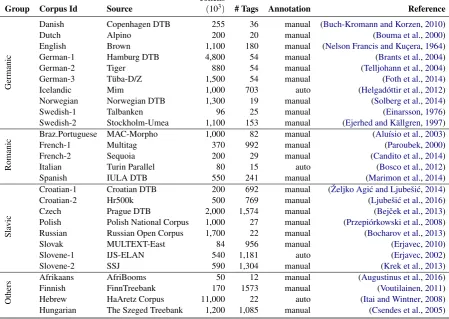
Table 1: Corpora used in our experiments
tagger unsuited for learning models for other lan-guages or tagsets. We will, thus, experiment with features and their configurations, and investigate how well they perform in combination for learn-ing fine-grained tagsets of various languages. We implement those experiments using CRF which are frequently used for PoS tagging (Remus et al.,
2016;Ljubeši´c et al.,2016).
The second paradigm isArchitecture Engineer-ing, which relies on methods to learn the input representation by themselves. The challenge lies in finding an architecture that supports this self-learning process. Most recent representatives of this paradigm are neural networks of which we use the LSTM tagger provided byPlank et al.(2016). In our experiments, we will focus on how to provide word- and character-level information to the classifiers as these two types of information are most relevant and most frequently used for training PoS tagger models. Furthermore, we will evaluate the performance on Out-Of-Vocabulary (OOV) words to learn if the taggers generalize to unseen words.
To provide a reference value to a well-known PoS tagger, we will compare all results to the HMM-based HunPos (Halácsy et al., 2007) tag-ger, which is a freely available re-implementation of the TNT tagger (Brants, 2000). HunPos has been used before for training models of various languages and tagsets (Seraji,2011;Attardi et al.,
2010;Hládek et al., 2012) which is why we
con-sider this tagger to be a suitable baseline.
3 Evaluation Corpora Dataset
Table1shows the fine-grained annotated corpora we collected by screening the literature. We do not claim that this list is complete, but the provided corpora are all reasonably easy to access and can be freely used for research purposes.
morpho-DanishDutchEnglish German-1German-2German-3IslandicNorwe
gian
Swedish-1Swedish-2B-Portug.French-1French-2 ItalianSpanish
Croatian-1Croatian-2CzechPolishRussianSlo vak
Slovene-1Slovene-2AfrikaansFinnishHebre w
Hung arian 0
10 20 30 40 50 60 70 80 90 100
OTHER SLAVIC
ROMANIC GERMANIC
percent
of
data
X VERB
[image:3.595.73.289.64.247.2]SYM SCONJ PUNCT PROPN PRON PART NUM NOUN INTJ DET CONJ AUX ADV ADP ADJ
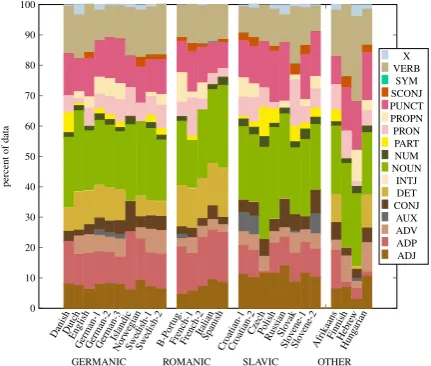
Figure 1: Coarse-grained PoS tag distribution of corpora by language group
logical analysis which is a different task than the tagging task on which we are focusing here. Most corpora are manually annotated or were at least human-verified. There are four exceptions which we decided to add anyway to increase the number of languages represented in our setup. The tagset granularity of the corpora ranges from coarse (12 tags) to morphologically fine (1574 tags) to evalu-ate all taggers on various stages of granularity.
Language & Corpora Diversity We analyzed the distribution of PoS tags in the corpora by map-ping all tags to the 17 coarse-grained PoS tags of the Universal Dependencies (UD) project (Nivre
et al., 2015) in Figure 1. The mappings to the
UD tagset have been manually created. The partly large differences between the syntactical classes help to better understand the challenge in con-struction a tagger that is suited for all those guages. For instance, Germanic and Romanic lan-guages have a lot of determiners while they do not occur at all in Slavic languages.
Corpus Size & Tagset The corpora have vary-ing sizes which makes a direct comparison be-tween corpora difficult. To run our experiments under fully controlled conditions, we extract a ran-domized sub-sample of sentences from each cor-pus, which accounts for 50k tokens, and run all our experiments with 10fold cross-validation (CV).1
Results reported use the fine-grained tagset of the respective corpus.
1While randomization prohibits exact reproducibility, it is
no barrier to the more interesting replicability. It is also less prone to continued overfitting on the known test set.
We deliberately do not use the corpora from the UD Treebank project in order to provide results on a fresh dataset. Additionally, UD uses a coarse-grained tagset for all its corpora. While this gran-ularity is sufficient for many tasks, linguistic anal-ysis often requires more fine-grained tagsets, and it is not clear whether results achieved on coarse-grained tagsets transfer well to more fine-coarse-grained tagsets. The collected corpora, thus, also represent an alternative dataset, which we suggest in case the UD tagset is too coarse-grained.
4 CRF Experiments
We reviewed the recent literature to determine the most commonly used features for training PoS tag-gers. As re-occurring features, we found word ngrams, fixed character sequences focusing on ei-ther pre-, in-, or suffixes of words and word dis-tributional knowledge for PoS taggers of various languages (Brants, 2000; Horsmann and Zesch,
2016;Ljubeši´c et al.,2016). Word- and
character-ngrams have been used with various parametriza-tions depending on the language and there is no agreement which parameters are most advisable. We will, hence, run a series of parameter-search experiments over the word- and character-ngram parametrization to determine a configuration ap-plicable to all languages. For this, we evaluate all permutations of the subsequently introduced fea-ture configurations with 10fold cross-validation. The objective is to find a configuration that works well on all corpora, languages, and tagsets.
Word Features We experiment with adding the 1,2,3 words to the right and left of the current word as lower-cased string features.
Character Features Which character-ngram is discriminative for a PoS tag strongly depends on the language. To avoid a language bias, we use a frequency-based approach in which we select the N most frequently occurring character-ngrams of length 1,2,3,4 from the training dataset. We ex-periment with the following frequency cut-off val-ues of N ε {250,500,750,1000} to select only frequent and potentially informative character-ngrams as features. TheseNfeatures are boolean and are set to 1 if the respective character-ngram occurs in the current word.
Semantic Features We use Brown clustering
Word Top 750
Lang. Ngrams±1 Char Ngrams Clusters Best CRF HunPos
Group Corpus Id All OOV All OOV All OOV All OOV All OOV
Germanic
Danish 90.9 53.3 90.3 69.3 89.5 67.6 96.1 82.4 94.9 74.2 Dutch 86.5 66.9 85.0 71.7 88.0 77.7 90.7 83.7 89.9 80.6 English 87.5 45.1 90.3 70.1 89.1 64.0 94.6 80.2 93.8 77.7 German-1 88.5 62.4 90.3 77.7 90.8 73.7 94.6 84.6 94.4 83.7 German-2 87.2 60.3 90.9 77.7 90.8 76.1 95.2 87.1 94.9 85.4 German-3 86.3 58.5 91.7 76.8 91.6 77.6 94.4 85.0 94.4 83.9 Icelandic 67.5 14.2 76.5 45.1 68.3 28.9 80.9 53.6 79.8 51.9 Norwegian 92.4 77.1 91.6 80.6 92.8 82.7 96.1 89.7 95.5 86.5 Swedish-1 91.1 70.6 92.9 82.2 92.3 79.9 96.3 90.3 95.6 85.9 Swedish-2 78.7 29.7 87.2 67.3 81.4 48.8 91.0 74.6 91.4 77.6
Romanic
B-Portug. 86.9 62.8 87.8 73.6 89.7 76.0 92.8 83.8 93.3 84.2 French-1 81.9 40.1 85.9 66.5 81.6 58.2 89.2 75.7 88.2 71.8 French-2 95.4 67.3 93.8 74.5 91.9 79.3 97.7 88.2 97.4 82.4 Italian 93.3 68.6 91.6 74.8 91.7 75.5 96.4 86.5 95.8 80.8 Spanish 88.5 45.5 94.5 78.2 88.1 58.8 96.4 83.5 96.6 83.6
Sla
vic
Croatian-1 69.0 18.6 80.6 56.3 75.2 47.2 84.9 65.4 84.7 66.7 Croatian-2 66.3 15.9 78.5 54.4 73.5 44.8 83.4 63.9 82.6 63.9 Czech 64.1 14.4 79.2 56.0 75.2 39.2 83.1 62.9 81.7 60.9 Polish 82.9 58.1 92.5 86.9 86.5 72.5 95.5 91.5 93.6 85.4 Russian 83.7 53.7 93.0 83.5 88.2 70.9 95.5 87.5 94.6 83.6 Slovak 67.7 14.9 80.5 57.8 65.6 31.9 83.5 63.8 82.9 61.6 Slovene-1 72.6 17.4 83.5 55.6 72.4 39.4 86.4 62.5 82.6 59.6 Slovene-2 65.4 12.1 78.2 50.5 73.0 39.0 83.0 59.4 86.2 59.5
Other
[image:4.595.109.484.62.458.2]Afrikaans 95.7 75.0 95.3 80.3 95.8 81.9 97.8 89.6 97.3 85.5 Finnish 62.6 10.0 77.1 48.5 67.8 33.8 82.3 56.7 81.3 55.8 Hebrew 82.3 41.7 81.3 60.9 76.3 53.3 90.5 68.5 90.3 60.1 Hungarian 72.7 13.9 86.7 63.3 72.0 31.7 89.9 69.6 89.4 69.5
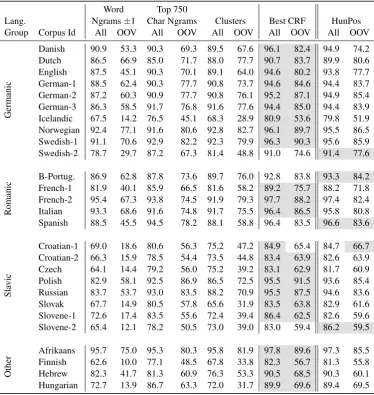
Table 2: Accuracy of CRF taggers (10fold CV)
unlabelled text is obtained from the Leipzig Cor-pus Collection (Quasthoff et al.,2006), which pro-vides large text quantities crawled from the web for many languages. We use 15·106tokens to
cre-ate the clusters from the same amount of text for all languages. We provide the cluster ids in sub-strings of varying length to the classifier (Owoputi
et al.,2013).
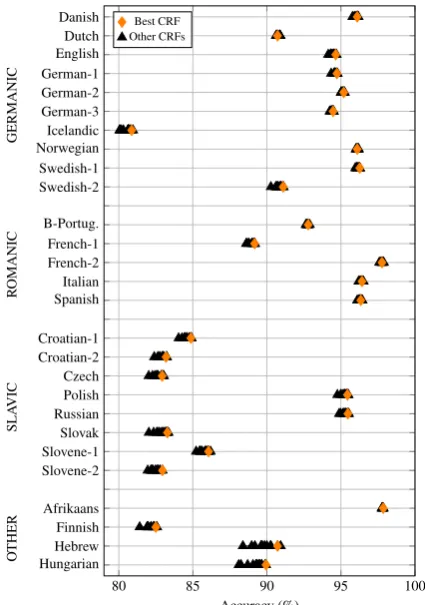
Results In Figure 2, we show the results of our parameter search experiment. The triangles mark the results of the various feature configu-rations. The diamond symbol shows the config-uration which works best over all corpora. We refer to this best working configuration as Best CRF subsequently, it uses a word-context win-dow of 1 word to the left and right and the 750 most frequent character [1..4] grams with additionally adding word clusters. Especially for morphologically-rich languages, the spread is
quite large which is caused by the lower number of character-ngrams in those configurations. For corpora such asSlovene-1, we see that more accu-rate configurations exist thanBest CRF but more importantly, the selected configuration is always among the best working ones.
80 85 90 95 100 HungarianHebrew
Finnish Afrikaans Slovene-2 Slovene-1 Slovak RussianPolish Czech Croatian-2 Croatian-1 SpanishItalian French-2 French-1 B-Portug. Swedish-2 Swedish-1 NorwegianIcelandic German-3 German-2 German-1 EnglishDutch Danish
GERMANIC
ROMANIC
SLA
VIC
O
THER
Accuracy (%) Best CRF
[image:5.595.71.284.60.363.2]Other CRFs
Figure 2: Variance of CRF taggers (10fold CV)
all kinds of character-ngrams. The cluster feature also performs better than the word-ngrams. Con-sidering that we had to limit the amount of data for creating the clusters for comparability, this feature assumedly has more potential when using larger data sizes (Derczynski et al.,2015). The combina-tion of all features in the columnBest CRFshows that the features address quite different informa-tion and add up well, so unsurprisingly, this con-figuration reaches the overall best accuracies. The difference to HunPos is, with often less than one percent point difference, only small. Off-the-shelf taggers do, hence, not necessary have a disadvan-tage over constructing an own tagger. In the re-mainder of this work, we will use theBest CRF configuration when discussing CRF tagger results.
5 LSTM Experiments
When using neural networks, the details of how word and character information is provided greatly influences the learning success of the network. We will reproduce network setups which have also been used inPlank et al.(2016) to ensure compa-rability to the coarse-grained results to which we compare our results:
Word In this setup, we train a network on the word embeddings only and provide them to a bidi-rectional LSTM. This setup will serve as baseline.
Char The character embeddings of a word are provided to a bidirectional LSTM. The last state of the forward and the backward character LSTM are combined (Ling et al.,2015) and provided to another bidirectional LSTM layer.
Word-Char This architecture is a combination of the previous two architectures. The last state of the character LSTMs is added to the word embed-ding information before it is provided to the next LSTM layer.
Word-Char+ The architecture by Plank et al.
(2016) combines word and character level in-formation and additionally considers the log-frequency of the next word during training. This tagger reported state-of-the-art results and we use the provided reference implementation of this tag-ger in our setup.
LSTMs have the reputation to require larger amounts of training data. With the 50k tokens we use this is barely fulfilled, however, Plank et al.
(2016) find this sensitivity to be less severe and set a corpus size of 60k tokens as lower bound for their coarse-grained tagging experiments. We will come back to this data size issue in Section
7, where we evaluate using all tokens in a corpus (and arriving at the same conclusions as for our 50k token datasets). Furthermore, in many cases only smaller dataset sizes are available, sometimes even less than 50k tokens. It is, thus, important to know if considering neural network taggers makes sense at all (on fine-grained tagsets), thus we will train LSTM models on smaller dataset sizes.
We implement the LSTM taggers in DyNet
(Neubig et al.,2017) and use the hyper-parameter
settings by Plank et al. (2016), i.e. we train 20 epochs using Statistical-Gradient-Descent with a learning rate of 0.1 and adding Gaussian noise of 0.2 to the embedding layer. We train word embed-dings on the data we already used for thesemantic featurein the CRF experiments by usingfastText
(Bojanowski et al.,2016) . The the character-level
embeddings are trained on-the-fly.
70 75 80 85 90 95 100 Danish
Dutch English German-1 German-2 German-3 Icelandic Norwegian Swedish-1 Swedish-2
B-Portug. French-1 French-2 Italian Spanish
Croatian-1 Croatian-2 Czech Polish Russian Slovak Slovene-1 Slovene-2
Afrikaans Finnish Hebrew Hungarian
GERMANIC
ROMANIC
SLA
VIC
O
THER
[image:6.595.72.283.60.365.2]Accuracy % Char Word-Char Word Word-Char+
Figure 3: Variance of LSTM taggers (10fold CV)
architecture. For the Germanic and Romanic lan-guages, the accuracy of the various architectures is similar but for Slavic languages, which use much more fine-grained tagsets, the differences are rather large. For instance, the Char archi-tecture reaches only small improvements over the Word baseline on Croatian or Czech while on Spanish, or Hungarianthe character architecture is clearly better than the baseline. Table 3shows the detailed results and additionally reports the accuracy values on OOV with best results high-lighted in grey. TheChararchitecture is in many cases competitive to the HunPos reference system. This shows that the performance of many off-the-shelf taggers is rather easy to approximate by re-lying only on character-level information.
The results by the Char architecture also ex-plains why the Word-Char architecture performs so well although the amount of syntactical infor-mation is quite limited with 50k tokens. A large part of the necessary information is already ob-tained by the character model, which requires a lot less training data than a model on the word level. Thus, the results ofPlank et al.(2016) on coarse-tagsets are reproducible for fine-grained coarse-tagsets
with theWord-Char architecture being the essen-tial property to achieving high accuracy.
6 Influence of Tagset Size
A researcher who works with morphologically rich languages will often be interested in addi-tional morphologic details such as case or gender. This drastically complicates the task, as a few hun-dred instead of a few dozen PoS tag distinctions have to be learned. In this experiment, we will ex-amine the impact of an increasing number of PoS tags on the accuracy of the taggers to provide ref-erence values of how much performance a tagger seems to loose with an increasing tagset size.
Results In Figure 4, we show a comparison of the tagging accuracy in relation to the number of PoS tags. We show the best performing LSTM taggerWord-Char+, theCRFtagger andHunPos. Each data point represents the averaged CV result on one corpus with the respective tagger. We see a certain clustering of the data points for the small tagset sizes, which shows that the taggers tend to perform highly similarly for many languages. This means that the tagset size has a larger effect on the accuracy than the language of the corpus.
For each PoS tagger, a regression trendline is plotted which indicates the average loss in ac-curacy with an increasing tagset size. For one-hundred additional PoS tags, Word-Char+ loses 0.35 points in accuracy, while CRF andHunPoS have a much steeper decay of 0.45 points. Hence, with growing tagset size the tagger choice be-comes increasingly more important. Furthermore, the benefit of more sophisticated tagger architec-tures becomes only apparent on large PoS tagsets. 7 Comparison with Reference Taggers In this experiment, we compare our results to ref-erence taggers from the literature that are tailored towards certain languages. Our experiments un-til now were limited to the fixed dataset size that we set at the beginning for comparability. Espe-cially for the morphologically fine-grained tagsets this might have been problematic, as it is doubtful if all PoS tags of a morphological tagset do even occur on 50k tokens. Thus, in order to evaluate the taggers using all available data, we will reproduce setups reported in the literature and compare the performance of the taggers to those results.
Lang. Word Char Word-Char Word-Char+ HunPos Group Corpus Id All OOV All OOV All OOV All OOV All OOV
Germanic
Danish 94.9 72.7 95.0 79.1 96.4 82.5 96.9 83.4 94.9 74.2 Dutch 91.1 82.3 90.3 83.6 91.6 85.7 92.5 87.1 89.9 80.6 English 91.9 65.9 92.3 77.4 94.1 79.6 94.9 80.9 93.8 77.7 German-1 93.6 78.3 94.1 84.5 95.6 87.6 96.0 88.3 94.4 83.7 German-2 94.5 82.4 94.6 87.1 96.4 90.1 96.8 91.5 94.4 85.4 German-3 93.8 80.3 94.0 84.9 95.8 88.6 96.4 89.8 94.4 83.9 Icelandic 76.0 34.8 76.5 49.3 81.8 56.2 84.1 60.6 79.8 51.9 Norwegian 95.8 86.2 95.7 88.2 96.6 90.3 96.9 90.3 95.5 86.5 Swedish-1 94.9 81.4 95.3 86.7 96.2 89.0 96.7 89.8 95.6 85.9 Swedish-2 86.5 54.3 88.9 74.3 91.8 78.5 92.5 80.4 91.4 77.6
Romanic
B-Portug. 93.3 82.4 93.9 87.4 95.0 90.3 95.1 90.8 93.3 84.2 French-1 87.6 67.0 85.8 72.0 88.7 77.4 89.7 78.7 88.2 71.8 French-2 97.5 80.4 97.4 83.4 98.1 87.7 98.3 88.7 97.4 82.4 Italian 96.0 81.3 95.6 84.2 96.5 85.9 97.1 86.9 95.8 80.8 Spanish 93.1 63.3 96.4 85.5 96.9 86.1 97.2 87.0 96.6 83.6
Sla
vic
Croatian-1 83.2 55.5 83.8 67.5 88.1 72.8 89.1 75.2 84.7 66.9 Croatian-2 80.3 52.4 81.1 63.8 84.9 69.1 86.8 72.4 82.6 63.9 Czech 79.4 49.1 81.0 62.7 85.8 68.7 87.7 72.4 81.7 60.9 Polish 86.9 73.6 89.2 84.7 95.5 91.2 91.2 88.0 93.6 85.4 Russian 91.3 73.2 94.6 85.8 95.3 86.9 96.0 88.4 94.6 83.6 Slovak 78.7 44.9 80.6 65.0 85.3 69.7 86.6 71.4 82.9 61.6 Slovene-1 81.9 44.5 83.9 61.1 86.0 62.6 87.9 65.7 82.6 59.6 Slovene-2 79.9 47.9 82.0 63.4 85.8 67.4 87.5 70.1 86.2 59.5
Other
[image:7.595.114.480.64.441.2]Afrikaans 97.3 82.8 97.1 85.8 97.8 88.4 98.0 90.0 97.3 85.5 Finnish 76.7 42.7 78.0 57.6 82.0 58.9 83.6 61.2 81.3 55.8 Hebrew 89.9 60.2 89.2 66.9 92.2 69.7 92.9 72.1 90.3 60.1 Hungarian 84.7 53.3 88.0 73.1 91.2 76.9 92.0 79.0 89.4 69.5
Table 3: Accuracy of LSTM taggers (10fold CV)
0 500 1,000 1,500
80 85 90 95 100
Number of PoS Tags
Accurac
y
%
Word-Char+ CRF HunPos
Figure 4: Influence of tagset size on accuracy
the same corpora as used in the literature. We, thus, reproduce for Czech the setup by
Spous-tová et al. (2009) with training on 106 and
eval-uation on 2·105 tokens, for German-2 the setup
byGiesbrecht and Evert(2009) and forSwedish-2
the setup byÖstling(2013), which both use 10fold cross-validation over the full corpus size.
Taggers for Slavic languages often make use of additional resources such as morphological dictio-naries, which we intentionally do not include to avoid human-crafted resources that are not avail-able for all languages. Thus, we do not expect to reach state-of-the-art performance, but we want to quantify the size of the gap.
[image:7.595.76.284.519.693.2]language-∆to reference tagger Corpus Id # Tags Acc (%) HunPos CRF Word-Char+
Czech 1,574 95.9 -4.7 -3.2 -1.5
German-2 54 97.6 -0.1 -0.2 0.9
[image:8.595.153.445.61.138.2]Swedish-2 153 96.1 0.0 -0.6 0.1
Table 4: Results of reproducing setups in the literature using thefull corpus size
fitted PoS taggers reach better results than neural networks when training models on corpora with extremely fine-grained PoS tagsets. However, for smaller tagsets sizes the need for using language-fitting is negligible.
8 Conclusion
We replicated a study in which LSTM PoS taggers are compared to CRF and HMM taggers on cor-pora with a coarse-grained tagset. Our replication focused on whether results reported for coarse-grained tagsets do also hold when training models on fine-grained tagsets. Therefore, we collected a large set of 27 evaluation corpora that are anno-tated with the commonly used fine-grained tagset of 21 languages. The replication confirmed the su-perior performance of the LSTM tagger reported
byPlank et al.(2016) also on fine-grained tagsets.
However, we also found that for smaller tagset sizes the differences between the LSTM, our self-implemented CRF and the HMM tagger are often only small. The advantages of the LSTM tagger over other taggers grow proportionally with the tagsets size of the corpus. On morphologically fine tagsets, even the LSTM tagger fails to reach results reported in the literature when reproducing those setups.
Acknowledgments
This work was supported by the Deutsche Forschungsgemeinschaft (DFG) under grant No. GRK 2167, Research Training Group “User-Centred Social Media”.
References
Željko Agi´c and Nikola Ljubeši´c. 2014. The se-times.hr linguistically annotated corpus of croatian. In Proceedings of the International Conference on Language Resources and Evaluation (LREC), pages 1724–1727, Reykjavik, Iceland. ELRA.
Sandra Aluísio, Jorge Pelizzoni, Ana Raquel Marchi, Lucélia de Oliveira, Regiana Manenti, and Vanessa
Marquiafável. 2003. An Account of the Challenge of Tagging a Reference Corpus for Brazilian Por-tuguese. Faro, Portugal.
Giuseppe Attardi, Stefano Dei Rossi, Giulia Di Pietro, Alessandro Lenci, Simonetta Montemagni, and Maria Simi. 2010. A Resource and Tool for Super-sense Tagging of Italian Texts. InProceedings of the International Conference on Language Resources and Evaluation (LREC), Valletta, Malta. ELRA. Liesbeth Augustinus, Peter Dirix, Daniel Van Niekerk,
Ineke Schuurman, Vincent Vandeghinste, Frank Van Eynde, and Gerhard Van Huyssteen. 2016. Afri-Booms: An Online Treebank for Afrikaans. In Pro-ceedings of the International Conference on Lan-guage Resources and Evaluation (LREC), Portorož, Slovenia. ELRA.
Eduard Bejˇcek, Eva Hajiˇcová, Jan Hajiˇc, Pavlína Jínová, Václava Kettnerová, Veronika Koláˇrová, Marie Mikulová, Jiˇrí Mírovský, Anna Nedoluzhko, Jarmila Panevová, Lucie Poláková, Magda Ševˇcíková, Jan Štˇepánek, and Šárka Zikánová. 2013. Prague Dependency Treebank 3.0.
V. V. Bocharov, S.V. Alexeeva, D.V. Granovsky, E.V. Protopopova, M.E. Stepanova, and A.V. Surikov. 2013. Crowdsourcing morphological annotation. http://opencorpora.org.
Piotr Bojanowski, Edouard Grave, Armand Joulin, and Tomas Mikolov. 2016. Enriching Word Vec-tors with Subword Information. arXiv preprint arXiv:1607.04606.
Cristina Bosco, Manuela Sanguinetti, and Leonardo Lesmo. 2012. The Parallel-TUT: a multilingual and multiformat treebank. In Proceedings of the In-ternational Conference on Language Resources and Evaluation (LREC), Istanbul, Turkey. ELRA.
Gosse Bouma, Gertjan van Noord, and Robert Mal-ouf. 2000. Alpino: Wide Coverage Computational Analysis of Dutch. Computational Linguistics in the Netherlands 2000. Selected Papers from the 11th CLIN Meeting., pages 45–59.
Thorsten Brants. 2000. TnT: A Statistical Part-of-speech Tagger. In Proceedings of the Sixth Con-ference on Applied Natural Language Processing, pages 224–231, Stroudsburg, PA, USA. Association for Computational Linguistics.
Peter F Brown, Peter V DeSouza, Robert L Mercer, Vincent J Della Pietra, and Jenifer C Lai. 1992. Class-Based n-gram Models of Natural Language.
Computational Linguistics, 18:467–479.
Matthias Buch-Kromann and Iørn Korzen. 2010. The Unified Annotation of Syntax and Discourse in the Copenhagen Dependency Treebanks. In Proceed-ings of the Fourth Linguistic Annotation Workshop, pages 127–131, Stroudsburg, PA, USA. Association for Computational Linguistics.
Marie Candito, Guy Perrier, Bruno Guillaume, Corentin Ribeyre, Karén Fort, Djamé Seddah, and Éric Villemonte De La Clergerie. 2014. Deep Syn-tax Annotation of the Sequoia French Treebank. In Proceedings of the International Conference on Language Resources and Evaluation (LREC), Reyk-javik, Iceland. ELRA.
Dóra Csendes, János Csirik, Tibor Gyimóthy, and An-drás Kocsor. 2005. The Szeged Treebank. Karloy Vary, Czech Republic.
Leon Derczynski, Sean Chester, and Kenneth S.Bøgh. 2015. Tune your brown clustering, please. In Pro-ceedings of the conference on Recent Advances in Natural Language Processing, pages 110 – 117, Bulgaria.
Jan Einarsson. 1976. Talbankens skriftspråkskonkor-dans. Technical report, Lund University: Depart-ment of Scandinavian Languages.
Eva Ejerhed and Gunnel Källgren. 1997. Stockholm Umeå Corpus (SUC) version 1.0. Department of Linguistics, Umeå University.
Tomaž Erjavec. 2002. Compiling and Using the IJS-ELAN Parallel Corpus. InInformatica, pages 299– 307.
Tomaž Erjavec. 2010. MULTEXT-East Version 4: Multilingual Morphosyntactic Specifications, Lexi-cons and Corpora. In Proceedings of the Interna-tional Conference on Language Resources and Eval-uation (LREC), Valletta, Malta. ELRA.
Kilian A. Foth, Arne Köhn, Niels Beuck, and Wolf-gang Menzel. 2014. Because Size Does Matter: The Hamburg Dependency Treebank. In Proceed-ings of the International Conference on Language Resources and Evaluation (LREC), Reykjavik, Ice-land. ELRA.
Eugenie Giesbrecht and Stefan Evert. 2009. Is Part-of-Speech Tagging a Solved Task? An Evaluation of POS Taggers for the German Web as Corpus. In
Proceedings of the 5th Web as Corpus Workshop (WAC5), San Sebastian, Spain.
Péter Halácsy, András Kornai, and Csaba Oravecz. 2007. HunPos: An open source trigram tagger. In
Proceedings of the 45th Annual Meeting of the ACL, pages 209–212, Stroudsburg. Association for Com-putational Linguistics.
Sigrún Helgadóttir, Ásta Svavarsdóttir, Eiríkur Rögn-valdsson, Kristín Bjanadóttir, and Hrafn Loftsson. 2012. The Tagged Icelandic Corpus (MIM). In Pro-ceedings of the Workshop on Language Technology for Normalisation of Less-Resourced Languages, Is-tanbul, Turkey. ELRA.
D. Hládek, J. Staš, and J. Juhár. 2012. Dagger: The Slovak morphological classifier. In Proceedings ELMAR-2012, pages 195–198.
Tobias Horsmann and Torsten Zesch. 2016. LTL-UDE @ EmpiriST 2015: Tokenization and PoS Tagging of Social Media Text. In Proceedings of the 10th Web as Corpus Workshop (WAC-X) and the Em-piriST Shared Task, pages 120–126, Berlin, Ger-many.
Alon Itai and Shuly Wintner. 2008. Language re-sources for Hebrew. Language Resources and Eval-uation, 42(1):75–98.
Simon Krek, Tomaž Erjavec, Kaja Dobrovoljc, Sara Može, Nina Ledinek, and Nanika Holz. 2013. Train-ing corpus ssj500k 1.3. Slovenian language resource repository CLARIN.SI.
John D Lafferty, Andrew McCallum, and Fernando C N Pereira. 2001. Conditional Random Fields: Probabilistic Models for Segmenting and Labeling Sequence Data. InProceedings of the Eighteenth In-ternational Conference on Machine Learning, pages 282–289, San Francisco, CA, USA.
Wang Ling, Tiago Luís, Luís Marujo, Ramón Fernán-dez Astudillo, Silvio Amir, Chris Dyer, Alan W. Black, and Isabel Trancoso. 2015. Finding Function in Form: Compositional Character Models for Open Vocabulary Word Representation.
Nikola Ljubeši´c, Filip Klubiˇcka, Željko Agi´c, and Ivo-Pavao Jazbec. 2016. New Inflectional Lexicons and Training Corpora for Improved Morphosyntac-tic Annotation of Croatian and Serbian. In Proceed-ings of the International Conference on Language Resources and Evaluation (LREC), Paris, France. ELRA.
Montserrat Marimon, Núria Bel, Beatriz Fisas, Blanca Arias, Silvia Vázquez, Jorge Vivaldi, Carlos Morell, and Mercè Lorente. 2014. The IULA Spanish LSP Treebank. InProceedings of the International Conference on Language Resources and Evaluation (LREC), Reykjavik, Iceland. ELRA.
Graham Neubig, Chris Dyer, Yoav Goldberg, Austin Matthews, Waleed Ammar, Antonios Anastasopou-los, Miguel Ballesteros, David Chiang, Daniel Clothiaux, Trevor Cohn, Kevin Duh, Manaal Faruqui, Cynthia Gan, Dan Garrette, Yangfeng Ji, Lingpeng Kong, Adhiguna Kuncoro, Gaurav Ku-mar, Chaitanya Malaviya, Paul Michel, Yusuke Oda, Matthew Richardson, Naomi Saphra, Swabha Swayamdipta, and Pengcheng Yin. 2017. DyNet: The Dynamic Neural Network Toolkit - Technical Report.
Joakim Nivre, Željko Agi´c, Maria Jesus Aranzabe, Masayuki Asahara, Aitziber Atutxa, Miguel Balles-teros, John Bauer, Kepa Bengoetxea, Riyaz Ah-mad Bhat, Cristina Bosco, Sam Bowman, Giuseppe G. A. Celano, Miriam Connor, Marie-Catherine de Marneffe, Arantza Diaz de Ilarraza, Kaja Do-brovoljc, Timothy Dozat, Tomaž Erjavec, Richárd Farkas, Jennifer Foster, Daniel Galbraith, Filip Gin-ter, Iakes Goenaga, Koldo Gojenola, Yoav Gold-berg, Berta Gonzales, Bruno Guillaume, Jan Ha-jiˇc, Dag Haug, Radu Ion, Elena Irimia, An-ders Johannsen, Hiroshi Kanayama, Jenna Kan-erva, Simon Krek, Veronika Laippala, Alessan-dro Lenci, Nikola Ljubeši´c, Teresa Lynn, Christo-pher Manning, C˘at˘alina M˘ar˘anduc, David Mareˇcek, Héctor Martínez Alonso, Jan Mašek, Yuji Mat-sumoto, Ryan McDonald, Anna Missilä, Verginica Mititelu, Yusuke Miyao, Simonetta Montemagni, Shunsuke Mori, Hanna Nurmi, Petya Osenova, Lilja Øvrelid, Elena Pascual, Marco Passarotti, Cenel-Augusto Perez, Slav Petrov, Jussi Piitulainen, Bar-bara Plank, Martin Popel, Prokopis Prokopidis, Sampo Pyysalo, Loganathan Ramasamy, Rudolf Rosa, Shadi Saleh, Sebastian Schuster, Wolfgang Seeker, Mojgan Seraji, Natalia Silveira, Maria Simi, Radu Simionescu, Katalin Simkó, Kiril Simov, Aaron Smith, Jan Štˇepánek, Alane Suhr, Zsolt Szántó, Takaaki Tanaka, Reut Tsarfaty, Sumire Ue-matsu, Larraitz Uria, Viktor Varga, Veronika Vincze, Zdenˇek Žabokrtský, Daniel Zeman, and Hanzhi Zhu. 2015. Universal Dependencies 1.2. LIN-DAT/CLARIN digital library at the Institute of For-mal and Applied Linguistics, Charles University in Prague.
Robert Östling. 2013. Stagger: An Open-Source Part of Speech Tagger for Swedish. Northern European Journal of Language Technology (NEJLT), 3:1–18. Olutobi Owoputi, Chris Dyer, Kevin Gimpel, Nathan
Schneider, and Noah A Smith. 2013. Improved part-of-speech tagging for online conversational text with word clusters. InProceedings of the 2013 NAACL: HLT. Association for Computational Linguistics. Patrick Paroubek. 2000. Language Resources as
by-Product of Evaluation: The MULTITAG Exam-ple. InProceedings of the International Conference on Language Resources and Evaluation (LREC), Athens, Greece. ELRA.
Barbara Plank, Anders Søgaard, and Yoav Goldberg. 2016. Multilingual Part-of-Speech Tagging with
Bidirectional Long Short-Term Memory Models and Auxiliary Loss. InProceedings of ACL2016, pages 412–418, Berlin, Germany. Association for Compu-tational Linguistics.
Adam Przepiórkowski, Rafał L. Górski, Barbara Lewandowska-Tomaszyk, and Marek Łazi´nski. 2008. Towards the National Corpus of Polish. In Proceedings of the International Conference on Language Resources and Evaluation (LREC), Mar-rakech, Morocco. ELRA.
Uwe Quasthoff, Matthias Richter, and Christian Bie-mann. 2006. Corpus Portal for Search in Monolin-gual Corpora. InProceedings of the International Conference on Language Resources and Evaluation (LREC), pages 1799–1802, Genoa. ELRA.
Steffen Remus, Gerold Hintz, Darina Benikova, Thomas Arnold, Judith Eckle-Kohler, Christian M. Meyer, Margot Mieskes, and Chris Biemann. 2016. EmpiriST: AIPHES Robust Tokenization and POS-Tagging for Different Genres. InProceedings of the 10th Web as Corpus Workshop (WAC-X), pages 106– 114, Berlin, Germany.
Mojgan Seraji. 2011. A Statistical Part-of-Speech Tag-ger for Persian. InProceedings of the 18th Nordic Conference of Computational Linguistics.
Per Erik Solberg, Arne Skjæholt, Lilja Øvrelid, Kristin Hagen, and Janne Bondi Johannessen. 2014. The Norwegian Dependency Treebank. InProceedings of the International Conference on Language Re-sources and Evaluation (LREC), Reykjavik, Iceland. ELRA.
Drahomíra “johanka” Spoustová, Jan Hajiˇc, Jan Raab, and Miroslav Spousta. 2009. Semi-Supervised Training for the Averaged Perceptron POS Tagger. InProceedings of the 12th Conference of the Euro-pean Chapter of the ACL (EACL 2009), pages 763– 771, Athens, Greece. Association for Computational Linguistics.
Heike Telljohann, Erhard Hinrichs, Sandra Kübler, Ra Kübler, and Universität Tübingen. 2004. The Tüba-D/Z Treebank: Annotating German with a Context-Free Backbone. In Proceedings of the In-ternational Conference on Language Resources and Evaluation (LREC), pages 1175–1178. ELRA. Atro Voutilainen. 2011. FinnTreeBank: Creating a