Using Context Information for Dialog Act Classification in DNN
Framework
Yang Liu and Kun Han and Zhao Tan and Yun Lei Applied Machine Learning, Facebook
Abstract
Previous work on dialog act (DA) classifi-cation has investigated different methods, such as hidden Markov models, maximum entropy, conditional random fields, graph-ical models, and support vector machines. A few recent studies explored using deep learning neural networks for DA classifi-cation, however, it is not clear yet what is the best method for using dialog context or DA sequential information, and how much gain it brings. This paper proposes several ways of using context informa-tion for DA classificainforma-tion, all in the deep learning framework. The baseline system classifies each utterance using the con-volutional neural networks (CNN). Our proposed methods include using hierar-chical models (recurrent neural networks (RNN) or CNN) for DA sequence tagging where the bottom layer takes the sentence CNN representation as input, concatenat-ing predictions from the previous utter-ances with the CNN vector for classifica-tion, and performing sequence decoding based on the predictions from the sentence CNN model. We conduct thorough ex-periments and comparisons on the Switch-board corpus, demonstrate that incorporat-ing context information significantly im-proves DA classification, and show that we achieve new state-of-the-art performance for this task.
1 Introduction
Dialog act (DA) represents a function of a speaker’s utterance in either human-to-human or human-to-computer conversations. Correct identi-fication of DAs is important for understanding
hu-man conversations, as well as for developing intel-ligent human-to-computer dialog systems (either written or spoken dialogs). For example, recogniz-ing DAs can help identify questions and answers in meetings, customer service, online forum, etc. Many machine learning techniques have been in-vestigated and shown reasonable performance for DA classification, for example, (Ang et al.,2005;
Ji and Bilmes,2005;Kalchbrenner and Blunsom,
2013; Ribeiro et al., 2015), just to name a few. Intuitively we would expect that leveraging dia-log context can help classify the current utterance. For example, if the previous sentence is a question, then there is a high probability that the current sen-tence is a response to that question. Such con-text information has been explored in some pre-vious methods, for example, hidden Markov mod-els (HMM), conditional random fields (CRF), dy-namic Bayesian networks (DBN). Given the re-cent success of the deep learning framework in various language processing tasks, in this work we also employ neural networks for DA classifica-tion. In fact, such models have been used in some recent studies for DA classification, e.g., ( Rojas-Barahona et al.,2016;Kalchbrenner and Blunsom,
2013;Zhou et al.,2015); however, previous work has not thoroughly evaluated the use of context in-formation for this task, and there is still a lack of good understanding about how we can use context information and how useful it is. This is the ques-tion we aim to answer in this work.
The contributions of this paper are: 1) We pro-pose several ways to incorporate context informa-tion for DA classificainforma-tion over the baseline method of using convolutional neural networks (CNN) for sentence classification, including: (a) a hierarchi-cal RNN/LSTM and CNN to model the utterance sequence in the conversation, where the input to the higher level LSTM and CNN unit is the sen-tence vector from the sensen-tence level CNN model;
(b) a two-step approach where the predicted DA results for the previous utterances, either labels or probability distributions, are concatenated with the sentence CNN vector for the current utterance as the new input for classification; (c) sequence level decoding based on the predicted DA prob-abilities and the transition probprob-abilities between DA labels. Some of these methods have not been exploited previously for this task. 2) We perform a detailed and thorough analysis of different mod-eling approaches and some impacting factors in the models (such as the context length, represen-tations and quality of the predictions). This is the first study with such kind of comparisons. 3) We achieve new state-of-the-art results.
2 Related work
Previous work has investigated different machine learning techniques for DA classification such as Maximum entropy, DBN, HMM, and SVM (Ang et al., 2005;Ji and Bilmes, 2005; Venkataraman et al.,2003;Webb et al.,2005;Fernandez and Pi-card,2002;Mast et al.,1996;Liu,2006;Kral and Cerisara,2014). Different features have been ex-plored in these models, including lexical, syntac-tic features, prosodic cues, and speaker interac-tions. In particular, context information has been previously used in some methods. For example, some early studies used HMMs (Venkataraman et al.,2003;Stolcke et al.,2000), where the “hid-den” states are the DA tags, which generate the se-quence of words as observations. The observation probabilities are obtained by DA specific word-based language models, and a DA tag word-based n-gram language model provides the transition prob-abilities between the DA tags. (Ji and Bilmes,
2005;Dielmann and Renals,2008) used DBN for sequence decoding and examined both the gen-erative and the conditional modeling approaches. CRF, as a powerful sequence labeling method, has also been widely used to incorporate context in-formation for DA classification (Kim et al.,2010;
Quarteroni et al.,2011;Chen and Eugenio,2013;
Dielmann and Renals, 2008). It is worth noting that (Ribeiro et al., 2015) used different configu-rations to capture information from previous con-text in the SVM classifiers, such as n-grams or DA predictions. This is similar to our work in that we also evaluate using the previous utterances, and the predicted DAs for them. However, our mod-eling approaches are all based on DNNs, as
de-scribed in more details in Section 3, and the inter-action between utterances and DA labels is mod-eled in the hierarchical models in a more princi-pled way.
Recently deep learning has been widely adopted in many language processing tasks, including DA classification. Context or sequence information is also explored in this framework. For exam-ple, (Rojas-Barahona et al.,2016) proposed to use DNN for DA classification and slot filling, and evaluated on two different sets. They showed that their proposed CNN+LSTM model has negligible gain on one data set, and significant improvement on the other one for the joint DA classification and slot filling task. (Kalchbrenner and Blunsom,
2013) proposed methods for discourse decompo-sition, and investigated using recurrent CNN for DA classification, reporting some positive results, e.g., 2.9% improvement over the LM-HMM base-line. In this paper we propose different meth-ods in the deep learning framework to incorporate context information. Our hierarchical LSTM and CNN method has some similarities to that used in (Rojas-Barahona et al.,2016;Kalchbrenner and Blunsom,2013), but unlike those that focus on just one method, we propose a few approaches and per-form comparisons among them for a deeper under-standing of different methods and their contribut-ing factors.
The discussions above are limited to DA clas-sification using speech/text data. Other knowl-edge sources have also been used in a multimodal setting (e.g., haptic actions in (Chen and Euge-nio, 2013)). In this study we just rely on tex-tual information. Also note that in some scenar-ios, for example, speech conversations where tran-scripts are from speech recognition systems, DA segmentation is also needed. This problem has been addressed in some previous work, for exam-ple, (Lendvai,2007;Quarteroni et al.,2011;Ang et al., 2005), which often uses a classification or sequence labeling setup for the segmentation task, or performs joint DA segmentation and classifica-tion. We use pre-segmented utterances and focus just on the DA classification task in this work.
3 DA Classification Methods 3.1 Task
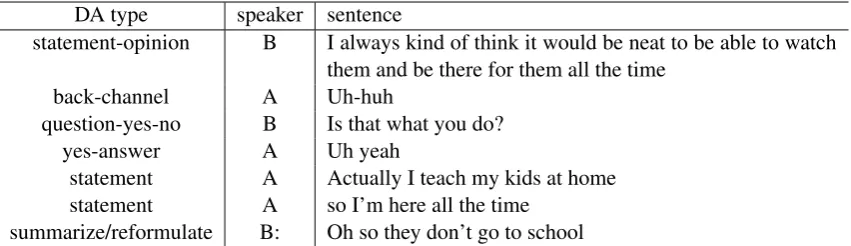
DA type speaker sentence
statement-opinion B I always kind of think it would be neat to be able to watch them and be there for them all the time
back-channel A Uh-huh
question-yes-no B Is that what you do?
yes-answer A Uh yeah
statement A Actually I teach my kids at home
statement A so I’m here all the time
[image:3.595.87.513.62.185.2]summarize/reformulate B: Oh so they don’t go to school
Table 1: An example of Switchboard conversation with the DA labels.
additional information on the data). There are dif-ferent granularities of the tag sets. In this work we use 42 tags (Jurafsky et al.,1997), which has been widely used in previous studies of DA classifica-tion on this data set. Table 1 shows an example of some utterances in a Switchboard conversation. We can see that the ‘answer’ DA follows the ‘ques-tion’ one, which is quite intuitive. Our goal is thus to model such sequential information for DA clas-sification. Again in this work we only use the tran-scriptions of the utterances along with the speaker information (i.e., if the current utterance is from the same or different speaker as the previous one), without any speech related features.
3.2 CNN for utterance classification
All of our methods are built based on the ba-sic CNN sentence representation, which has been widely used recently in sentence as well as doc-ument classification (Collobert et al., 2011;Kim,
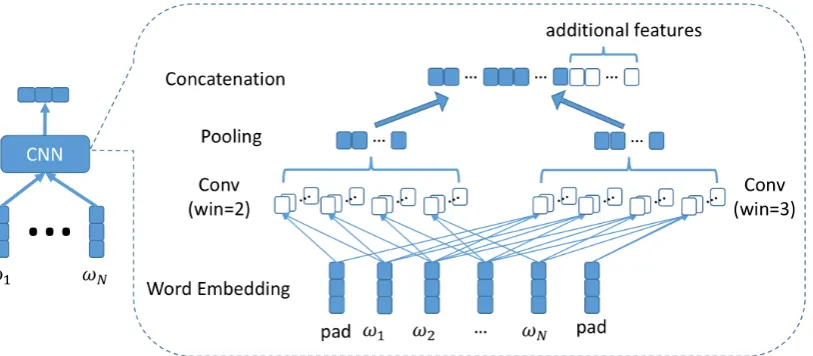
2014), therefore we first briefly describe this base-line. Figure 1 shows the context independent CNN-based classification method. Letw[1...n] rep-resent the word embedding sequence for a sen-tence with n words, where wi ∈ Rd is the d
-dimensional embedding vector for the ith word.
A temporal convolution operation is applied to the sentence:
c[1...n]= ˜w[1...n]∗f
where w˜[1...n] denotes the sequence w[1...n] with zero padding, andf is a filter map for the convo-lution operation. A max pooling layer is then ap-plied over the resulting sequencec[1...n] to obtain
one value for the sentence. If we use l window sizes andkfilters for each window, thenl×k con-volutional sequences are generated for each sen-tence, and after max pooling, we obtain a fixed-length vectorswith a dimension ofl×k. This is the feature vector representation for the sentence,
which is then used as the input in a multi-layer perceptron (MLP) or feedforward neural network for sentence classification. We only use one layer MLP in this work.
This baseline CNN model learns textual infor-mation in each sentence for DA classification. We can incorporate additional features into this model, for example, if the current sentence is from the same speaker as the previous one. Figure1shows the use of such additional features – they are con-catenated with the CNN-based textural vector, and then fed to the MLP for DA classification. In the rest of the paper, when there is no confusion, we also use CNN for the cases when additional fea-tures are concatenated with the standard CNN for sentence-level representation. We use this CNN model as a baseline, and in the following will ex-plore several methods using context information for DA classification.
3.3 Use history DA information
As discussed earlier, we expect there is valuable sequential information among the DA tags, there-fore in the first approach, we combine the history DA information with the current utterance to clas-sify its DA tag. This is represented as additional features concatenated with the CNN sentence rep-resentation, as shown in Figure1. We evaluate dif-ferent configurations in this framework.
• Use DA labels. We compare using reference and system predicted DA labels in training and testing. Note that using reference labels in testing is not a real testing setup. This is just meant to provide an upper bound and un-derstand the performance degradation due to prediction errors.
Figure 1: Baseline context-independent CNN-based DA classification method.
posterior probabilities from the system in or-der to capture more information.
• History length. We compare using DA infor-mation from different number of previous ut-terances.
Note that for most of these setups above when system’s predicted DA information is used, we need to go through the following procedure:
• train a context-independent sentence CNN model
• use it to generate predictions, for training and test data
• add the corresponding history DA informa-tion in the training set to retrain a model
• add the history DA information in the test set and apply the new model
The only scenario where these steps are not re-quired is when reference DA tags are used in both training and testing. There is one additional caveat that is worth pointing out – when generating the DA predictions for the training data, ideally we need to perform cross validation for the training set such that all the training sentences are labeled by a model trained from data that does not include this sentence, and thus we have matched infor-mation used in training and testing; however, we noticed that our model does not overfit the train-ing data very much, and the traintrain-ing accuracy is not significantly different from the test accuracy,
therefore we simply apply the trained CNN model to the training set itself to obtain the DA predic-tions for all the training sentences, and train the new model.
3.4 CNN + DA transition decoding
In this approach, we perform conversation level decoding that combines the probabilities from the context-independent CNN model and the DA tag transition probabilities. The DA classification problem can be represented as:
ˆ
Y =argmaxP(Y|X) =argmaxP(Y)P(X|Y)
=argmaxP(Y)Y
i
P(xi|yi)
where Y is the DA tag sequence, and X con-tains the entire conversation, i.e., sequence of sen-tences. P(Y) can be computed for the DA tag sequence (similar to word-based n-gram language model, here “words” are DA tags), and the prob-ability of a tag given the utterance (P(xi|yi)) can be obtained from the rescaled probability from the CNN model (that isP(yi|xi)). For decoding, we
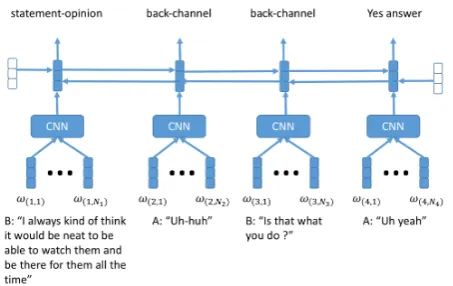
discrim-Figure 2: Hirarchical CNN: sequence CNN on top of sentence CNN for DA classification.
inative model, in contrast to the word-based lan-guage model that is a generative model.
3.5 Hierarchical model: CNN+CNN
Once we have the sentence vector representation built based on the baseline CNN model, we use another CNN to incorporate context information of an utterance for its classification. Figure 2
shows this method. The sequence of sentences is represented by a sequence of fixed length vectors s[1...m], where m is the number of sentences in the conversation, and si is the vector
representa-tion for sentenceifrom the baseline CNN model. Similar to the CNN model for word sequence, we apply a temporal convolutional layer with differ-ent filters tos[1...m]. Different from the sentence CNN model for word sequences, here we do not perform pooling for the entire dialog sequence, as the classification task is for each sentence, not the whole conversation (sentence sequence). Instead, for each sentence, the output of every convolu-tional filter is concatenated to form the sentence’s representation, and then an MLP is used for its classification. This approach can be thought as a hierarchical neural network, where the high level CNN is used to capture context information.
3.6 Hierarchical model: CNN+RNN
The hierarchical CNN method uses the neighbor-ing sentences to learn the dependencies among consecutive utterances. A different method to model the sequential information is via an RNN that is intrinsically capable of learning the tempo-ral dynamics, which is suitable for the problem. In this hierarchical model, the representation for each sentence is still learned by the CNN as in the
base-Figure 3: RNN/Bi-LSTM on top of sentence CNN for DA classification.
line, while the dialog-level sequence information among sentences is modeled by the RNN. Here, we use bidirectional-LSTM (BLSTM) to learn the context before and after the current sentence. The left-to-right LSTM output and the one from the reverse direction are concatenated and input to a hidden layer for classification. BLSTM has been widely used recently for various sequence labeling problems (such as part-of-speech tagging, named entity recognition) and achieved state-of-the-art performance. Figure3 shows the structure of the model. Note that the difference between these last two models and the one using history DA infor-mation is in that DA labels are not explicitly rep-resented in these hierarchical models.
4 Experiments 4.1 Data
[image:5.595.76.293.70.223.2] [image:5.595.307.534.76.219.2]Ta-ble2shows the basic statistics of the data. conversations sentences
training 1115 196,753
test set 1 20 3,764
[image:6.595.91.269.85.144.2]test set 2 20 3,771
Table 2: Data information.
4.2 Results
4.2.1 Baseline CNN
For all the DNN models, we did not tune model parameters very much. Most of the parameters were chosen based on literature or our experience with other DNN-based text classification tasks. We used pretrained embeddings (dimension 200) to initialize word vectors to use in CNN, and then update them during training.1 To avoid overfitting,
we use a dropout of 0.5. The baseline CNN uses three windows: 1, 2, and 3, and 100 filter maps for each. The output hidden layer dimension is 100. For learning, we use Adagrad with a learning rate of 0.01.
Table 3shows the baseline classification accu-racy results when no context information is used, for three setups: the baseline sentence CNN model with the pretrained embeddings, when speaker change information is added, and when no pre-trained embeddings are used. We can see the slight performance change because of the added speaker change feature. When no pretrained em-beddings are used, i.e., no additional information is used from other resources, there is a perfor-mance degradation of 2-3%. Note that these re-sults are better or at least comparable to state-of-the-art performance. In fact, we also imple-mented a CRF tagging model for this data set, where we used bag-of-word features for each ut-terance, therefore the information is similar to that used in the DNN framework (but the CRF does model DA tag sequential information). This CRF model has an accuracy of about 74% for the two sets combined. The CNN model without using pretrained embeddings has worse results than the CRF system that is trained just using the Switch-board data, confirming that when using word beddings as word representations, pretrained em-beddings are beneficial when the training size is small. However, the CNN model can effectively 1The embeddings we used are generated based on our
col-lected web data. We compared it to other embeddings, e.g., Senna, and found the performance difference is very small.
leverage word embedding information (obtained from unlabeled data), whereas it is not straightfor-ward to use such information in the CRF classi-fiers. This shows an advantage of the DNN-based method.
set 1 set 2
CNN 74.47 76.88
[image:6.595.315.517.138.196.2]+ speaker change 74.73 77.12 no pretrained embedding 71.81 74.49 Table 3: DA classification accuracy (%) when us-ing the baseline CNN without context information.
4.2.2 Hierarchical models: CNN+CNN/RNN
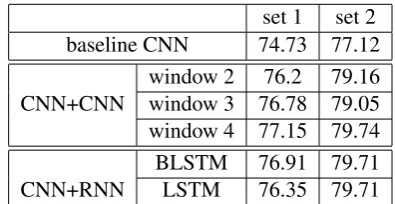
For the hierarchical models described in Sec-tion 3.5 and 3.6, i.e., adding CNN and BLSTM on top of the baseline sentence CNN, we kept the same model parameters in the sentence CNN part. The dimension is 64 for both the higher level CNN and LSTM. For these sequence labeling tasks, we use stochastic gradient descent (SGD), with a learning rate of 0.01. We observed this yielded better performance than Adagrad learning. Table
4shows the results for different setups in these two models to evaluate the impact of context informa-tion. For LSTM, we compare using LSTM and BLSTM; for CNN, we show results when using different context window sizes in the top layer.
set 1 set 2
baseline CNN 74.73 77.12
window 2 76.2 79.16
CNN+CNN window 3 76.78 79.05 window 4 77.15 79.74
BLSTM 76.91 79.71
[image:6.595.316.514.463.565.2]CNN+RNN LSTM 76.35 79.71
Table 4: DA classification results (%) when using the hierarchical structure: sentence CNN followed by dialog sequence level CNN or RNN/BLSTM.
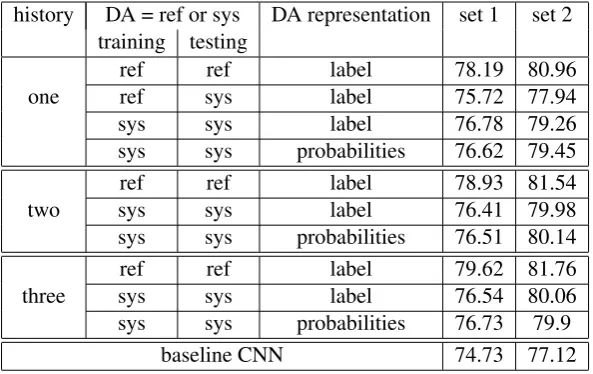
history DA = ref or sys DA representation set 1 set 2 training testing
ref ref label 78.19 80.96
one ref sys label 75.72 77.94
sys sys label 76.78 79.26
sys sys probabilities 76.62 79.45
ref ref label 78.93 81.54
two sys sys label 76.41 79.98
sys sys probabilities 76.51 80.14
ref ref label 79.62 81.76
three sys sys label 76.54 80.06
sys sys probabilities 76.73 79.9
[image:7.595.151.448.62.249.2]baseline CNN 74.73 77.12
Table 5: DA classification results (%) when incorporating history DA information in the current utterance in the CNN method. Three factors are examined: context history length, DA representations, and where DA information is from.
4.2.3 CNN + DA prediction
As described in Section3.3, another method to in-corporate context information is to use the DAs from previous utterances. We perform a detailed analysis to examine three factors under this frame-work:
• context history: we use a window of up to 3, i.e., information from the previous one, two, or three utterances;
• representation of the DA information, whether it is DA label or probabilities;
• reference vs. system predicted DA labels dur-ing traindur-ing and testdur-ing.
Using the reference DA labels in testing is ex-pected to give an oracle or upper bound perfor-mance for this set of experiments. Table5shows the results for these setups. The predictions for the utterances are generated using the baseline CNN model, with the pretrained embeddings and speaker information (i.e., the best utterance clas-sification model). The model parameters in the second-round CNN training (when additional his-tory DA information is included) are the same as the baseline CNN.
From Table 5 we can see that in terms of the representation of the history DA information, us-ing hard labels and soft predictions achieves sim-ilar performance. For model training, it is better to have matched information in training and test-ing. Using reference DA labels during training and
system predictions in testing (second row in the re-sults) is less effective compared to using both sys-tem predictions in training and testing. The quality of the prediction also affects the usefulness of the DA prediction information, as demonstrated by the better performance when the reference labels are used compared to using system predicted DAs, which is expected. The immediate previous utter-ance has the largest impact on the prediction of the current utterance (comparing to not using context at all), and adding longer context helps less. In addition, using the reference previous DA labels (ref train and ref test condition) benefits more than using system predicted DA labels when longer his-tory is used, suggesting that more predicted DAs, when used together, become more noisy and bring less gain.
4.2.4 Overall results
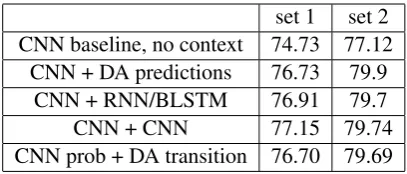
Table 6 summarizes the results for different sys-tems, including the baseline CNN model without using context information (this baseline uses pre-trained embeddings and speaker change feature), and four different ways of using context: (a) pre-dicted DA information (posterior probabilities) is combined with the current sentence’s CNN-based representation; (b) applying a BLSTM on top of the sentence CNN representation; (c) hierarchical CNN that combines the current sentence’s CNN representation with its neighbors; (d) sequence de-coding by combining CNN posteriors with DA transition scores.
set 1 set 2 CNN baseline, no context 74.73 77.12
CNN + DA predictions 76.73 79.9
CNN + RNN/BLSTM 76.91 79.7
CNN + CNN 77.15 79.74
[image:8.595.79.283.61.148.2]CNN prob + DA transition 76.70 79.69 Table 6: DA classification results (%) using differ-ent systems.
when context information is used. All the meth-ods using context yield significant improvement over the baseline (statistically significant based on t-test). Comparing representing context informa-tion via the DA labels of the previous utterances vs. using the hierarchical CNN or RNN model, we see there is not much difference. This observation is somewhat different from that found in (Ribeiro et al.,2015;Kim et al.,2010) where using previ-ous DA predictions yields more gain than adding n-gram features from the previous utterances. We believe one reason for this difference is the use of the DNN framework to model the utterance se-quences. Given the current data size and the oracle performance in Table5, we expect that when more data is available, using larger neural networks will further improve the performance. Furthermore, we want to mention that overall these results rep-resent new state-of-the-art performance for this task ((Kalchbrenner and Blunsom,2013) reported 73.9% accuracy using recurrent CNN, though the results are not directly comparable since they only evaluated on 19 test conversations).
4.2.5 Final remarks
As expected, our experimental results demonstrate that we can effectively incorporate context infor-mation to improve DA classification. We con-ducted some analyses to see what errors are cor-rected when we use the context models compared to the baseline results. Due to space limit, we show one positive example below where adding context changes the prediction from ‘backchannel’ to ‘answer’.
• Example:
- Is this a mail order parts house that special-izes in parts for parts for uh old imports? - right
It is clear that using context can help disam-biguate and better predict the DAs for the current
utterance. In fact, we noticed that close to 5% of errors are correctly changed from ‘back channel’ to ‘reply’ when context information is used.
One of the most frequent errors we notice the system makes is the mislabels between ‘state-ment’ and ‘statement-opinion’. To correctly iden-tify statement-opinion DAs, we can perform some opinion or subjectivity recognition, but that is out of the scope of this study. Another frequent error is the confusion between backchannel and agree-ment. For example, ‘right’ and ‘yeah’ are common words for both categories, and even with context information, they are still hard to disambiguate for the current models.
Finally it is worth pointing out that our work uses an offline setting where we perform DA tag-ging for the entire conversation. In real world ap-plications, an online setting may be needed; how-ever, information from previous utterances can still be used there. In fact, most of the per-formance gain from incorporating context infor-mation comes from the previous utterances (e.g., the difference between the hierarchical LSTM and BLSTM is very small). Our findings about the ef-fectiveness of context information are applicable to the online setting.
5 Conclusions
Acknowledgments
The authors thank Yandi Xia for preparing the Switchboard data, Xian Qian, Antoine Raux and Benoit Dumoulin for various discussions.
References
Jeremy Ang, Yang Liu, and Elizabeth Shriberg. 2005. Automatic dialog act segmentation and classifica-tion in multiparty meetings. InProc. of ICASSP. Lin Chen and Barbara Di Eugenio. 2013.
Multimodal-ity and dialogue act classification in the robohelper project. InProceddings of Sigdial.
Ronan Collobert, Jason Weston, L´eon Bottou, Michael Karlen, Koray Kavukcuoglu, and Pavel Kuksa. 2011. Natural language processing (almost) from
scratch. Journal of Machine Learning Research
12(Aug):2493–2537.
Alfred Dielmann and Steve Renals. 2008. Recogni-tion of dialogue acts in multiparty meetings using a
switching dbn. IEEE Transactions on Audio, Speech
and Language Processing16.
Raul Fernandez and Rosalind Picard. 2002. Dialog act classification from prosodic features using support vector machines. InProc. of Speech Prosody. Gang Ji and Jeff Bilmes. 2005. Dialog act tagging
us-ing graphical models. InProc. of ICASSP.
D. Jurafsky, L. Shriberg, and D. Biasca. 1997. Switch-board swbd-damsl shallow-discourse-function an-notation coders manual. Technical report, Univer-sity of Colorado at Boulder.
Nal Kalchbrenner and Phil Blunsom. 2013. Recurrent convolutional neural networks for discourse compo-sitionality.
Su Nam Kim, Lawrence Cavedon, and Timothy Bald-win. 2010. Classifying dialog acts in one-on-one
live chats. InProceedings of EMNLP.
Yoon Kim. 2014. Convolutional neural networks for
sentence classification. In Proc. of EMNLP. pages
1746–1751.
Pavel Kral and Chrisophe Cerisara. 2014. Automatic dialogue act recognition with syntactic features. In
Proceedings of LREC.
Piroska Lendvai. 2007. Token-based chunking of turn-internal dialogue act sequences.
Yang Liu. 2006. Using svm and error-correcting codes for multiclass dialog act classification in meeting corpus. InInterspeech.
Marion Mast, Ralf Kompe, Stefan Harbeck, Andreas Kiebling, Heinrich Niemann, and Elmar Noth. 1996. Dialog act classification with the help of prosody. In
Proc. of ICSLP.
Silvia Quarteroni, Alexei V. Ivanov, and Giuseppe Ric-cardi. 2011. Simultaneous dialog segmentation and classification from human-human spoken conversa-tions. InProceedings of ICASSP.
Eugenio Ribeiro, Ricardo Ribeiro, and David Martins de Matos. 2015. The influence of context on dia-logue act recognition .
Lina M. Rojas-Barahona, Milica Gasic, Nikola Mrksic, Pei-Hao Su, Stefan Ultes, Tsung-Hsien, and Steve Young. 2016. Exploiting sentence and context rep-resentation in deep neural models for spoken lan-guage understanding.
Andreas Stolcke, Klaus Ries, Noah Coccaro, Eliza-beth Shriberg, Rebecca Bates, Daniel Jurafsky, Paul Taylor, Rachel Martin, Carol Van Ess-Dykema, and Marie Meteer. 2000. Dialog act modeling for au-tomatic tagging and recognition of conversational
speech. Computational Linguistics.
Anand Venkataraman, Lucianna Ferrer, Andreas
Stol-cke, and Elizabeth Shriberg. 2003. Training a
prosody based dialog act tagger from unlabeled data. InProc. of ICASSP.
Nick Webb, Mark Hepple, and Yorick Wilks. 2005. Di-alog act classification based on intra-utterances
fea-tures. InAAAI workshop on Spoken Language
Un-derstanding.
Yucan Zhou, Qinghua Hu, Jie Liu, and Yuan Jia. 2015. Combining heterogeneious deep neural net-works with conditional random fields for chinese