
Natural Language Processing with Small Feed-Forward Networks
Jan A. Botha Emily Pitler Ji Ma Anton Bakalov Alex Salcianu David Weiss Ryan McDonald Slav Petrov
Google Inc. Mountain View, CA
{jabot,epitler,maji,abakalov,salcianu,djweiss,ryanmcd,slav}@google.com
Abstract
We show that small and shallow feed-forward neural networks can achieve near state-of-the-art results on a range of un-structured and un-structured language pro-cessing tasks while being considerably cheaper in memory and computational re-quirements than deep recurrent models. Motivated by resource-constrained envi-ronments like mobile phones, we show-case simple techniques for obtaining such small neural network models, and investi-gate different tradeoffs when deciding how to allocate a small memory budget.
1 Introduction
Deep and recurrent neural networks with large net-work capacity have become increasingly accurate for challenging language processing tasks. For ex-ample, machine translation models have been able to attain impressive accuracies, with models that use hundreds of millions (Bahdanau et al.,2014;
Wu et al.,2016) or billions (Shazeer et al.,2017) of parameters. These models, however, may not be feasible in all computational settings. In partic-ular, models running on mobile devices are often constrained in terms of memory and computation. Long Short-Term Memory (LSTM) mod-els (Hochreiter and Schmidhuber, 1997) have achieved good results with small memory foot-prints by using character-based input representa-tions: e.g., the part-of-speech tagging models of
Gillick et al. (2016) have only roughly 900,000 parameters. Latency, however, can still be an is-sue with LSTMs, due to the large number of ma-trix multiplications they require (eight per LSTM cell): Kim and Rush (2016) report speeds of only 8.8 words/second when running a two-layer LSTM translation system on an Android phone.
Feed-forward neural networks have the poten-tial to be much faster. In this paper, we show that small feed-forward networks can achieve results at or near the state-of-the-art on a variety of natural language processing tasks, with an order of mag-nitude speedup over an LSTM-based approach.
We begin by introducing the network model structure and the character-based representations we use throughout all tasks (§2). The four tasks that we address are: language identification (Lang-ID), part-of-speech (POS) tagging, word segmen-tation, and preordering for translation. In order to use feed-forward networks for structured pre-diction tasks, we use transition systems (Titov and Henderson,2007,2010) with feature embeddings as proposed byChen and Manning(2014), and in-troduce two novel transition systems for the last two tasks. We focus onbudgeted models and ab-late four techniques (one on each task) for improv-ing accuracy for a given memory budget:
1. Quantization: Using more dimensions and less precision (Lang-ID: §3.1).
2. Word clusters: Reducing the network size to allow for word clusters and derived features (POS tagging: §3.2).
3. Selected features: Adding explicit feature conjunctions (segmentation: §3.3).
4. Pipelines: Introducing another task in a pipeline and allocating parameters to the aux-iliary task instead (preordering: §3.4). We achieve results at or near state-of-the-art with small (<3MB) models on all four tasks.
2 Small Feed-Forward Network Models
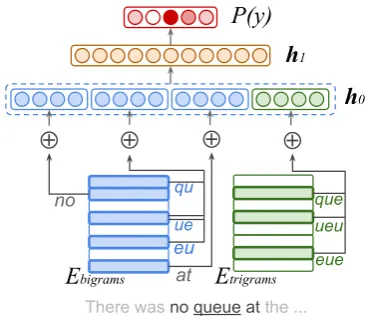
The network architectures are designed to limit the memory and runtime of the model. Figure1 illus-trates the model architecture:
1. Discrete features are organized into groups (e.g.,Ebigrams), with one embedding matrix
Eg ∈RVg×Dg per group.
2. Embeddings of features extracted for each group are reshaped into a single vector and concatenated to define the output of the em-bedding layer ash0= [XgEg | ∀g].
3. A single hidden layer, h1, with M rectified linear units (Nair and Hinton, 2010) is fully connected toh0.
4. A softmax function models the probability of an output class y: P(y) ∝ exp(βT
yh1+by),
whereβy ∈RM andby are the weight vector
and bias, respectively.
Memory needs are dominated by the embedding matrix sizes (PgVgDg, whereVg andDg are the
vocabulary sizes and dimensions respectively for each feature group g), while runtime is strongly influenced by the hidden layer dimensions.
Hashed Character n-grams Previous applica-tions of this network structure used (pretrained) word embeddings to represent words (Chen and Manning, 2014; Weiss et al., 2015). However, for word embeddings to be effective, they usu-ally need to cover large vocabularies (100,000+) and dimensions (50+). Inspired by the success of character-based representations (Ling et al.,2015), we use features defined over charactern-grams in-stead of relying on word embeddings, and learn their embeddings from scratch.
We use a distinct feature group g for each n -gram length N, and control the size Vg directly
by applyingrandom feature mixing(Ganchev and Dredze,2008). That is, we define the feature value v for an n-gram stringx asv = H(x) mod Vg,
whereHis a well-behaved hash function. Typical values forVg are in the 100-5000 range, which is
far smaller than the exponential number of unique raw n-grams. A consequence of these small ture vocabularies is that we can also use small fea-ture embeddings, typicallyDg=16.
Quantization A commonly used strategy for compressing neural networks is quantization, us-ing less precision to store parameters (Han et al.,
2015). We compress the embedding weights (the vast majority of the parameters for these shal-low models) by storing scale factors for each em-bedding (details in the supplementary material). In §3.1, we contrast devoting model size to higher
⨁
There was no queue at the ... no
eu
at
⨁
⨁
E
bigramsque ueu
eue
E
trigrams⨁
h
0h
1P(y)
qu
[image:2.595.316.499.60.218.2]ue
Figure 1: An example network structure for a model using bigrams of the previous, current and next word, and trigrams of the current word. Does not illustrate hashing.
precision and lower dimensionality versus lower precision and more network dimensions.
Training Our objective function combines the cross-entropy loss for model predictions relative to the ground truth with L2 regularization of the bi-ases and hidden layer weights. For optimization, we use mini-batched averaged stochastic gradient descent with momentum (Bottou, 2010; Hinton,
2012) and exponentially decaying learning rates. The mini-batch size is fixed to 32 and we perform a grid search for the other hyperparameters, tun-ing against the task-specific evaluation metric on held-out data, with early stopping. Full feature templates and optimal hyperparameter settings are given in the supplementary material.
3 Experiments
We experiment with small feed-forward networks for four diverse NLP tasks: language identifica-tion, part-of-speech tagging, word segmentaidentifica-tion, and preordering for statistical machine translation.
normal-ization, but still accounts for the final layer log-its. To ground this metric, we also provide indica-tive absolute speeds for each task, as measured on a modern workstation CPU (3.50GHz Intel Xeon E5-1650 v3).
3.1 Language Identification
Recent shared tasks on code-switching (Molina et al., 2016) and dialects (Malmasi et al., 2016) have generated renewed interest in language iden-tification. We restrict our focus to single language identification across diverse languages, and com-pare to the work ofBaldwin and Lui(2010) on pre-dicting the language of Wikipedia text in 66 lan-guages. For this task, we obtain the input h0 by separately averagingthe embeddings for each n -gram length (N = [1,4]), as summation did not produce good results.
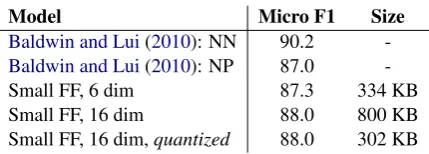
Table 1 shows that we outperform the low-memory nearest-prototype model ofBaldwin and Lui (2010). Their nearest neighbor model is the most accurate but its memory scales linearly with the size of the training data.
Moreover, we can apply quantization to the em-bedding matrix without hurting prediction accu-racy: it is better to use less precision for each dimension, but to use more dimensions. Our subsequent models all use quantization. There is no noticeable variation in processing speed when performing dequantization on-the-fly at in-ference time. Our 16-dim Lang-ID model runs at 4450 documents/second (5.6 MB of text per sec-ond) on the preprocessed Wikipedia dataset.
Relationship to Compact Language Detector
These techniques back the open-source Com-pact Language Detector v3 (CLD3)1 that runs
in Google Chrome browsers.2 Our experimental
Lang-ID model uses the same overall architecture as CLD3, but uses a simpler feature set, less in-volved preprocessing, and covers fewer languages.
3.2 POS Tagging
We apply our model as an unstructured classifier to predict a POS tag for each token independently, and compare its performance to that of the byte-to-span (BTS) model (Gillick et al., 2016). BTS is a 4-layer LSTM network that maps a sequence of bytes to a sequence of labeled spans, such as tokens and their POS tags. Both approaches limit
1github.com/google/cld3
2As of the date of this writing in 2017.
Model Micro F1 Size
Baldwin and Lui(2010): NN 90.2
[image:3.595.311.526.60.137.2]-Baldwin and Lui(2010): NP 87.0 -Small FF, 6 dim 87.3 334 KB Small FF, 16 dim 88.0 800 KB Small FF, 16 dim,quantized 88.0 302 KB
Table 1: Language Identification. Quantization allows trad-ing numerical precision for larger embeddtrad-ings. The two mod-els from Baldwin and Lui(2010) are the nearest neighbor (NN) and nearest prototype (NP) approaches.
Model Acc. Wts. MB Ops.
Gillick et al.(2016) 95.06 900k - 6.63m Small FF 94.76 241k 0.6 0.27m +Clusters 95.56 261k 1.0 0.31m
1
[image:3.595.311.523.198.260.2]2Dim. 95.39 143k 0.7 0.18m
Table 2: POS tagging. Embedded word clusters improves ac-curacy and allows the use of smaller embedding dimensions.
model size by using small input vocabularies: byte values in the case of BTS, and hashed charactern -grams and (optionally) cluster ids in our case.
Bloom Mapped Word Clusters It is well known that word clusters can be powerful features in linear models for a variety of tasks (Koo et al.,
2008; Turian et al., 2010). Here, we show that they can also be useful in neural network mod-els. However, naively introducing word cluster features drastically increases the amount of mem-ory required, as a word-to-cluster mapping file with hundreds of thousands of entries can be sev-eral megabytes on its own.3 By representing word
clusters with a Bloom map (Talbot and Talbot,
2008), a key-value based generalization of Bloom filters, we can reduce the space required by a fac-tor of∼15 and use 300KB to (approximately) rep-resent the clusters for 250,000 word types.
In order to compare against the monolingual setting of Gillick et al. (2016), we train models for the same set of 13 languages from the Univer-sal Dependency treebanks v1.1 (Nivre et al.,2016) corpus, using the standard predefined splits.
As shown in Table2, our best models are 0.3% more accuate on average across all languages than the BTS monolingual models, while using 6x fewer parameters and 36x fewer FLOPs. The clus-ter features play an important role, providing a 15% relative reduction in error over our vanilla model, but also increase the overall size.
Halv-3For example, the commonly used English clusters from
Transition
SPLIT ([σ],[i|β])→([σ|i],[β])
MERGE ([σ],[i|β])→([σ],[β])
Table 3: Segmentation Transition system. Initially all characters are on the buffer β and the stack σ is empty:
([],[c1c2...cn]). In the final state the buffer is empty and the stack contains the first character for each word.
ing all feature embedding dimensions (except for the cluster features) still gives a 12% reduction in error and trims the overall size back to 1.1x the vanilla model, staying well under 1MB in total. This halved model configuration has a throughput of 46k tokens/second, on average.
Two potential advantages of BTS are that it does not require tokenized input and has a more rate multilingual version, achieving 95.85% accu-racy. From a memory perspective, one multilin-gual BTS model will take less space than separate FF models. However, from aruntimeperspective, a pipeline of our models doing language identi-fication, word segmentation, and then POS tag-ging would still be faster than a single instance of the deep LSTM BTS model, by about 12x in our FLOPs estimate.4
3.3 Segmentation
Word segmentation is critical for processing Asian languages where words are not explicitly sep-arated by spaces. Recently, neural networks have significantly improved segmentation accu-racy (Zhang et al.,2016;Cai and Zhao,2016;Liu et al.,2016;Yang et al.,2017;Kong et al.,2015). We use a structured model based on the transition system in Table3, and similar to the one proposed byZhang and Clark(2007). We conduct the seg-mentation experiments on the Chinese Treebank 6.0 with the recommended data splits. No exter-nal resources or pretrained embeddings are used. Hashing was detrimental to quality in our prelim-inary experiments, hence we do not use it for this task. To learn an embedding for unknown charac-ters, we cast characters occurring only once in the training set to a special symbol.
Selected Features Because we are not using hashing here, we need to be careful about the size of the input vocabulary. The neural network with its non-linearity is in theory able to learn bigrams by conjoining unigrams, but it has been
4Our calculation of BTS FLOPs is very conservative and
favorable to BTS, as detailed in the supplementary material.
Model Accuracy Size
Zhang et al.(2016) 95.01 −
Zhang et al.(2016)-combo 95.95 −
Small FF, 64 dim 94.24 846KB Small FF, 256 dim 94.16 3.2MB Small FF, 64 dim,bigrams 95.18 2.0MB
Table 4: Segmentation results. Explicit bigrams are useful.
Transition Precondition
APPEND ([σ|i|j],[β])→([σ|[ij]],[β])
SHIFT ([σ],[i|β])→([σ|i],[β])
SWAP ([σ|i|j],[β])→[σ|j],[i|β]);i < j
Table 5: Preordering Transition system. Initially all words are part of singleton spans on the buffer:([],[[w1][w2]...[wn]]). In the final state the buffer is empty and the stack contains a single span.
shown that explicitly using character bigram fea-tures leads to better accuracy (Zhang et al.,2016;
Pei et al., 2014). Zhang et al. (2016) suggests that embedding manually specified feature con-junctions further improves accuracy (‘Zhang et al.
(2016)-combo’ in Table4). However, such embed-dings could easily lead to a model size explosion and thus are not considered in this work.
The results in Table 4 show that spending our memory budget on small bigram embeddings is more effective than on larger character embed-dings, in terms of both accuracy and model size. Our model featuring bigrams runs at 110KB of text per second, or 39k tokens/second.
3.4 Preordering
Preordering source-side words into the target-side word order is a useful preprocessing task for statis-tical machine translation (Xia and McCord,2004;
Collins et al.,2005;Nakagawa, 2015;de Gispert et al., 2015). We propose a novel transition sys-tem for this task (Table5), so that we can repeat-edly apply a small network to produce these per-mutations. Inspired by a non-projective parsing transition system (Nivre, 2009), the system uses a SWAP action to permute spans. The system is
sound for permutations: any derivation will end with all of the input words in a permuted order, and complete: all permutations are reachable (use
SHIFT and SWAP operations to perform a bubble
sort, then APPEND n−1 times to form a single
span). For training and evaluation, we use the English-Japanese manual word alignments from
[image:4.595.312.516.62.135.2]Model FRS Size
Nakagawa(2015) 81.6
[image:5.595.79.263.62.123.2]-Small FF 75.2 0.5MB Small FF + POS tags 81.3 1.3MB Small FF + Tagger input fts. 76.6 3.7MB
Table 6: Preordering results for English→Japanese.FRS(in
[0,100]) is the fuzzy reordering score (Talbot et al.,2011).
Pipelines For preordering, we experiment with either spending all of our memory budget on re-ordering, or spending some of the memory budget on features over predicted POS tags, which also requires an additional neural network to predict these tags. Full feature templates are in the supple-mentary material. As the POS tagger network uses features based on a three word window around the token, another possibility is to add all of the fea-tures that would have affected the POS tag of a token to the reorderer directly.
Table 6 shows results with or without using the predicted POS tags in the preorderer, as well as including the features used by the tagger in the reorderer directly and only training the down-stream task. The preorderer that includes a sep-arate network for POS tagging and then extracts features over the predicted tags is more accurate and smaller than the model that includes all the features that contribute to a POS tag in the re-orderer directly. This pipeline processes 7k to-kens/second when taking pretokenized text as in-put, with the POS tagger accounting for 23% of the computation time.
4 Conclusions
This paper shows that small feed-forward net-works are sufficient to achieve useful accuracies on a variety of tasks. In resource-constrained en-vironments, speed and memory are important met-rics to optimize as well as accuracies. While large and deep recurrent models are likely to be the most accurate whenever they can be afforded, feed-foward networks can provide better value in terms of runtime and memory, and should be con-sidered a strong baseline.
Acknowledgments
We thank Kuzman Ganchev, Fernando Pereira, and the anonymous reviewers for their useful com-ments.
References
Dzmitry Bahdanau, Kyunghyun Cho, and Yoshua Ben-gio. 2014. Neural machine translation by jointly learning to align and translate. arXiv preprint arXiv:1409.0473.
Timothy Baldwin and Marco Lui. 2010. Language identification: The long and the short of the mat-ter. InHuman Language Technologies: The 2010 Annual Conference of the North American Chap-ter of the Association for Computational Linguistics, pages 229–237. Association for Computational Lin-guistics.
L´eon Bottou. 2010. Large-scale machine learning with stochastic gradient descent. InProceedings of COMPSTAT’2010, pages 177–186. Springer. Deng Cai and Hai Zhao. 2016. Neural word
segmen-tation learning for Chinese. InProceedings of the 54th Annual Meeting of the Association for Compu-tational Linguistics (Volume 1: Long Papers), pages 409–420, Berlin, Germany. Association for Compu-tational Linguistics.
Danqi Chen and Christopher D. Manning. 2014. A fast and accurate dependency parser using neural net-works. InProceedings of the 2014 Conference on Empirical Methods in Natural Language Process-ing, pages 740–750.
M. Collins, P. Koehn, and I. Kuˇcerov´a. 2005. Clause restructuring for statistical machine translation. In Proceedings of ACL, pages 531–540.
Kuzman Ganchev and Mark Dredze. 2008. Small sta-tistical models by random feature mixing. In Pro-ceedings of the ACL-08- HLT Workshop on Mobile Language Processing, pages 18–19. Association for Computational Linguistics.
Dan Gillick, Cliff Brunk, Oriol Vinyals, and Amar-nag Subramanya. 2016. Multilingual language pro-cessing from bytes. InProceedings of NAACL-HLT, pages 1296–1306, San Diego, USA. Association for Computational Linguistics.
Adri`a de Gispert, Gonzalo Iglesias, and Bill Byrne. 2015. Fast and accurate preordering for SMT using neural networks. InProceedings of NAACL, pages 1012–1017.
Song Han, Huizi Mao, and William J Dally. 2015.
Deep compression: Compressing deep neural net-works with pruning, trained quantization and huff-man coding. arXiv preprint arXiv:1510.00149. Geoffrey E. Hinton. 2012. A practical guide to
train-ing restricted Boltzmann machines. InNeural Net-works: Tricks of the Trade (2nd ed.), Lecture Notes in Computer Science, pages 599–619. Springer. Sepp Hochreiter and J¨urgen Schmidhuber. 1997.
Yoon Kim and Alexander M. Rush. 2016. Sequence-level knowledge distillation. InProceedings of the 2016 Conference on Empirical Methods in Natu-ral Language Processing, pages 1317–1327, Austin, Texas. Association for Computational Linguistics. Lingpeng Kong, Chris Dyer, and Noah A. Smith.
2015. Segmental recurrent neural networks. CoRR, abs/1511.06018.
Terry Koo, Xavier Carreras, and Michael Collins. 2008.
Simple semi-supervised dependency parsing. In Proceedings of ACL-08: HLT, pages 595–603. Wang Ling, Tiago Lu´ıs, Lu´ıs Marujo, Ram´on
Fernan-dez Astudillo, Silvio Amir, Chris Dyer, Alan W Black, and Isabel Trancoso. 2015. Finding function in form: Compositional character models for open vocabulary word representation. InProceedings of the 2015 Conference on Empirical Methods in Nat-ural Language Processing, pages 1520–1530. Asso-ciation for Computational Linguistics.
Yijia Liu, Wanxiang Che, Jiang Guo, Bing Qin, and Ting Liu. 2016. Exploring segment representations for neural segmentation models. InProceedings of the Twenty-Fifth International Joint Conference on Artificial Intelligence, IJCAI 2016, New York, NY, USA, 9-15 July 2016, pages 2880–2886.
Shervin Malmasi, Marcos Zampieri, Nikola Ljubeˇsi´c, Preslav Nakov, Ahmed Ali, and J¨org Tiedemann. 2016. Discriminating between similar languages and Arabic dialect identification: A report on the third DSL shared task. InProceedings of the Third Workshop on NLP for Similar Languages, Varieties and Dialects (VarDial3), pages 1–14, Osaka, Japan. The COLING 2016 Organizing Committee. Giovanni Molina, Fahad AlGhamdi, Mahmoud
Ghoneim, Abdelati Hawwari, Nicolas Rey-Villamizar, Mona Diab, and Thamar Solorio. 2016.
Overview for the second shared task on language identification in code-switched data. InProceedings of the Second Workshop on Computational Ap-proaches to Code Switching, pages 40–49, Austin, Texas. Association for Computational Linguistics. Vinod Nair and Geoffrey E. Hinton. 2010. Rectified
linear units improve restricted Boltzmann machines. InProceedings of the 27th International Conference on Machine Learning, pages 807–814.
Tetsuji Nakagawa. 2015. Efficient top-down BTG parsing for machine translation preordering. In Pro-ceedings of ACL, pages 208–218.
Joakim Nivre. 2009. Non-projective dependency pars-ing in expected linear time. In Proceedings of the Joint Conference of the 47th Annual Meeting of the ACL and the 4th International Joint Conference on Natural Language Processing of the AFNLP, pages 351–359.
Joakim Nivre, Marie-Catherine de Marneffe, Filip Gin-ter, Yoav Goldberg, Jan Hajic, Christopher D. Man-ning, Ryan McDonald, Slav Petrov, Sampo Pyysalo, Natalia Silveira, Reut Tsarfaty, and Daniel Zeman. 2016. Universal Dependencies v1: A Multilingual Treebank Collection. InProceedings of the Tenth In-ternational Conference on Language Resources and Evaluation (LREC 2016), Paris, France. European Language Resources Association (ELRA).
Wenzhe Pei, Tao Ge, and Baobao Chang. 2014. Max-margin tensor neural network for Chinese word seg-mentation. InProceedings of the 52nd Annual Meet-ing of the Association for Computational LMeet-inguis- Linguis-tics (Volume 1: Long Papers), pages 293–303, Bal-timore, Maryland. Association for Computational Linguistics.
Noam Shazeer, Azalia Mirhoseini, Krzysztof Maziarz, Andy Davis, Quoc Le, Geoffrey Hinton, and Jeff Dean. 2017. Outrageously large neural networks: The sparsely-gated mixture-of-experts layer. arXiv preprint arXiv:1701.06538.
David Talbot, Hideto Kazawa, Hiroshi Ichikawa, Ja-son Katz-Brown, Masakazu Seno, and Franz J. Och. 2011. A lightweight evaluation framework for ma-chine translation reordering. InProceedings of the Sixth Workshop on Statistical Machine Translation, WMT ’11, pages 12–21, Stroudsburg, PA, USA. As-sociation for Computational Linguistics.
David Talbot and John Talbot. 2008. Bloom maps. In Proceedings of the Meeting on Analytic Algorith-mics and Combinatorics, pages 203–212. Society for Industrial and Applied Mathematics.
Ivan Titov and James Henderson. 2007.Fast and robust multilingual dependency parsing with a generative latent variable model. InProceedings of the 2007 Joint Conference on Empirical Methods in Natural Language Processing and Computational Natural Language Learning, pages 947–951.
Ivan Titov and James Henderson. 2010. A latent vari-able model for generative dependency parsing. In Harry Bunt, Paola Merlo, and Joakim Nivre, editors, Trends in Parsing Technology: Dependency Parsing, Domain Adaptation, and Deep Parsing, pages 35– 55. Springer Netherlands, Dordrecht.
Joseph Turian, Lev Ratinov, and Yoshua Bengio. 2010. Word Representations: A Simple and Gen-eral Method for Semi-supervised Learning. In Pro-ceedings of the 48th Annual Meeting of the Asso-ciation for Computational Linguistics, pages 384– 394, Stroudsburg, PA, USA. Association for Com-putational Linguistics.
Yonghui Wu, Mike Schuster, Zhifeng Chen, Quoc V. Le, Mohammad Norouzi, Wolfgang Macherey, Maxim Krikun, Yuan Cao, Qin Gao, Klaus Macherey, Jeff Klingner, Apurva Shah, Melvin Johnson, Xiaobing Liu, ukasz Kaiser, Stephan Gouws, Yoshikiyo Kato, Taku Kudo, Hideto Kazawa, Keith Stevens, George Kurian, Nishant Patil, Wei Wang, Cliff Young, Jason Smith, Jason Riesa, Alex Rudnick, Oriol Vinyals, Greg Corrado, Macduff Hughes, and Jeffrey Dean. 2016. Google’s neural machine translation system: Bridging the gap between human and machine translation. CoRR, abs/1609.08144.
Fei Xia and Michael McCord. 2004. Improving a statistical MT system with automatically learned rewrite patterns. InProceedings of COLING, page 508.
Jie Yang, Yue Zhang, and Fei Dong. 2017. Neural word segmentation with rich pretraining. CoRR, abs/1704.08960.
Meishan Zhang, Yue Zhang, and Guohong Fu. 2016.
Transition-based neural word segmentation. In Pro-ceedings of the 54th Annual Meeting of the Associa-tion for ComputaAssocia-tional Linguistics (Volume 1: Long Papers), pages 421–431, Berlin, Germany. Associa-tion for ComputaAssocia-tional Linguistics.
![Table 3:Segmentation Transition system.( [ ] ,Initially allcharacters are on the buffer βand the stack σis empty: [ c 1 c 2](https://thumb-us.123doks.com/thumbv2/123dok_us/1356337.668041/4.595.312.516.62.135/table-segmentation-transition-initially-allcharacters-buffer-band-stack.webp)
![Table 6: Preordering results for English →[ 0 ,Japanese. FRS (in 1 0 0 ] ) is the fuzzy reordering score (Talbot et al., 2011).](https://thumb-us.123doks.com/thumbv2/123dok_us/1356337.668041/5.595.79.263.62.123/table-preordering-results-english-japanese-fuzzy-reordering-talbot.webp)