Abstract - Worldwide cooperation among manufacturing companies is increasingly gaining importance to face emerging challenges in manufacturing. The traditional Computer Integrated Manufacturing (CIM) systems cannot satisfy the needs of global market as they are deployed only within an enterprise. Therefore, a more flexible and comprehensive integrating methodology is required to overcome distance barriers, facility sharing problems and communication obstacles. These issues lead to the concept of Virtual CIM (VCIM).
In this paper, the limitations of current agent based implementation of VCIM concept are analyzed. It also demonstrates approaches to address those limitations and further development on Agent based Resource Scheduling Process for Small and Medium Enterprises in VCIM network.
Index Terms— Virtual CIM, VCIM, Small and Medium
Manufacturing Enterprises, Multi-criteria selection, Agent based systems.
I. INTRODUCTION
Manufacturing enterprises face challenges from worldwide competitors and struggle to extend their business worldwide in today’s economic climate. Therefore, these enterprises tend to use fully integrated manufacturing systems so that they can have the capabilities to rapidly respond to constantly changing customer requirements and produce high quality products in shortest possible time with lowest possible cost. However, Small and Medium manufacturing Enterprises (SMMEs) are having difficulties in achieving this flexibility and competing with large companies, since SMMEs often do not have enough resources. By integrating manufacturing resources of many partner enterprises (which may be located at different regions), these enterprises can form a globally integrated SMME network and achieve a competitive edge [1].
Virtual Computer Integrated Manufacturing (VCIM), which is a network of interconnected global Computer Integrated Manufacturing (CIM) systems, extends traditional concept of CIM from a local and centralized system to worldwide co-operation [2]. Today, Companies are expanding their business boundaries locally and
Manuscript received October 9, 2009.
N. Zhou is with the University of South Australia, Australia , 5095 (phone: 61-8-830253734; e-mail: [email protected]).
K. Xing is with the University of South Australia, Australia , 5095 (e-mail: [email protected]).
S. Nagalingam is with the University of South Australia, Australia , 5095 (phone: 61-8-830253734; e-mail: [email protected]).
G. Lin was with the University of South Australia, Australia , 5095 (e-mail: [email protected]).
internationally, merging or co-operating with others across geographical demarcation. VCIM aims to unite and integrate all activities in an enterprise or a network of enterprises to share resources and management objectives through information integration, in a cohesive manner to work as a seamless global CIM system. In a VCIM system, manufacturing resources may belong to different enterprises or be located at different areas, but all have intention of working together in an integrated manner. When receiving a product order, a VCIM system schedule and organize distributed resources as a temporary production system based on working status information of the resources in real time. As this temporary system disappears when purpose are fulfilled, compared to the tight connection of manufacturing resources in traditional CIM systems, this transient system with VCIM is in a virtual status. To describe this status viewpoint, the word Virtual is used in the concept of VCIM (Virtual CIM).
This article is based on two parts. The first part analyzes the current development with Agent-based approaches to build the proposed VCIM system, including the limitations in current system design and future research focus. In the second part, possible solutions to above limitations are discussed. Major changes to current architecture will be demonstrated.
II. CURRENT DEVELOPMENT AND LIMITATIONS
SMMEs play a significant role in pioneering new technologies, markets, and creation of knowledge based industries, all of which are important for future growth and jobs of many countries. In addition, they are often characterized by niche specialist markets in which they have expertise. They succeed by providing high levels of responsiveness and personalized service. In many instances, they can offer lower priced products compared to other large enterprise, because SMMEs have less overheads and their labour and management force are the same. However, when SMMEs grow and develop a typical functional structure, they need to develop efficiencies within their total processes to remain competitive. Many growing SMMEs see their profit margin drop as these inefficiencies mount.
Global competition and today’s open markets are driving the enterprises to introduce high quality products and services economically and efficiently. A VCIM system is a strategic move that requires manufacturing enterprises to establish close relationships in order to exploit each other’s core competencies for the betterment of the SMME network. Participation in a VCIM is especially challenging for
Development of an Agent Based VCIM
Resource Scheduling Process for Small and
Medium Enterprises
SMMEs. Since, the VCIM activities involve complex operations and these participants of a VCIM system are distributed worldwide, the SMMEs must overcome global boundaries in terms of distances, time, regulatory constrains, as well as cultural and political differences, for reaching mutually-beneficial agreements on how to optimize the customer order fulfillment process. In addition, some of these partnerships are dynamic and becoming virtual representing the transient status of the collaboration [3]. A. Agent based system architecture
To optimize resource sharing and to provide a dynamic integration, an agent-based VCIM architecture has been developed. In the agent based VCIM system, three categories of agents have been identified [4]. These agents include Facilitator agents, Customer agents, and Resource agents. Facilitator agents are designed to act as coordinators to route the information flow across the VCIM agent community. Customer agents are designed to provide interfaces for customer to participate in the VCIM system. Finally, Resource agents are designed as agent interface to encapsulate distributed manufacturing functional entities and connect them with the agent community. The functionalities and responsibilities are described in earlier VCIM research [1, 3-5].
In VCIM agent-based architecture, all the agents are connected to the Internet. Facilitator agents need to register to Customer agents and Resource agents need to register to Facilitator agents. All the communication is delivered via the Internet.
After receiving the customer order, the Customer agent passes the order to a Facilitator agent. The Facilitator agent then works together with those resource agents registered to it and make an optimized production schedule.
The optimized production schedule is defined as the cheapest schedule with shortest duration time while it satisfies the customer’s required due date/time and delivery destination.
By connecting a Facilitator agent, a Customer agent and many Resource agents through the Internet, these agents can form a basic multi-agent VCIM system. Nevertheless, a real VCIM system includes many Facilitator agents, Customer agents and Resource agent while the functionalities of Resource agents may include design, manufacture, delivery, material supply and others.
B. Current limitation
Current Agent-based VCIM architecture still need improvement, because we have found three major limitations that prevent the Agent-based VCIM architecture into real practice. Those are:
1. Network limitation
The VCIM agents reside across the boundaries of many enterprises. According to past research [6], the agent communication between distributed locations is often unreliable. Thus when performing a resource scheduling across the VCIM network, the big number of VCIM agents, massive volume of exchanging messages, limited bandwidth and unreliable nature of the Internet will slow down the whole process. Unlike a faster and more reliable Intranet inside a single organization, the VCIM system must use the Internet more wisely with less communication volumes and
more flexible mechanisms. 2. Agent selection limitation
The VCIM network is designed to be dynamic. This means any time a new VCIM agent may join or quit the association. Current architecture doesn’t address the mechanism how Customer agent finds suitable Facilitator agents and selects the most suitable one among them. For a particular customer order, the most suitable Facilitator agent means the Facilitator agent who most satisfies the Customer agent with its offer content and other comparable factors.
3. Multiple criteria selection limitation
When making selection from proposed work schedule or manufacturing resources, current architecture only uses two factors: cost and time [5]. While in real situation, many other factors need to be considered, such as: quality, friendship, credit, and delivery reliability. Lack of a systematical multi-criteria selection method may be the limitation to the optimal result.
C. Research focus
The research focus is to address the above limitations and give possible solutions to enhance the functionality of the Multi-agent based VCIM. Therefore the focus can be divided into three parts.
1. For network limitation, messages exchange over the network must be minimized. More efficient mechanisms need to be used to optimize message flow and lower network overhead and latency. This part will mainly focus on a redesign of current agent network architecture.
2. For agent selection limitation, the way for agent communication needs to be improved. This part will focus on changes to agent negotiation and agent communication protocol. Detailed steps from customer order to final delivery need to be specified.
3. For multiple criteria selection limitation, multi-criteria needs to be implemented in two selection processes. First process is for a customer agent to find and select the best suitable facilitator agent for a particular order. Second process is for a facilitator agent to find and select the best suitable resource agent. This part will focus on solving the limitation in these two selection processes.
III. AGENT-BASED ARCHITECTURE AND RESOURCE SCHEDULING PROCESS
This research studies on the revolution of VCIM resource scheduling process and there are three major changes in system architecture, communication protocol and decision making process.
To improve the performance and functionality, an artificial intelligent decision making process is needed to be integrated to the Multi-agent framework. A multi-criteria approach is also needed to be integrated into the agent searching and selection process. According to the research focus addressed before, the new improvements over the new VCIM Agent Architecture and Framework based on three parts:
1. New Registry Service
2. New VCIM Agent Communication Process 3. New Multi-criteria selection Integration
connected to the Internet, forming a virtual collaboration network. All the VCIM agents are reside inside each SMME. Customers use the Internet to connect to Customer agents and submit order through them. The new Public Directory also connects directly to the Internet stand alone, not within any SMME. It holds all basic information of each VCIM agent and allows queries for agents.
ACL ACL ACL ACL 1 Enterprise Firewall Existing Network Infrastrature Customer Agent Facilitator Agent Resource Agent Resource Agent A typical SMME
H T T P H TT P H T T P H T T P H T T P Directory Agent Customer SMME SMME SMME SMME Customer Customer Customer SMME H TT P HT TP HTTP HTTP
[image:3.595.47.295.137.325.2]HTTP Internet
Figure 1, new VCIM Architecture
A. Registry service
[image:3.595.302.554.175.332.2]In order to improve the agent communication over Internet, a central registry like database that holds all the information of each agent across the whole interconnected VCIM network needs to be created to ease the multi-criteria agent searching. Here we define it as a Registry Service. A special agent called Directory Agent is created to provide this service.
Figure 2, Connection structure of a base VCIM system
Figure 2 shows the improvement to current connection structure. We can see that along with other agents, the new Directory agent is connected to the Internet. They virtually link together to form a Virtual CIM (VCIM) network. The VCIM network is dynamic because any time a VCIM agent may join or quit. When a new agent joins in the VCIM network, it needs to register itself to the Directory. When a new agent quits in the VCIM network, it needs to de-register itself from the Directory. When an agent wants to search for
[image:3.595.45.295.501.653.2]another agent, it submits criteria-based queries to the Directory and gets result from the Directory. In old implementation, when a new agent joins in the VCIM network, it needs to register itself to all Facilitator agents. When a facilitator wants to find suitable Resource agents, it needs to make queries to all Resource agents. The advantage of a directory service is obvious. Not only can the communication volume be minimized, but also better search response time.
Figure 3, Information flow in a basic VCIM system
Figure 3 shows the improvement in current information flow. The messages are transported among different types of agents. All agents need to communicate with the new Directory Agent for functions like Registering, De-registering, and Search. The figure also shows that Customer agent needs talk to Facilitator agent and Facilitator agent needs talk to Resource agents. The communication volume among them is greatly reduced, because the Directory can pre-select suitable agents for them to talk to. In old architecture, the Customer agent sends requests to all Facilitator agents. In new architecture, the Facilitator agent finds suitable Resource agents that can provide the parts and only send requests to them.
B. Agents based Resource planning
When a facilitator agent receives a request from a customer agent, it generates all possible production schedules. Then it finds the best suitable production schedule.
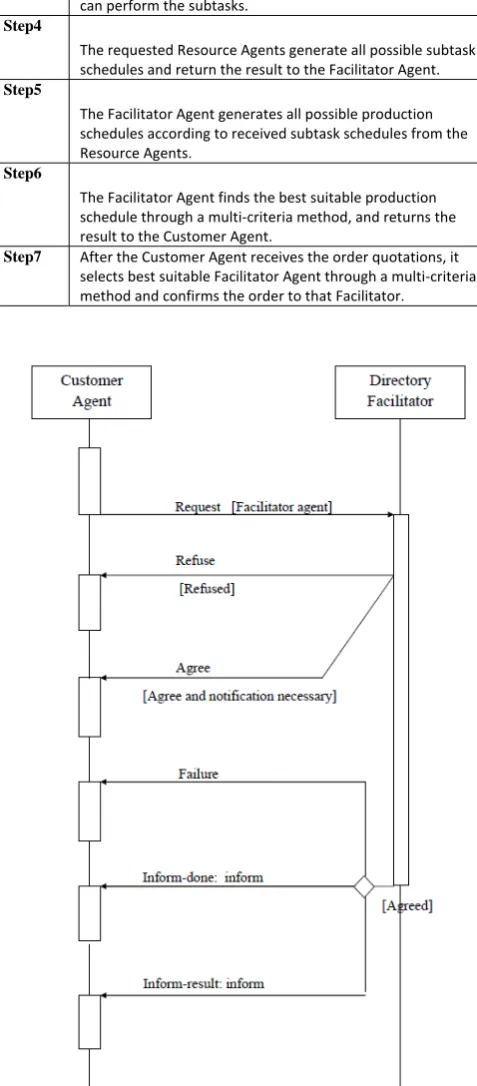
Table 1 shows the each step when a customer order comes in. When a facilitator agent receives a request from a customer agent, it divides the order into subtasks and sends a request to Directory Agent to find Resource Agents that can perform the subtasks. Then the Facilitator Agent sends requests to Resource Agents returned by Directory. The requested Resource Agents generate all possible subtask schedules and return the results to the Facilitator Agent. The Facilitator Agent generates all possible production schedules according to received subtask schedules from the Resource Agents and finds the best suitable production schedule. After the Customer Agent receives the order quotations, it selects best suitable Facilitator Agent based on their quotation content and other considerable factors. After the Facilitator Agent receives the order confirmation, it sends subtask confirmation to Resource Agents according to the subtask schedule. After the Resource Agent receives the
subtask confirmation, it starts the production process. Table 1, Steps of recourse scheduling for a single order
Step1 When a facilitator agent receives a request from a customer
agent, it divides the order into subtasks.
Step2
The Facilitator Agent sends a request to Directory Facilitator to
find Resource Agents that can perform the subtasks.
Step3
The Facilitator Agent sends a request to Resource Agents that
can perform the subtasks.
Step4
The requested Resource Agents generate all possible subtask
schedules and return the result to the Facilitator Agent.
Step5
The Facilitator Agent generates all possible production
schedules according to received subtask schedules from the
Resource Agents.
Step6
The Facilitator Agent finds the best suitable production
schedule through a multi‐criteria method, and returns the
result to the Customer Agent.
Step7 After the Customer Agent receives the order quotations, it
selects best suitable Facilitator Agent through a multi‐criteria
[image:4.595.45.284.162.706.2]method and confirms the order to that Facilitator.
Figure 4, A RIP cycle for Customer Agent searching for Facilitator Agents
Multi-agent communication protocol needs to be defined here to support above agent selection and resource scheduling. In this system, when a customer submits a
product order, a VCIM agent search and resource scheduling process is initiated. Protocols to support agent communication linkage and information exchange need to be defined. For example, Figure 4 shows an agent communication protocol used for Customer agent to search for suitable Facilitator agents. Here we use Request Interaction Protocol (RIP). The Customer agent first sends a search request to the Facilitator agent. The Facilitator agent replies with either refuse or agree. If agree the Facilitator agent then process the search based on criteria given by the Customer agent. If search fails, it returns Failed. Otherwise it returns Inform-done and Inform-result.
There are other scenarios like Resource agent registering to Directory agent, Facilitator agent search in the Directory for suitable Resource agents, order negotiation between Customer agent and Facilitator agent, and order negotiation between Facilitator agent and Resource agent. For each scenario, an agent interaction protocol is going to be defined.
C. Multi-criteria selection Integration
The VCIM system purpose is to automatically decompose the customer’s order into sub-orders and find best supplier and best paths for parts transport and assembly through computer based resource scheduling. This can be discomposed as two major processes. Process 1 is for Customer agent to find the best facilitator agent. Process 2 is for Facilitator agent to find the best production schedules by utilizing suitable resource agents. Those processes are emulating a customer finding a suitable broker to making some products and the broker finding several suitable workshops to work together for that order.
1) Factors in VCIM resource scheduling
In previous VCIM approach, only delivery time and cost are considered in resource scheduling. While in real world procurement, a lot of other factors affects final decision making. To make VCIM concept more practical, we need think about similar procedures for real person in a company to compare quotation and select outsourcing vendors and factors inside the selection.
marketplace, because vendors with unacceptable quality performance were dropped during the screening phase.
With consideration of previous research on Vendor selection and VCIM, the comparable factors for VCIM resource scheduling are identified as following:
a) Factors for Process 1, Customer agent find and select the best suitable facilitator agent for a particular order
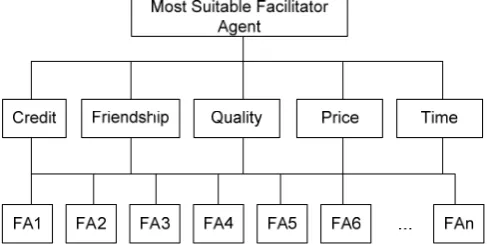
The customer agent finds suitable facilitator agents in the public registry (aka Directory Facilitator). Then it compares best suitable facilitator agent through a multi-criteria method. The comparable factors for this problem are: Credit, Friendship, Price, and Time.
Credit: A property that is stored in the public registry and can be retrieved by request. It is variable and will be adjusted by performance history (rating system)
Friendship: A property that is stored in the customer agent. It is variable and will be adjusted by performance history.
Quality: A property that is stored in the public registry and can be retrieved by request. It is variable and will be adjusted by performance history (rating system)
Price: A property that is generated by facilitator agent for that particular order. Different facilitator agent has different profit margins and different quotation prices from other resource agents. Even same production schedule may have different facilitator quotation prices.
Time: A property that is generated by facilitator agent for that particular order.
b) Factors for Process 2, when a facilitator agent receives a request from a customer agent, it generates all possible production schedules. Then it finds the best suitable production schedule through a multi-criteria method.
The comparable factors for this problem are:
For Cost, Time, Quality, Friendship, and Credit, they are the same as in Process 1. However there is one extra factor used.
Delivery reliability: A property that is stored in the public registry and can be retrieved by request. It is variable and will be adjusted by performance history (rating system)
The rating system mentioned above is supposed to be a simple survey of trust and reputation systems like eBay’s feedback form. In this case it is performed by software agents rather than human. In this way, many problems of human rating in eBay [12] can be controlled.
2) Multi-criteria Selection Process
As multiple factors that have been identified in VCIM resource scheduling, a multi-criteria selection approach is to be integrated. In the recent years, AHP method has been widely adapted as a decision making tool for outsourcing vendor selection problems. Many researches showed that the AHP is very effective solution to different kinds of Multi-criteria vendor selection, such as Manufacturing outsourcing vendor selection [13], Information system outsourcing vendor selection [14], E-business outsourcing vendor selection [15], and 3PL vendor selection of a 4PL system [16].
As shown in Figure 6, the hierarchy construction has
[image:5.595.305.549.101.226.2]three layers for Resource Scheduling Process 1. Suitable Facilitator Agents are compared by five factors: Credit, Friendship, Quality, Price and Time to find out the most suitable Facilitator for this process.
Figure 5, Hierarchy construction model for VCIM Resource Scheduling Process 1.
The comparable factors in VCIM are quite similar to those factors in Vendor selection. And some factors we identified are fuzzy, such as quality and friendship. Therefore a Fuzzy AHP method is going to be used in the two VCIM resource scheduling processes mentioned above where multiple factors are involved.
IV. CONCLUSION
VCIM is a way forward to the SMMEs in many countries, where the globalization has impacted dramatically on manufacturing industry. VCIM provides a facility to share resources of partner enterprises that are geographically distributed and provides a competitive edge for SMMEs to be in equal footing with large organizations that have abundance resources to meet the challenges imposed by the globalization. This article discusses more advanced Agent-based VCIM architecture and Multi-criteria Resource Scheduling Process that will help the SMMEs in global competition. As can be seen, there are still a lot of work to do on optimizing Agent based resource scheduling. This will involve designing new agent behavior, communication protocols, and an effective multi-criteria selection method Model.
REFERENCES
[1] Wang, D., Nagalingam, S. V., and Lin, G. C. I., Development of an agent-based Virtual CIM architecture for small and medium manufacturers. Robotics and Computer Integrated Manufacturing,, 2007. 23(1): p. 1-16.
[2] Nagalingam, S. V. and Lin, G. C. I., Latest developments in CIM. Robotics and Computer-Integrated Manufacturing, 1999. 15(6): p. 423.
[3] Wang, D., Nagalingam, S. V., and Lin, G. C. I., Development of a parallel processing multi-agent architecture for a virtual CIM system. [4] Wang, D., Nagalingam, S. V., and Lin, G. C. I. Implementation
approaches for a multi-agent Virtual CIM System. in 9th International Conference on Manufacturing Excellence (ICME – 2003). 2003. Melbourne, Australia.
[5] Wang, D., Nagalingam, S. V., and Lin, G. C. I., A Novel Multi-Agent Architecture for Virtual CIM System,. International Journal of Agile Manufacturing System, 2005. 8(8): p. 69-82..
[7] Kumar M, Vrat P, Shankar R. A fuzzy goal programming approach for vendor selection problem in a supply chain. Computers and Industrial Engineering. 2004;46(1):69-85.
[8] Yao Y, Evers PT, Dresner ME. Supply chain integration in vendor-managed inventory. Decision Support Systems. 2007;43(2):663-74. [9] Dickson GW. An analysis of vendor selection systems and decisions.
Journal of Purchasing. 1966;2(1):5-17.
[10] Weber C.V. et al., , Key Practices of the Capability Maturity Model. 1991. CMU/SEI-91-TR-25.
[11] Hill Jr S. Some outsourcing successes. Manufacturing Systems. 2000;18(6).
[12] P. Resnick, R. Zeckhauser, J. Swanson and K. Lockwood, The value of reputation on eBay: a controlled experiment, Working Paper for the June 2002 Esa Conference, Boston, Ma, School of Information, University of Michigan (2002) URL:
http://www.si.umich.edu/presnick/papers/postcards/.
[13] Jian-Jun W, Rui G, Xin-Jun D, editors. Using a hybrid multi-criteria decision aid method for outsourcing vendor selection2008; Piscataway, NJ, USA: IEEE.
[14] Fu Y, Liu H, editors. Information systems outsourcing vendor selection based on analytic hierarchy process2007; Shanghai, China: Inst. of Elec. and Elec. Eng. Computer Society.
[15] Wuwei L, Yuhong W, Ao C, editors. Grey relational evaluation on vendor selection based on e-business2008; Piscataway, NJ, USA: IEEE.
[16] He Z, Xiu L, Wenhuang L, Bing L, Zhihong Z, editors. An