Automatically Building Training Examples for Entity Extraction
Marco Pennacchiotti Yahoo! Labs Sunnyvale, CA, USA
Patrick Pantel Microsoft Research Redmond, WA, USA
Abstract
In this paper we present methods for automat-ically acquiring training examples for the task of entity extraction. Experimental evidence show that: (1) our methods compete with a current heavily supervised state-of-the-art sys-tem, within 0.04 absolute mean average pre-cision; and (2) our model significantly out-performs other supervised and unsupervised baselines by between 0.15 and 0.30 in abso-lute mean average precision.
1 Introduction
Entity extraction is a fundamental task in NLP and related applications. It is broadly defined as the task of extracting entities of a given semantic class from texts (e.g., lists of actors, musicians, cities). Search engines such as Bing, Yahoo, and Google collect large sets of entities to better interpret queries (Tan and Peng, 2006), to improve query suggestions (Cao et al., 2008) and to understand query intents (Hu et al., 2009). In response, automated techniques for entity extraction have been proposed (Pas¸ca, 2007; Wang and Cohen, 2008; Chaudhuri et al., 2009; Pan-tel et al., 2009).
There is mounting evidence that combining knowledge sources and information extraction sys-tems yield significant improvements over applying each in isolation (Pas¸ca et al., 2006; Mirkin et al., 2006). This intuition is explored by the Ensem-ble Semantics (ES) framework proposed by Pennac-chiotti and Pantel (2009), which outperforms pre-vious state-of-the-art systems. A severe limitation of this type of extraction system is its reliance on
editorial judgments for building large training sets for each semantic class to be extracted. This is particularly troublesome for applications such as web search that require large numbers of semantic classes in order to have a sufficient coverage of facts and objects (Tan and Peng, 2006). Hand-crafting training sets across international markets is often in-feasible. In an exploratory study we estimated that a pool of editors would need roughly 300 working days to complete a basic set of 100 English classes using the ES framework. Critically needed are meth-ods for automatically building training sets that pre-serve the extraction quality.
In this paper, we propose simple and intuitively appealing solutions to automatically build training sets. Positive and negative training sets for a tar-get semantic class are acquired by leveraging: i) ‘trusted’ sources such as structured databases (e.g., IMDB or Wikipedia for acquiring a list ofActors); ii) automatically constructed semantic lexicons; and iii) instances of semantic classes other than the tar-get class. Our models focus on extracting training sets that are large, balanced, and representative of the unlabeled data. These models can be used in any extraction setting, where ‘trusted’ sources of knowl-edge are available: Today, the popularity of struc-tured and semi-strucstruc-tured sources such as Wikipedia and internet databases, makes this approach widely applicable. As an example, in this paper we show that our methods can be successfully adapted and used in the ES framework. This gives us the possi-bility to test the methods on a large-scale entity ex-traction task. We replace the manually built training data in the the ES model with the training data built
by our algorithms. We show by means of a large em-pirical study that our algorithms perform nearly as good as the fully supervised ES model, within 4% in absolute mean average precision. Further, we com-pare the performance of our method against both Pas¸ca et al. (2006) and Mirkin et al. (2006), show-ing 17% and 15% improvements in absolute mean average precision, respectively.
The main contributions of this paper are:
• We propose several general methods for automatically acquiring labeled training data; we show that they can be used in a large-scale extraction framework, namely ES; and
• We show empirical evidence on a large-scale entity extraction task that our system using automatically labeled training data performs nearly as well as the fully-supervised ES model, and that it significantly outperforms state-of-the-art systems.
2 Automatic Acquisition of Training Data
Supervised machine learning algorithms require training data that is: (1) balanced and large enough to correctly model the problem at hand (Kubat and Matwin, 1997; Japkowicz and Stephen, 2002); and (2) representative of the unlabeled data to decode, i.e., training and unlabeled instances should be ide-ally drawn from the same distribution (Blumer et al., 1989; Blum and Langley, 1997). If these two prop-erties are not met, various learning problems, such as overfitting, can drastically impair predictive ac-curacy. To address the above properties, a common approach is to select a subset of the unlabeled data (i.e., the instances to be decoded), and manually la-bel them to build the training set.
In this section we propose methods to automate this task by leveraging the multitude of structured knowledge bases available on the Web.
Formally, given a target class c, our goal is to implement methods to automatically build a training set T(c), composed of both positive and negative examples, respectively P(c) and N(c); and to apply T(c) to classify (or rank) a set of unlabeled data U(c), by using a learning algorithm. For example, in entity extraction, given the class Actors, we might have P(c) = {Brad P itt, Robert De N iro} and N(c) = {Serena W illiams, Rome, Robert Demiro}.
Below, we define the components of a typical knowledge acquisition system as in the ES frame-work, where our methods can be applied :
Sources. Textual repositories of information, ei-ther structured (e.g., Freebase), semi-structured (e.g., HTML tables) or unstructured (e.g., a we-bcrawl). Information sources serve as inputs to the extraction system, either for the Knowledge Extrac-tors to generate candidate instances, or for the Fea-ture Generators to generate feaFea-tures (see below).
Knowledge Extractors (KE). Algorithms re-sponsible for extracting candidate instances such as entities or facts. Extractors fall into two categories: trusted and untrusted.Trusted extractorsexecute on structured sources where the contents are deemed to be highly accurate.Untrusted extractorsexecute on unstructured or semi-structured sources and gener-ally generate high coverage but noisy knowledge.
Feature Generators. Methods that extract evi-dence (features) of knowledge in order to decide which extracted candidate instances are correct.
Ranker. A module for ranking the extracted in-stances using the features generated by the feature generators. In supervised ML-based rankers, labeled training instances are required to train the model. Our goal here is to automatically label training in-stances thus avoiding the editorial costs.
2.1 Acquiring Positive Examples
Trusted positives: Candidate instances for a class cthat are extracted by a trusted Knowledge Extrac-tor (e.g., a wrapper induction system over IMDB), tend to be mostly positive examples. A basic ap-proach to acquiring a set of positive examples is then to sample from the unlabeled setU(c)as follows:
P(c) ={i∈U(c) : (∃KEi|KEiis trusted} (1)
whereKEi is a knowledge extractor that extracted instancei.
the trusted KEs, but that are not representative of the true population to be decoded (which is largely com-ing from untrusted KEs).
We therefore enforce that the instances in P(c)
are extracted not only from a trusted KE, but also from any of the untrusted extractors:
P(c) ={i∈U(c) :∃KEi|KEiis trusted∧
∃KEj|KEj is untrusted} (2)
External positives: This method selects the set of positive examplesP(c)from an external repository, such as an ontology, a database, or an automati-cally harvested source. The main advantage of this method is that such resources are widely available for many knowledge extraction tasks. Yet, the risk is thatP(c)is not representative of the unlabeled in-stancesU(c), as they are drawn from different pop-ulations.
2.1.1 Acquiring Negative Examples
Acquiring negative training examples is a much more daunting task (Fagni and Sebastiani, 2007). The main challenge is to select a set which is a good representative of the unlabeled negatives in U(c). Various strategies can be adopted, ranging from selecting near-miss examples to acquiring generic ones, each having its own pros and cons. Below we propose our methods, some building on previous work described in Section 5.
Near-class negatives: This method selectsN(c)
from the population U(C) of the set of classes C which are semantically similar toc. For example, in entity extraction, the classes Athletes, Directors andM usiciansare semantically similar to the class Actors, whileM anuf acturersandP roductsare dissimilar. Similar classes allow us to select negative examples that are semantic near-misses for the class c. The hypothesis is the following:
A positive instance extracted for a class similar to the target classc, is likely to be a near-miss incorrect instance forc.
To model this hypothesis, we acquire N(c) from the set of instances having the following two restric-tions:
1. The instance is most likely correct forC
2. The instance is most likely incorrect forc
Note that restriction (1) alone is not sufficient, as an instance ofCcan be at the same time also instance ofc. For example, given the target classActors, the instance‘Woody Allen’ ∈ Directors, is not a good negative example forActors, since Woody Allen is both a director and an actor.
In order to enforce restriction (1), we select only instances that have been extracted by a trusted KE ofC, i.e., the confidence of them being positive is very high. To enforce (2), we select instances that have never been extracted by any KE of c. More formally, we defineN(c)as follows:
N(c) = [
ci∈C
P(ci) \U(c) (3)
The main advantage of this method is that it acquires negatives that are semantic near-misses of the tar-get class, thus allowing the learning algorithm to fo-cus on these borderline cases (Fagni and Sebastiani, 2007). This is a very important property, as most incorrect instances extracted by unsupervised KEs are indeed semantic near-misses. On the downside, the extracted examples are not representative of the negative examples of the target class c, since they are drawn from two different distributions.
Generic negatives: This method selects N(c)
from the populationU(C)of all classesCdifferent from the target classc, i.e., both classes semantically similar and dissimilar toc. The method is very sim-ilar to the one above, apart from the selection ofC, which now includes any class different fromc. The underlying hypothesis is the following:
A positive instance extracted for a class different from the target classc, is likely to be an incorrect instance forc.
Same-class negatives: This method selects the set of negative examplesN(c)from the population U(c). The driving hypothesis is the following:
If a candidate instance for a classchas been ex-tracted by only one KE and this KE is untrusted, then the instance is likely to be incorrect, i.e., a negative example forc.
The above hypothesis stems from an intuitive obser-vation common to many ensemble-based paradigms (e.g., ensemble learning in Machine Learning): the more evidence you have of a given fact, the higher is the probability of it being actually true. In our case, the fact that an instance has been extracted by only one untrusted KE, provides weak evidence that the instance is correct.N(c)is defined as follows:
N(c) ={i∈U(c) :∃!KEi ∧KEiis untrusted} (4)
The main advantage of this method is that the ac-quired instances inN(c)are good representatives of the negatives that will have to be decoded, i.e., they are drawn from the same distributionU(c). This al-lows the learning algorithm to focus on the typical properties of the incorrect examples extracted by the pool of KEs.
A drawback of this method is that instances in N(c)are not guaranteed to be true negatives. It fol-lows that the final training set may be noisy. Two main strategies can be applied to mitigate this prob-lem: (1) Use a learning algorithm which is robust to noise in the training data; and (2) Adopt techniques to automatically reduce or eliminate noise. We here adopt the first solution, and leave the second as a possible avenue for future work, as described in Sec-tion 6. In SecSec-tion 4 we demonstrate the amount of noise in our training data, and show that its impact is not detrimental for the overall performance of the system.
3 A Use Case: Entity Extraction
Entity extraction is a fundamental task in NLP (Cimiano and Staab, 2004; McCarthy and Lehnert, 2005) and web search (Chaudhuri et al., 2009; Hu et al., 2009; Tan and Peng, 2006), responsible for extracting instances of semantic classes (e.g.,‘Brad Pitt’and‘Tom Hanks’are instances of the class Ac-tors). In this section we apply our methods for
auto-matically acquiring training data to the ES entity ex-traction system described in Pennacchiotti and Pan-tel (2009).1
The system relies on the following three knowl-edge extractors. KEtrs: a ‘trusted’ database
wrapper extractor acquiring entities from sources such asYahoo! Movies,Yahoo! MusicandYahoo! Sports, for extracting respectivelyActors,Musicians
andAthletes. KEpat: an ‘untrusted’ pattern-based
extractor reimplementing Pas¸ca et al.’s (2006) state-of-the-art web-scale fact extractor. KEdis: an
‘un-trusted’ distributional extractor implementing a vari-ant of Pvari-antel et al.’s (2009).
The system includes four feature generators, which compute a total of 402 features of various types extracted from the following sources: (1) a body of 600 million documents crawled from the Web at Yahoo! in 2008; (2) one year of web search queries issued to Yahoo! Search; (3) all HTML inner tables extracted from the above web crawl; (4) an official Wikipedia dump from February 2008, con-sisting of about 2 million articles.
The system adopts as a ranker a supervised Gradient Boosted Decision Tree regression model (GBDT) (Friedman, 2001). GBDT is generally con-sidered robust to noisy training data, and hence is a good choice given the errors introduced by our auto-matic training set construction algorithms.
3.1 Training Data Acquisition
The positive and negative components of the training set for GBDT are built using the methods presented in Section 2, as follows:
Trusted positives (Ptrs and Pcls): According to Eq. 2, we acquire a set of positive instances Pcls as a random sample of the instances extracted by both KEtrs and either: KEdis, KEpat or both of them. As a basic variant, we also experiment with the simpler definition in Eq. 1, i.e. we acquire a set of positive instancesPtrsas a random sample of the instances extracted by the trusted extractorKEtrs, irrespective ofKEdisandKEpat.
External positives (Pcbc): Any external repository of positive examples would serve here. In our
spe-1
cific implementation, we select a set of positive ex-amples from the CBC repository (Pantel and Lin, 2002). CBC is a word clustering algorithm that groups instances appearing in similar textual con-texts. By manually analyzing the cluster members in the repository created by CBC, it is easy to pick-up the cluster(s) representing a target class.
Same-class negatives (Ncls): We select a set of negative instances as a random sample of the in-stances extracted by only one extractor, which can be either of the two untrusted ones, KEdis or KEpat.
Near-class negatives (Noth): We select a set of negative instances, as a random sample of the in-stances extracted by any of our three extractors for a class different than the one at hand. We also enforce the condition that instances in Noth must not have been extracted for the class at hand.
Generic negatives (Ncbc): We automatically se-lect as generic negatives a random sample of in-stances appearing in any CBC cluster, except those containing at least one member of the class at hand (i.e., containing at least one instance extracted by one of our KEs for the given class).
4 Experimental Evaluation
In this section, we report experiments comparing the ranking performance of our different methods for acquiring training data presented in Section 3, to three different baselines and a fully supervised upper-bound.
4.1 Experimental Setup
We evaluate over three semantic classes: Actors
(movie, tv and stage actors); Athletes (profes-sional and amateur);Musicians(singers, musicians, composers, bands, and orchestras), so to compare with (Pennacchiotti and Pantel, 2009). Ranking per-formance is tested over the test set described in the above paper, composed of 500 instances, randomly selected from the instances extracted byKEpatand KEdisfor each of the classes2.
We experiment with various instantiations of the ES system, each trained on a different training set
2
We do not test over instances extracted byKEtrs, as they
do not go though the decoding phase
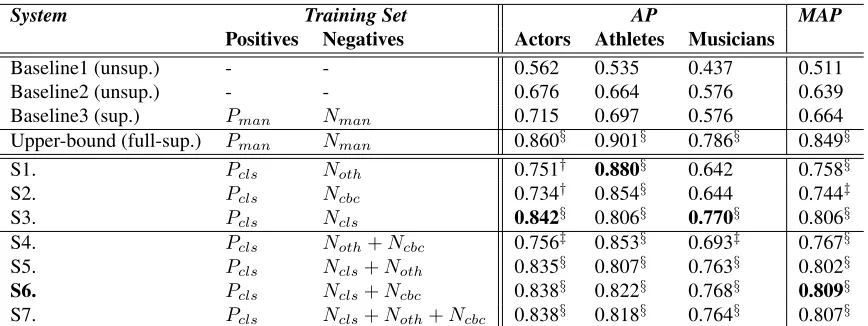
obtained from our methods. The different system in-stantiations (i.e., different training sets) are reported in Table 1 (Columns 1-3). Each training set consists of 500 positive examples, and 500 negative exam-ples.
As anupper bound, we use the ES system, where the training consists of 500 manually annotated in-stances (Pman andNman), randomly selected from those extracted by the KEs. This allows us to di-rectly check if our automatically acquired training sets can compete to the human upper-bound. We also compare to the following baselines.
Baseline 1: An unsupervised rule-based ES sys-tem, assigning the lowest score to instances ex-tracted by only one KE, when the KE is untrusted; and assigning the highest score to any other instance.
Baseline 2: An unsupervised rule-based ES sys-tem, adopting as KEs the two untrusted extractors KEpatandKEdis, and a rule-basedRankerthat as-signs scores to instances according to the sum of their normalized confidence scores.
Baseline 3: An instantiation of our ES system, trained on Pman and Nman. The only differ-ence with the upper-bound is that it uses only two features, namely the confidence score returned by KEdis andKEpat. This instantiation implements the system presented in (Mirkin et al., 2006).
For evaluation, we useaverage precision(AP), a standard information retrieval measure for evaluat-ing rankevaluat-ing algorithms:
AP(L) =
P|L|
i=1P(i)·corr(i)
P|L|
i=1corr(i)
(5)
whereLis a ranked list produced by a system,P(i)
is the precision ofLat ranki, andcorr(i)is 1 if the instance at rankiis correct, and 0 otherwise.
In order to accurately compute statistical signifi-cance, we divide the test set in 10-folds, and com-pute the AP mean and variance obtained over the 10-folds. For each configuration, we perform the random sampling of the training set five times, re-building the model each time, to estimate the vari-ance when varying the training sampling.
4.2 Experimental Results
System Training Set AP MAP
Positives Negatives Actors Athletes Musicians
Baseline1 (unsup.) - - 0.562 0.535 0.437 0.511
Baseline2 (unsup.) - - 0.676 0.664 0.576 0.639
Baseline3 (sup.) Pman Nman 0.715 0.697 0.576 0.664
Upper-bound (full-sup.) Pman Nman 0.860§ 0.901§ 0.786§ 0.849§
S1. Pcls Noth 0.751† 0.880§ 0.642 0.758§
S2. Pcls Ncbc 0.734† 0.854§ 0.644 0.744‡
S3. Pcls Ncls 0.842§ 0.806§ 0.770§ 0.806§
S4. Pcls Noth+Ncbc 0.756‡ 0.853§ 0.693‡ 0.767§
S5. Pcls Ncls+Noth 0.835§ 0.807§ 0.763§ 0.802§
S6. Pcls Ncls+Ncbc 0.838§ 0.822§ 0.768§ 0.809§
[image:6.612.88.522.53.216.2]S7. Pcls Ncls+Noth+Ncbc 0.838§ 0.818§ 0.764§ 0.807§
Table 1: Average precision (AP) results of systems using different training sets, compared to two usupervised Base-lines, a supervised Baseline, and a fully supervised upper-bound system.§indicates statistical significance at the 0.95 level wrt all Baselines. ‡indicates statistical significance at the 0.95 level wrt Baseline1 and Baseline 2. †indicates statistical significance at the 0.95 level wrt Baseline1.
classes; and the mean average precision (MAP) computed across the classes. We report results us-ing Pcls as positive training, and varying the neg-ative training composition3. Systems S1-S3 use a single method to build the negatives. Systems S4-S6 combine two methods (250 examples from one method, 250 from the other), and S7 combines all three methods. Table 3 reports additional basic re-sults when varying the positive training set compo-sition, and fixing the best performing negative set (namelyNcls).
Table 1 shows that all systems outperform the baselines in MAP, with 0.95 statistical significance, butS2which is not significant wrtBaseline 3.S6is the best performing system, achieving 0.809 MAP, only 4% below the supervised upper-bound (statis-tically insignificant at the 0.95 level). These results indicate that our methods for automatically acquir-ing trainacquir-ing data are highly effective and competitive with manually crafted training sets.
A class-by-class analysis reveals similar behav-ior forActorsandMusicians. For these two classes, the best negative set isNcls (systemS3), achieving alone the best AP (respectively 0.842 and 0.770 for
ActorsandMusicians, 2.1% and 1.6% points below the upper-bound). Noth andNcbc show a lower ac-curacy, more than 10% below Ncls. This suggest that the most promising strategy for automatically
3
For space limitation we cannot report exhaustively all com-binations.
Negative set False Negatives
Actors Athletes Musicians
Ncls 5% 45% 30%
Noth 0% 10% 10%
[image:6.612.323.528.285.347.2]Ncbc 0% 0% 15%
Table 2: Percentage of false negatives in different types of negative sets, across the three experimented classes (esti-mations over a random sample of 20 examples per class).
acquiring negative training data is to collect exam-ples from the target class, as they guarantee to be drawn from the same distribution as the instances to be decoded. The use of near- and far-misses is still valuable (AP results are still better than the base-lines), but less effective.
Results for Athletes give different evidence: the best performing negative set is Noth, performing significantly better than Ncls. To investigate this contrasting result, we manually picked 20 exam-ples from Ncls, Noth and Ncbc for each class, and checked their degree of noise, i.e., how many false negatives they contain. Table 2 reports the results: these numbers indicate that the Ncls is very noisy for theAthletesclass, while it is more clean for the other two classes. This suggests that the learning algorithm, while being robust enough to cope with the small noise inNclsforActorsandMusicians, it starts to diverge when too many false negatives are presented for training, as it happens forAthletes.
Table 2 indicates that our untrusted KEs are more accurate in extracting instances forAthletesthan for the other classes: accurate enough to make our train-ing set too noisy, thus decreastrain-ing the performance ofS3wrtS1andS2. This indicates that the effec-tiveness ofNclsdecreases when the accuracy of the untrusted KEs is higher.
A good strategy to avoid the above problem is to pair Ncls with another negative set, either Ncbc or Noth, as in S5 and S6, respectively. Then, when the above problem is presented, the learning algo-rithm can rely on the other negative set to com-pensate some for the noise. Indeed, when adding NcbctoNcls(systemS6) the accuracy overAthletes improves, while the overall performance across all classes (MAP) is kept constant wrt the system using Ncls(S3).
It is interesting that in Table 2,NcbcandNothalso have a few false negatives. An intrinsic analysis re-veals that these are either: (1) Incorrect instances of the other classes that are actual instances of the target class; (2) Correct instances of other classes that are also instances of the target class. Case (1) is caused by errors of KEs for the other classes (e.g., erroneously extracting ‘Matthew Flynt’as a Musi-cian). Case (2) covers cases in which instances are ambiguous across classes, for example‘Kerry Tay-lor’is both anActorand aMusician. This observa-tion is still surprising, since Eq. 3 explicitly removes fromNcbc andNothany correct instance of the tar-get class extracted by the KEs. The presence of false negatives is then due to the low coverage of the KEs for the target class, e.g. the KEs were not able to ex-tract‘Matthew Flynt’and‘Kerry Taylor’as actors.
Correlations. We computed the Spearman corre-lation coefficient r among the rankings produced by the different system instantiations, to verify how complementary the information enclosed in the training sets are for building the learning model. Among the basic systemsS1−S3, the highest cor-relation is between S1 andS2 (r = 0.66 in aver-age across all classes), which is expected, since they both apply the principle of acquiring negative ex-amples from classes other than the target one. S3
exhibits lower correlation with bothS1andS2, re-spectivelyr= 0.57andr= 0.53, suggesting that it is complementary to them. Also, the best systemS6
System Training Set AP MAP
Pos. Neg. Act. Ath. Mus.
S3. Pcls Ncls 0.842 0.806 0.770 0.806
S8. Ptrs Ncls 0.556 0.779 0.557 0.631
S9. Pcbc Ncls 0.633 0.521 0.561 0.571
Table 3: Comparative average precision (AP) results for systems using different positive sets as training data.
Figure 1: Average precision of systemS6with different training sizes.
has higher correlation withS3(r = 0.94) than with S2(r= 0.62), indicating that in the combination of NclsandNcbc, most of the model is built onNcls.
Varying the positive training. Table 3 reports re-sults when fixing the negative set to the best per-formingNcls, and exploring the use of other posi-tive sets. As expectedPclslargely outperformsPtrs, confirming that removing the constraint in Eq. 2 and using the simpler Eq. 1 makes the training set unrep-resentative of the unlabeled population. A similar observation stands for Pcbc. These results indicate that having a good trusted KE, or even an external resource of positives, is effective only when select-ing from the trainselect-ing set examples that are also ex-tracted by the untrusted KEs.
[image:7.612.319.533.161.291.2]5 Related Work
Most relevant are efforts in semi-supervised learn-ing. Semi-supervised systems use both labeled and unlabeled data to train a machine learning system. Most common techniques are based on co-training and self-training. Co-traininguses a small set of la-beled examples to train two classifiers at the same time. The classifiers use independent views (i.e. ‘conditionally independent’ feature sets) to repre-sent the labeled examples. After the learning phase, the most confident predictions of each classifier on the unlabeled data are used to increase the la-beled set of the other. These two phases are re-peated until a stop condition is met. Co-training has been successfully applied to various applica-tions, such as statistical parsing (Sarkar, 2001) and web pages classification (Yarowsky, 1998). Self-training techniques (or bootsrapping) (Yarowsky, 1995) start with a small set of labeled data, and it-eratively classify unlabeled data, selecting the most confident predictions as additional training. Self-training has been applied in many NLP tasks, such as word sense disambiguation (Yarowsky, 1995) and relation extraction (Hearst, 1992). Unlike typical semi-supervised approaches, our approach reduces the needed amount of labeled data not by acting on the learning algorithm itself (any algorithm can be used in our approach), but on the method to acquire the labeled training data.
Our work also relates to the automatic acquisi-tion of labeled negative training data. Yangarber et al. (2002) propose a pattern-based bootstrapping ap-proach for harvesting generalized names (e.g., dis-eases, locations), where labeled negative examples for a given class are taken from positive seed exam-ples of ‘competing’ classes (e.g. examexam-ples of dis-eases are used as negatives for locations). The ap-proach is semi-supervised, in that it requires some manually annotated seeds. The study shows that using competing categories improves the accuracy of the system, by avoiding sematic drift, which is a common cause of divergence in boostrapping ap-proaches. Similar approaches are used among others in (Thelen and Riloff, 2002) for learning semantic lexicons, in (Collins and Singer, 1999) for named-entity recognition, and in (Fagni and Sebastiani, 2007) for hierarchical text categorization. Some of
our methods rely on the same intuition described above, i.e., using instances of other classes as nega-tive training examples. Yet, the ES framework al-lows us to add further restrictions to improve the quality of the data.
6 Conclusion
We presented simple and general techniques for au-tomatically acquiring training data, and then tested them in the context of the Ensemble Semantics framework. Experimental results show that our methods can compete with supervised systems us-ing manually crafted trainus-ing data. It is our hope that these simple and easy-to-implement methods can al-leviate some of the cost of building machine learn-ing architectures for supportlearn-ing open-domain infor-mation extraction, where the potentially very large number of classes to be extracted makes infeasible the use of manually labeled training data.
There are many avenues for future work. Al-though our reliance on high-quality knowledge sources is not an issue for many head classes, it poses a challenge for tail classes such as ‘wine con-noisseurs’, where finding alternative sources of high precision samples is important. We also plan to ex-plore techniques to automatically identify and elim-inate mislabeled examples in the training data as in (Rebbapragada and Brodley, 2007), and relax the boolean assumption of trusted/untrusted extractors into a graded one. Another important issue regards the discovery of ‘classes’ for collecting near-classes negatives: we plan to automate this step by adapting existing techniques as in (McIntosh, 2010). Finally, we plan to experiment on a larger set of classes, to show the generalizability of the approach. Our current work focuses on leveraging auto-learning to create an extensive taxonomy of classes, which will constitute the foundation of a very large knowledge-base for supporting web search.
References
Avrim L. Blum and Pat Langley. 1997. Selection of rel-evant features and examples in machine learning. Ar-tificial Intelligence, 97:245–271.
Huanhuan Cao, Daxin Jiang, Jian Pei, Qi He, Zhen Liao, Enhong Chen, and Hang Li. 2008. Context-aware query suggestion by mining click-through and session data. InProceedings of KDD-08, pages 875–883. Surajit Chaudhuri, Venkatesh Ganti, and Dong Xin.
2009. Exploiting web search to generate synonyms for entities. InProceedings of WWW-09, pages 151–160. Philipp Cimiano and Steffen Staab. 2004. Learning by
googling. SIGKDD Explorations, 6(2):24–34. M. Collins and Y. Singer. 1999. Unsupervised
mod-els for named entity classification. InProceedings of WVLC/EMNLP-99, pages 100–110.
Tiziano Fagni and Fabrizio Sebastiani. 2007. On the se-lection of negative examples for hierarchical text cate-gorization. InProceedings of LTC-07, pages 24–28. Jerome H. Friedman. 2001. Greedy function
approxima-tion: A gradient boosting machine. Annals of Statis-tics, 29(5):1189–1232.
Marti A. Hearst. 1992. Automatic acquisition of hy-ponyms from large text corpora. In Proceedings of COLING-92, pages 539–545.
Jian Hu, Gang Wang, Fred Lochovsky, Jian tao Sun, and Zheng Chen. 2009. Understanding user’s query intent with Wikipedia. In Proceedings of WWW-09, pages 471–480.
N. Japkowicz and S. Stephen. 2002. The class imbalance problem: A systematic study. Intelligent Data Analy-sis, 6(5).
M. Kubat and S. Matwin. 1997. Addressing the curse of inbalanced data sets: One-side sampleing. In Pro-ceedings of the ICML-1997, pages 179–186. Morgan Kaufmann.
Joseph F. McCarthy and Wendy G Lehnert. 2005. Using decision trees for coreference resolution. In Proceed-ings of IJCAI-1995, pages 1050–1055.
Tara McIntosh. 2010. Unsupervised discovery of nega-tive categories in lexicon bootstrapping. In Proceed-ings of the 2010 Conference on Empirical Methods in Natural Language Processing, pages 356–365, Mas-sachusetts, USA. Association for Computational Lin-guistics.
Shachar Mirkin, Ido Dagan, and Maayan Geffet. 2006. Integrating pattern-based and distributional similarity methods for lexical entailment acquisition. In Pro-ceedings of ACL/COLING-06, pages 579–586. Marius Pas¸ca, Dekang Lin, Jeffrey Bigham, Andrei
Lif-chits, and Alpa Jain. 2006. Organizing and search-ing the world wide web of facts - step one: The one-million fact extraction challenge. In Proceedings of AAAI-06, pages 1400–1405.
Marius Pas¸ca. 2007. Weakly-supervised discovery of named entities using web search queries. In Proceed-ings of CIKM-07, pages 683–690, New York, NY, USA.
Patrick Pantel and Dekang Lin. 2002. Discovering word senses from text. In Proceedings of KDD-02, pages 613–619.
Patrick Pantel, Eric Crestan, Arkady Borkovsky, Ana-Maria Popescu, and Vishnu Vyas. 2009. Web-scale distributional similarity and entity set expansion. In Proceedings of EMNLP-09.
Marco Pennacchiotti and Patrick Pantel. 2009. Entity extraction via ensemble semantics. InProceedings of the 2009 Conference on Empirical Methods in Natu-ral Language Processing, pages 238–247, Singapore. Association for Computational Linguistics.
Umaa Rebbapragada and Carla E. Brodley. 2007. Class noise mitigation through instance weighting. In Pro-ceedings of the 18th European Conference on Machine Learning.
Anoop Sarkar. 2001. Applying co-training methods to statistical parsing. InNAACL-2001.
Bin Tan and Fuchun Peng. 2006. Unsupervised query segmentation using generative language models and wikipedia. InProceedings of WWW-06, pages 1400– 1405.
Michael Thelen and Ellen Riloff. 2002. A bootstrapping method for learning semantic lexicons using extraction pattern contexts. InProceedings of the 2002 Confer-ence on Empirical Methods in Natural Language Pro-cessing, pages 214–221, Philadelphia, PA, USA. As-sociation for Computational Linguistics.
Richard C. Wang and William W. Cohen. 2008. Itera-tive set expansion of named entities using the web. In ICDM ’08: Proceedings of the 2008 Eighth IEEE In-ternational Conference on Data Mining, pages 1091– 1096, Washington, DC, USA. IEEE Computer Society. Roman Yangarber, Winston Lin, and Ralph Grishman. 2002. Unsupervised learning of generalized names. InCOLING-2002.
David Yarowsky. 1995. Unsupervised word sense dis-ambiguation rivaling supervised methods. In Proceed-ings of ACL-1996, pages 189–196.