Resolving Speculation: MaxEnt Cue Classification and
Dependency-Based Scope Rules
∗Erik Velldal♣ and Lilja Øvrelid♠♣ and Stephan Oepen♣ ♣University of Oslo, Department of Informatics (Norway)
♠Universität Potsdam, Institut für Linguistik (Germany)
[email protected] and [email protected] and [email protected]
Abstract
This paper describes a hybrid, two-level approach for resolving hedge cues, the problem of the CoNLL-2010 shared task. First, a maximum entropy classifier is ap-plied to identify cue words, using both syntactic- and surface-oriented features. Second, a set of manually crafted rules, operating on dependency representations and the output of the classifier, is applied to resolve the scope of the hedge cues within the sentence.
1 Introduction
The CoNLL-2010 shared task1 comprises two
sub-tasks. Task 1 is described aslearning to detect sentences containing uncertainty, while the object of Task 2 is learning to resolve the in-sentence scope of hedge cues(Farkas et al., 2010). Parallel-ing this two-fold task definition, the architecture of our system naturally decomposes into two main steps. First, a maximum entropy (MaxEnt) classi-fier is applied to automatically detect cue words. For Task 1, a given sentence is labeled as uncer-tain if it contains a word classified as a cue. For Task 2, we then go on to determine the scope of the identified cues using a set of manually crafted rules operating on dependency representations.
For both Task 1 and Task 2, our system partic-ipates in the stricter category of ‘closed’ or ‘in-domain’ systems. This means that we do not use any additional uncertainty-annotated material beyond the supplied training data, consisting of 14541 sentences from biomedical abstracts and ar-ticles (see Table 2). In the official ranking of
re-∗
We are grateful to our colleagues at the University of Oslo and the University of Potsdam, for many useful discus-sions, constructive critique, and encouragment. We specifi-cally thank Woodley Packard for careful proof-reading.
1The CoNLL-2010 shared task website:http://www.
inf.u-szeged.hu/rgai/conll2010st/.
sults, and considering systems in all categories to-gether (closed/open/cross-domain), our system is ranked 4 out of 24 for Task 1 and 3 out of 15 for Task 2, resulting in highest average rank (and F1)
overall. We detail the implementation of the cue classifier and the syntactic rules in Sections 3 and 4, respectively. Results for the held-out testing are provided in Section 5. First, however, the next sec-tion describes the various resources that we used for pre-processing the CoNLL data sets, to prepare the input to our hedge analysis systems.
2 Architecture and Set-Up 2.1 Preprocessing
To ease integration of annotations across system components, we converted theXML training data
to plain-text files, with stand-off annotation linked to the raw data by virtue of character start and end positions (dubbedcharacterizationin the follow-ing). Thus, hedge cues, scope boundaries, tok-enization, Part-of-Speech (PoS) assignments, etc.
are all represented in a uniform fashion: as po-tentially overlapping annotations on sub-strings of the raw input.
TheGENIAtagger (Tsuruoka et al., 2005) takes
an important role in our pre-processing set-up. However, maybe somewhat surprisingly, we found that its tokenization rules are not always opti-mally adapted for the BioScope corpus. GENIA
unconditionally introduces token boundaries for some punctuation marks that can also occur token-internally. For example, it wrongly splits tokens like ‘3,926.50’, ‘methlycobamide:CoM’, or ‘Ca(2+)’. Conversely, GENIA fails to isolate
some kinds of opening single quotes, because the quoting conventions assumed in BioScope differ from those used in theGENIACorpus; furthermore,
it mis-tokenizes LATEX-style n- and m-dashes.
On average, one in five sentences in the CoNLL training data exhibited GENIA tokenization
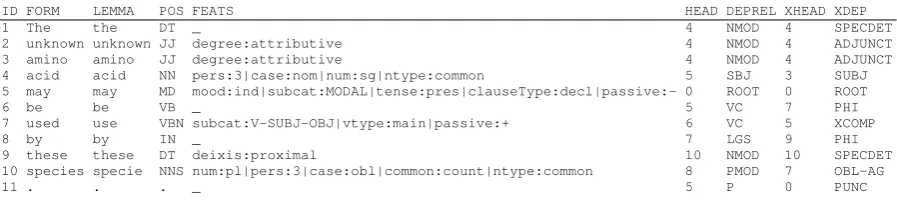
ID FORM LEMMA POS FEATS HEAD DEPREL XHEAD XDEP
1 The the DT _ 4 NMOD 4 SPECDET
2 unknown unknown JJ degree:attributive 4 NMOD 4 ADJUNCT
3 amino amino JJ degree:attributive 4 NMOD 4 ADJUNCT
4 acid acid NN pers:3|case:nom|num:sg|ntype:common 5 SBJ 3 SUBJ 5 may may MD mood:ind|subcat:MODAL|tense:pres|clauseType:decl|passive:- 0 ROOT 0 ROOT
6 be be VB _ 5 VC 7 PHI
7 used use VBN subcat:V-SUBJ-OBJ|vtype:main|passive:+ 6 VC 5 XCOMP
8 by by IN _ 7 LGS 9 PHI
9 these these DT deixis:proximal 10 NMOD 10 SPECDET
10 species specie NNS num:pl|pers:3|case:obl|common:count|ntype:common 8 PMOD 7 OBL-AG
[image:2.595.75.524.61.161.2]11 . . . _ 5 P 0 PUNC
Table 1: Enhanced dependency representation of the example sentenceThe unknown amino acid may be used by these species with GENIAPoS-tags (P O S), Malt parses (H E A D,D E P R E L) and XLE parses
(X H E A D,X D E P).
lems. Our pre-processing approach therefore de-ploys a home-grown, cascaded finite-state tok-enizer (borrowed and adapted from the open-source English Reopen-source Grammar; Flickinger (2000)), which aims to implement the tokeniza-tion decisions made in the Penn Treebank (Mar-cus et al., 1993) – much like GENIA, in principle – but properly treating corner cases like the ones above. Synchronized via characterization, this to-kenization is then enriched with the output of no less than two PoS taggers, as detailed in the next
section.
2.2 PoS Tagging and Lemmatization
For PoS tagging and lemmatization, we combine GENIA (with its built-in, occasionally deviant
to-kenizer) and TnT (Brants, 2000), which operates on pre-tokenized inputs but in its default model is trained on financial news from the Penn Tree-bank. Our general goal here is to take advantage of the higherPoS accuracy provided byGENIAin
the biomedical domain, while using our improved tokenization and producing inputs to the parsing stage (see Section 2.3 below) that as much as pos-sible resemble the conventions used in the original training data for the parser – the Penn Treebank, once again.
To this effect, for the vast majority of tokens we can align the GENIA tokenization with our own,
and in these cases we typically use GENIA PoS
tags and lemmas (i.e. base forms). For better nor-malization, we downcase base forms for all parts of speech except proper nouns. However, GENIA
does not make a PoS distinction between proper
and common nouns, as in the Penn Treebank, and hence we give precedence to TnT outputs for to-kens tagged as nominal by both taggers. Finally, for the small number of cases where we cannot es-tablish a one-to-one alignment from an element in
our own tokenization to aGENIAtoken, we rely on
TnTannotation only. In the merging of annotations
across components, and also in downstream pro-cessing we have found it most convenient to op-erate predominantly in terms of characterization, i.e. sub-strings of the raw input that need not align perfectly with token boundaries.
2.3 Dependency Parsing with LFG Features
For syntactic parsing we employ a data-driven de-pendency parser which incorporates the predic-tions from a large-scale LFG grammar. A
tech-nique ofparser stacking is employed, which en-ables a data-driven parser to learn from the out-put of another parser, in addition to gold stan-dard treebank annotations (Nivre and McDonald, 2008). This technique has been shown to pro-vide significant improvements in accuracy for both English and German (Øvrelid et al., 2009), and a similar approach employing an HPSG grammar has been shown to increase domain independence in data-driven dependency parsing (Zhang and Wang, 2009). For our purposes, we decide to use a parser which incorporates analyses from two quite different parsing approaches – data-driven depen-dency parsing and “deep” parsing with a hand-crafted grammar – providing us with a range of different types of linguistic features which may be used in hedge detection.
We employ the freely available MaltParser (Nivre et al., 2006), which is a language-independent system for data-driven dependency parsing.2 It is based on a deterministic
pars-ing strategy in combination with treebank-induced classifiers for predicting parse transitions. It sup-ports a rich feature representation of the parse his-tory in order to guide parsing and may easily be extended to take into account new features of the
Sentences Hedged Cues Multi-Word Tokens Cue Tokens
Sentences Cues
Abstracts 11871 2101 2659 364 309634 3056
Articles 2670 519 668 84 68579 782
Total 14541 2620 3327 448 378213 3838
Table 2: Some descriptive figures for the shared task training data. Token-level counts are based on the tokenization described in Section 2.1.
parse history.
Parser stacking The procedure to enable the data-driven parser to learn from the grammar-driven parser is quite simple. We parse a treebank with theXLEplatform (Crouch et al., 2008) and the
English grammar developed within the ParGram project (Butt et al., 2002). We then convert the
LFG output to dependency structures, so that we
have two parallel versions of the treebank – one gold standard and one with LFG-annotation. We extend the gold standard treebank with additional information from the correspondingLFG analysis
and train the data-driven dependency parser on the enhanced data set. See Øvrelid et al. (2010) for details of the conversion and training of the parser. Table 1 shows the enhanced dependency rep-resentation of the English sentenceThe unknown amino acid may be used by these species, taken from the training data. For each token, the parsed data contains information on the surface form, lemma, andPoStag, as well as on the head and
de-pendency relation in columns 6 and 7. The depen-dency analysis suggested by XLE is contained in
columns 8 and 9, whereas additionalXLE
informa-tion, such as morphosyntactic properties like num-ber and voice, as well as more semantic properties detailing, e.g., subcategorization frames, seman-tic conceptual categories such as human, time and location, etc., resides in the F E A T S column. The parser outputs, which in turn form the basis for our scope resolution rules discussed in Section 4, also take this same form.
The parser employed in this work is trained on the Wall Street Journal sections 2 – 24 of the Penn Treebank, converted to dependency format (Johansson and Nugues, 2007) and extended with
XLEfeatures, as described above. Parsing is
per-formed using the arc-eager mode of MaltParser (Nivre, 2003) and anSVMwith a polynomial
ker-nel. When tested using 10-fold cross-validation on this data set, the parser achieves a labeled accuracy
score of 89.8 (Øvrelid et al., 2010).
3 Identifying Hedge Cues
For the task of identifying hedge cues, we devel-oped a binary maximum entropy (MaxEnt) classi-fier. The identification of cue words is used for (i) classifying sentences as certain/uncertain (Task 1), and (ii) providing input to the syntactic rules that we later apply for resolving the in-sentence scope of the cues (Task 2). We also report evaluation scores for the sub-task of cue detection in isola-tion.
As annotated in the training data, it is possible for a hedge cue to span multiple tokens, e.g. as in whether or not. The majority of the multi-word cues in the training data are very infrequent, how-ever, most occurring only once, and the classifier itself is not sensitive to the notion of multi-word cues. A given word token in the training data is simply considered to be either a cue or a non-cue, depending on whether it falls within the span of a cue annotation. The task of determining whether a cue word forms part of a larger multi-word cue, is performed by a separate post-processing step, further described in Section 3.2.
3.1 Maximum Entropy Classification
In the MaxEnt framework, each training exam-ple – in our case a paired word and labelhwi, yii – is represented as a feature vector f(wi, yi) = fi ∈ <d. Each dimension or feature functionfij
can encode arbitrary properties of the data. The particular feature functions we are using for the cue identification are described under Section 3.4 below. For model estimation we use the TADM3
software (Malouf, 2002). For feature extraction and model tuning, we build on the experimen-tation environment developed by Velldal (2008) (in turn extending earlier work by Oepen et al.
3Toolkit for Advanced Discriminative Modeling;
(2004)). Among other things, its highly optimized feature handling – where the potentially expen-sive feature extraction step is performed only once and then combined with several levels of feature caching – make it computationally feasible to per-form large-scale ‘grid searches’ over different con-figurations of features and model parameters when using many millions of features.
3.2 Multi-Word Cues
After applying the classifier, a separate post-processing step aims to determine whether tokens identified as cue words belong to a larger multi-word cue. For example, when the classifier has already identified one or more of the tokens in a phrase such asraises the possibilityto be part of a hedge cue, a heuristic rule (viz. basically lemma-level pattern-matching, targeted at only the most frequently occurring multi-word cues in the train-ing data) makes sure that the tokens are treated as part of one and the same cue.
3.3 Model Development, Data Sets and Evaluation Measures
While the training data made available for the shared task consisted of both abstracts and full articles from the BioScope corpus (Vincze et al., 2008), the test data were pre-announced to consist of biomedical articles only. In order to make the testing situation during development as similar as possible to what could be expected for the held-out testing, we only tested on sentences taken from the articles part of the training data. When developing the classifiers we performed 10-fold training and testing over the articles, while always including all sentences from the abstracts in the training set as well. Table 2 provides some basic descriptive fig-ures summarizing the training data.
As can be seen in Table 3, we will be report-ing precision, recall and F-scores for three dif-ferent levels of evaluation for the cue classifiers: the sentence-level, token-level and cue-level. The sentence-level scores correspond to Task 1 of the shared task, i.e. correctly identifying sentences as beingcertain oruncertain. A sentence is labeled uncertain if it contains at least one token classi-fied as a hedge cue. The token-level scores indi-cate how well the classifiers succeed in identify-ing individual cue words (this score does not take into account the heuristic post-processing rules for finding multi-word cues). Finally, the cue-level scores are based on the exact-match counts for full
70 75 80 85 90
10 20 30 40 50 60 70 80 90 100 Token level F1
Sentence level F1
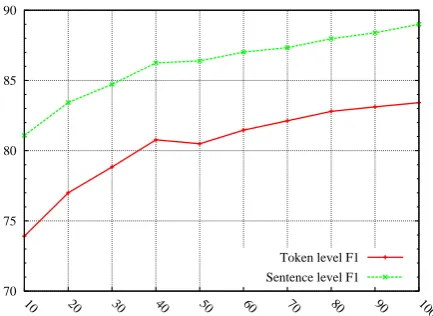
Figure 1: Learning curves showing, for both token- and sentence-level F-scores, the effect of incrementally including a larger percentage of training data into the 10-fold cycles. (As described also for the other development results, while we are training on both the articles and the abstracts, we are testing only on the articles.)
hedge cues (possibly spanning multiple tokens). These latter scores are computed using the official shared task scorer script.
3.4 Feature Types
We trained cue classifiers using a wide vari-ety of feature types, both syntactic and surface-oriented. However, to better assess the contri-bution of the different features, we first trained two baseline models using only features defined for non-normalized surface forms as they occur in the training data. The most basic baseline model (Baseline 1) included only unigram features. The behavior of this classifier is similar to what we would expect from simply compiling a list of cue words from the training data, based on the major-ity usage of each word as cue or non-cue. Base-line 2 additionally included 2 words to the left and 3 to the right of the focus word (after first perform-ing a search for the optimal spans ofn-grams up
to 5). As shown in Table 3, this model achieved a sentence-level F1 of 87.14 and a token-level F1 of 81.97. The corresponding scores for Baseline 1 are 79.20 and 69.59.
[image:4.595.306.523.60.218.2]proposed by the stacked MaltParser and converted fromXLE) as well as the deep grammar (XLE).
Ad-ditionally we defined various features on the basis of base forms andPoSinformation provided by the
GENIApre-processing (see Section 2.2).
For a quick overview, the feature types we ex-perimented with include the following:
GENIA features n-gram features over the base
forms and PoS tags from the GENIA information
described in Section 2.2.
Dependency features A range of features ex-tracted from dependency structures produced by MaltParser and XLE (see Section 2.3), designed to capture the syntactic properties and environ-ment of a token: deprel – dependency rela-tion (Malt and XLE), deppath – dependency
path to root, deppattern – ordered set of co-dependents/siblings, including focus token (Malt),
lextriple/postriple– lexicalized and unlexicalized dependency triplet for token (Malt), coord – bi-nary feature expressing coordination (XLE),
co-ordLevel– phrase-structural level of coordination (XLE).
Lexical parser features Other features con-structed on the basis of the parser output: subcat
– subcategorization frame for verbs (XLE), adv-Type– type of adverbial, e.g. sentence,VP(XLE),
adjType– adjectival function, e.g. attributive vs. predicative (XLE)
When added to Baseline 2 in isolation, most of these features resulted in a boost in classifier per-formance. For the dependency-based features, the contribution was more pronounced forlexicalized versions of the features. This also points to the fact that lexical information seems to be the key for the task of cue identification, where the model using only n-grams over surface forms proved a
strong baseline. As more feature types were added to the classifier together, we also saw a clear trend of diminishing returns, in that many of the fea-tures seemed to contribute overlapping informa-tion. After several rounds of grid-search over dif-ferent feature configurations, the best-performing classifier (as used for the shared task) used only the following feature types: n-grams over surface
forms (including up to 2 tokens to the right), n
-grams over base forms (up to 3 tokens left and right), PoS of the target word, ‘subcat’, ‘coord’,
and ‘coordLevel’. The ‘subcat’ feature contains
information taken fromXLEregarding the subcat-egorization requirements of a verb in a specific context, e.g., whether a verb is modal, takes an expletive subject etc., whereas the coordination features signal coordination (‘coord’) and detail the phrase-structural level of coordination (‘co-ordLevel’), e.g., NP, VP, etc. This defines the fea-ture set used for the model referred to asfinal in Table 3.
Recall that for Baseline 2, the F-score is 87.14 for the sentence-level evaluation and 81.97 for the token-level. For our best and final feature config-uration, the corresponding F-scores are 89.00 and 83.42, respectively. At both the sentence-level and the token-level, the differences in classifier per-formance were found to be statistically significant at p < 0.005, using a two-tailed sign-test.
Af-ter also applying the heuristic rules for detecting multi-word cues, the cue-level F-score for our final model is 84.60, compared to 82.83 for Baseline 2.
3.5 The Effect of Data Size
Daele-Sentence Level Token Level Cue Level
Model Prec Rec F1 Prec Rec F1 Prec Rec F1
[image:6.595.98.501.64.143.2]Baseline 1 79.25 79.45 79.20 77.71 63.41 69.59 77.37 71.70 74.43 Baseline 2 86.83 87.54 87.14 86.86 77.69 81.97 85.34 80.21 82.69 Final 91.39 86.78 89.00 91.20 76.95 83.42 90.18 79.47 84.49
Table 3: Averaged 10-fold cross-validation results on the articles in the official shared task training data, always including the abstracts in the training portion. The model listed asfinal includes features such asn-grams over surface forms and base forms (both left and right),PoS, subcategorization frames, and
phrase-structural coordination level. The feature types are further described in Section 3.4.
PoS Description Source
C C Coordinations scope over their conjuncts M
I N Prepositions scope over their arguments with its descendants M J Jattr Attributive adjectives scope over their nominal head and its descendants M
J Jpred Predicative adjectives scope over referential subjects and clausal arguments, if any M, X
M D Modals inherit subj-scope from their lexical verb and scope over their descendants M, X R B Adverbs scope over their heads with its descendants M V Bpass Passive verbs scope over referential subjects and the verbal descendants M, X
V Brais Raising verbs scope over referential subjects and the verbal descendants M, X
* For multi-word cues, the head determines scope for all elements * Back off from final punctuation and parentheses
Table 4: Overview of dependency-based scope rules with information source (MaltParser orXLE),
orga-nized by PoS of the cue.
mans, 2009).
4 Resolving Cue Scope
In our approach to scope resolution we rely heav-ily on syntactic information, taken from the depen-dency structures proposed by both MaltParser and
XLE, as well as various additional features from
the XLE parses relating to specific syntactic
con-structions.
4.1 Scope Rules
We construct a small set of heuristic rules which define the scope for each cue detected in Stage 1. In the construction of these rules, we made use of the information provided by the guidelines for scope annotation in the BioScope corpus (Vincze et al., 2008) as well as manual inspection of the training data in order to arrive at reasonable scope hypotheses for various types of cues.
The rules take as input a parsed sentence which has been tagged with hedge cues and operate over the dependency structures and additional features provided by the parser. Default scope is set to
start at the cue word and span to the end of the sentence (not including final puctuation), and this scope also provides the baseline for the evaluation of our rules. Table 4 provides an overview of the rules employed for scope resolution.
In the case of multi-word cues, such asindicate that, andeither ... or, which share scope, we need to determine the head of the multi-word unit. We then set the scope of the whole unit to the scope of the head token.
Task 1 Task 2 Cue Detection
Prec Rec F1 Prec Rec F1 Prec Rec F1
[image:7.595.133.465.65.121.2]85.48 84.94 85.21 56.71 54.02 55.33 81.20 76.31 78.68
Table 6: Evaluation results for the official held-out testing.
Scope Prec Rec F1
Default w/gold cues 45.21 45.21 45.21 Rules w/gold cues 72.31 72.31 72.31 Rules w/classified cues 68.56 61.38 64.77
Table 5: Evaluation of the scope resolution rules on the training articles, using both gold standard cues and predicted cues. For the row labeled De-fault, the scope for each cue is always taken to span rightward to the end of the sentence. In the rows labeledRules, the scopes have been resolved using the dependency-based rules.
(1) (The unknown amino acid<may>beused
by these species).
4.2 Rule Evaluation
Table 5 shows the evaluation of the set of scope rules on the articles section of the data set, using gold standard cues.4 This gives us an indication of
the performance of the rules, isolated from errors in cue detection.
First of all, we may note that the baseline is a strong one: choosing to extend the scope of a cue to the end of the sentence provides an F-score of 45.21. Given gold standard cue information, the set of scope rules improves on the baseline by 27 percentage points on the articles section of the data set, giving us an F-score of 72.31. Comparing to the evaluation using classified cues (the bottom row of Table 5), we find that the use of automati-cally assigned cues causes a drop in performance of 7.5 percentage points, to a result of 64.77.
5 Held-Out Testing
Table 6 presents the final results as obtained on the held-out test data, which constitute the official
4This evaluation was carried out using the official scorer
script of the CoNLL shared task. When cue information is kept constant, as in our case, the values for false positives and false negatives will be identical, hence the precision and recall values will always be identical as well.
results for our system in the CoNLL-2010 shared task. The held-out test set comprises biomedical articles with a total of 5003 sentences (790 of them hedged).
For Task 1 we obtain an F-score of 85.21. The corresponding result for the training data, which is reported as ‘Sentence Level’ in Table 3, is 89.00. Although we experience a slight drop in perfor-mance (3.8 percentage points), the system seems to generalize quite well to unseen data when it comes to the detection of sentence-level uncer-tainty.
For Task 2, the result on the held-out data set is an F-score of 55.33, with quite balanced values for precision and recall, 56.7 and 54.0, respectively. If we compare this to the end-to-end evaluation on the training data, provided in the bottom row of Table 5, we find a somewhat larger drop in perfor-mance (9.5 percentage points), from an F-score of 64.77 to the held-out 55.3. There are several pos-sible reasons for this drop. First of all, there might be a certain degree of overfitting of our system to the training data. The held-out data may contain hedging constructions that are not covered by our set of scope rules. Moreover, the performance of the scope rules is also influenced by the cue de-tection, which is reported in the final columns of Table 6. The cue-level performance of our system on the held-out data set is 78.68, whereas the same evaluation on the training data is 84.49. We find that it is the precision, in particular, which suffers in the application to the held-out data set. A pos-sible strategy for future work is to optimize both components of the Task 2 system, the cue detec-tion and the scope rules, on the entire training set, instead of just on the articles.
6 Conclusions – Outlook
data, achieves an F-score of 78.68 on the cue-level and 85.21 on the sentence-level (Task 1). For the task of resolving the in-sentence scope of the iden-tified cues (Task 2), we apply a set of manually crafted rules operating on dependency representa-tions, resulting in an end-to-end F-score of 55.33 (based on exact match of both cues and scopes). In the official shared task ranking of results, and con-sidering systems in all tracks together, our system is ranked 4 out of 24 for Task 1 and 3 out of 15 for Task 2, resulting in the highest average rank over-all. For future work we aim to further improve the cue detection, in particular with respect to multi-word cues, and also continue to refine the scope rules. Instead of defining the scopal rules only at the level of dependency structure, one could also have rules operating on constituent structure – per-haps even combining alternative resolution candi-dates using a statistical ranker.
References
Thorsten Brants. 2000. TnT. A statistical Part-of-Speech tagger. In Proceedings of the Sixth Con-ference on Applied Natural Language Processing, pages 224–231.
Miriam Butt, Helge Dyvik, Tracy Holloway King, Hi-roshi Masuichi, and Christian Rohrer. 2002. The Parallel Grammar Project. InProceedings of COL-ING Workshop on Grammar Engineering and Eval-uation, pages 1–7.
Dick Crouch, Mary Dalrymple, Ron Kaplan, Tracy King, John Maxwell, and Paula Newman. 2008. XLE documentation. Palo Alto Research Center. Richárd Farkas, Veronika Vincze, György Móra, János
Csirik, and György Szarvas. 2010. The CoNLL-2010 Shared Task: Learning to Detect Hedges and their Scope in Natural Language Text. In Proceed-ings of the Fourteenth Conference on Computational Natural Language Learning (CoNLL-2010): Shared Task, pages 1–12.
Dan Flickinger. 2000. On building a more efficient grammar by exploiting types. Natural Language Engineering, 6 (1):15–28.
Richard Johansson and Pierre Nugues. 2007. Ex-tended constituent-to-dependency conversion for English. In Joakim Nivre, Heiki-Jaan Kaalep, and Mare Koit, editors,Proceedings of NODALIDA 2007, pages 105–112.
Robert Malouf. 2002. A comparison of algorithms for maximum entropy parameter estimation. In Pro-ceedings of the 6th Conference on Natural Language Learning, pages 49–55.
Mitchell P. Marcus, Beatrice Santorini, and Mary Ann Marcinkiewicz. 1993. Building a large annotated corpus of English. The Penn Treebank. Computa-tional Linguistics, 19:313–330.
Roser Morante and Walter Daelemans. 2009. Learn-ing the scope of hedge cues in biomedical texts. In Proceedings of the BioNLP 2009 Workshop, pages 28–36.
Joakim Nivre and Ryan McDonald. 2008. Integrat-ing graph-based and transition-based dependency parsers. InProceedings of the 46th Meeting of the Association for Computational Linguistics, pages 950–958.
Joakim Nivre, Johan Hall, and Jens Nilsson. 2006. MaltParser: A data-driven parser-generator for de-pendency parsing. In Proceedings of the Fifth In-ternational Conference on Language Resources and Evaluation, pages 2216–2219.
Joakim Nivre. 2003. An efficient algorithm for pro-jective dependency parsing. In Proceedings of the Eighth International Workshop on Parsing Tech-nologies, pages 149–160.
Stephan Oepen, Daniel Flickinger, Kristina Toutanova, and Christopher D. Manning. 2004. LinGO Red-woods. A rich and dynamic treebank for HPSG. Journal of Research on Language and Computation, 2(4):575–596.
Lilja Øvrelid, Jonas Kuhn, and Kathrin Spreyer. 2009. Improving data-driven dependency parsing using large-scale LFG grammars. InProceedings of the 47th Meeting of the Association for Computational Linguistics, pages 37–40.
Lilja Øvrelid, Jonas Kuhn, and Kathrin Spreyer. 2010. Cross-framework parser stacking for data-driven de-pendency parsing. TAL 2010 special issue on Ma-chine Learning for NLP, 50(3).
Yoshimasa Tsuruoka, Yuka Tateishi, Jin-Dong Kim, Tomoko Ohta, John McNaught, Sophia Ananiadou, and Jun’ichi Tsujii. 2005. Developing a robust Part-of-Speech tagger for biomedical text. InAdvances in Informatics, pages 382–392. Springer, Berlin, Germany.
Erik Velldal. 2008. Empirical Realization Ranking. Ph.D. thesis, University of Oslo, Institute of Infor-matics, Oslo.
Veronika Vincze, György Szarvas, Richárd Farkas, György Móra, and János Csirik. 2008. The Bio-Scope corpus: Annotation for negation, uncertainty and their scope in biomedical texts. InProceedings of the BioNLP 2008 Workshop.