Navigation in Tilings of the Hyperbolic Plane
and Possible Applications
Maurice Margenstern
∗Abstract—This paper introduces a method of nav-igation in a large family of tilings of the hyperbolic plane and looks at the question of possible applica-tions in the light of the few ones which were already obtained.
Keywords: hyperbolic tilings, cellular automata, appli-cations.
1
Introduction
Hyperbolic geometry appeared in the first half of the 19th
century, proving the independence of the parallel axiom of Euclidean geometry. Models were devised in the second
half of the 19th century and we shall use here one of
the most popular ones, Poincar´e’s disc. This model is
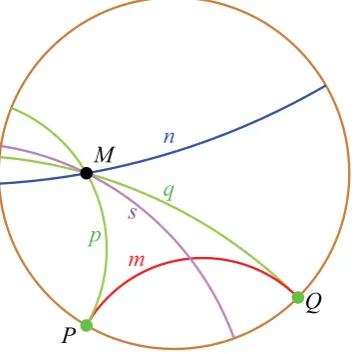
represented by Figure 1.
M
n
q
p
s
m
[image:1.595.80.260.387.564.2]Q
P
Figure 1 Poincar´e’s disc model: inside the open disc, the points of the hyperbolic plane. Lines are trace of diameters or circles orthogonal to the border of the disc, e.g. the linem. Through the pointA we can see a line s which cuts m, two lines which are parallel to m: p and q, touching m in the model atP and Qrespectively which are points of the border and which are called points at infinity. At last, and not the least: the line n also passes through A without cutting m, neither inside the disc nor outside it.
∗Universit´e Paul-Verlaine−Metz,
LITA, EA 3097, UFR MIM,
Campus du Saulcy, 57045 METZ C´edex, FRANCE, Email: [email protected]
From a famous theorem established by Poincar´e in the
late 19th century, it is known that there are infinitely
many tilings in the hyperbolic plane, each one generated
by the reflection of a polygonP in its sides and,
recur-sively, in the reflection of the images in their sides,
pro-vided that the numberpof sides ofP and the numberq
of copies ofP which can be put around a pointAand
ex-actly covering a neighbourhood ofAwithout overlapping
satisfy the relation: 1
p+
1
q <
1
2. The numbers p and q
characterize the tiling which is denoted {p, q} and the
condition says that the considered polygons live in the hyperbolic plane. Note that the three tilings of the Eu-clidean plane which can be defined up to similarities can
be characterized by the relation obtained by replacing<
with = in the above expression. We get, in this way,
{4,4} for the square, {3,6} for the equilateral triangle and{6,3}for the regular hexagon.
In the paper, we shall focus our attention on the simplest tilings which can be defined in this way in the hyperbolic
plane: {5,4} and {7,3}. We call them the pentagrid
and theheptagridrespectively, see Figure 2.
Figure 2 Left-hand side: the pentagrid; right-hand side: the heptagrid.
To navigate in this tilings was for a long time a non triv-ial question. In 1999 and 2000, see [15, 2], the author found a technique which allows to find one’s way in these tilings, first in the pentagrid. The generalization of this way to the heptagrid and to infinitely other tilings of the hyperbolic plane was obtained a bit later. Details and ref-erences on these results can be found in [10, 12] as well as
their extension to one tiling of the hyperbolic 3D space
[image:1.595.301.541.455.569.2]Cellular automata are a tool used in various sciences, from gas statistical physics to economy, for simulation purposes with good results and a few industrial applica-tions. We refer the reader to proceedings of the last two
issues ofACRIconferences to have a look at this range
of applications.
The navigation technique introduced in [2] allowed to im-plement cellular automata in the pentagrid and in the heptagrid and to devise a few applications.
In Section 2, we sketchily describe the navigation tech-nique. In Section 3, we remind the results on cellular automata and in Section 4, we consider the applications already performed as well as a few others which could be useful. In Section 5, we conclude with what could be done in future work.
2
Navigation in the Pentagrid and in the
Heptagrid
The navigation in a tiling of the hyperbolic space can be compared to the flight of a plane with instruments only. Indeed, we are in the same situation as a pilot in this image as long as the representation of the hyperbolic plane in the Euclidean one entails such a distortion that only a very limited part of the hyperbolic plane is actually visible.
Figure 3 First part of the splitting: around a central tile, fixed in advance, five sectors. Each of them is spanned by the Fibonacci tree defined in Figure4.
[image:2.595.303.538.187.298.2]The principle of the navigation algorithms rely on two ideas which we illustrate on the pentagrid. The first one, is a way to split the hyperbolic plane, see Figure 3 and Figure 4: the recursive structure of this splitting defines a tree which spans the tiling. The second idea consists in numbering the nodes of the tree level after level and,
re-marking that the number of nodes on the levelnisf2n+1
defined by the Fibonacci sequence wheref0=f1= 1, to
represent the numbers in the numbering basis defined by
this sequence. Also, as the representation is not unique, we fix it by choosing the longest one.
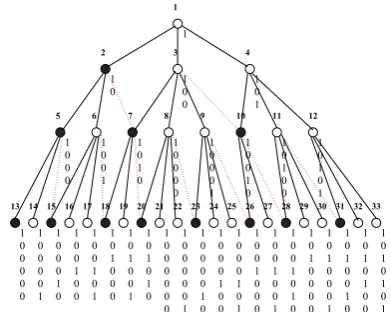
On Figure 4, we can notice that the Fibonacci tree has
two kinds of nodes: the white ones, which have three
sons, and theblackones, which have two sons. In both
cases, the leftmost son is black, the others are white. Figure 5 represents the tree in a more traditional way together with the numbering of the nodes and their rep-resentation in the Fibonacci basis. Later on, we shall call
[image:2.595.75.247.394.568.2]coordinatethis representation of the number of a node.
Figure 4 Second part of the splitting: splitting a sector, here a quarter of the hyperbolic plane. On the left-hand side: the first two steps of the splitting. On the right-hand side: explic-iting the tree which spans a sector.
There are important properties which are illustrated by
Figure 5 and which I called the preferred son
prop-erties. It consists in the fact that for each node of a Fibonacci tree, among the coordinates of its sons, there is exactly one of them which is obtained from the coordi-nate of the node by appending two 0’s and which is called the preferred son. Moreover, the place of the preferred son is always the same among the sons of a node: the leftmost son for a black node, the second one for a white node. 1 0 1 0 0 1 0 1 1 0 0 0 1 0 0 1 0 1 0 1 0 0 0 1 0 0 0 1 0 0 1 1 0 1 0 1 0 1 0 1
0 1 0 0 1
1 0 0 0 0 1 0 0 0 1 0 0 1 0 0 1 0 0 0 1 0 1 0 0 1 0 0 1 0 1 0 0 0 1 1 0 1 0 1 0 0 1 1 0 1 0 1 0 1 0 0 0 1 0 0 0 0 1 0 0 0 0 1 0 0 0 0 1 0 0 0 0 1 0 0 0 0 1 0 0 0 0 1 0 0 0 0 0 1 0 0 0 0 1 0 0 0 0 0 1 0 0 0 0 0 1 0 0 0 0 0 1 1 0 0 0 0 0 0 1 1
2 3 4
5 6 7 8 9 10 11 12
13 14 15 16 17 18 19 20 21 22 23 24 25 26 27 28 29 30 31 32 33
1 1 1 1 1 1 1 1 1 1 1 0 1 1 1 1
1 1 1
1
Figure 5 The Fibonacci tree: the representation of the num-bers of the nodes in the Fibonacci basis.
[image:2.595.320.516.498.654.2]to a node in a linear time in the length of the coordinate of the node, see [4]. From this, we also get that the coor-dinates of the neighbours of a given tile can be computed from the coordinate of the tile in linear time too.
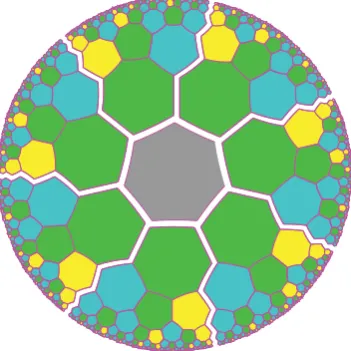
Figure 6 First part of the splitting: around a central tile, fixed in advance, seven sectors. Each of them is spanned by the Fibonacci tree defined in Figure4, see Figure7.
It is interesting to remark that the heptagrid possesses properties which are very similar to those of the penta-grid, see Figures 6 and 7. Note that Figure 7 explains why the same tree basically spans each of the seven sectors of Figure 6.
Figure 7 The mid-point lines: the tool which shows how a sector spanned by the Fibonacci tree is defined in the heptagrid.
We conclude this section by mentioning that these nice properties of the pentagrid and of the heptagrid can be extended to two infinite families of tilings of the hyper-bolic plane. In particular, the fact that the same tree spans the pentagrid and the heptagrid can be extended as follows: for eachp,p≥5, the same tree spans the tiling
{p,4}and the tiling{p+2,3}. The trees are different for
different values ofpalthough they share a common
fea-ture: nodes are divided into black and white nodes. The difference in the number of sons from a white node to a black one is 1. The unique black son can be chosen to be the leftmost one.
3
Results on Cellular Automata in
Hy-perbolic Spaces
These fast algorithms allowed to implement cellular au-tomata in the hyperbolic plane, first in the pentagrid and, a few years later, in the heptagrid.
We have three kinds of results regarding cellular au-tomata in these spaces: complexity results, universality results and a solution of two problems dealing with com-munications between cells of a cellular automaton. Al-though these results have a definite theoretical character, they nevertheless have a practical significance.
The most striking result regarding complexity, is that for cellular automata in the hyperbolic plane, we have
Phc = NPhc. This means that non-deterministic
poly-nomial time computations of a cellular automaton in the hyperbolic plane can be performed also in polynomial time by a deterministic cellular automaton in the hyper-bolic plane. Moreover, the exact power of computation
of the classPhc is the well-known classPSPACE. The
reader is referred to [15, 3, 5, 12].
For what is universality, there are universal cellular
au-tomata in the hyperbolic plane,i.e. able to simulate the
computation of any Turing machine. What is more im-portant is that if infinite but elementary initial
configu-rations are allowed−within this limited room we cannot
formally describe the exact meaning of this expression−
it is possible to simulate any Turing machine with a cellu-lar automaton with 9 states in the case of the pentagrid, see [16], and with 6 states in the case of the heptagrid, see [17] and even less: 4 states, see [13]. All the quoted cellular automata have a common structure: they sim-ulate a railway circuit traversed by a unique locomotive consisting of tracks and three kinds of switches devised in [18], see also [12].
Now, the linear algorithm for finding the path from a node to the root of the sector to which the node be-longs allows to devise efficient communication protocols for cells of a cellular automaton in the pentagrid or in the heptagrid, see [6, 9, 12].
in this frame, never in more time than what is required for a Euclidean cellular automaton, and very often in much less time. In particular, in this setting, hard problems of everyday life turn out to be solvable in polynomial time, very often even in linear time.
4
On the Side of Applications
The above results might seem too beautiful to be true. However, they are theoretical results whose proofs were checked, some of them with the help of a computer pro-gram, and they are correct.
But is this feasible?
Our local environment is usually thought as Euclidean al-though it would be better to see it as governed by spher-ical geometry. Many cosmologists consider our universe as a space with a negative curvature. In this regard, hy-perbolic geometry could be a better model for medium scale than Euclidean geometry. Computations on the or-bit of Mercury are more conformal to observations when performed in a hyperbolic setting. So, our tools might have applications at this scale which is not a today ur-gent matter, but we know that possible tools exist.
I would also mention another argument. An important feature of hyperbolic geometry is the lack of similarity. As a consequence, it can be said that a shape has nec-essarily a certain size. As an example, in the hyperbolic plane, there is a unique size of the edge for a regular pentagon with right angles. This means that two such pentagons can be transformed from each other through a simple geometric transformation which is an isometry. And so, up to isometries, such a pentagon is unique. This property is shared by any figure of the hyperbolic plane. Now, if we look at biology, we can notice that there is no true similarity. Individual differences, for instance, are not answerable by similarity. This remark led me to [7] where I used the pentagrid to represent a theoreti-cal model of living cells, the common point being the fact that, in both cases, a tree underlies the structures.
Now, another field of application, more important in my eye, is provided by computer science itself. We need new concepts to handle problems raised by massive computa-tions and by the management of huge amounts of infor-mation. For this, we need new horizons and it is not at all unreasonable to consider tilings of the hyperbolic plane with their navigation tools as a possible model for tack-ling these problems. Note, for instance, that trees are already used in the organization of operating systems: many a user is faced with the tree structure of the direc-tories of his/her machine. Now, trees are also spanning hyperbolic geometry and this is particularly blatant in the field of tilings in the hyperbolic plane as I hope the reader is convinced after reading Section 2.
In the present section, we first have a look at the ex-isting applications, see Subsections 4.1 and 4.2. These
applications are based on afisher eyeeffect of the
pen-tagrid and the heppen-tagrid. Now, it is known that fisher eye techniques are of interest for several applications in human-machine interaction. In Subsection 4.3, we again address the problem of representing, storing and explor-ing information which mainly use the coordinate system.
4.1
The Colour Chooser
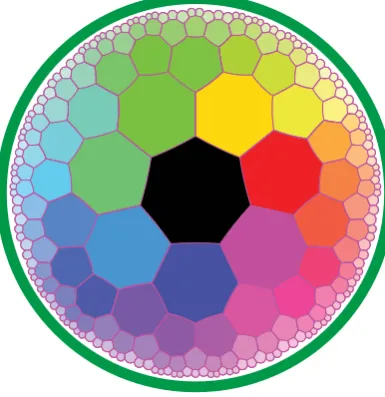
[image:4.595.318.511.312.511.2]The colour chooser is a software which was developed in my laboratory by members of my team, see [1, 12]. From the initial state of the chooser illustrated by Figure 8, the user can navigate in the tiling in order to look after the colour he/she thinks the most adapted for his/her purpose.
Figure 8 The colour chooser: the pentagrid is also a possible tool but the heptagrid gives the best representation. Probably because at first glance, the heptagons of the figure are seen as hexagons: it is needed to count the sides in order to detect the difference.
4.2
The Keyboards
Another application was developed in the laboratory, see [14], which we consider in Subsection 4.2.1 and which was developed in a different direction, as will be seen in Subsection 4.2.2.
4.2.1 Latin Keyboard
The first idea was a proposal of a keyboard for cell phones. As our laboratory is in France, tests were per-formed with French students on randomly chosen se-quences of French sentences devised for the experiment.
Below, Figure 9 illustrates the basic principle of the soft-ware. The idea is close to that of the chooser. But this time, the tiles contain letters and the user goes from the initial empty centre to the desired letter by pressing ap-propriate keys. At most three keys have to be pressed and with other media, pressing the keys can be replaced by three quick moves of the hand.
u
w vxy
z
a
b
c d
e
f
g h
i
j k l mn
o
p
q rts
o
v
u
a e
b c d f g
hj i
p
k lq
r
s
t
q
o
v rt u a e
p
[image:5.595.323.514.218.411.2]i
s
Figure 9 A proposal of a keyboard for cell phones.
Also, the pentagrid is used instead of the heptagrid be-cause for this purpose it is more suited to the gestures of the user and letters can be better seen. The reason is that the regular pentagon with right angle is bigger than the
rectangular heptagon with the angle 2π
3 . This explains
that letter can be better seen. This explains also that less accuracy is required from the user for his/her gestures. The experiments proved that the keyboard is certainly not worse than commercial products. Moreover, among young people, it raised a curiosity which contributed to the quick learning of the keyboard. Another important feature is that we adopted a distribution of the letters as close as possible to the standard alphabetic order, which raises no additional effort of memory from the user.
4.2.2 Japanese Keyboard
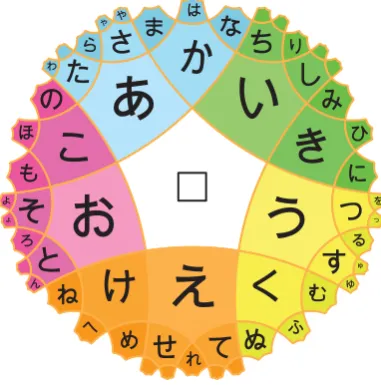
The use of the pentagrid and the fact that hiraganas and katakanas of the Japanese language are traditionally pre-sented in series based on the five vowels of the language inspired me the idea to use the same grid but this time, in a Japanese environment. We did some work in this direction, with Japanese colleagues, see [8]. Figure 10 illustrates the principle of the working.
This keyboard has always met a big success in the con-ferences were I presented it in Japan. There was a pro-totypical implementation on actual cell phones and con-cluding experiments were performed with a small group of Japanese students on a protocol which was similar to the one followed in France but, of course, adapted to the Japanese language.
[image:5.595.42.283.318.393.2]It is important to indicate that our project also aims at a full representation of the kanjis used in the Japanese language, starting from a phonetic approach. This is a very complex task and, at the present moment it is not completed.
Figure 10 A proposal of a keyboard for Japanese cell phones.
The question could be raised of the adaptation of the same principle to other languages. I was indicated by several colleagues that the occurrence of exactly five vow-els is a common feature of many Asian languages as the languages from Malaysia and Philippines, also including the Polynesian languages. It would be interesting to see whether similar ideas could be developed for other lan-guages: any proposal would be welcomed!
4.3
Other Possible Applications
Now, let us turn to other possible applications which were not yet tested and which are based on other principles.
As indicated in the beginning of this section, computer science and computer engineering could be an important field of application of the navigation technique introduced by Section 2.
These three sub-fields are: the representation of the In-ternet, computer architecture and operating systems and data processing.
The Internet can be represented as a graph. This is often performed in force oriented representation which assigns a mass to each node and define their respective positions by application of the laws of mechanics. Using the pen-tagrid or the heppen-tagrid can be an alternative representa-tion. In [12], I illustrate this point by defining addresses of nodes which is based on the navigation technique of Section 2 but which looks like the today used IP num-bers. There is another advantage in this proposal. For both the pentagrid and the heptagrid, [12] gives an
algo-rithm which, from the coordinates of two tilesAandB,
gives a shortest path from A to B in linear time in the
size of the coordinates. This is an important improve-ment of the path algorithm from a node to the root of the sector of the node mentioned in Section 2. It also allows to define a fast algorithm for changing the centre of coordinates.
This possibility may better represent the Internet con-nections by giving addresses which are continuous with respect to the connection distance between nodes. In [9], I introduced a protocol of communication between tiles of the pentagrid or the heptagrid based on the following principle: there is an absolute system of coordinates but when sending a message, a tile considers itself as the cen-tral tile and sends a message to all tiles together with its
relativeaddress which is 0. Now each tile which receives the message, convey it to its sons with respect to the co-ordinate system of the sender, appending an information of constant size in order to form the address it will convey to its sons. This allows a tile which receives the message and which wishes to establish a contact with the sender to send an answer to the appropriate sender: it simply reverses the address in a way which is described in [9].
This can be transported to a set of processors: they could be organized as if they would stand in a disc of the penta-grid or of the heptapenta-grid around a central one which would not necessarily have a control function. It is enough for that to assign them coordinates as those introduced in Section 2. The communication between processors could be organized according to the just described protocol.
The shortest path algorithm can be used for the repre-sentation of the Internet but also for the reprerepre-sentation of a file storage for an operating system. The system of coordinates which allows to construct a shortest path from one point to another in a linear time with respect to both coordinates should facilitate the finding of queries as topological neighbourhood is up to a point reflected in the coordinates themselves. From this remark, we can see that this can be of help also for data processing. In particular, constant saving mechanisms can be organised by scanning a circular area by a branch which moves from
a central point to an indicated point of the circumference. The idea is that the branch constantly moves around this circumference and that at each time, the content of the branch only is saved. After a certain time, everything is saved and updates can also be included in this constant saving provided that it does not exceed a fixed in advance amount. In case of exceeding the threshold, the update is split in as many parts as needed in order that each part should fall within the threshold. It can be noted that when the branch goes from one node of the circumfer-ence to the next one, in many cases, the two positions of
the branch may have a long common intervalI starting
from the center which consists of the same nodes. If no
update occur on the nodes belonging to I between the
two corresponding tops of saving, then only a small part of the new branch has to be saved. This can be easily managed by an appropriate signalization on the branch, see [11].
5
Conclusion
There is still much work to do in this domain, both in theory but also for applications.
Practical problems are difficult as this is witnessed by the example of scheduling problems, either in airplane traffic or in production processes: such problems are NP-complete. We have seen that the frame proposed by this paper allows to solve them in polynomial time. This is not the single theoretical approach leading to such re-sults. As an example, molecular computations based on a modelling of DNA strand reactions or on a modelling of a living cell lead to similar results. But our frame has the advantage of not being concerned by still unsolved biolog-ical problems for a practbiolog-ical implementation, the nature of which is not yet well understood: either it comes from fundamental issues or it comes from not well enough mas-tered techniques. Subsection 4.3 pointed at fields where our approach might have feasible applications.
It seems to me that exchanging all possible ideas is a way to find out paths which will turn out to give the expected solution with, in many cases, surprising outcomes. This paper aims at being a contribution to this large exchange. I hope that the already few applications explored so far will be followed by many ones. I hope that it will en-courage people to venture along the tracks opened in this paper and, it would be the best, to go further towards new avenues.
References
[1] K. Chelghoum, M. Margenstern, B. Martin, I. Pecci, Palette hyperbolique : un outil pour interagir avec
des ensembles de donn´ees, IHM’2004, Namur,
(2004). (Hyperbolic chooser: a tool to interact with
[2] Margenstern M., New tools for cellular automata in
the hyperbolic plane,Journal of Universal Computer
Science, vol 6, issue 12, 1226–1252, (2000).
[3] Ch. Iwamoto, M. Margenstern, K. Morita, Th. Worsch, Polynomial Time Cellular Automata in the Hyperbolic Plane Accept Exactly the PSPACE
Lan-guages,SCI’2002, (2002).
[4] Margenstern M., Implementing Cellular Automata on the Triangular Grids of the Hyperbolic Plane
for New Simulation Tools,ASTC’2003, (2003),
Or-lando, March, 29- April, 4.
[5] Iwamoto Ch., Margenstern M., Time and Space Complexity Classes of Hyperbolic Cellular
Au-tomata, IEICE Transactions on Information and
Systems,387-D(3), (2004), 700-707.
[6] Margenstern M., A new way to implement cellular
automata on the penta- and heptagrids, Journal of
Cellular Automata1(1), (2006), 1-24.
[7] Margenstern M., Can Hyperbolic Geometry Be of
Help for P Systems?,Lecture Notes in Computer
Sci-ence,2933, (2004), 240-249.
[8] M. Margenstern, B. Martin, H. Umeo, S. Yamano, K. Nishioka, A Proposal for a Japanese Keyboard on
Cellular Phones,Lecture Notes in Computer Science,
5191, (2008), 299-306.
[9] Margenstern M., On the communication between cells of a cellular automaton on the penta- and
hep-tagrids of the hyperbolic plane, Journal of Cellular
Automata1(3), (2006), 213-232.
[10] Margenstern M., Cellular Automata in Hyperbolic
Spaces, vol. 1: Theory, Old City Publishing, Philadelphia, (2007), 422p.
[11] Margenstern M., A uniform and intrinsic proof that there are universal cellular automata in hyperbolic
spaces, Journal of Cellular Automata,3(2), (2008),
157-180.
[12] Margenstern M., Cellular Automata in Hyperbolic
Spaces, vol. 2: Theory, Old City Publishing, Philadelphia, (2008), 360p.
[13] Margenstern M., Universal Cellular Automata in
Hyperbolic Spaces, 13th WSEAS International
Conference on Computers, Rodos, (2009), July 23-25, 83-89, ISBN 978-960-474-099-4.
[14] Martin B., VirHKey: a VIRtual Hyperbolic KEY-board with gesture interaction and visual feedback
for mobile devices. Mobile HCI, (2005), 99-106.
[15] Margenstern M., Morita K., A Polynomial Solution for 3-SAT in the Space of Cellular Automata in the
Hyperbolic Plane, Journal of Universal
Computa-tions and Systems,5, (1999), 563-573.
[16] Margenstern M., Song Y., A new universal
cellu-lar automaton on the pentagrid,Parallel Processing
Letters,19(2), (2009), 227-246.
[17] Margenstern M., Song Y., A universal cellular
au-tomaton on the ternary heptagrid, Electronic Notes
in Theoretical Computer Science,223, (2008), 167-185.
[18] Stewart I., A Subway Named Turing, Mathematical