Proceedings of the 2019 Conference on Empirical Methods in Natural Language Processing
5702
MultiFiT: Efficient Multi-lingual Language Model Fine-tuning
Julian Eisenschlos1†∗ Sebastian Ruder2,3‡∗ Piotr Czapla4∗ Marcin Kardas4∗ Sylvain Gugger5 Jeremy Howard5,6
1ASAPP, Inc. 2National University of Ireland 3Aylien Ltd., Dublin 4n-waves, Wrocław 5fast.ai 6University of San Francisco
Abstract
Pretrained language models are promising par-ticularly for low-resource languages as they only require unlabelled data. However, train-ing existtrain-ing models requires huge amounts of compute, while pretrained cross-lingual mod-els often underperform on low-resource lan-guages. We propose Multi-lingual language model Fine-Tuning (MultiFiT) to enable prac-titioners to train and fine-tune language mod-els efficiently in their own language. In ad-dition, we propose a zero-shot method us-ing an existus-ing pretrained cross-lus-ingual model. We evaluate our methods on two widely used cross-lingual classification datasets where they outperform models pretrained on orders of magnitude more data and compute. We release all models and code1.
1 Introduction
Pretrained language models (LMs) have shown striking improvements on a range of natural lan-guage processing (NLP) tasks (Peters et al.,2018a;
Howard and Ruder, 2018; Devlin et al., 2018). These models only require unlabelled data for training and are thus particularly useful in scenar-ios where labelled data is scarce. As much of NLP research has focused on the English language, the larger promise of these models is to bridge the dig-ital language divide2and enable the application of NLP methods to many of the world’s other 6,000 languages where labelled data is less plentiful.
Recently, cross-lingual extensions of these LMs have been proposed that train on multiple lan-guages jointly (Artetxe and Schwenk,2018;
Lam-ple and Conneau, 2019). These models are able
1
http://nlp.fast.ai
?
The first four authors contributed equally.
†
Corresponding author:[email protected]
‡
Sebastian is now affiliated with DeepMind. 2http://labs.theguardian.com/
digital-language-divide/
to perform zero-shot learning, only requiring la-belled data in the source language. However, source data in another language may often not be available, whereas obtaining a small number of la-bels is typically straightforward.
Furthermore such models have several down-sides: a) some variants rely on large amounts of parallel data, which may not be available for truly low-resource languages; b) they require a huge amount of compute for training3; and c) cross-lingual models underperform on low-resource languages—precisely the setting where they would be most useful. We are aware of two possible reasons for this: 1) Languages that are less frequently seen during training are un-derrepresented in the embedding space.4 2) In-frequent scripts are over-segmented in the shared word piece vocabulary (Wang et al.,2019).
In this work, we show that small monolin-gual LMs are able to outperform expensive cross-lingual models both in the zero-shot and the super-vised setting. We propose Multi-lingual language model Fine-tuning (MultiFit) to enable practition-ers to train and fine-tune language models effi-ciently.5 Our model combines universal language model fine-tuning (ULMFiT;Howard and Ruder,
2018) with the quasi-recurrent neural network (QRNN; Bradbury et al., 2017) and subword to-kenization (Kudo,2018) and can be pretrained on a single Tesla V100 GPU in a few hours. In addi-tion, we propose to use a pretrained cross-lingual model’s predictions as pseudo labels to adapt the
3
The training cost is amortized over time as pretraining only needs to be performed once and fine-tuning is much cheaper. However, if a model needs to be applied to a new language or a domain not covered by the model, a new model needs to be trained from scratch.
4This is similar to how word embeddings are known to underperform on low-frequency tokens (Gong et al.,2018).
5We use ‘multilingual’ as referring to training
monolingual language model to the zero-shot set-ting. We evaluate our models on two widely used cross-lingual classification datasets, MLDoc
(Schwenk and Li, 2018) and CLS (Prettenhofer
and Stein, 2010) where we outperform the state-of-the-art zero-shot model LASER (Artetxe and
Schwenk,2018) and multi-lingual BERT (Devlin
et al.,2018) in the supervised setting—even with-out any pretraining. In the zero-shot setting, we outperform both models using pseudo labels—and report significantly higher performance with as lit-tle as 100 examples. We finally show that infor-mation from monolingual and cross-lingual lan-guage models is complementary and that pretrain-ing makes models robust to noise.
2 Related work
Pretrained language models Pretrained
lan-guage models based on an LSTM (Peters et al.,
2018a; Howard and Ruder, 2018) and a
Trans-former (Radford et al.,2018;Devlin et al.,2018) have been proposed. Recent work (Peters et al.,
2018b) suggests that—all else being equal—an
LSTM outperforms the Transformer in terms of downstream performance. For this reason, we use a variant of the LSTM as our language model.
Cross-lingual pretrained language models
The multi-lingual BERT model is pretrained on the Wikipedias of 104 languages using a shared word piece vocabulary. LASER (Artetxe and
Schwenk, 2018) is trained on parallel data of
93 languages with a shared BPE vocabulary. XLM (Lample and Conneau, 2019) additionally pretrains BERT with parallel data. These models enable zero-shot transfer, but achieve lower results than monolingual models. In contrast, we focus on making the training of monolingual language models more efficient in a multi-lingual context. Concurrent work (Mulcaire et al.,2019) pretrains on English and another language, but shows that cross-lingual pretraining only helps sometimes.
Multi-lingual language modeling Training
lan-guage models in non-English lanlan-guages has only recently received some attention.Kawakami et al.
(2017) evaluate on seven languages. Cotterell et al.(2018) study 21 languages.Gerz et al.(2018) create datasets for 50 languages. All of these stud-ies, however, only create small datasets, which are inadequate for pretraining language models. In contrast, we are among the first to report the
SUB1 400 embs.
1550 QRNN1
1550 QRNN2
1550 QRNN3
400 QRNN4
SUB2 400 embs.
1550 QRNN1
1550 QRNN2
1550 QRNN3
400 QRNN4
..
. ... ... ... ... ... SUBn
400 embs.
1550 QRNN1
1550 QRNN2
1550 QRNN3
400 QRNN4
400 avg pool
400 max pool
50 linear1
#classes linear2
[image:2.595.312.523.58.128.2]400 last
Figure 1: The MultiFiT language model with classifier consisting of a subword embedding layer, four QRNN layers, an aggregation layer, and two linear layers.
Source Language Documents
Source Language Gold Labels
Target Language Wikipedia
LASER Classifier
Pretrained LM Fine-tuned LM Zero-shot Classifier Target Language
Documents
Target Language Predicted Labels Train
Cross-lingual Classifier
Predict Labels
a) Pretrain b) Fine-tune c) Train Classifier
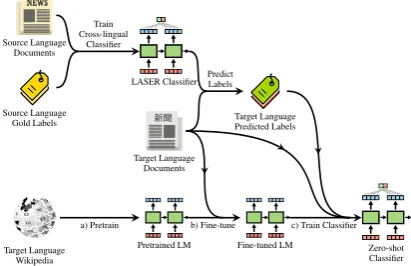
Figure 2: The steps of our cross-lingual bootstrapping method for zero-shot cross-lingual transfer. a) A mono-lingual language model (LM) is pretrained on target language data; b) the LM is fine-tuned on target lan-guage documents; and c) the LM is fine-tuned as a classifier using the zero-shot predictions from a linear classification layer fine-tuned on top of cross-lingual representations from LASER.
performance of monolingual language models on downstream tasks in multiple languages.
3 Our method
3.1 Multi-lingual Fine-Tuning
We propose Multi-lingual Fine-tuning (MultiFit). Our method uses the ULMFiT model (Howard and Ruder, 2018) with discriminative fine-tuning as foundation. ULMFiT is based on a 3-layer AWD-LSTM (Mer, 2017) language model. The AWD-LSTM is a regular LSTM (Hochreiter and
Schmidhuber, 1997) with tuned dropout
hyper-parameters. To enable faster training and fine-tuning of the model, we replace it with a QRNN
(Bradbury et al., 2017). The QRNN alternates
[image:2.595.311.517.205.338.2]more robust across languages, we use subword tokenization based on a unigram language model (Kudo,2018), which is more flexible compared to byte-pair encoding (Sennrich et al.,2016). We ad-ditionally employ label smoothing (Szegedy et al.,
2016) and a novel cosine variant of the one-cycle policy (Smith,2018)6, which we found to
outper-form ULMFiT’s slanted triangular learning rate schedule and gradual unfreezing. The full model can be seen in Figure1.
3.2 Cross-lingual Bootstrapping
Prior methods have employed cross-lingual train-ing strategies relytrain-ing on parallel data and a shared BPE vocabulary. These can be combined with our language model, but increase its training com-plexity. For the case where an existing pre-trained cross-lingual model and source language data are available, we propose a bootstrapping method (Ruder and Plank,2018) that uses the pre-trained model’s zero-shot predictions as pseudo la-bels to fine-tune the monolingual model on target language data.
The steps of the method can be seen in Figure
2. Specifically, we first fine-tune a linear classifi-cation layer on top of pretrained cross-lingual rep-resentations on source language training data. We then apply this cross-lingual classifier to the target language data and store its predicted label for ev-ery example. We now fine-tune our pretrained LM on the target language data and these pseudo la-bels7. Importantly, this method enables our mono-lingual LM to significantly outperform its cross-lingual teacher in the zero-shot setting (§5).
4 Experimental setup
This section provides an overview of our experi-mental setup; see the appendix for full details.
Data We evaluate our models on the Multilin-gual Document Classification Corpus (MLDoc;
Schwenk and Li,2018)8—a new subset of Reuters Corpus Volume 2 (Lewis et al., 2004) with bal-anced class priors for eight languages—and on the Cross-Lingual Sentiment dataset (CLS; Pret-tenhofer and Stein,2010)9 consisting of Amazon
6
The idea is due to private conversation with the author. 7
Distillation (Hinton et al.,2015) yielded similar results. 8
https://github.com/facebookresearch/ MLDoc
9https://webis.de/data/webis-cls-10.
html
Domain Languages Train Dev Test
MLDoc News EN,DE,ES,FR, 1k / 2k / 2k 10k
IT,JA,RU,ZH 5k / 10k
CLS Product EN,DE,FR,JA 2k - 2k
[image:3.595.308.527.176.332.2]reviews
Table 1: The domain, languages, and number of train-ing, development, and test examples in each dataset.
DE ES FR IT JA RU ZH
Zero-shot (1,000 source language examples)
MultiCCA 81.20 72.50 72.38 69.38 67.63 60.80 74.73 LASER, paper 86.25 79.30 78.30 70.20 60.95 67.25 70.98 LASER, code 87.65 75.48 84.00 71.18 64.58 66.58 76.65 MultiBERT 82.35 74.98 83.03 68.27 64.58 71.58 66.17 MultiFiT, pseudo 91.62 79.10 89.42 76.02 69.57 67.83 82.48
Supervised (100 target language examples)
MultiFit 90.90 89.00 85.03 80.12 80.55 73.55 88.02 Supervised (1,000 target language examples)
MultiCCA 93.70 94.45 92.05 85.55 85.35 85.65 87.30 LASER, paper 92.70 88.75 90.80 85.93 85.15 84.65 88.98 MultiBERT 94.00 95.15 93.20 85.82 87.48 86.85 90.72 Monolingual BERT 94.93 - - - 92.17 MultiFiT, no wiki 95.23 95.07 94.65 89.30 88.63 87.52 90.03 MultiFiT 95.90 96.07 94.75 90.25 90.03 87.65 92.52
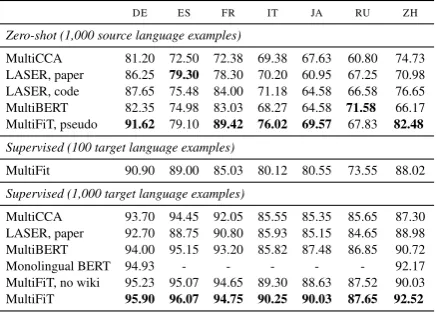
Table 2: Comparison of zero-shot and supervised meth-ods on MLDoc.
product reviews in four languages. We provide an overview of the datasets in Table1.
Pretraining We pretrain our models on 100M
tokens extracted from the Wikipedia of the corre-sponding language for 10 epochs. As fewer to-kens might be available for some languages, we also compare against a version (no wiki) that uses no pretraining. For all models, we fine-tune the LMs on the target data of the same language for 20 epochs. We perform subword tokenization with the unigram language model (Kudo,2018).
Evaluation settings We compare two settings
based on the availability of source and target lan-guage data: supervised and zero-shot. In the su-pervised setting, every model is fine-tuned and evaluated on examples from the target language. In the zero-shot setting, every model is fine-tuned on source language examples and evaluated on tar-get language examples. In all cases, we use En-glish as the source language.
Baselines We compare against the
state-of-the-art cross-lingual embedding models LASER
(Artetxe and Schwenk, 2018), which uses a
(MultiB-DE FR JA
Books DVD Music Books DVD Music Books DVD Music
Zer
o-shot
LASER, code 84.15 78.00 79.15 83.90 83.40 80.75 74.99 74.55 76.30 MultiBERT 72.15 70.05 73.80 75.50 74.70 76.05 65.41 64.90 70.33 MultiFiT, pseudo 89.60 81.80 84.40 87.84 83.50 85.60 80.45 77.65 81.50
T
ranslat.
MT-BOW 79.68 77.92 77.22 80.76 78.83 75.78 70.22 71.30 72.02 CL-SCL 79.50 76.92 77.79 78.49 78.80 77.92 73.09 71.07 75.11 BiDRL 84.14 84.05 84.67 84.39 83.60 82.52 73.15 76.78 78.77
Super
.
[image:4.595.70.535.64.221.2]MultiBERT 86.05 84.90 82.00 86.15 86.90 86.65 80.87 82.83 79.95 MultiFiT 93.19 90.54 93.00 91.25 89.55 93.40 86.29 85.75 86.59
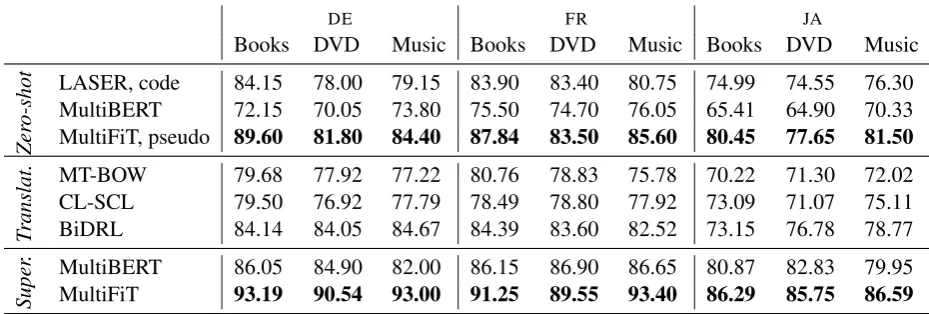
Table 3: Comparison of zero-shot, translation-based and supervised methods (with 2k training examples) on all domains of CLS. MT-BOW and CL-SCL results are from (Zhou et al.,2016).
LSTM QRNN
Language model pretraining 143 71
Classifier fine-tuning 467 156
Table 4: Comparison of LSTM and QRNN per-batch training speed on a Tesla V100 (in ms) in MultiFiT.
ERT)10, and monolingual BERT11. We also com-pare against the best models on each dataset, Mul-tiCCA (Ammar et al.,2016), a cross-lingual word embedding model, and BiDRL (Zhou et al.,2016), which translates source and target data.
Our methods We evaluate our monolingual
LMs in the supervised setting (MultiFit) and our LMs fine-tuned with pseudo labels from LASER in the zero-shot setting (pseudo).
DE ES ZH
ULMFiT 94.19 95.23 66.82
MultiFiT, no wiki 95.23 95.07 90.03 MultiFiT, small Wiki 95.37 95.30 89.80 MultiFiT 95.90 96.07 92.52
Table 5: Comparison of MultiFiT results with different pretraining corpora and ULMFiT, fine-tuned with 1k labels on MLDoc.
5 Results
MLDoc We show results for MLDoc in Table
2. In the zero-shot setting, MultiBERT
underper-10
https://github.com/google-research/ bert/blob/master/multilingual.md
11Models are available for English, Chinese, and German (https://deepset.ai/german-bert).
forms the comparison methods as the shared em-bedding space between many languages is overly restrictive. Our monolingual LMs outperform their cross-lingual teacher LASER in almost ev-ery setting. When fine-tuned with only 100 target language examples, they are able to outperform all zero-shot approaches except MultiFiT on DE
andFR. This calls into question the need for
zero-shot approaches, as fine-tuning with even a small number of target examples is able to yield superior performance. When fine-tuning with 1,000 target examples, MultiFiT—even without pretraining— outperforms all comparison methods, including monolingual BERT.
CLS We show results for CLS in Table3. Mul-tiFiT is able to outperform its zero-shot teacher LASER across all domains. Importantly, the bootstrapped monolingual model also outperforms more sophisticated models that are trained on translations across almost all domains. In the su-pervised setting, MultiFiT similarly outperforms multilingual BERT. For both datasets, our methods that have been pretrained on 100 million tokens outperform both multilingual BERT and LASER, models that have been trained with orders of mag-nitude more data and compute.
6 Analysis
Speed We compare the LSTM and QRNN cell
in MultiFiT based on the speed for processing a single batch for pretraining and fine-tuning in Ta-ble4. MultiFiT with a QRNN pretrains and fine-tunes about2×and3×faster respectively.
MultiFiT vs. ULMFiT We compare
ULMFiT pretrained on the same data using a 3-layer LSTM and spaCy tokenization12 as well as MultiFiT pretrained on 2M Wikipedia tokens, and MultiFiT with no pretraining in Table5. Pretrain-ing on more data generally helps. MultiFiT out-performs ULMFiT significantly; the performance improvement is particularly pronounced in Chi-nese where ULMFiT’s word-based tokenization underperformed.
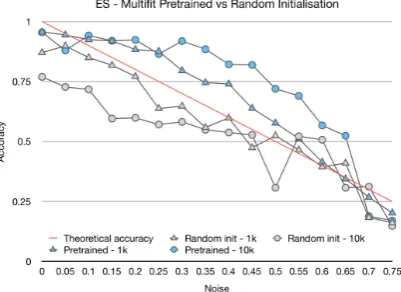
Figure 3: Comparison of MultiFiT’s robustness to label noise on MLDoc with and without pretraining.
DE ES FR IT JA RU ZH
LASER, code 87.65 75.48 84.00 71.18 64.58 66.58 76.65 Random init. (1k) 77.80 70.50 75.65 68.52 68.50 61.37 79.19 Random init. (10k) 90.53 69.75 87.40 72.72 67.55 63.67 81.44 MultiFiT, pseudo (1k) 91.34 78.92 89.45 76.00 69.57 68.19 82.45
Table 6: Bootstrapping results on MLDoc with and without pretraining, trained on 1k/10k LASER labels.
DE ES FR IT RU
Word-based 95.28 95.97 94.72 89.97 88.02
Subword 96.10 96.07 94.75 94.75 87.65
Table 7: Comparison of different tokenization strate-gies for different languages on MLDoc.
Robustness to noise We suspect that MultiFiT
is able to outperform its teacher as the information from pretraining makes it robust to label noise. To test this hypothesis, we train MultiFiT and a ran-domly initialized model with the same architec-ture on 1k and 10k examples of the Spanish ML-Doc. We randomly perturb labels with a probabil-ity ranging from 0-0.75 and show results in Fig-ure3. The pretrained MultiFiT is able to partially
12https://spacy.io/api/tokenizer
ignore the noise, up to 65% of noisy training ex-amples. Without pretraining, the model does not exceed the theoretical baseline (the percentage of correct examples). In addition, we compare Mul-tiFiT with and without pretraining in Table6. Pre-training enables MultiFiT to achieve much better performance compared to a randomly initialised model. Both results together suggest a) that pre-training increases robustness to noise and b) that information from monolingual and cross-lingual language models is complementary.
Tokenization Subword tokenization has been
found useful for language modeling with mor-phologically rich languages (Czapla et al., 2018;
Mielke and Eisner, 2019) and has been used in
recent pretrained LMs (Devlin et al., 2018), but its concrete impact on downstream performance has not been observed. We train models with the best performing vocabulary sizes for subword (15k) and regular word-based tokenization (60k) with the Moses tokenizer (Koehn et al.,2007) on German and Russian MLDoc and show results in Table7. Subword tokenization outperforms word-based tokenization on most languages, while being faster to train due to the smaller vocabulary size.
7 Conclusion
We have proposed novel methods for multilingual fine-tuning of languages that outperform mod-els trained with far more data and compute on two widely studied cross-lingual text classification datasets on eight languages in both the zero-shot and supervised setting.
References
2017. Pointer Sentinel Mixture Models. In Proceed-ings of ICLR 2017.
Waleed Ammar, George Mulcaire, Yulia Tsvetkov, Guillaume Lample, Chris Dyer, and Noah A. Smith. 2016.Massively Multilingual Word Embeddings.
Mikel Artetxe and Holger Schwenk. 2018. Massively Multilingual Sentence Embeddings for Zero-Shot Cross-Lingual Transfer and Beyond. arXiv preprint arXiv:1812.10464.
James Bradbury, Stephen Merity, Caiming Xiong, and Richard Socher. 2017. Quasi-Recurrent Neural Net-works. InProceedings of ICLR 2017.
[image:5.595.81.282.206.352.2]Piotr Czapla, Jeremy Howard, and Marcin Kardas. 2018. Universal language model fine-tuning with subword tokenization for polish. InProceedings of PolEval 2018 Workshop.
Jacob Devlin, Ming-Wei Chang, Kenton Lee, and Kristina Toutanova. 2018. BERT: Pre-training of Deep Bidirectional Transformers for Language Un-derstanding.
Daniela Gerz, Ivan Vuli´c, Edoardo Ponti, Jason Narad-owsky, Roi Reichart, and Anna Korhonen. 2018. Language Modeling for Morphologically Rich Lan-guages: Character-Aware Modeling for Word-Level Prediction. Proceedings of TACL 2018.
Chengyue Gong, Di He, Xu Tan, Tao Qin, Liwei Wang, and Tie-Yan Liu. 2018. FRAGE: Frequency-Agnostic Word Representation. InProceedings of NIPS 2018.
Geoffrey Hinton, Oriol Vinyals, and Jeff Dean. 2015. Distilling the Knowledge in a Neural Network. arXiv preprint arXiv:1503.02531.
Sepp Hochreiter and J¨urgen Schmidhuber. 1997. Long Short-Term Memory. Neural Computation, 9(8):1735–1780.
Jeremy Howard and Sebastian Ruder. 2018. Universal Language Model Fine-tuning for Text Classification. InProceedings of ACL 2018.
Kazuya Kawakami, Chris Dyer, and Phil Blunsom. 2017.Learning to Create and Reuse Words in Open-Vocabulary Neural Language Modeling. In ACL 2017.
Philipp Koehn, Hieu Hoang, Alexandra Birch, Chris Callison-Burch, Marcello Federico, Nicola Bertoldi, Brooke Cowan, Wade Shen, Christine Moran, Richard Zens, et al. 2007. Moses: Open source toolkit for statistical machine translation. In Pro-ceedings of ACL 2007, pages 177–180.
Taku Kudo. 2018. Subword regularization: Improv-ing neural network translation models with multiple subword candidates. InProceedings of ACL 2018, pages 66–75.
Guillaume Lample and Alexis Conneau. 2019. Cross-lingual Language Model Pretraining.arXiv preprint arXiv:1901.07291.
David D Lewis, Yiming Yang, Tony G Rose, and Fan Li. 2004. Rcv1: A new benchmark collection for text categorization research. Journal of machine learning research, 5(Apr):361–397.
Sebastian J. Mielke and Jason Eisner. 2019. Spell Once, Summon Anywhere: A Two-Level Open-Vocabulary Language Model. In Proceedings of AAAI 2019.
Phoebe Mulcaire, Jungo Kasai, and Noah Smith. 2019.Polyglot Contextual Representations Improve Crosslingual Transfer. In Proceedings of NAACL 2019.
Matthew E. Peters, Mark Neumann, Mohit Iyyer, Matt Gardner, Christopher Clark, Kenton Lee, and Luke Zettlemoyer. 2018a. Deep contextualized word rep-resentations. InProceedings of NAACL-HLT 2018.
Matthew E. Peters, Mark Neumann, Luke Zettlemoyer, Wen-tau Yih, Paul G Allen, and Computer Science. 2018b. Dissecting Contextual Word Embeddings: Architecture and Representation. InProceedings of EMNLP 2018.
Peter Prettenhofer and Benno Stein. 2010. Cross-Language Text Classification using Structural Cor-respondence Learning. InACL ’10 Proceedings of the 48th Annual Meeting of the Association for Com-putational Linguistics (ACL ’10 ), pages 1118–1127.
Alec Radford, Karthik Narasimhan, Tim Salimans, and Ilya Sutskever. 2018. Improving Language Under-standing by Generative Pre-Training.
Sebastian Ruder and Barbara Plank. 2018. Strong Baselines for Neural Semi-supervised Learning un-der Domain Shift. InProceedings of ACL 2018.
Holger Schwenk and Xian Li. 2018. A Corpus for Multilingual Document Classification in Eight Lan-guages. In Proceedings of the Eleventh Interna-tional Conference on Language Resources and Eval-uation (LREC 2018).
Rico Sennrich, Barry Haddow, and Alexandra Birch. 2016. Neural Machine Translation of Rare Words with Subword Units. InProceedings of ACL 2016.
Leslie N Smith. 2018. A disciplined approach to neu-ral network hyper-parameters: Part 1–learning rate, batch size, momentum, and weight decay. arXiv preprint arXiv:1803.09820.
Christian Szegedy, Vincent Vanhoucke, Sergey Ioffe, Jonathon Shlens, and Zbigniew Wojna. 2016. Re-thinking the Inception Architecture for Computer Vision. InProceedings of CVPR 2016.
Xinyi Wang, Hieu Pham, Philip Arthur, and Graham Neubig. 2019. Multilingual neural machine transla-tion with soft decoupled encoding. InProceedings of ICLR 2019.