116
Exploiting Discourse-Level Segmentation for Extractive Summarization
Zhengyuan Liu, Nancy F. Chen
Institute for Infocomm Research, A*STAR
{liu zhengyuan, nfychen}@i2r.a-star.edu.sg
Abstract
Extractive summarization selects and concate-nates the most essential text spans in a docu-ment. Most, if not all, neural approaches use sentences as the elementary unit to select con-tent for summarization. However, semantic segments containing supplementary informa-tion or descriptive details are often nonessen-tial in the generated summaries. In this work, we propose to exploit discourse-level segmen-tation as a finer-grained means to more pre-cisely pinpoint the core content in a document. We investigate how the sub-sentential segmen-tation improves extractive summarization per-formance when content selection is modeled through two basic neural network architec-tures and a deep bi-directional transformer. Experiment results on the CNN/Daily Mail dataset show that discourse-level segmenta-tion is effective in both cases. In particular, we achieve state-of-the-art performance when discourse-level segmentation is combined with our adapted contextual representation model.
1 Introduction
Document summarization is a core task in natu-ral language processing, targeting to automatically generate a shorter version of one or multiple docu-ments while retaining the most important informa-tion. As a straightforward and effective method, extractive summarization creates a summary by selecting and subsequently concatenating the most salient semantic units in a document; much effort has been devoted to this area. While traditional approaches rely heavily on human-engineered fea-tures, which is time-consuming and difficult to expand to massive data, neural networks can be trained in an end-to-end manner with fewer lin-guistic annotation, achieving favorable improve-ments on large-scale benchmarks (Hermann et al., 2015;Cheng and Lapata,2016;Zhou et al.,2018). However, the selected content in current neu-ral approaches is often not succinct enough. As
Figure 1: An example of news summarization. Colored spans are salient segments selected to form a summary, and their corresponding sentences are underlined.
shown in Figure 1, human editors tend to fur-ther distill the selected sentences by removing nonessential phrases or clauses to compose more concise summaries. While the extracted sentences often contain the main points of the document, such sentences are usually embellished with more clauses or segments of background knowledge to give the readers more context, descriptive details to paint a more colorful picture, supplementary in-formation to make the content more comprehen-sive, or subtle nuances to give a more polished touch. Therefore, sentence-level extraction might dilute the density of the key information in the summary.
segmentation can help model semantic informa-tion with more refined granularity. This can help us more precisely pinpoint the key information when we subsequently use neural models to se-lect content for summarization. We empirically compare two different selector architectures: a multi-layer recurrent neural network (RNN) and a Transformer network, as they each have their own model assumptions and knowledge represen-tations (Liu et al., 2019), and we further fine-tune a contextualized language model based on the deep bi-directional Transformer. Our experiments on the CNN/Daily Mail dataset demonstrate that discourse-level segmentation is effective, achiev-ing state-of-the-art performance when combined with an adapted large-scale pre-trained model of contextualized language representation.
2 In Relation to Other Work
[image:2.595.323.510.60.244.2]Content selection plays a key role for both ex-tractive and absex-tractive paradigms of text summa-rization (Nallapati et al.,2017;Zhou et al.,2018; Gehrmann et al., 2018; Hsu et al., 2018). While traditional approaches utilize human-engineered linguistic features (Jones,2007;Shen et al.,2007), neural network approaches learn the features in a data-driven manner, with components such as se-mantic vector representation of words (Pennington et al., 2014), contextual representation with vari-ous neural structures (Schuster and Paliwal,1997; Kalchbrenner et al., 2014), attention mechanism and hierarchical document modeling (Cheng and Lapata, 2016). Despite the achievement of so-phisticated neural extractive models (Kedzie et al., 2018), sentences are the default elementary se-mantic unit, potentially leading to low density of key information in the summary. Thus, we target to introduce a finer-grained segmentation scheme. Discourse structure has proved effective for an-alyzing and extracting important spans in a docu-ment (Louis et al.,2010;Hirao et al.,2015). Uti-lizing the elementary unit segmentation for extrac-tive summarization has been studied via traditional feature-based approaches (Li et al., 2016). How-ever, to the best of our knowledge, it has not been adopted in the recent neural approaches for sum-marization. While discourse analysis contains unit segmentation, nucleus-satellite recognition and re-lation classification (Carlson et al.,2001), segmen-tation has the highest accuracy (Joty et al.,2013; Heilman and Sagae,2015), thus making it a more
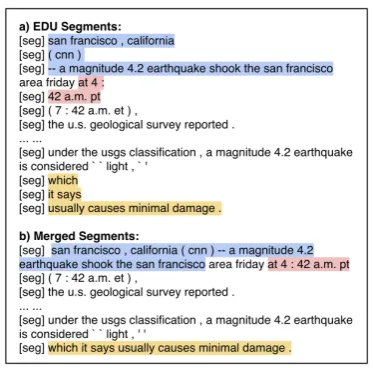
Figure 2: Examples of discourse-level segmentation. a) spans in blue and yellow are the EDUs with seman-tically fragmented information and spans in red are the inaccurate EDU splits; b) the sub-sentential segments after merging.
mature pre-processing task to be integrated with downstream tasks such as summarization.
3 Discourse-Level Segmentation
For discourlevel segmentation for content se-lection, our target is to split a document into sub-sentential segments that preserve congruently se-mantic information.
In the RST discourse framework, a document is split into elementary discourse units (EDUs) that are contiguous token spans similar to independent clauses, and re-organized in a binary tree struc-ture. EDU pairs are assigned to specific discourse relations like elaboration, condition, and contrast, ensuring the semantic coherence and integrity of the entire structure. Therefore, we followed the conventions annotated in the RST Discourse Tree-bank1 (Carlson et al., 2001), which contains dis-course tree annotations for 385 WSJ articles from the Penn Treebank corpus (Marcus et al., 1993). We trained a fast and robust model2(Heilman and Sagae,2015) on the treebank, obtaining over0.84 accuracy on its validation set. Next, we applied the model to segment the documents, and here we firstly conducted sentence splitting as it im-proved the accuracy of subsequent EDU segmen-tation. Then, we specified[edu seg]tags between two EDUs and [sen seg]tags between two sen-tences.
1
https://catalog.ldc.upenn.edu/LDC2002T07
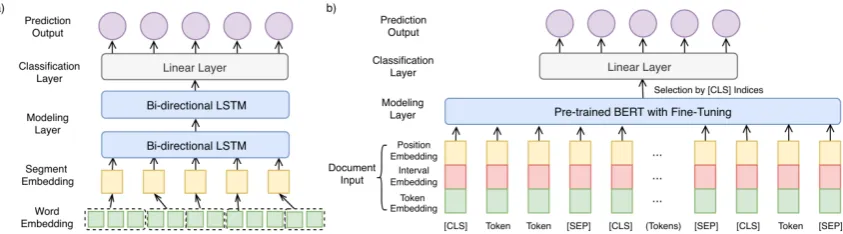
Figure 3: Content selector designs: a) RNN architecture; b) BERT architecture.
As shown in Figure2a, some EDUs are too se-mantically fragmented to form an informative seg-ment. In addition, there are inevitable errors in the segmentations, which is not unexpected due to the limited size of the training corpus. In order to balance the segment length and informativeness in addition to mitigating the side-effects from inac-curate EDU segmentation, we therefore defined a set of criteria such as word length, the existence of verbs, and symmetry of quotation marks, to merge short EDUs into longer sub-sentential seg-ments, which are typically at the clause-level. A discourse segment is on average 14 tokens after merging compared to average 7.5 tokens before merging (see Figure2b).
4 Neural Content Selection
Given a documentdcontaining a number of text spans [span1, span2, ..., spann], the content
se-lector assigns a score yi ∈ [0,1] to each span i,
indicating its probability of being included in the summary. We implemented and compared three neural architectures, which we elaborate below.
4.1 RNN Selector
Recurrent neural network, with its capability of se-quential information modeling, is widely applied in extractive summarization.
Here we introduce a multi-layer RNN architec-ture as the selector, which is simple but competi-tive as in (Kedzie et al.,2018). As shown in Fig-ure3a, the input is a sequence of discourse-level segment embeddings, which is calculated by aver-aging word embeddings. The sentence boundary tags [sen seg] are converted to a randomly ini-tialized embedding vector. In the modeling layer, a multi-layer Bi-directional LSTM (Schuster and Paliwal,1997) is used, in which the forward and backward hidden states are concatenated. Then the hidden representation is fed to a linear layer
with a sigmoid function, to predict the probability of extracting each segment.
In our setting, word embeddings were initial-ized with pre-trained 300-dimension GloVe (Pen-nington et al.,2014) and fixed during training. Vo-cabulary size was set to 200k. Out-of-voVo-cabulary words were mapped to a zero embedding. For the modeling layer, it was empirically shown that a two-layer Bi-LSTM worked best. Adam optimizer with 3e−4 learning rate was used (Kingma and Ba,2015). Drop-out withrate= 0.2was applied in the modeling and classification layers (Srivas-tava et al.,2014).
4.2 Transformer Selector
The Transformer (Vaswani et al.,2017) is another effective and efficient neural architecture for lan-guage modeling. To compare it with the recurrent encoding scheme, we changed the modeling layer of the design in Section4.1, by replacing the Bi-directional LSTM with a multi-head attention en-coding component. In our setting, we empirically set the layer number of Transformer encoder to 3, and the self-attention head number to 5. The hid-den and feed-forward dimension size were set to 400 and 1024 respectively. To better utilize the se-quential information, we pre-calculated the posi-tion embedding with 100 dimension size and con-catenated it with the segment embedding as input. The other hyperparameters of training were set as the same as the RNN selector.
4.3 BERT Selector
Model ROUGE-1 F1 ROUGE-2 F1
Lead-3 40.43 17.64
SummaRuNNer* 39.60 16.20
NeuSUM* 41.59 19.01
[image:4.595.74.290.61.183.2]S-Level Oracle 53.29 32.14 S-Level Bi-LSTM 38.86 17.31 S-Level Transformer 38.57 17.26 S-Level BERT 41.02 19.39 D-Level Oracle 57.74 35.16 D-Level Bi-LSTM 40.36 18.42 D-Level Transformer 40.03 17.83 D-Level BERT 42.78 20.23
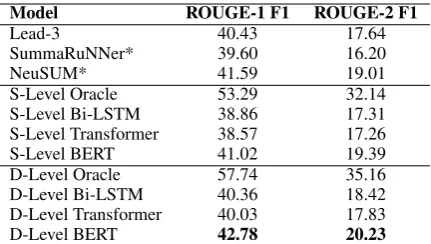
Table 1: Experimental results of baselines, oracles and models on Sentence-Level (S-Level) and Discourse-Level (D-Discourse-Level) segmentation. * denotes results from the papers.
Manning, 2019) and semantic dependency (Con-neau et al.,2018).
Since BERT is originally trained as a contextu-alized language representation model, we adapted and fine-tuned it for discourlevel content se-lection, as illustrated in Figure 3b. While BERT can be applied to encode sequences separately or jointly, the latter works better for document tasks (Qiao et al.,2019). Therefore, we decided to take the adapted embedding list as our document in-put. For each segment, we inserted a [CLS] token before and a [SEP] token after it, then converted it to token embeddings with word-piece tokeniza-tion (Wu et al.,2016). To distinguish multiple seg-ments, we assigned0/1to adjacent segment pairs respectively as interval label. Combined with po-sition embedding, the document input was fed to BERT for contextualized encoding. After that, we collected all the hidden states of [CLS] tokens in the last layer of BERT, which captured the contex-tual information of segments, then fed them to a linear layer with sigmoid function to get the pre-dicted salient scores.
In our setting, we used the PyTorch version of ‘bert-base-uncased’ BERT3, and fine-tuned all the layers during training. We truncated the lengthy documents to the size of 512 due to the limita-tion of posilimita-tion index and the significant increase of computational cost by the sliding-window strat-egy. Adam algorithm (Kingma and Ba, 2015) with warm-up learning was used for optimization. Drop-out rate was set to0.2was applied after the modeling layer (Srivastava et al.,2014).
For all models, we obtained the normalized pre-dicted scoreyi of each segmenti. The loss is
cal-culated as the binary cross entropy of yi against
3https://github.com/huggingface/pytorch-transformers
Figure 4: Examples of generated summaries. Colored spans contain key information from the gold reference.
ground-truthyˆi. Each epoch constitutes a full pass
through the data with shuffling. During training, the best models were selected with early stopping strategy on the validation set.
5 Experiment & Results
Experiments were conducted on the CNN/Daily Mail dataset (Hermann et al.,2015). We applied discourse-level segmentation in Section 3 on the training, validation, and test set. Since there is no oracle extractive summary set for generating gold labelsyˆi, we constructed them with a greedy
algo-rithm similar to (Kedzie et al.,2018), and obtained the discourse-level oracle summaries by concate-nating segments with gold label indices.
Having gotten the prediction outputs, we se-lected 4 discourse-level segments with the highest scores for each document sample, and then eval-uated the candidates against reference summaries with the F1 scores of ROUGE-1 and ROUGE-2 (Lin,2004). We compared our method with sev-eral strong extractive baselines: SummaRuNNer (Nallapati et al., 2017), NeuSUM (Zhou et al., 2018), and Lead-3, a simple but competitive base-line, which takes the first 3 sentences of the doc-ument as a summary. Moreover, as control, we split documents into sentences, built a sentence-level oracle set, and trained the selector models in which the most 3 salient sentences were selected.
[image:4.595.316.522.64.186.2]conducted at the sentence-level can be transferred to sub-sentential levels. Additionally, we ob-served that merging initial EDUs in Section3 sig-nificantly contributed to obtaining better perfor-mance, suggesting that preserving semantic con-gruence is crucial in sub-sentential segmentation.
An example from our results demonstrates that discourse-level extractive summarization retains most of the key information in the reference, and it is more concise than the sentence-level counter-part (see Figure4). It is able to trim the trivial de-tails that are nonessential to the core meaning of the source text, achieving 19% decrease of the av-erage word length when compared to the sentence-level baseline (from 71 tokens to 57 tokens).
6 Conclusion
In this paper, we proposed using sub-sentential segmentation for single-document extractive sum-marization. We exploited a discourse-level seg-mentation scheme and verified its effectiveness by obtaining improvements over sentence-level schemes. We adapted and fine-tuned a deep con-textual model for our task and achieved state-of-the-art performance. Incorporating discourse tree structures implicitly or explicitly in the neural net-work approaches for summarization is an area of interest for future work.
Acknowledgments
The authors would like to thank insightful discus-sions with Bonnie Webber, Wenqiang Lei, and Ai Ti Aw. This research is supported by the Agency for Science, Technology and Research (A*STAR) under its AME Programmatic Funding Scheme (Project No. A18A2b0046).
References
Lynn Carlson, Daniel Marcu, and Mary Ellen Okurovsky. 2001. Building a discourse-tagged cor-pus in the framework of rhetorical structure theory. InProceedings of the Second SIGdial Workshop on Discourse and Dialogue.
Jianpeng Cheng and Mirella Lapata. 2016. Neural summarization by extracting sentences and words. In Proceedings of the 54th Annual Meeting of the Association for Computational Linguistics (Volume 1: Long Papers), pages 484–494, Berlin, Germany. Association for Computational Linguistics.
Alexis Conneau, Germ´an Kruszewski, Guillaume Lample, Lo¨ıc Barrault, and Marco Baroni. 2018.
What you can cram into a single $&!#* vector: Probing sentence embeddings for linguistic proper-ties. InProceedings of the 56th Annual Meeting of the Association for Computational Linguistics (Vol-ume 1: Long Papers), pages 2126–2136, Melbourne, Australia. Association for Computational Linguis-tics.
Jacob Devlin, Ming-Wei Chang, Kenton Lee, and Kristina Toutanova. 2018. BERT: pre-training of deep bidirectional transformers for language under-standing.CoRR, abs/1810.04805.
Sebastian Gehrmann, Yuntian Deng, and Alexander Rush. 2018. Bottom-up abstractive summariza-tion. In Proceedings of the 2018 Conference on Empirical Methods in Natural Language Process-ing, pages 4098–4109, Brussels, Belgium. Associ-ation for ComputAssoci-ational Linguistics.
Michael Heilman and Kenji Sagae. 2015. Fast rhetor-ical structure theory discourse parsing. CoRR, abs/1505.02425.
Karl Moritz Hermann, Tomas Kocisky, Edward Grefenstette, Lasse Espeholt, Will Kay, Mustafa Su-leyman, and Phil Blunsom. 2015. Teaching ma-chines to read and comprehend. In Advances in neural information processing systems, pages 1693– 1701.
John Hewitt and Christopher D Manning. 2019. A structural probe for finding syntax in word repre-sentations. InProceedings of the 2019 Conference of the North American Chapter of the Association for Computational Linguistics: Human Language Technologies. Association for Computational Lin-guistics.
Tsutomu Hirao, Masaaki Nishino, Yasuhisa Yoshida, Jun Suzuki, Norihito Yasuda, and Masaaki Nagata. 2015. Summarizing a document by trimming the discourse tree. IEEE/ACM Transactions on Au-dio, Speech and Language Processing (TASLP), 23(11):2081–2092.
Wan-Ting Hsu, Chieh-Kai Lin, Ming-Ying Lee, Kerui Min, Jing Tang, and Min Sun. 2018. A unified model for extractive and abstractive summarization using inconsistency loss. InProceedings of the 56th Annual Meeting of the Association for Computa-tional Linguistics (Volume 1: Long Papers), pages 132–141. Association for Computational Linguis-tics.
Karen Sp¨arck Jones. 2007. Automatic summarising: The state of the art. Information Processing & Man-agement, 43(6):1449–1481.
Sofia, Bulgaria. Association for Computational Lin-guistics.
Nal Kalchbrenner, Edward Grefenstette, and Phil Blun-som. 2014. A convolutional neural network for modelling sentences. In Proceedings of the 52nd Annual Meeting of the Association for Computa-tional Linguistics (Volume 1: Long Papers), pages 655–665, Baltimore, Maryland. Association for Computational Linguistics.
Chris Kedzie, Kathleen McKeown, and Hal Daume III. 2018. Content selection in deep learning models of summarization. In Proceedings of the 2018 Con-ference on Empirical Methods in Natural Language Processing, pages 1818–1828, Brussels, Belgium. Association for Computational Linguistics.
Diederik P Kingma and Jimmy Ba. 2015. Adam: A method for stochastic optimization. InProceedings of the 3rd International Conference for Learning Representations.
Junyi Jessy Li, Kapil Thadani, and Amanda Stent. 2016. The role of discourse units in near-extractive summarization. InProceedings of the 17th Annual Meeting of the Special Interest Group on Discourse and Dialogue, pages 137–147, Los Angeles. Asso-ciation for Computational Linguistics.
Chin-Yew Lin. 2004. ROUGE: A package for auto-matic evaluation of summaries. In Text Summa-rization Branches Out: Proceedings of the ACL-04 Workshop, pages 74–81, Barcelona, Spain. Associa-tion for ComputaAssocia-tional Linguistics.
Nelson F Liu, Matt Gardner, Yonatan Belinkov, Matthew Peters, and Noah A Smith. 2019. Lin-guistic knowledge and transferability of contextual representations. InProceedings of the 2019 Confer-ence of the North American Chapter of the Associ-ation for ComputAssoci-ational Linguistics: Human Lan-guage Technologies. Association for Computational Linguistics.
Annie Louis, Aravind Joshi, and Ani Nenkova. 2010. Discourse indicators for content selection in summa-rization. InProceedings of the 11th Annual Meeting of the Special Interest Group on Discourse and Di-alogue, pages 147–156. Association for Computa-tional Linguistics.
William C Mann and Sandra A Thompson. 1988. Rhetorical structure theory: Toward a functional the-ory of text organization. Text-Interdisciplinary Jour-nal for the Study of Discourse, 8(3):243–281.
Mitchell P. Marcus, Beatrice Santorini, and Mary Ann Marcinkiewicz. 1993. Building a large annotated corpus of English: The Penn Treebank. Computa-tional Linguistics, 19(2):313–330.
Ramesh Nallapati, Feifei Zhai, and Bowen Zhou. 2017. Summarunner: A recurrent neural network based se-quence model for extractive summarization of docu-ments. InThirty-First AAAI Conference on Artificial Intelligence.
Jeffrey Pennington, Richard Socher, and Christopher Manning. 2014. Glove: Global vectors for word representation. In Proceedings of the 2014 Con-ference on Empirical Methods in Natural Language Processing (EMNLP), pages 1532–1543. Associa-tion for ComputaAssocia-tional Linguistics.
Matthew Peters, Mark Neumann, Mohit Iyyer, Matt Gardner, Christopher Clark, Kenton Lee, and Luke Zettlemoyer. 2018. Deep contextualized word rep-resentations. In Proceedings of the 2018 Confer-ence of the North American Chapter of the Associ-ation for ComputAssoci-ational Linguistics: Human Lan-guage Technologies, Volume 1 (Long Papers), pages 2227–2237, New Orleans, Louisiana. Association for Computational Linguistics.
Yifan Qiao, Chenyan Xiong, Zhenghao Liu, and Zhiyuan Liu. 2019. Understanding the behaviors of bert in ranking.arXiv preprint arXiv:1904.07531.
Mike Schuster and Kuldip K Paliwal. 1997. Bidirec-tional recurrent neural networks. IEEE Transactions on Signal Processing, 45(11):2673–2681.
Dou Shen, Jian-Tao Sun, Hua Li, Qiang Yang, and Zheng Chen. 2007. Document summarization us-ing conditional random fields. In Proceedings of the 20th International Joint Conferences on Artifi-cial Intelligence., pages 2862–2867.
Nitish Srivastava, Geoffrey Hinton, Alex Krizhevsky, Ilya Sutskever, and Ruslan Salakhutdinov. 2014. Dropout: a simple way to prevent neural networks from overfitting. The Journal of Machine Learning Research, 15(1):1929–1958.
Ashish Vaswani, Noam Shazeer, Niki Parmar, Jakob Uszkoreit, Llion Jones, Aidan N Gomez, Łukasz Kaiser, and Illia Polosukhin. 2017. Attention is all you need. InAdvances in neural information pro-cessing systems, pages 5998–6008.
Yonghui Wu, Mike Schuster, Zhifeng Chen, Quoc V Le, Mohammad Norouzi, Wolfgang Macherey, Maxim Krikun, Yuan Cao, Qin Gao, Klaus Macherey, et al. 2016. Google’s neural ma-chine translation system: Bridging the gap between human and machine translation. arXiv preprint arXiv:1609.08144.