Proceedings of the 2019 Conference on Empirical Methods in Natural Language Processing 6413
STANCY: Stance Classification Based on Consistency Cues
Kashyap Popat1, Subhabrata Mukherjee2, Andrew Yates1, Gerhard Weikum1
1Max Planck Institute for Informatics, Saarbr¨ucken, Germany 2Microsoft Research, Redmond, WA, USA
1{kpopat,ayates,weikum}@mpi-inf.mpg.de 2[email protected]
Abstract
Controversial claims are abundant in online media and discussion forums. A better understanding of such claims requires an-alyzing them from different perspectives. Stance classification is a necessary step for inferring these perspectives in terms of supporting or opposing the claim. In this work, we present a neural network model for stance classification leveraging BERT representations and augmenting them with a novel consistency constraint. Experiments on
thePerspectrumdataset, consisting of claims
and users’ perspectives from various debate websites, demonstrate the effectiveness of our approach over state-of-the-art baselines.
1 Introduction
There is an abundance of contentious claims on the Web including controversial statements from politicians, biased news reports, rumors, etc. People express their perspectives about these controversial claims through various channels like editorials, blog posts, social media, and discussion forums. To achieve a deeper understanding of these claims, we need to understand users’ perspectives and stance towards the claims. Recent research (FNC-1,2016;Baly et al.,2018;
Chen et al.,2019) has shown stance classification to be a critical step for information credibility and automated fact-checking.
Prior Work and Limitations: Prior ap-proaches for stance classification proposed in
Somasundaran and Wiebe (2010); Anand et al.
(2011);Walker et al.(2012);Hasan and Ng(2013,
2014); Sridhar et al. (2015); Sun et al. (2018) rely on various linguistic features, e.g., n-grams, dependency parse tree, opinion lexicons, and sentiment to determine the stance of perspectives regarding controversial topics. Ferreira and Vla-chos (2016) further incorporate natural language
claims and propose a logistic regression model using the lexical and semantic features of claims and perspectives. SemEval tasks (Mohammad et al., 2016; Kochkina et al., 2017) and other approaches (Chen and Ku, 2016; Lukasik et al.,
2016; Sobhani et al., 2017) have focused on determining stance only in Tweets.
Bar-Haim et al.(2017) propose classifiers based on hand-crafted lexicons to identify important phrases in perspectives and their consistency with the claim to predict the stance However, their model critically relies on manual lexicons and assumes that the important phrases in claims are already identified.
Neural-network-based approaches for stance classification learn the claim and perspective representations separately and later combine them with conditional LSTM encoding (Augenstein et al., 2016), attention mechanisms (Du et al.,
2017) or memory networks (Mohtarami et al.,
2018). Some neural network models also incorporate lexical features (Riedel et al., 2017;
Hanselowski et al., 2018). None of these approaches leverage knowledge acquired from massive external corpora.
Approach and Contributions: To overcome the limitations of prior works, we present STANCY, a neural network model for stance classification. Given an input pair of a claim and a user’s perspective, our model predicts whether the perspective issupportingoropposing
the claim. For example, the claim “You have nothing to worry about surveillance, if you have done nothing wrong” is supported by the user perspective “Information gathered through surveillance could be used to fight terrorism”
and opposed by another user perspective “With surveillance, the user privacy will go away!”.
BERT
Dense Layer Stance Claim
Tokens
Perspective Tokens
[CLS] [SEP] [SEP]
Perspective Rep.
(a) BERTBASE: Fine-tuning BERT for stance classification.
BERT
Dense Layer Stance Claim
Tokens
Perspective Tokens
[CLS] [SEP] [SEP]
Claim Tokens
[CLS] [SEP] Consistency
Score Perspective
Rep.
Claim Rep.
Cosine Similarity
(b) BERTCONS: Enhancing BERT using the joint loss
[image:2.595.66.526.72.158.2](losscefor stance classification andlosscosfor consistency).
Figure 1: BERT-based methods for determining the stance of the perspective with respect to the claim.
Encoder Representations from Transformers) neural network model (Devlin et al.,2019). BERT is trained on huge text corpora and serves as background knowledge. We fine-tune BERT for our task which also allows us to jointly model claims and perspectives. Furthermore, we enhance our model by augmenting it with a novel consistency constraint to capture agreement between the claim and perspective.
Key contributions of this paper are:
• Model: A neural network model for stance classification leveraging BERT representa-tions learned over massive external corpora and a novel consistency constraint to jointly model claims and perspectives.
• Interpretability: A simple approach to interpret the contribution of perspective tokens in deciding their stance towards the claim.
• Experiments: Experiments on a recent dataset, Perspectrum, highlighting the effec-tiveness of our approach with error analysis.
2 BERT-based Approaches
In this section, first we describe the base model, BERTBASE, that is adapted for the stance classification (Chen et al.,2019). Thereafter, we present our consistency-aware model, BERTCONS.
2.1 Adapting BERT for Stance Classification
The goal of the stance classification task is to determine the stance of the user Perspective (P)
with respect to the Claim (C). Since this task involves a pair of sentences (CandP), we follow the approach for sentence pair classification task as proposed in Devlin et al. (2019); Chen et al.
(2019).
In order to obtain the representation XP|C of
P with respect to C, this sentence pair is fused into a single input sequence by using a special
classification token ([CLS]) and a separator token ([SEP]): [CLS] Ctoks [SEP] Ptoks [SEP].
The input sequences are tokenized using Word-Piece tokenization. The final hidden state representation corresponding to the[CLS]token is used as XP|C ∈ RH. The classification
probability is given by passing this representation through the softmax layer:
ˆ
y=sof tmax(XP|CWT) (1)
where softmax layer weights W ∈ RH×K
and K is the number of stance (classification) labels. All the parameters of BERT and W are fine-tuned jointly by minimizing the cross-entropy loss (lossce). The architecture of this model,
BERTBASE, is shown in Figure1a.
2.2 Consistency-aware Stance Classification
In this setting, we want to incorporate the consistency between the claim (C) and perspective (P) representations. We hypothesize that the latent representations of claim and perspective should be dissimilar if the perspective opposes
the claim, whereas their representations should be similar if the claim is supported by the perspective. We capture this with the following components.
Claim Representation: To capture the latent representation of the claim, we use only the claim text as the input sequence to BERT, i.e.,
[CLS] C [SEP]. The final hidden state of the first input token ([CLS]) is used as the claim’s representationXC ∈RH.
Split Supporting Pairs
Opposing Pairs
Total Pairs
train 3603 3404 7007
dev 1051 1045 2096
test 1471 1302 2773
Total 6125 5751 11876
Table 1: Perspectrum data statistics.
Capturing Consistency: To incorporate the consistency between claim and perspective repre-sentations, we use thecosine embedding loss:
losscos=
1−cos(XC, XP|C) ysim= 1
max(0,cos(XC, XP|C)) ysim=−1
where cos(.) is the cosine similarity function.
ysim is equal to1if the perspective issupporting
the claim (similar representations), and−1if the claim is opposed by the perspective (dissimilar
representations).
Joint Loss: The classification probabilities are determined by concatenating XP|C and cos(XC, XP|C)and passing it through a softmax layer. However, unlike the BERTBASE con-figuration, parameters of the consistency-aware model are learned by optimizing the joint loss function: loss=lossce+losscos. With this joint
loss function, we enforce consistency between latent representations of the claim and perspective. The architecture of this consistency-aware model, BERTCONS, is shown in Figure1b.
3 Experimental Setup
For our experiments, we consider the base version of BERT1 with 12 layers, 768 hidden size, and 12 attention heads. We fine-tune BERT-based models using the Adam optimizer with learning rates {1,3,5} × 10−5 and training batch sizes
{24,28,32}. We choose the best parameters based on the development split of the dataset. For measuring the performance, we use per-class and macro-averaged Precision/Recall/F1.
3.1 Dataset
We evaluate our approach on the Perspectrum
dataset (Chen et al.,2019). Perspectrumcontains claims and users’ perspectives from various online debate websites like idebate.com,
debatewise.org, and procon.org. Each claim has different perspectives along with the stance (supporting or opposing the claim). We
1BERT implementation:https://git.io/fhbJQ
use the same train/dev/test split as provided in the released dataset. Statistics of the dataset is shown in Table1.
3.2 Baselines
We use the following baselines:
LSTM: A long short-term memory (LSTM) model, in which we pass the claim and perspective word representations (using GloVE-6B word embeddings of size 300) through a bidirectional LSTM. Then we concatenate the final hidden states of the claim and perspective, and pass it through dense layers with ReLU activations.
ESIM: An enhanced sequential inference model (ESIM) for natural language inference proposed in
Chen et al.(2017).
MLP: Multi-layer perceptron (MLP) based model using lexical and similarity-based features – presented as a simple but tough-to-beat baseline
for stance detection inRiedel et al.(2017).
WordAttn: Our implementation of word-by-word attention-based model using long short-term memory networks (Rockt¨aschel et al.,2016).
LangFeat: A random forest classifier using linguistic lexicons like NRC lexicon (Mohammad and Turney, 2010), hedges (e.g., possibly, might, etc.), positive/negative sentiment words (Hu and Liu, 2004), MPQA subjective lexicon (Wilson et al., 2005) and bias lexicon (Recasens et al.,
2013) along with sentiment scores as features.
BERTBASE: Approach proposed in Chen et al.
(2019) (as described in Section2.1).
Human: Human performance on this task as reported inChen et al.(2019).
4 Results and Discussion
Approach Supporting Opposing Overall (Macro)
Prec. Recall F1 Prec. Recall F1 Prec. Recall F1
LSTM 63.42 58.80 61.02 56.99 61.67 59.24 60.20 60.24 60.13 ESIM 64.38 61.32 62.81 58.53 61.67 60.06 61.46 61.50 61.44 MLP 64.53 60.98 62.71 58.50 62.14 60.26 61.51 61.56 61.48 WordAttn 64.43 63.43 63.93 59.40 60.45 59.92 62.07 62.03 62.04 LangFeat 63.74 75.05 68.94 64.75 51.77 57.53 64.24 63.41 63.23 BERTBASE 78.43 80.08 79.25 76.95 75.12 76.02 77.69 77.60 77.63
BERTCONS 79.05 84.64 81.75 81.14 74.65 77.76 80.09 79.65 79.95
[image:4.595.75.289.248.336.2]Human - - - 91.3 90.6 90.9
Table 2: Comparison of our approach BERTCONSwith different baseline models for stance classification.
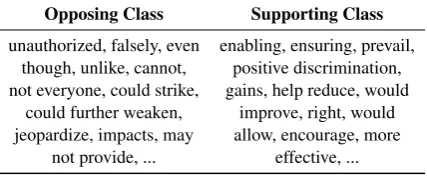
Opposing Class Supporting Class
unauthorized, falsely, even though, unlike, cannot, not everyone, could strike,
could further weaken, jeopardize, impacts, may
not provide, ...
enabling, ensuring, prevail, positive discrimination, gains, help reduce, would
improve, right, would allow, encourage, more
effective, ...
Table 3: Top phrases for determining stance.
4.1 Interpreting Token-level Contribution
Due to the massive structure of BERT with a complex attention mechanism, it is difficult to interpret the significance of different lexical units in the text. Therefore, we propose a simple technique to interpret the contribution of each token in the text in determining the stance.
Given the claim (C) and perspective (P) pair, we tokenizePintophrases. We record the change in stance classification probabilities by adding one perspective phrase at a time to the input:
∆i=|BERTCON S(C, Pi)−BERTCON S(C, Pi−1)|
where Pi is the prefix ofP up to the ith phrase.
This helps us in understanding the contribution of each perspective phrase towards determining the stance – the larger the change in the classification probabilities, the larger the contribution. For this analysis, we consider unigrams and chunks from a shallow parser as phrases. The top contributing phrases for the supporting and opposing classes are shown in Table3.
4.2 Error Analysis
In this section, we analyze why the task of stance classification is challenging and why the performance of the best model configuration is far from human performance as observed by the performance gap in Table2.
Negations:One of the major challenges in solving this task is understanding negations and their scope. For example, given the claim “College education is worth it”, the perspective “Many college graduates are employed in jobs that do notrequire college degrees”is opposing the claim. However, our model is not able to capture that the negation phrase ‘do not require’ opposes the claim. On the other hand, the presence of negation in the perspective does not necessarily imply that it is opposing the claim. Contrast this with the claim
“Chess must be at the Olympics”and perspective
“Chess is currently not an Olympic sport, but it should be”– where the negation is merely a part of the statement and the stance is given by the discourse segment following‘but’.
Commonsense: Determining the stance may require commonsense knowledge. For example, the claim “Chess must be at the Olympics” is opposed by the perspective “Olympic sports are supposed to bephysical”. To understand this, the model should have the background knowledge that chess is not a physical sport.
Semantics: Understanding the stance also involves a deeper understanding of semantics. For example, given the claim“Make all museums free of charge” is opposed by the perspective“State funding should be used elsewhere”. Here, the word‘elsewhere’is the key cue which determines the stance. However, the presence of the word
‘elsewhere’ does not necessarily imply that the perspective is opposing the claim. For instance, the perspective “We could spend the money
5 Conclusion
In this work, we propose a consistency-aware neural network model for stance classification. Our model leverages representations from the BERT model trained over massive external corpora and a novel consistency constraint to jointly model claims and perspectives. Our experiments on a recent benchmark highlight the advantages of our approach. We also study the gap in human performance and the performance of the best model for stance classification.
Acknowledgments
This research was partly supported by the ERC Synergy Grant “imPACT” (No. 610150).
References
Pranav Anand, Marilyn Walker, Rob Abbott, Jean E. Fox Tree, Robeson Bowmani, and Michael Minor. 2011. Cats rule and dogs drool!: Classifying stance in online debate. In Proceedings of the 2nd Workshop on Computational Approaches to Subjectivity and Sentiment Analysis (WASSA
2.011), pages 1–9, Portland, Oregon. Association for
Computational Linguistics.
Isabelle Augenstein, Tim Rockt¨aschel, Andreas Vlachos, and Kalina Bontcheva. 2016. Stance detection with bidirectional conditional encoding.
InProceedings of the 2016 Conference on Empirical
Methods in Natural Language Processing, pages
876–885, Austin, Texas. Association for Computa-tional Linguistics.
Ramy Baly, Mitra Mohtarami, James Glass, Llu´ıs M`arquez, Alessandro Moschitti, and Preslav Nakov. 2018.Integrating stance detection and fact checking in a unified corpus. In Proceedings of the 2018 Conference of the North American Chapter of the Association for Computational Linguistics: Human
Language Technologies, Volume 2 (Short Papers),
pages 21–27, New Orleans, Louisiana. Association for Computational Linguistics.
Roy Bar-Haim, Indrajit Bhattacharya, Francesco Din-uzzo, Amrita Saha, and Noam Slonim. 2017. Stance classification of context-dependent claims. In
Proceedings of the 15th Conference of the European Chapter of the Association for Computational
Linguistics: Volume 1, Long Papers, pages 251–261,
Valencia, Spain. Association for Computational Linguistics.
Qian Chen, Xiaodan Zhu, Zhen-Hua Ling, Si Wei, Hui Jiang, and Diana Inkpen. 2017. Enhanced LSTM for natural language inference. In Proceedings of the 55th Annual Meeting of the Association
for Computational Linguistics (Volume 1: Long
Papers), pages 1657–1668, Vancouver, Canada.
Association for Computational Linguistics.
Sihao Chen, Daniel Khashabi, Wenpeng Yin, Chris Callison-Burch, and Dan Roth. 2019. Seeing things from a different angle:discovering diverse perspectives about claims. In Proceedings of the 2019 Conference of the North American Chapter of the Association for Computational Linguistics: Human Language Technologies, Volume 1 (Long
and Short Papers), pages 542–557. Association for
Computational Linguistics.
Wei-Fan Chen and Lun-Wei Ku. 2016. UTCNN: a deep learning model of stance classification on social media text. InProceedings of COLING 2016, the 26th International Conference on Computational
Linguistics: Technical Papers, pages 1635–1645,
Osaka, Japan. The COLING 2016 Organizing Committee.
Jacob Devlin, Ming-Wei Chang, Kenton Lee, and Kristina Toutanova. 2019. Bert: Pre-training of deep bidirectional transformers for language understanding. In Proceedings of the 2019 Conference of the North American Chapter of the Association for Computational Linguistics: Human
Language Technologies.
Jiachen Du, Ruifeng Xu, Yulan He, and Lin Gui. 2017. Stance classification with target-specific neural attention. InProceedings of the Twenty-Sixth International Joint Conference on Artificial
Intelli-gence, IJCAI-17, pages 3988–3994.
William Ferreira and Andreas Vlachos. 2016. Emer-gent: a novel data-set for stance classification.
In Proceedings of the 2016 Conference of the
North American Chapter of the Association for Computational Linguistics: Human Language
Tech-nologies, pages 1163–1168, San Diego, California.
Association for Computational Linguistics.
FNC-1. 2016. Fake news challenge stage 1 (fnc-1): Stance detection.
Andreas Hanselowski, Avinesh PVS, Benjamin Schiller, Felix Caspelherr, Debanjan Chaudhuri, Christian M. Meyer, and Iryna Gurevych. 2018. A retrospective analysis of the fake news challenge stance-detection task. In Proceedings of the 27th International Conference on Computational
Linguistics, pages 1859–1874, Santa Fe, New
Mexico, USA. Association for Computational Linguistics.
Kazi Saidul Hasan and Vincent Ng. 2013. Stance classification of ideological debates: Data, models, features, and constraints. In Proceedings of the Sixth International Joint Conference on Natural
Language Processing, pages 1348–1356, Nagoya,
Kazi Saidul Hasan and Vincent Ng. 2014. Why are you taking this stance? identifying and classifying reasons in ideological debates. InEMNLP.
Minqing Hu and Bing Liu. 2004. Mining and summarizing customer reviews. In Proceedings of the Tenth ACM SIGKDD International Conference
on Knowledge Discovery and Data Mining, KDD
’04, pages 168–177, New York, NY, USA. ACM.
Elena Kochkina, Maria Liakata, and Isabelle Au-genstein. 2017. Turing at semeval-2017 task 8: Sequential approach to rumour stance classification with branch-lstm.CoRR, abs/1704.07221.
Michal Lukasik, P. K. Srijith, Duy Vu, Kalina Bontcheva, Arkaitz Zubiaga, and Trevor Cohn. 2016. Hawkes processes for continuous time sequence classification: an application to rumour stance classification in twitter. InProceedings of the 54th Annual Meeting of the Association for
Com-putational Linguistics (Volume 2: Short Papers),
pages 393–398, Berlin, Germany. Association for Computational Linguistics.
Saif Mohammad, Svetlana Kiritchenko, Parinaz Sobhani, Xiaodan Zhu, and Colin Cherry. 2016.
SemEval-2016 task 6: Detecting stance in tweets.
In Proceedings of the 10th International Workshop
on Semantic Evaluation (SemEval-2016), pages
31–41, San Diego, California. Association for Computational Linguistics.
Saif M. Mohammad and Peter D. Turney. 2010.
Emotions evoked by common words and phrases: Using mechanical turk to create an emotion lexicon.
InProceedings of the NAACL HLT 2010 Workshop
on Computational Approaches to Analysis and
Generation of Emotion in Text, CAAGET ’10.
Mitra Mohtarami, Ramy Baly, James Glass, Preslav Nakov, Llu´ıs M`arquez, and Alessandro Moschitti. 2018. Automatic stance detection using end-to-end memory networks. In Proceedings of the 2018 Conference of the North American Chapter of the Association for Computational Linguistics: Human Language Technologies, Volume 1 (Long
Papers), pages 767–776, New Orleans, Louisiana.
Association for Computational Linguistics.
Marta Recasens, Cristian Danescu-Niculescu-Mizil, and Dan Jurafsky. 2013. Linguistic models for analyzing and detecting biased language. In
Proceedings of the 51st Annual Meeting of the Association for Computational Linguistics (Volume
1: Long Papers), pages 1650–1659, Sofia, Bulgaria.
Association for Computational Linguistics.
Benjamin Riedel, Isabelle Augenstein, Georgios P. Spithourakis, and Sebastian Riedel. 2017. A simple but tough-to-beat baseline for the fake news challenge stance detection task. CoRR, abs/1707.03264.
Tim Rockt¨aschel, Edward Grefenstette, Karl Moritz Hermann, Tom´as Kocisk´y, and Phil Blunsom. 2016.
Reasoning about entailment with neural attention. InICLR.
Parinaz Sobhani, Diana Inkpen, and Xiaodan Zhu. 2017.A dataset for multi-target stance detection. In
Proceedings of the 15th Conference of the European Chapter of the Association for Computational
Lin-guistics: Volume 2, Short Papers, pages 551–557,
Valencia, Spain. Association for Computational Linguistics.
Swapna Somasundaran and Janyce Wiebe. 2010.
Recognizing stances in ideological on-line debates.
InProceedings of the NAACL HLT 2010 Workshop
on Computational Approaches to Analysis and
Generation of Emotion in Text, pages 116–124,
Los Angeles, CA. Association for Computational Linguistics.
Dhanya Sridhar, James Foulds, Bert Huang, Lise Getoor, and Marilyn Walker. 2015. Joint models of disagreement and stance in online debate. In
Proceedings of the 53rd Annual Meeting of the Association for Computational Linguistics and the 7th International Joint Conference on Natural
Language Processing (Volume 1: Long Papers),
pages 116–125, Beijing, China. Association for Computational Linguistics.
Qingying Sun, Zhongqing Wang, Qiaoming Zhu, and Guodong Zhou. 2018. Stance detection with hierarchical attention network. In Proceedings of the 27th International Conference on Computational
Linguistics, pages 2399–2409, Santa Fe, New
Mexico, USA. Association for Computational Linguistics.
Marilyn Walker, Pranav Anand, Rob Abbott, and Ricky Grant. 2012. Stance classification using dialogic properties of persuasion. InProceedings of the 2012 Conference of the North American Chapter of the Association for Computational Linguistics: Human
Language Technologies, pages 592–596, Montr´eal,
Canada. Association for Computational Linguistics.