Proceedings of the 2nd Workshop on Deep Learning Approaches for Low-Resource NLP (DeepLo), pages 202–208 202
Natural Language Generation for Effective Knowledge Distillation
Raphael Tang, Yao Lu, and Jimmy Lin David R. Cheriton School of Computer Science
University of Waterloo
Abstract
Knowledge distillation can effectively transfer knowledge from BERT, a deep language repre-sentation model, to traditional, shallow word embedding-based neural networks, helping them approach or exceed the quality of other heavyweight language representation models. As shown in previous work, critical to this dis-tillation procedure is the construction of an unlabeled transfer dataset, which enables ef-fective knowledge transfer. To create transfer set examples, we propose to sample from pre-trained language models fine-tuned on task-specific text. Unlike previous techniques, this directly captures the purpose of the trans-fer set. We hypothesize that this principled, general approach outperforms rule-based tech-niques. On four datasets in sentiment clas-sification, sentence similarity, and linguistic acceptability, we show that our approach im-proves upon previous methods. We outper-form OpenAI GPT, a deep pretrained trans-former, on three of the datasets, while using a single-layer bidirectional LSTM that runs at least ten times faster.
1 Introduction
That bigger neural networks plus more data equals higher quality is a tried-and-true formula. In the natural language processing (NLP) literature, the recent darling of this mantra is the deep, pretrained language representation model. After pretrain-ing hundreds of millions of parameters on vast amounts of text, models such as BERT (Bidirec-tional Encoder Representations from Transform-ers;Devlin et al.,2018) achieve remarkable state of the art in question answering, sentiment analy-sis, and sentence similarity tasks, to list a few.
Does this progress mean, then, that classic, shallow word embedding-based neural networks are noncompetitive? Not quite. Recently, Tang
et al.(2019) demonstrate that knowledge distilla-tion (Ba and Caruana, 2014;Hinton et al.,2015) can transfer knowledge from BERT to small, tra-ditional neural networks, helping them approach or exceed the quality of much larger pretrained long short-term memory (LSTM; Hochreiter and Schmidhuber, 1997) language models, such as ELMo (Embeddings from Language Models; Pe-ters et al.,2018).
As shown in Tang et al. (2019), crucial to knowledge distillation is constructing a transfer dataset of unlabeled examples. In this paper, we explore how to construct such an effective trans-fer set. Previous approaches comprise manual data curation, a meticulous method where the end user manually selects a corpus similar enough to the present task, and rule-based techniques, where a transfer set is fabricated from the training set using a set of data augmentation rules. However, these rules only indirectly model the purpose of the transfer set, which is to provide more input drawn from the task-specific data distribution. Hence, we instead propose to construct the transfer set by generating text with pretrained language models fine-tuned on task-specific text. We validate our approach on four small- to mid-sized datasets in sentiment classification, sentence similarity, and linguistic acceptability.
We claim two contributions: first, we elucidate a novel approach for constructing the transfer set in knowledge distillation. Second, we are the first to outperform OpenAI GPT (Radford et al.,2018) in sentiment classification and sentence similar-ity with a single-layer bidirectional LSTM (Bi-LSTM) that runs more than ten times faster, with-out pretraining or domain-specific data curation. We make our datasets and codebase public in a GitHub repository.1
2 Background and Related Work
Ba and Caruana (2014) propose knowledge dis-tillation, a method for improving the quality of a smallerstudentmodel by encouraging it to match the outputs of a larger, higher-qualityteacher net-work. Concretely, suppose hS(·) and hT(·)
re-spectively denote the untrained student and trained teacher models, and we are given a training set of inputsS ={x1, . . . , xN}. On classification tasks,
the model outputs are log probabilities; on regres-sion tasks, the outputs are as-is. Then, the distilla-tion objectiveLKDis
LKD = 1 N
N
X
i=1
khS(xi)−hT(xi)k22 (1)
Hinton et al. (2015) alternatively use Kullback– Leibler divergence for classification, along with additional hyperparameters. For simplicity and generality, we stick with the original mean-squared error (MSE) formulation. We minimize LKD end-to-end with backpropagation, updating
the student’s parameters and fixing the teacher’s. LKDcan optionally be combined with the original, supervised cross-entropy or MSE loss; following Tang et al.(2019) and Shi et al.(2019), we opti-mize onlyLKDfor training the student.
Using only the given training set for S, how-ever, is often insufficient. Thus,Ba and Caruana (2014) augmentS with atransferset comprising unlabeled input, providing the student with more examples to distill from the teacher. Techniques for constructing this transfer set consist of either manual data curation or unprincipled data synthe-sis rules. Ba and Caruana (2014) choose images from the 80 million tiny images dataset, which is a superset of their dataset. In the NLP domain,Tang et al. (2019) propose text perturbation rules for creating a transfer set from the training set, achiev-ing results comparable to ELMo usachiev-ing a BiLSTM with 100 times fewer parameters.
We wish to avoid these previous approaches. Manual data curation requires the researcher to select an unlabeled set similar enough to the tar-get dataset, a difficult-to-impossible task for many datasets in, for example, linguistic acceptability and sentence similarity. Rule-based techniques, while general, unfortunately deviate from thetrue
purpose of modeling the input distribution; hence, we hypothesize that they are less effective than a principled approach, which we detail below.
3 Our Approach
In knowledge distillation, the student perceives the oracular teacher to be the true p(Y|X), where X and Y respectively denote the input sentence and label. This is reasonable, since the student treats the teacher outputy as ground truth, given some sentencexcomprising words{w1, . . . , wn}.
The purpose of the transfer set is, then, to pro-vide additional input sentences for querying the teacher. To construct such a set, we propose the following: first, we parameterize p(X) di-rectly as a language model p(w1, . . . , wn) =
Πni=1p(wi|w1, . . . , wi−1)trained on the given sen-tences{x1, . . . , xN}. Then, to generate unlabeled
examples, we sample from the language model, i.e., the ith word of a sentence is drawn from p(wi|w1, . . . , wi−1). We stop upon generating the special end-of-sentence token[EOS], which we append to each sentence while fine-tuning the lan-guage model (LM).
Unlike previous methods, our approach directly parameterizes p(X) to provide unlabeled exam-ples. We hypothesize that this approach outper-forms ad hoc rule-based methods, which only in-directly model the input distributionp(X).
Sentence-pair modeling.To language model sen-tence pairs, we follow Devlin et al. (2018) and join both sentences with a special separator token [SEP] between, treating the resulting sequence as a single contiguous sentence.
3.1 Model Architecture
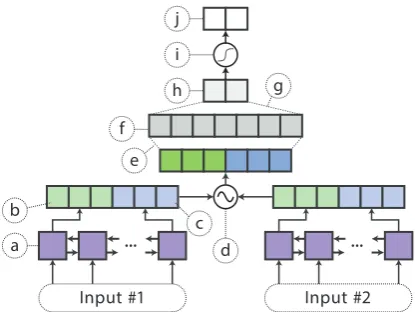
For simplicity and efficient inference, our student models use the same single-layer BiLSTM models fromTang et al.(2019)—see Figures1and2.
First, we map an input sequence of words to their corresponding word2vec embeddings, trained on Google News. Next, for single-sentence tasks, these embeddings are fed into a single-layer BiLSTM encoder to yield concatenated forward and backward statesh = [hf;hb]. For
sentence-pair tasks, we encode each sentence separately us-ing a BiLSTM to yield h1 and h2. To produce a single vector h, following Wang et al. (2018), we compute h = [h1;h2;δ(h1,h2);h1 · h2], where · denotes elementwise multiplication and δ denotes elementwise absolute difference. Fi-nally, for both single- and paired-sentence tasks,h
fi-...
...
1
2
n
a b c e
d
h
g
i j
[image:3.595.311.519.64.220.2]f
Figure 1: Illustration of the single-sentence BiLSTM, copied fromTang et al.(2019). The labels are as fol-lows: (a) word embeddings (b) BiLSTM layer (c) fi-nal forward hidden state (d) fifi-nal backward hidden state (e) nonlinear layer (f) the final representation (g) fully-connected layer (h) logits or similarity score (i) soft-max activation for classification tasks; identity for re-gression (j) final probabilities or score.
nal output is interpreted as the logits of each class; for real-valued sentence similarity, the final output is a single score.
Our teacher model is the large variant of BERT, a deep pretrained language representation model that achieves close to state of the art (SOTA) on our tasks. Extremely recent, improved pre-trained models like XLNet (Yang et al.,2019) and RoBERTa (Liu et al., 2019) likely offer greater benefits to the student model, but BERT is widely used and sufficient for the point of this paper. We follow the same experimental procedure inDevlin et al. (2018) and fine-tune BERT end-to-end for each task, varying only the final classifier layer for the desired number of classes.
Language modeling. For creating the transfer set, we apply two public, state-of-the-art lan-guage models: the word-level Transformer-XL (TXL; Dai et al., 2019) pretrained on WikiText-103 (Merity et al., 2017), which is derived from Wikipedia, and the subword-level GPT-2 (345M version; Radford et al.,2019) pretrained on Web-Text, which represents a large web corpus that
excludes Wikipedia. Other models exist, but we choose these two since they represent the state of the art. We name the GPT-2 and TXL-constructed transfer sets TSGPT-2and TSTXL, respectively.
4 Experimental Setup
We validate our approach on four datasets in timent classification, linguistic acceptability,
sen-... a
b
e
c f
...
h g
i j
d
[image:3.595.79.287.65.197.2]Input #1 Input #2
Figure 2: Illustration of the sentence-pair BiLSTM, copied fromTang et al.(2019). The labels are as fol-lows: (a) BiLSTM layer (b) final forward hidden state (c) final backward hidden state (d) comparison unit, as detailed in the text (e) nonlinear layer (f) the final repre-sentation (g) fully-connected layer (h) logits or similar-ity score (i) softmax activation for classification tasks; identity for regression (j) final probabilities or score.
tence similarity, and paraphrasing: Stanford Sen-timent Treebank-2 (SST-2; Socher et al., 2013), the Corpus of Linguistic Acceptability (CoLA; Warstadt et al., 2018), Semantic Textual Simi-larity Benchmark (STS-B; Cer et al., 2017), and Microsoft Research Paraphrase Corpus (MRPC; Dolan and Brockett, 2005). SST-2 is a bi-nary polarity dataset of single-sentence movie re-views. CoLA is a single-sentence grammaticality task, with expertly annotated binary judgements. STS-B comprises sentence pairs labeled with real-valued similarity between 1 and 5. Lastly, MRPC has sentence pairs with binary labels denoting se-mantic equivalence. We pick these four tasks from the General Language Understanding Evaluation (GLUE;Wang et al.,2018) benchmark, and sub-mit results to their public evaluation server.2
4.1 Baselines
As a sanity check, we attempt knowledge distilla-tionwithout a transfer set, as well as training our BiLSTM from scratch on the original labels. We compare to the best official GLUE test results re-ported for single- and multi-task ELMo models, OpenAI GPT, single- and multi-task single-layer BiLSTMs, and the SOTA before GPT. ELMo and GPT are pretrained language representation mod-els with around a hundred million parameters. We name our distilled model BiLSTMKD.
Transfer set construction baselines. For our rule-based baseline, we use the masking and part of speech (POS)-guided word swapping rules as originally suggested byTang et al.(2019), which consist of the following: iterating through a dataset’s sentences, we replace 10% of the words with the masking token [MASK]. We swap an-other mutually exclusive 10% of the words with others of the same POS tag from the vocabulary, randomly sampling by unigram probability. For sentence-pair tasks, we apply the rules to the first sentence only, then the second only, and, finally, both. Discarding any duplicates, we repeat this entire process until meeting the target number of transfer set sentences.Tang et al.(2019) also sug-gest to sample n-grams; however, we omit this rule, since our preliminary experiments find that it hurts accuracy. We call this method TSMP.
For our unlabeled dataset baseline, we choose the document-level IMDb movie reviews dataset (Diao et al., 2014) as our transfer set for SST-2. To match the single-sentence SST-2, we break paragraphs into individual linguistic sentences and, hence, multiple transfer set ex-amples. To confirm that this is domain sensitive, we also apply it to the out-of-domain CoLA task in linguistic acceptability. We are unable to find a suitable unlabeled set for our other tasks—by construction, most sentence-pair datasets require manual balancing to prevent an overabundance of a single class, e.g., dissimilar examples in sentence similarity. We call this method TSIMDb.
4.2 Training and Hyperparameters
We fine-tune our pretrained language models us-ing largely the same procedure fromDevlin et al. (2018). For fair comparison, we use 800K sen-tences foralltransfer sets, including TSIMDb. For
our BiLSTM student models, we followTang et al. (2019) and use ADADELTA (Zeiler, 2012) with its default LR of 1.0 and ρ = 0.95. We train our models for 30 epochs, choosing the best per-forming on the standard development set. As is standard, for classification tasks, we minimize the negative log-likelihood; for regression, the mean-squared error. Depending on the loss on the development set, we choose either 150 or 300 LSTM units, and 200 or 400 hidden MLP units. This results in a model size between 1–3 million parameters. We use the 300-dimensional word2vec vectors trained on Google News,
initial-izing out-of-vocabulary (OOV) vectors from UNI
-FORM[−0.25,0.25], followingKim(2014), along with multichannel embeddings.
To fine-tune our pretrained language models, we use Adam (Kingma and Ba,2014) with a learn-ing rate (LR) linear warmup proportion of 0.1, linearly decaying the LR afterwards. We choose a batch size of eight and one fine-tuning epoch, which is sufficient for convergence. We tune the LR from{1,5} ×10−5 based on word-level per-plexity on the development set.
5 Results and Discussion
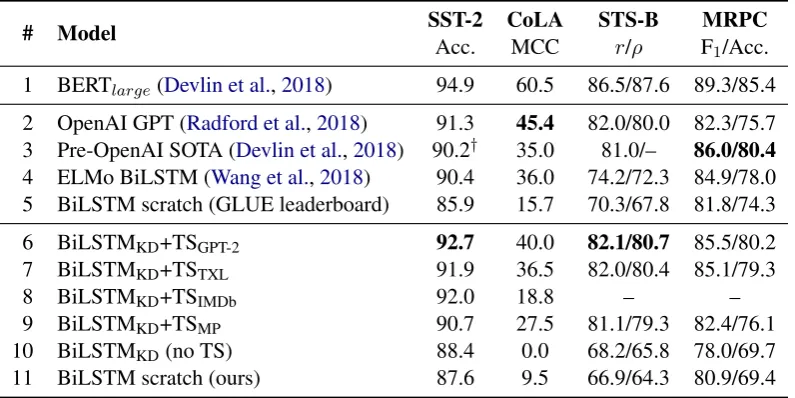
We present our results in Table1. As an initial san-ity check, we confirm that our BiLSTM (row 11) is acceptably similar to the previous best reported BiLSTM (row 5). We also verify that a transfer set is necessary—see rows 10 and 11, where us-ing only the trainus-ing dataset for distillation is in-sufficient. We further confirm that TSIMDbworks
poorly for the out-of-domain CoLA dataset (row 8). Note that the absolute best result on SST-2 before BERT is 93.2, fromRadford et al. (2017), but that approach demands copious amounts of domain-specific data from the practitioner.
5.1 Quality and Efficiency
Of the transfer set construction approaches, our principled generation methods consistently achieve the highest results (see Table1, rows 6 and 7), followed by the rule-based TSMPand the
man-ually curated TSIMDb(rows 8 and 9). TSGPT-2is
es-pecially effective for CoLA, yielding a respective 12.5- and 30-point increase in Matthew’s Corre-lation Coefficient (MCC) over TSMP and training
from scratch.
Interestingly, on SST-2, the synthetic GPT-2 samples outperform handwritten movie reviews from IMDb. Unlike the rule-based TSMP, our
LM-driven approaches outperform ELMo on all four tasks. TSGPT-2, our best method, reaches GPT
par-ity on all but CoLA, establishing domain-agnostic, pre-BERT SOTA on SST-2 and STS-B.
Our models use between one and three mil-lion parameters, which is at least 30 and 40 times smaller than ELMo and GPT, respectively. This represents an improvement over the previous SOTA—see the official GLUE leaderboard and Devlin et al.(2018) for specifics.
# Model SST-2 CoLA STS-B MRPC
Acc. MCC r/ρ F1/Acc.
1 BERTlarge(Devlin et al.,2018) 94.9 60.5 86.5/87.6 89.3/85.4
2 OpenAI GPT (Radford et al.,2018) 91.3 45.4 82.0/80.0 82.3/75.7 3 Pre-OpenAI SOTA (Devlin et al.,2018) 90.2† 35.0 81.0/– 86.0/80.4
4 ELMo BiLSTM (Wang et al.,2018) 90.4 36.0 74.2/72.3 84.9/78.0 5 BiLSTM scratch (GLUE leaderboard) 85.9 15.7 70.3/67.8 81.8/74.3
6 BiLSTMKD+TSGPT-2 92.7 40.0 82.1/80.7 85.5/80.2
7 BiLSTMKD+TSTXL 91.9 36.5 82.0/80.4 85.1/79.3
8 BiLSTMKD+TSIMDb 92.0 18.8 – –
9 BiLSTMKD+TSMP 90.7 27.5 81.1/79.3 82.4/76.1
10 BiLSTMKD(no TS) 88.4 0.0 68.2/65.8 78.0/69.7
[image:5.595.103.501.63.262.2]11 BiLSTM scratch (ours) 87.6 9.5 66.9/64.3 80.9/69.4
Table 1: GLUE test results for our models, along with previous comparison points. Bolded are the best scores from rows 2–11. †For fair comparison, this result is copied fromLooks et al.(2017), which represents the best
domain-agnosticapproach; the rest in row 3 is fromDevlin et al.(2018) and the GLUE website.
# Dataset SST-2 CoLA STS-B MRPC
U3% p/n U3% p/n U3% U3% p/n
1 TSGPT-2 77% 1.14 88% 2.71 83% 82% 0.41
2 TSTXL 76% 1.29 87% 1.51 80% 82% 0.25
3 TSIMDb 65% 1.65 65% 8.35 – – –
4 TSMP 44% 1.23 69% 1.10 62% 60% 1.38
5 Training 20% 1.26 64% 2.38 66% 64% 2.07
Table 2: Diversity and generation statistics.
disk usage. All traditional, word embedding-based models require storing the word vectors, which obviously precludes many on-device applications. Instead, the main benefit is that these shallow Bi-LSTMs perform inference an order of magnitude faster than GPT, which is mostly important for server-based, in-production NLP systems.
5.2 Language Generation Analysis
To characterize the transfer sets, we present diver-sity statistics in Table2. U3%denotes the average percentage of unique trigrams (Fedus et al.,2018) across sequential dataset chunks of sizeM, where M matches the original dataset size for fairness. Specifically, it represents the following:
1 K
K
X
i=1
# unique trigrams inx((i−1)M+1):iM
# total trigrams inx((i−1)M+1):iM
(2)
where K = bN/Mc and {x1, . . . , xN} the
dataset. We find that TSGPT-2 and TSTXL (rows 1
and 2) contain more unique trigrams than TSMP,
the original training set, and, surprisingly, hand-written movie reviews from IMDb (see rows 3–5).
Model SST-2 CoLA STS-B MRPC
OOV ppl bpc OOV ppl bpc OOV ppl bpc OOV ppl bpc
[image:5.595.79.285.329.406.2]GPT-2 0% 67 1.3 0% 60 1.1 0% 35 1.2 0% 19 1.3 TXL 2.9% 77 1.8 0.1% 32 1.2 1.4% 32 1.9 1.0% 17 2.5
Table 3: Language modeling statistics.
To examine whether the class distribution of the transfer sets matches the original, we compute p/n, the positive-to-negative label ratio. Based on the statistics, we conclude thatp/n varies wildly among the methods and datasets, with our LM-generated transfer sets differing substantially on MRPC, e.g., TSGPT-2’s 0.41 versus the original’s
2.07. This suggests that similar examples are more difficult to generate than dissimilar ones.
Set Example
TSGPT-2 cansfield ’s further oeuvre encompasses it somehow , and the surreal feels natural .[EOS]
TSTXL ethereal and plot of irony and irony and , most importantly , subtle suspense and spirit game - of - humor .[EOS]
TSMP what should have been a cutting hollywood satire is[MASK]about as fresh as last week ’s issue of variety .[EOS]
TSIMDb but it the end, the film is a big steaming pile of...y’know.[EOS]
Training the cinematography to the outstanding soundtrack and unconventional narrative[EOS]
Table 4: Generation examples on SST-2.
Generation examples. We present a random ex-ample from each transfer set in Table4for SST-2. The generated samples ostensibly consist of movie reviews and contain acceptable linguistic struc-ture, despite only one epoch of fine-tuning. Due to space limitations, we show only SST-2; however, the other transfer sets are public for examination in our GitHub repository.
6 Conclusions and Future Work
We propose using text generation for construct-ing the transfer set in knowledge distillation. We validate our hypothesis that generating text us-ing pretrained LMs outperforms manual data cura-tion and rule-based techniques: the former in gen-erality, and the latter efficacy. Across multiple datasets, we achieve OpenAI GPT-level quality us-ing a sus-ingle-layer BiLSTM.
The presented techniques can be readily ex-tended to sequence-to-sequence-level knowledge distillation for applications in neural machine translation and logical form induction. Another line of future work involves applying the tech-niques to knowledge distillation for traditional, in-production NLP systems.
Acknowledgments
This research was supported by the Natu-ral Sciences and Engineering Research Council (NSERC) of Canada. This research was enabled in part by resources provided by Compute Ontario and Compute Canada.
References
Jimmy Ba and Rich Caruana. 2014. Do deep nets really need to be deep? InAdvances in Neural Information Processing Systems.
Daniel Cer, Mona Diab, Eneko Agirre, Inigo Lopez-Gazpio, and Lucia Specia. 2017. SemEval-2017 task 1: Semantic textual similarity multilingual and crosslingual focused evaluation. InProceedings of the 11th International Workshop on Semantic Eval-uation (SemEval-2017).
Zihang Dai, Zhilin Yang, Yiming Yang, William W. Cohen, Jaime Carbonell, Quoc V. Le, and Rus-lan Salakhutdinov. 2019. Transformer-XL: Atten-tive language models beyond a fixed-length context.
arXiv:1901.02860.
Jacob Devlin, Ming-Wei Chang, Kenton Lee, and Kristina Toutanova. 2018. BERT: Pre-training of deep bidirectional transformers for language under-standing. arXiv:1810.04805.
Qiming Diao, Minghui Qiu, Chao-Yuan Wu, Alexan-der J. Smola, Jing Jiang, and Chong Wang. 2014. Jointly modeling aspects, ratings and sentiments for movie recommendation (JMARS). InProceedings of the 20th ACM SIGKDD International Conference on Knowledge Discovery and Data Mining.
William B. Dolan and Chris Brockett. 2005. Automati-cally constructing a corpus of sentential paraphrases. InProceedings of the Third International Workshop on Paraphrasing (IWP2005).
William Fedus, Ian Goodfellow, and Andrew M. Dai. 2018. MaskGAN: Better text generation via filling in the . InInternational Conference on Learn-ing Representations.
Geoffrey Hinton, Oriol Vinyals, and Jeff Dean. 2015. Distilling the knowledge in a neural network.
arXiv:1503.02531.
Sepp Hochreiter and J¨urgen Schmidhuber. 1997. Long short-term memory.Neural Computation.
Yoon Kim. 2014. Convolutional neural networks for sentence classification. InProceedings of the 2014 Conference on Empirical Methods in Natural Lan-guage Processing.
Diederik P. Kingma and Jimmy Ba. 2014. Adam: A method for stochastic optimization. InInternational Conference on Learning Representations.
Yinhan Liu, Myle Ott, Naman Goyal, Jingfei Du, Man-dar Joshi, Danqi Chen, Omer Levy, Mike Lewis, Luke Zettlemoyer, and Veselin Stoyanov. 2019. RoBERTa: A robustly optimized BERT pretraining approach.arXiv:1907.11692.
Stephen Merity, Caiming Xiong, James Bradbury, and Richard Socher. 2017. Pointer sentinel mixture models. In International Conference on Learning Representations.
Matthew Peters, Mark Neumann, Mohit Iyyer, Matt Gardner, Christopher Clark, Kenton Lee, and Luke Zettlemoyer. 2018. Deep contextualized word rep-resentations. In Proceedings of the 2018 Confer-ence of the North American Chapter of the Asso-ciation for Computational Linguistics: Human Lan-guage Technologies, Volume 1 (Long Papers).
Alec Radford, Rafal Jozefowicz, and Ilya Sutskever. 2017. Learning to generate reviews and discovering sentiment. arXiv:1704.01444.
Alec Radford, Karthik Narasimhan, Tim Salimans, and Ilya Sutskever. 2018. Improving language under-standing by generative pre-training.
Alec Radford, Jeffrey Wu, Rewon Child, David Luan, Dario Amodei, and Ilya Sutskever. 2019. Language models are unsupervised multitask learners. OpenAI Blog.
Yangyang Shi, Mei-Yuh Hwang, Xin Lei, and Haoyu Sheng. 2019. Knowledge distillation for recurrent neural network language modeling with trust reg-ularization. In 2019 IEEE International Confer-ence on Acoustics, Speech and Signal Processing (ICASSP).
Richard Socher, Alex Perelygin, Jean Wu, Jason Chuang, Christopher D. Manning, Andrew Ng, and Christopher Potts. 2013. Recursive deep models for semantic compositionality over a sentiment tree-bank. In Proceedings of the 2013 Conference on Empirical Methods in Natural Language Process-ing.
Raphael Tang, Yao Lu, Linqing Liu, Lili Mou, Olga Vechtomova, and Jimmy Lin. 2019. Distilling task-specific knowledge from BERT into simple neural networks. arXiv:1903.12136.
Alex Wang, Amapreet Singh, Julian Michael, Fe-lix Hill, Omer Levy, and Samuel R. Bowman. 2018. GLUE: A multi-task benchmark and anal-ysis platform for natural language understanding.
arXiv:1804.07461.
Alex Warstadt, Amanpreet Singh, and Samuel R. Bow-man. 2018. Neural network acceptability judg-ments. arXiv:1805.12471.
Zhilin Yang, Zihang Dai, Yiming Yang, Jaime G. Carbonell, Ruslan Salakhutdinov, and Quoc V. Le. 2019. XLNet: Generalized autoregressive pretrain-ing for language understandpretrain-ing. arXiv:1906.08237.