Proceedings of the Fourth Workshop on Discourse in Machine Translation (DiscoMT 2019), pages 13–23 13
Context-Aware Neural Machine Translation Decoding
Eva Mart´ınez Garcia
TALP Research Center, Universitat Polit`ecnica de Catalunya
Barcelona
Carles Creus
Vicomtech Donostia
Cristina Espa ˜na-Bonet
Saarland University DFKI GmbH
Saarbr¨ucken
Abstract
This work presents a decoding architecture that fuses the information from a neural trans-lation model and the context semantics en-closed in a semantic space language model based on word embeddings. The method ex-tends the beam search decoding process and therefore can be applied to any neural machine translation framework. With this, we sidestep two drawbacks of current document-level sys-tems: (i) we do not modify the training pro-cess so there is no increment in training time, and (ii) we do not require document-level an-notated data. We analyze the impact of the fu-sion system approach and its parameters on the final translation quality for English–Spanish. We obtain consistent and statistically signifi-cant improvements in terms of BLEU and ME-TEOR and observe how the fused systems are able to handle synonyms to propose more ade-quate translations as well as help the system to disambiguate among several translation candi-dates for a word.
1 Introduction
Neural Machine Translation (NMT) systems rep-resent the current state-of-the-art for machine translation technologies and even some evalua-tions claim that they have reached human perfor-mance (Hassan et al., 2018). These systems typ-ically translate documents sentence by sentence, ignoring in the process inter-sentence context and document-level information, and this fact limits the maximum quality that they can achieve.L¨aubli et al.(2018) show how human translations are pre-ferred over machine translations when they are evaluated at document level, even if the opposite happens at sentence level.
Although there exist several approaches that successfully enhance state-of-the-art neural ma-chine translation systems to take into account
document-level information, these systems usu-ally propose modifications to the neural archi-tecture (Wang et al., 2017a; Jean et al., 2017; Voita et al., 2018; Tu et al., 2018; Maruf and Haffari, 2018; Miculicich Werlen et al., 2018; Jean and Cho,2019) making the training process slower, or require the training data to be anno-tated with document-level information, such as the document boundaries (Tiedemann and Scher-rer,2017;Junczys-Dowmunt,2019;Talman et al., 2019;Espa˜na-Bonet et al.,2019). The main ben-efit of these approaches is that the neural transla-tion models they obtain are better tuned and able to handle document-level information. However, the training data with the document-level annotations that they require is still scarce, and also, their de-sign increments the training times since the com-plexity of their neural architectures increase the model parameters to learn.
We propose an alternative to introducing inter-sentence information in an NMT system that fol-lows the encoder–decoder architecture with atten-tion of Bahdanau et al. (2015) without changing the neural translation model architecture. Further-more, our approach does not need a costly training process with scarce document-level tagged data. Roughly, we modify the beam search algorithm to allow the introduction of a Semantic Space Lan-guage Model (SSLM) (Hardmeier et al., 2012) working in shallow fusion (G¨ulc¸ehre et al.,2017) with a pre-trained NMT model. When evalu-ated on English–Spanish translations, we observe promising improvements in the automatic evalua-tion metrics used for the analysis.
2 Related Work
The interest in making NMT systems able to in-clude wider context information in the translation process has increased in recent years (Jean et al., 2017; Popescu-Belis, 2019), and even in some cases thenecessityfor exploring new approaches of document-level machine translation has been argued (L¨aubli et al.,2018).
On the one hand, several approaches tried to ex-tend the context beyond the sentence information by modifying the system’s input. Tiedemann and Scherrer (2017) concatenate the previous source sentence to the current one, whereasBawden et al. (2018) also concatenate the previous predicted tar-get sentence.
On the other hand, more sophisticated context-aware approaches propose to modify the NMT ar-chitecture. Jean et al. (2017) propose a varia-tion of an attenvaria-tional recurrent NMT system (Bah-danau et al.,2015) by including an additional en-coder and attentional model to encode as context sentence the previous source sentence, showing how NMT systems can also benefit from larger contexts. Wang et al. (2017a) propose a cross-sentence context-aware approach that integrates the historical contextual information within the NMT system. However, these approaches only ex-tend the source context but ignore the target side context. In contrast,Tu et al.(2018) take into ac-count the target side context by using a lightweight cache-like memory network which stores bilin-gual hidden representations as translation history. More recent approaches implement system exten-sions that handle both source and target side con-texts. Maruf and Haffari(2018) use memory net-works to capture global source and target docu-ment context. Also,Maruf et al.(2019) present an approach to selectively focus on relevant sentences in the document context and not only consider a few previous sentences as context.
There are other approaches that study the ef-fect of introducing context information within Transformer-based translation systems. Voita et al. (2018) present a variation of the Trans-former (Vaswani et al.,2017) that extends the han-dled context by taking in the input both the cur-rent and previous sentences. Miculicich Werlen et al. (2018) extend it by integrating a hierar-chical attention model to capture inter-sentence connections, Jean and Cho (2019) by including a context-aware regularization, and Zhang et al.
(2018) propose to use a new context encoder to represent document-level context in combination with the original Transformer encoder-decoder ar-chitecture.
The importance of document-level translation is also seen in the recent WMT20191 news transla-tion shared task, where for the first time a specific track for document-level MT was included. The systems presented at the shared task follow the previously explained strategies: introducing the inter-sentence context information into the NMT system by augmenting the training data including document-level information, i.e., including coref-erence information (Espa˜na-Bonet et al.,2019), or just by increasing the training-sequence length in order to capture a larger data context (Popel et al., 2019; Talman et al., 2019; Junczys-Dowmunt, 2019), or introducing variations in the NMT ar-chitecture to take into account document-level in-formation (Stahlberg et al., 2019; Talman et al., 2019).
Also related to our work, but far from ma-chine translation, is the work by Wang and Cho (2016). They present an approach to include document-level context into language modeling by implementing fusion approaches that help the LSTM maintain separated the inter- and the intra-sentence context dependencies. Their conclusions show how using a wider context helps neural lan-guage models. We borrow the idea of (shallow) fusion and apply it to neural machine translation. In this line, Ji et al. (2015) presented new lan-guage models able to capture contextual informa-tion within and beyond the sentence level.
3 Context-Aware Decoding
Our document-level extension of the NMT decod-ing process benefits from the shallow fusion tech-nique. In particular, it exploits the flexibility of being able to combine a general NMT model with a more domain specific Language Model (LM) to guide the NMT system towards a more adequate translation. In our approach, this other model is an SSLM used to introduce inter-sentence context in-formation into the NMT decoding process. In the remaining of this section we briefly describe the SSLM (Section3.1), the shallow fusion technique (Section3.2), and finalize detailing our proposed combination (Section3.3).
1http://www.statmt.org/wmt19/
3.1 Semantic Space Language Model (SSLM)
A semantic space language model is a probabilis-tic model able to predict the following word on a sequence taking into account the semantics, and so able to score the semantic relationship among a bunch of words in a sequence. In particular, we follow the SSLM definition presented by Hard-meier et al.(2012), who describe an SSLM based on a word dense vector model built with latent semantic analysis (Foltz et al., 1998;Bellegarda, 2000) and the cosine similarity, which is converted into a probability by a histogram lookup, as pro-posed byBellegarda(2000). However, we substi-tute their LSA model for a word vector model built on the CBOW implementation of theWORD2VEC
toolkit (Mikolov et al.,2013).
Intuitively, an SSLM mimics a traditional n-gram language model, but it is computed over se-mantic information and its expected effect is to promote translation choices that are semantically similar to the target context. To this end, for each candidate wordwto append to the target transla-tion, a score is computed based on the cosine sim-ilarity between the vector representation ofwand the sum of the vector representations of then tar-get words that precede w in the document trans-lation. In our system, the non-content words and the words unknown to the model are handled spe-cially, both when computing their associated score and when considering them as part of the context of any later word. More precisely, given an already generated word sequenceyk−1 =w1w2. . . wk−1,
the score associated by the SSLM to a translation candidate wk proposed to extend the translation sequence, denotedpSSLM(wk|yk−1), is:
puni(wk) ifwkis a SW
α sim(~cyk−1, µ(wk)) ifwk ∈dom(µ)is not SW
ε otherwise
wherepunimaps each stop word (SW) to its rela-tive frequency in the training corpus,αis the pro-portion of content words in the training corpus, ~cyk−1 is the vector representing the preceding
con-text ofwk (i.e., the sum of the vector representa-tions of the lastnnon-stop known words ofyk−1),
simof two vectors is their cosine similarity lin-early scaled to the range[0,1], i.e.,
sim(~a,~b) = 1 2
~a·~b k~akk~bk +
1 2,
the word vector model is represented by µ and
maps words to their associated vector represen-tations, with dom(µ) being its domain, and εis a small fixed probability. Note that the lower bound 0 of sim corresponds to the case where the vectors are diametrically opposed (semanti-cally distant) whereas the upper bound 1 to the case where they have the same orientation (seman-tically close). We use the value n = 30 chosen byHardmeier et al.(2012) to make it possible that the context~cyk−1 used in the computations crosses
sentence boundaries. Note that although our sys-tem does not need any document-level annotation, it will understand that any set of sentences in its input can be understood as a document. Thus, we need to translate document per document.
3.2 Shallow Fusion
Fusion techniques (G¨ulc¸ehre et al., 2015, 2017) have shown to be successful in several natural lan-guage tasks to merge information from two dif-ferent neural models. In our context, they are motivated by how Statistical Machine Translation (SMT) systems integrate the information from dif-ferent feature functions that represent difdif-ferent probabilistic models. There are four main fusion techniques: deep, shallow, cold, and simple fu-sion. All of them extend the conditional probabil-ity learned by one model introducing the informa-tion from a second one, where the specific method that is used to combine both models is the main differentiator between the approaches.
Deep, cold, and simple fusion are tech-niques that need to train the resulting fused net-work. Deep fusion (G¨ulc¸ehre et al., 2015, 2017; Stahlberg et al., 2018; Sriram et al., 2018) pro-poses a method to merge a translation model and a language model by introducing a gating mecha-nism that learns to balance the weight of the addi-tional language model. Cold fusion (Sriram et al., 2018) goes a step beyond and proposes to im-plement a deep fusion where the NMT model is trained from scratch including the LM as a fixed part of the network. This allows the NMT to bet-ter model the conditioning on the source sequence while the target language modeling is covered by the LM. Simple fusion (Stahlberg et al., 2018) is the latest approach. It arises as an alternative simple method to use monolingual data for NMT training. Roughly, it integrates the shallow fusion technique in training time.
fol-El
de
mostrador
cerrado .
está
The information desk is closed. Source
información
SSLM NMT λ
escritorio mesa
ventanilla
recepción
asistencia pupitre
banco
caja
0.3
0.2 0.18 0.16
0.12
0.07 0.05 0.04 0.03
0.6 0.30 0.05
0.1 0.1
0.175 0.21 0.23 SCORE
[image:4.595.90.514.62.288.2]mostrador 0.15 0.7 0.36
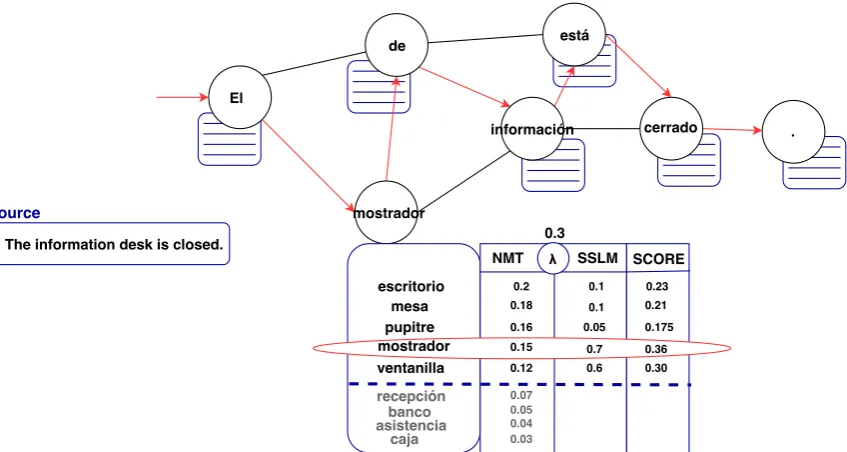
Figure 1: Sketch of the shallow fusion of an SSLM and an NMT inside the beam search algorithm. In this example, the process re-scores theN = 5best candidates from the NMT model using the scores from the SSLM. Directed edges in the graph mark the path found by the beam search that maximizes the translation probability, whereas undirected edges mark possible steps considered by the beam search algorithm.
lows the same idea as deep fusion but, in contrast, proposes the combination of the probabilities from the two models at inference time. To this end, it changes the decoding objective function to inte-grate an LM prediction. The usual decoding ob-jective function for an MT system with inputxcan be written as:
ˆ
y = arg max
y
logp(y|x)
whereas the shallow fusion variation introduces the LM in a manner inspired by the SMT log-linear model:
ˆ
y= arg max
y
logp(y|x) +λlogpLM(y)
(1)
wherepLM is a language model trained on mono-lingual target data and λis its weight. The LM used byG¨ulc¸ehre et al.(2017) is an LSTM-based RNN language model, but could be any model that generates as output a probability distribution on the discrete space of the target vocabulary shared with the translation model.
An advantage of shallow fusion over the other fusion techniques is that it only needs to adjust the weightλfor the language model by a grid-search on development data, avoiding a long training on large corpora. Furthermore, this technique can be easily applied to any NMT model, either RNN-based or purely attention-RNN-based neural models. In
the same way as deep fusion, it uses independently pre-trained LM and NMT models. Although this can hinder the system performance, it can also be seen as an advantage due to the flexibility it con-fers.
3.3 Shallow Fusion between NMT and SSLM
In our model, we substitute the language model probability pLM in the shallow fusion decoding function (Eq. 1) by the SSLM associated proba-bility:
ˆ
y= arg max
y
logp(y|x) +λlogpSSLM(y)
Since the computation ofpSSLM for each gen-erated word takes into account the preceding con-text of that word, it is necessary to modify the beam search of the NMT decoder. We implement a cache mechanism to keep track of the context information from the previously generated words, extending beyond sentence boundaries. The cache allows to add together the word embeddings from the previously generated words to obtain~cyk−1.
Additionally, the NMT model requires not only an estimate for a given target word, but a dis-tribution probability over the entire target vocab-ulary space. Thus, pSSLM(wk|yk−1) must be
have a high computational cost. Following the ranking/filtering approaches ofJean et al. (2015) andWang et al.(2017b), we speed up this compu-tation by filtering the words to score by the SSLM. In particular, pSSLM is only computed on theN target words with the highest probabilities from the NMT model, that is, only the N best candi-dates from the NMT model are considered by the SSLM. Figure1 depicts how the filtering process works in combination with the shallow fusion of the NMT and the SSLM models during the beam search. Recall that although our system does not need any document-level annotation, it will under-stand any set of sentences in its input as a ment, and thus we translate document per docu-ment.
4 Experiments
4.1 Settings
Our baseline NMT model follows the encoder– decoder architecture with attention of Bah-danau et al. (2015) and it is built using the OPENNMT-LUA toolkit (Klein et al., 2017). We use a 4-layered bidirectional RNN encoder and a 4-layered RNN-based decoder with 800 -dimensional hidden layers. Word embeddings are set to 500 dimensions for both source and tar-get vocabularies. Stochastic gradient descent is used as optimizer algorithm for training, setting an initial learning rate of 1 and a learning decay of 0.7 after epoch 10 or if there is no loss im-provement over the validation set. Training data is distributed on batches of64sentences and we use a 0.3 dropout probability between recurrent lay-ers. Finally, a maximum sentence length of50 to-kens is used for both source and target sides and the vocabulary size is 50,000for both target and source languages. The system is trained on the EUROPARL-V7 parallel corpus, using theNEWS -COMMENTARY2009 corpus as validation set. The system at epoch20is to be shallow fused with the SSLM.
We implement the shallow fusion of the SSLM and an NMT as an extension of the attentional encoder–decoder NMT baseline. The Word Vec-tor Models (WVM) used as SSLMs are built using
WORD2VECwith the CBOW algorithm (Mikolov et al., 2013), using a context window size of 5
and 600-dimensional vectors. The training data set for this model is the Spanish side of a set of parallel English–Spanish corpora available in
OPUS2 (Tiedemann, 2012, 2009). We select the EUROPARL-v7, UNITED NATIONS, MULTILIN
-GUAL UNITED NATIONS, and SUBTITLES-2012 corpora, which total759million words for Span-ish. We useNEWSCOMMENTARY2011 as test set. We take advantage of the document annotations from theNEWSCOMMENTARYcorpus to translate
the test set document by document to avoid addi-tion of random noise.
We evaluate the quality of the outputs with two automatic metrics, BLEU (Papineni et al., 2002) and METEOR (Banerjee and Lavie,2005).
4.2 Oracle Analysis
We implement three oracles to assess the poten-tial impact of our techniques. The oracles behave as our fused approach, but leverage the reference translation to bias the decoding towards the word choices that are present in the reference. The goal of ORACLE1 and ORACLE2 is to assess the util-ity of the information enclosed in the WVM used by the SSLM, i.e., to check whether the seman-tic information of SSLM can help in producing better translations. ORACLE3 mimics our fused
decoding approach and its goal is to evaluate the potential gain of using an SSLM in combination with an NMT. In other words, with ORACLE3 we
check how much the SSLM can help the NMT dis-ambiguate between its best translation candidates, thus obtaining an upper bound for the improve-ments that can be achieved by shallow fusing an SSLM and an NMT system.
ORACLE1 proceeds offline as follows: once a sentence has been translated, for each target wordt (i) it uses the attention information to map thattto its corresponding source wordsand, in turn, maps thatsto its corresponding target wordrfound in the reference, and (ii) it replaces the target word t by r whenever t 6= r and r is among the M words that are closest tot(w.r.t. cosine similarity) according to our WVM. Note that the use of atten-tion in step (i) to map between target and source words is not as straightforward as the alignment information in an SMT system. In particular, we consider that a target wordtand a source words are one-to-one mapped, denotedt←→1 s, when the following holds: the attention fromttosis maxi-mal among the attentions from thattto any source word s0 and also among the attentions from any
M=5 M=10 M=50 M=100 M=1,000 baseline
B
L
E
U
30 32 34 36 38 40
a
0.2 0.4 0.6 0.8
N=3 N=4 N=5 N=7 N=10 N=50 baseline
B
L
E
U
26 28 30 32 34
a
[image:6.595.75.527.59.222.2]0.2 0.4 0.6 0.8
Figure 2: BLEU score of ORACLE1 (left, bullets), ORACLE2 (left, line plots), and ORACLE3 (right, line plots), as a function of the thresholda(ORACLE2 and ORACLE3) and for several values of the parametersM (ORACLE1 and ORACLE2) andN (ORACLE3). For ORACLE1 and ORACLE2, increasing the value ofM beyond1,000does not affect the obtained scores noticeably.
target word t0 to that s, i.e., t ←→1 s if and only if att(t, s) = max{att(t0, s0) : t0 = t∨ s0 =
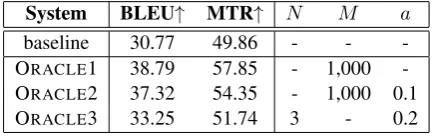
s}, whereatt(., .)denotes the attention value be-tween two words. We use an analogous definition for the one-to-one mappings ←→1 r between the source and reference words.3 Thus, for the target word tin consideration, step (i) tries to find the word r of the reference satisfying t ←→1 s ←→1 r, for some source word s. Table 1 and Figure 2 show the results for ORACLE1. We observe that the WVM encodes semantically-valid candidates close together, as there is a noticeable improve-ment in the BLEU score even when considering just theM = 5 closest candidates. Also, the ac-curacy of the oracle’s translations increases with the numberM of considered closest words. This is expected since augmenting the numberM also increases the coverage of the target vocabulary. In the limit, whenMallows to encompass the whole
50K-word vocabulary, ORACLE1 simply rewrites the translation into the reference as far as the at-tention information allows, reaching an increase of+8.02in BLEU score.
ORACLE2 works as ORACLE1 but proceeds on-line with the beam search. That is, when a hy-pothesis of the beam is to be extended with a new target wordt, the oracle (i) analyzes the attention information to identify the actual wordr used in the reference to translate the source wordsthatt corresponds to and (ii) replacestwithrunder the
3The mapping from source to reference is done through attention by using the OpenNMT option of passing the target gold standard in the input.
System BLEU↑ MTR↑ N M a
baseline 30.77 49.86 - -
-ORACLE1 38.79 57.85 - 1,000
-ORACLE2 37.32 54.35 - 1,000 0.1
ORACLE3 33.25 51.74 3 - 0.2
Table 1: BLEU and METEOR (MTR) scores obtained with the oracles defined in Section4.2.
same circumstances as before (i.e., when t 6= r and r appears in the list of M words closest to taccording to our WVM). In this occasion, how-ever, the attention information needed in step (i) to deduce the one-to-one mappings between the tar-get and source is not fully available, as the tartar-get sentence is still being generated. For this reason, we need to add a minimal thresholdafor the atten-tion and refine our criterion ast←→1,a sif and only ift←→1 s∧att(t, s)≥a. Thus, for the target word tin consideration, step (i) tries to find the wordr of the reference satisfyingt←→1,a s←→1 r, for some source words. Table1and Figure 2present also the results for ORACLE2. The results are analo-gous to those of ORACLE1, but with lower scores.
[image:6.595.308.525.303.371.2]N=2 N=3 N=4 N=5 N=7 baseline
B
L
E
U
30.2 30.4 30.6 30.8 31
λ
[image:7.595.74.289.58.218.2]0.05 0.1 0.15 0.2 0.25
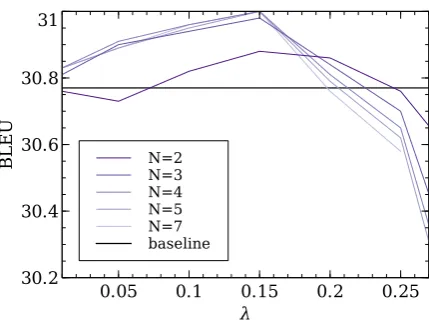
Figure 3: BLEU score of the fused system as a function of the weightλ, for several values of the parameterN.
semantically-close words (e.g., by synonyms), and thus, each of the substitutions preserves the mean-ing of the replaced word even if in some occasions the computed alignment is not adequate. Con-versely, by increasing M the oracle handles lists of candidates that are more semantically distant, and thus, in combination with the uncertainty of the alignments, the system introduces more errors.
ORACLE3 proceeds online with the beam
search like ORACLE2, just differing on the cri-terion used to replace the target word t by the corresponding reference wordr: the replacement is done when t 6= r and, moreover, r appears among the N best candidates proposed by the NMT model. Note that this oracle does not use in any way the WVM underlying the SSLM: it simply assumes that such model will properly pro-mote the correct word (i.e., the reference word) whenever it is present among theNtop candidates of the NMT. Table 1 and Figure 2 present also the results for ORACLE3, which show that there
is some margin for improvement for the fused sys-tem with respect to the NMT working in isolation. In contrast with ORACLE2, ORACLE3 produces
more errors the more candidates that it considers, i.e., the greater the value ofN is. Also, consider-ing alignments with lower probabilities only helps when the value ofN is small. In particular, con-sidering more candidates by increasingN needs a stronger (i.e., higher) attention thresholdain or-der to filter out noisy substitutions. Nevertheless, in that more restrictive configuration ofa, the re-sults for the various values ofN tend to converge. In summary, ORACLE1 shows that the WVM of the SSLM properly clusters semantically-valid
N BLEU↑ METEOR↑ #unknown
- 30.77 49.86 5901
2 30.88 50.17 4632
3 †30.98 50.14 4501 4 †31.00 50.15 4475 5 †31.00 50.14 4459 7 †31.00 50.14 4463 10 †31.00 50.14 4463
Table 2: BLEU and METEOR scores obtained with the fused systems withλ= 0.15, together with the amount of unknown words in their output, where the first row corresponds to the baseline. †marks systems that are significantly different to the baseline with ap-value of 0.05, according to bootstrap resampling (Koehn,2004).
candidates close together, ORACLE2 that incom-plete attention information does not hinder the or-acle’s ability to approximate the alignments, and ORACLE3 that there is a wide enough margin for improvement when fusing the systems.
4.3 System Results and Analysis
Our system has two main hyperparameters: the number N of NMT translation options that are used in the fusion, and the weight of the semantic language modelλ. Table2and Figure3show the results of the automatic evaluation of the different variations of the presented fused system. The fig-ure shows how the maximum quality is achieved around λ = 0.15, independently of the number N of re-scored candidates. All of our systems are able to improve the baseline for every value ofN that we explored, achieving a statistically signif-icant improvement of+0.23 in BLEU score and
+0.31 in METEOR. Nevertheless, there is still room for further gains since, as seen in Table 1, ORACLE3 is able to increase +2.48 BLEU and +1.88METEOR points.
We observe in Table2that the scores improve as long as we increase the value ofN until it seems to stabilize for N ≥ 4. Furthermore, comparing the outputs forλ = 0.15, the translations that the system produces with N = 4 only differ in 95
sentences with respect to those forN = 5and in
107forN = 7, while having1,407sentences out of 3,003that differ with respect to the baseline. Also, the translations for N = 5 are almost ex-actly the same as withN = 7, differing only in
30sentences, whereas the translations forN = 7
[image:7.595.316.518.61.175.2]an equivalent output. Looking into these differ-ences, we realize that they manage different syn-onyms that may or not be in the reference. Like translating “I have to” as “Tengo” or “Voy a tener” which can be equivalent depending on the context. We also observe that with larger values of N, the translations tend to be noisier or less adequate with respect to the source. For instance, “Offices need a kindergarten nearby, architects have un-derstood.” is translated as:
“las Oficinas necesitan una guarder´ıa cercana, los arquitectos han comprendido” (N=4)
“las oficinas de las oficinas de asistencia nece-sitan una guarder´ıa cercana.” (N=7)
Notice in the second one the useless repetition of the translation for “Offices” and the appearance of the extra concept of assistance (“asistencia”) that does not appear in the source sentence. Also, the information regarding the architects is missing in the second translation. Two important error types in NMT systems, word omission and new word creation, are exacerbated with large values forN.
Another example of more accurate transla-tion occurs when translating “According to Meteo France”. The best system using N ≥ 5 trans-lates this as “Seg´un Francia” losing the reference to the meteorological company. In contrast, us-ingN = 4, the system is able to generate a more accurate translation “Seg´un Meteo Francia”. This analysis reflects the noise introduced by increasing the number of re-scored translation candidates by the system. In other words, it is important to have enough candidates to see more adequate transla-tions, but there is a trade-off that the system needs to maintain between the number of new options and the noise introduced by these re-scored op-tions.
Finally, we observe that the increase in the translation quality is also related to the decrease in the number of unknown words generated by the system. Since we use complete tokens with-out BPE (Sennrich et al., 2016) or SENTENCE
-PIECE (Kudo and Richardson, 2018) as transla-tion units, several tokens are unknowns to the sys-tem. In general, the number of generated un-known words with the shallow fusion approach drops almost a25%with respect to the unknown words generated by the baseline. For instance, the worst case-scenario sentence “I’m rather a novice in Prague politics responded Lukas Kaucky.” is translated by the baseline as:
“M´as bien soy unhunkien la pol´ıtica de Praga, hunkia Lucashunki.”
whereas our fused system is able to produce:
“M´as bien soy un novato en la pol´ıtica de Praga,respondi´oa Lucashunki.”
generating good translations for “novice” and “ re-sponded”. These examples illustrate how fusing the SSLM with the NMT model helps the latter to disambiguate between the considered translation candidates for a word.
Finally, we pursue a little manual evaluation with 3 native-Spanish speakers with fluent En-glish. We select a common subset of sentences from the test set translated by the baseline NMT and by the fused system with N = 4 andλ = 0.15. We randomly choose100sentences with at least5and at most30words with different trans-lations. The annotators were asked for each of the 100 selected sentences to rank the output of both systems according to their general translation quality, allowing to rank them as tying. System outputs were presented in random order to avoid system identification. The annotators find49%of the time that the translation from the fused sys-tem is better than the baseline, and they consider the quality of both translations to tie19% of the time. They agreed 67.33%of the time, reaching a κ = 0.4733 (Fleiss, 1971) showing a “moder-ate” inter-annotator agreement (Landis and Koch, 1977). These results support that fused systems are able to improve the translations’ quality.
5 Summary and Conclusions
We presented a new approach that extends NMT decoding by introducing information from the pre-ceding context on the target side. It fuses an atten-tional RNN with an SSLM by modifying the com-putation of the final score for an element of the tar-get vocabulary inside the beam search algorithm. It is a flexible approach since it is compatible with any NMT architecture, and it allows to combine pre-trained models.
propose valid translations where the baseline fails to choose one, making the number of unknown words drop while the translation quality increases. Also, a small manual evaluation shows that hu-mans tend to prefer fused system outputs.
As future work, we find interesting to pursue an in-depth manual evaluation to analyze how end users perceive the variations produced by our sys-tems. The next step will be to test this imple-mentation within Transformer-based NMT sys-tems (Vaswani et al., 2017) to analyze how the inter-sentence information can affect the quality of attention-based translation systems and also to use BPEed input to compare the positive effect on un-known words that we observed. These two stud-ies will improve the quality of the systems as a whole (both baseline and fused). In order to better capture the improvements reachable by our ora-cles, we want to analyse the validity of the cosine similarity as a measure and use other alternatives such as CSLS (cross-domain similarity local scal-ing) (Lample et al.,2018), or other margin-based scores instead (Artetxe and Schwenk,2019).
Finally, we are interested in making a thor-ougher evaluation of the domain adaptation power of this technique by carrying out experiments de-signed to show how an embedding model trained on several specific domain data can guide a general-oriented NMT system towards more spe-cific and adequate translations.
Acknowledgments
The project on which this paper is based was par-tially funded by the German Federal Ministry of Education and Research under the funding code 01IW17001 (Deeplee). Responsibility for the con-tent of this publication is with the authors.
References
Mikel Artetxe and Holger Schwenk. 2019. Margin-based parallel corpus mining with multilingual sen-tence embeddings. InProceedings of the 57th Con-ference of the Association for Computational Lin-guistics (ACL) – Volume 1, pages 3197–3203.
Dzmitry Bahdanau, Kyunghyun Cho, and Yoshua Ben-gio. 2015. Neural machine translation by jointly learning to align and translate. In Proceedings of the 3rd International Conference on Learning Rep-resentations (ICLR).
Satanjeev Banerjee and Alon Lavie. 2005. METEOR: An automatic metric for MT evaluation with
im-proved correlation with human judgments. In Pro-ceedings of the Workshop on Intrinsic and Extrin-sic Evaluation Measures for Machine Translation and/or Summarization (IEEvaluation@ACL), pages 65–72.
Rachel Bawden, Rico Sennrich, Alexandra Birch, and Barry Haddow. 2018. Evaluating discourse phe-nomena in neural machine translation. In Proceed-ings of the 2018 Conference of the North American Chapter of the Association for Computational Lin-guistics: Human Language Technologies (NAACL-HLT) – Volume 1, pages 1304–1313.
Jerome R. Bellegarda. 2000. Exploiting latent se-mantic information in statistical language modeling. Proceedings of the IEEE, 88(8):1279–1296.
Cristina Espa˜na-Bonet, Dana Ruiter, and Josef van Genabith. 2019. UdS-DFKI participation at WMT 2019: Low-resource (en–gu) and coreference-aware (en–de) systems. InProceedings of the Fourth Con-ference on Machine Translation (WMT) – Volume 2: Shared Task Papers, pages 382–389.
Joseph L. Fleiss. 1971. Measuring nominal scale agreement among many raters. Psychological Bul-letin, 76(5):378–382.
Peter W. Foltz, Walter Kintsch, and Thomas K. Lan-dauer. 1998. The measurement of textual coherence with latent semantic analysis. Discourse Processes, 25(2–3):285–307.
C¸ aˇglar G¨ulc¸ehre, Orhan Firat, Kelvin Xu, Kyunghyun Cho, Lo¨ıc Barrault, Huei-Chi Lin, Fethi Bougares, Holger Schwenk, and Yoshua Bengio. 2015. On us-ing monolus-ingual corpora in neural machine transla-tion.CoRR, abs/1503.03535.
C¸ aˇglar G¨ulc¸ehre, Orhan Firat, Kelvin Xu, Kyunghyun Cho, and Yoshua Bengio. 2017. On integrating a language model into neural machine translation. Computer Speech & Language, 45:137–148.
Christian Hardmeier, Joakim Nivre, and J¨org Tiede-mann. 2012. Document-wide decoding for phrase-based statistical machine translation. In Proceed-ings of the 2012 Joint Conference on Empirical Methods in Natural Language Processing and Com-putational Natural Language Learning (EMNLP-CoNLL), pages 1179–1190.
Hany Hassan, Anthony Aue, Chang Chen, Vishal Chowdhary, Jonathan Clark, Christian Feder-mann, Xuedong Huang, Marcin Junczys-Dowmunt, William Lewis, Mu Li, Shujie Liu, Tie-Yan Liu, Renqian Luo, Arul Menezes, Tao Qin, Frank Seide, Xu Tan, Fei Tian, Lijun Wu, Shuangzhi Wu, Yingce Xia, Dongdong Zhang, Zhirui Zhang, and Ming Zhou. 2018. Achieving human parity on auto-matic Chinese to English news translation. CoRR, abs/1803.05567.
S´ebastien Jean, Orhan Firat, Kyunghyun Cho, Roland Memisevic, and Yoshua Bengio. 2015. Montreal neural machine translation systems for WMT’15. In Proceedings of the Tenth Workshop on Statistical Machine Translation (WMT), pages 134–140.
S´ebastien Jean, Stanislas Lauly, Orhan Firat, and Kyunghyun Cho. 2017. Does neural machine translation benefit from larger context? CoRR, abs/1704.05135.
Yangfeng Ji, Trevor Cohn, Lingpeng Kong, Chris Dyer, and Jacob Eisenstein. 2015. Document context lan-guage models.CoRR, abs/1511.03962.
Marcin Junczys-Dowmunt. 2019. Microsoft translator at WMT 2019: Towards large-scale document-level neural machine translation. In Proceedings of the Fourth Conference on Machine Translation (WMT) – Volume 2: Shared Task Papers, pages 424–432.
Guillaume Klein, Yoon Kim, Yuntian Deng, Jean Senellart, and Alexander M. Rush. 2017. Open-NMT: Open-source toolkit for neural machine trans-lation. InProceedings of the 55th Annual Meeting of the Association for Computational Linguistics: Sys-tem Demonstrations (ACL), pages 67–72.
Philipp Koehn. 2004. Statistical significance tests for machine translation evaluation. In Proceedings of the Conference on Empirical Methods in Natural Language Processing (EMNLP), pages 388–395.
Taku Kudo and John Richardson. 2018. Sentence-Piece: A simple and language independent subword tokenizer and detokenizer for neural text process-ing. In Proceedings of the 2018 Conference on Empirical Methods in Natural Language Processing (EMNLP), pages 66–71.
Guillaume Lample, Alexis Conneau, Marc’Aurelio Ranzato, Ludovic Denoyer, and Herv´e J´egou. 2018. Word translation without parallel data. In Proceed-ings of the 6th International Conference on Learning Representations (ICLR).
John Richard Landis and Gary Grove Koch. 1977. The measurement of observer agreement for categorical data.Biometrics, 33(1):159–174.
Samuel L¨aubli, Rico Sennrich, and Martin Volk. 2018. Has machine translation achieved human parity? A case for document-level evaluation. In Proceed-ings of the 2018 Conference on Empirical Methods in Natural Language Processing (EMNLP), pages 4791–4796.
Sameen Maruf and Gholamreza Haffari. 2018. Docu-ment context neural machine translation with mem-ory networks. In Proceedings of the 56th Annual Meeting of the Association for Computational Lin-guistics (ACL) – Volume 1, pages 1275–1284.
Sameen Maruf, Andr´e F. T. Martins, and Gholamreza Haffari. 2019. Selective attention for context-aware neural machine translation.CoRR, abs/1903.08788.
Lesly Miculicich Werlen, Dhananjay Ram, Nikolaos Pappas, and James Henderson. 2018. Document-level neural machine translation with hierarchical at-tention networks. InProceedings of the 2018 Con-ference on Empirical Methods in Natural Language Processing (EMNLP), pages 2947–2954.
Tomas Mikolov, Kai Chen, Gregory S. Corrado, and Jeffrey Dean. 2013. Efficient estimation of word representations in vector space. CoRR, abs/1301.3781.
Kishore Papineni, Salim Roukos, Todd Ward, and Wei-Jing Zhu. 2002. BLEU: a method for automatic evaluation of machine translation. In Proceedings of the 40th Annual Meeting on Association for Com-putational Linguistics (ACL), pages 311–318.
Martin Popel, Dominik Mach´aˇcek, Michal Auersperger, Ondˇrej Bojar, and Pavel Pecina. 2019. English-Czech systems in WMT19: Document-level transformer. InProceedings of the Fourth Conference on Machine Translation (WMT) – Volume 2: Shared Task Papers, pages 541–547.
Andrei Popescu-Belis. 2019. Context in neural ma-chine translation: A review of models and evalua-tions.CoRR, abs/1901.09115.
Rico Sennrich, Barry Haddow, and Alexandra Birch. 2016. Neural machine translation of rare words with subword units. InProceedings of the 54th Annual Meeting of the Association for Computational Lin-guistics (ACL) – Volume 1, pages 1715–1725.
Anuroop Sriram, Heewoo Jun, Sanjeev Satheesh, and Adam Coates. 2018. Cold fusion: Training Seq2Seq models together with language models. In Proceed-ings of the 19th Annual Conference of the Inter-national Speech Communication Association (Inter-speech), pages 387–391.
Felix Stahlberg, James Cross, and Veselin Stoyanov. 2018. Simple fusion: Return of the language model. InProceedings of the Third Conference on Machine Translation: Research Papers (WMT), pages 204– 211.
Felix Stahlberg, Danielle Saunders, Adri`a de Gispert, and Bill Byrne. 2019. CUED@WMT19:EWC&LMs. In Proceedings of the Fourth Conference on Machine Translation (WMT) – Volume 2: Shared Task Papers, pages 563–572.
Aarne Talman, Umut Sulubacak, Ra´ul V´azquez, Yves Scherrer, Sami Virpioja, Alessandro Raganato, Arvi Hurskainen, and J¨org Tiedemann. 2019. The Uni-versity of Helsinki submissions to the WMT19 news translation task. InProceedings of the Fourth Con-ference on Machine Translation (WMT) – Volume 2: Shared Task Papers, pages 611–622.
J¨org Tiedemann. 2012. Parallel data, tools and inter-faces in OPUS. InProceedings of the 8th Interna-tional Conference on Language Resources and Eval-uation (LREC), pages 2214–2218.
J¨org Tiedemann and Yves Scherrer. 2017. Neural ma-chine translation with extended context. In Proceed-ings of the Third Workshop on Discourse in Machine Translation (DiscoMT@EMNLP), pages 82–92.
Zhaopeng Tu, Yang Liu, Shuming Shi, and Tong Zhang. 2018. Learning to remember translation his-tory with a continuous cache. Transactions of the Association for Computational Linguistics (TACL), 6:407–420.
Ashish Vaswani, Noam Shazeer, Niki Parmar, Jakob Uszkoreit, Llion Jones, Aidan N. Gomez, Łukasz Kaiser, and Illia Polosukhin. 2017. Attention is all you need. In Proceedings of the 31st Annual Con-ference on Neural Information Processing Systems (NIPS), pages 6000–6010.
Elena Voita, Pavel Serdyukov, Rico Sennrich, and Ivan Titov. 2018. Context-aware neural machine trans-lation learns anaphora resolution. In Proceedings of the 56th Annual Meeting of the Association for Computational Linguistics (ACL) – Volume 1, pages 1264–1274.
Longyue Wang, Zhaopeng Tu, Andy Way, and Qun Liu. 2017a. Exploiting cross-sentence context for neural machine translation. In Proceedings of the 2017 Conference on Empirical Methods in Natural Language Processing (EMNLP), pages 2826–2831.
Tian Wang and Kyunghyun Cho. 2016. Larger-context language modelling with recurrent neural network. In Proceedings of the 54th Annual Meeting of the Association for Computational Linguistics (ACL) – Volume 1, pages 1319–1329.
Yuguang Wang, Shanbo Cheng, Liyang Jiang, Jiajun Yang, Wei Chen, Muze Li, Lin Shi, Yanfeng Wang, and Hongtao Yang. 2017b. Sogou neural machine translation systems for WMT17. In Proceedings of the Second Conference on Machine Translation (WMT), pages 410–415.
Jiacheng Zhang, Huanbo Luan, Maosong Sun, Feifei Zhai, Jingfang Xu, Min Zhang, and Yang Liu. 2018.