Memory-based grammatical error correction
Antal van den Bosch
Radboud University Nijmegen P.O. Box 9103
NL-6500 HD Nijmegen, The Netherlands
Peter Berck
Tilburg University P.O. Box 90153
NL-5000 LE Tilburg, The Netherlands
Abstract
We describe the ’TILB’ team entry for the CONLL-2013 Shared Task. Our sys-tem consists of five memory-based classi-fiers that generate correction suggestions for center positions in small text windows of two words to the left and to the right. Trained on the Google Web 1T corpus, the first two classifiers determine the presence of a determiner or a preposition between all words in a text. The second pair of clas-sifiers determine which is the most likely correction of an occurring determiner or preposition. The fifth classifier is a general word predictor which is used to suggest noun and verb form corrections. We re-port on the scores attained and errors cor-rected and missed. We point out a num-ber of obvious improvements to boost the scores obtained by the system.
1 Introduction
Our team entry, known under the abbreviation ’TILB’ in the CONLL-2013 Shared Task, is a sim-plistic text and grammar correction system based on five memory-based classifiers implementing eight different error correctors. The goal of the system is to be lightweight: simple to set up and train, fast in execution. It requires a preferably very large but unannotated corpus to train on, and closed lists of words that contain categories of in-terest (in our case, determiners and prepositions). The error correctors make use of information from a lemmatizer and a noun and verb inflection mod-ule. The amount of explicit grammatical infor-mation input in the system is purposely kept to a minimum, as accurate deep grammatical infor-mation cannot be assumed to be present in most
real-world situations and languages. The system described in this article takes plain text as input and produces plain text as output.
Memory-based classifiers have been applied to similar tasks before. (Van den Bosch, 2006) de-scribes memory based classifiers used for con-fusible disambiguation, and (Stehouwer and Van den Bosch, 2009) shows how agreement errors can be detected. In the 2012 shared task ’Helping Our Own’ (Dale et al., 2012) memory based classifiers were used to solve the problem of missing and incorrect determiners and prepositions (Van den Bosch and Berck, 2012).
The CONLL-2013 Shared Task context limited the grammatical error correction task to detecting and correcting five error types:
ArtOrDet Missing, unnecessary or incorrect article or de-terminer;
Prep Incorrect preposition used;
Nn Wrong form of noun used (e.g. singular instead of plural);
Vform Incorrect verb form used (e.g.I have went); SVA Incorrect subject-verb agreement (e.g.He have).
The corrections made by the system are scored by a program provided by the organizers (Ng, 2012). It takes a plain textfile as input (the output generated by the system) and outputs a list with correctly rectified errors followed by precision, re-call and F-score.
As training material we used two corpora. The Google Web 1T corpus (Brants and Franz, 2006) was used to train the classifiers for the ArtOrDet and Prep error categories. The GigaWord Newspa-per text corpus1was used to create the data for the classifier for the noun and verb-related error cat-egories. To make the classifiers more compatible
1http://www.ldc.upenn.edu/
with each other, future versions of the system will all be trained on the same corpus. We also used two lists, one consisting of 64 prepositions and one consisting of 23 determiners, both extracted from the CONLL-2013 Shared Task training data. Using the Google corpus means that we restricted ourselves to a simple 5-gram context, which ob-viously places a limit on the context sensitivity of our system; on the other hand, we were able to make use of the entire Google Web 1T corpus. The context for the grammatical error detectors was kept similar to the other classifiers, also 5-grams.
2 System
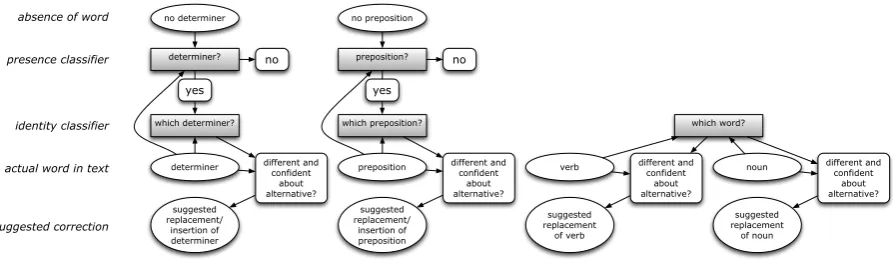
Our system is based on five memory-based clas-sifiers that all run the IGTree classifier algorithm (Daelemans et al., 1997), a decision-tree approx-imation of k-nearest neighbour classification im-plemented in the TiMBL software package.2 The first two classifiers determine the presence of a de-terminer or a preposition between all words in a text in which the actual determiners and prepo-sitions are masked. The second pair of classi-fiers determine which is the most likely correction given a masked determiner or preposition. The fifth classifier is a general word predictor that is used for suggesting noun and verb form correc-tions.
All classifiers take a windowed input of two words to the left of the focus position, and two words to the right. The focus may either be a posi-tionbetweentwo words, or beona word. In case of a position between two words, the task is to pre-dict whether the position should actually be filled by an determiner or a preposition. When the fo-cus is on the word in question, the task is to decide whether it should be deleted, or whether it should be corrected.
It is important to note that not just one classifi-cation is returned for a given context by the IGTree classifier, but adistribution of results and their re-spective occurrence counts. The classifier matches the words in the context to examples in the tree in a fixed order, and returns the distribution stored at that point in the tree when an unknown word is encountered. This is analogous to the back-off mechanisms often used in othern-gram based language modeling systems. When even the first feature fails to match, the complete class distribu-tion is returned. The output from the classifiers
2http://ilk.uvt.nl/timbl
is filtered by the error correctors for the correct answers. Filtering is done based on distribution size, occurrence counts and ratios in occurrence counts (in the remainder of the text, where we say frequency we mean occurrence count), and in the case of the noun and verb-related error types, on part-of-speech tags.
The system corrects a text from left to right, starting with the first word and working its way to the end. Each error corrector is tried after the other, in the order specified below, until a correc-tion is suggested. At this point, the correccorrec-tion is stored, and the system starts processing the next word. The other classifiers are not tried anymore after a correction has been suggested by one of the classifiers.
The first two classifiers,preposition? and de-terminer?, are binary classifiers that determine whether or not there should be a preposition or a determiner, respectively, between two words to the left and two words to the right:
• Thepreposition? classifier is trained on all 120,711,874 positive cases of contexts in the Google Web 1T corpus in which one of the 64 known prepositions are found to occur in the middle position of a 5-gram. To enable the classifier to answer negatively to other con-texts, roughly the same amount of negative cases of randomly selected contexts with no preposition in the middle are added to form a training set of 238,046,975 cases. We in-corporate the Google corpus token counts in our model. We performed a validation exper-iment on a single 90%-10% split of the train-ing data; the classifier is able to make a cor-rect decision on 88.6% of the 10% heldout cases.
• Analogously, the determiner? classifier takes all 86,253,841 positive cases of 5-grams with a determiner in the middle po-sition, and adds randomly selected negative cases to arrive at a training set of 169,874,942 cases. On a 90%–10% split, the classifier makes the correct decision in 90.0% of the 10% heldout cases.
determiner?
which determiner? no determiner
no
yes
determiner
suggested replacement/
insertion of determiner
different and confident
about alternative?
preposition?
which preposition? no preposition
no
yes
preposition
suggested replacement/
insertion of preposition
different and confident
about alternative?
which word?
verb
suggested replacement
of verb
different and confident
about alternative?
noun
suggested replacement
of noun
different and confident
about alternative?
actual word in text
suggested correction absence of word
presence classifier
[image:3.595.77.524.63.197.2]identity classifier
Figure 1: System architecture. Shaded rectangles are the five classifiers.
these classifiers are trained on the entire Google Web 1T corpus, including its token counts:
• Thewhich preposition? classifier is trained on the aforementioned 120,711,874 cases of any of the 64 prepositions occurring in the middle of 5-grams. The task of the classi-fier is to generate a class distribution of likely prepositions given an input of the four words surrounding the preposition, with 64 possible outcomes. In a 90%-10% split experiment on the complete training set, this classifier labels 63.3% of the 10% heldout cases correctly.
• Thewhich determiner? classifier, by anal-ogy, is trained on the 86,253,841 positive cases of 5-grams with a determiner in the middle position, and generates class distribu-tions composed of the 23 possible class labels (the possible determiners). On a 90%-10% split of the training set, the classifier predicts 68.3% of all heldout cases correctly.
The fifth classifier predicts the most likely word(s) between a context of two words to the left and two to the right.
• The general word predictor, which word?, for the grammatical error types, was trained on 10 million lines of the GigaWord En-glish Newspaper corpus. This amounts to 66,675,151 5-grams. It predicts the word in the middle between the two context words on the left and on the right.
From the predictions of the five classifiers the following eight error correctors are derived. There is no one-to-one correspondence between classi-fier and corrector. The ArtOrDet and Prep error categories are handled by three separate errors cor-rectors each that handle replacement, deletion, and
insertion errors. The three error types Nn, Vform and SVA are handled by just two correctors:
1 missing preposition (Prep) 2 replace preposition (Prep) 3 unnecessary preposition (Prep) 4 missing determiner (ArtOrDet) 5 replace determiner (ArtOrDet) 6 unnecessary determiner (ArtOrDet) 7 noun form (Nn, SVA)
8 verb form (Vform, SVA)
For the latter two error correctors, 7 and 8, we make additional use of a lemmatizer3 and a singular-plural determiner and generator4for noun form errors, and a verb tense determiner and gen-erator5for verb form and SVA errors.
The algorithms for the six preposition and de-terminer correctors will be explained in the rest of this section. The algorithms use the same logic, the difference is in the different lists and parame-ters used for each error type.
The algorithm for missing preposition (or deter-miner) is as follows.
1 next word is not a preposition 2 runpositive-negative classifierP+−
3 if the classification= +(i.e. we expect a preposition), and freq(+):freq(−)>MP PNR
4 run thewhich preposition?classifier
5 if length distribution<=MP DStake answer as missing preposition
The parameters (MP PNR and MP DS in the above algorithm) are used to control the certainty we expect from the classifier. Their values were determined in our submission to the 2012 ’Helping
3
http://www-nlp.stanford.edu/software/ corenlp.shtml
4
https://pypi.python.org/pypi/inflect
5http://nodebox.net/code/index.php/
Our Own’ shared task (Dale et al., 2012), which focused on determiner and preposition errors (Van den Bosch and Berck, 2012). Similar classifiers were used in this year’s system, and the same pa-rameters were used this time.
In step 3 above, we check the ratio between the frequency of the positive answer and the negative answer. If the ratio is larger than the parameter MP PNR (set to 20) we interpret this as being cer-tain. In step 5, we prefer a small, sharp distribution of answers. A large distribution indicates the clas-sifier not finding any matches in the context and returning a large distribution with all possible an-swers. In that case, the majority class tends to be the majority class of the complete training data, and not the specific answer(s) in the context we are looking at. To avoid this we only suggest an answer when the distribution is equal to or smaller than a certain preset threshold,MP DS, which was set to 20 for this task.
The algorithm for replacing propositions (or de-terminers) proceeds as follows:
1 word in focus is a prepositionp
2 runwhich preposition?, classification ispalt
3 if freq(palt)>RP Fand
4 if word is in distribution and freq(palt):freq(p)>RP R, takepaltas a correction
This algorithm shows another parameter, namely a check on frequency (occurrence count). In order to be generated as a correction, the alternate answer must have a frequency higher than RP F, set to 5 in our system, and the ratio between its frequency and that of the preposition in the distribution that is the same as in the text must be larger thanRP R. This parameter was set to 20.
The algorithm for unnecessary preposition (or determiner) works as follows:
1 word in focus is a preposition 2 runpositive-negativeclassifier P+−
3 if classification=−and freq(−):freq(+)>UP NPR 4 the preposition is unnecessary
The next two algorithms show the Nn and Vf correctors. The parameters these correctors use have not been extensively tweaked, but rather use the same settings as used in the preposition and determiner correctors.
The first list shows the algorithm for the noun type error. This error corrector also makes use of a noun inflection module to turn singular nouns into
plural and vice versa. The algorithm first looks for the alternative version of the noun in the distribu-tion returned by the classifier given the context. If it is found, and if it is much more frequent in the distribution than the noun form used in the text, a noun form error may have been found. The alter-native form found in the distribution is returned as the correction.
1 word in focuswis a noun
2 check singular or plural, determine alternate versionwalt
3 run thewhich-word? classifier, resulting in distribution D
4 check ifwis in D 5 check ifwaltis in D
6 if freq(w) in D<10 andwaltis in D usewaltas
correc-tion
Finally, the verb form error corrector makes use of a verb-tense determiner and generator, and a lemmatizer. The alternative verb forms are gen-erated from the lemma of the verb and the tense of the verb. To prevent the system changing, for ex-ample,givetogave, the generated alternatives are kept in the same tense as the word in the text. This does, however, mean that it will not be able to cor-rect verb tense errors (I see him yesterdayversusI saw him yesterday).
1 word in focus is a verbv 2 determine the lemma ofv 3 determine the tense ofv
4 generate alternatives in same tense as word,valt
5 runwhich-word?predictor, resulting in distribution D 6 check ifvis in D
7 check which valt are in D, take highest frequency
freq(valt)
8 if freq(valt):freq(v)>10: takevaltas a correction ofv
3 Results
Table 1 lists the precision, recall and F-score of our system on the test data. The test data (Tetreault, 2013) consisted of 300 paragraphs of English text written by non-native speakers. The system’s out-put is processed by a scorer supplied by the orga-nizers (Ng, 2012). For each sentence, it reports the number of correct, proposed and gold edits, and a running total of the system’s precision, recall and F-score.
Precision 6.20% Recall 7.18%
F1 6.66%
Table 1: Summary Score
We see a number of errors which are difficult to correct because they depend on understanding the sentence. Take the following sentence for exam-ple:
Surveillance technology such as RFID can be operated twenty-four hours with the absence of operators to track done every detail about human activities .
The gold-edit for this sentence is changing with
(word 11) towithout. This edit may be question-able, but questionability aside, it is based on a un-derstanding of what is being talked about in the text. Correcting these kinds of errors falls outside the scope of the system at the moment.
Multi-word edits are also a problem. InAll pas-sengers and pilots were died, the gold-edit is to changewere died todied. InThe readers are just smiling when they flip the page because it never comes to their mind that one day it might come true, the gold-edit is to changeare just smiling to
just smile. These kind of corrections are missed by our system at the moment due to the rigid one-word, left-to-right checking of the sentence.
Inserting more than one word is also problem-atic for our system at the moment. Take the fol-lowing sentence.
Firstly , security systems are improved in many areas such as school campus or at the workplace .
The gold-edit is to inserton the beforeschool. A potential solution for this problem is to take mul-tiple passes over the sentence, first inserting on, followed bythe in a later pass.
Nevertheless, the system made a number of cor-rect edits as well. The next subsections list exam-ples of each error type and a correction, where ap-plicable.
Missing determiner
In this sentence, the missing determiner before
smart was corrected by the system.
In spite of that,the smartphone is still a device . . .
In the following sentence however, a determiner is inserted where it is not needed, beforeRFID.
. . . the idea of usingthe RFIDto track people . . .
To illustrate the reasoning of our system, the de-terminer? classifier thinks that it is more than 13 times more likely to find a determiner betweenof using andRFID to than not. Of the possible de-terminers, the determiner the has the highest fre-quency with 38,809 occurrences.
Replace Determiner
Here is an example of a determiner which is cor-rected:
. . . signal and alsoa⇒therisk that their phone . . .
It also happens that the right determiner is incor-rectly changed into another determiner, as shown in the next example.
. . . this kind of tragedy to happen onany⇒thefamily.
The determiner the had a frequency of more than 6 million in the distribution, compared to only 68,612 forany.
Unnecessary Determiner
The system did not detect any unnecessary deter-miners. It missed, for example, removing the de-terminerthe in this setentence:
. . . technology available for the Man ’s life .
Replace Preposition
In this example, a preposition was corrected.
. . . to be putinto⇒underclose surveillance . . .
But in the following sentence
. . . remain functionalfor⇒aftera long period of . . .
the prepositionforis unfortunately changed to af-ter, which in this context is more common.
Unnecessary Preposition
. . . , manyofthings that are regarded . . .
Prepositions were also incorrectly removed, as shown in the following example. Here
. . . that can be outofour imaginations . . .
of is deemed unnecessary.
Missing Preposition
In this example, the missing preposition on was inserted afterlive.
. . . find another planet to liveon, the earth is . . .
In the sentence
. . . especiallyinthe elderly and the children . . .
the system inserts the prepositionin between es-peciallyandand, which in this case was incorrect.
Noun form
The next example shows a noun form correction.
. . . brought harmful sideeffect⇒effectsto human body
This can, of course, also go wrong:
Since RFIDtags⇒tagattached to the product . . .
Here the singular form of the noun was deemed correct.
Verb form
Finally, an example of a verb form correction:
Peopleneeds⇒needa safe environment to live . . .
And the final example, an incorrect replacement ofbeentowas.
. . . that has currently been⇒was implemented
4 Discussion
We have described a memory-based grammar checker specialized in correcting the five types of errors in the CONLL-2013 Shared Task. The sys-tem is built on five classifiers specialized in the error categories relevant for the task. They are trained to find errors in a small local context of two words to the left and two words to the right.
The system scans each word in each sentence in the test data and calls the relevant classifier(s) to determine if a word needs to be replaced, deleted, or inserted. The classifiers take word tokens as input; no deep grammatical information was plied to them. Even though the training data sup-plied for the task contained syntax trees, they were not used in creating our system. On the other hand, the part-of-speech information in the training data was used to create the lists of prepositions and de-terminers. Furthermore, a part-of-speech tagger was used to determine if the noun or verb form error corrector was to be applied.
There are several obvious shortcomings to this approach. The most obvious one is that each cor-rector is applied to single words, using only a small local context of two words to the left and right. This may work fine for missing preposi-tions and determiners, but for spotting grammat-ical errors like subject-verb agreement this limited contextual scope is insufficient. It also means that we are only able to correct “single words to single words”. That is, it is not possible to substitute two words for one, and vice versa. One avenue that could be explored is larger contexts. In addition, the classifiers are not limited to words, and con-texts with other (contextual) information could be tried as well.
Secondly, the correctors are applied in a strict order one after the other. This should not be a big problem as the classifiers are called separately for their particular part-of-speech category (deter-miner, preposition, verb, or noun). On the other hand, this puts a lot of weight on the part of speech tagger. Ambiguous or wrong tags could cause the wrong corrector to be tried and even applied, and could miss a potential correct correction.
Furthermore, the corrected words are not fed back into the system. This means that the context after an error still contains that error. This may cause the classifiers to mismatch and miss the next error. It should be noted that the small context of two words to the left and right probably helps to alleviate this problem. However, making the sys-tem insert corrections and backtracking a step (or more) could help towards solving the problem of multi-word corrections.
the parameters controlling the error correctors.
4.1 Update
The organizers of the shared task updated the m2-scorer used to calculate the results, resulting in slightly better scores. Table 2 shows the revised score of our system, with the old score between parentheses.
Precision 7.60% (6.20%) Recall 9.29% (7.18%) F1 8.36% (6.66%)
Table 2: Revised Summary Score
And to conclude, we continued working on the system and tweaked some of the parameters con-trolling the preposition and determiner checkers. By allowing the correctors to be applied more of-ten, we see an increase in the number of proposed and correct edits (2,533 and 178 respectively). The downside to this is of course that the number of false positives increases, which decreases the pre-cision of the system.
The tweaked score is shown in table 3, with the revised score between parentheses.
Precision 7.03% (7.60%) Recall 10.83% (9.29%) F1 8.52% (8.36%)
Table 3: Tweaked Summary Score
These improved scores give us good hope that the highest scores have not been reached yet.
Acknowledgements
The authors thank Ko van der Sloot for his sus-tained improvements of the TiMBL software. This work is rooted in earlier joint work funded through a grant from the Netherlands Organization for Sci-entific Research (NWO) for the Vici project Im-plicit Linguistics.
References
T. Brants and A. Franz. 2006. LDC2006T13: Web 1T 5-gram Version 1.
W. Daelemans, A. Van den Bosch, and A. Weijters. 1997. IGTree: using trees for compression and clas-sification in lazy learning algorithms. Artificial In-telligence Review, 11:407–423.
R. Dale, I. Anisimoff, and G. Narroway. 2012. HOO 2012: A report on the preposition and determiner error correction shared task. In Proceedings of the Seventh Workshop on Innovative Use of NLP for Building Educational Applications, Montreal, Canada.
Daniel Dahlmeier & Hwee Tou Ng. 2012. Better eval-uation for grammatical error correction. In Proceed-ings of the 2012 Conference of the North American Chapter of the Association for Computational Lin-guistics, pages 568 – 572.
H. Stehouwer and A. Van den Bosch. 2009. Putting the t where it belongs: Solving a confusion prob-lem in Dutch. In S. Verberne, H. van Halteren, and P.-A. Coppen, editors,Computational Linguistics in the Netherlands 2007: Selected Papers from the 18th CLIN Meeting, pages 21–36, Nijmegen, The Nether-lands.
Hwee Tou Ng & Siew Mei Wu & Yuanbin Wu & Chris-tian Hadiwinoto & Joel Tetreault. 2013. The conll-2013 shared task on grammatical error correction. In
Proceedings of the Seventeenth Conference on Com-putational Natural Language Learning.
A. Van den Bosch and P. Berck. 2012. Memory-based text correction for preposition and determiner errors. InProceedings of the 7th Workshop on the Innova-tive Use of NLP for Building Educational Applica-tions, pages 289–294, New Brunswick, NJ. ACL.